TAY-SACHS DISEASE


DEFINITION


Tay-Sachs disease (pronounced tay-SACKS) is a genetic disorder that can lead to paralysis, blindness, convulsions, mental retardation (see mental retardation entry) and death. A genetic disorder is a medical problem passed down from one generation to the next. The disorder occurs because of a faulty gene. Genes are the chemical units in all cells that tell cells what functions they should perform. When those genes are absent or faulty, cells do not function properly and a medical disorder results.

DESCRIPTION


Gangliosides (pronounced GANG-glee-uh-SIDES) are fatty substances needed for the proper development of the brain and nerve cells. Under normal conditions, gangliosides are continuously broken down so that the correct amount of gangliosides is always present.

The chemical required to break down gangliosides is an enzyme. Enzymes are chemical compounds present in all cells. These compounds make possible thousands of different reactions needed to keep cells operating normally. In a person with Tay-Sachs disease, the enzyme needed to break down gangliosides is missing. As a result, gangliosides continue to build up in the brain. When the brain becomes clogged with this fatty material it is no longer able to function normally.

Tay-Sachs is especially common among Jewish people of eastern European and Russian origin, sometimes referred to as Ashkenazic Jews. About 1 in every 3,600 babies born to Ashkenazic Jewish couples will have Tay-Sachs disease. The disease is also relatively common among certain French-Canadian and Cajun French families. Tay-Sachs disease is quite rare in families of other ethnic backgrounds.

CAUSES


Every child receives two sets of genes, one from its mother and one from its father. These genes may be either dominant or recessive. A dominant gene is "stronger" than a recessive gene and controls the way a cell is going to function.

If a recessive gene is paired with a dominant gene, the recessive gene has no effect on the way a cell functions. The dominant gene overcomes the recessive gene. The only way a recessive gene has any effect on a cell if it is paired with another recessive gene. In such cases, the two recessive genes work together to direct a cell's operation.

Tay-Sachs is caused by a recessive gene. A child with one recessive gene shows no effect as a result of having the gene. The child is a carrier for the disease. A carrier is a person who has one recessive gene for a characteristic. The carrier can pass the gene on to his or her children even though the carrier does not have the disease.

A child with a pair of these recessive genes, however, will show the symptoms of Tay-Sachs disease because the child will lack a normal gene to makes the enzyme needed to break down gangliosides.

SYMPTOMS


Tay-Sachs disease normally shows up at about the age of six months. Prior to that time, the baby acts normally. Once the symptoms of Tay-Sachs begin to appear the baby stops interacting with other people. It may develop a staring gaze. Normal levels of noise tend to startle the baby to an abnormal degree.

Tay-Sachs Disease: Words to Know

Dominant gene:
A form of a gene that predominates over a second form of the same gene.
Enzymes:
Chemicals present in all cells that make possible the chemical reactions needed to keep a cell alive.
Ganglioside:
A fatty substance found in brain and nerve cells.
Gene:
A chemical unit that carries instructions as to the functions a cell should perform.
Genetic disorder:
A medical problem caused by one or more defective genes.
Recessive gene:
A form of a gene that does not operate in the presence of a dominant form of the same gene.

By the time the baby is one year old, it has weak, floppy muscles. The baby may be completely blind, and will usually have a large head. Seizures become a problem between the ages of one and two years and the baby usually dies by the age of four.

DIAGNOSIS


A preliminary diagnosis for Tay-Sachs disease can usually be made by looking into the baby's eyes. If a baby has Tay-Sachs a characteristic cherryred spot can be seen at the back of the eye.

In order to confirm this diagnosis, blood tests are performed that measure the amount of enzyme needed to break down gangliosides. If the level is very low, the baby has Tay-Sachs disease.

TREATMENT


There is currently no treatment for Tay-Sachs disease. Scientists hope to develop some type of treatment eventually. The treatment would involve providing babies with Tay-Sachs disease new genes. These genes would take

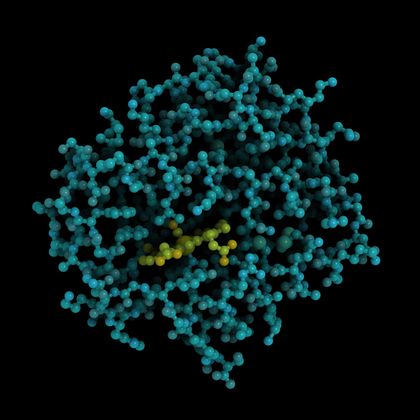
Tay-Sachs disease causes the abnormal buildup of gangliosides, a fatty material required for the normal development of the brain. When the brain becomes clogged with this fatty material it is no longer able to function normally. (© 1992 IMS Creative. Reproduced by permission of Custom Medical Stock Photo.)
Tay-Sachs disease causes the abnormal buildup of gangliosides, a fatty material required for the normal development of the brain. When the brain becomes clogged with this fatty material it is no longer able to function normally. (© 1992
IMS Creative
. Reproduced by permission of
Custom Medical Stock Photo
.)

over the job of making the enzyme the babies currently lack. While this technology is now being investigated, no technique has yet been shown to work satisfactorily.

PROGNOSIS


At the present time, the prognosis for a baby born with Tay-Sachs disease is certain death. Nothing can be done to keep the baby alive.

PREVENTION


Once a baby receives recessive genes from both parents, it is destined to develop Tay-Sachs disease. The only way to prevent this condition from happening, then, is to make sure no baby receives two recessive genes.

Parents from ethnic groups at risk for Tay-Sachs have the option of being tested for recessive genes. If only one parent has a recessive gene, the baby will not develop Tay-Sachs disease. If both parents have the recessive gene, the child will develop the disorder. Couples can use this kind of information to decide whether or not to have children.

Prenatal testing can also provide information about Tay-Sachs disease. A pregnant woman can be tested to see if her child has Tay-Sachs disease. She and her partner can then decide whether or not to continue with the pregnancy.

FOR MORE INFORMATION


Organizations

Late Onset Tay-Sachs Foundation. 1303 Paper Mill Rd., Erdenheim, PA 19038. (800) 672–2022.

March of Dimes Birth Defects Foundation. National Office. 1275 Mamaroneck Ave., White Plains, NY 10605. http://www.modimes.org.

National Tay-Sachs and Allied Diseases Association, Inc. 2001 Beacon St., Suite 204, Brookline, MA 02146. (800) 672–2022.

Web sites

"Ask NOAH About: Neurological Problems." NOAH: New York Online Access to Health. [Online] http://www.noah.cuny.edu/neuro/neuropg.html#TAYSACHS (accessed on October 31, 1999).