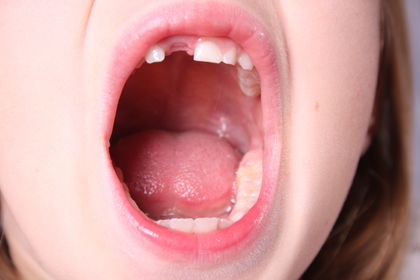
Tonsillitis (pronounced tahn-suh-LIE-tiss) is an infection and swelling of the tonsils. The tonsils are lymph nodes, or oval-shaped masses of lymph gland tissue, located on both sides of the throat that are part of the body immune system.
The tonsils normally help prevent infections in two ways. They act like filters to trap bacteria, viruses, and other materials that enter the body through the mouth and sinuses. They also produce antibodies to help fight off infections. An antibody is a chemical produced by blood cells to fight off specific kinds of foreign bodies, such as bacteria and viruses.
While a person can get tonsillitis at any age, the infection occurs most commonly among children between the ages of five and ten years.
Tonsillitis is caused by viruses or bacteria that infect the tonsils. They cause the tonsils to become inflamed and swollen. One of the first symptoms of tonsillitis is a severe sore throat (see sore throat entry). Other symptoms include fever, chills, tiredness, muscle aches, earache, swollen glands in the neck, and pain or discomfort when swallowing. Very young children with tonsillitis may become fussy and stop eating.
Tonsillitis may cause the tonsils, which are visible at the back of the throat, to look red and enlarged. The tonsils may also have visible white or yellow spots or a thin coating. The symptoms of tonsillitis usually last four to six days.
Tonsillitis can be diagnosed from visible symptoms and a physical examination. A doctor will examine the patient's eyes, ears, nose, and throat and look for signs of swelling, redness, or discharge.
The doctor may also take a throat culture. To do a throat culture, the doctor wipes a cotton swab across the tonsils and back of the throat. The swab is then tested for the presence of bacteria and viruses that cause tonsillitis.
Some tests can be performed quickly. A doctor may suspect the presence of certain disease-causing bacteria almost immediately. He or she can then prescribe antibiotics to treat the infection. An antibiotic is a substance derived from bacteria or other organisms that fights the growth of other bacteria or organisms.
But a longer waiting period is needed for more reliable tests. The cotton swab may need to be incubated for twenty-four to forty-eight hours. During incubation the swab is kept in a warm, moist environment. Bacteria and viruses grow well in this environment. A researcher can then study the material on the swab under a microscope and determine which bacteria and/or viruses are present. With this information, the doctor can make a sound diagnosis of the patient's condition.
A doctor may decide to conduct exclusionary tests also. An exclusionary test is one performed to find out if some condition other than tonsillitis is present. For example, the patient's sore throat might be caused by diphtheria. Blood tests will often rule out infections other than those that cause tonsillitis. If no other infections are present, the doctor may decide that the patient's problem really is tonsillitis.
Treatment for tonsillitis depends on the agent that caused the infection. If the infection is bacterial, antibiotics can help cure the disease. If the infection is viral, there are no drugs that will cure the disease.
Most doctors will recommend treatments designed to keep a patient comfortable while the disease runs its course. These treatments include bed rest, drinking extra fluids, gargling with warm salt water, and taking pain relievers to reduce fever. Eating frozen juice bars or drinking either cold fruit drinks or warm tea or broth can also bring some relief of sore throat pain.
In many cases, doctors decide to treat tonsillitis with surgery. This treatment may be recommended for children who have severe cases of tonsillitis more than once. In a tonsillectomy, the tonsils are surgically removed.
Alternative practitioners recommend a variety of natural products for the treatment of tonsillitis. These products include dietary supplements, such as vitamin C and beta-carotenes, and certain herbal remedies. The herbs that are suggested include calendula, cleavers, echinacea, astragalus, goldenseal, myrrh, bitter orange, Lomatium dissectum, and Ligusticum porteri. Some of these
herbs are thought to strengthen the immune system. Others are believed to kill bacteria or viruses.
Some homeopathic remedies suggested for tonsillitis include Belladonna, Phytolacca, Mercurius, Lycopodium, Lachesis, Hepar sulphuris, Arsenicum, and Rhus toxicodendron.
Tonsillitis usually gets better on its own within a few days. Treating the symptoms of sore throat and fever will make the patient more comfortable. In cases where the fever lasts for more than forty-eight hours or reaches a temperature of more than 102°F (38°C) the patient should be seen by a doctor.
Any medication that has been prescribed should be taken until all of it has been taken. Patients sometimes stop taking their medications when they feel better, but though the symptoms may have cleared up, the infection may not have been cured. The infection may spread to other parts of the upper respiratory (breathing) system. The ears and sinuses are especially subject to such infection. In rare cases, much more serious conditions, such as rheumatic fever (see rheumatic fever entry) or pneumonia (see pneumonia entry) may develop.
The bacteria and viruses that cause tonsillitis are easily transmitted from person to person. The infection often spreads quickly among members of a family or students in a classroom. Avoiding contact with anyone who has the symptoms of tonsillitis can reduce the risk of infection.
Drinking glasses and eating utensils should never be shared. A person who has had tonsillitis should throw out his or her toothbrush to avoid reinfection. People who are caring for a person with tonsillitis should take special precautions and wash their hands often to prevent spreading the infection to other people.
Inlander, Charles B., and the staff of the People's Medical Society, eds. "Tonsilitis." In The Consumer's Medical Desk Reference. New York: Stonesong Press, 1995.
Shaw, Michael, ed. "Tonsilitis." In Everything You Need to Know about Diseases. Springhouse, PA: Springhouse Corporation, 1996.
"Childhood Infections: Tonsillitis." KidsHealth. [Online] http://kidshealth.org/parent/common/tonsillitis.html (accessed on November 5, 1999).