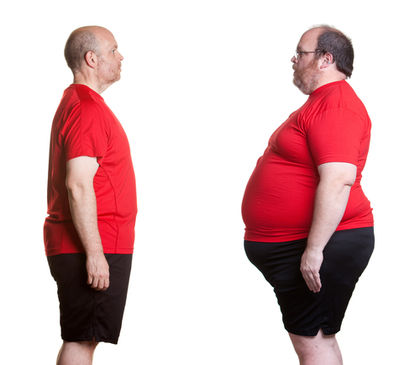
Obesity is an abnormal accumulation of body fat, usually 20 percent or more over an individual's ideal body weight. Obesity is associated with an increased risk of illness, disability, and death.
Medical researchers have developed charts showing a person's ideal body weight. Ideal body weight means the weight a person should be in order to maintain good health. Ideal body weight depends primarily on three factors: gender, age, and height.
A person is said to be obese if his or her body weight is at least 20 percent more than his or her ideal weight. A range of 20 percent to 40 percent overweight is regarded as mild obesity; 40 percent to 100 percent overweight is regarded as moderate obesity; and more than 100 percent overweight is regarded as severe obesity. Severe obesity is also called morbid obesity. The term "morbid" is used for conditions that can lead to death. A person more than 100 percent overweight is regarded to have such serious health problems that his or her life is threatened.
Obesity can result in many serious, and potentially deadly, health problems. These problems include hypertension (high blood pressure; see hypertension entry), Type II diabetes mellitus (see diabetes mellitus entry), coronary (heart) disease, infertility, and a higher risk for certain forms of cancer (see cancer entry), such as those that affect the colon, prostate, endometrium, and possibly breasts.
According to some estimates, about one-quarter of the U.S. population can be considered obese. Four million of these people may be classified as morbidly obese. About three hundred thousand deaths each year can be blamed on obesity. Public-health leaders point out that obesity is the second leading cause of preventable deaths (after smoking) in the United States.
Part of the food we eat is "burned" to make energy. We use this energy to move, breathe, and carry out all our normal daily activities. The amount of energy present in food is measured in calories. If a person takes in more calories than his or her body burns up, the extra calories are stored in the form of fat.
There are other reasons why an individual's body might retain fat. Some people have a larger appetite than others. Their bodies seem to expect them to eat more often. For others, their bodies do not efficiently convert food to energy. They are more likely to convert the food they eat to fat.
Scientists now think that heredity is an important factor in obesity. That is, some people may inherit from their parents a genetic predisposition to gain weight. A genetic predisposition is a natural tendency over which a person has some, but not complete, control.
This theory has been supported by studies of adopted children. These children tend to have weight patterns more like those of their natural parents than those of their adoptive parents. This finding suggests that the children inherited from their natural parents the tendency to eat normally or excessively.
Even if people do inherit a tendency toward obesity, they do not necessarily have to become overweight. First, they can choose a diet that will reduce the risk of gaining weight. Some types of food, such as carbohydrates, are turned into energy more quickly than other types of foods, such as fats. A beneficial diet high in carbohydrates would consist of cereals, breads, fruits, and vegetables.
Second, a person can choose a lifestyle that will help burn up excess calories. A quiet lifestyle spent watching television will not burn up many calories compared with one that includes jogging, swimming, walking, or other forms of exercise.
Obesity can be caused by other factors as well. For example, a person may feel depressed (see depressive disorders entry) or have a low self-image. In response to those feelings, the person may eat more than his or her body really needs. The excess calories are converted to body fat.
The stage at which a person first becomes obese can affect his or her ability to lose weight. In childhood, excess calories are converted into new fat cells. Those fat cells remain in the child's body throughout life. In adulthood, excess calories simply cause existing fat cells to get larger. What this means is that obesity in childhood is especially serious. In some studies, people who became obese as children had up to five times as many fat cells as those who became obese as adults.
Obesity can also be caused by certain medical conditions. For example, hypothyroidism (pronounced HI-po-THIE-roi-DIZ-uhm) is a condition in which the thyroid gland does not function normally. The thyroid gland is responsible for the body's general level of activity. In hypothyroidism, the body's overall level of activity is reduced, causing fewer calories to be burned. As a result, the body tends to gain weight.
Consumption of certain drugs can also result in obesity. Steroids and antidepressants are examples of such drugs.
The major symptoms of obesity are excessive weight gain and the presence of large amounts of fatty tissue. Obesity can also give rise to several other conditions, including:
Diagnosis of obesity is made by comparing the patient's weight with ideal weight charts. A direct measure of body fat can also be made with an instrument known as calipers. Calipers are a scissor-shaped device used to measure the thickness of a person's flesh at the back of the upper arm. This measurement can be used to tell whether a person has an excess of fatty tissue. Women whose body weight consists of more than 30 percent fatty tissue are regarded as obese. Men with 25 percent fatty tissue in their body weight are considered to be obese.
Doctors may also note the way in which a person's body fat is distributed. Some patterns of distribution are associated with certain complications of obesity. For example, a person who is "apple-shaped" has a higher risk of cancer, heart disease, and diabetes than someone who is "pear-shaped." An "apple-shaped" person is one whose weight is concentrated around the waist and abdomen. A "pear-shaped" person is one whose extra weight tends to be around the hips and thighs.
Treatment of obesity depends on two factors: how overweight is a person and how good is his or her general health. The most important point is that to be successful, any treatment must effect lifelong, not short-term, changes. Many people try "yo-yo" dieting. Yo-yo dieting is a pattern in which a person tries some kind of diet for a few weeks or a few months and then quits the diet. Later on, the person tries the same diet again or a new one.
As a result, the person is constantly losing weight and then regaining it. This pattern can be very dangerous. A person who practices yo-yo dieting is more likely to develop fatal health problems than someone who lost the weight all at once and kept it off or someone who never lost the weight at all.
Effective treatment for obesity depends on a few general issues, such as:
For most individuals who are mildly obese, changes of this kind can be made with or without consulting a physician. Other mildly obese people may seek the help of a commercial weight-loss program, such as Weight Watchers. The success of such programs is difficult to measure, however. The programs themselves vary from the highly reputable to the less promising. Also, people tend to drop out of such programs quickly, so it is difficult to judge how effective any one program might be in helping a person lose weight.
Generally speaking, people should be cautious of programs that offer quick and easy results. Losing weight usually requires significant lifestyle changes, including diet and amount of exercise.
People who are moderately obese may require a higher level of professional help. A common approach is to recommend a balanced diet of no more than 1,500 calories per day. Less commonly, a doctor may recommend a verylow-calorie liquid protein diet. A diet of this kind provides no more than 700 calories a day and may be continued for up to three months. This kind of diet should not be confused with commercial liquid protein diets or commercial weight-loss shakes and drinks. Doctors design these diets for the specific needs of each individual patient.
Doctors may also recommend counseling for obese patients. Counseling sometimes helps people deal with psychological issues that lead to their weight-gain problems.
Dietary and lifestyle changes are useful with severely obese patients. But such patients may need even more aggressive treatment. For example, surgery may be performed to decrease the size of a person's stomach or small intestine. The purpose of this kind of surgery is to reduce the volume of food a person can eat.
Other forms of obesity surgery are sometimes performed. Liposuction, for example, is a procedure in which fat is removed from beneath the skin. Liposuction is of little or no value in solving a person's obesity problems. It may change his or her physical appearance, but it does not solve any of the underlying problems that lead to obesity in the first place.
Appetite-suppressant drugs are sometimes prescribed to aid in weight loss. These drugs work by increasing the level of certain chemicals that occur naturally in the brain, making a person feel full. Appetite suppressants can work on a short-term basis. That is, people are likely to lose weight while they are taking the drugs. But the drugs do not solve the basic problems that lead to obesity. When a person stops taking the drugs, his or her appetite returns. The person once again begins eating too much, and the weight returns.
Appetite suppressants are also of some concern because they may have harmful side effects and long-term effects that are not well understood. In November 1997, for example, the U.S. Food and Drug Administration removed a group of appetite-suppressant drugs from the market because they could cause potentially fatal heart defects.
The only weight-loss drug available without a prescription is phenyl-propanolamine (pronounced FEN-uhl-PRO-puh-NOL-uh-meen, trade names Acutrim, Dexatrim). This drug has been found to increase weight loss by a factor of about 5 percent. The problem is that the weight tends to return as soon as the drug is discontinued.
Some of the side effects that may accompany the use of weight-loss drugs include:
Some alternative forms of treatment for obesity have problems similar to those of drugs. For example, the Chinese herb ephedra has been recommended in a weight-loss program that also includes a low-fat diet and exercise. The herb does help a person lose weight on a short-term basis. But the weight tends to return when use of the herb is discontinued. In addition, large amounts of ephedra can produce a number of side effects, such as anxiety, irregular heartbeat, heart attack, high blood pressure, insomnia, irritability, nervousness, seizures, stroke, and even death.
Diuretic herbs have also been suggested for the treatment of obesity. A diuretic is a substance that increases the rate of urine output. As a person produces more urine, his or her weight decreases. However, once the herb is discontinued, urine production returns to normal, as does obesity.
Other natural remedies that have been suggested for weight loss include:
Acupressure and acupuncture are also said to decrease the desire for food. Acupuncture is a Chinese therapy that uses fine needles to pierce the body; acupressure involves applying pressure to certain points in the body. Mental techniques such as visualization and meditation may create a better self-image and decrease the need to overeat. Mental concentration, yoga, and similar techniques may provide similar benefits. In many cases, support groups can help a person deal with the problems that led to his or her obesity.
Short-term diet programs are seldom successful. Studies show that 85 percent of dieters who do not exercise on a regular basis regain their lost weight within two years. Yo-yo dieting encourages the body to store fat and may increase the risk of heart problems. The only certain way to conquer obesity is to make fundamental changes in eating and exercise habits.
The best way to prevent obesity is to avoid a high intake of fats. The National Cholesterol Education Program suggests that no more than 30 percent of the calories people eat should come from fats. A good way to monitor one's diet is to keep a detailed food diary. That way, one will know exactly how many calories are consumed in a day and where those calories come from.
A program of vigorous exercise is also very important. Activity is the only way that calories are used up. The more active a person is, the less likely that calories will be converted into fat.
Finally, children should learn early in their lives the value of a healthful diet and exercise. By controlling their intake of calories and planning activities that will burn them up, the problems of obesity can usually be avoided.
Gottlieb, Bill, ed. New Choices in Natural Healing. Emmaus, PA: Rodale Press, 1995.
Harris, Dan R., ed. Diet and Nutrition Sourcebook. Detroit: Omnigraphics, 1996.
Slupik, Ramona I., ed. American Medical Association Complete Guide to Women's Health. New York: Random House, 1996.
HFC Nutrition Research Foundation, Inc. P.O. Box 22124, Lexington, KY 40522. (606) 276-3119.
National Institute of Diabetes and Digestive and Kidney Diseases of the National Institutes of Health. 2 Information Way, Bethesda, MD 20892-3570. http://www.niddk.nih.gov.
National Obesity Research Foundation. Temple University, Weiss Hall 867, Philadelphia, PA 19122.
The Weight-Control Information Network. 1 Win Way, Bethesda, MD 20896-3665. (301) 951-1120.