Lung cancer is a disease in which the cells of lung tissues grow uncontrollably and form tumors. A tumor is a mass or lump of tissue made of abnormal cells.
Lung cancer is the leading cause of death from cancer among both men and women in the United States. Experts estimate that 28 percent of all cancer deaths—about 160,000—are caused by lung cancer. It is further estimated that at least 172,000 new cases of lung cancer are diagnosed each year.
Lung cancer is rare among children and young adults. It is usually found in people older than fifty. The average age at diagnosis is sixty. There are two kinds of lung cancer, primary and secondary. Primary lung cancer starts in the lungs. Secondary lung cancer starts somewhere else in the body; cancer cells then spread to the lungs and start a new infection. When cancer cells travel from one area of the body to another it is called metastasis (pronounced muh-TASS-tuh-siss). When this happens, a cancer is said to have metastasized (pronounced muh-TASS-tuh-sized).
By far the major cause of lung cancer is tobacco smoking. Ninety percent of all cases of lung cancer are thought to be caused by smoking. Other factors that may lead to lung cancer include:
The most common symptoms of lung cancer include:
The first step in diagnosing lung cancer is a medical history and a physical examination. An important part of the medical history involves questions about smoking. A patient who smokes is at high risk for lung cancer.
The primary purpose of the physical examination is to rule out other disorders with similar symptoms. For example, many respiratory problems can cause hoarseness and coughing. The doctor needs to be certain that none of these problems is responsible for the patient's symptoms.
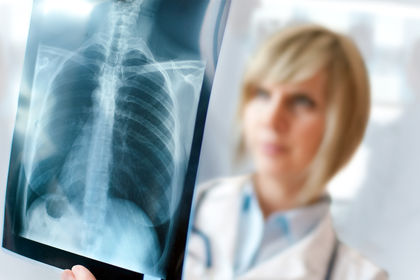
Imaging techniques may also be used. A chest X ray may show the presence of unusual masses in the lungs. A computed tomography (CT) scan or magnetic resonance imaging (MRI) test may provide further information about the size, shape, and location of any tumors.
Sputum analysis may be ordered to study materials coughed up by the patient. This test can detect at least 30 percent of all lung cancers. An important feature of a sputum test is that it can detect cancer in its earliest stages.
The most conclusive test for lung cancer is a lung biopsy. A biopsy is a procedure in which a small sample of tissue is removed. The sample is then studied under a microscope. Cancer cells can be identified under a microscope because of their distinctive appearance.
Treatment of lung cancer depends on the type of cancer, its location, and its stage of development. The patient's age, general health, and medical history are also taken into account. The three most common forms of treatment are surgery, radiation, and chemotherapy.
Some types of lung cancer cannot be treated surgically. For example, surgery is not an option if the cancer has already metastasized. The type of surgery performed depends on how far the cancer has spread. If it is still limited to one area of the lung, only that area is removed. In many cases, however, the cancer has already spread to other parts of the lung. The next most aggressive step is to remove one lobe of the lung. The right lung has three lobes, and the left lung has two. The lungs can continue to function if one lobe is removed. The most drastic surgery involves the removal of the whole lung, followed by a lung transplantation. This procedure is used only when cancer has spread throughout the entire lung.
Radiation is also used to treat lung cancer. Radiation involves the use of high-energy rays to kill cancer cells. In most cases, the radiation comes from radioactive materials. Radioactive materials are substances that give off high-energy radiation, similar to X rays. The radiation can be given either externally or internally. If it is given externally, the radioactive source is placed above the patient's body in the area of the cancer. Radiation from the source penetrates the body and destroys cancer cells. Radiation can also be given internally by implanting the source directly in the patient's body.
Radiation can also be used prior to surgery. In this case, the purpose of the radiation treatment is to shrink the tumor. Radiation may also be given following surgery. The purpose in this case is to destroy any cancer cells that may remain after the surgery.
Chemotherapy is the use of chemicals that kill cancer cells. These chemicals can be given either orally (by mouth) or intravenously (into the bloodstream). Chemotherapy is often used when cancer has spread beyond the lungs. The chemicals spread throughout the patient's body and attack cancer cells wherever they occur. As with radiation, chemotherapy may be given either before or after surgery.
Both radiation and chemotherapy have a number of unpleasant side effects. Radiation may cause tiredness, skin rashes, upset stomach, diarrhea, sore throat, difficulty swallowing, and loss of hair. Chemotherapy also causes nausea, vomiting, hair loss, anemia (general weakness due to low blood count; see anemias entry), and weakening of the immune system.
Many alternative treatments are available that may prove helpful in combating the side effects of traditional cancer therapies. These alternatives, however, should not replace prescribed cancer treatments; rather, they are suggested to work in conjunction with conventional treatment.
Body work therapy such as acupuncture (Chinese therapy involving the use of fine needles), acupressure (Chinese therapy that involves applying pressure to certain points in the body), reflexology, and massage may help calm the patient and reduce stress. Relaxation techniques such as yoga and meditation may relieve nausea and discomfort. An exercise program, designed in consultation with a physician, may help promote better breathing and stronger chest muscles. A well-balanced diet high in fresh fruits and vegetables and whole grains and low in fats, sugar, and alcohol is suggested for overall well-being.
The prognosis for lung cancer depends very much on how early the condition is discovered. If it is treated in its earliest stages, about half of all patients survive at least five years after initial diagnosis. The problem is that only 15 percent of lung cancers are found in an early stage. Overall, the five-year survival rate for all forms of lung cancer is 14 percent.
In the vast majority of cases, lung cancer is relatively easy to prevent. People who do not smoke or who stop smoking are at very low risk for contracting the disease. Some authorities suspect that secondhand smoke may also pose a threat for lung cancer. Secondhand smoke is smoke that a person breathes in from another person's cigarette, cigar, or pipe.
Other ways to prevent lung cancer are to avoid contact with chemicals that can cause the disease (such as asbestos) and to have one's home checked for radon gas. Home test kits for radon are available. They are easy to use and can tell in a matter of minutes whether radon is present in a building.
Morra, Marion E., and Eve Potts. Choices. New York: Avon Books, 1994.
American Cancer Society. 1599 Clifton Road NE, Atlanta, GA 30329. (800) 227–2345. http://www.cancer.org.
American Lung Association. 1740 Broadway, New York, NY 10019-4374. (800) 586-4872. http://www.lungusa.org.
Cancer Care, Inc. 1180 Avenue of the Americas. New York, NY 10036. (800) 813–HOPE. http://www.cancercareinc.org.
Cancer Research Institute. 681 Fifth Avenue, New York, NY 10022. (800) 992–2623. http://www.cancerresearch.org.
National Cancer Institute. 31 Center Drive, Bethesda, MD 20892–2580. (800) 4–CANCER. http://www.nci.nih.gov.
National Coalition for Cancer Survivorship. 1010 Wayne Avenue, 5th Floor, Silver Springs, MD 20910. (301) 650–8868.
Oncolink. [Online] University of Pennsylvania Cancer Center. http://cancer.med.upenn.edu (accessed on October 13, 1999).