
Environmental Health - Indoor air pollution
The quality of the air people breathe in outdoor activities is a concern, but the quality of the air indoors is an equally, possibly even more, significant issue of environmental health. Research suggests that Americans spend 90 percent of their time indoors. And, in recent years, scientific studies have revealed that the air in homes and other buildings may contain even more pollutants, or higher levels of pollutants, than the air outdoors. These severe levels of indoor air pollution have been found even in highly industrial metropolitan areas, where one might automatically assume that air pollution risks would be greater outdoors than indoors. In light of this research, organizations like the Environmental Protection Agency are taking a closer look at what's happening with air quality inside homes, schools, and offices. Some of the key threats to air quality, and in turn to human health, are discussed below.
Tobacco Smoke
Environmental tobacco smoke (ETS) is the mixture of the smoke from a lit cigarette, pipe, or cigar and the smoke exhaled by the person smoking. ETS exposure is sometimes referred to as passive smoking or secondhand smoking. Even though the affected person is not actively lighting up and inhaling, enough smoke is being breathed into the person's lungs to have a negative impact on his or her health.
ETS contains over 4,000 chemical compounds. According to the EPA, over 40 percent of these chemicals are known to cause cancer in humans or animals, and many of them are strong irritants. A 1992 EPA study (Respiratory Health Effects of Passive Smoking: Lung Cancer and Other Disorders) evaluated the risks of ETS to nonsmokers and concluded that ETS posed a significant health threat to nonsmokers, putting them at risk for a wide range of irritations and illnesses. Most significantly, the study indicated that, annually, exposure to ETS is responsible for about 3,000 lung-cancer deaths among nonsmoking adults.
The 1986 Surgeon General's Report concluded that physically separating smokers from nonsmokers in a home or office—by putting the smokers in a separate room—did not entirely eliminate a nonsmoker's exposure to ETS. Nonsmoking regulations have been put into effect in many offices and public areas to protect nonsmokers from the harmful effects of secondhand smoke. Nevertheless, individuals have to be conscientious about their exposure to ETS in private homes and unregulated public areas.
Radon
Radon is a colorless, odorless, radioactive gas produced by the naturally occurring breakdown of the chemical element uranium in soil or rocks. Radon gas is released into the air when radon is broken down. It can get into a home through dirt floors, cracks in concrete walls and floors, floor drains, and sumps (underground drainage system, or cesspool). When radon gas enters and becomes trapped in a home, it can build up to dangerous levels and pose threats to human health. In rare cases, building materials used in a home give off radon. Radon can also surface in well water.
REPORTED HEALTH EFFECTS OF ETS (SECONDHAND SMOKE) EXPOSURE
- There is an increased risk of lung cancer in nonsmoking adults.
- ETS endangers, or damages, the respiratory health of hundreds of thousands of children each year.
- Parents who smoke in the presence of their children increase the risk for the children to develop lower respiratory tract infections such as bronchitis.
- Infants and children exposed to ETS by smoking parents more frequently have problems with coughing, excess mucus, and wheezing.
- ETS annually causes between 150,000–300,000 lower respiratory infections in children under the age of eighteen months.
- Older children might experience reduced lung function due to ETS exposure.
- Asthmatic children are especially vulnerable to effects of ETS.
- Exposure to secondhand smoke can increase the number or severity of asthma attacks experienced by hundreds of thousands of young asthma sufferers each year.
- Each year, ETS might lead to the development of asthma in thousands of nonasthmatic children.
- The asthmatic condition of 200,000 to 1,000,000 children is worsened each year as a result of ETS exposure.
- ETS causes significant eye, ear, nose, and throat irritations.
- ETS may negatively affect cardiovascular (relating to the heart and lungs) health.
When inhaled, high levels of radon can cause lung cancer in people. It can also be unhealthy to swallow radon-contaminated water. But the most serious exposure is from breathing air with high levels of radon. Organizations like the Centers for Disease Control and Prevention, the American Lung Association, and the American Medical Association agree that radon causes thousands of lung-cancer deaths each year. There is also agreement that many of these deaths could be prevented by better controls on indoor air pollution. According to estimates by the Environmental Protection Agency, on average there are about 14,000 deaths caused by radon in the United States each year. Studies also suggest that smokers are especially vulnerable to health risks posed by radon.
Stoves, Heaters, Fireplaces, and Chimneys
Harmful pollutants, in the form of gases or particles, can be released into the air by combustion (or burning) processes that take place in the home. Poorly ventilated kerosene and gas space heaters, wood stoves, fireplaces, and gas stoves can release combustion products. Other sources include improperly installed chimneys and flues and cracked furnace equipment. Fireplaces and wood stoves, in particular, can backdraft (or draw) pollutants from the chimney into a room. Carbon monoxide and nitrogen dioxide particles are generated by combustion.
Carbon Monoxide
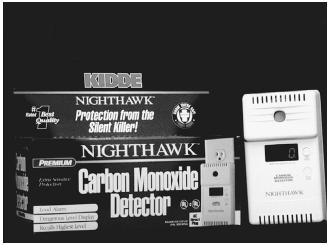
A colorless, odorless gas, carbon monoxide makes it difficult for the body to circulate oxygen. In large amounts, carbon monoxide can lead to unconsciousness and even death. Smaller amounts result in headaches, dizziness, nausea, disorientation, and fatigue. People who suffer from heart disease might experience increased chest pain when exposed to carbon monoxide. Beside people with chronic heart diseases, the negative health effects brought on by carbon monoxide exposure particularly endanger infants and the elderly.
Nitrogen Dioxide
Like carbon monoxide, nitrogen dioxide is a gas that cannot be seen or smelled. It irritates the eyes, ears, nose, and throat. Human exposure to large quantities of nitrogen dioxide (or repeated exposure to lower quantities over a long period of time) can cause shortness of breath or lead to increased risk of respiratory infection. Some studies with animals indicate that nitrogen dioxide exposure can lead to lung diseases such as emphysema. Adults and children who suffer from asthma or other breathing disorders are especially vulnerable if exposed to nitrogen dioxide.
Particles
Particles are released when fuel does not burn completely. They can enter and bury themselves in human lungs, where they can cause irritation or damage. Particles also provide a hanger for other airborne pollutants (such as radon, for example) to latch onto and use to gain entry into human lung tissue. Cancer-causing radon, for example, could latch onto a particle produced by incomplete combustion. The radon would be inhaled with the particle and end up lodged deep in the human lungs where it could lead to cancer.
Household Products
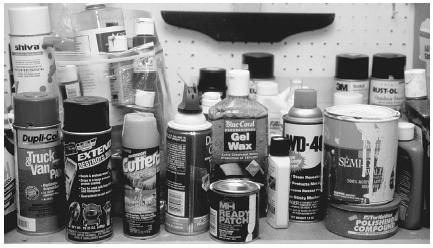
Many household products contain organic (carbon-containing) chemicals. These products can release polluting organic chemicals or compounds while in use or storage. Products with organic chemical ingredients include paints; varnishes; wax; many disinfecting, degreasing, or cosmetic agents; and fuels. According to the EPA, twelve common organic pollutants have been found in the air in homes at levels two to five times higher than the levels at which they were found in the air outside homes (even in industrial areas). EPA studies also indicate that people using household products, as well as others, can be exposed to high levels of chemical pollutants. These chemical pollutants also linger in the air even after the product is no longer being applied.
Evidence is still being gathered as to the short- and long-term health risks of organic chemicals released by household products, and what concentrations or lengths of exposure are dangerous. Findings to date suggest that health risks include respiratory tract irritation, headaches, dizziness, visual disorders, and impaired memory. A larger concern is that many organic compounds have been shown to cause cancer in animals and are suspected, or proven, to be cancer-causing agents in humans. While research continues, household products should be used in well-ventilated areas and according to label instructions.
Asbestos
A mineral fiber, asbestos was frequently used to insulate or fireproof building materials until studies began to reveal asbestos-related health dangers. The EPA has banned some asbestos products and manufacturers are limiting their use of asbestos products, but some older homes and buildings built before 1978 were built with asbestos-based materials. In these buildings, asbestos can appear in pipe and furnace insulation materials, shingles, textured paints, and floor tiles.
Asbestos fibers are dangerous when airborne. They can become airborne if asbestos-containing materials are cut, sanded, or disturbed in removal or remodeling efforts. Once airborne, tiny asbestos fibers can be inhaled and accumulate in human lungs, where they can cause cancer, meso-thelioma (cancer of chest and abdominal linings), and asbestosis. Asbestosis creates scar tissue in the lungs that cannot be repaired; this can be a life-threatening condition. Asbestos-related diseases have mostly been traced to high exposure on the job, or exposure to asbestos particles carried into a home on clothing and equipment by someone working a job involving high exposure to asbestos.
Lead
Like other chemicals that pose health risks, lead cannot be seen, smelled, or tasted. Since it does not break down naturally, trained professionals must physically remove lead sources from the environment they are polluting. Before
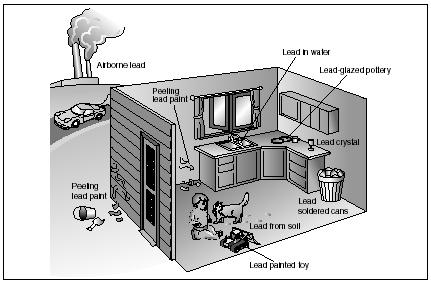
the health risks of lead were known, lead was used in paint and water pipes. Today, most house paint is almost entirely lead-free, and lead-based materials are not used in household plumbing systems. On the other hand, homes and buildings built before 1960, and even as late as 1978, may contain lead-based paint. Lead-based paint in good condition usually does not pose a risk. But lead-based paint in bad condition can cause serious problems.
Lead gets into the body from breathing contaminated lead dust from air, swallowing contaminated water, or ingesting lead-filled paint chips or soil. Problem sites can include window frames, walls, doors and doorframes, stairs, railings, banisters, and any objects or surfaces covered in lead-based paint. Hobbies such as refinishing furniture and making pottery or stained glass can produce lead remains. Workers who have jobs in construction, demolition, radiator repair, or handling batteries could carry dust from their job sites back to their homes. Soil that contains lead can also be easily tracked into the house from outdoors.
In spite of the growing awareness about the dangers of lead poisoning, the Centers for Disease Control and Prevention report that one in eleven American children has a high level of lead in their blood. Children can have especially serious health problems if they consume lead, causing learning disabilities, decreased growth, hyperactivity, and even brain damage. Pregnant women are also especially sensitive to lead-related problems.
Pesticides
Surveys have shown that at least one indoor pesticide product is used in about 75 percent of U.S. homes each year. Insecticides and disinfectants are used even more. Indoor exposure is responsible for 80 percent of an average American's exposure to pesticides, according to a recent study. The study also found that the air content of average homes could have high levels of as many as twelve different pesticides. While this research attributes 80 percent of an average American's pesticide exposure to indoor sources, actual pesticide use in the home does not accurately account for all the pesticides that are found in the air in a home. Contaminated air, water, or soil that is brought into a household from the outdoors can also contribute to the pesticide content in the home. Other contributors are stored pesticides, and household objects and surfaces where pesticides can accumulate, then later be released.
According to the 1990 records of the American Association of Poison Control Centers (AAPCC), 79,000 children were exposed to, or poisoned by, a household pesticide in that year. The AAPCC also reported that in almost 50 percent of households with children under age five, at least one pesticide product was stored in a place children could access.
When people use pesticides (insecticides, disinfectants, repellants, and rodenticides) in and around their homes, they should always keep in mind that how and where they handle, apply, and dispose of pesticides might also affect the environment and other people, pets, plants, and wildlife.
Effects of Indoor Air Pollution
There can be both short- and long-term effects from exposure to indoor air pollution. Short-term or immediate effects include irritations of the eyes, nose, and throat; headaches; dizziness; and fatigue. Symptoms of diseases such as asthma might appear not long after a single, or repeated, exposure to indoor air pollutants. Other, more serious, health problems, such as respiratory diseases, heart disease, and even cancer, may surface a long time after a person's first exposure to an indoor air pollutant (or several indoor air pollutants). These serious, even fatal, diseases might also appear after a person has been repeatedly exposed to the same air pollutants over a long period of time.
What to Do to Protect Against Indoor Air Pollution
All the pollutants can't be eliminated from the air people breathe, nor can there be an avoidance of some exposure to them. It is possible, however, to have protection against exposure to indoor air pollution, or at least against dangerous levels of indoor air pollution, by taking some basic steps:
TOBACCO SMOKE. Tobacco smoke exposure can be reduced or eliminated by:
- not smoking
- discouraging smoking in the home
- discouraging people from smoking around infants and children
RADON. Exposure to radon can be controlled by:
- being sure all living space is properly ventilated
- encouraging parents/teachers to have the air circulating at home and in school checked for radon levels and other pollutants
- having well water tested, and if necessary treated, for high levels of radon
- taking time to identify the sources of air pollution problems
- keeping windows open when painting to control, or prevent, problems
- encouraging everyone at home or at school who works on painting or soldering projects or hobbies to work carefully and clean up thoroughly
- investigating products and services to improve ventilation and clean air
- keeping living and working spaces as clean and dust-free as possible
STOVES, HEATERS, FIREPLACES, AND CHIMNEYS. Pollution from stoves, heaters, fireplaces and chimneys can be eliminated or reduced by:
- following instructions when installing and using unvented, fuel-burning space heaters
- having exhaust fans over gas cooking stoves and adjusting burners correctly
- making sure wood-stove emissions meet EPA standards
- selecting a stove that is the correct size for the space in which it will be used
- arranging the annual inspection of central air conditioning and heating systems
- repairing damaged or broken parts immediately
HOUSEHOLD PRODUCTS. With household products it is advisable to:
- read and follow label instructions
- safely dispose of chemicals that are old or no longer used
- buy household products on a need-only basis so a lot of chemicals aren't stored
- limit exposure to paint strippers, adhesive removers, and aerosol spray paints
- ask dry-cleaners to remove as much as possible of the perchloroethylene (active chemical agent used in dry-cleaning)
ASBESTOS. Because of asbestos's hazardous nature one should:
- not tamper with asbestos material that is in good condition in the home
- avoid cutting, ripping, or sanding asbestos-based materials
- have a professional contain or remove asbestos in the home
LEAD. To prevent problems related to lead, it's important to:
- get tested for lead poisoning
- use a solution of water mixed with powdered dishwasher detergent to wash floors and windowsills
- be sure children are not chewing on objects or surfaces covered with lead-based paint
- get professional help to remove lead paint from the home
- have water tested for dangerous levels of lead
- run cold water for thirty to sixty seconds if it has not been used in over two hours to give pipes a chance to clear before drinking or cooking
- not store food or liquid in lead crystal or in pottery with high lead content
PESTICIDES. For protection from pesticides, it's important to:
- read and follow exactly all label instructions
- never use a large amount of a pesticide, or use it more frequently than what is indicated
- limit exposure to moth repellants
- keep living space clean and well ventilated
- avoid direct physical contact with pesticide being used
- cover exposed human/pet food and water containers before applying pesticides
Comment about this article, ask questions, or add new information about this topic: