
Hemophilia - Causes
Hemophilia is a genetic disorder. A genetic disorder is a medical condition in which a person has one or more abnormal genes. Genes are the chemical units that are present in all cells. They tell cells what functions to perform. For example, everyone has certain genes that tell cells how to make clotting factors. There is one gene for making clotting factor I, one gene for clotting factor II, one gene for clotting factor III, and so on.
Inherited Hemophilia
Sometimes a person inherits a defective gene from a parent. That defective gene carries no instructions, or the wrong instructions, for performing some function. A cell does not know how to make a certain material, such as clotting factor VIII, or it makes the material incorrectly. In such cases, a genetic disorder may develop.
Genes are arranged in cells on long strings known as chromosomes. Under a microscope, chromosomes look like a string of beads, in which genes are the individual beads.
All normal human cells contain twenty-three pairs of chromosomes. Half of the chromosomes come from the father, and half from the mother. One pair of chromosomes is the sex chromosomes. These two chromosomes determine sexual characteristics, along with other characteristics. Two types of sex chromosomes exist: an X chromosome and a Y chromosome. Men have one X and one Y chromosome. Women have two X chromosomes.
The genes for making clotting factors are located on X chromosomes. This means that males are more likely to have hemophilia than females. A female always has two X chromosomes. She may inherit one defective X chromosome, but she will probably not inherit two defective X chromosomes. Her normal X chromosome will still carry the correct instructions for making clotting factors.
Males, however, carry only one X chromosome. If the X chromosome a male inherits is defective, he will not have a normal X chromosome to compensate for the defective one. His cells will not receive the correct instructions for making clotting factors.
For this reason, hemophilia is almost entirely a disorder in males. The condition very rarely occurs among women. Even if women carry one defective X chromosome, they will not have the disorder. However, they will have the ability to pass the disorder on to their children. For that reason, a female with just one defective X chromosome is said to be a carrier for the disorder.
Spontaneous Gene Mutation
About 30 percent of all people with hemophilia A or B are the first members of their family to ever have the disease. These individuals have the unfortunate occurrence of a spontaneous mutation. In their early development some random genetic accident caused a defect in their X chromosome. Once
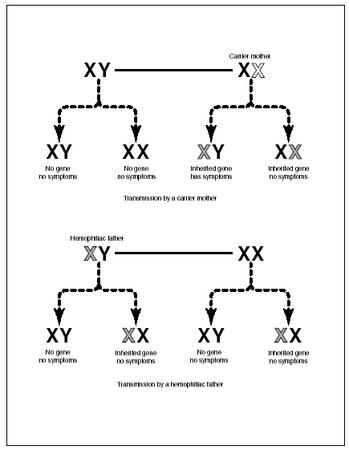
a genetic mutation takes place, offspring of the affected person can inherit the newly-created, flawed chromosome.
Comment about this article, ask questions, or add new information about this topic: