
The Urinogenital System and the Kidneys - The urinary tract
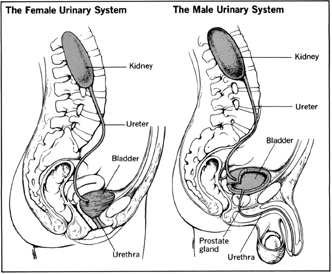
From the ends of the million or so tubules in each kidney, urine drains into larger and larger collecting basins (called calyces , singular calyx ) which drain in turn into the kidney's master urine reservoir, the kidney pelvis . Then, drop by drop, urine slides down each ureter to the urinary bladder.
Urine is held in the bladder by the contraction of two muscle rings, or sphincters , one located just inside the bladder before it meets the urethra, and the other encircling the urethra itself. When about a half-pint has accumulated, nerves convey the urge to urinate to the brain, and the person voluntarily causes the sphincters to relax, emptying the bladder. (In exceptional circumstances, the elastic-walled bladder can hold two or three quarts of urine.) Up to the point where the bladder drains, the male and female urinary tracts are very similar, but after the bladder, any similarity stops.
Female Urethra
The female's urethra, normally about one and a half inches long, is not much more than a short channel by which urine is eliminated from the bladder. Its very shortness often gives it an undesired significance, because it represents an easy upward invasion route for bacteria and other infection-causing microbes from the outside. Acute and painful inflammations of the urethra ( urethritis ) and bladder ( cystitis ) are thus common in women. These lower urinary tract infections, however, can usually be halted before spreading further up the urinary tract by the administration of any of several antimicrobial drugs. See Ch. 25, for more information on these disorders.
Male Urethra
In contrast to the female, the male's urethra is involved with reproductive functions. So closely connected are the male's lower urinary tract and genital organs that his urethra (from bladder to the outside) is properly called the urinogenital (or genitourinary) tract. This is the reason why the medical specialty known as urology deals with both the urinary and genital apparatus of men; but with only the urinary tract of women. The urologist's specialty does not extend to the female genital and childbearing organs, which are the concern of the gynecologist and obstetrician .
However, all the distinctly male sex glands and organs are linked more or less directly into the eight- or nine-inch length of the male urethra.
Comment about this article, ask questions, or add new information about this topic: