
THE 9/11
COMMISSION
REPORT
Final FM.1pp 7/17/04 5:25 PM Page i

List of Illustrations and Tables ix
Member List xi
Staff List xiiixiv
Preface xv
1. "WE HAVE SOME PLANES" 1
1.1
Inside the Four Flights 1
1.2
Improvising a Homeland Defense 14
1.3
National Crisis Management 35
2. THE FOUNDATION OF THE NEW TERRORISM 47
2.1
A Declaration of War 47
2.2
Bin Ladin's Appeal in the Islamic World 48
2.3
The Rise of Bin Ladin and al Qaeda (19881992) 55
2.4
Building an Organization, Declaring
War on the United States (19921996) 59
2.5
Al Qaeda's Renewal in Afghanistan (19961998) 63
3. COUNTERTERRORISM EVOLVES 71
3.1
From the Old Terrorism to the New:
The First World Trade Center Bombing 71
3.2
Adaptation--and Nonadaptation--
. . .
in the Law Enforcement Community 73
3.3
. . . and in the Federal Aviation Administration 82
3.4
. . . and in the Intelligence Community 86
CONTENTS
v
Final FM.1pp 7/17/04 5:25 PM Page v

3.5
. . . and in the State Department and the Defense Department 93
3.6
. . . and in the White House 98
3.7
. . . and in the Congress 102
4. RESPONSES TO AL QAEDA'S INITIAL ASSAULTS 108
4.1
Before the Bombings in Kenya and Tanzania 108
4.2
Crisis: August 1998 115
4.3
Diplomacy 121
4.4
Covert Action 126
4.5
Searching for Fresh Options 134
5. AL QAEDA AIMS AT THE AMERICAN HOMELAND 145
5.1
Terrorist Entrepreneurs 145
5.2
The "Planes Operation" 153
5.3
The Hamburg Contingent 160
5.4
A Money Trail? 169
6. FROM THREAT TO THREAT 174
6.1
The Millennium Crisis 174
6.2
Post-Crisis Reflection: Agenda for 2000 182
6.3
The Attack on the USS Cole
190
6.4
Change and Continuity 198
6.5
The New Administration's Approach 203
7. THE ATTACK LOOMS 215
7.1
First Arrivals in California 215
7.2
The 9/11 Pilots in the United States 223
7.3
Assembling the Teams 231
7.4
Final Strategies and Tactics 241
8. "THE SYSTEM WAS BLINKING RED" 254
8.1
The Summer of Threat 254
8.2
Late Leads--Mihdhar, Moussaoui, and KSM 266
9. HEROISM AND HORROR 278
9.1
Preparedness as of September 11 278
9.2
September 11, 2001 285
9.3
Emergency Response at the Pentagon 311
9.4
Analysis 315
vi
Final FM.1pp 7/17/04 5:25 PM Page vi

10. WARTIME 325
10.1
Immediate Responses at Home 326
10.2
Planning for War 330
10.3
"Phase Two" and the Question of Iraq 334
11. FORESIGHT--AND HINDSIGHT 339
11.1
Imagination 339
11.2
Policy 348
11.3
Capabilities 350
11.4
Management 353
12. WHAT TO DO? A GLOBAL STRATEGY 361
12.1
Reflecting on a Generational Challenge 361
12.2
Attack Terrorists and Their Organizations 365
12.3
Prevent the Continued Growth of Islamist Terrorism 374
12.4
Protect against and Prepare for Terrorist Attacks 383
13. HOW TO DO IT? A DIFFERENT WAY OF
ORGANIZING THE GOVERNMENT 399
13.1
Unity of Effort across the Foreign-Domestic Divide 400
13.2
Unity of Effort in the Intelligence Community 407
13.3
Unity of Effort in Sharing Information 416
13.4
Unity of Effort in the Congress 419
13.5
Organizing America's Defenses in the United States 423
Appendix A: Common Abbreviations
429
Appendix B:Table of Names
431
Appendix C: Commission Hearings
439
Notes
449
vii
Final FM.1pp 7/17/04 5:25 PM Page vii

Final FM.1pp 7/17/04 5:25 PM Page viii

p. 15
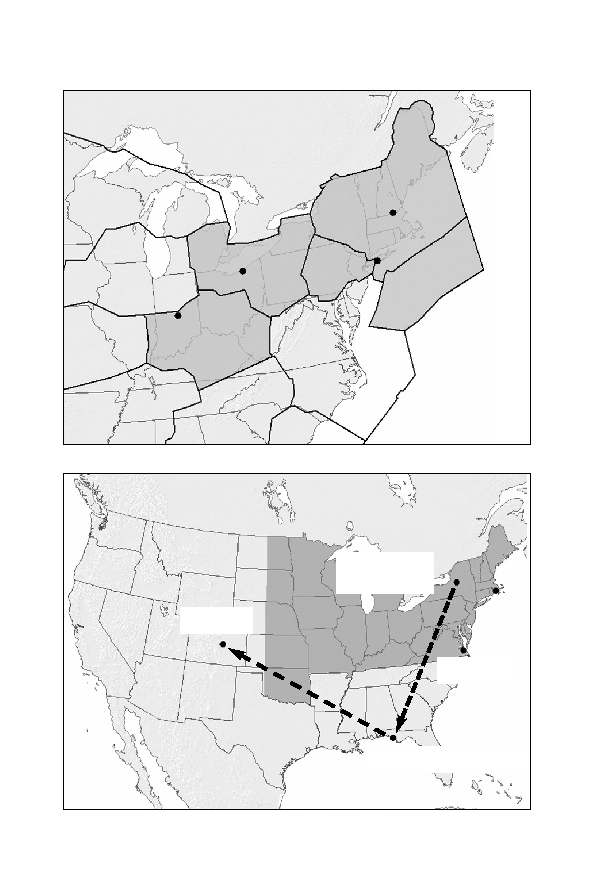
FAA Air Traffic Control Centers
p. 15
Reporting structure, Northeast Air Defense Sector
p. 3233
Flight paths and timelines
p. 49
Usama Bin Ladin
p. 64
Map of Afghanistan
p. 148
Khalid Sheikh Mohammed
p. 238239
The 9/11 hijackers
p. 279
The World Trade Center Complex as of 9/11
p. 284
The World Trade Center radio repeater system
p. 288
The World Trade Center North Tower stairwell with deviations
p. 312
The Twin Towers following the impact of American Airlines
Flight 11 and United Airlines Flight 175
p. 313
The Pentagon after being struck by American Airlines Flight 77
p. 313
American Airlines Flight 93 crash site, Shanksville, Pennsylvania
p. 413
Unity of effort in managing intelligence
LIST OF ILLUSTRATIONS
AND TABLES
ix
Final FM.1pp 7/17/04 5:25 PM Page ix

Final FM.1pp 7/17/04 5:25 PM Page x
Thomas H. Kean
chair
Richard Ben-Veniste
Fred F. Fielding
Jamie S. Gorelick
Slade Gorton
Lee H. Hamilton
vice chair
Bob Kerrey
John F. Lehman
Timothy J. Roemer
James R.Thompson
COMMISSION
MEMBERS
Final FM.1pp 7/17/04 5:25 PM Page xi

Final FM.1pp 7/17/04 5:25 PM Page xii

Joanne M. Accolla
Staff Assistant
Alexis Albion
Professional Staff Member
Scott H. Allan, Jr.
Counsel
John A. Azzarello
Counsel
Caroline Barnes
Professional Staff Member
Warren Bass
Professional Staff Member
Ann M. Bennett
Information Control Officer
Mark S. Bittinger
Professional Staff Member
Madeleine Blot
Counsel
Antwion M. Blount
Systems Engineer
Sam Brinkley
Professional Staff Member
Geoffrey Scott Brown
Research Assistant
Daniel Byman
Professional Staff Member
Dianna Campagna
Manager of Operations
Samuel M.W. Caspersen
Counsel
Melissa A. Coffey
Staff Assistant
Lance Cole
Consultant
Marquittia L. Coleman
Staff Assistant
Marco A. Cordero
Professional Staff Member
Rajesh De
Counsel
George W. Delgrosso
Investigator
Gerald L. Dillingham
Professional Staff Member
Thomas E. Dowling
Professional Staff Member
Steven M. Dunne
Deputy General Counsel
Thomas R. Eldridge
Counsel
Alice Falk
Editor
John J. Farmer, Jr.
Senior Counsel & Team Leader
Alvin S. Felzenberg
Deputy for Communications
COMMISSION
STAFF
xiii
Philip Zelikow, Executive Director
Christopher A. Kojm, Deputy Executive Director
Daniel Marcus, General Counsel
Final FM.1pp 7/17/04 5:25 PM Page xiii

Lorry M. Fenner
Professional Staff Member
Susan Ginsburg
Senior Counsel & Team Leader
T. Graham Giusti
Security Officer
Nicole Marie Grandrimo
Professional Staff Member
Douglas N. Greenburg
Counsel
Barbara A. Grewe
Senior Counsel, Special Projects
Elinore Flynn Hartz
Family Liaison
Leonard R. Hawley
Professional Staff Member
L. Christine Healey
Senior Counsel & Team Leader
Karen Heitkotter
Executive Secretary
Walter T. Hempel II
Professional Staff Member
C. Michael Hurley
Senior Counsel & Team Leader
Dana J. Hyde
Counsel
John W. Ivicic
Security Officer
Michael N. Jacobson
Counsel
Hunter W. Jamerson
Intern
Bonnie D. Jenkins
Counsel
Reginald F. Johnson
Staff Assistant
R.William Johnstone
Professional Staff Member
Stephanie L. Kaplan
Special Assistant & Managing Editor
Miles L. Kara, Sr.
Professional Staff Member
Janice L. Kephart
Counsel
Hyon Kim
Counsel
Katarzyna Kozaczuk
Financial Assistant
Gordon Nathaniel Lederman
Counsel
Daniel J. Leopold
Staff Assistant
Sarah Webb Linden
Professional Staff Member
Douglas J. MacEachin
Professional Staff Member & Team Leader
Ernest R. May
Senior Adviser
Joseph McBride
Intern
James Miller
Professional Staff Member
Kelly Moore
Professional Staff Member
Charles M. Pereira
Professional Staff Member
John Raidt
Professional Staff Member
John Roth
Senior Counsel & Team Leader
Peter Rundlet
Counsel
Lloyd D. Salvetti
Professional Staff Member
Kevin J. Scheid
Professional Staff Member & Team Leader
Kevin Shaeffer
Professional Staff Member
Tracy J. Shycoff
Deputy for Administration & Finance
Dietrich L. Snell
Senior Counsel & Team Leader
Jonathan DeWees Stull
Communications Assistant
Lisa Marie Sullivan
Staff Assistant
Quinn John Tamm, Jr.
Professional Staff Member
Catharine S.Taylor
Staff Assistant
Yoel Tobin
Counsel
Emily Landis Walker
Professional Staff Member & Family Liaison
Garth Wermter
Senior IT Consultant
Serena B.Wille
Counsel
Peter Yerkes
Public Affairs Assistant
xiv
COMMISSION STAFF
xiv
Final FM.1pp 7/17/04 5:26 PM Page xiv

We p re se nt th e narrat ive of this report and the recommendations
that flow from it to the President of the United States, the United States
Congress, and the American people for their consideration. Ten
Commissioners--five Republicans and five Democrats chosen by elected
leaders from our nation's capital at a time of great partisan division--have
come together to present this report without dissent.
We have come together with a unity of purpose because our nation
demands it. September 11, 2001, was a day of unprecedented shock and suf-
fering in the history of the United States.The nation was unprepared. How
did this happen, and how can we avoid such tragedy again?
To answer these questions, the Congress and the President created the
National Commission on Terrorist Attacks Upon the United States (Public
Law 107-306, November 27, 2002).
Our mandate was sweeping.The law directed us to investigate "facts and
circumstances relating to the terrorist attacks of September 11, 2001," includ-
ing those relating to intelligence agencies, law enforcement agencies, diplo-
macy, immigration issues and border control, the flow of assets to terrorist
organizations, commercial aviation, the role of congressional oversight and
resource allocation, and other areas determined relevant by the Commission.
In pursuing our mandate, we have reviewed more than 2.5 million pages
of documents and interviewed more than 1,200 individuals in ten countries.
This included nearly every senior official from the current and previous
administrations who had responsibility for topics covered in our mandate.
We have sought to be independent, impartial, thorough, and nonpartisan.
From the outset, we have been committed to share as much of our investi-
gation as we can with the American people.To that end, we held 19 days of
hearings and took public testimony from 160 witnesses.
PREFACE
xv
Final FM.1pp 7/17/04 5:26 PM Page xv

Our aim has not been to assign individual blame. Our aim has been to
provide the fullest possible account of the events surrounding 9/11 and to
identify lessons learned.
We learned about an enemy who is sophisticated, patient, disciplined,
and lethal.The enemy rallies broad support in the Arab and Muslim world
by demanding redress of political grievances, but its hostility toward us and
our values is limitless. Its purpose is to rid the world of religious and polit-
ical pluralism, the plebiscite, and equal rights for women. It makes no dis-
tinction between military and civilian targets. Collateral damage is not in its
lexicon.
We learned that the institutions charged with protecting our borders,
civil aviation, and national security did not understand how grave this threat
could be, and did not adjust their policies, plans, and practices to deter or
defeat it.We learned of fault lines within our government--between foreign
and domestic intelligence, and between and within agencies.We learned of
the pervasive problems of managing and sharing information across a large
and unwieldy government that had been built in a different era to confront
different dangers.
At the outset of our work, we said we were looking backward in order
to look forward. We hope that the terrible losses chronicled in this report
can create something positive--an America that is safer, stronger, and wiser.
That September day, we came together as a nation. The test before us is to
sustain that unity of purpose and meet the challenges now confronting us.
We need to design a balanced strategy for the long haul, to attack terror-
ists and prevent their ranks from swelling while at the same time protecting
our country against future attacks.We have been forced to think about the
way our government is organized. The massive departments and agencies
that prevailed in the great struggles of the twentieth century must work
together in new ways, so that all the instruments of national power can be
combined. Congress needs dramatic change as well to strengthen oversight
and focus accountability.
As we complete our final report, we want to begin by thanking our fel-
low Commissioners, whose dedication to this task has been profound. We
have reasoned together over every page, and the report has benefited from
this remarkable dialogue. We want to express our considerable respect for
the intellect and judgment of our colleagues, as well as our great affection
for them.
We want to thank the Commission staff.The dedicated professional staff,
headed by Philip Zelikow, has contributed innumerable hours to the com-
pletion of this report, setting aside other important endeavors to take on this
xvi
PREFACE
Final FM.1pp 7/17/04 5:26 PM Page xvi

all-consuming assignment. They have conducted the exacting investigative
work upon which the Commission has built.They have given good advice,
and faithfully carried out our guidance.They have been superb.
We thank the Congress and the President. Executive branch agencies
have searched records and produced a multitude of documents for us. We
thank officials, past and present, who were generous with their time and
provided us with insight. The PENTTBOM team at the FBI, the
Director's Review Group at the CIA, and Inspectors General at the
Department of Justice and the CIA provided great assistance. We owe a
huge debt to their investigative labors, painstaking attention to detail, and
readiness to share what they have learned. We have built on the work of
several previous Commissions, and we thank the Congressional Joint
Inquiry, whose fine work helped us get started.We thank the City of New
York for assistance with documents and witnesses, and the Government
Printing Office and W.W. Norton & Company for helping to get this
report to the broad public.
We conclude this list of thanks by coming full circle:We thank the fam-
ilies of 9/11, whose persistence and dedication helped create the
Commission.They have been with us each step of the way, as partners and
witnesses.They know better than any of us the importance of the work we
have undertaken.
We want to note what we have done, and not done.We have endeavored
to provide the most complete account we can of the events of September
11, what happened and why.This final report is only a summary of what we
have done, citing only a fraction of the sources we have consulted. But in
an event of this scale, touching so many issues and organizations, we are
conscious of our limits.We have not interviewed every knowledgeable per-
son or found every relevant piece of paper. New information inevitably will
come to light. We present this report as a foundation for a better under-
standing of a landmark in the history of our nation.
We have listened to scores of overwhelming personal tragedies and
astounding acts of heroism and bravery. We have examined the staggering
impact of the events of 9/11 on the American people and their amazing
resilience and courage as they fought back.We have admired their determi-
nation to do their best to prevent another tragedy while preparing to
respond if it becomes necessary. We emerge from this investigation with
enormous sympathy for the victims and their loved ones, and with
enhanced respect for the American people. We recognize the formidable
challenges that lie ahead.
We also approach the task of recommendations with humility. We have
PREFACE
xvii
Final FM.1pp 7/17/04 5:26 PM Page xvii

made a limited number of them. We decided consciously to focus on rec-
ommendations we believe to be most important, whose implementation
can make the greatest difference. We came into this process with strong
opinions about what would work. All of us have had to pause, reflect, and
sometimes change our minds as we studied these problems and considered
the views of others.We hope our report will encourage our fellow citizens
to study, reflect--and act.
xviii
PREFACE
Thomas H. Kean
chair
Lee H. Hamilton
vice chair
Final FM.1pp 7/17/04 5:26 PM Page xviii

THE 9/11
COMMISSION
REPORT
Final FM.1pp 7/17/04 5:26 PM Page xix

Final FM.1pp 7/17/04 5:26 PM Page xx

1
"WE HAVE
SOME PLANES"
1
Tue sday, S e p te m b e r 11, 2 0 01, dawned temperate and nearly cloudless in
the eastern United States. Millions of men and women readied themselves for
work. Some made their way to the Twin Towers, the signature structures of the
World Trade Center complex in New York City. Others went to Arlington,Vir-
ginia, to the Pentagon. Across the Potomac River, the United States Congress
was back in session. At the other end of Pennsylvania Avenue, people began to
line up for a White House tour. In Sarasota, Florida, President George W. Bush
went for an early morning run.
For those heading to an airport, weather conditions could not have been
better for a safe and pleasant journey.Among the travelers were Mohamed Atta
and Abdul Aziz al Omari, who arrived at the airport in Portland, Maine.
1.1 INSIDE THE FOUR FLIGHTS
Boarding the Flights
Boston:American 11 and United 175.
Atta and Omari boarded a 6:00
A
.
M
.
flight from Portland to Boston's Logan International Airport.
1
When he checked in for his flight to Boston, Atta was selected by a com-
puterized prescreening system known as CAPPS (Computer Assisted Passen-
ger Prescreening System), created to identify passengers who should be
subject to special security measures. Under security rules in place at the time,
the only consequence of Atta's selection by CAPPS was that his checked bags
were held off the plane until it was confirmed that he had boarded the air-
craft. This did not hinder Atta's plans.
2
Atta and Omari arrived in Boston at 6:45. Seven minutes later, Atta appar-
ently took a call from Marwan al Shehhi, a longtime colleague who was at
another terminal at Logan Airport.They spoke for three minutes.
3
It would be
their final conversation.
Final1-4.4pp 7/17/04 9:12 AM Page 1

Between 6:45 and 7:40,Atta and Omari, along with Satam al Suqami,Wail
al Shehri, and Waleed al Shehri, checked in and boarded American Airlines
Flight 11, bound for Los Angeles.The flight was scheduled to depart at 7:45.
4
In another Logan terminal, Shehhi, joined by Fayez Banihammad, Mohand
al Shehri, Ahmed al Ghamdi, and Hamza al Ghamdi, checked in for United
Airlines Flight 175, also bound for Los Angeles.A couple of Shehhi's colleagues
were obviously unused to travel; according to the United ticket agent, they had
trouble understanding the standard security questions, and she had to go over
them slowly until they gave the routine, reassuring answers.
5
Their flight was
scheduled to depart at 8:00.
The security checkpoints through which passengers, including Atta and his
colleagues, gained access to the American 11 gate were operated by Globe
Security under a contract with American Airlines. In a different terminal, the
single checkpoint through which passengers for United 175 passed was con-
trolled by United Airlines, which had contracted with Huntleigh USA to per-
form the screening.
6
In passing through these checkpoints, each of the hijackers would have been
screened by a walk-through metal detector calibrated to detect items with at
least the metal content of a .22-caliber handgun. Anyone who might have set
off that detector would have been screened with a hand wand--a procedure
requiring the screener to identify the metal item or items that caused the alarm.
In addition, an X-ray machine would have screened the hijackers' carry-on
belongings.The screening was in place to identify and confiscate weapons and
other items prohibited from being carried onto a commercial flight.
7
None of
the checkpoint supervisors recalled the hijackers or reported anything suspi-
cious regarding their screening.
8
While Atta had been selected by CAPPS in Portland, three members of his
hijacking team--Suqami,Wail al Shehri, and Waleed al Shehri--were selected
in Boston.Their selection affected only the handling of their checked bags, not
their screening at the checkpoint. All five men cleared the checkpoint and
made their way to the gate for American 11. Atta, Omari, and Suqami took
their seats in business class (seats 8D, 8G, and 10B, respectively). The Shehri
brothers had adjacent seats in row 2 (Wail in 2A, Waleed in 2B), in the first-
class cabin. They boarded American 11 between 7:31 and 7:40. The aircraft
pushed back from the gate at 7:40.
9
Shehhi and his team, none of whom had been selected by CAPPS, boarded
United 175 between 7:23 and 7:28 (Banihammad in 2A, Shehri in 2B, Shehhi
in 6C, Hamza al Ghamdi in 9C, and Ahmed al Ghamdi in 9D).Their aircraft
pushed back from the gate just before 8:00.
10
Washington Dulles: American 77.
Hundreds of miles southwest of Boston,
at Dulles International Airport in the Virginia suburbs of Washington, D.C.,
five more men were preparing to take their early morning flight.At 7:15, a pair
2
THE 9/11 COMMISSION REPORT
Final1-4.4pp 7/17/04 9:12 AM Page 2

of them, Khalid al Mihdhar and Majed Moqed, checked in at the American
Airlines ticket counter for Flight 77, bound for Los Angeles.Within the next
20 minutes, they would be followed by Hani Hanjour and two brothers, Nawaf
al Hazmi and Salem al Hazmi.
11
Hani Hanjour, Khalid al Mihdhar, and Majed Moqed were flagged by
CAPPS.The Hazmi brothers were also selected for extra scrutiny by the air-
line's customer service representative at the check-in counter. He did so
because one of the brothers did not have photo identification nor could he
understand English, and because the agent found both of the passengers to
be suspicious.The only consequence of their selection was that their checked
bags were held off the plane until it was confirmed that they had boarded
the aircraft.
12
All five hijackers passed through the Main Terminal's west security screen-
ing checkpoint; United Airlines, which was the responsible air carrier, had
contracted out the work to Argenbright Security.
13
The checkpoint featured
closed-circuit television that recorded all passengers, including the hijackers,
as they were screened. At 7:18, Mihdhar and Moqed entered the security
checkpoint.
Mihdhar and Moqed placed their carry-on bags on the belt of the X-ray
machine and proceeded through the first metal detector. Both set off the alarm,
and they were directed to a second metal detector. Mihdhar did not trigger the
alarm and was permitted through the checkpoint. After Moqed set it off, a
screener wanded him. He passed this inspection.
14
About 20 minutes later, at 7:35, another passenger for Flight 77, Hani Han-
jour, placed two carry-on bags on the X-ray belt in the Main Terminal's west
checkpoint, and proceeded, without alarm, through the metal detector. A short
time later, Nawaf and Salem al Hazmi entered the same checkpoint. Salem al
Hazmi cleared the metal detector and was permitted through; Nawaf al Hazmi
set off the alarms for both the first and second metal detectors and was then
hand-wanded before being passed. In addition, his over-the-shoulder carry-on
bag was swiped by an explosive trace detector and then passed. The video
footage indicates that he was carrying an unidentified item in his back pocket,
clipped to its rim.
15
When the local civil aviation security office of the Federal Aviation Admin-
istration (FAA) later investigated these security screening operations, the
screeners recalled nothing out of the ordinary.They could not recall that any
of the passengers they screened were CAPPS selectees. We asked a screening
expert to review the videotape of the hand-wanding, and he found the qual-
ity of the screener's work to have been "marginal at best." The screener should
have "resolved" what set off the alarm; and in the case of both Moqed and
Hazmi, it was clear that he did not.
16
At 7:50, Majed Moqed and Khalid al Mihdhar boarded the flight and were
seated in 12A and 12B in coach. Hani Hanjour, assigned to seat 1B (first class),
"WE HAVE SOME PLANES"
3
Final1-4.4pp 7/17/04 9:12 AM Page 3

soon followed.The Hazmi brothers, sitting in 5E and 5F, joined Hanjour in the
first-class cabin.
17
Newark: United 93.
Between 7:03 and 7:39, Saeed al Ghamdi, Ahmed al
Nami, Ahmad al Haznawi, and Ziad Jarrah checked in at the United Airlines
ticket counter for Flight 93, going to Los Angeles.Two checked bags; two did
not. Haznawi was selected by CAPPS. His checked bag was screened for explo-
sives and then loaded on the plane.
18
The four men passed through the security checkpoint, owned by United
Airlines and operated under contract by Argenbright Security. Like the check-
points in Boston, it lacked closed-circuit television surveillance so there is no
documentary evidence to indicate when the hijackers passed through the
checkpoint, what alarms may have been triggered, or what security procedures
were administered.The FAA interviewed the screeners later; none recalled any-
thing unusual or suspicious.
19
The four men boarded the plane between 7:39 and 7:48. All four had seats
in the first-class cabin; their plane had no business-class section. Jarrah was in
seat 1B, closest to the cockpit; Nami was in 3C, Ghamdi in 3D, and Haznawi
in 6B.
20
The 19 men were aboard four transcontinental flights.
21
They were plan-
ning to hijack these planes and turn them into large guided missiles, loaded
with up to 11,400 gallons of jet fuel. By 8:00
A
.
M
. on the morning of Tuesday,
September 11, 2001, they had defeated all the security layers that America's civil
aviation security system then had in place to prevent a hijacking.
The Hijacking of American 11
American Airlines Flight 11 provided nonstop service from Boston to Los
Angeles. On September 11, Captain John Ogonowski and First Officer
Thomas McGuinness piloted the Boeing 767. It carried its full capacity of nine
flight attendants. Eighty-one passengers boarded the flight with them (includ-
ing the five terrorists).
22
The plane took off at 7:59. Just before 8:14, it had climbed to 26,000 feet,
not quite its initial assigned cruising altitude of 29,000 feet.All communications
and flight profile data were normal. About this time the "Fasten Seatbelt" sign
would usually have been turned off and the flight attendants would have begun
preparing for cabin service.
23
At that same time, American 11 had its last routine communication with
the ground when it acknowledged navigational instructions from the FAA's
air traffic control (ATC) center in Boston. Sixteen seconds after that transmis-
sion,ATC instructed the aircraft's pilots to climb to 35,000 feet.That message
and all subsequent attempts to contact the flight were not acknowledged.
From this and other evidence, we believe the hijacking began at 8:14 or
shortly thereafter.
24
4
THE 9/11 COMMISSION REPORT
Final1-4.4pp 7/17/04 9:12 AM Page 4

Reports from two flight attendants in the coach cabin, Betty Ong and
Madeline "Amy" Sweeney, tell us most of what we know about how the
hijacking happened. As it began, some of the hijackers--most likely Wail al
Shehri and Waleed al Shehri, who were seated in row 2 in first class--stabbed
the two unarmed flight attendants who would have been preparing for cabin
service.
25
We do not know exactly how the hijackers gained access to the cockpit;
FAA rules required that the doors remain closed and locked during flight. Ong
speculated that they had "jammed their way" in. Perhaps the terrorists stabbed
the flight attendants to get a cockpit key, to force one of them to open the cock-
pit door, or to lure the captain or first officer out of the cockpit. Or the flight
attendants may just have been in their way.
26
At the same time or shortly thereafter, Atta--the only terrorist on board
trained to fly a jet--would have moved to the cockpit from his business-class
seat, possibly accompanied by Omari.As this was happening, passenger Daniel
Lewin, who was seated in the row just behind Atta and Omari, was stabbed by
one of the hijackers--probably Satam al Suqami, who was seated directly
behind Lewin. Lewin had served four years as an officer in the Israeli military.
He may have made an attempt to stop the hijackers in front of him, not real-
izing that another was sitting behind him.
27
The hijackers quickly gained control and sprayed Mace, pepper spray, or
some other irritant in the first-class cabin, in order to force the passengers and
flight attendants toward the rear of the plane.They claimed they had a bomb.
28
About five minutes after the hijacking began, Betty Ong contacted the
American Airlines Southeastern Reservations Office in Cary, North Carolina,
via an AT&T airphone to report an emergency aboard the flight.This was the
first of several occasions on 9/11 when flight attendants took action outside
the scope of their training, which emphasized that in a hijacking, they were to
communicate with the cockpit crew.The emergency call lasted approximately
25 minutes, as Ong calmly and professionally relayed information about events
taking place aboard the airplane to authorities on the ground.
29
At 8:19, Ong reported:"The cockpit is not answering, somebody's stabbed
in business class--and I think there's Mace--that we can't breathe--I don't
know, I think we're getting hijacked." She then told of the stabbings of the two
flight attendants.
30
At 8:21, one of the American employees receiving Ong's call in North Car-
olina, Nydia Gonzalez, alerted the American Airlines operations center in Fort
Worth,Texas, reaching Craig Marquis, the manager on duty. Marquis soon real-
ized this was an emergency and instructed the airline's dispatcher responsible
for the flight to contact the cockpit. At 8:23, the dispatcher tried unsuccessfully
to contact the aircraft. Six minutes later, the air traffic control specialist in Amer-
ican's operations center contacted the FAA's Boston Air Traffic Control Center
about the flight. The center was already aware of the problem.
31
"WE HAVE SOME PLANES"
5
Final1-4.4pp 7/17/04 9:12 AM Page 5

Boston Center knew of a problem on the flight in part because just before
8:25 the hijackers had attempted to communicate with the passengers. The
microphone was keyed, and immediately one of the hijackers said, "Nobody
move. Everything will be okay. If you try to make any moves, you'll endanger
yourself and the airplane. Just stay quiet."Air traffic controllers heard the trans-
mission; Ong did not.The hijackers probably did not know how to operate the
cockpit radio communication system correctly, and thus inadvertently broad-
cast their message over the air traffic control channel instead of the cabin
public-address channel. Also at 8:25, and again at 8:29, Amy Sweeney got
through to the American Flight Services Office in Boston but was cut off after
she reported someone was hurt aboard the flight.Three minutes later, Sweeney
was reconnected to the office and began relaying updates to the manager,
Michael Woodward.
32
At 8:26, Ong reported that the plane was "flying erratically."A minute later,
Flight 11 turned south. American also began getting identifications of the
hijackers, as Ong and then Sweeney passed on some of the seat numbers of
those who had gained unauthorized access to the cockpit.
33
Sweeney calmly reported on her line that the plane had been hijacked; a
man in first class had his throat slashed; two flight attendants had been
stabbed--one was seriously hurt and was on oxygen while the other's wounds
seemed minor; a doctor had been requested; the flight attendants were unable
to contact the cockpit; and there was a bomb in the cockpit. Sweeney told
Woodward that she and Ong were trying to relay as much information as they
could to people on the ground.
34
At 8:38, Ong told Gonzalez that the plane was flying erratically again.
Around this time Sweeney told Woodward that the hijackers were Middle East-
erners, naming three of their seat numbers. One spoke very little English and
one spoke excellent English.The hijackers had gained entry to the cockpit, and
she did not know how.The aircraft was in a rapid descent.
35
At 8:41, Sweeney told Woodward that passengers in coach were under the
impression that there was a routine medical emergency in first class. Other
flight attendants were busy at duties such as getting medical supplies while Ong
and Sweeney were reporting the events.
36
At 8:41, in American's operations center, a colleague told Marquis that the
air traffic controllers declared Flight 11 a hijacking and "think he's [American
11] headed toward Kennedy [airport in New York City].They're moving every-
body out of the way.They seem to have him on a primary radar.They seem to
think that he is descending."
37
At 8:44, Gonzalez reported losing phone contact with Ong. About this
same time Sweeney reported to Woodward,"Something is wrong.We are in a
rapid descent . . . we are all over the place."Woodward asked Sweeney to look
out the window to see if she could determine where they were. Sweeney
responded:"We are flying low. We are flying very, very low. We are flying way
6
THE 9/11 COMMISSION REPORT
Final1-4.4pp 7/17/04 9:12 AM Page 6

too low." Seconds later she said,"Oh my God we are way too low." The phone
call ended.
38
At 8:46:40, American 11 crashed into the North Tower of the World Trade
Center in New York City.
39
All on board, along with an unknown number of
people in the tower, were killed instantly.
The Hijacking of United 175
United Airlines Flight 175 was scheduled to depart for Los Angeles at 8:00. Cap-
tain Victor Saracini and First Officer Michael Horrocks piloted the Boeing 767,
which had seven flight attendants. Fifty-six passengers boarded the flight.
40
United 175 pushed back from its gate at 7:58 and departed Logan Airport
at 8:14. By 8:33, it had reached its assigned cruising altitude of 31,000 feet.The
flight attendants would have begun their cabin service.
41
The flight had taken off just as American 11 was being hijacked, and at 8:42
the United 175 flight crew completed their report on a "suspicious transmis-
sion" overheard from another plane (which turned out to have been Flight 11)
just after takeoff. This was United 175's last communication with the ground.
42
The hijackers attacked sometime between 8:42 and 8:46.They used knives
(as reported by two passengers and a flight attendant), Mace (reported by one
passenger), and the threat of a bomb (reported by the same passenger). They
stabbed members of the flight crew (reported by a flight attendant and one pas-
senger). Both pilots had been killed (reported by one flight attendant).The eye-
witness accounts came from calls made from the rear of the plane, from
passengers originally seated further forward in the cabin, a sign that passengers
and perhaps crew had been moved to the back of the aircraft. Given similari-
ties to American 11 in hijacker seating and in eyewitness reports of tactics and
weapons, as well as the contact between the presumed team leaders, Atta and
Shehhi, we believe the tactics were similar on both flights.
43
The first operational evidence that something was abnormal on United
175 came at 8:47, when the aircraft changed beacon codes twice within a
minute. At 8:51, the flight deviated from its assigned altitude, and a minute
later New York air traffic controllers began repeatedly and unsuccessfully try-
ing to contact it.
44
At 8:52, in Easton, Connecticut, a man named Lee Hanson received a
phone call from his son Peter, a passenger on United 175. His son told him:
"I think they've taken over the cockpit--An attendant has been stabbed--
and someone else up front may have been killed. The plane is making
strange moves. Call United Airlines--Tell them it's Flight 175, Boston to LA."
Lee Hanson then called the Easton Police Department and relayed what he
had heard.
45
Also at 8:52, a male flight attendant called a United office in San Francisco,
reaching Marc Policastro.The flight attendant reported that the flight had been
hijacked, both pilots had been killed, a flight attendant had been stabbed, and
"WE HAVE SOME PLANES"
7
Final1-4.4pp 7/17/04 9:12 AM Page 7

the hijackers were probably flying the plane.The call lasted about two minutes,
after which Policastro and a colleague tried unsuccessfully to contact the
flight.
46
At 8:58, the flight took a heading toward New York City.
47
At 8:59, Flight 175 passenger Brian David Sweeney tried to call his wife,
Julie. He left a message on their home answering machine that the plane had
been hijacked. He then called his mother, Louise Sweeney, told her the flight
had been hijacked, and added that the passengers were thinking about storm-
ing the cockpit to take control of the plane away from the hijackers.
48
At 9:00, Lee Hanson received a second call from his son Peter:
It's getting bad, Dad--A stewardess was stabbed--They seem to have
knives and Mace--They said they have a bomb--It's getting very bad
on the plane--Passengers are throwing up and getting sick--The
plane is making jerky movements--I don't think the pilot is flying the
plane--I think we are going down--I think they intend to go to
Chicago or someplace and fly into a building--Don't worry, Dad--
If it happens, it'll be very fast--My God, my God.
49
The call ended abruptly. Lee Hanson had heard a woman scream just before
it cut off. He turned on a television, and in her home so did Louise Sweeney.
Both then saw the second aircraft hit the World Trade Center.
50
At 9:03:11, United Airlines Flight 175 struck the South Tower of the World
Trade Center.
51
All on board, along with an unknown number of people in
the tower, were killed instantly.
The Hijacking of American 77
American Airlines Flight 77 was scheduled to depart from Washington Dulles
for Los Angeles at 8:10. The aircraft was a Boeing 757 piloted by Captain
Charles F. Burlingame and First Officer David Charlebois. There were four
flight attendants. On September 11, the flight carried 58 passengers.
52
American 77 pushed back from its gate at 8:09 and took off at 8:20. At 8:46,
the flight reached its assigned cruising altitude of 35,000 feet. Cabin service
would have begun. At 8:51, American 77 transmitted its last routine radio com-
munication.The hijacking began between 8:51 and 8:54. As on American 11
and United 175, the hijackers used knives (reported by one passenger) and
moved all the passengers (and possibly crew) to the rear of the aircraft (reported
by one flight attendant and one passenger). Unlike the earlier flights, the Flight
77 hijackers were reported by a passenger to have box cutters. Finally, a pas-
senger reported that an announcement had been made by the "pilot" that the
plane had been hijacked. Neither of the firsthand accounts mentioned any stab-
bings or the threat or use of either a bomb or Mace,though both witnesses began
the flight in the first-class cabin.
53
8
THE 9/11 COMMISSION REPORT
Final1-4.4pp 7/17/04 9:12 AM Page 8

At 8:54, the aircraft deviated from its assigned course, turning south. Two
minutes later the transponder was turned off and even primary radar contact
with the aircraft was lost.The Indianapolis Air Traffic Control Center repeat-
edly tried and failed to contact the aircraft. American Airlines dispatchers also
tried, without success.
54
At 9:00, American Airlines Executive Vice President Gerard Arpey learned
that communications had been lost with American 77.This was now the sec-
ond American aircraft in trouble. He ordered all American Airlines flights in
the Northeast that had not taken off to remain on the ground. Shortly before
9:10, suspecting that American 77 had been hijacked, American headquarters
concluded that the second aircraft to hit the World Trade Center might have
been Flight 77. After learning that United Airlines was missing a plane,Amer-
ican Airlines headquarters extended the ground stop nationwide.
55
At 9:12, Renee May called her mother, Nancy May, in Las Vegas. She said
her flight was being hijacked by six individuals who had moved them to the
rear of the plane. She asked her mother to alert American Airlines. Nancy May
and her husband promptly did so.
56
At some point between 9:16 and 9:26, Barbara Olson called her husband,
Ted Olson, the solicitor general of the United States. She reported that the
flight had been hijacked, and the hijackers had knives and box cutters. She fur-
ther indicated that the hijackers were not aware of her phone call, and that they
had put all the passengers in the back of the plane. About a minute into the
conversation, the call was cut off. Solicitor General Olson tried unsuccessfully
to reach Attorney General John Ashcroft.
57
Shortly after the first call, Barbara Olson reached her husband again. She
reported that the pilot had announced that the flight had been hijacked, and
she asked her husband what she should tell the captain to do.Ted Olson asked
for her location and she replied that the aircraft was then flying over houses.
Another passenger told her they were traveling northeast.The Solicitor Gen-
eral then informed his wife of the two previous hijackings and crashes. She did
not display signs of panic and did not indicate any awareness of an impending
crash. At that point, the second call was cut off.
58
At 9:29, the autopilot on American 77 was disengaged; the aircraft was at
7,000 feet and approximately 38 miles west of the Pentagon.
59
At 9:32, con-
trollers at the Dulles Terminal Radar Approach Control "observed a primary
radar target tracking eastbound at a high rate of speed." This was later deter-
mined to have been Flight 77.
At 9:34,Ronald Reagan Washington National Airport advised the Secret Ser-
vice of an unknown aircraft heading in the direction of the White House.Amer-
ican 77 was then 5 miles west-southwest of the Pentagon and began a
330-degree turn. At the end of the turn, it was descending through 2,200 feet,
pointed toward the Pentagon and downtown Washington.The hijacker pilot then
advanced the throttles to maximum power and dove toward the Pentagon.
60
"WE HAVE SOME PLANES"
9
Final1-4.4pp 7/17/04 9:12 AM Page 9

At 9:37:46, American Airlines Flight 77 crashed into the Pentagon, travel-
ing at approximately 530 miles per hour.
61
All on board, as well as many civil-
ian and military personnel in the building, were killed.
The Battle for United 93
At 8:42, United Airlines Flight 93 took off from Newark (New Jersey) Liberty
International Airport bound for San Francisco.The aircraft was piloted by Cap-
tain Jason Dahl and First Officer Leroy Homer, and there were five flight atten-
dants. Thirty-seven passengers, including the hijackers, boarded the plane.
Scheduled to depart the gate at 8:00, the Boeing 757's takeoff was delayed
because of the airport's typically heavy morning traffic.
62
The hijackers had planned to take flights scheduled to depart at 7:45 (Amer-
ican 11), 8:00 (United 175 and United 93), and 8:10 (American 77). Three of
the flights had actually taken off within 10 to 15 minutes of their planned
departure times. United 93 would ordinarily have taken off about 15 minutes
after pulling away from the gate.When it left the ground at 8:42, the flight was
running more than 25 minutes late.
63
As United 93 left Newark, the flight's crew members were unaware of the
hijacking of American 11.Around 9:00, the FAA,American, and United were
facing the staggering realization of apparent multiple hijackings. At 9:03, they
would see another aircraft strike the World Trade Center. Crisis managers at
the FAA and the airlines did not yet act to warn other aircraft.
64
At the same
time, Boston Center realized that a message transmitted just before 8:25 by the
hijacker pilot of American 11 included the phrase,"We have some planes."
65
No one at the FAA or the airlines that day had ever dealt with multiple
hijackings. Such a plot had not been carried out anywhere in the world in more
than 30 years, and never in the United States.As news of the hijackings filtered
through the FAA and the airlines, it does not seem to have occurred to their
leadership that they needed to alert other aircraft in the air that they too might
be at risk.
66
United 175 was hijacked between 8:42 and 8:46, and awareness of that
hijacking began to spread after 8:51. American 77 was hijacked between 8:51
and 8:54. By 9:00, FAA and airline officials began to comprehend that attack-
ers were going after multiple aircraft. American Airlines' nationwide ground
stop between 9:05 and 9:10 was followed by a United Airlines ground stop.
FAA controllers at Boston Center, which had tracked the first two hijackings,
requested at 9:07 that Herndon Command Center "get messages to airborne
aircraft to increase security for the cockpit."There is no evidence that Hern-
don took such action. Boston Center immediately began speculating about
other aircraft that might be in danger, leading them to worry about a transcon-
tinental flight--Delta 1989--that in fact was not hijacked. At 9:19, the FAA's
New England regional office called Herndon and asked that Cleveland Cen-
ter advise Delta 1989 to use extra cockpit security.
67
10
THE 9/11 COMMISSION REPORT
Final1-4.4pp 7/17/04 9:12 AM Page 10

Several FAA air traffic control officials told us it was the air carriers' respon-
sibility to notify their planes of security problems. One senior FAA air traffic
control manager said that it was simply not the FAA's place to order the air-
lines what to tell their pilots.
68
We believe such statements do not reflect an
adequate appreciation of the FAA's responsibility for the safety and security of
civil aviation.
The airlines bore responsibility, too.They were facing an escalating number
of conflicting and, for the most part, erroneous reports about other flights, as
well as a continuing lack of vital information from the FAA about the hijacked
flights.We found no evidence, however, that American Airlines sent any cock-
pit warnings to its aircraft on 9/11. United's first decisive action to notify its
airborne aircraft to take defensive action did not come until 9:19, when a
United flight dispatcher, Ed Ballinger, took the initiative to begin transmitting
warnings to his 16 transcontinental flights: "Beware any cockpit intrusion--
Two a/c [aircraft] hit World Trade Center." One of the flights that received
the warning was United 93. Because Ballinger was still responsible for his
other flights as well as Flight 175, his warning message was not transmitted to
Flight 93 until 9:23.
69
By all accounts, the first 46 minutes of Flight 93's cross-country trip pro-
ceeded routinely. Radio communications from the plane were normal. Head-
ing, speed, and altitude ran according to plan. At 9:24, Ballinger's warning to
United 93 was received in the cockpit.Within two minutes, at 9:26, the pilot,
Jason Dahl, responded with a note of puzzlement: "Ed, confirm latest mssg
plz--Jason."
70
The hijackers attacked at 9:28. While traveling 35,000 feet above eastern
Ohio, United 93 suddenly dropped 700 feet. Eleven seconds into the descent,
the FAA's air traffic control center in Cleveland received the first of two radio
transmissions from the aircraft. During the first broadcast, the captain or first
officer could be heard declaring "Mayday" amid the sounds of a physical strug-
gle in the cockpit. The second radio transmission, 35 seconds later, indicated
that the fight was continuing.The captain or first officer could be heard shout-
ing:"Hey get out of here--get out of here--get out of here."
71
On the morning of 9/11, there were only 37 passengers on United 93--33
in addition to the 4 hijackers.This was below the norm for Tuesday mornings
during the summer of 2001. But there is no evidence that the hijackers manip-
ulated passenger levels or purchased additional seats to facilitate their operation.
72
The terrorists who hijacked three other commercial flights on 9/11 oper-
ated in five-man teams.They initiated their cockpit takeover within 30 min-
utes of takeoff. On Flight 93, however, the takeover took place 46 minutes after
takeoff and there were only four hijackers. The operative likely intended to
round out the team for this flight, Mohamed al Kahtani, had been refused entry
by a suspicious immigration inspector at Florida's Orlando International Air-
port in August.
73
"WE HAVE SOME PLANES"
11
Final1-4.4pp 7/17/04 9:12 AM Page 11

Because several passengers on United 93 described three hijackers on the
plane, not four, some have wondered whether one of the hijackers had been
able to use the cockpit jump seat from the outset of the flight. FAA rules allow
use of this seat by documented and approved individuals, usually air carrier or
FAA personnel.We have found no evidence indicating that one of the hijack-
ers, or anyone else, sat there on this flight. All the hijackers had assigned seats
in first class, and they seem to have used them.We believe it is more likely that
Jarrah, the crucial pilot-trained member of their team, remained seated and
inconspicuous until after the cockpit was seized; and once inside, he would not
have been visible to the passengers.
74
At 9:32, a hijacker, probably Jarrah, made or attempted to make the follow-
ing announcement to the passengers of Flight 93:"Ladies and Gentlemen: Here
the captain, please sit down keep remaining sitting.We have a bomb on board.
So, sit." The flight data recorder (also recovered) indicates that Jarrah then
instructed the plane's autopilot to turn the aircraft around and head east.
75
The cockpit voice recorder data indicate that a woman, most likely a flight
attendant, was being held captive in the cockpit. She struggled with one of the
hijackers who killed or otherwise silenced her.
76
Shortly thereafter, the passengers and flight crew began a series of calls from
GTE airphones and cellular phones. These calls between family, friends, and
colleagues took place until the end of the flight and provided those on the
ground with firsthand accounts. They enabled the passengers to gain critical
information, including the news that two aircraft had slammed into the World
Trade Center.
77
At 9:39, the FAA's Cleveland Air Route Traffic Control Center overheard
a second announcement indicating that there was a bomb on board, that the
plane was returning to the airport, and that they should remain seated.
78
While
it apparently was not heard by the passengers, this announcement, like those on
Flight 11 and Flight 77, was intended to deceive them. Jarrah, like Atta earlier,
may have inadvertently broadcast the message because he did not know how
to operate the radio and the intercom. To our knowledge none of them had
ever flown an actual airliner before.
At least two callers from the flight reported that the hijackers knew that pas-
sengers were making calls but did not seem to care. It is quite possible Jarrah
knew of the success of the assault on the World Trade Center. He could have
learned of this from messages being sent by United Airlines to the cockpits of
its transcontinental flights, including Flight 93, warning of cockpit intrusion
and telling of the New York attacks. But even without them, he would cer-
tainly have understood that the attacks on the World Trade Center would
already have unfolded, given Flight 93's tardy departure from Newark. If Jar-
rah did know that the passengers were making calls, it might not have occurred
to him that they were certain to learn what had happened in New York, thereby
defeating his attempts at deception.
79
12
THE 9/11 COMMISSION REPORT
Final1-4.4pp 7/17/04 9:12 AM Page 12

At least ten passengers and two crew members shared vital information with
family, friends, colleagues, or others on the ground. All understood the plane
had been hijacked. They said the hijackers wielded knives and claimed to have
a bomb.The hijackers were wearing red bandanas, and they forced the passen-
gers to the back of the aircraft.
80
Callers reported that a passenger had been stabbed and that two people were
lying on the floor of the cabin, injured or dead--possibly the captain and first
officer. One caller reported that a flight attendant had been killed.
81
One of the callers from United 93 also reported that he thought the hijack-
ers might possess a gun. But none of the other callers reported the presence of
a firearm. One recipient of a call from the aircraft recounted specifically ask-
ing her caller whether the hijackers had guns.The passenger replied that he did
not see one. No evidence of firearms or of their identifiable remains was found
at the aircraft's crash site, and the cockpit voice recorder gives no indication of
a gun being fired or mentioned at any time.We believe that if the hijackers had
possessed a gun, they would have used it in the flight's last minutes as the pas-
sengers fought back.
82
Passengers on three flights reported the hijackers' claim of having a bomb.
The FBI told us they found no trace of explosives at the crash sites. One of
the passengers who mentioned a bomb expressed his belief that it was not real.
Lacking any evidence that the hijackers attempted to smuggle such illegal
items past the security screening checkpoints, we believe the bombs were
probably fake.
83
During at least five of the passengers' phone calls, information was shared
about the attacks that had occurred earlier that morning at the World Trade
Center. Five calls described the intent of passengers and surviving crew mem-
bers to revolt against the hijackers. According to one call, they voted on
whether to rush the terrorists in an attempt to retake the plane. They decided,
and acted.
84
At 9:57, the passenger assault began. Several passengers had terminated
phone calls with loved ones in order to join the revolt. One of the callers
ended her message as follows:"Everyone's running up to first class. I've got to
go. Bye."
85
The cockpit voice recorder captured the sounds of the passenger assault
muffled by the intervening cockpit door. Some family members who listened
to the recording report that they can hear the voice of a loved one among the
din. We cannot identify whose voices can be heard. But the assault was sus-
tained.
86
In response, Jarrah immediately began to roll the airplane to the left and
right, attempting to knock the passengers off balance. At 9:58:57, Jarrah told
another hijacker in the cockpit to block the door. Jarrah continued to roll the
airplane sharply left and right, but the assault continued. At 9:59:52, Jarrah
changed tactics and pitched the nose of the airplane up and down to disrupt
"WE HAVE SOME PLANES"
13
Final1-4.4pp 7/17/04 9:12 AM Page 13

the assault.The recorder captured the sounds of loud thumps, crashes, shouts,
and breaking glasses and plates. At 10:00:03, Jarrah stabilized the airplane.
87
Five seconds later, Jarrah asked,"Is that it? Shall we finish it off?" A hijacker
responded,"No. Not yet.When they all come, we finish it off." The sounds of
fighting continued outside the cockpit. Again, Jarrah pitched the nose of the
aircraft up and down.At 10:00:26, a passenger in the background said,"In the
cockpit. If we don't we'll die!" Sixteen seconds later, a passenger yelled,"Roll
it!" Jarrah stopped the violent maneuvers at about 10:01:00 and said,"Allah is
the greatest! Allah is the greatest!" He then asked another hijacker in the cock-
pit,"Is that it? I mean, shall we put it down?" to which the other replied,"Yes,
put it in it, and pull it down."
88
The passengers continued their assault and at 10:02:23, a hijacker said,"Pull
it down! Pull it down!"The hijackers remained at the controls but must have
judged that the passengers were only seconds from overcoming them.The air-
plane headed down; the control wheel was turned hard to the right.The air-
plane rolled onto its back, and one of the hijackers began shouting "Allah is
the greatest. Allah is the greatest."With the sounds of the passenger counter-
attack continuing, the aircraft plowed into an empty field in Shanksville, Penn-
sylvania, at 580 miles per hour, about 20 minutes' flying time from
Washington, D.C.
89
Jarrah's objective was to crash his airliner into symbols of the American
Republic, the Capitol or the White House. He was defeated by the alerted,
unarmed passengers of United 93.
1.2 IMPROVISING A HOMELAND DEFENSE
The FAA and NORAD
On 9/11, the defense of U.S. airspace depended on close interaction between
two federal agencies: the FAA and the North American Aerospace Defense
Command (NORAD).The most recent hijacking that involved U.S. air traf-
fic controllers, FAA management, and military coordination had occurred in
1993.
90
In order to understand how the two agencies interacted eight years
later, we will review their missions, command and control structures, and work-
ing relationship on the morning of 9/11.
FAA Mission and Structure.
As of September 11, 2001, the FAA was man-
dated by law to regulate the safety and security of civil aviation. From an air
traffic controller's perspective, that meant maintaining a safe distance between
airborne aircraft.
91
Many controllers work at the FAA's 22 Air Route Traffic Control Centers.
They are grouped under regional offices and coordinate closely with the
national Air Traffic Control System Command Center, located in Herndon,
14
THE 9/11 COMMISSION REPORT
Final1-4.4pp 7/17/04 9:12 AM Page 14
"WE HAVE SOME PLANES"
15
BOSTON
NEW
YORK
NEW
YORK
CLEVELAND
INDIANAPOLIS
Boston
Center
Otis
Air Force
Base
Langley
Air Force Base
Northeast Air
Defense Sector
(NEADS)
NORAD
Headquarters
Continental Aerospace
Command Region (CONR)
Cleveland
Center
Indianapolis Center
New York
Center
FAA Air Traffic Control Centers
Reporting structure, Northeast Air Defense Sector
Graphics courtesy of ESRI
Final1-4.4pp 7/17/04 9:12 AM Page 15

Virginia, which oversees daily traffic flow within the entire airspace system.
FAA headquarters is ultimately responsible for the management of the
National Airspace System.The Operations Center located at FAA headquarters
receives notifications of incidents, including accidents and hijackings.
92
FAA Control Centers often receive information and make operational deci-
sions independently of one another. On 9/11, the four hijacked aircraft were
monitored mainly by the centers in Boston, New York, Cleveland, and Indi-
anapolis. Each center thus had part of the knowledge of what was going on
across the system.What Boston knew was not necessarily known by centers in
New York, Cleveland, or Indianapolis, or for that matter by the Command
Center in Herndon or by FAA headquarters in Washington.
Controllers track airliners such as the four aircraft hijacked on 9/11 primar-
ily by watching the data from a signal emitted by each aircraft's transponder
equipment.Those four planes, like all aircraft traveling above 10,000 feet, were
required to emit a unique transponder signal while in flight.
93
On 9/11, the terrorists turned off the transponders on three of the four
hijacked aircraft.With its transponder off, it is possible, though more difficult,
to track an aircraft by its primary radar returns. But unlike transponder data,
primary radar returns do not show the aircraft's identity and altitude. Con-
trollers at centers rely so heavily on transponder signals that they usually do not
display primary radar returns on their radar scopes. But they can change the
configuration of their scopes so they can see primary radar returns.They did this
on 9/11 when the transponder signals for three of the aircraft disappeared.
94
Before 9/11, it was not unheard of for a commercial aircraft to deviate
slightly from its course, or for an FAA controller to lose radio contact with a
pilot for a short period of time. A controller could also briefly lose a commer-
cial aircraft's transponder signal, although this happened much less frequently.
However, the simultaneous loss of radio and transponder signal would be a rare
and alarming occurrence, and would normally indicate a catastrophic system
failure or an aircraft crash. In all of these instances, the job of the controller was
to reach out to the aircraft, the parent company of the aircraft, and other planes
in the vicinity in an attempt to reestablish communications and set the aircraft
back on course.Alarm bells would not start ringing until these efforts--which
could take five minutes or more--were tried and had failed.
95
NORAD Mission and Structure.
NORAD is a binational command estab-
lished in 1958 between the United States and Canada. Its mission was, and is,
to defend the airspace of North America and protect the continent.That mis-
sion does not distinguish between internal and external threats; but because
NORAD was created to counter the Soviet threat, it came to define its job as
defending against external attacks.
96
The threat of Soviet bombers diminished significantly as the Cold War
ended, and the number of NORAD alert sites was reduced from its Cold War
high of 26. Some within the Pentagon argued in the 1990s that the alert sites
16
THE 9/11 COMMISSION REPORT
Final1-4.4pp 7/17/04 9:12 AM Page 16

should be eliminated entirely. In an effort to preserve their mission, members
of the air defense community advocated the importance of air sovereignty
against emerging "asymmetric threats" to the United States: drug smuggling,
"non-state and state-sponsored terrorists," and the proliferation of weapons of
mass destruction and ballistic missile technology.
97
NORAD perceived the dominant threat to be from cruise missiles. Other
threats were identified during the late 1990s, including terrorists' use of aircraft
as weapons. Exercises were conducted to counter this threat, but they were not
based on actual intelligence. In most instances, the main concern was the use
of such aircraft to deliver weapons of mass destruction.
Prior to 9/11, it was understood that an order to shoot down a commer-
cial aircraft would have to be issued by the National Command Authority (a
phrase used to describe the president and secretary of defense). Exercise plan-
ners also assumed that the aircraft would originate from outside the United
States, allowing time to identify the target and scramble interceptors.The threat
of terrorists hijacking commercial airliners within the United States--and using
them as guided missiles--was not recognized by NORAD before 9/11.
98
Notwithstanding the identification of these emerging threats, by 9/11 there
were only seven alert sites left in the United States, each with two fighter air-
craft on alert.This led some NORAD commanders to worry that NORAD
was not postured adequately to protect the United States.
99
In the United States, NORAD is divided into three sectors. On 9/11, all
the hijacked aircraft were in NORAD's Northeast Air Defense Sector (also
known as NEADS), which is based in Rome, New York. That morning
NEADS could call on two alert sites, each with one pair of ready fighters: Otis
Air National Guard Base in Cape Cod, Massachusetts, and Langley Air Force
Base in Hampton,Virginia.
100
Other facilities, not on "alert," would need time
to arm the fighters and organize crews.
NEADS reported to the Continental U.S. NORAD Region (CONR)
headquarters, in Panama City, Florida, which in turn reported to NORAD
headquarters, in Colorado Springs, Colorado.
Interagency Collaboration.
The FAA and NORAD had developed proto-
cols for working together in the event of a hijacking.As they existed on 9/11,
the protocols for the FAA to obtain military assistance from NORAD
required multiple levels of notification and approval at the highest levels of gov-
ernment.
101
FAA guidance to controllers on hijack procedures assumed that the aircraft
pilot would notify the controller via radio or by "squawking" a transponder code
of "7500"--the universal code for a hijack in progress. Controllers would notify
their supervisors, who in turn would inform management all the way up to FAA
headquarters in Washington.Headquarters had a hijack coordinator,who was the
director of the FAA Office of Civil Aviation Security or his or her designate.
102
If a hijack was confirmed, procedures called for the hijack coordinator on
"WE HAVE SOME PLANES"
17
Final1-4.4pp 7/17/04 9:12 AM Page 17

duty to contact the Pentagon's National Military Command Center (NMCC)
and to ask for a military escort aircraft to follow the flight, report anything
unusual, and aid search and rescue in the event of an emergency.The NMCC
would then seek approval from the Office of the Secretary of Defense to pro-
vide military assistance. If approval was given, the orders would be transmitted
down NORAD's chain of command.
103
The NMCC would keep the FAA hijack coordinator up to date and help
the FAA centers coordinate directly with the military. NORAD would receive
tracking information for the hijacked aircraft either from joint use radar or from
the relevant FAA air traffic control facility. Every attempt would be made to
have the hijacked aircraft squawk 7500 to help NORAD track it.
104
The protocols did not contemplate an intercept.They assumed the fighter
escort would be discreet,"vectored to a position five miles directly behind the
hijacked aircraft," where it could perform its mission to monitor the aircraft's
flight path.
105
In sum, the protocols in place on 9/11 for the FAA and NORAD to
respond to a hijacking presumed that
· the hijacked aircraft would be readily identifiable and would not
attempt to disappear;
· there would be time to address the problem through the appropriate
FAA and NORAD chains of command; and
· the hijacking would take the traditional form: that is, it would not
be a suicide hijacking designed to convert the aircraft into a guided
missile.
On the morning of 9/11, the existing protocol was unsuited in every respect
for what was about to happen.
American Airlines Flight 11
FAA Awareness.
Although the Boston Center air traffic controller realized at
an early stage that there was something wrong with American 11, he did not
immediately interpret the plane's failure to respond as a sign that it had been
hijacked. At 8:14, when the flight failed to heed his instruction to climb to
35,000 feet, the controller repeatedly tried to raise the flight. He reached out
to the pilot on the emergency frequency. Though there was no response, he
kept trying to contact the aircraft.
106
At 8:21,American 11 turned off its transponder, immediately degrading the
information available about the aircraft.The controller told his supervisor that
he thought something was seriously wrong with the plane, although neither
suspected a hijacking.The supervisor instructed the controller to follow stan-
dard procedures for handling a "no radio" aircraft.
107
18
THE 9/11 COMMISSION REPORT
Final1-4.4pp 7/17/04 9:12 AM Page 18

The controller checked to see if American Airlines could establish commu-
nication with American 11. He became even more concerned as its route
changed, moving into another sector's airspace. Controllers immediately began
to move aircraft out of its path, and asked other aircraft in the vicinity to look
for American 11.
108
At 8:24:38, the following transmission came from American 11:
American 11:
We have some planes. Just stay quiet, and you'll be okay.
We are returning to the airport.
The controller only heard something unintelligible; he did not hear the spe-
cific words "we have some planes." The next transmission came seconds later:
American 11:
Nobody move. Everything will be okay. If you try to make
any moves, you'll endanger yourself and the airplane. Just stay quiet.
109
The controller told us that he then knew it was a hijacking. He alerted his
supervisor, who assigned another controller to assist him. He redoubled his
efforts to ascertain the flight's altitude. Because the controller didn't understand
the initial transmission, the manager of Boston Center instructed his quality
assurance specialist to "pull the tape" of the radio transmission, listen to it
closely, and report back.
110
Between 8:25 and 8:32, in accordance with the FAA protocol, Boston Cen-
ter managers started notifying their chain of command that American 11 had
been hijacked.At 8:28, Boston Center called the Command Center in Herndon
to advise that it believed American 11 had been hijacked and was heading toward
New York Center's airspace.
By this time, American 11 had taken a dramatic turn to the south. At 8:32,
the Command Center passed word of a possible hijacking to the Operations
Center at FAA headquarters.The duty officer replied that security personnel
at headquarters had just begun discussing the apparent hijack on a conference
call with the New England regional office. FAA headquarters began to follow
the hijack protocol but did not contact the NMCC to request a fighter
escort.
111
The Herndon Command Center immediately established a teleconfer-
ence between Boston, New York, and Cleveland Centers so that Boston
Center could help the others understand what was happening.
112
At 8:34, the Boston Center controller received a third transmission from
American 11:
American 11:
Nobody move please.We are going back to the airport.
Don't try to make any stupid moves.
113
"WE HAVE SOME PLANES"
19
Final1-4.4pp 7/17/04 9:12 AM Page 19

In the succeeding minutes, controllers were attempting to ascertain the alti-
tude of the southbound flight.
114
Military Notification and Response.
Boston Center did not follow the
protocol in seeking military assistance through the prescribed chain of com-
mand. In addition to notifications within the FAA, Boston Center took the ini-
tiative, at 8:34, to contact the military through the FAA's Cape Cod facility.
The center also tried to contact a former alert site in Atlantic City, unaware it
had been phased out. At 8:37:52, Boston Center reached NEADS. This was
the first notification received by the military--at any level--that American 11
had been hijacked:
115
FAA:
Hi. Boston Center TMU [Traffic Management Unit], we have a
problem here.We have a hijacked aircraft headed towards New York,
and we need you guys to, we need someone to scramble some F-16s
or something up there, help us out.
NEADS:
Is this real-world or exercise?
FAA:
No, this is not an exercise, not a test.
116
NEADS ordered to battle stations the two F-15 alert aircraft at Otis Air
Force Base in Falmouth, Massachusetts, 153 miles away from New York City.
The air defense of America began with this call.
117
At NEADS, the report of the hijacking was relayed immediately to Battle
Commander Colonel Robert Marr. After ordering the Otis fighters to battle
stations, Colonel Marr phoned Major General Larry Arnold, commanding
general of the First Air Force and NORAD's Continental Region. Marr sought
authorization to scramble the Otis fighters. General Arnold later recalled
instructing Marr to "go ahead and scramble them, and we'll get authorities
later." General Arnold then called NORAD headquarters to report.
118
F-15 fighters were scrambled at 8:46 from Otis Air Force Base. But NEADS
did not know where to send the alert fighter aircraft, and the officer directing
the fighters pressed for more information:"I don't know where I'm scrambling
these guys to. I need a direction, a destination." Because the hijackers had
turned off the plane's transponder, NEADS personnel spent the next minutes
searching their radar scopes for the primary radar return. American 11 struck
the North Tower at 8:46. Shortly after 8:50, while NEADS personnel were still
trying to locate the flight, word reached them that a plane had hit the World
Trade Center.
119
Radar data show the Otis fighters were airborne at 8:53. Lacking a target,
they were vectored toward military-controlled airspace off the Long Island
coast.To avoid New York area air traffic and uncertain about what to do, the
fighters were brought down to military airspace to "hold as needed." From 9:09
to 9:13, the Otis fighters stayed in this holding pattern.
120
20
THE 9/11 COMMISSION REPORT
Final1-4.4pp 7/17/04 9:12 AM Page 20

In summary, NEADS received notice of the hijacking nine minutes before
it struck the North Tower. That nine minutes' notice before impact was the
most the military would receive of any of the four hijackings.
121
United Airlines Flight 175
FAA Awareness.
One of the last transmissions from United Airlines Flight
175 is, in retrospect, chilling. By 8:40, controllers at the FAA's New York Cen-
ter were seeking information on American 11. At approximately 8:42, shortly
after entering New York Center's airspace, the pilot of United 175 broke in
with the following transmission:
UAL 175:
New York UAL 175 heavy.
FAA:
UAL 175 go ahead.
UAL 175:
Yeah.We figured we'd wait to go to your center.Ah, we heard
a suspicious transmission on our departure out of Boston, ah, with
someone, ah, it sounded like someone keyed the mikes and said ah
everyone ah stay in your seats.
FAA:
Oh, okay. I'll pass that along over here.
122
Minutes later, United 175 turned southwest without clearance from air traf-
fic control. At 8:47, seconds after the impact of American 11, United 175's
transponder code changed, and then changed again. These changes were not
noticed for several minutes, however, because the same New York Center con-
troller was assigned to both American 11 and United 175.The controller knew
American 11 was hijacked; he was focused on searching for it after the aircraft
disappeared at 8:46.
123
At 8:48, while the controller was still trying to locate American 11, a New
York Center manager provided the following report on a Command Center
teleconference about American 11:
Manager, New York Center:
Okay. This is New York Center. We're
watching the airplane. I also had conversation with American Air-
lines, and they've told us that they believe that one of their stew-
ardesses was stabbed and that there are people in the cockpit that
have control of the aircraft, and that's all the information they have
right now.
124
The New York Center controller and manager were unaware that American
11 had already crashed.
At 8:51, the controller noticed the transponder change from United 175 and
tried to contact the aircraft.There was no response. Beginning at 8:52, the con-
troller made repeated attempts to reach the crew of United 175. Still no
response.The controller checked his radio equipment and contacted another
"WE HAVE SOME PLANES"
21
Final1-4.4pp 7/17/04 9:12 AM Page 21

controller at 8:53, saying that "we may have a hijack" and that he could not
find the aircraft.
125
Another commercial aircraft in the vicinity then radioed in with "reports
over the radio of a commuter plane hitting the World Trade Center."The con-
troller spent the next several minutes handing off the other flights on his scope
to other controllers and moving aircraft out of the way of the unidentified air-
craft (believed to be United 175) as it moved southwest and then turned
northeast toward New York City.
126
At about 8:55, the controller in charge notified a New York Center man-
ager that she believed United 175 had also been hijacked.The manager tried
to notify the regional managers and was told that they were discussing a
hijacked aircraft (presumably American 11) and refused to be disturbed.At 8:58,
the New York Center controller searching for United 175 told another New
York controller "we might have a hijack over here, two of them."
127
Between 9:01 and 9:02, a manager from New York Center told the Com-
mand Center in Herndon:
Manager, New York Center:
We have several situations going on here. It's
escalating big, big time.We need to get the military involved with us. . . .
We're, we're involved with something else, we have other aircraft that
may have a similar situation going on here.
128
The "other aircraft" referred to by New York Center was United 175. Evi-
dence indicates that this conversation was the only notice received by either
FAA headquarters or the Herndon Command Center prior to the second crash
that there had been a second hijacking.
While the Command Center was told about this "other aircraft" at 9:01,
New York Center contacted New York terminal approach control and asked
for help in locating United 175.
Terminal:
I got somebody who keeps coasting but it looks like he's going
into one of the small airports down there.
Center:
Hold on a second. I'm trying to bring him up here and get
you--There he is right there. Hold on.
Terminal:
Got him just out of 9,500--9,000 now.
Center:
Do you know who he is?
Terminal:
We're just, we just we don't know who he is.We're just pick-
ing him up now.
Center (at 9:02):
Alright. Heads up man, it looks like another one com-
ing in.
129
The controllers observed the plane in a rapid descent; the radar data termi-
nated over Lower Manhattan. At 9:03, United 175 crashed into the South
Tower.
130
22
THE 9/11 COMMISSION REPORT
Final1-4.4pp 7/17/04 9:12 AM Page 22

Meanwhile, a manager from Boston Center reported that they had deci-
phered what they had heard in one of the first hijacker transmissions from
American 11:
Boston Center:
Hey . . . you still there?
New England Region:
Yes, I am.
Boston Center:
. . . as far as the tape, Bobby seemed to think the guy
said that "we have planes." Now, I don't know if it was because it was
the accent, or if there's more than one, but I'm gonna, I'm gonna
reconfirm that for you, and I'll get back to you real quick. Okay?
New England Region:
Appreciate it.
Unidentified Female Voice:
They have what?
Boston Center:
Planes, as in plural.
Boston Center:
It sounds like, we're talking to New York, that there's
another one aimed at the World Trade Center.
New England Region:
There's another aircraft?
Boston Center:
A second one just hit the Trade Center.
New England Region:
Okay.Yeah, we gotta get--we gotta alert the
military real quick on this.
131
Boston Center immediately advised the New England Region that it was
going to stop all departures at airports under its control. At 9:05, Boston Cen-
ter confirmed for both the FAA Command Center and the New England
Region that the hijackers aboard American 11 said "we have planes." At the
same time, New York Center declared "ATC zero"--meaning that aircraft were
not permitted to depart from, arrive at, or travel through New York Center's
airspace until further notice.
132
Within minutes of the second impact, Boston Center instructed its con-
trollers to inform all aircraft in its airspace of the events in New York and to
advise aircraft to heighten cockpit security. Boston Center asked the Herndon
Command Center to issue a similar cockpit security alert nationwide.We have
found no evidence to suggest that the Command Center acted on this request
or issued any type of cockpit security alert.
133
Military Notification and Response.
The first indication that the
NORAD air defenders had of the second hijacked aircraft, United 175, came
in a phone call from New York Center to NEADS at 9:03.The notice came at
about the time the plane was hitting the South Tower.
134
By 9:08, the mission crew commander at NEADS learned of the second
explosion at the World Trade Center and decided against holding the fighters
in military airspace away from Manhattan:
Mission Crew Commander, NEADS:
This is what I foresee that we
probably need to do.We need to talk to FAA.We need to tell 'em if
"WE HAVE SOME PLANES"
23
Final1-4.4pp 7/17/04 9:12 AM Page 23

this stuff is gonna keep on going, we need to take those fighters, put
'em over Manhattan.That's best thing, that's the best play right now.
So coordinate with the FAA.Tell 'em if there's more out there, which
we don't know, let's get 'em over Manhattan.At least we got some kind
of play.
135
The FAA cleared the airspace. Radar data show that at 9:13, when the Otis
fighters were about 115 miles away from the city, the fighters exited their hold-
ing pattern and set a course direct for Manhattan. They arrived at 9:25 and
established a combat air patrol (CAP) over the city.
136
Because the Otis fighters had expended a great deal of fuel in flying first to
military airspace and then to New York, the battle commanders were con-
cerned about refueling. NEADS considered scrambling alert fighters from Lan-
gley Air Force Base in Virginia to New York, to provide backup.The Langley
fighters were placed on battle stations at 9:09.
137
NORAD had no indication
that any other plane had been hijacked.
American Airlines Flight 77
FAA Awareness.
American 77 began deviating from its flight plan at 8:54,
with a slight turn toward the south.Two minutes later, it disappeared completely
from radar at Indianapolis Center, which was controlling the flight.
138
The controller tracking American 77 told us he noticed the aircraft turn-
ing to the southwest, and then saw the data disappear. The controller looked
for primary radar returns. He searched along the plane's projected flight path
and the airspace to the southwest where it had started to turn. No primary tar-
gets appeared. He tried the radios, first calling the aircraft directly, then the air-
line.Again there was nothing.At this point, the Indianapolis controller had no
knowledge of the situation in New York. He did not know that other aircraft
had been hijacked. He believed American 77 had experienced serious electri-
cal or mechanical failure, or both, and was gone.
139
Shortly after 9:00, Indianapolis Center started notifying other agencies that
American 77 was missing and had possibly crashed.At 9:08, Indianapolis Cen-
ter asked Air Force Search and Rescue at Langley Air Force Base to look for a
downed aircraft.The center also contacted the West Virginia State Police and
asked whether any reports of a downed aircraft had been received. At 9:09, it
reported the loss of contact to the FAA regional center, which passed this infor-
mation to FAA headquarters at 9:24.
140
By 9:20, Indianapolis Center learned that there were other hijacked aircraft,
and began to doubt its initial assumption that American 77 had crashed.A dis-
cussion of this concern between the manager at Indianapolis and the Com-
mand Center in Herndon prompted it to notify some FAA field facilities that
American 77 was lost. By 9:21, the Command Center, some FAA field facili-
ties, and American Airlines had started to search for American 77.They feared
24
THE 9/11 COMMISSION REPORT
Final1-4.4pp 7/17/04 9:12 AM Page 24

it had been hijacked. At 9:25, the Command Center advised FAA headquar-
ters of the situation.
141
The failure to find a primary radar return for American 77 led us to inves-
tigate this issue further. Radar reconstructions performed after 9/11 reveal that
FAA radar equipment tracked the flight from the moment its transponder was
turned off at 8:56. But for 8 minutes and 13 seconds, between 8:56 and 9:05,
this primary radar information on American 77 was not displayed to controllers
at Indianapolis Center.
142
The reasons are technical, arising from the way the
software processed radar information, as well as from poor primary radar cov-
erage where American 77 was flying.
According to the radar reconstruction,American 77 reemerged as a primary
target on Indianapolis Center radar scopes at 9:05, east of its last known posi-
tion.The target remained in Indianapolis Center's airspace for another six min-
utes, then crossed into the western portion of Washington Center's airspace at
9:10.As Indianapolis Center continued searching for the aircraft, two managers
and the controller responsible for American 77 looked to the west and south-
west along the flight's projected path, not east--where the aircraft was now
heading. Managers did not instruct other controllers at Indianapolis Center to
turn on their primary radar coverage to join in the search for American 77.
143
In sum, Indianapolis Center never saw Flight 77 turn around. By the time
it reappeared in primary radar coverage, controllers had either stopped look-
ing for the aircraft because they thought it had crashed or were looking toward
the west. Although the Command Center learned Flight 77 was missing, nei-
ther it nor FAA headquarters issued an all points bulletin to surrounding cen-
ters to search for primary radar targets. American 77 traveled undetected for
36 minutes on a course heading due east for Washington, D.C.
144
By 9:25, FAA's Herndon Command Center and FAA headquarters knew
two aircraft had crashed into the World Trade Center.They knew American 77
was lost. At least some FAA officials in Boston Center and the New England
Region knew that a hijacker on board American 11 had said "we have some
planes." Concerns over the safety of other aircraft began to mount.A manager at
the Herndon Command Center asked FAA headquarters if they wanted to order
a "nationwide ground stop." While this was being discussed by executives at FAA
headquarters, the Command Center ordered one at 9:25.
145
The Command Center kept looking for American 77. At 9:21, it advised the
Dulles terminal control facility, and Dulles urged its controllers to look for pri-
mary targets. At 9:32, they found one. Several of the Dulles controllers
"observed a primary radar target tracking eastbound at a high rate of speed" and
notified Reagan National Airport. FAA personnel at both Reagan National and
Dulles airports notified the Secret Service. The aircraft's identity or type was
unknown.
146
Reagan National controllers then vectored an unarmed National Guard C-
130H cargo aircraft, which had just taken off en route to Minnesota, to iden-
"WE HAVE SOME PLANES"
25
Final1-4.4pp 7/17/04 9:12 AM Page 25

tify and follow the suspicious aircraft.The C-130H pilot spotted it, identified
it as a Boeing 757, attempted to follow its path, and at 9:38, seconds after
impact, reported to the control tower:"looks like that aircraft crashed into the
Pentagon sir."
147
Military Notification and Response.
NORAD heard nothing about the
search for American 77. Instead, the NEADS air defenders heard renewed
reports about a plane that no longer existed: American 11.
At 9:21, NEADS received a report from the FAA:
FAA:
Military, Boston Center. I just had a report that American 11 is still
in the air, and it's on its way towards--heading towards Washington.
NEADS:
Okay. American 11 is still in the air?
FAA:
Yes.
NEADS:
On its way towards Washington?
FAA:
That was another--it was evidently another aircraft that hit the
tower.That's the latest report we have.
NEADS:
Okay.
FAA:
I'm going to try to confirm an ID for you, but I would assume
he's somewhere over, uh, either New Jersey or somewhere further
south.
NEADS:
Okay. So American 11 isn't the hijack at all then, right?
FAA:
No, he is a hijack.
NEADS:
He--American 11 is a hijack?
FAA:
Yes.
NEADS:
And he's heading into Washington?
FAA:
Yes.This could be a third aircraft.
148
The mention of a "third aircraft" was not a reference to American 77. There
was confusion at that moment in the FAA. Two planes had struck the World
Trade Center, and Boston Center had heard from FAA headquarters in Wash-
ington that American 11 was still airborne.We have been unable to identify the
source of this mistaken FAA information.
The NEADS technician who took this call from the FAA immediately
passed the word to the mission crew commander, who reported to the
NEADS battle commander:
Mission Crew Commander, NEADS:
Okay, uh, American Airlines is
still airborne. Eleven, the first guy, he's heading towards Washington.
Okay? I think we need to scramble Langley right now.And I'm gonna
take the fighters from Otis, try to chase this guy down if I can find
him.
149
26
THE 9/11 COMMISSION REPORT
Final1-4.4pp 7/17/04 9:12 AM Page 26

After consulting with NEADS command, the crew commander issued the
order at 9:23:"Okay . . . scramble Langley. Head them towards the Washington
area. . . . [I]f they're there then we'll run on them. . . . These guys are smart."
That order was processed and transmitted to Langley Air Force Base at 9:24.
Radar data show the Langley fighters airborne at 9:30. NEADS decided to
keep the Otis fighters over New York.The heading of the Langley fighters was
adjusted to send them to the Baltimore area. The mission crew commander
explained to us that the purpose was to position the Langley fighters between
the reported southbound American 11 and the nation's capital.
150
At the suggestion of the Boston Center's military liaison, NEADS contacted
the FAA's Washington Center to ask about American 11. In the course of the
conversation, a Washington Center manager informed NEADS:"We're look-
ing--we also lost American 77." The time was 9:34.
151
This was the first notice
to the military that American 77 was missing, and it had come by chance. If
NEADS had not placed that call, the NEADS air defenders would have
received no information whatsoever that the flight was even missing, although
the FAA had been searching for it. No one at FAA headquarters ever asked for
military assistance with American 77.
At 9:36, the FAA's Boston Center called NEADS and relayed the discovery
about an unidentified aircraft closing in on Washington:"Latest report.Aircraft
VFR [visual flight rules] six miles southeast of the White House. . . . Six, south-
west. Six, southwest of the White House, deviating away." This startling news
prompted the mission crew commander at NEADS to take immediate control
of the airspace to clear a flight path for the Langley fighters:"Okay, we're going
to turn it . . . crank it up. . . . Run them to the White House." He then discov-
ered, to his surprise, that the Langley fighters were not headed north toward
the Baltimore area as instructed, but east over the ocean."I don't care how many
windows you break," he said."Damn it. . . . Okay. Push them back."
152
The Langley fighters were heading east, not north, for three reasons. First,
unlike a normal scramble order, this order did not include a distance to the tar-
get or the target's location. Second, a "generic" flight plan--prepared to get the
aircraft airborne and out of local airspace quickly--incorrectly led the Lang-
ley fighters to believe they were ordered to fly due east (090) for 60 miles.Third,
the lead pilot and local FAA controller incorrectly assumed the flight plan
instruction to go "090 for 60" superseded the original scramble order.
153
After the 9:36 call to NEADS about the unidentified aircraft a few miles
from the White House, the Langley fighters were ordered to Washington, D.C.
Controllers at NEADS located an unknown primary radar track, but "it kind
of faded" over Washington.The time was 9:38.The Pentagon had been struck
by American 77 at 9:37:46.The Langley fighters were about 150 miles away.
154
Right after the Pentagon was hit, NEADS learned of another possible
hijacked aircraft. It was an aircraft that in fact had not been hijacked at all.After
the second World Trade Center crash, Boston Center managers recognized that
"WE HAVE SOME PLANES"
27
Final1-4.4pp 7/17/04 9:12 AM Page 27

both aircraft were transcontinental 767 jetliners that had departed Logan Air-
port. Remembering the "we have some planes" remark, Boston Center
guessed that Delta 1989 might also be hijacked. Boston Center called NEADS
at 9:41 and identified Delta 1989, a 767 jet that had left Logan Airport for Las
Vegas, as a possible hijack. NEADS warned the FAA's Cleveland Center to
watch Delta 1989. The Command Center and FAA headquarters watched it
too. During the course of the morning, there were multiple erroneous reports
of hijacked aircraft. The report of American 11 heading south was the first;
Delta 1989 was the second.
155
NEADS never lost track of Delta 1989, and even ordered fighter aircraft
from Ohio and Michigan to intercept it. The flight never turned off its
transponder. NEADS soon learned that the aircraft was not hijacked, and
tracked Delta 1989 as it reversed course over Toledo, headed east, and landed
in Cleveland.
156
But another aircraft was heading toward Washington, an air-
craft about which NORAD had heard nothing: United 93.
United Airlines Flight 93
FAA Awareness.
At 9:27, after having been in the air for 45 minutes, United
93 acknowledged a transmission from the Cleveland Center controller.This was
the last normal contact the FAA had with the flight.
157
Less than a minute later, the Cleveland controller and the pilots of aircraft
in the vicinity heard "a radio transmission of unintelligible sounds of possible
screaming or a struggle from an unknown origin."
158
The controller responded, seconds later: "Somebody call Cleveland?"This
was followed by a second radio transmission, with sounds of screaming. The
Cleveland Center controllers began to try to identify the possible source of the
transmissions, and noticed that United 93 had descended some 700 feet.The
controller attempted again to raise United 93 several times, with no response.
At 9:30, the controller began to poll the other flights on his frequency to deter-
mine if they had heard the screaming; several said they had.
159
At 9:32, a third radio transmission came over the frequency:"Keep remain-
ing sitting.We have a bomb on board."The controller understood, but chose
to respond: "Calling Cleveland Center, you're unreadable. Say again, slowly."
He notified his supervisor, who passed the notice up the chain of command.
By 9:34, word of the hijacking had reached FAA headquarters.
160
FAA headquarters had by this time established an open line of communi-
cation with the Command Center at Herndon and instructed it to poll all its
centers about suspect aircraft.The Command Center executed the request and,
a minute later, Cleveland Center reported that "United 93 may have a bomb
on board."At 9:34, the Command Center relayed the information concerning
United 93 to FAA headquarters.At approximately 9:36, Cleveland advised the
Command Center that it was still tracking United 93 and specifically inquired
whether someone had requested the military to launch fighter aircraft to inter-
cept the aircraft. Cleveland even told the Command Center it was prepared to
28
THE 9/11 COMMISSION REPORT
Final1-4.4pp 7/17/04 9:12 AM Page 28

contact a nearby military base to make the request.The Command Center told
Cleveland that FAA personnel well above them in the chain of command had
to make the decision to seek military assistance and were working on the issue.
161
Between 9:34 and 9:38, the Cleveland controller observed United 93 climb-
ing to 40,700 feet and immediately moved several aircraft out its way.The con-
troller continued to try to contact United 93, and asked whether the pilot could
confirm that he had been hijacked.
162
There was no response.
Then, at 9:39, a fourth radio transmission was heard from United 93:
Ziad Jarrah:
Uh, this is the captain.Would like you all to remain seated.
There is a bomb on board and are going back to the airport, and to
have our demands [unintelligible]. Please remain quiet.
The controller responded: "United 93, understand you have a bomb on
board. Go ahead." The flight did not respond.
163
From 9:34 to 10:08, a Command Center facility manager provided frequent
updates to Acting Deputy Administrator Monte Belger and other executives at
FAA headquarters as United 93 headed toward Washington, D.C. At 9:41,
Cleveland Center lost United 93's transponder signal. The controller located
it on primary radar, matched its position with visual sightings from other air-
craft, and tracked the flight as it turned east, then south.
164
At 9:42, the Command Center learned from news reports that a plane had
struck the Pentagon.The Command Center's national operations manager, Ben
Sliney, ordered all FAA facilities to instruct all aircraft to land at the nearest
airport.This was an unprecedented order.The air traffic control system han-
dled it with great skill, as about 4,500 commercial and general aviation aircraft
soon landed without incident.
165
At 9:46 the Command Center updated FAA headquarters that United 93
was now "twenty-nine minutes out of Washington, D.C."
At 9:49, 13 minutes after Cleveland Center had asked about getting mili-
tary help, the Command Center suggested that someone at headquarters should
decide whether to request military assistance:
FAA Headquarters:
They're pulling Jeff away to go talk about United
93.
Command Center:
Uh, do we want to think, uh, about scrambling
aircraft?
FAA Headquarters:
Oh, God, I don't know.
Command Center:
Uh, that's a decision somebody's gonna have to
make probably in the next ten minutes.
FAA Headquarters:
Uh, ya know everybody just left the room.
166
At 9:53, FAA headquarters informed the Command Center that the deputy
director for air traffic services was talking to Monte Belger about scrambling
"WE HAVE SOME PLANES"
29
Final1-4.4pp 7/17/04 9:12 AM Page 29

aircraft. Then the Command Center informed headquarters that controllers
had lost track of United 93 over the Pittsburgh area.Within seconds, the Com-
mand Center received a visual report from another aircraft, and informed head-
quarters that the aircraft was 20 miles northwest of Johnstown. United 93 was
spotted by another aircraft, and, at 10:01, the Command Center advised FAA
headquarters that one of the aircraft had seen United 93 "waving his wings."
The aircraft had witnessed the hijackers' efforts to defeat the passengers' coun-
terattack.
167
United 93 crashed in Pennsylvania at 10:03:11, 125 miles from Washington,
D.C. The precise crash time has been the subject of some dispute.The 10:03:11
impact time is supported by previous National Transportation Safety Board
analysis and by evidence from the Commission staff 's analysis of radar, the flight
data recorder, the cockpit voice recorder, infrared satellite data, and air traffic
control transmissions.
168
Five minutes later, the Command Center forwarded this update to head-
quarters:
Command Center:
O.K. Uh, there is now on that United 93.
FAA Headquarters:
Yes.
Command Center:
There is a report of black smoke in the last position
I gave you, fifteen miles south of Johnstown.
FAA Headquarters:
From the airplane or from the ground?
Command Center:
Uh, they're speculating it's from the aircraft.
FAA Headquarters:
Okay.
Command Center:
Uh, who, it hit the ground.That's what they're spec-
ulating, that's speculation only.
169
The aircraft that spotted the "black smoke" was the same unarmed Air
National Guard cargo plane that had seen American 77 crash into the Penta-
gon 27 minutes earlier. It had resumed its flight to Minnesota and saw the
smoke from the crash of United 93, less than two minutes after the plane went
down. At 10:17, the Command Center advised headquarters of its conclusion
that United 93 had indeed crashed.
170
Despite the discussions about military assistance, no one from FAA head-
quarters requested military assistance regarding United 93. Nor did any man-
ager at FAA headquarters pass any of the information it had about United 93
to the military.
Military Notification and Response.
NEADS first received a call about
United 93 from the military liaison at Cleveland Center at 10:07. Unaware that
the aircraft had already crashed, Cleveland passed to NEADS the aircraft's last
known latitude and longitude. NEADS was never able to locate United 93 on
radar because it was already in the ground.
171
30
THE 9/11 COMMISSION REPORT
Final1-4.4pp 7/17/04 9:12 AM Page 30

At the same time, the NEADS mission crew commander was dealing with
the arrival of the Langley fighters over Washington, D.C., sorting out what their
orders were with respect to potential targets. Shortly after 10:10, and having
no knowledge either that United 93 had been heading toward Washington or
that it had crashed, he explicitly instructed the Langley fighters: "negative--
negative clearance to shoot" aircraft over the nation's capital.
172
The news of a reported bomb on board United 93 spread quickly at
NEADS.The air defenders searched for United 93's primary radar return and
tried to locate other fighters to scramble. NEADS called Washington Center
to report:
NEADS:
I also want to give you a heads-up,Washington.
FAA (DC):
Go ahead.
NEADS:
United nine three, have you got information on that yet?
FAA:
Yeah, he's down.
NEADS:
He's down?
FAA:
Yes.
NEADS:
When did he land? 'Cause we have got confirmation--
FAA:
He did not land.
NEADS:
Oh, he's down? Down?
FAA:
Yes. Somewhere up northeast of Camp David.
NEADS:
Northeast of Camp David.
FAA:
That's the last report.They don't know exactly where.
173
The time of notification of the crash of United 93 was 10:15.
174
The
NEADS air defenders never located the flight or followed it on their radar
scopes.The flight had already crashed by the time they learned it was hijacked.
Clarifying the Record
The defense of U.S. airspace on 9/11 was not conducted in accord with pre-
existing training and protocols. It was improvised by civilians who had never
handled a hijacked aircraft that attempted to disappear, and by a military unpre-
pared for the transformation of commercial aircraft into weapons of mass
destruction. As it turned out, the NEADS air defenders had nine minutes'
notice on the first hijacked plane, no advance notice on the second, no advance
notice on the third, and no advance notice on the fourth.
We do not believe that the true picture of that morning reflects discredit on
the operational personnel at NEADS or FAA facilities. NEADS commanders
and officers actively sought out information, and made the best judgments they
could on the basis of what they knew. Individual FAA controllers, facility man-
agers, and Command Center managers thought outside the box in recommend-
ing a nationwide alert, in ground-stopping local traffic, and, ultimately, in
deciding to land all aircraft and executing that unprecedented order flawlessly.
"WE HAVE SOME PLANES"
31
Final1-4.4pp 7/17/04 9:12 AM Page 31
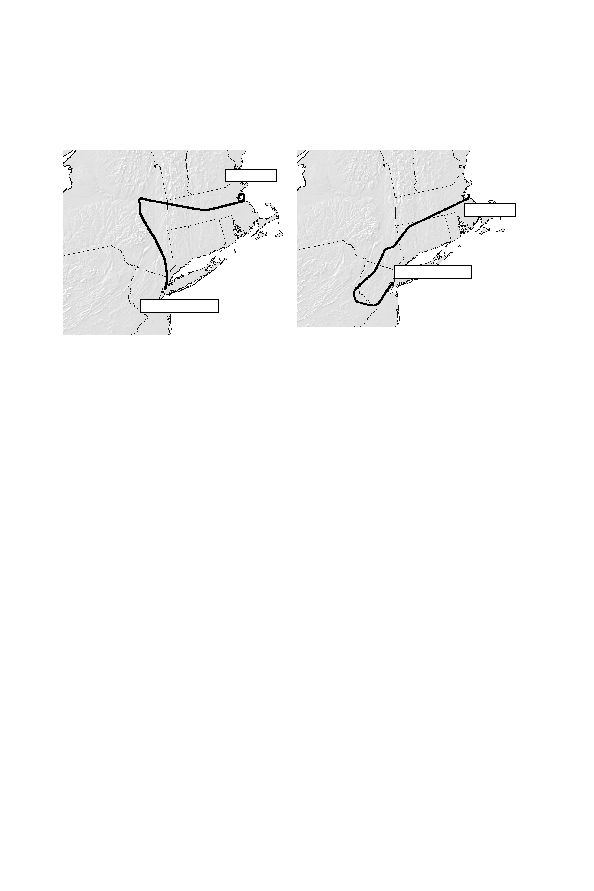
32
THE 9/11 COMMISSION REPORT
American Airlines Flight 11
(AA 11)
Boston to Los Angeles
United Airlines Flight 175
(UA 175)
Boston to Los Angeles
7:59
Takeoff
8:14
Last routine radio
communication; likely takeover
8:19
Flight attendant notifies AA of
hijacking
8:21
Transponder is turned off
8:23
AA attempts to contact the
cockpit
8:25
Boston Center aware of
hijacking
8:38
Boston Center notifies NEADS
of hijacking
8:46
NEADS scrambles Otis fighter
jets in search of AA 11
8:46:40
AA 11 crashes into 1 WTC
(North Tower)
8:53
Otis fighter jets airborne
9:16
AA headquarters aware that
Flight 11 has crashed into
WTC
9:21 Boston
Center
advises NEADS
that AA 11 is airborne heading
for Washington
9:24
NEADS scrambles Langley
fighter jets in search of
AA 11
8:14
Takeoff
8:42
Last radio communication
8:42-8:46 Likely takeover
8:47
Transponder code changes
8:52
Flight attendant notifies UA of
hijacking
8:54
UA attempts to contact the
cockpit
8:55
New York Center suspects
hijacking
9:03:11
Flight 175 crashes into 2 WTC
(South Tower)
9:15
New York Center advises
NEADS that UA 175 was the
second aircraft crashed into
WTC
9:20
UA headquarters aware that
Flight 175 had crashed into
WTC
Boston
Boston
New York City
New York City
Final1-4.4pp 7/17/04 9:12 AM Page 32
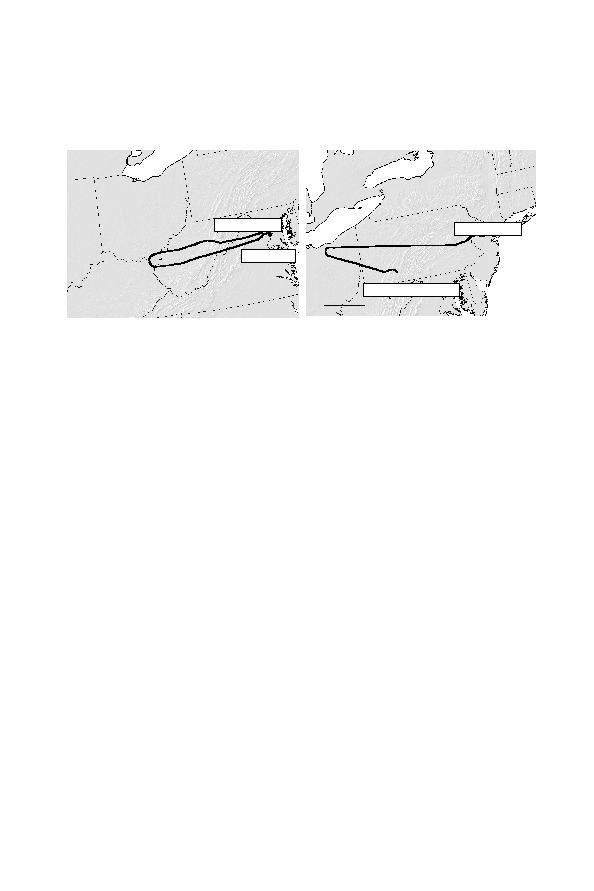
"WE HAVE SOME PLANES"
33
American Airlines Flight 77
(AA 77)
Washington, D.C., to Los Angeles
United Airlines Flight 93
(UA 93)
Newark to San Francisco
8:20
Takeoff
8:51
Last routine radio
communication
8:51-8:54 Likely takeover
8:54
Flight 77 makes unauthorized
turn to south
8:56
Transponder is turned off
9:05
AA headquarters aware that
Flight 77 is hijacked
9:25
Herndon Command Center
orders nationwide ground stop
9:32
Dulles tower observes radar of
fast-moving aircraft (later
identified as AA 77)
9:34
FAA advises NEADS that
AA 77 is missing
9:37:46
AA 77 crashes into the
Pentagon
10:30
AA headquarters confirms
Flight 77 crash into Pentagon
8:42
Takeoff
9:24
Flight 93 receives warning
from UA about possible
cockpit intrusion
9:27
Last routine radio
communication
9:28 Likely
takeover
9:34
Herndon Command Center
advises FAA headquarters that
UA 93 is hijacked
9:36
Flight attendant notifies UA of
hijacking; UA attempts to
contact the cockpit
9:41
Transponder is turned off
9:57
Passenger revolt begins
10:03:11 Flight 93 crashes in field in
Shanksville, PA
10:07
Cleveland Center advises
NEADS of UA 93 hijacking
10:15 UA
headquarters
aware
that
Flight 93 has crashed in PA;
Washington Center advises
NEADS that Flight 93 has
crashed in PA
Dulles
Newark
Shanksville, PA
Pentagon
Final1-4.4pp 7/17/04 9:12 AM Page 33

More than the actual events, inaccurate government accounts of those events
made it appear that the military was notified in time to respond to two of the
hijackings, raising questions about the adequacy of the response.Those accounts
had the effect of deflecting questions about the military's capacity to obtain
timely and accurate information from its own sources. In addition, they over-
stated the FAA's ability to provide the military with timely and useful informa-
tion that morning.
In public testimony before this Commission in May 2003, NORAD offi-
cials stated that at 9:16, NEADS received hijack notification of United 93 from
the FAA.
175
This statement was incorrect.There was no hijack to report at 9:16.
United 93 was proceeding normally at that time.
In this same public testimony, NORAD officials stated that at 9:24,
NEADS received notification of the hijacking of American 77.
176
This state-
ment was also incorrect.The notice NEADS received at 9:24 was that Amer-
ican 11 had not hit the World Trade Center and was heading for Washington,
D.C.
177
In their testimony and in other public accounts, NORAD officials also
stated that the Langley fighters were scrambled to respond to the notifications
about American 77,
178
United 93, or both.These statements were incorrect as
well.The fighters were scrambled because of the report that American 11 was
heading south, as is clear not just from taped conversations at NEADS but also
from taped conversations at FAA centers; contemporaneous logs compiled at
NEADS, Continental Region headquarters, and NORAD; and other records.
Yet this response to a phantom aircraft was not recounted in a single public
timeline or statement issued by the FAA or Department of Defense.The inac-
curate accounts created the impression that the Langley scramble was a logical
response to an actual hijacked aircraft.
In fact, not only was the scramble prompted by the mistaken information
about American 11, but NEADS never received notice that American 77 was
hijacked. It was notified at 9:34 that American 77 was lost.Then, minutes later,
NEADS was told that an unknown plane was 6 miles southwest of the White
House. Only then did the already scrambled airplanes start moving directly
toward Washington, D.C.
Thus the military did not have 14 minutes to respond to American 77, as
testimony to the Commission in May 2003 suggested. It had at most one or
two minutes to react to the unidentified plane approaching Washington, and
the fighters were in the wrong place to be able to help.They had been respond-
ing to a report about an aircraft that did not exist.
Nor did the military have 47 minutes to respond to United 93, as would be
implied by the account that it received notice of the flight's hijacking at 9:16.
By the time the military learned about the flight, it had crashed.
We now turn to the role of national leadership in the events that morning.
34
THE 9/11 COMMISSION REPORT
Final1-4.4pp 7/17/04 9:12 AM Page 34

1.3 NATIONAL CRISIS MANAGEMENT
When American 11 struck the World Trade Center at 8:46, no one in the White
House or traveling with the President knew that it had been hijacked.While
that information circulated within the FAA, we found no evidence that the
hijacking was reported to any other agency in Washington before 8:46.
179
Most federal agencies learned about the crash in New York from CNN.
180
Within the FAA, the administrator, Jane Garvey, and her acting deputy, Monte
Belger, had not been told of a confirmed hijacking before they learned from
television that a plane had crashed.
181
Others in the agency were aware of it,
as we explained earlier in this chapter.
Inside the National Military Command Center, the deputy director of oper-
ations and his assistant began notifying senior Pentagon officials of the inci-
dent. At about 9:00, the senior NMCC operations officer reached out to the
FAA operations center for information. Although the NMCC was advised of
the hijacking of American 11, the scrambling of jets was not discussed.
182
In Sarasota, Florida, the presidential motorcade was arriving at the Emma
E. Booker Elementary School, where President Bush was to read to a class and
talk about education.White House Chief of Staff Andrew Card told us he was
standing with the President outside the classroom when Senior Advisor to the
President Karl Rove first informed them that a small, twin-engine plane had
crashed into the World Trade Center.The President's reaction was that the inci-
dent must have been caused by pilot error.
183
At 8:55, before entering the classroom, the President spoke to National
Security Advisor Condoleezza Rice, who was at the White House. She recalled
first telling the President it was a twin-engine aircraft--and then a commer-
cial aircraft--that had struck the World Trade Center, adding "that's all we know
right now, Mr. President."
184
At the White House,Vice President Dick Cheney had just sat down for a
meeting when his assistant told him to turn on his television because a plane
had struck the North Tower of the World Trade Center. The Vice President was
wondering "how the hell could a plane hit the World Trade Center" when he
saw the second aircraft strike the South Tower.
185
Elsewhere in the White House, a series of 9:00 meetings was about to begin.
In the absence of information that the crash was anything other than an acci-
dent, the White House staff monitored the news as they went ahead with their
regular schedules.
186
The Agencies Confer
When they learned a second plane had struck the World Trade Center, nearly
everyone in the White House told us, they immediately knew it was not an
accident. The Secret Service initiated a number of security enhancements
"WE HAVE SOME PLANES"
35
Final1-4.4pp 7/17/04 9:12 AM Page 35

around the White House complex. The officials who issued these orders did
not know that there were additional hijacked aircraft, or that one such aircraft
was en route to Washington. These measures were precautionary steps taken
because of the strikes in New York.
187
The FAA and White House Teleconferences.
The FAA, the White House,
and the Defense Department each initiated a multiagency teleconference
before 9:30. Because none of these teleconferences--at least before 10:00--
included the right officials from both the FAA and Defense Department, none
succeeded in meaningfully coordinating the military and FAA response to the
hijackings.
At about 9:20, security personnel at FAA headquarters set up a hijacking
teleconference with several agencies, including the Defense Department.The
NMCC officer who participated told us that the call was monitored only peri-
odically because the information was sporadic,it was of little value,and there were
other important tasks. The FAA manager of the teleconference also remem-
bered that the military participated only briefly before the Pentagon was hit.
Both individuals agreed that the teleconference played no role in coordinating
a response to the attacks of 9/11.Acting Deputy Administrator Belger was frus-
trated to learn later in the morning that the military had not been on the call.
188
At the White House, the video teleconference was conducted from the Sit-
uation Room by Richard Clarke, a special assistant to the president long
involved in counterterrorism. Logs indicate that it began at 9:25 and included
the CIA; the FBI; the departments of State, Justice, and Defense; the FAA; and
the White House shelter. The FAA and CIA joined at 9:40. The first topic
addressed in the White House video teleconference--at about 9:40--was the
physical security of the President, the White House, and federal agencies.
Immediately thereafter it was reported that a plane had hit the Pentagon.We
found no evidence that video teleconference participants had any prior infor-
mation that American 77 had been hijacked and was heading directly toward
Washington. Indeed, it is not clear to us that the video teleconference was fully
under way before 9:37, when the Pentagon was struck.
189
Garvey, Belger, and other senior officials from FAA headquarters partici-
pated in this video teleconference at various times.We do not know who from
Defense participated, but we know that in the first hour none of the person-
nel involved in managing the crisis did.And none of the information conveyed
in the White House video teleconference, at least in the first hour, was being
passed to the NMCC.As one witness recalled,"[It] was almost like there were
parallel decisionmaking processes going on; one was a voice conference
orchestrated by the NMCC . . . and then there was the [White House video
teleconference]. . . . [I]n my mind they were competing venues for command
and control and decisionmaking."
190
At 10:03, the conference received reports of more missing aircraft, "2 pos-
36
THE 9/11 COMMISSION REPORT
Final1-4.4pp 7/17/04 9:12 AM Page 36

sibly 3 aloft," and learned of a combat air patrol over Washington. There was
discussion of the need for rules of engagement. Clarke reported that they were
asking the President for authority to shoot down aircraft. Confirmation of that
authority came at 10:25, but the commands were already being conveyed in
more direct contacts with the Pentagon.
191
The Pentagon Teleconferences.
Inside the National Military Command
Center, the deputy director for operations immediately thought the second
strike was a terrorist attack.The job of the NMCC in such an emergency is to
gather the relevant parties and establish the chain of command between the
National Command Authority--the president and the secretary of defense--
and those who need to carry out their orders.
192
On the morning of September 11, Secretary Rumsfeld was having break-
fast at the Pentagon with a group of members of Congress. He then returned
to his office for his daily intelligence briefing.The Secretary was informed of
the second strike in New York during the briefing; he resumed the briefing
while awaiting more information. After the Pentagon was struck, Secretary
Rumsfeld went to the parking lot to assist with rescue efforts.
193
Inside the NMCC, the deputy director for operations called for an all-
purpose "significant event" conference. It began at 9:29, with a brief recap: two
aircraft had struck the World Trade Center, there was a confirmed hijacking of
American 11, and Otis fighters had been scrambled.The FAA was asked to pro-
vide an update, but the line was silent because the FAA had not been added to
the call.A minute later, the deputy director stated that it had just been confirmed
that American 11 was still airborne and heading toward D.C. He directed the
transition to an air threat conference call. NORAD confirmed that American
11 was airborne and heading toward Washington, relaying the erroneous FAA
information already mentioned.The call then ended, at about 9:34.
194
It resumed at 9:37 as an air threat conference call,
*
which lasted more than
eight hours.The President,Vice President, Secretary of Defense,Vice Chairman
of the Joint Chiefs of Staff, and Deputy National Security Advisor Stephen
Hadley all participated in this teleconference at various times, as did military
personnel from the White House underground shelter and the President's mil-
itary aide on Air Force One.
195
Operators worked feverishly to include the FAA, but they had equipment
problems and difficulty finding secure phone numbers. NORAD asked three
times before 10:03 to confirm the presence of the FAA in the teleconference.
The FAA representative who finally joined the call at 10:17 had no familiar-
ity with or responsibility for hijackings, no access to decisionmakers, and none
of the information available to senior FAA officials.
196
"WE HAVE SOME PLANES"
37
* All times given for this conference call are estimates, which we and the Department of Defense believe to
be accurate within a ± 3 minute margin of error.
Final1-4.4pp 7/17/04 9:12 AM Page 37

We found no evidence that, at this critical time, NORAD's top command-
ers, in Florida or Cheyenne Mountain, coordinated with their counterparts at
FAA headquarters to improve awareness and organize a common response.
Lower-level officials improvised--for example, the FAA's Boston Center
bypassed the chain of command and directly contacted NEADS after the first
hijacking. But the highest-level Defense Department officials relied on the
NMCC's air threat conference, in which the FAA did not participate for the
first 48 minutes.
197
At 9:39, the NMCC's deputy director for operations, a military officer,
opened the call from the Pentagon, which had just been hit. He began:"An air
attack against North America may be in progress. NORAD, what's the situa-
tion?" NORAD said it had conflicting reports. Its latest information was "of a
possible hijacked aircraft taking off out of JFK en route to Washington D.C."
The NMCC reported a crash into the mall side of the Pentagon and requested
that the Secretary of Defense be added to the conference.
198
At 9:44, NORAD briefed the conference on the possible hijacking of Delta
1989.Two minutes later, staff reported that they were still trying to locate Sec-
retary Rumsfeld and Vice Chairman Myers. The Vice Chairman joined the
conference shortly before 10:00; the Secretary, shortly before 10:30.The Chair-
man was out of the country.
199
At 9:48, a representative from the White House shelter asked if there were
any indications of another hijacked aircraft.The deputy director for operations
mentioned the Delta flight and concluded that "that would be the fourth pos-
sible hijack." At 9:49, the commander of NORAD directed all air sovereignty
aircraft to battle stations, fully armed.
200
At 9:59, an Air Force lieutenant colonel working in the White House Mil-
itary Office joined the conference and stated he had just talked to Deputy
National Security Advisor Stephen Hadley.The White House requested (1) the
implementation of continuity of government measures, (2) fighter escorts for
Air Force One, and (3) a fighter combat air patrol over Washington, D.C.
201
By 10:03, when United 93 crashed in Pennsylvania, there had been no
mention of its hijacking and the FAA had not yet been added to the tele-
conference.
202
The President and the Vice President
The President was seated in a classroom when, at 9:05,Andrew Card whispered
to him: "A second plane hit the second tower. America is under attack." The
President told us his instinct was to project calm, not to have the country see
an excited reaction at a moment of crisis. The press was standing behind the
children; he saw their phones and pagers start to ring. The President felt he
should project strength and calm until he could better understand what was
happening.
203
The President remained in the classroom for another five to seven minutes,
38
THE 9/11 COMMISSION REPORT
Final1-4.4pp 7/17/04 9:12 AM Page 38

while the children continued reading. He then returned to a holding room
shortly before 9:15, where he was briefed by staff and saw television coverage.
He next spoke to Vice President Cheney, Dr. Rice, New York Governor George
Pataki, and FBI Director Robert Mueller. He decided to make a brief state-
ment from the school before leaving for the airport.The Secret Service told us
they were anxious to move the President to a safer location, but did not think
it imperative for him to run out the door.
204
Between 9:15 and 9:30, the staff was busy arranging a return to Washington,
while the President consulted his senior advisers about his remarks. No one in
the traveling party had any information during this time that other aircraft were
hijacked or missing. Staff was in contact with the White House Situation Room,
but as far as we could determine, no one with the President was in contact with
the Pentagon.The focus was on the President's statement to the nation.The only
decision made during this time was to return to Washington.
205
The President's motorcade departed at 9:35, and arrived at the airport
between 9:42 and 9:45. During the ride the President learned about the attack
on the Pentagon. He boarded the aircraft, asked the Secret Service about the
safety of his family, and called the Vice President. According to notes of the
call, at about 9:45 the President told the Vice President:"Sounds like we have
a minor war going on here, I heard about the Pentagon.We're at war . . . some-
body's going to pay."
206
About this time, Card, the lead Secret Service agent, the President's military
aide, and the pilot were conferring on a possible destination for Air Force One.
The Secret Service agent felt strongly that the situation in Washington was too
unstable for the President to return there, and Card agreed. The President
strongly wanted to return to Washington and only grudgingly agreed to go
elsewhere.The issue was still undecided when the President conferred with the
Vice President at about the time Air Force One was taking off. The Vice Pres-
ident recalled urging the President not to return to Washington.Air Force One
departed at about 9:54 without any fixed destination.The objective was to get
up in the air--as fast and as high as possible--and then decide where to go.
207
At 9:33, the tower supervisor at Reagan National Airport picked up a
hotline to the Secret Service and told the Service's operations center that
"an aircraft [is] coming at you and not talking with us." This was the first
specific report to the Secret Service of a direct threat to the White House.
No move was made to evacuate the Vice President at this time. As the offi-
cer who took the call explained, "[I was] about to push the alert button
when the tower advised that the aircraft was turning south and approach-
ing Reagan National Airport."
208
American 77 began turning south, away from the White House, at 9:34. It
continued heading south for roughly a minute, before turning west and begin-
ning to circle back.This news prompted the Secret Service to order the imme-
diate evacuation of the Vice President just before 9:36. Agents propelled him
"WE HAVE SOME PLANES"
39
Final1-4.4pp 7/17/04 9:12 AM Page 39

out of his chair and told him he had to get to the bunker.The Vice President
entered the underground tunnel leading to the shelter at 9:37.
209
Once inside,Vice President Cheney and the agents paused in an area of the
tunnel that had a secure phone, a bench, and television. The Vice President
asked to speak to the President, but it took time for the call to be connected.
He learned in the tunnel that the Pentagon had been hit, and he saw televi-
sion coverage of smoke coming from the building.
210
The Secret Service logged Mrs. Cheney's arrival at the White House at 9:52,
and she joined her husband in the tunnel. According to contemporaneous
notes, at 9:55 the Vice President was still on the phone with the President advis-
ing that three planes were missing and one had hit the Pentagon. We believe
this is the same call in which the Vice President urged the President not to
return to Washington. After the call ended, Mrs. Cheney and the Vice Presi-
dent moved from the tunnel to the shelter conference room.
211
United 93 and the Shootdown Order
On the morning of 9/11, the President and Vice President stayed in contact
not by an open line of communication but through a series of calls.The Pres-
ident told us he was frustrated with the poor communications that morning.
He could not reach key officials, including Secretary Rumsfeld, for a period of
time.The line to the White House shelter conference room--and the Vice Pres-
ident--kept cutting off.
212
The Vice President remembered placing a call to the President just after
entering the shelter conference room. There is conflicting evidence about
when the Vice President arrived in the shelter conference room.We have con-
cluded, from the available evidence, that the Vice President arrived in the room
shortly before 10:00, perhaps at 9:58.The Vice President recalled being told, just
after his arrival, that the Air Force was trying to establish a combat air patrol
over Washington.
213
The Vice President stated that he called the President to discuss the rules of
engagement for the CAP. He recalled feeling that it did no good to establish
the CAP unless the pilots had instructions on whether they were authorized
to shoot if the plane would not divert. He said the President signed off on that
concept. The President said he remembered such a conversation, and that it
reminded him of when he had been an interceptor pilot.The President empha-
sized to us that he had authorized the shootdown of hijacked aircraft.
214
The Vice President's military aide told us he believed the Vice President
spoke to the President just after entering the conference room, but he did not
hear what they said. Rice, who entered the room shortly after the Vice Presi-
dent and sat next to him, remembered hearing him inform the President,"Sir,
the CAPs are up. Sir, they're going to want to know what to do." Then she
recalled hearing him say, "Yes sir." She believed this conversation occurred a
few minutes, perhaps five, after they entered the conference room.
215
We believe this call would have taken place sometime before 10:10 to 10:15.
40
THE 9/11 COMMISSION REPORT
Final1-4.4pp 7/17/04 9:12 AM Page 40

Among the sources that reflect other important events of that morning, there
is no documentary evidence for this call, but the relevant sources are incom-
plete. Others nearby who were taking notes, such as the Vice President's chief
of staff, Scooter Libby, who sat next to him, and Mrs. Cheney, did not note a
call between the President and Vice President immediately after the Vice Pres-
ident entered the conference room.
216
At 10:02, the communicators in the shelter began receiving reports from
the Secret Service of an inbound aircraft--presumably hijacked--heading
toward Washington.That aircraft was United 93.The Secret Service was get-
ting this information directly from the FAA.The FAA may have been track-
ing the progress of United 93 on a display that showed its projected path to
Washington, not its actual radar return.Thus, the Secret Service was relying on
projections and was not aware the plane was already down in Pennsylvania.
217
At some time between 10:10 and 10:15, a military aide told the Vice Pres-
ident and others that the aircraft was 80 miles out. Vice President Cheney was
asked for authority to engage the aircraft.
218
His reaction was described by
Scooter Libby as quick and decisive, "in about the time it takes a batter to
decide to swing." The Vice President authorized fighter aircraft to engage the
inbound plane. He told us he based this authorization on his earlier conversa-
tion with the President.The military aide returned a few minutes later, proba-
bly between 10:12 and 10:18, and said the aircraft was 60 miles out. He again
asked for authorization to engage.The Vice President again said yes.
219
At the conference room table was White House Deputy Chief of Staff
Joshua Bolten. Bolten watched the exchanges and, after what he called "a quiet
moment," suggested that the Vice President get in touch with the President and
confirm the engage order. Bolten told us he wanted to make sure the Presi-
dent was told that the Vice President had executed the order. He said he had
not heard any prior discussion on the subject with the President.
220
The Vice President was logged calling the President at 10:18 for a two-
minute conversation that obtained the confirmation. On Air Force One, the
President's press secretary was taking notes; Ari Fleischer recorded that at
10:20, the President told him that he had authorized a shootdown of aircraft
if necessary.
221
Minutes went by and word arrived of an aircraft down in Pennsylvania.
Those in the shelter wondered if the aircraft had been shot down pursuant to
this authorization.
222
At approximately 10:30, the shelter started receiving reports of another
hijacked plane, this time only 5 to 10 miles out. Believing they had only a
minute or two, the Vice President again communicated the authorization to
"engage or "take out" the aircraft. At 10:33, Hadley told the air threat confer-
ence call: "I need to get word to Dick Myers that our reports are there's an
inbound aircraft flying low 5 miles out.The Vice President's guidance was we
need to take them out."
223
Once again, there was no immediate information about the fate of the
"WE HAVE SOME PLANES"
41
Final1-4.4pp 7/17/04 9:12 AM Page 41

inbound aircraft. In the apt description of one witness,"It drops below the radar
screen and it's just continually hovering in your imagination; you don't know
where it is or what happens to it." Eventually, the shelter received word that
the alleged hijacker 5 miles away had been a medevac helicopter.
224
Transmission of the Authorization from the White House
to the Pilots
The NMCC learned of United 93's hijacking at about 10:03.At this time the
FAA had no contact with the military at the level of national command.The
NMCC learned about United 93 from the White House. It, in turn, was
informed by the Secret Service's contacts with the FAA.
225
NORAD had no information either. At 10:07, its representative on the air
threat conference call stated that NORAD had "no indication of a hijack head-
ing to DC at this time."
226
Repeatedly between 10:14 and 10:19, a lieutenant colonel at the White
House relayed to the NMCC that the Vice President had confirmed fighters
were cleared to engage inbound aircraft if they could verify that the aircraft
was hijacked.
227
The commander of NORAD, General Ralph Eberhart, was en route to the
NORAD operations center in Cheyenne Mountain, Colorado, when the
shootdown order was communicated on the air threat conference call. He told
us that by the time he arrived, the order had already been passed down
NORAD's chain of command.
228
It is not clear how the shootdown order was communicated within
NORAD. But we know that at 10:31, General Larry Arnold instructed his staff
to broadcast the following over a NORAD instant messaging system: "10:31
Vice president has cleared to us to intercept tracks of interest and shoot them
down if they do not respond per [General Arnold]."
229
In upstate New York, NEADS personnel first learned of the shootdown
order from this message:
Floor Leadership:
You need to read this. . . .The Region Commander
has declared that we can shoot down aircraft that do not respond to
our direction. Copy that?
Controllers:
Copy that, sir.
Floor Leadership:
So if you're trying to divert somebody and he won't
divert--
Controllers:
DO [Director of Operations] is saying no.
Floor Leadership:
No? It came over the chat. . . .You got a conflict on
that direction?
Controllers:
Right now no, but--
Floor Leadership:
Okay? Okay, you read that from the Vice President,
right? Vice President has cleared. Vice President has cleared us to
42
THE 9/11 COMMISSION REPORT
Final1-4.4pp 7/17/04 9:12 AM Page 42

intercept traffic and shoot them down if they do not respond per
[General Arnold].
230
In interviews with us, NEADS personnel expressed considerable confusion
over the nature and effect of the order.
The NEADS commander told us he did not pass along the order because
he was unaware of its ramifications. Both the mission commander and the sen-
ior weapons director indicated they did not pass the order to the fighters cir-
cling Washington and New York because they were unsure how the pilots
would, or should, proceed with this guidance. In short, while leaders in
Washington believed that the fighters above them had been instructed to "take
out" hostile aircraft, the only orders actually conveyed to the pilots were to "ID
type and tail."
231
In most cases, the chain of command authorizing the use of force runs from
the president to the secretary of defense and from the secretary to the combat-
ant commander.The President apparently spoke to Secretary Rumsfeld for the
first time that morning shortly after 10:00. No one can recall the content of this
conversation, but it was a brief call in which the subject of shootdown author-
ity was not discussed.
232
At 10:39, the Vice President updated the Secretary on the air threat
conference:
Vice President:
There's been at least three instances here where we've
had reports of aircraft approaching Washington--a couple were con-
firmed hijack. And, pursuant to the President's instructions I gave
authorization for them to be taken out. Hello?
SecDef:
Yes, I understand.Who did you give that direction to?
Vice President:
It was passed from here through the [operations] cen-
ter at the White House, from the [shelter].
SecDef:
OK, let me ask the question here. Has that directive been trans-
mitted to the aircraft?
Vice President:
Yes, it has.
SecDef:
So we've got a couple of aircraft up there that have those
instructions at this present time?
Vice President:
That is correct. And it's my understanding they've
already taken a couple of aircraft out.
SecDef:
We can't confirm that.We're told that one aircraft is down but
we do not have a pilot report that did it.
233
As this exchange shows, Secretary Rumsfeld was not in the NMCC when
the shootdown order was first conveyed. He went from the parking lot to his
office (where he spoke to the President), then to the Executive Support Cen-
ter, where he participated in the White House video teleconference. He moved
"WE HAVE SOME PLANES"
43
Final1-4.4pp 7/17/04 9:12 AM Page 43

to the NMCC shortly before 10:30, in order to join Vice Chairman Myers.
Secretary Rumsfeld told us he was just gaining situational awareness when he
spoke with the Vice President at 10:39. His primary concern was ensuring that
the pilots had a clear understanding of their rules of engagement.
234
The Vice President was mistaken in his belief that shootdown authorization
had been passed to the pilots flying at NORAD's direction. By 10:45 there was,
however, another set of fighters circling Washington that had entirely different
rules of engagement.These fighters, part of the 113th Wing of the District of
Columbia Air National Guard, launched out of Andrews Air Force Base in
Maryland in response to information passed to them by the Secret Service.The
first of the Andrews fighters was airborne at 10:38.
235
General David Wherley--the commander of the 113th Wing--reached out
to the Secret Service after hearing secondhand reports that it wanted fighters
airborne. A Secret Service agent had a phone in each ear, one connected to
Wherley and the other to a fellow agent at the White House, relaying instruc-
tions that the White House agent said he was getting from the Vice President.
The guidance for Wherley was to send up the aircraft, with orders to protect
the White House and take out any aircraft that threatened the Capitol. Gen-
eral Wherley translated this in military terms to flying "weapons free"--that is,
the decision to shoot rests in the cockpit, or in this case in the cockpit of the
lead pilot. He passed these instructions to the pilots that launched at 10:42 and
afterward.
236
Thus, while the fighter pilots under NORAD direction who had scram-
bled out of Langley never received any type of engagement order, the Andrews
pilots were operating weapons free--a permissive rule of engagement. The
President and the Vice President indicated to us they had not been aware that
fighters had been scrambled out of Andrews, at the request of the Secret Ser-
vice and outside the military chain of command.
237
There is no evidence that
NORAD headquarters or military officials in the NMCC knew--during the
morning of September 11--that the Andrews planes were airborne and oper-
ating under different rules of engagement.
What If ?
NORAD officials have maintained consistently that had the passengers not
caused United 93 to crash, the military would have prevented it from reach-
ing Washington, D.C.That conclusion is based on a version of events that we
now know is incorrect.The Langley fighters were not scrambled in response
to United 93; NORAD did not have 47 minutes to intercept the flight;
NORAD did not even know the plane was hijacked until after it had crashed.
It is appropriate, therefore, to reconsider whether United 93 would have been
intercepted.
Had it not crashed in Pennsylvania at 10:03, we estimate that United 93
44
THE 9/11 COMMISSION REPORT
Final1-4.4pp 7/17/04 9:12 AM Page 44

could not have reached Washington any earlier than 10:13, and probably would
have arrived before 10:23.There was only one set of fighters circling Washing-
ton during that time frame--the Langley F-16s.They were armed and under
NORAD's control.After NEADS learned of the hijacking at 10:07, NORAD
would have had from 6 to 16 minutes to locate the flight, receive authoriza-
tion to shoot it down, and communicate the order to the pilots, who (in the
same span) would have had to authenticate the order, intercept the flight, and
execute the order.
238
At that point in time, the Langley pilots did not know the threat they were
facing, did not know where United 93 was located, and did not have shoot-
down authorization.
First, the Langley pilots were never briefed about the reason they were
scrambled.As the lead pilot explained,"I reverted to the Russian threat. . . . I'm
thinking cruise missile threat from the sea.You know you look down and see
the Pentagon burning and I thought the bastards snuck one by us. . . . [Y]ou
couldn't see any airplanes, and no one told us anything."The pilots knew their
mission was to divert aircraft, but did not know that the threat came from
hijacked airliners.
239
Second, NEADS did not have accurate information on the location of
United 93. Presumably FAA would have provided such information, but we
do not know how long that would have taken, nor how long it would have
taken NEADS to locate the target.
Third, NEADS needed orders to pass to the pilots.At 10:10, the pilots over
Washington were emphatically told,"negative clearance to shoot." Shootdown
authority was first communicated to NEADS at 10:31. It is possible that
NORAD commanders would have ordered a shootdown in the absence of the
authorization communicated by the Vice President, but given the gravity of the
decision to shoot down a commercial airliner, and NORAD's caution that a
mistake not be made, we view this possibility as unlikely.
240
NORAD officials have maintained that they would have intercepted and
shot down United 93.We are not so sure.We are sure that the nation owes a
debt to the passengers of United 93.Their actions saved the lives of countless
others, and may have saved either the Capitol or the White House from
destruction.
The details of what happened on the morning of September 11 are com-
plex, but they play out a simple theme. NORAD and the FAA were unpre-
pared for the type of attacks launched against the United States on September
11, 2001.They struggled, under difficult circumstances, to improvise a home-
land defense against an unprecedented challenge they had never before
encountered and had never trained to meet.
At 10:02 that morning, an assistant to the mission crew commander at
NORAD's Northeast Air Defense Sector in Rome, New York, was working
"WE HAVE SOME PLANES"
45
Final1-4.4pp 7/17/04 9:12 AM Page 45

with his colleagues on the floor of the command center. In a brief moment of
reflection, he was recorded remarking that "This is a new type of war."
241
He was, and is, right. But the conflict did not begin on 9/11. It had been
publicly declared years earlier, most notably in a declaration faxed early in 1998
to an Arabic-language newspaper in London. Few Americans had noticed it.
The fax had been sent from thousands of miles away by the followers of a Saudi
exile gathered in one of the most remote and impoverished countries on earth.
46
THE 9/11 COMMISSION REPORT
Final1-4.4pp 7/17/04 9:12 AM Page 46

2
THE FOUNDATION OF
THE NEW TERRORISM
47
2.1 A DECLARATION OF WAR
In February 1998, the 40-year-old Saudi exile Usama Bin Ladin and a fugitive
Egyptian physician,Ayman al Zawahiri, arranged from their Afghan headquar-
ters for an Arabic newspaper in London to publish what they termed a fatwa
issued in the name of a "World Islamic Front." A fatwa is normally an inter-
pretation of Islamic law by a respected Islamic authority, but neither Bin Ladin,
Zawahiri, nor the three others who signed this statement were scholars of
Islamic law. Claiming that America had declared war against God and his mes-
senger, they called for the murder of any American, anywhere on earth, as the
"individual duty for every Muslim who can do it in any country in which it
is possible to do it."
1
Three months later, when interviewed in Afghanistan by ABC-TV, Bin
Ladin enlarged on these themes.
2
He claimed it was more important for Mus-
lims to kill Americans than to kill other infidels."It is far better for anyone to
kill a single American soldier than to squander his efforts on other activities,"
he said.Asked whether he approved of terrorism and of attacks on civilians, he
replied: "We believe that the worst thieves in the world today and the worst
terrorists are the Americans. Nothing could stop you except perhaps retalia-
tion in kind. We do not have to differentiate between military or civilian. As
far as we are concerned, they are all targets."
Note: Islamic names often do not follow the Western practice of the consistent use of surnames. Given the variety of names we
mention, we chose to refer to individuals by the last word in the names by which they are known: Nawaf al Hazmi as Hazmi,
for instance, omitting the article "al" that would be part of their name in their own societies.We generally make an exception for
the more familiar English usage of "Bin" as part of a last name, as in Bin Ladin. Further, there is no universally accepted way
to transliterate Arabic words and names into English.We have relied on a mix of common sense, the sound of the name in Ara-
bic, and common usage in source materials, the press, or government documents.When we quote from a source document, we use
its transliteration, e.g.,"al Qida" instead of al Qaeda.
Final1-4.4pp 7/17/04 9:12 AM Page 47

Though novel for its open endorsement of indiscriminate killing, Bin
Ladin's 1998 declaration was only the latest in the long series of his public and
private calls since 1992 that singled out the United States for attack.
In August 1996, Bin Ladin had issued his own self-styled fatwa calling on
Muslims to drive American soldiers out of Saudi Arabia.The long, disjointed
document condemned the Saudi monarchy for allowing the presence of an
army of infidels in a land with the sites most sacred to Islam, and celebrated
recent suicide bombings of American military facilities in the Kingdom. It
praised the 1983 suicide bombing in Beirut that killed 241 U.S. Marines, the
1992 bombing in Aden, and especially the 1993 firefight in Somalia after which
the United States "left the area carrying disappointment, humiliation, defeat
and your dead with you."
3
Bin Ladin said in his ABC interview that he and his followers had been
preparing in Somalia for another long struggle, like that against the Soviets in
Afghanistan, but "the United States rushed out of Somalia in shame and dis-
grace." Citing the Soviet army's withdrawal from Afghanistan as proof that a
ragged army of dedicated Muslims could overcome a superpower, he told the
interviewer: "We are certain that we shall--with the grace of Allah--prevail
over the Americans." He went on to warn that "If the present injustice contin-
ues . . . , it will inevitably move the battle to American soil."
4
Plans to attack the United States were developed with unwavering single-
mindedness throughout the 1990s. Bin Ladin saw himself as called "to follow
in the footsteps of the Messenger and to communicate his message to all
nations,"
5
and to serve as the rallying point and organizer of a new kind of war
to destroy America and bring the world to Islam.
2.2 BIN LADIN'S APPEAL IN THE ISLAMIC WORLD
It is the story of eccentric and violent ideas sprouting in the fertile ground
of political and social turmoil. It is the story of an organization poised to seize
its historical moment. How did Bin Ladin--with his call for the indiscrimi-
nate killing of Americans--win thousands of followers and some degree of
approval from millions more?
The history, culture, and body of beliefs from which Bin Ladin has shaped
and spread his message are largely unknown to many Americans. Seizing on
symbols of Islam's past greatness, he promises to restore pride to people who
consider themselves the victims of successive foreign masters. He uses cultural
and religious allusions to the holy Qur'an and some of its interpreters. He
appeals to people disoriented by cyclonic change as they confront modernity
and globalization. His rhetoric selectively draws from multiple sources--Islam,
history, and the region's political and economic malaise. He also stresses griev-
ances against the United States widely shared in the Muslim world. He
48
THE 9/11 COMMISSION REPORT
Final1-4.4pp 7/17/04 9:12 AM Page 48
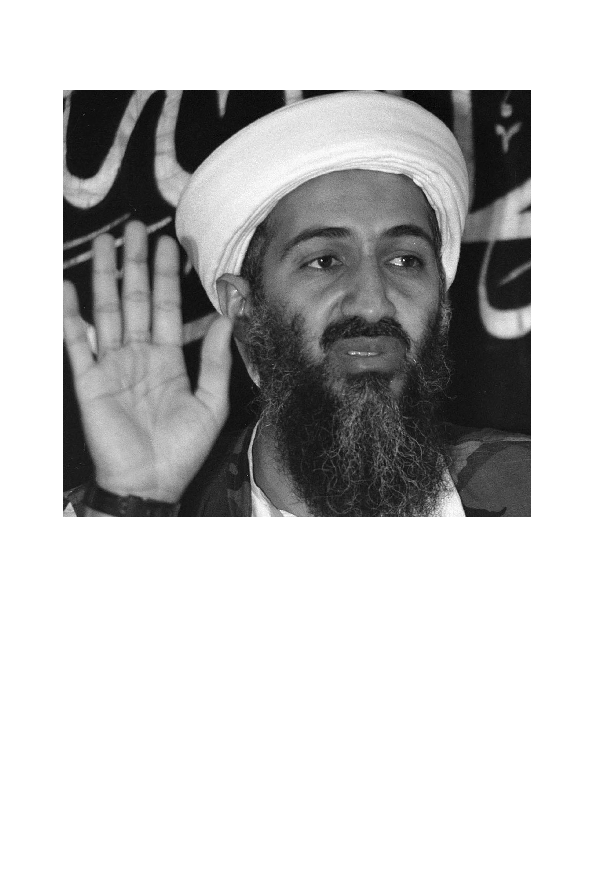
inveighed against the presence of U.S. troops in Saudi Arabia, the home of
Islam's holiest sites. He spoke of the suffering of the Iraqi people as a result of
sanctions imposed after the Gulf War, and he protested U.S. support of Israel.
Islam
Islam (a word that literally means "surrender to the will of God") arose in Ara-
bia with what Muslims believe are a series of revelations to the Prophet
Mohammed from the one and only God, the God of Abraham and of Jesus.
These revelations, conveyed by the angel Gabriel, are recorded in the Qur'an.
Muslims believe that these revelations, given to the greatest and last of a chain
of prophets stretching from Abraham through Jesus, complete God's message
to humanity. The Hadith, which recount Mohammed's sayings and deeds as
recorded by his contemporaries, are another fundamental source. A third key
element is the Sharia, the code of law derived from the Qur'an and the Hadith.
Islam is divided into two main branches, Sunni and Shia. Soon after the
THE FOUNDATION OF THE NEW TERRORISM
49
Usama Bin Ladin at a news conference in Afghanistan in 1998
©Reuters 2004
Final1-4.4pp 7/17/04 9:12 AM Page 49

Prophet's death, the question of choosing a new leader, or caliph, for the Mus-
lim community, or Ummah, arose. Initially, his successors could be drawn from
the Prophet's contemporaries, but with time, this was no longer possible.Those
who became the Shia held that any leader of the Ummah must be a direct
descendant of the Prophet; those who became the Sunni argued that lineal
descent was not required if the candidate met other standards of faith and
knowledge.After bloody struggles, the Sunni became (and remain) the major-
ity sect. (The Shia are dominant in Iran.) The Caliphate--the institutionalized
leadership of the Ummah--thus was a Sunni institution that continued until
1924, first under Arab and eventually under Ottoman Turkish control.
Many Muslims look back at the century after the revelations to the Prophet
Mohammed as a golden age. Its memory is strongest among the Arabs.What
happened then--the spread of Islam from the Arabian Peninsula throughout
the Middle East, North Africa, and even into Europe within less than a cen-
tury--seemed, and seems, miraculous.
6
Nostalgia for Islam's past glory remains
a powerful force.
Islam is both a faith and a code of conduct for all aspects of life. For many
Muslims, a good government would be one guided by the moral principles of
their faith.This does not necessarily translate into a desire for clerical rule and
the abolition of a secular state. It does mean that some Muslims tend to be
uncomfortable with distinctions between religion and state, though Muslim
rulers throughout history have readily separated the two.
To extremists, however, such divisions, as well as the existence of parliaments
and legislation, only prove these rulers to be false Muslims usurping God's
authority over all aspects of life. Periodically, the Islamic world has seen surges
of what, for want of a better term, is often labeled "fundamentalism."
7
Denouncing waywardness among the faithful, some clerics have appealed for
a return to observance of the literal teachings of the Qur'an and Hadith. One
scholar from the fourteenth century from whom Bin Ladin selectively quotes,
Ibn Taimiyyah, condemned both corrupt rulers and the clerics who failed to
criticize them. He urged Muslims to read the Qur'an and the Hadith for them-
selves, not to depend solely on learned interpreters like himself but to hold one
another to account for the quality of their observance.
8
The extreme Islamist version of history blames the decline from Islam's
golden age on the rulers and people who turned away from the true path of
their religion, thereby leaving Islam vulnerable to encroaching foreign powers
eager to steal their land, wealth, and even their souls.
Bin Ladin's Worldview
Despite his claims to universal leadership, Bin Ladin offers an extreme view of
Islamic history designed to appeal mainly to Arabs and Sunnis. He draws on
fundamentalists who blame the eventual destruction of the Caliphate on lead-
ers who abandoned the pure path of religious devotion.
9
He repeatedly calls
on his followers to embrace martyrdom since "the walls of oppression and
50
THE 9/11 COMMISSION REPORT
Final1-4.4pp 7/17/04 9:12 AM Page 50

humiliation cannot be demolished except in a rain of bullets."
10
For those
yearning for a lost sense of order in an older, more tranquil world, he offers his
"Caliphate" as an imagined alternative to today's uncertainty. For others, he
offers simplistic conspiracies to explain their world.
Bin Ladin also relies heavily on the Egyptian writer Sayyid Qutb. A mem-
ber of the Muslim Brotherhood
11
executed in 1966 on charges of attempting
to overthrow the government, Qutb mixed Islamic scholarship with a very
superficial acquaintance with Western history and thought. Sent by the Egypt-
ian government to study in the United States in the late 1940s, Qutb returned
with an enormous loathing of Western society and history. He dismissed West-
ern achievements as entirely material, arguing that Western society possesses
"nothing that will satisfy its own conscience and justify its existence."
12
Three basic themes emerge from Qutb's writings. First, he claimed that the
world was beset with barbarism, licentiousness, and unbelief (a condition he
called jahiliyya, the religious term for the period of ignorance prior to the rev-
elations given to the Prophet Mohammed). Qutb argued that humans can
choose only between Islam and jahiliyya. Second, he warned that more peo-
ple, including Muslims, were attracted to jahiliyya and its material comforts
than to his view of Islam; jahiliyya could therefore triumph over Islam.Third,
no middle ground exists in what Qutb conceived as a struggle between God
and Satan. All Muslims--as he defined them--therefore must take up arms in
this fight.Any Muslim who rejects his ideas is just one more nonbeliever wor-
thy of destruction.
13
Bin Ladin shares Qutb's stark view, permitting him and his followers to
rationalize even unprovoked mass murder as righteous defense of an embattled
faith. Many Americans have wondered,"Why do `they' hate us?" Some also ask,
"What can we do to stop these attacks?"
Bin Ladin and al Qaeda have given answers to both these questions.To the
first, they say that America had attacked Islam; America is responsible for all
conflicts involving Muslims. Thus Americans are blamed when Israelis fight
with Palestinians, when Russians fight with Chechens, when Indians fight with
Kashmiri Muslims, and when the Philippine government fights ethnic Mus-
lims in its southern islands.America is also held responsible for the governments
of Muslim countries, derided by al Qaeda as "your agents." Bin Ladin has stated
flatly,"Our fight against these governments is not separate from our fight against
you."
14
These charges found a ready audience among millions of Arabs and
Muslims angry at the United States because of issues ranging from Iraq to Pales-
tine to America's support for their countries' repressive rulers.
Bin Ladin's grievance with the United States may have started in reaction
to specific U.S. policies but it quickly became far deeper.To the second ques-
tion, what America could do, al Qaeda's answer was that America should aban-
don the Middle East, convert to Islam, and end the immorality and godlessness
of its society and culture:"It is saddening to tell you that you are the worst civ-
ilization witnessed by the history of mankind." If the United States did not
THE FOUNDATION OF THE NEW TERRORISM
51
Final1-4.4pp 7/17/04 9:12 AM Page 51

comply, it would be at war with the Islamic nation, a nation that al Qaeda's
leaders said "desires death more than you desire life."
15
History and Political Context
Few fundamentalist movements in the Islamic world gained lasting political
power. In the nineteenth and twentieth centuries, fundamentalists helped artic-
ulate anticolonial grievances but played little role in the overwhelmingly sec-
ular struggles for independence after World War I.Western-educated lawyers,
soldiers, and officials led most independence movements, and clerical influence
and traditional culture were seen as obstacles to national progress.
After gaining independence from Western powers following World War II,
the Arab Middle East followed an arc from initial pride and optimism to today's
mix of indifference, cynicism, and despair. In several countries, a dynastic state
already existed or was quickly established under a paramount tribal family.
Monarchies in countries such as Saudi Arabia, Morocco, and Jordan still sur-
vive today.Those in Egypt, Libya, Iraq, and Yemen were eventually overthrown
by secular nationalist revolutionaries.
The secular regimes promised a glowing future, often tied to sweeping ide-
ologies (such as those promoted by Egyptian President Gamal Abdel Nasser's
Arab Socialism or the Ba'ath Party of Syria and Iraq) that called for a single,
secular Arab state. However, what emerged were almost invariably autocratic
regimes that were usually unwilling to tolerate any opposition--even in coun-
tries, such as Egypt, that had a parliamentary tradition. Over time, their poli-
cies--repression, rewards, emigration, and the displacement of popular anger
onto scapegoats (generally foreign)--were shaped by the desire to cling to
power.
The bankruptcy of secular, autocratic nationalism was evident across the
Muslim world by the late 1970s.At the same time, these regimes had closed off
nearly all paths for peaceful opposition, forcing their critics to choose silence,
exile, or violent opposition. Iran's 1979 revolution swept a Shia theocracy into
power. Its success encouraged Sunni fundamentalists elsewhere.
In the 1980s, awash in sudden oil wealth, Saudi Arabia competed with Shia
Iran to promote its Sunni fundamentalist interpretation of Islam,Wahhabism.
The Saudi government, always conscious of its duties as the custodian of Islam's
holiest places, joined with wealthy Arabs from the Kingdom and other states
bordering the Persian Gulf in donating money to build mosques and religious
schools that could preach and teach their interpretation of Islamic doctrine.
In this competition for legitimacy, secular regimes had no alternative to
offer. Instead, in a number of cases their rulers sought to buy off local Islamist
movements by ceding control of many social and educational issues. Embold-
ened rather than satisfied, the Islamists continued to push for power--a trend
especially clear in Egypt. Confronted with a violent Islamist movement that
killed President Anwar Sadat in 1981, the Egyptian government combined
52
THE 9/11 COMMISSION REPORT
Final1-4.4pp 7/17/04 9:12 AM Page 52

harsh repression of Islamic militants with harassment of moderate Islamic schol-
ars and authors, driving many into exile. In Pakistan, a military regime sought
to justify its seizure of power by a pious public stance and an embrace of
unprecedented Islamist influence on education and society.
These experiments in political Islam faltered during the 1990s: the Iranian
revolution lost momentum, prestige, and public support, and Pakistan's rulers
found that most of its population had little enthusiasm for fundamentalist Islam.
Islamist revival movements gained followers across the Muslim world, but failed
to secure political power except in Iran and Sudan. In Algeria, where in 1991
Islamists seemed almost certain to win power through the ballot box, the mili-
tary preempted their victory, triggering a brutal civil war that continues today.
Opponents of today's rulers have few, if any, ways to participate in the existing
political system. They are thus a ready audience for calls to Muslims to purify
their society, reject unwelcome modernization, and adhere strictly to the Sharia.
Social and Economic Malaise
In the 1970s and early 1980s, an unprecedented flood of wealth led the then
largely unmodernized oil states to attempt to shortcut decades of development.
They funded huge infrastructure projects, vastly expanded education, and cre-
ated subsidized social welfare programs. These programs established a wide-
spread feeling of entitlement without a corresponding sense of social
obligations. By the late 1980s, diminishing oil revenues, the economic drain
from many unprofitable development projects, and population growth made
these entitlement programs unsustainable.The resulting cutbacks created enor-
mous resentment among recipients who had come to see government largesse
as their right.This resentment was further stoked by public understanding of
how much oil income had gone straight into the pockets of the rulers, their
friends, and their helpers.
Unlike the oil states (or Afghanistan, where real economic development has
barely begun), the other Arab nations and Pakistan once had seemed headed
toward balanced modernization. The established commercial, financial, and
industrial sectors in these states, supported by an entrepreneurial spirit and
widespread understanding of free enterprise, augured well. But unprofitable
heavy industry, state monopolies, and opaque bureaucracies slowly stifled
growth. More importantly, these state-centered regimes placed their highest
priority on preserving the elite's grip on national wealth. Unwilling to foster
dynamic economies that could create jobs attractive to educated young men,
the countries became economically stagnant and reliant on the safety valve of
worker emigration either to the Arab oil states or to the West. Furthermore,
the repression and isolation of women in many Muslim countries have not only
seriously limited individual opportunity but also crippled overall economic
productivity.
16
By the 1990s, high birthrates and declining rates of infant mortality had
THE FOUNDATION OF THE NEW TERRORISM
53
Final1-4.4pp 7/17/04 9:12 AM Page 53

produced a common problem throughout the Muslim world: a large, steadily
increasing population of young men without any reasonable expectation of
suitable or steady employment--a sure prescription for social turbulence. Many
of these young men, such as the enormous number trained only in religious
schools, lacked the skills needed by their societies. Far more acquired valuable
skills but lived in stagnant economies that could not generate satisfying jobs.
Millions, pursuing secular as well as religious studies, were products of edu-
cational systems that generally devoted little if any attention to the rest of the
world's thought, history, and culture.The secular education reflected a strong
cultural preference for technical fields over the humanities and social sciences.
Many of these young men, even if able to study abroad, lacked the perspective
and skills needed to understand a different culture.
Frustrated in their search for a decent living, unable to benefit from an edu-
cation often obtained at the cost of great family sacrifice, and blocked from
starting families of their own, some of these young men were easy targets for
radicalization.
Bin Ladin's Historical Opportunity
Most Muslims prefer a peaceful and inclusive vision of their faith, not the
violent sectarianism of Bin Ladin.Among Arabs, Bin Ladin's followers are com-
monly nicknamed takfiri, or "those who define other Muslims as unbelievers,"
because of their readiness to demonize and murder those with whom they dis-
agree. Beyond the theology lies the simple human fact that most Muslims, like
most other human beings, are repelled by mass murder and barbarism what-
ever their justification.
"All Americans must recognize that the face of terror is not the true face of
Islam," President Bush observed. "Islam is a faith that brings comfort to a bil-
lion people around the world. It's a faith that has made brothers and sisters of
every race. It's a faith based upon love, not hate."
17
Yet as political, social, and
economic problems created flammable societies, Bin Ladin used Islam's most
extreme, fundamentalist traditions as his match.All these elements--including
religion--combined in an explosive compound.
Other extremists had, and have, followings of their own. But in appealing
to societies full of discontent, Bin Ladin remained credible as other leaders and
symbols faded. He could stand as a symbol of resistance--above all, resistance
to the West and to America. He could present himself and his allies as victori-
ous warriors in the one great successful experience for Islamic militancy in the
1980s: the Afghan jihad against the Soviet occupation.
By 1998, Bin Ladin had a distinctive appeal, as he focused on attacking
America. He argued that other extremists, who aimed at local rulers or Israel,
did not go far enough.They had not taken on what he called "the head of the
snake."
18
54
THE 9/11 COMMISSION REPORT
Final1-4.4pp 7/17/04 9:12 AM Page 54

Finally, Bin Ladin had another advantage: a substantial, worldwide organi-
zation. By the time he issued his February 1998 declaration of war, Bin Ladin
had nurtured that organization for nearly ten years. He could attract, train, and
use recruits for ever more ambitious attacks, rallying new adherents with each
demonstration that his was the movement of the future.
2.3 THE RISE OF BIN LADIN AND AL QAEDA (19881992)
A decade of conflict in Afghanistan, from 1979 to 1989, gave Islamist extrem-
ists a rallying point and training field.A Communist government in Afghanistan
gained power in 1978 but was unable to establish enduring control.At the end
of 1979, the Soviet government sent in military units to ensure that the coun-
try would remain securely under Moscow's influence. The response was an
Afghan national resistance movement that defeated Soviet forces.
19
Young Muslims from around the world flocked to Afghanistan to join as vol-
unteers in what was seen as a "holy war"--jihad--against an invader.The largest
numbers came from the Middle East. Some were Saudis, and among them was
Usama Bin Ladin.
Twenty-three when he arrived in Afghanistan in 1980, Bin Ladin was the
seventeenth of 57 children of a Saudi construction magnate. Six feet five and
thin, Bin Ladin appeared to be ungainly but was in fact quite athletic, skilled
as a horseman, runner, climber, and soccer player. He had attended Abdul Aziz
University in Saudi Arabia. By some accounts, he had been interested there in
religious studies, inspired by tape recordings of fiery sermons by Abdullah
Azzam, a Palestinian and a disciple of Qutb. Bin Ladin was conspicuous among
the volunteers not because he showed evidence of religious learning but
because he had access to some of his family's huge fortune. Though he took
part in at least one actual battle, he became known chiefly as a person who gen-
erously helped fund the anti-Soviet jihad.
20
Bin Ladin understood better than most of the volunteers the extent to
which the continuation and eventual success of the jihad in Afghanistan
depended on an increasingly complex, almost worldwide organization. This
organization included a financial support network that came to be known as
the "Golden Chain," put together mainly by financiers in Saudi Arabia and the
Persian Gulf states. Donations flowed through charities or other nongovern-
mental organizations (NGOs). Bin Ladin and the "Afghan Arabs" drew largely
on funds raised by this network, whose agents roamed world markets to buy
arms and supplies for the mujahideen, or "holy warriors."
21
Mosques, schools, and boardinghouses served as recruiting stations in many
parts of the world, including the United States. Some were set up by Islamic
extremists or their financial backers. Bin Ladin had an important part in this
THE FOUNDATION OF THE NEW TERRORISM
55
Final1-4.4pp 7/17/04 9:12 AM Page 55

activity. He and the cleric Azzam had joined in creating a "Bureau of Services"
(Mektab al Khidmat, or MAK), which channeled recruits into Afghanistan.
22
The international environment for Bin Ladin's efforts was ideal. Saudi Ara-
bia and the United States supplied billions of dollars worth of secret assistance
to rebel groups in Afghanistan fighting the Soviet occupation. This assistance
was funneled through Pakistan:the Pakistani military intelligence service (Inter-
Services Intelligence Directorate, or ISID), helped train the rebels and dis-
tribute the arms. But Bin Ladin and his comrades had their own sources of
support and training, and they received little or no assistance from the
United States.
23
April 1988 brought victory for the Afghan jihad. Moscow declared it would
pull its military forces out of Afghanistan within the next nine months.As the
Soviets began their withdrawal, the jihad's leaders debated what to do next.
Bin Ladin and Azzam agreed that the organization successfully created for
Afghanistan should not be allowed to dissolve.They established what they called
a base or foundation (al Qaeda) as a potential general headquarters for future
jihad.
24
Though Azzam had been considered number one in the MAK, by
August 1988 Bin Ladin was clearly the leader (emir) of al Qaeda.This organi-
zation's structure included as its operating arms an intelligence component, a
military committee, a financial committee, a political committee, and a com-
mittee in charge of media affairs and propaganda. It also had an Advisory Coun-
cil (Shura) made up of Bin Ladin's inner circle.
25
Bin Ladin's assumption of the helm of al Qaeda was evidence of his grow-
ing self-confidence and ambition. He soon made clear his desire for unchal-
lenged control and for preparing the mujahideen to fight anywhere in the
world. Azzam, by contrast, favored continuing to fight in Afghanistan until it
had a true Islamist government. And, as a Palestinian, he saw Israel as the top
priority for the next stage.
26
Whether the dispute was about power, personal differences, or strategy, it
ended on November 24, 1989, when a remotely controlled car bomb killed
Azzam and both of his sons. The killers were assumed to be rival Egyptians.
The outcome left Bin Ladin indisputably in charge of what remained of the
MAK and al Qaeda.
27
Through writers like Qutb, and the presence of Egyptian Islamist teachers
in the Saudi educational system, Islamists already had a strong intellectual influ-
ence on Bin Ladin and his al Qaeda colleagues. By the late 1980s, the Egypt-
ian Islamist movement--badly battered in the government crackdown
following President Sadat's assassination--was centered in two major organiza-
tions: the Islamic Group and the Egyptian Islamic Jihad. A spiritual guide for
both, but especially the Islamic Group, was the so-called Blind Sheikh, Omar
Abdel Rahman. His preaching had inspired the assassination of Sadat. After
being in and out of Egyptian prisons during the 1980s, Abdel Rahman found
56
THE 9/11 COMMISSION REPORT
Final1-4.4pp 7/17/04 9:12 AM Page 56

refuge in the United States. From his headquarters in Jersey City, he distrib-
uted messages calling for the murder of unbelievers.
28
The most important Egyptian in Bin Ladin's circle was a surgeon, Ayman al
Zawahiri, who led a strong faction of the Egyptian Islamic Jihad. Many of his fol-
lowers became important members in the new organization, and his own close
ties with Bin Ladin led many to think of him as the deputy head of al Qaeda. He
would in fact become Bin Ladin's deputy some years later,when they merged their
organizations.
29
Bin Ladin Moves to Sudan
By the fall of 1989, Bin Ladin had sufficient stature among Islamic extremists
that a Sudanese political leader, Hassan al Turabi, urged him to transplant his
whole organization to Sudan. Turabi headed the National Islamic Front in a
coalition that had recently seized power in Khartoum.
30
Bin Ladin agreed to
help Turabi in an ongoing war against African Christian separatists in southern
Sudan and also to do some road building.Turabi in return would let Bin Ladin
use Sudan as a base for worldwide business operations and for preparations for
jihad.
31
While agents of Bin Ladin began to buy property in Sudan in 1990,
32
Bin Ladin himself moved from Afghanistan back to Saudi Arabia.
In August 1990, Iraq invaded Kuwait. Bin Ladin, whose efforts in
Afghanistan had earned him celebrity and respect, proposed to the Saudi
monarchy that he summon mujahideen for a jihad to retake Kuwait. He was
rebuffed, and the Saudis joined the U.S.-led coalition. After the Saudis agreed
to allow U.S. armed forces to be based in the Kingdom, Bin Ladin and a num-
ber of Islamic clerics began to publicly denounce the arrangement.The Saudi
government exiled the clerics and undertook to silence Bin Ladin by, among
other things, taking away his passport.With help from a dissident member of
the royal family, he managed to get out of the country under the pretext of
attending an Islamic gathering in Pakistan in April 1991.
33
By 1994, the Saudi
government would freeze his financial assets and revoke his citizenship.
34
He no
longer had a country he could call his own.
Bin Ladin moved to Sudan in 1991 and set up a large and complex set of
intertwined business and terrorist enterprises. In time, the former would
encompass numerous companies and a global network of bank accounts and
nongovernmental institutions. Fulfilling his bargain with Turabi, Bin Ladin used
his construction company to build a new highway from Khartoum to Port
Sudan on the Red Sea coast. Meanwhile, al Qaeda finance officers and top oper-
atives used their positions in Bin Ladin's businesses to acquire weapons, explo-
sives, and technical equipment for terrorist purposes. One founding member,
Abu Hajer al Iraqi, used his position as head of a Bin Ladin investment com-
pany to carry out procurement trips from western Europe to the Far East.Two
others,Wadi al Hage and Mubarak Douri, who had become acquainted in Tuc-
THE FOUNDATION OF THE NEW TERRORISM
57
Final1-4.4pp 7/17/04 9:12 AM Page 57

son,Arizona, in the late 1980s, went as far afield as China, Malaysia, the Philip-
pines, and the former Soviet states of Ukraine and Belarus.
35
Bin Ladin's impressive array of offices covertly provided financial and other
support for terrorist activities. The network included a major business enter-
prise in Cyprus; a "services" branch in Zagreb; an office of the Benevolence
International Foundation in Sarajevo, which supported the Bosnian Muslims
in their conflict with Serbia and Croatia; and an NGO in Baku, Azerbaijan,
that was employed as well by Egyptian Islamic Jihad both as a source and con-
duit for finances and as a support center for the Muslim rebels in Chechnya.
He also made use of the already-established Third World Relief Agency
(TWRA) headquartered in Vienna, whose branch office locations included
Zagreb and Budapest. (Bin Ladin later set up an NGO in Nairobi as a cover
for operatives there.)
36
Bin Ladin now had a vision of himself as head of an international jihad con-
federation. In Sudan, he established an "Islamic Army Shura" that was to serve
as the coordinating body for the consortium of terrorist groups with which he
was forging alliances. It was composed of his own al Qaeda Shura together with
leaders or representatives of terrorist organizations that were still independent.
In building this Islamic army, he enlisted groups from Saudi Arabia, Egypt, Jor-
dan, Lebanon, Iraq, Oman, Algeria, Libya, Tunisia, Morocco, Somalia, and
Eritrea.Al Qaeda also established cooperative but less formal relationships with
other extremist groups from these same countries; from the African states of
Chad, Mali, Niger, Nigeria, and Uganda; and from the Southeast Asian states
of Burma, Thailand, Malaysia, and Indonesia. Bin Ladin maintained connec-
tions in the Bosnian conflict as well.
37
The groundwork for a true global ter-
rorist network was being laid.
Bin Ladin also provided equipment and training assistance to the Moro
Islamic Liberation Front in the Philippines and also to a newly forming Philip-
pine group that called itself the Abu Sayyaf Brigade, after one of the major
Afghan jihadist commanders.
38
Al Qaeda helped Jemaah Islamiya (JI), a nas-
cent organization headed by Indonesian Islamists with cells scattered across
Malaysia, Singapore, Indonesia, and the Philippines. It also aided a Pakistani
group engaged in insurrectionist attacks in Kashmir. In mid-1991, Bin Ladin
dispatched a band of supporters to the northern Afghanistan border to assist
the Tajikistan Islamists in the ethnic conflicts that had been boiling there even
before the Central Asian departments of the Soviet Union became indepen-
dent states.
39
This pattern of expansion through building alliances extended to the
United States. A Muslim organization called al Khifa had numerous branch
offices, the largest of which was in the Farouq mosque in Brooklyn. In the mid-
1980s, it had been set up as one of the first outposts of Azzam and Bin Ladin's
MAK.
40
Other cities with branches of al Khifa included Atlanta, Boston,
Chicago, Pittsburgh, and Tucson.
41
Al Khifa recruited American Muslims to
58
THE 9/11 COMMISSION REPORT
Final1-4.4pp 7/17/04 9:12 AM Page 58

fight in Afghanistan; some of them would participate in terrorist actions in the
United States in the early 1990s and in al Qaeda operations elsewhere, includ-
ing the 1998 attacks on U.S. embassies in East Africa.
2.4 BUILDING AN ORGANIZATION, DECLARING WAR
ON THE UNITED STATES (19921996)
Bin Ladin began delivering diatribes against the United States before he left
Saudi Arabia. He continued to do so after he arrived in Sudan. In early 1992,
the al Qaeda leadership issued a fatwa calling for jihad against the Western
"occupation" of Islamic lands. Specifically singling out U.S. forces for attack,
the language resembled that which would appear in Bin Ladin's public fatwa
in August 1996. In ensuing weeks, Bin Ladin delivered an often-repeated lec-
ture on the need to cut off "the head of the snake."
42
By this time, Bin Ladin was well-known and a senior figure among Islamist
extremists, especially those in Egypt, the Arabian Peninsula, and the
Afghanistan-Pakistan border region. Still, he was just one among many diverse
terrorist barons. Some of Bin Ladin's close comrades were more peers than sub-
ordinates. For example, Usama Asmurai, also known as Wali Khan, worked with
Bin Ladin in the early 1980s and helped him in the Philippines and in Tajik-
istan. The Egyptian spiritual guide based in New Jersey, the Blind Sheikh,
whom Bin Ladin admired, was also in the network.Among sympathetic peers
in Afghanistan were a few of the warlords still fighting for power and Abu
Zubaydah, who helped operate a popular terrorist training camp near the bor-
der with Pakistan.There were also rootless but experienced operatives, such as
Ramzi Yousef and Khalid Sheikh Mohammed, who--though not necessarily
formal members of someone else's organization--were traveling around the
world and joining in projects that were supported by or linked to Bin Ladin,
the Blind Sheikh, or their associates.
43
In now analyzing the terrorist programs carried out by members of this net-
work, it would be misleading to apply the label "al Qaeda operations" too often
in these early years.Yet it would also be misleading to ignore the significance
of these connections.And in this network, Bin Ladin's agenda stood out.While
his allied Islamist groups were focused on local battles, such as those in Egypt,
Algeria, Bosnia, or Chechnya, Bin Ladin concentrated on attacking the "far
enemy"--the United States.
Attacks Known and Suspected
After U.S. troops deployed to Somalia in late 1992, al Qaeda leaders formu-
lated a fatwa demanding their eviction. In December, bombs exploded at two
hotels in Aden where U.S. troops routinely stopped en route to Somalia, killing
two, but no Americans. The perpetrators are reported to have belonged to a
THE FOUNDATION OF THE NEW TERRORISM
59
Final1-4.4pp 7/17/04 9:12 AM Page 59

group from southern Yemen headed by a Yemeni member of Bin Ladin's Islamic
Army Shura; some in the group had trained at an al Qaeda camp in Sudan.
44
Al Qaeda leaders set up a Nairobi cell and used it to send weapons and train-
ers to the Somali warlords battling U.S. forces, an operation directly supervised
by al Qaeda's military leader.
45
Scores of trainers flowed to Somalia over the
ensuing months, including most of the senior members and weapons training
experts of al Qaeda's military committee.These trainers were later heard boast-
ing that their assistance led to the October 1993 shootdown of two U.S. Black
Hawk helicopters by members of a Somali militia group and to the subsequent
withdrawal of U.S. forces in early 1994.
46
In November 1995, a car bomb exploded outside a Saudi-U.S. joint facil-
ity in Riyadh for training the Saudi National Guard. Five Americans and two
officials from India were killed.The Saudi government arrested four perpetra-
tors, who admitted being inspired by Bin Ladin.They were promptly executed.
Though nothing proves that Bin Ladin ordered this attack, U.S. intelligence sub-
sequently learned that al Qaeda leaders had decided a year earlier to attack a
U.S. target in Saudi Arabia, and had shipped explosives to the peninsula for this
purpose. Some of Bin Ladin's associates later took credit.
47
In June 1996, an enormous truck bomb detonated in the Khobar Towers
residential complex in Dhahran, Saudi Arabia, that housed U.S.Air Force per-
sonnel. Nineteen Americans were killed, and 372 were wounded.The opera-
tion was carried out principally, perhaps exclusively, by Saudi Hezbollah, an
organization that had received support from the government of Iran.While the
evidence of Iranian involvement is strong, there are also signs that al Qaeda
played some role, as yet unknown.
48
In this period, other prominent attacks in which Bin Ladin's involvement is
at best cloudy are the 1993 bombing of the World Trade Center, a plot that
same year to destroy landmarks in New York, and the 1995 Manila air plot to
blow up a dozen U.S. airliners over the Pacific. Details on these plots appear in
chapter 3.
Another scheme revealed that Bin Ladin sought the capability to kill on a
mass scale. His business aides received word that a Sudanese military officer who
had been a member of the previous government cabinet was offering to sell
weapons-grade uranium.After a number of contacts were made through inter-
mediaries, the officer set the price at $1.5 million, which did not deter Bin
Ladin.Al Qaeda representatives asked to inspect the uranium and were shown
a cylinder about 3 feet long, and one thought he could pronounce it genuine.
Al Qaeda apparently purchased the cylinder, then discovered it to be bogus.
49
But while the effort failed, it shows what Bin Ladin and his associates hoped
to do. One of the al Qaeda representatives explained his mission: "it's easy to
kill more people with uranium."
50
Bin Ladin seemed willing to include in the confederation terrorists from
60
THE 9/11 COMMISSION REPORT
Final1-4.4pp 7/17/04 9:12 AM Page 60

almost every corner of the Muslim world. His vision mirrored that of Sudan's
Islamist leader,Turabi, who convened a series of meetings under the label Pop-
ular Arab and Islamic Conference around the time of Bin Ladin's arrival in that
country. Delegations of violent Islamist extremists came from all the groups
represented in Bin Ladin's Islamic Army Shura. Representatives also came from
organizations such as the Palestine Liberation Organization, Hamas, and
Hezbollah.
51
Turabi sought to persuade Shiites and Sunnis to put aside their divisions and
join against the common enemy. In late 1991 or 1992, discussions in Sudan
between al Qaeda and Iranian operatives led to an informal agreement to coop-
erate in providing support--even if only training--for actions carried out pri-
marily against Israel and the United States. Not long afterward, senior al Qaeda
operatives and trainers traveled to Iran to receive training in explosives. In the
fall of 1993, another such delegation went to the Bekaa Valley in Lebanon for
further training in explosives as well as in intelligence and security. Bin Ladin
reportedly showed particular interest in learning how to use truck bombs such
as the one that had killed 241 U.S. Marines in Lebanon in 1983.The relation-
ship between al Qaeda and Iran demonstrated that Sunni-Shia divisions did not
necessarily pose an insurmountable barrier to cooperation in terrorist opera-
tions.As will be described in chapter 7, al Qaeda contacts with Iran continued
in ensuing years.
52
Bin Ladin was also willing to explore possibilities for cooperation with Iraq,
even though Iraq's dictator, Saddam Hussein, had never had an Islamist
agenda--save for his opportunistic pose as a defender of the faithful against
"Crusaders" during the Gulf War of 1991. Moreover, Bin Ladin had in fact
been sponsoring anti-Saddam Islamists in Iraqi Kurdistan, and sought to attract
them into his Islamic army.
53
To protect his own ties with Iraq,Turabi reportedly brokered an agreement
that Bin Ladin would stop supporting activities against Saddam. Bin Ladin
apparently honored this pledge, at least for a time, although he continued to
aid a group of Islamist extremists operating in part of Iraq (Kurdistan) outside
of Baghdad's control. In the late 1990s, these extremist groups suffered major
defeats by Kurdish forces. In 2001, with Bin Ladin's help they re-formed into
an organization called Ansar al Islam.There are indications that by then the Iraqi
regime tolerated and may even have helped Ansar al Islam against the common
Kurdish enemy.
54
With the Sudanese regime acting as intermediary, Bin Ladin himself met
with a senior Iraqi intelligence officer in Khartoum in late 1994 or early 1995.
Bin Ladin is said to have asked for space to establish training camps, as well as
assistance in procuring weapons, but there is no evidence that Iraq responded
to this request.
55
As described below, the ensuing years saw additional efforts to
establish connections.
THE FOUNDATION OF THE NEW TERRORISM
61
Final1-4.4pp 7/17/04 9:12 AM Page 61

Sudan Becomes a Doubtful Haven
Not until 1998 did al Qaeda undertake a major terrorist operation of its own,
in large part because Bin Ladin lost his base in Sudan. Ever since the Islamist
regime came to power in Khartoum, the United States and other Western gov-
ernments had pressed it to stop providing a haven for terrorist organizations.
Other governments in the region, such as those of Egypt, Syria, Jordan, and
even Libya, which were targets of some of these groups, added their own pres-
sure. At the same time, the Sudanese regime began to change.Though Turabi
had been its inspirational leader, General Omar al Bashir, president since 1989,
had never been entirely under his thumb.Thus as outside pressures mounted,
Bashir's supporters began to displace those of Turabi.
The attempted assassination in Ethiopia of Egyptian President Hosni
Mubarak in June 1995 appears to have been a tipping point. The would-be
killers, who came from the Egyptian Islamic Group, had been sheltered in
Sudan and helped by Bin Ladin.
56
When the Sudanese refused to hand over
three individuals identified as involved in the assassination plot, the UN Secu-
rity Council passed a resolution criticizing their inaction and eventually sanc-
tioned Khartoum in April 1996.
57
A clear signal to Bin Ladin that his days in Sudan were numbered came when
the government advised him that it intended to yield to Libya's demands to stop
giving sanctuary to its enemies. Bin Ladin had to tell the Libyans who had been
part of his Islamic army that he could no longer protect them and that they had
to leave the country. Outraged, several Libyan members of al Qaeda and the
Islamic Army Shura renounced all connections with him.
58
Bin Ladin also began to have serious money problems. International pres-
sure on Sudan, together with strains in the world economy, hurt Sudan's cur-
rency. Some of Bin Ladin's companies ran short of funds. As Sudanese
authorities became less obliging, normal costs of doing business increased. Saudi
pressures on the Bin Ladin family also probably took some toll. In any case, Bin
Ladin found it necessary both to cut back his spending and to control his out-
lays more closely.He appointed a new financial manager,whom his followers saw
as miserly.
59
Money problems proved costly to Bin Ladin in other ways. Jamal Ahmed al
Fadl, a Sudanese-born Arab, had spent time in the United States and had been
recruited for the Afghan war through the Farouq mosque in Brooklyn. He had
joined al Qaeda and taken the oath of fealty to Bin Ladin, serving as one of his
business agents. Then Bin Ladin discovered that Fadl had skimmed about
$110,000, and he asked for restitution. Fadl resented receiving a salary of only
$500 a month while some of the Egyptians in al Qaeda were given $1,200 a
month. He defected and became a star informant for the United States. Also
testifying about al Qaeda in a U.S. court was L'Houssaine Kherchtou, who told
of breaking with Bin Ladin because of Bin Ladin's professed inability to pro-
vide him with money when his wife needed a caesarian section.
60
In February 1996, Sudanese officials began approaching officials from the
62
THE 9/11 COMMISSION REPORT
Final1-4.4pp 7/17/04 9:12 AM Page 62

United States and other governments, asking what actions of theirs might ease
foreign pressure. In secret meetings with Saudi officials, Sudan offered to expel
Bin Ladin to Saudi Arabia and asked the Saudis to pardon him. U.S. officials
became aware of these secret discussions, certainly by March. Saudi officials
apparently wanted Bin Ladin expelled from Sudan.They had already revoked
his citizenship, however, and would not tolerate his presence in their country.
And Bin Ladin may have no longer felt safe in Sudan, where he had already
escaped at least one assassination attempt that he believed to have been the
work of the Egyptian or Saudi regimes, or both. In any case, on May 19, 1996,
Bin Ladin left Sudan--significantly weakened, despite his ambitions and orga-
nizational skills. He returned to Afghanistan.
61
2.5 AL QAEDA'S RENEWAL IN AFGHANISTAN
(19961998)
Bin Ladin flew on a leased aircraft from Khartoum to Jalalabad, with a refuel-
ing stopover in the United Arab Emirates.
62
He was accompanied by family
members and bodyguards, as well as by al Qaeda members who had been close
associates since his organization's 1988 founding in Afghanistan. Dozens of
additional militants arrived on later flights.
63
Though Bin Ladin's destination was Afghanistan, Pakistan was the nation
that held the key to his ability to use Afghanistan as a base from which to revive
his ambitious enterprise for war against the United States.
For the first quarter century of its existence as a nation, Pakistan's identity
had derived from Islam, but its politics had been decidedly secular.The army
was--and remains--the country's strongest and most respected institution, and
the army had been and continues to be preoccupied with its rivalry with India,
especially over the disputed territory of Kashmir.
From the 1970s onward, religion had become an increasingly powerful force
in Pakistani politics. After a coup in 1977, military leaders turned to Islamist
groups for support, and fundamentalists became more prominent. South Asia
had an indigenous form of Islamic fundamentalism, which had developed in
the nineteenth century at a school in the Indian village of Deoband.
64
The
influence of the Wahhabi school of Islam had also grown, nurtured by Saudi-
funded institutions. Moreover, the fighting in Afghanistan made Pakistan home
to an enormous--and generally unwelcome--population of Afghan refugees;
and since the badly strained Pakistani education system could not accommo-
date the refugees, the government increasingly let privately funded religious
schools serve as a cost-free alternative. Over time, these schools produced large
numbers of half-educated young men with no marketable skills but with deeply
held Islamic views.
65
Pakistan's rulers found these multitudes of ardent young Afghans a source
THE FOUNDATION OF THE NEW TERRORISM
63
Final1-4.4pp 7/17/04 9:12 AM Page 63
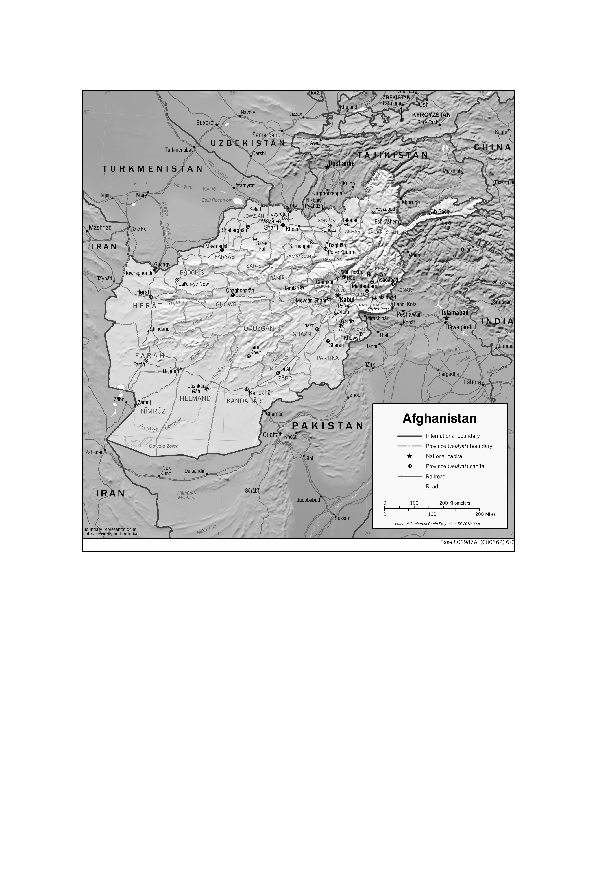
of potential trouble at home but potentially useful abroad.Those who joined
the Taliban movement, espousing a ruthless version of Islamic law, perhaps
could bring order in chaotic Afghanistan and make it a cooperative ally.They
thus might give Pakistan greater security on one of the several borders where
Pakistani military officers hoped for what they called "strategic depth."
66
It is unlikely that Bin Ladin could have returned to Afghanistan had Pak-
istan disapproved. The Pakistani military intelligence service probably had
advance knowledge of his coming, and its officers may have facilitated his travel.
During his entire time in Sudan, he had maintained guesthouses and training
camps in Pakistan and Afghanistan.These were part of a larger network used
by diverse organizations for recruiting and training fighters for Islamic insur-
gencies in such places as Tajikistan, Kashmir, and Chechnya. Pakistani intelli-
gence officers reportedly introduced Bin Ladin to Taliban leaders in Kandahar,
their main base of power, to aid his reassertion of control over camps near
64
THE 9/11 COMMISSION REPORT
Final1-4.4pp 7/17/04 9:12 AM Page 64

Khowst, out of an apparent hope that he would now expand the camps and
make them available for training Kashmiri militants.
67
Yet Bin Ladin was in his weakest position since his early days in the war
against the Soviet Union.The Sudanese government had canceled the registra-
tion of the main business enterprises he had set up there and then put some of
them up for public sale. According to a senior al Qaeda detainee, the govern-
ment of Sudan seized everything Bin Ladin had possessed there.
68
He also lost the head of his military committee,Abu Ubaidah al Banshiri, one
of the most capable and popular leaders of al Qaeda.While most of the group's
key figures had accompanied Bin Ladin to Afghanistan, Banshiri had remained
in Kenya to oversee the training and weapons shipments of the cell set up some
four years earlier. He died in a ferryboat accident on Lake Victoria just a few
days after Bin Ladin arrived in Jalalabad, leaving Bin Ladin with a need to
replace him not only in the Shura but also as supervisor of the cells and
prospective operations in East Africa.
69
He had to make other adjustments as
well, for some al Qaeda members viewed Bin Ladin's return to Afghanistan as
occasion to go off in their own directions. Some maintained collaborative rela-
tionships with al Qaeda, but many disengaged entirely.
70
For a time, it may not have been clear to Bin Ladin that the Taliban would
be his best bet as an ally.When he arrived in Afghanistan, they controlled much
of the country, but key centers, including Kabul, were still held by rival war-
lords. Bin Ladin went initially to Jalalabad, probably because it was in an area
controlled by a provincial council of Islamic leaders who were not major con-
tenders for national power. He found lodgings with Younis Khalis, the head of
one of the main mujahideen factions. Bin Ladin apparently kept his options
open, maintaining contacts with Gulbuddin Hekmatyar, who, though an
Islamic extremist, was also one of the Taliban's most militant opponents. But
after September 1996, when first Jalalabad and then Kabul fell to the Taliban,
Bin Ladin cemented his ties with them.
71
That process did not always go smoothly. Bin Ladin, no longer constrained
by the Sudanese, clearly thought that he had new freedom to publish his appeals
for jihad. At about the time when the Taliban were making their final drive
toward Jalalabad and Kabul, Bin Ladin issued his August 1996 fatwa, saying that
"We . . . have been prevented from addressing the Muslims," but expressing
relief that "by the grace of Allah, a safe base here is now available in the high
Hindu Kush mountains in Khurasan." But the Taliban, like the Sudanese, would
eventually hear warnings, including from the Saudi monarchy.
72
Though Bin Ladin had promised Taliban leaders that he would be circum-
spect, he broke this promise almost immediately, giving an inflammatory inter-
view to CNN in March 1997. The Taliban leader Mullah Omar promptly
"invited" Bin Ladin to move to Kandahar, ostensibly in the interests of Bin
Ladin's own security but more likely to situate him where he might be easier
to control.
73
THE FOUNDATION OF THE NEW TERRORISM
65
Final1-4.4pp 7/17/04 9:12 AM Page 65

There is also evidence that around this time Bin Ladin sent out a number
of feelers to the Iraqi regime, offering some cooperation. None are reported
to have received a significant response.According to one report, Saddam Hus-
sein's efforts at this time to rebuild relations with the Saudis and other Middle
Eastern regimes led him to stay clear of Bin Ladin.
74
In mid-1998, the situation reversed; it was Iraq that reportedly took the ini-
tiative. In March 1998, after Bin Ladin's public fatwa against the United States,
two al Qaeda members reportedly went to Iraq to meet with Iraqi intelli-
gence. In July, an Iraqi delegation traveled to Afghanistan to meet first with
the Taliban and then with Bin Ladin. Sources reported that one, or perhaps
both, of these meetings was apparently arranged through Bin Ladin's Egypt-
ian deputy, Zawahiri, who had ties of his own to the Iraqis. In 1998, Iraq was
under intensifying U.S. pressure, which culminated in a series of large air
attacks in December.
75
Similar meetings between Iraqi officials and Bin Ladin or his aides may have
occurred in 1999 during a period of some reported strains with the Taliban.
According to the reporting, Iraqi officials offered Bin Ladin a safe haven in Iraq.
Bin Ladin declined, apparently judging that his circumstances in Afghanistan
remained more favorable than the Iraqi alternative. The reports describe
friendly contacts and indicate some common themes in both sides' hatred of
the United States. But to date we have seen no evidence that these or the ear-
lier contacts ever developed into a collaborative operational relationship. Nor
have we seen evidence indicating that Iraq cooperated with al Qaeda in devel-
oping or carrying out any attacks against the United States.
76
Bin Ladin eventually enjoyed a strong financial position in Afghanistan,
thanks to Saudi and other financiers associated with the Golden Chain.
Through his relationship with Mullah Omar--and the monetary and other
benefits that it brought the Taliban--Bin Ladin was able to circumvent restric-
tions; Mullah Omar would stand by him even when other Taliban leaders raised
objections. Bin Ladin appeared to have in Afghanistan a freedom of move-
ment that he had lacked in Sudan.Al Qaeda members could travel freely within
the country, enter and exit it without visas or any immigration procedures, pur-
chase and import vehicles and weapons, and enjoy the use of official Afghan
Ministry of Defense license plates.Al Qaeda also used the Afghan state-owned
Ariana Airlines to courier money into the country.
77
The Taliban seemed to open the doors to all who wanted to come to
Afghanistan to train in the camps.The alliance with the Taliban provided al Qaeda
a sanctuary in which to train and indoctrinate fighters and terrorists, import
weapons, forge ties with other jihad groups and leaders, and plot and staff ter-
rorist schemes.While Bin Ladin maintained his own al Qaeda guesthouses and
camps for vetting and training recruits, he also provided support to and bene-
66
THE 9/11 COMMISSION REPORT
Final1-4.4pp 7/17/04 9:12 AM Page 66

fited from the broad infrastructure of such facilities in Afghanistan made avail-
able to the global network of Islamist movements. U.S. intelligence estimates
put the total number of fighters who underwent instruction in Bin Ladinsup-
ported camps in Afghanistan from 1996 through 9/11 at 10,000 to 20,000.
78
In addition to training fighters and special operators, this larger network of
guesthouses and camps provided a mechanism by which al Qaeda could screen
and vet candidates for induction into its own organization.Thousands flowed
through the camps, but no more than a few hundred seem to have become
al Qaeda members. From the time of its founding, al Qaeda had employed
training and indoctrination to identify "worthy" candidates.
79
Al Qaeda continued meanwhile to collaborate closely with the many Mid-
dle Eastern groups--in Egypt, Algeria, Yemen, Lebanon, Morocco, Tunisia,
Somalia, and elsewhere--with which it had been linked when Bin Ladin was
in Sudan. It also reinforced its London base and its other offices around Europe,
the Balkans, and the Caucasus. Bin Ladin bolstered his links to extremists in
South and Southeast Asia, including the Malaysian-Indonesian JI and several
Pakistani groups engaged in the Kashmir conflict.
80
The February 1998 fatwa thus seems to have been a kind of public launch
of a renewed and stronger al Qaeda, after a year and a half of work. Having
rebuilt his fund-raising network, Bin Ladin had again become the rich man of
the jihad movement. He had maintained or restored many of his links with ter-
rorists elsewhere in the world. And he had strengthened the internal ties in his
own organization.
The inner core of al Qaeda continued to be a hierarchical top-down group
with defined positions, tasks, and salaries. Most but not all in this core swore
fealty (or bayat) to Bin Ladin. Other operatives were committed to Bin Ladin
or to his goals and would take assignments for him, but they did not swear
bayat and maintained, or tried to maintain, some autonomy. A looser circle of
adherents might give money to al Qaeda or train in its camps but remained
essentially independent. Nevertheless, they constituted a potential resource for
al Qaeda.
81
Now effectively merged with Zawahiri's Egyptian Islamic Jihad,
82
al Qaeda
promised to become the general headquarters for international terrorism, with-
out the need for the Islamic Army Shura. Bin Ladin was prepared to pick up
where he had left off in Sudan. He was ready to strike at "the head of the snake."
Al Qaeda's role in organizing terrorist operations had also changed. Before
the move to Afghanistan, it had concentrated on providing funds, training, and
weapons for actions carried out by members of allied groups.The attacks on
the U.S. embassies in East Africa in the summer of 1998 would take a differ-
ent form--planned, directed, and executed by al Qaeda, under the direct super-
vision of Bin Ladin and his chief aides.
THE FOUNDATION OF THE NEW TERRORISM
67
Final1-4.4pp 7/17/04 9:12 AM Page 67

The Embassy Bombings
As early as December 1993, a team of al Qaeda operatives had begun casing
targets in Nairobi for future attacks. It was led by Ali Mohamed, a former
Egyptian army officer who had moved to the United States in the mid-1980s,
enlisted in the U.S.Army, and became an instructor at Fort Bragg. He had pro-
vided guidance and training to extremists at the Farouq mosque in Brooklyn,
including some who were subsequently convicted in the February 1993 attack
on the World Trade Center. The casing team also included a computer expert
whose write-ups were reviewed by al Qaeda leaders.
83
The team set up a makeshift laboratory for developing their surveillance
photographs in an apartment in Nairobi where the various al Qaeda opera-
tives and leaders based in or traveling to the Kenya cell sometimes met. Ban-
shiri, al Qaeda's military committee chief, continued to be the operational
commander of the cell; but because he was constantly on the move, Bin Ladin
had dispatched another operative, Khaled al Fawwaz, to serve as the on-site
manager. The technical surveillance and communications equipment
employed for these casing missions included state-of-the-art video cameras
obtained from China and from dealers in Germany. The casing team also
reconnoitered targets in Djibouti.
84
As early as January 1994, Bin Ladin received the surveillance reports, com-
plete with diagrams prepared by the team's computer specialist. He, his top mil-
itary committee members--Banshiri and his deputy, Abu Hafs al Masri (also
known as Mohammed Atef)--and a number of other al Qaeda leaders
reviewed the reports. Agreeing that the U.S. embassy in Nairobi was an easy
target because a car bomb could be parked close by, they began to form a plan.
Al Qaeda had begun developing the tactical expertise for such attacks months
earlier, when some of its operatives--top military committee members and sev-
eral operatives who were involved with the Kenya cell among them--were sent
to Hezbollah training camps in Lebanon.
85
The cell in Kenya experienced a series of disruptions that may in part
account for the relatively long delay before the attack was actually carried out.
The difficulties Bin Ladin began to encounter in Sudan in 1995, his move to
Afghanistan in 1996, and the months spent establishing ties with the Taliban
may also have played a role, as did Banshiri's accidental drowning.
In August 1997, the Kenya cell panicked. The London Daily Telegraph
reported that Madani al Tayyib, formerly head of al Qaeda's finance committee,
had turned himself over to the Saudi government.The article said (incorrectly)
that the Saudis were sharing Tayyib's information with the U.S. and British
authorities.
86
At almost the same time, cell members learned that U.S. and
Kenyan agents had searched the Kenya residence of Wadi al Hage, who had
become the new on-site manager in Nairobi, and that Hage's telephone was
being tapped. Hage was a U.S. citizen who had worked with Bin Ladin in Afgha-
68
THE 9/11 COMMISSION REPORT
Final1-4.4pp 7/17/04 9:12 AM Page 68

nistan in the 1980s, and in 1992 he went to Sudan to become one of al Qaeda's
major financial operatives.When Hage returned to the United States to appear
before a grand jury investigating Bin Ladin, the job of cell manager was taken
over by Harun Fazul, a Kenyan citizen who had been in Bin Ladin's advance
team to Sudan back in 1990. Harun faxed a report on the "security situation"
to several sites, warning that "the crew members in East Africa is [sic] in grave
danger" in part because "America knows . . . that the followers of [Bin Ladin]
. . . carried out the operations to hit Americans in Somalia." The report pro-
vided instructions for avoiding further exposure.
87
On February 23, 1998, Bin Ladin issued his public fatwa.The language had
been in negotiation for some time, as part of the merger under way between
Bin Ladin's organization and Zawahiri's Egyptian Islamic Jihad. Less than a
month after the publication of the fatwa, the teams that were to carry out the
embassy attacks were being pulled together in Nairobi and Dar es Salaam.The
timing and content of their instructions indicate that the decision to launch
the attacks had been made by the time the fatwa was issued.
88
The next four months were spent setting up the teams in Nairobi and Dar
es Salaam. Members of the cells rented residences, and purchased bomb-mak-
ing materials and transport vehicles. At least one additional explosives expert
was brought in to assist in putting the weapons together. In Nairobi, a hotel
room was rented to put up some of the operatives. The suicide trucks were
purchased shortly before the attack date.
89
While this was taking place, Bin Ladin continued to push his public mes-
sage. On May 7, the deputy head of al Qaeda's military committee,
Mohammed Atef, faxed to Bin Ladin's London office a new fatwa issued by a
group of sheikhs located in Afghanistan. A week later, it appeared in Al Quds
al Arabi, the same Arabic-language newspaper in London that had first published
Bin Ladin's February fatwa, and it conveyed the same message--the duty of
Muslims to carry out holy war against the enemies of Islam and to expel the
Americans from the Gulf region.Two weeks after that, Bin Ladin gave a video-
taped interview to ABC News with the same slogans, adding that "we do not
differentiate between those dressed in military uniforms and civilians; they are
all targets in this fatwa."
90
By August 1, members of the cells not directly involved in the attacks had
mostly departed from East Africa. The remaining operatives prepared and
assembled the bombs, and acquired the delivery vehicles. On August 4, they
made one last casing run at the embassy in Nairobi. By the evening of August 6,
all but the delivery teams and one or two persons assigned to remove the evi-
dence trail had left East Africa. Back in Afghanistan, Bin Ladin and the al Qaeda
leadership had left Kandahar for the countryside, expecting U.S. retaliation.
Declarations taking credit for the attacks had already been faxed to the joint
al QaedaEgyptian Islamic Jihad office in Baku, with instructions to stand by
THE FOUNDATION OF THE NEW TERRORISM
69
Final1-4.4pp 7/17/04 9:12 AM Page 69

for orders to "instantly" transmit them to Al Quds al Arabi. One proclaimed "the
formation of the Islamic Army for the Liberation of the Holy Places," and two
others--one for each embassy--announced that the attack had been carried
out by a "company" of a "battalion" of this "Islamic Army."
91
On the morning of August 7, the bomb-laden trucks drove into the
embassies roughly five minutes apart--about 10:35
A
.
M
. in Nairobi and 10:39
A
.
M
. in Dar es Salaam. Shortly afterward, a phone call was placed from Baku
to London.The previously prepared messages were then faxed to London.
92
The attack on the U.S. embassy in Nairobi destroyed the embassy and killed
12 Americans and 201 others, almost all Kenyans. About 5,000 people were
injured.The attack on the U.S. embassy in Dar es Salaam killed 11 more peo-
ple, none of them Americans. Interviewed later about the deaths of the Africans,
Bin Ladin answered that "when it becomes apparent that it would be impos-
sible to repel these Americans without assaulting them, even if this involved
the killing of Muslims, this is permissible under Islam."Asked if he had indeed
masterminded these bombings, Bin Ladin said that the World Islamic Front for
jihad against "Jews and Crusaders" had issued a "crystal clear" fatwa. If the insti-
gation for jihad against the Jews and the Americans to liberate the holy places
"is considered a crime," he said,"let history be a witness that I am a criminal."
93
70
THE 9/11 COMMISSION REPORT
Final1-4.4pp 7/17/04 9:12 AM Page 70

3
COUNTERTERRORISM
EVOLVES
71
I n c hap te r 2 , we described the growth of a new kind of terrorism, and a
new terrorist organization--especially from 1988 to 1998, when Usama Bin
Ladin declared war and organized the bombing of two U.S. embassies. In this
chapter, we trace the parallel evolution of government efforts to counter ter-
rorism by Islamic extremists against the United States.
We mention many personalities in this report. As in any study of the U.S.
government, some of the most important characters are institutions. We will
introduce various agencies, and how they adapted to a new kind of terrorism.
3.1 FROM THE OLD TERRORISM TO THE NEW:
THE FIRST WORLD TRADE CENTER BOMBING
At 18 minutes after noon on February 26, 1993, a huge bomb went off beneath
the two towers of the World Trade Center.This was not a suicide attack.The
terrorists parked a truck bomb with a timing device on Level B-2 of the under-
ground garage, then departed.The ensuing explosion opened a hole seven sto-
ries up. Six people died. More than a thousand were injured. An FBI agent at
the scene described the relatively low number of fatalities as a miracle.
1
President Bill Clinton ordered his National Security Council to coordinate
the response. Government agencies swung into action to find the culprits.The
Counterterrorist Center located at the CIA combed its files and queried
sources around the world. The National Security Agency (NSA), the huge
Defense Department signals collection agency, ramped up its communications
intercept network and searched its databases for clues.
2
The New York Field
Office of the FBI took control of the local investigation and, in the end, set a
pattern for future management of terrorist incidents.
Four features of this episode have significance for the story of 9/11.
Final1-4.4pp 7/17/04 9:12 AM Page 71

First, the bombing signaled a new terrorist challenge, one whose rage and
malice had no limit. Ramzi Yousef, the Sunni extremist who planted the bomb,
said later that he had hoped to kill 250,000 people.
3
Second, the FBI and the Justice Department did excellent work investigat-
ing the bombing.Within days, the FBI identified a truck remnant as part of a
Ryder rental van reported stolen in Jersey City the day before the bombing.
4
Mohammed Salameh, who had rented the truck and reported it stolen, kept
calling the rental office to get back his $400 deposit.The FBI arrested him there
on March 4, 1993. In short order, the Bureau had several plotters in custody,
including Nidal Ayyad, an engineer who had acquired chemicals for the bomb,
and Mahmoud Abouhalima, who had helped mix the chemicals.
5
The FBI identified another conspirator, Ahmad Ajaj, who had been arrested
by immigration authorities at John F. Kennedy International Airport in Sep-
tember 1992 and charged with document fraud. His traveling companion was
Ramzi Yousef, who had also entered with fraudulent documents but claimed
political asylum and was admitted. It quickly became clear that Yousef had been
a central player in the attack. He had fled to Pakistan immediately after the
bombing and would remain at large for nearly two years.
6
The arrests of Salameh, Abouhalima, and Ayyad led the FBI to the Farouq
mosque in Brooklyn, where a central figure was Sheikh Omar Abdel Rahman,
an extremist Sunni Muslim cleric who had moved to the United States from
Egypt in 1990. In speeches and writings, the sightless Rahman, often called the
"Blind Sheikh," preached the message of Sayyid Qutb's Milestones, characteriz-
ing the United States as the oppressor of Muslims worldwide and asserting that
it was their religious duty to fight against God's enemies. An FBI informant
learned of a plan to bomb major New York landmarks, including the Holland
and Lincoln tunnels. Disrupting this "landmarks plot," the FBI in June 1993
arrested Rahman and various confederates.
7
As a result of the investigations and arrests, the U.S.Attorney for the South-
ern District of New York prosecuted and convicted multiple individuals,
including Ajaj, Salameh, Ayyad, Abouhalima, the Blind Sheikh, and Ramzi
Yousef, for crimes related to the World Trade Center bombing and other plots.
An unfortunate consequence of this superb investigative and prosecutorial
effort was that it created an impression that the law enforcement system was
well-equipped to cope with terrorism. Neither President Clinton, his princi-
pal advisers, the Congress, nor the news media felt prompted, until later, to press
the question of whether the procedures that put the Blind Sheikh and Ramzi
Yousef behind bars would really protect Americans against the new virus of
which these individuals were just the first symptoms.
8
Third, the successful use of the legal system to address the first World Trade
Center bombing had the side effect of obscuring the need to examine the char-
acter and extent of the new threat facing the United States.The trials did not
bring the Bin Ladin network to the attention of the public and policymakers.
72
THE 9/11 COMMISSION REPORT
Final1-4.4pp 7/17/04 9:12 AM Page 72

The FBI assembled, and the U.S. Attorney's office put forward, some evi-
dence showing that the men in the dock were not the only plotters. Materials
taken from Ajaj indicated that the plot or plots were hatched at or near the
Khaldan camp, a terrorist training camp on the Afghanistan-Pakistan border.
Ajaj had left Texas in April 1992 to go there to learn how to construct bombs.
He had met Ramzi Yousef in Pakistan, where they discussed bombing targets
in the United States and assembled a "terrorist kit" that included bomb-mak-
ing manuals, operations guidance, videotapes advocating terrorist action
against the United States, and false identification documents.
9
Yousef was captured in Pakistan following the discovery by police in the
Philippines in January 1995 of the Manila air plot, which envisioned placing
bombs on board a dozen trans-Pacific airliners and setting them off simultane-
ously. Khalid Sheikh Mohammed--Yousef 's uncle, then located in Qatar--was
a fellow plotter of Yousef 's in the Manila air plot and had also wired him some
money prior to the Trade Center bombing. The U.S. Attorney obtained an
indictment against KSM in January 1996, but an official in the government of
Qatar probably warned him about it. Khalid Sheikh Mohammed evaded cap-
ture (and stayed at large to play a central part in the 9/11 attacks).
10
The law enforcement process is concerned with proving the guilt of per-
sons apprehended and charged. Investigators and prosecutors could not pres-
ent all the evidence of possible involvement of individuals other than those
charged, although they continued to pursue such investigations, planning or
hoping for later prosecutions.The process was meant, by its nature, to mark for
the public the events as finished--case solved, justice done. It was not designed
to ask if the events might be harbingers of worse to come. Nor did it allow for
aggregating and analyzing facts to see if they could provide clues to terrorist
tactics more generally--methods of entry and finance, and mode of operation
inside the United States.
Fourth, although the bombing heightened awareness of a new terrorist dan-
ger, successful prosecutions contributed to widespread underestimation of the
threat.The government's attorneys stressed the seriousness of the crimes, and
put forward evidence of Yousef 's technical ingenuity.Yet the public image that
persisted was not of clever Yousef but of stupid Salameh going back again and
again to reclaim his $400 truck rental deposit.
3.2 ADAPTATION--AND NONADAPTATION--IN THE
LAW ENFORCEMENT COMMUNITY
Legal processes were the primary method for responding to these early mani-
festations of a new type of terrorism. Our overview of U.S. capabilities for deal-
ing with it thus begins with the nation's vast complex of law enforcement
agencies.
COUNTERTERRORISM EVOLVES
73
Final1-4.4pp 7/17/04 9:12 AM Page 73

The Justice Department and the FBI
At the federal level, much law enforcement activity is concentrated in the
Department of Justice. For countering terrorism, the dominant agency under
Justice is the Federal Bureau of Investigation.The FBI does not have a general
grant of authority but instead works under specific statutory authorizations.
Most of its work is done in local offices called field offices. There are 56 of
them, each covering a specified geographic area, and each quite separate from
all others. Prior to 9/11, the special agent in charge was in general free to set
his or her office's priorities and assign personnel accordingly.
11
The office's priorities were driven by two primary concerns. First, perform-
ance in the Bureau was generally measured against statistics such as numbers
of arrests, indictments, prosecutions, and convictions. Counterterrorism and
counterintelligence work, often involving lengthy intelligence investigations
that might never have positive or quantifiable results, was not career-enhanc-
ing. Most agents who reached management ranks had little counterterrorism
experience. Second, priorities were driven at the local level by the field offices,
whose concerns centered on traditional crimes such as white-collar offenses
and those pertaining to drugs and gangs. Individual field offices made choices
to serve local priorities, not national priorities.
12
The Bureau also operates under an "office of origin" system.To avoid dupli-
cation and possible conflicts, the FBI designates a single office to be in charge
of an entire investigation. Because the New York Field Office indicted Bin
Ladin prior to the East Africa bombings, it became the office of origin for all
Bin Ladin cases, including the East Africa bombings and later the attack on the
USS Cole. Most of the FBI's institutional knowledge on Bin Ladin and al Qaeda
resided there.This office worked closely with the U.S.Attorney for the South-
ern District of New York to identify, arrest, prosecute, and convict many of the
perpetrators of the attacks and plots. Field offices other than the specified office
of origin were often reluctant to spend much energy on matters over which
they had no control and for which they received no credit.
13
The FBI's domestic intelligence gathering dates from the 1930s.With World
War II looming, President Franklin D. Roosevelt ordered FBI Director J. Edgar
Hoover to investigate foreign and foreign-inspired subversion--Communist,
Nazi, and Japanese. Hoover added investigation of possible espionage, sabotage,
or subversion to the duties of field offices. After the war, foreign intelligence
duties were assigned to the newly established Central Intelligence Agency.
Hoover jealously guarded the FBI's domestic portfolio against all rivals.
Hoover felt he was accountable only to the president, and the FBI's domestic
intelligence activities kept growing. In the 1960s, the FBI was receiving signif-
icant assistance within the United States from the CIA and from Army Intel-
ligence.The legal basis for some of this assistance was dubious.
Decades of encouragement to perform as a domestic intelligence agency
abruptly ended in the 1970s.Two years after Hoover's death in 1972, congres-
74
THE 9/11 COMMISSION REPORT
Final1-4.4pp 7/17/04 9:12 AM Page 74

sional and news media investigations of the Watergate scandals of the Nixon
administration expanded into general investigations of foreign and domestic
intelligence by the Church and Pike committees.
14
They disclosed domestic
intelligence efforts, which included a covert action program that operated from
1956 to 1971 against domestic organizations and, eventually, domestic dissi-
dents.The FBI had spied on a wide range of political figures, especially indi-
viduals whom Hoover wanted to discredit (notably the Reverend Martin
Luther King, Jr.), and had authorized unlawful wiretaps and surveillance.The
shock registered in public opinion polls, where the percentage of Americans
declaring a "highly favorable" view of the FBI dropped from 84 percent to 37
percent.The FBI's Domestic Intelligence Division was dissolved.
15
In 1976, Attorney General Edward Levi adopted domestic security guide-
lines to regulate intelligence collection in the United States and to deflect calls
for even stronger regulation. In 1983,Attorney General William French Smith
revised the Levi guidelines to encourage closer investigation of potential ter-
rorism. He also loosened the rules governing authorization for investigations
and their duration. Still, his guidelines, like Levi's, took account of the reality
that suspicion of "terrorism," like suspicion of "subversion," could lead to mak-
ing individuals targets for investigation more because of their beliefs than
because of their acts. Smith's guidelines also took account of the reality that
potential terrorists were often members of extremist religious organizations and
that investigation of terrorism could cross the line separating state and
church.
16
In 1986, Congress authorized the FBI to investigate terrorist attacks against
Americans that occur outside the United States. Three years later, it added
authority for the FBI to make arrests abroad without consent from the host
country. Meanwhile, a task force headed by Vice President George H.W. Bush
had endorsed a concept already urged by Director of Central Intelligence
William Casey--a Counterterrorist Center, where the FBI, the CIA, and other
organizations could work together on international terrorism.While it was dis-
tinctly a CIA entity, the FBI detailed officials to work at the Center and
obtained leads that helped in the capture of persons wanted for trial in the
United States.
The strengths that the FBI brought to counterterrorism were nowhere more
brilliantly on display than in the case of Pan American Flight 103, bound from
London to New York, which blew up over Lockerbie, Scotland, in December
1988, killing 270 people. Initial evidence pointed to the government of Syria
and, later, Iran.The Counterterrorist Center reserved judgment on the perpe-
trators of the attack. Meanwhile, FBI technicians, working with U.K. security
services, gathered and analyzed the widely scattered fragments of the airliner.
In 1991, with the help of the Counterterrorist Center, they identified one small
fragment as part of a timing device--to the technicians, as distinctive as DNA.
It was a Libyan device.Together with other evidence, the FBI put together a
COUNTERTERRORISM EVOLVES
75
Final1-4.4pp 7/17/04 9:12 AM Page 75

case pointing conclusively to the Libyan government. Eventually Libya
acknowledged its responsibility.
17
Pan Am 103 became a cautionary tale
against rushing to judgment in attributing responsibility for a terrorist act. It
also showed again how--given a case to solve--the FBI remained capable of
extraordinary investigative success.
FBI Organization and Priorities
In 1993, President Clinton chose Louis Freeh as the Director of the Bureau.
Freeh, who would remain Director until June 2001, believed that the FBI's
work should be done primarily by the field offices.To emphasize this view he
cut headquarters staff and decentralized operations.The special agents in charge
gained power, influence, and independence.
18
Freeh recognized terrorism as a major threat. He increased the number of
legal attaché offices abroad, focusing in particular on the Middle East. He also
urged agents not to wait for terrorist acts to occur before taking action. In his
first budget request to Congress after the 1993 World Trade Center bombing,
he stated that "merely solving this type of crime is not enough; it is equally
important that the FBI thwart terrorism before such acts can be perpetrated."
Within headquarters, he created a Counterterrorism Division that would com-
plement the Counterterrorist Center at the CIA and arranged for exchanges
of senior FBI and CIA counterterrorism officials. He pressed for more coop-
eration between legal attachés and CIA stations abroad.
19
Freeh's efforts did not, however, translate into a significant shift of resources
to counterterrorism. FBI, Justice, and Office of Management and Budget offi-
cials said that FBI leadership seemed unwilling to shift resources to terrorism
from other areas such as violent crime and drug enforcement; other FBI offi-
cials blamed Congress and the OMB for a lack of political will and failure to
understand the FBI's counterterrorism resource needs. In addition, Freeh did
not impose his views on the field offices. With a few notable exceptions, the
field offices did not apply significant resources to terrorism and often repro-
grammed funds for other priorities.
20
In 1998, the FBI issued a five-year strategic plan led by its deputy director,
Robert "Bear" Bryant. For the first time, the FBI designated national and eco-
nomic security, including counterterrorism, as its top priority. Dale Watson, who
would later become the head of the new Counterterrorism Division, said that
after the East Africa bombings,"the light came on" that cultural change had to
occur within the FBI.The plan mandated a stronger intelligence collection effort.
It called for a nationwide automated system to facilitate information collection,
analysis,and dissemination.It envisioned the creation of a professional intelligence
cadre of experienced and trained agents and analysts.If successfully implemented,
this would have been a major step toward addressing terrorism systematically,
rather than as individual unrelated cases. But the plan did not succeed.
21
First, the plan did not obtain the necessary human resources. Despite des-
76
THE 9/11 COMMISSION REPORT
Final1-4.4pp 7/17/04 9:12 AM Page 76

ignating "national and economic security" as its top priority in 1998, the
FBI did not shift human resources accordingly.Although the FBI's counter-
terrorism budget tripled during the mid-1990s, FBI counterterrorism
spending remained fairly constant between fiscal years 1998 and 2001. In
2000, there were still twice as many agents devoted to drug enforcement as
to counterterrorism.
22
Second, the new division intended to strengthen the FBI's strategic analy-
sis capability faltered. It received insufficient resources and faced resistance from
senior managers in the FBI's operational divisions.The new division was sup-
posed to identify trends in terrorist activity, determine what the FBI did not
know, and ultimately drive collection efforts. However, the FBI had little appre-
ciation for the role of analysis.Analysts continued to be used primarily in a tac-
tical fashion--providing support for existing cases. Compounding the problem
was the FBI's tradition of hiring analysts from within instead of recruiting indi-
viduals with the relevant educational background and expertise.
23
Moreover, analysts had difficulty getting access to the FBI and intelligence
community information they were expected to analyze.The poor state of the
FBI's information systems meant that such access depended in large part on an
analyst's personal relationships with individuals in the operational units or
squads where the information resided. For all of these reasons, prior to 9/11
relatively few strategic analytic reports about counterterrorism had been com-
pleted. Indeed, the FBI had never completed an assessment of the overall ter-
rorist threat to the U.S. homeland.
24
Third, the FBI did not have an effective intelligence collection effort. Col-
lection of intelligence from human sources was limited, and agents were inad-
equately trained. Only three days of a 16-week agents' course were devoted to
counterintelligence and counterterrorism, and most subsequent training was
received on the job.The FBI did not have an adequate mechanism for validat-
ing source reporting, nor did it have a system for adequately tracking and shar-
ing source reporting, either internally or externally.The FBI did not dedicate
sufficient resources to the surveillance and translation needs of counter-
terrorism agents. It lacked sufficient translators proficient in Arabic and other
key languages, resulting in a significant backlog of untranslated intercepts.
25
Finally, the FBI's information systems were woefully inadequate. The FBI
lacked the ability to know what it knew: there was no effective mechanism for
capturing or sharing its institutional knowledge. FBI agents did create records of
interviews and other investigative efforts, but there were no reports officers to
condense the information into meaningful intelligence that could be retrieved
and disseminated.
26
In 1999, the FBI created separate Counterterrorism and Counterintelli-
gence divisions. Dale Watson, the first head of the new Counterterrorism Divi-
sion, recognized the urgent need to increase the FBI's counterterrorism
capability. His plan, called MAXCAP 05, was unveiled in 2000: it set the goal
COUNTERTERRORISM EVOLVES
77
Final1-4.4pp 7/17/04 9:12 AM Page 77

of bringing the Bureau to its "maximum feasible capacity" in counterterror-
ism by 2005. Field executives told Watson that they did not have the analysts,
linguists, or technically trained experts to carry out the strategy. In a report pro-
vided to Director Robert Mueller in September 2001, one year after Watson
presented his plan to field executives, almost every FBI field office was assessed
to be operating below "maximum capacity."The report stated that "the goal to
`prevent terrorism' requires a dramatic shift in emphasis from a reactive capa-
bility to highly functioning intelligence capability which provides not only
leads and operational support, but clear strategic analysis and direction."
27
Legal Constraints on the FBI and "the Wall"
The FBI had different tools for law enforcement and intelligence.
28
For crim-
inal matters, it could apply for and use traditional criminal warrants. For intel-
ligence matters involving international terrorism, however, the rules were
different. For many years the attorney general could authorize surveillance of
foreign powers and agents of foreign powers without any court review, but in
1978 Congress passed the Foreign Intelligence Surveillance Act.
29
This law reg-
ulated intelligence collection directed at foreign powers and agents of foreign
powers in the United States. In addition to requiring court review of proposed
surveillance (and later, physical searches), the 1978 act was interpreted by the
courts to require that a search be approved only if its "primary purpose" was
to obtain foreign intelligence information. In other words, the authorities of
the FISA law could not be used to circumvent traditional criminal warrant
requirements.The Justice Department interpreted these rulings as saying that
criminal prosecutors could be briefed on FISA information but could not
direct or control its collection.
30
Throughout the 1980s and early 1990s, Justice prosecutors had informal
arrangements for obtaining information gathered in the FISA process, the
understanding being that they would not improperly exploit that process for
their criminal cases. Whether the FBI shared with prosecutors information
pertinent to possible criminal investigations was left solely to the judgment of
the FBI.
31
But the prosecution of Aldrich Ames for espionage in 1994 revived con-
cerns about the prosecutors' role in intelligence investigations.The Department
of Justice's Office of Intelligence Policy and Review (OIPR) is responsible for
reviewing and presenting all FISA applications to the FISA Court. It worried
that because of the numerous prior consultations between FBI agents and pros-
ecutors, the judge might rule that the FISA warrants had been misused. If that
had happened,Ames might have escaped conviction. Richard Scruggs, the act-
ing head of OIPR, complained to Attorney General Janet Reno about the lack
of information-sharing controls. On his own, he began imposing information-
sharing procedures for FISA material. The Office of Intelligence Policy and
Review became the gatekeeper for the flow of FISA information to criminal
prosecutors.
32
78
THE 9/11 COMMISSION REPORT
Final1-4.4pp 7/17/04 9:12 AM Page 78

In July 1995, Attorney General Reno issued formal procedures aimed at
managing information sharing between Justice Department prosecutors and
the FBI.They were developed in a working group led by the Justice Depart-
ment's Executive Office of National Security, overseen by Deputy Attorney
General Jamie Gorelick.
33
These procedures--while requiring the sharing of
intelligence information with prosecutors--regulated the manner in which
such information could be shared from the intelligence side of the house to
the criminal side.
These procedures were almost immediately misunderstood and misapplied.
As a result, there was far less information sharing and coordination between
the FBI and the Criminal Division in practice than was allowed under the
department's procedures. Over time the procedures came to be referred to as
"the wall." The term "the wall" is misleading, however, because several factors
led to a series of barriers to information sharing that developed.
34
The Office of Intelligence Policy and Review became the sole gatekeeper
for passing information to the Criminal Division. Though Attorney General
Reno's procedures did not include such a provision, the Office assumed the
role anyway, arguing that its position reflected the concerns of Judge Royce
Lamberth, then chief judge of the Foreign Intelligence Surveillance Court.The
Office threatened that if it could not regulate the flow of information to crim-
inal prosecutors, it would no longer present the FBI's warrant requests to the
FISA Court.The information flow withered.
35
The 1995 procedures dealt only with sharing between agents and criminal
prosecutors, not between two kinds of FBI agents, those working on intelli-
gence matters and those working on criminal matters. But pressure from the
Office of Intelligence Policy Review, FBI leadership, and the FISA Court built
barriers between agents--even agents serving on the same squads. FBI Deputy
Director Bryant reinforced the Office's caution by informing agents that too
much information sharing could be a career stopper.Agents in the field began
to believe--incorrectly--that no FISA information could be shared with
agents working on criminal investigations.
36
This perception evolved into the still more exaggerated belief that the FBI
could not share any intelligence information with criminal investigators, even
if no FISA procedures had been used. Thus, relevant information from the
National Security Agency and the CIA often failed to make its way to crimi-
nal investigators. Separate reviews in 1999, 2000, and 2001 concluded inde-
pendently that information sharing was not occurring, and that the intent of
the 1995 procedures was ignored routinely.
37
We will describe some of the
unfortunate consequences of these accumulated institutional beliefs and prac-
tices in chapter 8.
There were other legal limitations. Both prosecutors and FBI agents argued
that they were barred by court rules from sharing grand jury information, even
though the prohibition applied only to that small fraction that had been pre-
sented to a grand jury, and even that prohibition had exceptions. But as inter-
COUNTERTERRORISM EVOLVES
79
Final1-4.4pp 7/17/04 9:12 AM Page 79

preted by FBI field offices, this prohibition could conceivably apply to much
of the information unearthed in an investigation.There were also restrictions,
arising from executive order, on the commingling of domestic information
with foreign intelligence. Finally the NSA began putting caveats on its Bin
Ladinrelated reports that required prior approval before sharing their contents
with criminal investigators and prosecutors. These developments further
blocked the arteries of information sharing.
38
Other Law Enforcement Agencies
The Justice Department is much more than the FBI. It also has a U.S. Marshals
Service, almost 4,000 strong on 9/11 and especially expert in tracking fugi-
tives, with much local police knowledge.The department's Drug Enforcement
Administration had, as of 2001, more than 4,500 agents.
39
There were a num-
ber of occasions when DEA agents were able to introduce sources to the FBI
or CIA for counterterrorism use.
The Immigration and Naturalization Service (INS), with its 9,000 Border
Patrol agents, 4,500 inspectors, and 2,000 immigration special agents, had per-
haps the greatest potential to develop an expanded role in counterterrorism.
However, the INS was focused on the formidable challenges posed by illegal
entry over the southwest border, criminal aliens, and a growing backlog in the
applications for naturalizing immigrants.The White House, the Justice Depart-
ment, and above all the Congress reinforced these concerns. In addition, when
Doris Meissner became INS Commissioner in 1993, she found an agency seri-
ously hampered by outdated technology and insufficient human resources. Bor-
der Patrol agents were still using manual typewriters; inspectors at ports of entry
were using a paper watchlist; the asylum and other benefits systems did not
effectively deter fraudulent applicants.
40
Commissioner Meissner responded in 1993 to the World Trade Center
bombing by providing seed money to the State Department's Consular Affairs
Bureau to automate its terrorist watchlist, used by consular officers and border
inspectors. The INS assigned an individual in a new "lookout" unit to work
with the State Department in watchlisting suspected terrorists and with the
intelligence community and the FBI in determining how to deal with them
when they appeared at ports of entry. By 1998, 97 suspected terrorists had been
denied admission at U.S. ports of entry because of the watchlist.
41
How to conduct deportation cases against aliens who were suspected ter-
rorists caused significant debate.The INS had immigration law expertise and
authority to bring the cases, but the FBI possessed the classified information
sometimes needed as evidence, and information-sharing conflicts resulted.
New laws in 1996 authorized the use of classified evidence in removal hear-
ings, but the INS removed only a handful of the aliens with links to terrorist
activity (none identified as associated with al Qaeda) using classified evidence.
42
Midlevel INS employees proposed comprehensive counterterrorism pro-
80
THE 9/11 COMMISSION REPORT
Final1-4.4pp 7/17/04 9:12 AM Page 80

posals to management in 1986, 1995, and 1997. No action was taken on them.
In 1997, a National Security Unit was set up to handle alerts, track potential
terrorist cases for possible immigration enforcement action, and work with the
rest of the Justice Department. It focused on the FBI's priorities of Hezbollah
and Hamas, and began to examine how immigration laws could be brought to
bear on terrorism. For instance, it sought unsuccessfully to require that CIA
security checks be completed before naturalization applications were
approved.
43
Policy questions, such as whether resident alien status should be
revoked upon the person's conviction of a terrorist crime, were not addressed.
Congress, with the support of the Clinton administration, doubled the num-
ber of Border Patrol agents required along the border with Mexico to one
agent every quarter mile by 1999. It rejected efforts to bring additional
resources to bear in the north.The border with Canada had one agent for every
13.25 miles. Despite examples of terrorists entering from Canada, awareness of
terrorist activity in Canada and its more lenient immigration laws, and an
inspector general's report recommending that the Border Patrol develop a
northern border strategy, the only positive step was that the number of Border
Patrol agents was not cut any further.
44
Inspectors at the ports of entry were not asked to focus on terrorists. Inspec-
tors told us they were not even aware that when they checked the names of
incoming passengers against the automated watchlist, they were checking in
part for terrorists. In general, border inspectors also did not have the informa-
tion they needed to make fact-based determinations of admissibility.The INS
initiated but failed to bring to completion two efforts that would have pro-
vided inspectors with information relevant to counterterrorism--a proposed
system to track foreign student visa compliance and a program to establish a way
of tracking travelers' entry to and exit from the United States.
45
In 1996, a new law enabled the INS to enter into agreements with state and
local law enforcement agencies through which the INS provided training and
the local agencies exercised immigration enforcement authority. Terrorist
watchlists were not available to them. Mayors in cities with large immigrant
populations sometimes imposed limits on city employee cooperation with fed-
eral immigration agents. A large population lives outside the legal framework.
Fraudulent documents could be easily obtained. Congress kept the number of
INS agents static in the face of the overwhelming problem.
46
The chief vehicle for INS and for state and local participation in law
enforcement was the Joint Terrorism Task Force (JTTF), first tried out in New
York City in 1980 in response to a spate of incidents involving domestic ter-
rorist organizations.This task force was managed by the New York Field Office
of the FBI, and its existence provided an opportunity to exchange information
and, as happened after the first World Trade Center bombing, to enlist local offi-
cers, as well as other agency representatives, as partners in the FBI investiga-
tion.The FBI expanded the number of JTTFs throughout the 1990s, and by
COUNTERTERRORISM EVOLVES
81
Final1-4.4pp 7/17/04 9:12 AM Page 81

9/11 there were 34.While useful, the JTTFs had limitations.They set priori-
ties in accordance with regional and field office concerns, and most were not
fully staffed. Many state and local entities believed they had little to gain from
having a full-time representative on a JTTF.
47
Other federal law enforcement resources, also not seriously enlisted for
counterterrorism, were to be found in the Treasury Department.
Treasury housed the Secret Service, the Customs Service, and the Bureau
of Alcohol,Tobacco, and Firearms. Given the Secret Service's mission to pro-
tect the president and other high officials, its agents did become involved with
those of the FBI whenever terrorist assassination plots were rumored.
The Customs Service deployed agents at all points of entry into the
United States. Its agents worked alongside INS agents, and the two groups
sometimes cooperated. In the winter of 19992000, as will be detailed in
chapter 6, questioning by an especially alert Customs inspector led to the
arrest of an al Qaeda terrorist whose apparent mission was to bomb Los
Angeles International Airport.
The Bureau of Alcohol,Tobacco, and Firearms was used on occasion by the
FBI as a resource.The ATF's laboratories and analysis were critical to the inves-
tigation of the February 1993 bombing of the World Trade Center and the April
1995 bombing of the Alfred P. Murrah Federal Building in Oklahoma City.
48
Before 9/11, with the exception of one portion of the FBI, very little of the
sprawling U.S. law enforcement community was engaged in countering ter-
rorism. Moreover, law enforcement could be effective only after specific indi-
viduals were identified, a plot had formed, or an attack had already occurred.
Responsible individuals had to be located, apprehended, and transported back
to a U.S. court for prosecution. As FBI agents emphasized to us, the FBI and
the Justice Department do not have cruise missiles.They declare war by indict-
ing someone.They took on the lead role in addressing terrorism because they
were asked to do so.
49
3.3 . . . AND IN THE FEDERAL AVIATION
ADMINISTRATION
The Federal Aviation Administration (FAA) within the Department of Trans-
portation had been vested by Congress with the sometimes conflicting man-
date of regulating the safety and security of U.S. civil aviation while also
promoting the civil aviation industry.The FAA had a security mission to pro-
tect the users of commercial air transportation against terrorism and other
criminal acts. In the years before 9/11, the FAA perceived sabotage as a greater
threat to aviation than hijacking. First, no domestic hijacking had occurred in
a decade. Second, the commercial aviation system was perceived as more vul-
nerable to explosives than to weapons such as firearms. Finally, explosives were
82
THE 9/11 COMMISSION REPORT
Final1-4.4pp 7/17/04 9:12 AM Page 82

perceived as deadlier than hijacking and therefore of greater consequence. In
1996, a presidential commission on aviation safety and security chaired by Vice
President Al Gore reinforced the prevailing concern about sabotage and explo-
sives on aircraft.The Gore Commission also flagged, as a new danger, the pos-
sibility of attack by surface-to-air missiles. Its 1997 final report did not discuss
the possibility of suicide hijackings.
50
The FAA set and enforced aviation security rules, which airlines and air-
ports were required to implement.The rules were supposed to produce a "lay-
ered" system of defense.This meant that the failure of any one layer of security
would not be fatal, because additional layers would provide backup security.
But each layer relevant to hijackings--intelligence, passenger prescreening,
checkpoint screening, and onboard security--was seriously flawed prior to
9/11.Taken together, they did not stop any of the 9/11 hijackers from getting
on board four different aircraft at three different airports.
51
The FAA's policy was to use intelligence to identify both specific plots and
general threats to civil aviation security, so that the agency could develop and
deploy appropriate countermeasures. The FAA's 40-person intelligence unit
was supposed to receive a broad range of intelligence data from the FBI, CIA,
and other agencies so that it could make assessments about the threat to avia-
tion. But the large volume of data contained little pertaining to the presence
and activities of terrorists in the United States. For example, information on
the FBI's effort in 1998 to assess the potential use of flight training by terror-
ists and the Phoenix electronic communication of 2001 warning of radical
Middle Easterners attending flight school were not passed to FAA headquar-
ters. Several top FAA intelligence officials called the domestic threat picture a
serious blind spot.
52
Moreover, the FAA's intelligence unit did not receive much attention from
the agency's leadership. Neither Administrator Jane Garvey nor her deputy rou-
tinely reviewed daily intelligence, and what they did see was screened for them.
She was unaware of a great amount of hijacking threat information from her
own intelligence unit, which, in turn, was not deeply involved in the agency's
policymaking process. Historically, decisive security action took place only after
a disaster had occurred or a specific plot had been discovered.
53
The next aviation security layer was passenger prescreening. The FAA
directed air carriers not to fly individuals known to pose a "direct" threat to
civil aviation. But as of 9/11, the FAA's "no-fly" list contained the names of
just 12 terrorist suspects (including 9/11 mastermind Khalid Sheikh
Mohammed), even though government watchlists contained the names of
many thousands of known and suspected terrorists.This astonishing mismatch
existed despite the Gore Commission's having called on the FBI and CIA four
years earlier to provide terrorist watchlists to improve prescreening.The long-
time chief of the FAA's civil aviation security division testified that he was not
even aware of the State Department's TIPOFF list of known and suspected ter-
COUNTERTERRORISM EVOLVES
83
Final1-4.4pp 7/17/04 9:12 AM Page 83

rorists (some 60,000 before 9/11) until he heard it mentioned during the
Commission's January 26, 2004, public hearing.The FAA had access to some
TIPOFF data, but apparently found it too difficult to use.
54
The second part of prescreening called on the air carriers to implement an
FAA-approved computerized algorithm (known as CAPPS, for Computer
Assisted Passenger Prescreening System) designed to identify passengers whose
profile suggested they might pose more than a minimal risk to aircraft.
Although the algorithm included hijacker profile data, at that time only pas-
sengers checking bags were eligible to be selected by CAPPS for additional
scrutiny. Selection entailed only having one's checked baggage screened for
explosives or held off the airplane until one had boarded. Primarily because of
concern regarding potential discrimination and the impact on passenger
throughput, "selectees" were no longer required to undergo extraordinary
screening of their carry-on baggage as had been the case before the system was
computerized in 1997.
55
This policy change also reflected the perception that
nonsuicide sabotage was the primary threat to civil aviation.
Checkpoint screening was considered the most important and obvious layer
of security. Walk-through metal detectors and X-ray machines operated by
trained screeners were employed to stop prohibited items. Numerous govern-
ment reports indicated that checkpoints performed poorly, often failing to
detect even obvious FAA test items. Many deadly and dangerous items did not
set off metal detectors, or were hard to distinguish in an X-ray machine from
innocent everyday items.
56
While FAA rules did not expressly prohibit knives with blades under 4
inches long, the airlines' checkpoint operations guide (which was developed in
cooperation with the FAA), explicitly permitted them.The FAA's basis for this
policy was (1) the agency did not consider such items to be menacing, (2) most
local laws did not prohibit individuals from carrying such knives, and (3) such
knives would have been difficult to detect unless the sensitivity of metal detec-
tors had been greatly increased. A proposal to ban knives altogether in 1993
had been rejected because small cutting implements were difficult to detect and
the number of innocent "alarms" would have increased significantly, exacer-
bating congestion problems at checkpoints.
57
Several years prior to 9/11, an FAA requirement for screeners to conduct
"continuous" and "random" hand searches of carry-on luggage at checkpoints
had been replaced by explosive trace detection or had simply become ignored
by the air carriers. Therefore, secondary screening of individuals and their
carry-on bags to identify weapons (other than bombs) was nonexistent, except
for passengers who triggered the metal detectors. Even when small knives were
detected by secondary screening, they were usually returned to the traveler.
Reportedly, the 9/11 hijackers were instructed to use items that would be
undetectable by airport checkpoints.
58
In the pre-9/11 security system, the air carriers played a major role. As the
84
THE 9/11 COMMISSION REPORT
Final1-4.4pp 7/17/04 9:12 AM Page 84

Inspector General of the Department of Transportation told us, there were great
pressures from the air carriers to control security costs and to "limit the impact
of security requirements on aviation operations, so that the industry could con-
centrate on its primary mission of moving passengers and aircraft. . . . [T]hose
counterpressures in turn manifested themselves as significant weaknesses in
security."A longtime FAA security official described the air carriers' approach
to security regulation as "decry, deny and delay" and told us that while "the air
carriers had seen the enlightened hand of self-interest with respect to safety,
they hadn't seen it in the security arena."
59
The final layer, security on board commercial aircraft, was not designed to
counter suicide hijackings.The FAA-approved "Common Strategy" had been
elaborated over decades of experience with scores of hijackings, beginning in
the 1960s. It taught flight crews that the best way to deal with hijackers was to
accommodate their demands, get the plane to land safely, and then let law
enforcement or the military handle the situation. According to the FAA, the
record had shown that the longer a hijacking persisted, the more likely it was
to end peacefully. The strategy operated on the fundamental assumption that
hijackers issue negotiable demands (most often for asylum or the release of pris-
oners) and that, as one FAA official put it,"suicide wasn't in the game plan" of
hijackers. FAA training material provided no guidance for flight crews should
violence occur.
60
This prevailing Common Strategy of cooperation and nonconfrontation
meant that even a hardened cockpit door would have made little difference in
a hijacking.As the chairman of the Security Committee of the Air Line Pilots
Association observed when proposals were made in early 2001 to install rein-
forced cockpit doors in commercial aircraft,"Even if you make a vault out of
the door, if they have a noose around my flight attendant's neck, I'm going to
open the door." Prior to 9/11, FAA regulations mandated that cockpit doors
permit ready access into and out of the cockpit in the event of an emergency.
Even so, rules implemented in the 1960s required air crews to keep the cock-
pit door closed and locked in flight.This requirement was not always observed
or vigorously enforced.
61
As for law enforcement, there were only 33 armed and trained federal air
marshals as of 9/11.They were not deployed on U.S. domestic flights, except
when in transit to provide security on international departures. This policy
reflected the FAA's view that domestic hijacking was in check--a view held
confidently as no terrorist had hijacked a U.S. commercial aircraft anywhere in
the world since 1986.
62
In the absence of any recent aviation security incident and without "spe-
cific and credible" evidence of a plot directed at civil aviation, the FAA's lead-
ership focused elsewhere, including on operational concerns and the
ever-present issue of safety. FAA Administrator Garvey recalled that "every day
in 2001 was like the day before Thanksgiving." Heeding calls for improved air
COUNTERTERRORISM EVOLVES
85
Final1-4.4pp 7/17/04 9:12 AM Page 85

service, Congress concentrated its efforts on a "passenger bill of rights," to
improve capacity, efficiency, and customer satisfaction in the aviation system.
There was no focus on terrorism.
63
3.4 . . . AND IN THE INTELLIGENCE COMMUNITY
The National Security Act of 1947 created the position of Director of Central
Intelligence (DCI). Independent from the departments of Defense, State, Justice,
and other policy departments,the DCI heads the U.S.intelligence community and
provides intelligence to federal entities.
The sole element of the intelligence community independent from a cab-
inet agency is the CIA.As an independent agency, it collects, analyzes, and dis-
seminates intelligence from all sources.The CIA's number one customer is the
president of the United States, who also has the authority to direct it to con-
duct covert operations.
64
Although covert actions represent a very small frac-
tion of the Agency's entire budget, these operations have at times been
controversial and over time have dominated the public's perception of the CIA.
The DCI is confirmed by the Senate but is not technically a member of the
president's cabinet.The director's power under federal law over the loose, con-
federated "intelligence community" is limited.
65
He or she states the commu-
nity's priorities and coordinates development of intelligence agency budget
requests for submission to Congress.
This responsibility gives many the false impression that the DCI has line
authority over the heads of these agencies and has the power to shift resources
within these budgets as the need arises. Neither is true. In fact, the DCI's real
authority has been directly proportional to his personal closeness to the presi-
dent, which has waxed and waned over the years, and to others in government,
especially the secretary of defense.
Intelligence agencies under the Department of Defense account for
approximately 80 percent of all U.S. spending for intelligence, including some
that supports a national customer base and some that supports specific Defense
Department or military service needs.
66
As they are housed in the Defense
Department, these agencies are keenly attentive to the military's strategic and
tactical requirements.
One of the intelligence agencies in Defense with a national customer base
is the National Security Agency, which intercepts and analyzes foreign com-
munications and breaks codes.The NSA also creates codes and ciphers to pro-
tect government information. Another is the recently renamed National
Geospatial-Intelligence Agency (NGA), which provides and analyzes imagery
and produces a wide array of products, including maps, navigation tools, and
surveillance intelligence. A third such agency in Defense is the National
Reconnaissance Office. It develops, procures, launches, and maintains in orbit
86
THE 9/11 COMMISSION REPORT
Final1-4.4pp 7/17/04 9:12 AM Page 86

information-gathering satellites that serve other government agencies.
The Defense Intelligence Agency supports the secretary of defense, Joint
Chiefs of Staff, and military field commanders. It does some collection through
human sources as well as some technical intelligence collection. The Army,
Navy, Air Force, and Marine Corps have their own intelligence components
that collect information, help them decide what weapons to acquire, and serve
the tactical intelligence needs of their respective services.
In addition to those from the Department of Defense, other elements in the
intelligence community include the national security parts of the FBI; the
Bureau of Intelligence and Research in the State Department; the intelligence
component of the Treasury Department; the Energy Department's Office of
Intelligence and Counterintelligence, the former of which, through leverag-
ing the expertise of the national laboratory system, has special competence in
nuclear weapons; the Office of Intelligence of the Coast Guard; and, today, the
Directorate of Intelligence Analysis and Infrastructure Protection in the
Department of Homeland Security.
The National Security Agency
The National Security Agency's intercepts of terrorist communications often
set off alarms elsewhere in the government. Often, too, its intercepts are con-
clusive elements in the analyst's jigsaw puzzle. NSA engineers build technical
systems to break ciphers and to make sense of today's complex signals environ-
ment. Its analysts listen to conversations between foreigners not meant for
them.They also perform "traffic analysis"--studying technical communications
systems and codes as well as foreign organizational structures, including those
of terrorist organizations.
Cold War adversaries used very hierarchical, familiar, and predictable mili-
tary command and control methods.With globalization and the telecommu-
nications revolution, and with loosely affiliated but networked adversaries using
commercial devices and encryption, the technical impediments to signals col-
lection grew at a geometric rate. At the same time, the end of the Cold War
and the resultant cuts in national security funding forced intelligence agencies
to cut systems and seek economies of scale. Modern adversaries are skilled users
of communications technologies.The NSA's challenges, and its opportunities,
increased exponentially in "volume, variety, and velocity."
67
The law requires the NSA to not deliberately collect data on U.S. citizens
or on persons in the United States without a warrant based on foreign intelli-
gence requirements. Also, the NSA was supposed to let the FBI know of any
indication of crime, espionage, or "terrorist enterprise" so that the FBI could
obtain the appropriate warrant. Later in this story, we will learn that while the
NSA had the technical capability to report on communications with suspected
terrorist facilities in the Middle East, the NSA did not seek FISA Court war-
rants to collect communications between individuals in the United States and
COUNTERTERRORISM EVOLVES
87
Final1-4.4pp 7/17/04 9:12 AM Page 87

foreign countries, because it believed that this was an FBI role. It also did not
want to be viewed as targeting persons in the United States and possibly vio-
lating laws that governed NSA's collection of foreign intelligence.
68
An almost obsessive protection of sources and methods by the NSA, and its
focus on foreign intelligence, and its avoidance of anything domestic would, as
will be seen, be important elements in the story of 9/11.
Technology as an Intelligence Asset and Liability
The application of newly developed scientific technology to the mission of U.S.
war fighters and national security decisionmakers is one of the great success sto-
ries of the twentieth century. It did not happen by accident. Recent wars have
been waged and won decisively by brave men and women using advanced tech-
nology that was developed, authorized, and paid for by conscientious and dili-
gent executive and legislative branch leaders many years earlier.
The challenge of technology, however, is a daunting one. It is expensive,
sometimes fails, and often can create problems as well as solve them. Some of
the advanced technologies that gave us insight into the closed-off territories
of the Soviet Union during the Cold War are of limited use in identifying and
tracking individual terrorists.
Terrorists, in turn, have benefited from this same rapid development of com-
munication technologies.They simply could buy off the shelf and harvest the
products of a $3 trillion a year telecommunications industry.They could acquire
without great expense communication devices that were varied, global,
instantaneous, complex, and encrypted.
The emergence of the World Wide Web has given terrorists a much easier
means of acquiring information and exercising command and control over
their operations.The operational leader of the 9/11 conspiracy, Mohamed Atta,
went online from Hamburg, Germany, to research U.S. flight schools.Targets
of intelligence collection have become more sophisticated.These changes have
made surveillance and threat warning more difficult.
Despite the problems that technology creates,Americans' love affair with it
leads them to also regard it as the solution. But technology produces its best
results when an organization has the doctrine, structure, and incentives to
exploit it. For example, even the best information technology will not improve
information sharing so long as the intelligence agencies' personnel and secu-
rity systems reward protecting information rather than disseminating it.
The CIA
The CIA is a descendant of the Office of Strategic Services (OSS), which Pres-
ident Roosevelt created early in World War II after having first thought the FBI
might take that role.The father of the OSS was William J."Wild Bill" Dono-
van, a Wall Street lawyer. He recruited into the OSS others like himself--well
traveled, well connected, well-to-do professional men and women.
69
88
THE 9/11 COMMISSION REPORT
Final1-4.4pp 7/17/04 9:12 AM Page 88

An innovation of Donovan's, whose legacy remains part of U.S. intelligence
today, was the establishment of a Research and Analysis Branch. There large
numbers of scholars from U.S. universities pored over accounts from spies, com-
munications intercepted by the armed forces, transcripts of radio broadcasts,
and publications of all types, and prepared reports on economic, political, and
social conditions in foreign theaters of operation.
At the end of World War II, to Donovan's disappointment, President Harry
Truman dissolved the Office of Strategic Services. Four months later, the Pres-
ident directed that "all Federal foreign intelligence activities be planned, devel-
oped and coordinated so as to assure the most effective accomplishment of the
intelligence mission related to the national security," under a National Intelli-
gence Authority consisting of the secretaries of State,War, and the Navy, and a
personal representative of the president.This body was to be assisted by a Cen-
tral Intelligence Group, made up of persons detailed from the departments of
each of the members and headed by a Director of Central Intelligence.
70
Subsequently, President Truman agreed to the National Security Act of
1947, which, among other things, established the Central Intelligence Agency,
under the Director of Central Intelligence. Lobbying by the FBI, combined
with fears of creating a U.S. Gestapo,
71
led to the FBI's being assigned respon-
sibility for internal security functions and counterespionage. The CIA was
specifically accorded "no police, subpoena, or law enforcement powers or
internal security functions."
72
This structure built in tensions between the CIA
and the Defense Department's intelligence agencies, and between the CIA and
the FBI.
Clandestine and Covert Action.
With this history, the CIA brought to the
era of 9/11 many attributes of an elite organization, viewing itself as serving on
the nation's front lines to engage America's enemies. Officers in its Clandestine
Service, under what became the Directorate of Operations, fanned out into sta-
tions abroad. Each chief of station was a very important person in the organi-
zation, given the additional title of the DCI's representative in that country. He
(occasionally she) was governed by an operating directive that listed operational
priorities issued by the relevant regional division of the Directorate, constrained
by centrally determined allocations of resources.
Because the conduct of espionage was a high-risk activity, decisions on the
clandestine targeting, recruitment, handling, and termination of secret sources
and the dissemination of collected information required Washington's approval
and action. But in this decentralized system, analogous in some ways to the cul-
ture of the FBI field offices in the United States, everyone in the Directorate
of Operations presumed that it was the job of headquarters to support the field,
rather than manage field activities.
In the 1960s, the CIA suffered exposure of its botched effort to land Cuban
exiles at the Bay of Pigs.The Vietnam War brought on more criticism.A promi-
COUNTERTERRORISM EVOLVES
89
Final1-4.4pp 7/17/04 9:12 AM Page 89

nent feature of the Watergate era was investigations of the CIA by committees
headed by Frank Church in the Senate and Otis Pike in the House.They pub-
lished evidence that the CIA had secretly planned to assassinate Fidel Castro
and other foreign leaders.The President had not taken plain responsibility for
these judgments. CIA officials had taken most of the blame, saying they had
done so in order to preserve the President's "plausible deniability."
73
After the Watergate era, Congress established oversight committees to
ensure that the CIA did not undertake covert action contrary to basic Amer-
ican law. Case officers in the CIA's Clandestine Service interpreted legislation,
such as the Hughes-Ryan Amendment requiring that the president approve and
report to Congress any covert action, as sending a message to them that covert
action often leads to trouble and can severely damage one's career. Controver-
sies surrounding Central American covert action programs in the mid-1980s
led to the indictment of several senior officers of the Clandestine Service. Dur-
ing the 1990s, tension sometimes arose, as it did in the effort against al Qaeda,
between policymakers who wanted the CIA to undertake more aggressive
covert action and wary CIA leaders who counseled prudence and making sure
that the legal basis and presidential authorization for their actions were unde-
niably clear.
The Clandestine Service felt the impact of the postCold War peace divi-
dend, with cuts beginning in 1992. As the number of officers declined and
overseas facilities were closed, the DCI and his managers responded to devel-
oping crises in the Balkans or in Africa by "surging," or taking officers from
across the service to use on the immediate problem. In many cases the surge
officers had little familiarity with the new issues. Inevitably, some parts of the
world and some collection targets were not fully covered, or not covered at all.
This strategy also placed great emphasis on close relations with foreign liaison
services, whose help was needed to gain information that the United States
itself did not have the capacity to collect.
The nadir for the Clandestine Service was in 1995, when only 25 trainees
became new officers.
74
In 1998, the DCI was able to persuade the administra-
tion and the Congress to endorse a long-range rebuilding program. It takes five
to seven years of training, language study, and experience to bring a recruit up
to full performance.
75
Analysis.
The CIA's Directorate of Intelligence retained some of its original
character of a university gone to war. Its men and women tended to judge one
another by the quantity and quality of their publications (in this case, classified
publications). Apart from their own peers, they looked for approval and guid-
ance to policymakers. During the 1990s and today, particular value is attached
to having a contribution included in one of the classified daily "newspapers"--
the Senior Executive Intelligence Brief--or, better still, selected for inclusion
in the President's Daily Brief.
76
90
THE 9/11 COMMISSION REPORT
Final1-4.4pp 7/17/04 9:12 AM Page 90

The CIA had been created to wage the Cold War. Its steady focus on one
or two primary adversaries, decade after decade, had at least one positive effect:
it created an environment in which managers and analysts could safely invest
time and resources in basic research, detailed and reflective. Payoffs might not
be immediate. But when they wrote their estimates, even in brief papers, they
could draw on a deep base of knowledge.
When the Cold War ended, those investments could not easily be reallo-
cated to new enemies. The cultural effects ran even deeper. In a more fluid
international environment with uncertain, changing goals and interests, intel-
ligence managers no longer felt they could afford such a patient, strategic
approach to long-term accumulation of intellectual capital. A university cul-
ture with its versions of books and articles was giving way to the culture of the
newsroom.
During the 1990s, the rise of round-the-clock news shows and the Internet
reinforced pressure on analysts to pass along fresh reports to policymakers at an
ever-faster pace, trying to add context or supplement what their customers were
receiving from the media.Weaknesses in all-source and strategic analysis were
highlighted by a panel, chaired by Admiral David Jeremiah, that critiqued the
intelligence community's failure to foresee the nuclear weapons tests by India
and Pakistan in 1998, as well as by a 1999 panel, chaired by Donald Rumsfeld,
that discussed the community's limited ability to assess the ballistic missile threat
to the United States. Both reports called attention to the dispersal of effort on
too many priorities, the declining attention to the craft of strategic analysis, and
security rules that prevented adequate sharing of information.Another Cold War
craft had been an elaborate set of methods for warning against surprise attack,
but that too had faded in analyzing new dangers like terrorism.
77
Security.
Another set of experiences that would affect the capacity of the CIA
to cope with the new terrorism traced back to the early Cold War, when the
Agency developed a concern, bordering on paranoia, about penetration by the
Soviet KGB. James Jesus Angleton, who headed counterintelligence in the CIA
until the early 1970s, became obsessed with the belief that the Agency harbored
one or more Soviet "moles."Although the pendulum swung back after Angle-
ton's forced retirement, it did not go very far. Instances of actual Soviet pene-
tration kept apprehensions high.
78
Then, in the early 1990s, came the Aldrich
Ames espionage case, which intensely embarrassed the CIA.Though obviously
unreliable,Ames had been protected and promoted by fellow officers while he
paid his bills by selling to the Soviet Union the names of U.S. operatives and
agents, a number of whom died as a result.
The concern about security vastly complicated information sharing. Infor-
mation was compartmented in order to protect it against exposure to skilled and
technologically sophisticated adversaries. There were therefore numerous
restrictions on handling information and a deep suspicion about sending infor-
COUNTERTERRORISM EVOLVES
91
Final1-4.4pp 7/17/04 9:12 AM Page 91

mation over newfangled electronic systems, like email, to other agencies of the
U.S. government.
79
Security concerns also increased the difficulty of recruiting officers quali-
fied for counterterrorism.Very few American colleges or universities offered
programs in Middle Eastern languages or Islamic studies.The total number of
undergraduate degrees granted in Arabic in all U.S. colleges and universities in
2002 was six.
80
Many who had traveled much outside the United States could
expect a very long wait for initial clearance.Anyone who was foreign-born or
had numerous relatives abroad was well-advised not even to apply.With budg-
ets for the CIA shrinking after the end of the Cold War, it was not surprising
that, with some notable exceptions, new hires in the Clandestine Service
tended to have qualifications similar to those of serving officers: that is, they
were suited for traditional agent recruitment or for exploiting liaison relation-
ships with foreign services but were not equipped to seek or use assets inside
the terrorist network.
Early Counterterrorism Efforts
In the 1970s and 1980s, terrorism had been tied to regional conflicts, mainly
in the Middle East.The majority of terrorist groups either were sponsored by
governments or, like the Palestine Liberation Organization, were militants try-
ing to create governments.
In the mid-1980s, on the basis of a report from a task force headed by Vice
President George Bush and after terrorist attacks at airports in Rome and
Athens, the DCI created a Counterterrorist Center to unify activities across the
Directorate of Operations and the Directorate of Intelligence.The Countert-
errorist Center had representation from the FBI and other agencies. In the for-
mal table of organization it reported to the DCI, but in fact most of the Center's
chiefs belonged to the Clandestine Service and usually looked for guidance to
the head of the Directorate of Operations.
81
The Center stimulated and coordinated collection of information by CIA
stations, compiled the results, and passed selected reports to appropriate stations,
the Directorate of Intelligence analysts, other parts of the intelligence commu-
nity, or to policymakers.The Center protected its bureaucratic turf.The Direc-
tor of Central Intelligence had once had a national intelligence officer for
terrorism to coordinate analysis; that office was abolished in the late 1980s and
its duties absorbed in part by the Counterterrorist Center. Though analysts
assigned to the Center produced a large number of papers, the focus was sup-
port to operations.A CIA inspector general's report in 1994 criticized the Cen-
ter's capacity to provide warning of terrorist attacks.
82
Subsequent chapters will raise the issue of whether, despite tremendous tal-
ent, energy, and dedication, the intelligence community failed to do enough in
coping with the challenge from Bin Ladin and al Qaeda. Confronted with such
questions, managers in the intelligence community often responded that they
had meager resources with which to work.
83
92
THE 9/11 COMMISSION REPORT
Final1-4.4pp 7/17/04 9:12 AM Page 92

Cuts in national security expenditures at the end of the Cold War led to
budget cuts in the national foreign intelligence program from fiscal years 1990
to 1996 and essentially flat budgets from fiscal years 1996 to 2000 (except for
the so-called Gingrich supplemental to the FY1999 budget and two later,
smaller supplementals).These cuts compounded the difficulties of the intelli-
gence agencies. Policymakers were asking them to move into the digitized
future to fight against computer-to-computer communications and modern
communication systems, while maintaining capability against older systems,
such as high-frequency radios and ultra-high- and very-high-frequency (line
of sight) systems that work like old-style television antennas.Also, demand for
imagery increased dramatically following the success of the 1991 Gulf War.
Both these developments, in turn, placed a premium on planning the next gen-
eration of satellite systems, the cost of which put great pressure on the rest of
the intelligence budget. As a result, intelligence agencies experienced staff
reductions, affecting both operators and analysts.
84
Yet at least for the CIA, part of the burden in tackling terrorism arose from
the background we have described: an organization capable of attracting
extraordinarily motivated people but institutionally averse to risk, with its
capacity for covert action atrophied, predisposed to restrict the distribution of
information, having difficulty assimilating new types of personnel, and accus-
tomed to presenting descriptive reportage of the latest intelligence.The CIA,
to put it another way, needed significant change in order to get maximum effect
in counterterrorism. President Clinton appointed George Tenet as DCI in
1997, and by all accounts terrorism was a priority for him. But Tenet's own
assessment, when questioned by the Commission, was that in 2004, the CIA's
clandestine service was still at least five years away from being fully ready to
play its counterterrorism role.
85
And while Tenet was clearly the leader of the
CIA, the intelligence community's confederated structure left open the ques-
tion of who really was in charge of the entire U.S. intelligence effort.
3.5 . . . AND IN THE STATE DEPARTMENT AND THE
DEFENSE DEPARTMENT
The State Department
The Commission asked Deputy Secretary of State Richard Armitage in 2004
why the State Department had so long pursued what seemed, and ultimately
proved, to be a hopeless effort to persuade the Taliban regime in Afghanistan
to deport Bin Ladin. Armitage replied: "We do what the State Department
does, we don't go out and fly bombers, we don't do things like that[;] . . . we
do our part in these things."
86
Fifty years earlier, the person in Armitage's position would not have spoken
of the Department of State as having such a limited role. Until the late 1950s,
the department dominated the processes of advising the president and Con-
COUNTERTERRORISM EVOLVES
93
Final1-4.4pp 7/17/04 9:12 AM Page 93

gress on U.S. relations with the rest of the world.The National Security Coun-
cil was created in 1947 largely as a result of lobbying from the Pentagon for a
forum where the military could object if they thought the State Department
was setting national objectives that the United States did not have the where-
withal to pursue.
The State Department retained primacy until the 1960s, when the
Kennedy and Johnson administrations turned instead to Robert McNamara's
Defense Department, where a ministate department was created to analyze
foreign policy issues. President Richard Nixon then concentrated policy plan-
ning and policy coordination in a powerful National Security Council staff,
overseen by Henry Kissinger.
In later years, individual secretaries of state were important figures, but the
department's role continued to erode. State came into the 1990s overmatched
by the resources of other departments and with little support for its budget
either in the Congress or in the president's Office of Management and Bud-
get.
Like the FBI and the CIA's Directorate of Operations, the State Department
had a tradition of emphasizing service in the field over service in Washington.
Even ambassadors, however, often found host governments not only making
connections with the U.S. government through their own missions in Wash-
ington, but working through the CIA station or a Defense attaché. Increasingly,
the embassies themselves were overshadowed by powerful regional command-
ers in chief reporting to the Pentagon.
87
Counterterrorism
In the 1960s and 1970s, the State Department managed counterterrorism pol-
icy. It was the official channel for communication with the governments pre-
sumed to be behind the terrorists. Moreover, since terrorist incidents of this
period usually ended in negotiations, an ambassador or other embassy official
was the logical person to represent U.S. interests.
Keeping U.S. diplomatic efforts against terrorism coherent was a recurring
challenge. In 1976, at the direction of Congress, the department elevated its
coordinator for combating terrorism to the rank equivalent to an assistant sec-
retary of state. As an "ambassador at large," this official sought to increase the
visibility of counterterrorism matters within the department and to help inte-
grate U.S. policy implementation among government agencies.The prolonged
crisis of 19791981, when 53 Americans were held hostage at the U.S. embassy
in Tehran, ended the State Department leadership in counterterrorism. Presi-
dent Carter's assertive national security advisor, Zbigniew Brzezinski, took
charge, and the coordination function remained thereafter in the White House.
President Reagan's second secretary of state, George Shultz, advocated active
U.S. efforts to combat terrorism, often recommending the use of military force.
Secretary of Defense Caspar Weinberger opposed Shultz, who made little head-
94
THE 9/11 COMMISSION REPORT
Final1-4.4pp 7/17/04 9:12 AM Page 94

way against Weinberger, or even within his own department. Though Shultz
elevated the status and visibility of counterterrorism coordination by appoint-
ing as coordinator first L. Paul Bremer and then Robert Oakley, both senior
career ambassadors of high standing in the Foreign Service, the department
continued to be dominated by regional bureaus for which terrorism was not a
first-order concern.
Secretaries of state after Shultz took less personal interest in the problem.
Only congressional opposition prevented President Clinton's first secretary of
state, Warren Christopher, from merging terrorism into a new bureau that
would have also dealt with narcotics and crime.The coordinator under Secre-
tary Madeleine Albright told the Commission that his job was seen as a minor
one within the department.
88
Although the description of his status has been
disputed, and Secretary Albright strongly supported the August 1998 strikes
against Bin Ladin, the role played by the Department of State in counterter-
rorism was often cautionary before 9/11. This was a reflection of the reality
that counterterrorism priorities nested within broader foreign policy aims of
the U.S. government.
State Department consular officers around the world, it should not be for-
gotten, were constantly challenged by the problem of terrorism, for they han-
dled visas for travel to the United States. After it was discovered that Abdel
Rahman, the Blind Sheikh, had come and gone almost at will, State initiated
significant reforms to its watchlist and visa-processing policies. In 1993, Con-
gress passed legislation allowing State to retain visa-processing fees for border
security; those fees were then used by the department to fully automate the
terrorist watchlist. By the late 1990s, State had created a worldwide, real-time
electronic database of visa, law enforcement, and watchlist information, the core
of the post-9/11 border screening systems. Still, as will be seen later, the sys-
tem had many holes.
89
The Department of Defense
The Department of Defense is the behemoth among federal agencies.With an
annual budget larger than the gross domestic product of Russia, it is an empire.
The Defense Department is part civilian, part military.The civilian secretary of
defense has ultimate control, under the president. Among the uniformed mil-
itary, the top official is the chairman of the Joint Chiefs of Staff, who is sup-
ported by a Joint Staff divided into standard military staff compartments--J-2
(intelligence), J-3 (operations), and so on.
Because of the necessary and demanding focus on the differing mission of
each service, and their long and proud traditions, the Army, Navy, Air Force,
and Marine Corps have often fought ferociously over roles and missions in war
fighting and over budgets and posts of leadership. Two developments dimin-
ished this competition.
The first was the passage by Congress in 1986 of the Goldwater-Nichols
COUNTERTERRORISM EVOLVES
95
Final1-4.4pp 7/17/04 9:12 AM Page 95

Act, which, among other things, mandated that promotion to high rank
required some period of duty with a different service or with a joint (i.e.,
multiservice) command.This had strong and immediate effects, loosening the
loyalties of senior officers to their separate services and causing them to think
more broadly about the military establishment as a whole.
90
However, it also
may have lessened the diversity of military advice and options presented to the
president.The Goldwater-Nichols example is seen by some as having lessons
applicable to lessening competition and increasing cooperation in other parts
of the federal bureaucracy, particularly the law enforcement and intelligence
communities.
The second, related development was a significant transfer of planning and
command responsibilities from the service chiefs and their staffs to the joint
and unified commands outside of Washington, especially those for Strategic
Forces and for four regions: Europe, the Pacific, the Center, and the South. Posts
in these commands became prized assignments for ambitious officers, and the
voices of their five commanders in chief became as influential as those of the
service chiefs.
Counterterrorism
The Pentagon first became concerned about terrorism as a result of hostage
taking in the 1970s. In June 1976, Palestinian terrorists seized an Air France
plane and landed it at Entebbe in Uganda, holding 105 Israelis and other Jews
as hostages. A special Israeli commando force stormed the plane, killed all the
terrorists, and rescued all but one of the hostages. In October 1977, a West Ger-
man special force dealt similarly with a Lufthansa plane sitting on a tarmac in
Mogadishu: every terrorist was killed, and every hostage brought back safely.
The White House, members of Congress, and the news media asked the Pen-
tagon whether the United States was prepared for similar action.The answer
was no. The Army immediately set about creating the Delta Force, one of
whose missions was hostage rescue.
The first test for the new force did not go well. It came in April 1980 dur-
ing the Iranian hostage crisis, when Navy helicopters with Marine pilots flew
to a site known as Desert One, some 200 miles southeast of Tehran, to ren-
dezvous with Air Force planes carrying Delta Force commandos and fresh fuel.
Mild sandstorms disabled three of the helicopters, and the commander ordered
the mission aborted. But foul-ups on the ground resulted in the loss of eight
aircraft, five airmen, and three marines. Remembered as "Desert One," this fail-
ure remained vivid for members of the armed forces. It also contributed to the
later Goldwater-Nichols reforms.
In 1983 came Hezbollah's massacre of the Marines in Beirut. President Rea-
gan quickly withdrew U.S. forces from Lebanon--a reversal later routinely
cited by jihadists as evidence of U.S. weakness. A detailed investigation pro-
duced a list of new procedures that would become customary for forces
96
THE 9/11 COMMISSION REPORT
Final1-4.4pp 7/17/04 9:12 AM Page 96

deployed abroad.They involved a number of defensive measures, including cau-
tion not only about strange cars and trucks but also about unknown aircraft
overhead. "Force protection" became a significant claim on the time and
resources of the Department of Defense.
A decade later, the military establishment had another experience that
evoked both Desert One and the withdrawal from Beirut.The first President
Bush had authorized the use of U.S. military forces to ensure humanitarian
relief in war-torn Somalia.Tribal factions interfered with the supply missions.
By the autumn of 1993, U.S. commanders concluded that the main source of
trouble was a warlord, Mohammed Farrah Aidid. An Army special force
launched a raid on Mogadishu to capture him. In the course of a long night,
two Black Hawk helicopters were shot down, 73 Americans were wounded,
18 were killed, and the world's television screens showed images of an Amer-
ican corpse dragged through the streets by exultant Somalis. Under pressure
from Congress, President Clinton soon ordered the withdrawal of U.S. forces.
"Black Hawk down" joined "Desert One" as a symbol among Americans in
uniform, code phrases used to evoke the risks of daring exploits without max-
imum preparation, overwhelming force, and a well-defined mission.
In 19951996, the Defense Department began to invest effort in planning
how to handle the possibility of a domestic terrorist incident involving
weapons of mass destruction (WMD). The idea of a domestic command for
homeland defense began to be discussed in 1997, and in 1999 the Joint Chiefs
developed a concept for the establishment of a domestic Unified Command.
Congress killed the idea. Instead, the Department established the Joint Forces
Command, located at Norfolk, Virginia, making it responsible for military
response to domestic emergencies, both natural and man-made.
91
Pursuant to the Nunn-Lugar-Domenici Domestic Preparedness Program,
the Defense Department began in 1997 to train first responders in 120 of the
nation's largest cities.As a key part of its efforts, Defense created National Guard
WMD Civil Support Teams to respond in the event of a WMD terrorist inci-
dent. A total of 32 such National Guard teams were authorized by fiscal year
2001. Under the command of state governors, they provided support to civil-
ian agencies to assess the nature of the attack, offer medical and technical advice,
and coordinate state and local responses.
92
The Department of Defense, like the Department of State, had a coordina-
tor who represented the department on the interagency committee concerned
with counterterrorism. By the end of President Clinton's first term, this offi-
cial had become the assistant secretary of defense for special operations and
low-intensity conflict.
93
The experience of the 1980s had suggested to the military establishment
that if it were to have a role in counterterrorism, it would be a traditional mil-
itary role--to act against state sponsors of terrorism.And the military had what
seemed an excellent example of how to do it. In 1986, a bomb went off at a
COUNTERTERRORISM EVOLVES
97
Final1-4.4pp 7/17/04 9:12 AM Page 97

disco in Berlin, killing two American soldiers. Intelligence clearly linked the
bombing to Libya's Colonel Muammar Qadhafi. President Reagan ordered air
strikes against Libya.The operation was not cost free: the United States lost two
planes. Evidence accumulated later, including the 1988 bombing of Pan Am
103, clearly showed that the operation did not curb Qadhafi's interest in ter-
rorism. However, it was seen at the time as a success.The lesson then taken from
Libya was that terrorism could be stopped by the use of U.S. air power that
inflicted pain on the authors or sponsors of terrorist acts.
This lesson was applied, using Tomahawk missiles, early in the Clinton
administration. George H.W. Bush was scheduled to visit Kuwait to be hon-
ored for his rescue of that country in the Gulf War of 1991. Kuwaiti security
services warned Washington that Iraqi agents were planning to assassinate the
former president. President Clinton not only ordered precautions to protect
Bush but asked about options for a reprisal against Iraq.The Pentagon proposed
12 targets for Tomahawk missiles. Debate in the White House and at the CIA
about possible collateral damage pared the list down to three, then to one--
Iraqi intelligence headquarters in central Baghdad. The attack was made at
night, to minimize civilian casualties.Twenty-three missiles were fired. Other
than one civilian casualty, the operation seemed completely successful: the
intelligence headquarters was demolished. No further intelligence came in
about terrorist acts planned by Iraq.
94
The 1986 attack in Libya and the 1993 attack on Iraq symbolized for the
military establishment effective use of military power for counterterrorism--
limited retaliation with air power, aimed at deterrence.What remained was the
hard question of how deterrence could be effective when the adversary was a
loose transnational network.
3.6 . . . AND IN THE WHITE HOUSE
Because coping with terrorism was not (and is not) the sole province of any
component of the U.S. government, some coordinating mechanism is neces-
sary.When terrorism was not a prominent issue, the State Department could
perform this role. When the Iranian hostage crisis developed, this procedure
went by the board: National Security Advisor Zbigniew Brzezinski took charge
of crisis management.
The Reagan administration continued and formalized the practice of hav-
ing presidential staff coordinate counterterrorism. After the killing of the
marines in Beirut, President Reagan signed National Security Directive 138,
calling for a "shift . . . from passive to active defense measures" and reprogram-
ming or adding new resources to effect the shift. It directed the State Depart-
ment "to intensify efforts to achieve cooperation of other governments" and
the CIA to "intensify use of liaison and other intelligence capabilities and also
98
THE 9/11 COMMISSION REPORT
Final1-4.4pp 7/17/04 9:12 AM Page 98

to develop plans and capability to preempt groups and individuals planning
strikes against U.S. interests."
95
Speaking to the American Bar Association in July 1985, the President char-
acterized terrorism as "an act of war" and declared:"There can be no place on
earth left where it is safe for these monsters to rest, to train, or practice their
cruel and deadly skills. We must act together, or unilaterally, if necessary to
ensure that terrorists have no sanctuary--anywhere."
96
The air strikes against
Libya were one manifestation of this strategy.
Through most of President Reagan's second term, the coordination of
counterterrorism was overseen by a high-level interagency committee chaired
by the deputy national security adviser. But the Reagan administration closed
with a major scandal that cast a cloud over the notion that the White House
should guide counterterrorism.
President Reagan was concerned because Hezbollah was taking Americans
hostage and periodically killing them. He was also constrained by a bill he
signed into law that made it illegal to ship military aid to anticommunist Con-
tra guerrillas in Nicaragua, whom he strongly supported. His national security
adviser, Robert McFarlane, and McFarlane's deputy,Admiral John Poindexter,
thought the hostage problem might be solved and the U.S. position in the Mid-
dle East improved if the United States quietly negotiated with Iran about
exchanging hostages for modest quantities of arms. Shultz and Weinberger,
united for once, opposed McFarlane and Poindexter.
A staffer for McFarlane and Poindexter, Marine Lieutenant Colonel Oliver
North, developed a scheme to trade U.S. arms for hostages and divert the pro-
ceeds to the Contras to get around U.S. law. He may have had encouragement
from Director of Central Intelligence William Casey.
97
When the facts were revealed in 1986 and 1987, it appeared to be the 1970s
all over again: a massive abuse of covert action. Now, instead of stories about
poisoned cigars and Mafia hit men, Americans heard testimony about a secret
visit to Tehran by McFarlane, using an assumed name and bearing a chocolate
cake decorated with icing depicting a key. An investigation by a special coun-
sel resulted in the indictment of McFarlane, Poindexter, North, and ten oth-
ers, including several high-ranking officers from the CIA's Clandestine
Service. The investigations spotlighted the importance of accountability and
official responsibility for faithful execution of laws. For the story of 9/11, the
significance of the Iran-Contra affair was that it made parts of the bureaucracy
reflexively skeptical about any operating directive from the White House.
98
As the national security advisor's function expanded, the procedures and
structure of the advisor's staff, conventionally called the National Security
Council staff, became more formal.The advisor developed recommendations
for presidential directives, differently labeled by each president. For President
Clinton, they were to be Presidential Decision Directives; for President George
W. Bush, National Security Policy Directives.These documents and many oth-
COUNTERTERRORISM EVOLVES
99
Final1-4.4pp 7/17/04 9:12 AM Page 99

ers requiring approval by the president worked their way through interagency
committees usually composed of departmental representatives at the assistant
secretary level or just below it.The NSC staff had senior directors who would
sit on these interagency committees, often as chair, to facilitate agreement and
to represent the wider interests of the national security advisor.
When President Clinton took office, he decided right away to coordinate
counterterrorism from the White House. On January 25, 1993, Mir Amal
Kansi, an Islamic extremist from Pakistan, shot and killed two CIA employees
at the main highway entrance to CIA headquarters in Virginia. (Kansi drove
away and was captured abroad much later.) Only a month afterward came the
World Trade Center bombing and, a few weeks after that, the Iraqi plot against
former President Bush.
President Clinton's first national security advisor, Anthony Lake, had
retained from the Bush administration the staffer who dealt with crime, nar-
cotics, and terrorism (a portfolio often known as "drugs and thugs"), the vet-
eran civil servant Richard Clarke. President Clinton and Lake turned to Clarke
to do the staff work for them in coordinating counterterrorism. Before long,
he would chair a midlevel interagency committee eventually titled the Coun-
terterrorism Security Group (CSG).We will later tell of Clarke's evolution as
adviser on and, in time, manager of the U.S. counterterrorist effort.
When explaining the missile strike against Iraq provoked by the plot to kill
President Bush, President Clinton stated:"From the first days of our Revolu-
tion,America's security has depended on the clarity of the message: Don't tread
on us. A firm and commensurate response was essential to protect our sover-
eignty, to send a message to those who engage in state-sponsored terrorism, to
deter further violence against our people, and to affirm the expectation of civ-
ilized behavior among nations."
99
In his State of the Union message in January 1995, President Clinton prom-
ised "comprehensive legislation to strengthen our hand in combating terror-
ists, whether they strike at home or abroad." In February, he sent Congress
proposals to extend federal criminal jurisdiction, to make it easier to deport
terrorists, and to act against terrorist fund-raising. In early May, he submitted a
bundle of strong amendments.The interval had seen the news from Tokyo in
March that a doomsday cult, Aum Shinrikyo, had released sarin nerve gas in a
subway, killing 12 and injuring thousands.The sect had extensive properties and
laboratories in Japan and offices worldwide, including one in New York. Nei-
ther the FBI nor the CIA had ever heard of it. In April had come the bomb-
ing of the Murrah federal building in Oklahoma City; immediate suspicions
that it had been the work of Islamists turned out to be wrong, and the bombers
proved to be American antigovernment extremists named Timothy McVeigh
and Terry Nichols. President Clinton proposed to amend his earlier proposals
by increasing wiretap and electronic surveillance authority for the FBI, requir-
ing that explosives carry traceable taggants, and providing substantial new
money not only for the FBI and CIA but also for local police.
100
100
THE 9/11 COMMISSION REPORT
Final1-4.4pp 7/17/04 9:12 AM Page 100

President Clinton issued a classified directive in June 1995, Presidential
Decision Directive 39, which said that the United States should "deter, defeat
and respond vigorously to all terrorist attacks on our territory and against our
citizens."The directive called terrorism both a matter of national security and
a crime, and it assigned responsibilities to various agencies.Alarmed by the inci-
dent in Tokyo, President Clinton made it the very highest priority for his own
staff and for all agencies to prepare to detect and respond to terrorism that
involved chemical, biological, or nuclear weapons.
101
During 1995 and 1996, President Clinton devoted considerable time to
seeking cooperation from other nations in denying sanctuary to terrorists. He
proposed significantly larger budgets for the FBI, with much of the increase
designated for counterterrorism. For the CIA, he essentially stopped cutting
allocations and supported requests for supplemental funds for counterterror-
ism.
102
When announcing his new national security team after being reelected in
1996, President Clinton mentioned terrorism first in a list of several challenges
facing the country.
103
In 1998, after Bin Ladin's fatwa and other alarms, Pres-
ident Clinton accepted a proposal from his national security advisor, Samuel
"Sandy" Berger, and gave Clarke a new position as national coordinator for
security, infrastructure protection, and counterterrorism. He issued two Presi-
dential Decision Directives, numbers 62 and 63, that built on the assignments
to agencies that had been made in Presidential Decision Directive 39; laid out
ten program areas for counterterrorism; and enhanced, at least on paper,
Clarke's authority to police these assignments. Because of concerns especially
on the part of Attorney General Reno, this new authority was defined in pre-
cise and limiting language. Clarke was only to "provide advice" regarding budg-
ets and to "coordinate the development of interagency agreed guidelines" for
action.
104
Clarke also was awarded a seat on the cabinet-level Principals Committee
when it met on his issues--a highly unusual step for a White House staffer. His
interagency body, the CSG, ordinarily reported to the Deputies Committee of
subcabinet officials, unless Berger asked them to report directly to the princi-
pals. The complementary directive, number 63, defined the elements of the
nation's critical infrastructure and considered ways to protect it. Taken
together, the two directives basically left the Justice Department and the FBI
in charge at home and left terrorism abroad to the CIA, the State Department,
and other agencies, under Clarke's and Berger's coordinating hands.
Explaining the new arrangement and his concerns in another commence-
ment speech, this time at the Naval Academy, in May 1998, the President said:
First, we will use our new integrated approach to intensify the fight against
all forms of terrorism: to capture terrorists, no matter where they hide; to
work with other nations to eliminate terrorist sanctuaries overseas; to
respond rapidly and effectively to protect Americans from terrorism at
COUNTERTERRORISM EVOLVES
101
Final1-4.4pp 7/17/04 9:12 AM Page 101

home and abroad. Second, we will launch a comprehensive plan to detect,
deter, and defend against attacks on our critical infrastructures, our power
systems, water supplies, police, fire, and medical services, air traffic con-
trol, financial services, telephone systems, and computer networks. . . .
Third, we will undertake a concerted effort to prevent the spread and use
of biological weapons and to protect our people in the event these terri-
ble weapons are ever unleashed by a rogue state, a terrorist group, or an
international criminal organization. . . . Finally, we must do more to pro-
tect our civilian population from biological weapons.
105
Clearly, the President's concern about terrorism had steadily risen. That
heightened worry would become even more obvious early in 1999, when
he addressed the National Academy of Sciences and presented his most
somber account yet of what could happen if the United States were hit,
unprepared, by terrorists wielding either weapons of mass destruction or
potent cyberweapons.
3.7 . . . AND IN THE CONGRESS
Since the beginning of the Republic, few debates have been as hotly contested
as the one over executive versus legislative powers.At the Constitutional Con-
vention, the founders sought to create a strong executive but check its powers.
They left those powers sufficiently ambiguous so that room was left for Con-
gress and the president to struggle over the direction of the nation's security
and foreign policies.
The most serious question has centered on whether or not the president
needs congressional authorization to wage war. The current status of that
debate seems to have settled into a recognition that a president can deploy mil-
itary forces for small and limited operations, but needs at least congressional
support if not explicit authorization for large and more open-ended military
operations.
This calculus becomes important in this story as both President Clinton and
President Bush chose not to seek a declaration of war on Bin Ladin after he
had declared and begun to wage war on us, a declaration that they did not
acknowledge publicly. Not until after 9/11 was a congressional authorization
sought.
The most substantial change in national security oversight in Congress took
place following World War II.The Congressional Reorganization Act of 1946
created the modern Armed Services committees that have become so power-
ful today. One especially noteworthy innovation was the creation of the Joint
House-Senate Atomic Energy Committee, which is credited by many with the
development of our nuclear deterrent capability and was also criticized for
wielding too much power relative to the executive branch.
102
THE 9/11 COMMISSION REPORT
Final1-4.4pp 7/17/04 9:12 AM Page 102

Ironically, this committee was eliminated in the 1970s as Congress was
undertaking the next most important reform of oversight in response to the
Church and Pike investigations into abuses of power. In 1977, the House and
Senate created select committees to exercise oversight of the executive
branch's conduct of intelligence operations.
The Intelligence Committees
The House and Senate select committees on intelligence share some impor-
tant characteristics.They have limited authorities.They do not have exclusive
authority over intelligence agencies.Appropriations are ultimately determined
by the Appropriations committees. The Armed Services committees exercise
jurisdiction over the intelligence agencies within the Department of Defense
(and, in the case of the Senate, over the Central Intelligence Agency). One con-
sequence is that the rise and fall of intelligence budgets are tied directly to
trends in defense spending.
The president is required by law to ensure the congressional Intelligence
committees are kept fully and currently informed of the intelligence activities
of the United States.The committees allow the CIA to some extent to with-
hold information in order to protect sources, methods, and operations.The CIA
must bring presidentially authorized covert action Findings and Memoranda
of Notification to the Intelligence committees, and it must detail its failures.
The committees conduct their most important work in closed hearings or
briefings in which security over classified material can be maintained.
Members of the Intelligence committees serve for a limited time, a restric-
tion imposed by each chamber. Many members believe these limits prevent
committee members from developing the necessary expertise to conduct effec-
tive oversight.
Secrecy, while necessary, can also harm oversight.The overall budget of the
intelligence community is classified, as are most of its activities.Thus, the Intel-
ligence committees cannot take advantage of democracy's best oversight
mechanism: public disclosure. This makes them significantly different from
other congressional oversight committees, which are often spurred into action
by the work of investigative journalists and watchdog organizations.
Adjusting to the PostCold War Era
The unexpected and rapid end of the Cold War in 1991 created trauma in the
foreign policy and national security community both in and out of govern-
ment.While some criticized the intelligence community for failing to forecast
the collapse of the Soviet Union (and used this argument to propose drastic
cuts in intelligence agencies), most recognized that the good news of being
relieved of the substantial burden of maintaining a security structure to meet
the Soviet challenge was accompanied by the bad news of increased insecurity.
In many directions, the community faced threats and intelligence challenges
that it was largely unprepared to meet.
COUNTERTERRORISM EVOLVES
103
Final1-4.4pp 7/17/04 9:12 AM Page 103

So did the intelligence oversight committees. New digitized technologies,
and the demand for imagery and continued capability against older systems,
meant the need to spend more on satellite systems at the expense of human
efforts. In addition, denial and deception became more effective as targets
learned from public sources what our intelligence agencies were doing. There
were comprehensive reform proposals of the intelligence community, such as
those offered by Senators Boren and McCurdy. That said, Congress still took
too little action to address institutional weaknesses.
106
With the Cold War over, and the intelligence community roiled by the Ames
spy scandal, a presidential commission chaired first by former secretary of
defense Les Aspin and later by former secretary of defense Harold Brown exam-
ined the intelligence community's future. After it issued recommendations
addressing the DCI's lack of personnel and budget authority over the intelli-
gence community, the Intelligence committees in 1996 introduced implement-
ing legislation to remedy these problems.
The Department of Defense and its congressional authorizing committees
rose in opposition to the proposed changes. The President and DCI did not
actively support these changes. Relatively small changes made in 1996 gave the
DCI consultative authority and created a new deputy for management and
assistant DCIs for collection and analysis.These reforms occurred only after the
Senate Select Committee on Intelligence took the unprecedented step of
threatening to bring down the defense authorization bill. Indeed, rather than
increasing the DCI's authorities over national intelligence, the 1990s witnessed
movement in the opposite direction through, for example, the transfer of the
CIA's imaging analysis capability to the new imagery and mapping agency cre-
ated within the Department of Defense.
Congress Adjusts
Congress as a whole, like the executive branch, adjusted slowly to the rise of
transnational terrorism as a threat to national security. In particular, the grow-
ing threat and capabilities of Bin Ladin were not understood in Congress.As the
most representative branch of the federal government, Congress closely tracks
trends in what public opinion and the electorate identify as key issues. In the
years before September 11, terrorism seldom registered as important. To the
extent that terrorism did break through and engage the attention of the Con-
gress as a whole, it would briefly command attention after a specific incident,
and then return to a lower rung on the public policy agenda.
Several points about Congress are worth noting. First, Congress always has
a strong orientation toward domestic affairs. It usually takes on foreign policy
and national security issues after threats are identified and articulated by the
administration. In the absence of such a detailed--and repeated--articulation,
national security tends not to rise very high on the list of congressional prior-
ities. Presidents are selective in their use of political capital for international issues.
104
THE 9/11 COMMISSION REPORT
Final1-4.4pp 7/17/04 9:12 AM Page 104

In the decade before 9/11, presidential discussion of and congressional and
public attention to foreign affairs and national security were dominated by
other issues--among them, Haiti, Bosnia, Russia, China, Somalia, Kosovo,
NATO enlargement, the Middle East peace process, missile defense, and glob-
alization.Terrorism infrequently took center stage; and when it did, the con-
text was often terrorists' tactics--a chemical, biological, nuclear, or computer
threat--not terrorist organizations.
107
Second, Congress tends to follow the overall lead of the president on budget
issues with respect to national security matters.There are often sharp arguments
about individual programs and internal priorities, but by and large the overall
funding authorized and appropriated by the Congress comes out close to the
president's request. This tendency was certainly illustrated by the downward
trends in spending on defense, intelligence, and foreign affairs in the first part
of the 1990s. The White House, to be sure, read the political signals coming
from Capitol Hill, but the Congress largely acceded to the executive branch's
funding requests. In the second half of the decade, Congress appropriated some
98 percent of what the administration requested for intelligence programs.Apart
from the Gingrich supplemental of $1.5 billion for overall intelligence pro-
grams in fiscal year 1999, the key decisions on overall allocation of resources
for national security issues in the decade before 9/11--including counterter-
rorism funding--were made in the president's Office of Management and Bud-
get.
108
Third, Congress did not reorganize itself after the end of the Cold War to
address new threats. Recommendations by the Joint Committee on the Orga-
nization of Congress were implemented, in part, in the House of Representa-
tives after the 1994 elections, but there was no reorganization of national
security functions.The Senate undertook no appreciable changes.Traditional
issues--foreign policy, defense, intelligence--continued to be handled by
committees whose structure remained largely unaltered, while issues such as
transnational terrorism fell between the cracks.Terrorism came under the juris-
diction of at least 14 different committees in the House alone, and budget and
oversight functions in the House and Senate concerning terrorism were also
splintered badly among committees. Little effort was made to consider an inte-
grated policy toward terrorism, which might range from identifying the threat
to addressing vulnerabilities in critical infrastructure; and the piecemeal
approach in the Congress contributed to the problems of the executive branch
in formulating such a policy.
109
Fourth, the oversight function of Congress has diminished over time. In
recent years, traditional review of the administration of programs and the
implementation of laws has been replaced by "a focus on personal investiga-
tions, possible scandals, and issues designed to generate media attention."The
unglamorous but essential work of oversight has been neglected, and few mem-
bers past or present believe it is performed well. DCI Tenet told us: "We ran
COUNTERTERRORISM EVOLVES
105
Final1-4.4pp 7/17/04 9:12 AM Page 105

from threat to threat to threat. . . . [T]here was not a system in place to say,`You
got to go back and do this and this and this.'" Not just the DCI but the entire
executive branch needed help from Congress in addressing the questions of
counterterrorism strategy and policy, looking past day-to-day concerns. Mem-
bers of Congress, however, also found their time spent on such everyday mat-
ters, or in looking back to investigate mistakes, and often missed the big
questions--as did the executive branch. Staff tended as well to focus on
parochial considerations, seeking to add or cut funding for individual (often
small) programs, instead of emphasizing comprehensive oversight projects.
110
Fifth, on certain issues, other priorities pointed Congress in a direction that
was unhelpful in meeting the threats that were emerging in the months lead-
ing up to 9/11. Committees with oversight responsibility for aviation focused
overwhelmingly on airport congestion and the economic health of the airlines,
not aviation security. Committees with responsibility for the INS focused on
the Southwest border, not on terrorists. Justice Department officials told us that
committees with responsibility for the FBI tightly restricted appropriations for
improvements in information technology, in part because of concerns about
the FBI's ability to manage such projects. Committees responsible for South
Asia spent the decade of the 1990s imposing sanctions on Pakistan, leaving pres-
idents with little leverage to alter Pakistan's policies before 9/11. Committees
with responsibility for the Defense Department paid little heed to developing
military responses to terrorism and stymied intelligence reform. All commit-
tees found themselves swamped in the minutiae of the budget process, with lit-
tle time for consideration of longer-term questions, or what many members
past and present told us was the proper conduct of oversight.
111
Each of these trends contributed to what can only be described as Con-
gress's slowness and inadequacy in treating the issue of terrorism in the years
before 9/11.The legislative branch adjusted little and did not restructure itself
to address changing threats.
112
Its attention to terrorism was episodic and splin-
tered across several committees. Congress gave little guidance to executive
branch agencies, did not reform them in any significant way, and did not sys-
tematically perform oversight to identify, address, and attempt to resolve the
many problems in national security and domestic agencies that became appar-
ent in the aftermath of 9/11.
Although individual representatives and senators took significant steps, the
overall level of attention in the Congress to the terrorist threat was low. We
examined the number of hearings on terrorism from January 1998 to Septem-
ber 2001.The Senate Armed Services Committee held nine--four related to
the attack on the USS Cole. The House Armed Services Committee also held
nine, six of them by a special oversight panel on terrorism.The Senate Foreign
Relations Committee and its House counterpart both held four. The Senate
Select Committee on Intelligence, in addition to its annual worldwide threat
hearing, held eight; its House counterpart held perhaps two exclusively
106
THE 9/11 COMMISSION REPORT
Final1-4.4pp 7/17/04 9:12 AM Page 106

devoted to counterterrorism, plus the briefings by its terrorist working group.
The Senate and House intelligence panels did not raise public and congressional
attention on Bin Ladin and al Qaeda prior to the joint inquiry into the attacks
of September 11, perhaps in part because of the classified nature of their work.
Yet in the context of committees that each hold scores of hearings every year
on issues in their jurisdiction, this list is not impressive. Terrorism was a sec-
ond- or third-order priority within the committees of Congress responsible
for national security.
113
In fact, Congress had a distinct tendency to push questions of emerging
national security threats off its own plate, leaving them for others to consider.
Congress asked outside commissions to do the work that arguably was at the
heart of its own oversight responsibilities.
114
Beginning in 1999, the reports of
these commissions made scores of recommendations to address terrorism and
homeland security but drew little attention from Congress. Most of their
impact came after 9/11.
COUNTERTERRORISM EVOLVES
107
Final1-4.4pp 7/17/04 9:12 AM Page 107

4
RESPONSES TO AL QAEDA'S
INITIAL ASSAULTS
108
4.1 BEFORE THE BOMBINGS IN KENYA
AND TANZANIA
Although the 1995 National Intelligence Estimate had warned of a new type
of terrorism, many officials continued to think of terrorists as agents of states
(Saudi Hezbollah acting for Iran against Khobar Towers) or as domestic crim-
inals (Timothy McVeigh in Oklahoma City). As we pointed out in chapter 3,
the White House is not a natural locus for program management. Hence, gov-
ernment efforts to cope with terrorism were essentially the work of individ-
ual agencies.
President Bill Clinton's counterterrorism Presidential Decision Directives
in 1995 (no. 39) and May 1998 (no. 62) reiterated that terrorism was a national
security problem, not just a law enforcement issue.They reinforced the author-
ity of the National Security Council (NSC) to coordinate domestic as well as
foreign counterterrorism efforts, through Richard Clarke and his interagency
Counterterrorism Security Group (CSG). Spotlighting new concerns about
unconventional attacks, these directives assigned tasks to lead agencies but did
not differentiate types of terrorist threats.Thus, while Clarke might prod or push
agencies to act, what actually happened was usually decided at the State Depart-
ment, the Pentagon, the CIA, or the Justice Department.The efforts of these
agencies were sometimes energetic and sometimes effective.Terrorist plots were
disrupted and individual terrorists were captured. But the United States did not,
before 9/11, adopt as a clear strategic objective the elimination of al Qaeda.
Early Efforts against Bin Ladin
Until 1996, hardly anyone in the U.S. government understood that Usama Bin
Ladin was an inspirer and organizer of the new terrorism. In 1993, the CIA
noted that he had paid for the training of some Egyptian terrorists in Sudan.
The State Department detected his money in aid to the Yemeni terrorists who
Final1-4.4pp 7/17/04 9:12 AM Page 108

set a bomb in an attempt to kill U.S. troops in Aden in 1992. State Department
sources even saw suspicious links with Omar Abdel Rahman, the "Blind
Sheikh" in the New York area, commenting that Bin Ladin seemed "commit-
ted to financing `Jihads' against `anti Islamic' regimes worldwide." After the
department designated Sudan a state sponsor of terrorism in 1993, it put Bin
Ladin on its TIPOFF watchlist, a move that might have prevented his getting
a visa had he tried to enter the United States. As late as 1997, however, even
the CIA's Counterterrorist Center continued to describe him as an "extrem-
ist financier."
1
In 1996, the CIA set up a special unit of a dozen officers to analyze intelli-
gence on and plan operations against Bin Ladin. David Cohen, the head of the
CIA's Directorate of Operations, wanted to test the idea of having a "virtual
station"--a station based at headquarters but collecting and operating against
a subject much as stations in the field focus on a country.Taking his cue from
National Security Advisor Anthony Lake, who expressed special interest in ter-
rorist finance, Cohen formed his virtual station as a terrorist financial links unit.
He had trouble getting any Directorate of Operations officer to run it; he finally
recruited a former analyst who was then running the Islamic Extremist Branch
of the Counterterrorist Center.This officer, who was especially knowledgeable
about Afghanistan, had noticed a recent stream of reports about Bin Ladin and
something called al Qaeda, and suggested to Cohen that the station focus on
this one individual. Cohen agreed.Thus was born the Bin Ladin unit.
2
In May 1996, Bin Ladin left Sudan for Afghanistan. A few months later, as
the Bin Ladin unit was gearing up, Jamal Ahmed al Fadl walked into a U.S.
embassy in Africa, established his bona fides as a former senior employee of Bin
Ladin, and provided a major breakthrough of intelligence on the creation, char-
acter, direction, and intentions of al Qaeda. Corroborating evidence came from
another walk-in source at a different U.S. embassy. More confirmation was sup-
plied later that year by intelligence and other sources, including material gath-
ered by FBI agents and Kenyan police from an al Qaeda cell in Nairobi.
3
By 1997, officers in the Bin Ladin unit recognized that Bin Ladin was more
than just a financier.They learned that al Qaeda had a military committee that
was planning operations against U.S. interests worldwide and was actively try-
ing to obtain nuclear material. Analysts assigned to the station looked at the
information it had gathered and "found connections everywhere," including
links to the attacks on U.S. troops in Aden and Somalia in 1992 and 1993 and
to the Manila air plot in the Philippines in 19941995.
4
The Bin Ladin station was already working on plans for offensive opera-
tions against Bin Ladin.These plans were directed at both physical assets and
sources of finance. In the end, plans to identify and attack Bin Ladin's money
sources did not go forward.
5
In late 1995, when Bin Ladin was still in Sudan, the State Department and
the CIA learned that Sudanese officials were discussing with the Saudi gov-
RESPONSES TO AL QAEDA'S INITIAL ASSAULTS
109
Final1-4.4pp 7/17/04 9:12 AM Page 109

ernment the possibility of expelling Bin Ladin. U.S.Ambassador Timothy Car-
ney encouraged the Sudanese to pursue this course.The Saudis, however, did
not want Bin Ladin, giving as their reason their revocation of his citizenship.
6
Sudan's minister of defense, Fatih Erwa, has claimed that Sudan offered to
hand Bin Ladin over to the United States.The Commission has found no cred-
ible evidence that this was so.Ambassador Carney had instructions only to push
the Sudanese to expel Bin Ladin.Ambassador Carney had no legal basis to ask
for more from the Sudanese since, at the time, there was no indictment out-
standing.
7
The chief of the Bin Ladin station, whom we will call "Mike," saw Bin
Ladin's move to Afghanistan as a stroke of luck.Though the CIA had virtually
abandoned Afghanistan after the Soviet withdrawal, case officers had reestab-
lished old contacts while tracking down Mir Amal Kansi, the Pakistani gun-
man who had murdered two CIA employees in January 1993.These contacts
contributed to intelligence about Bin Ladin's local movements, business activ-
ities, and security and living arrangements, and helped provide evidence that
he was spending large amounts of money to help the Taliban.The chief of the
Counterterrorist Center, whom we will call "Jeff," told Director George Tenet
that the CIA's intelligence assets were "near to providing real-time informa-
tion about Bin Ladin's activities and travels in Afghanistan." One of the con-
tacts was a group associated with particular tribes among Afghanistan's ethnic
Pashtun community.
8
By the fall of 1997, the Bin Ladin unit had roughed out a plan for these
Afghan tribals to capture Bin Ladin and hand him over for trial either in the
United States or in an Arab country. In early 1998, the cabinet-level Principals
Committee apparently gave the concept its blessing.
9
On their own separate track, getting information but not direction from the
CIA, the FBI's New York Field Office and the U.S.Attorney for the Southern
District of New York were preparing to ask a grand jury to indict Bin Ladin.
The Counterterrorist Center knew that this was happening.
10
The eventual
charge, conspiring to attack U.S. defense installations, was finally issued from
the grand jury in June 1998--as a sealed indictment.The indictment was pub-
licly disclosed in November of that year.
When Bin Ladin moved to Afghanistan in May 1996, he became a subject
of interest to the State Department's South Asia bureau. At the time, as one
diplomat told us, South Asia was seen in the department and the government
generally as a low priority. In 1997, as Madeleine Albright was beginning her
tenure as secretary of state, an NSC policy review concluded that the United
States should pay more attention not just to India but also to Pakistan and
Afghanistan.
11
With regard to Afghanistan, another diplomat said, the United
States at the time had "no policy."
12
In the State Department, concerns about India-Pakistan tensions often
crowded out attention to Afghanistan or Bin Ladin. Aware of instability and
110
THE 9/11 COMMISSION REPORT
Final1-4.4pp 7/17/04 9:12 AM Page 110

growing Islamic extremism in Pakistan, State Department officials worried most
about an arms race and possible war between Pakistan and India.After May 1998,
when both countries surprised the United States by testing nuclear weapons,
these dangers became daily first-order concerns of the State Department.
13
In Afghanistan, the State Department tried to end the civil war that had con-
tinued since the Soviets' withdrawal.The South Asia bureau believed it might
have a carrot for Afghanistan's warring factions in a project by the Union Oil
Company of California (UNOCAL) to build a pipeline across the country.
While there was probably never much chance of the pipeline actually being
built, the Afghan desk hoped that the prospect of shared pipeline profits might
lure faction leaders to a conference table. U.S. diplomats did not favor the Tal-
iban over the rival factions. Despite growing concerns, U.S. diplomats were
willing at the time, as one official said, to "give the Taliban a chance."
14
Though Secretary Albright made no secret of thinking the Taliban "despi-
cable," the U.S. ambassador to the United Nations, Bill Richardson, led a del-
egation to South Asia--including Afghanistan--in April 1998. No U.S. official
of such rank had been to Kabul in decades.Ambassador Richardson went pri-
marily to urge negotiations to end the civil war. In view of Bin Ladin's recent
public call for all Muslims to kill Americans, Richardson asked the Taliban to
expel Bin Ladin. They answered that they did not know his whereabouts. In
any case, the Taliban said, Bin Ladin was not a threat to the United States.
15
In sum, in late 1997 and the spring of 1998, the lead U.S. agencies each pur-
sued their own efforts against Bin Ladin.The CIA's Counterterrorist Center was
developing a plan to capture and remove him from Afghanistan. Parts of the Jus-
tice Department were moving toward indicting Bin Ladin, making possible a
criminal trial in a New York court.Meanwhile,the State Department was focused
more on lessening Indo-Pakistani nuclear tensions, ending the Afghan civil war,
and ameliorating the Taliban's human rights abuses than on driving out Bin
Ladin. Another key actor, Marine General Anthony Zinni, the commander in
chief of the U.S. Central Command, shared the State Department's view.
16
The CIA Develops a Capture Plan
Initially, the DCI's Counterterrorist Center and its Bin Ladin unit considered
a plan to ambush Bin Ladin when he traveled between Kandahar, the Taliban
capital where he sometimes stayed the night, and his primary residence at the
time,Tarnak Farms. After the Afghan tribals reported that they had tried such
an ambush and failed, the Center gave up on it, despite suspicions that the trib-
als' story might be fiction.Thereafter, the capture plan focused on a nighttime
raid on Tarnak Farms.
17
A compound of about 80 concrete or mud-brick buildings surrounded by
a 10-foot wall,Tarnak Farms was located in an isolated desert area on the out-
skirts of the Kandahar airport. CIA officers were able to map the entire site,
identifying the houses that belonged to Bin Ladin's wives and the one where
RESPONSES TO AL QAEDA'S INITIAL ASSAULTS
111
Final1-4.4pp 7/17/04 9:12 AM Page 111

Bin Ladin himself was most likely to sleep.Working with the tribals, they drew
up plans for the raid.They ran two complete rehearsals in the United States
during the fall of 1997.
18
By early 1998, planners at the Counterterrorist Center were ready to come
back to the White House to seek formal approval. Tenet apparently walked
National Security Advisor Sandy Berger through the basic plan on February 13.
One group of tribals would subdue the guards, enter Tarnak Farms stealthily,
grab Bin Ladin, take him to a desert site outside Kandahar, and turn him over
to a second group.This second group of tribals would take him to a desert land-
ing zone already tested in the 1997 Kansi capture. From there, a CIA plane
would take him to New York, an Arab capital, or wherever he was to be
arraigned. Briefing papers prepared by the Counterterrorist Center acknowl-
edged that hitches might develop. People might be killed, and Bin Ladin's sup-
porters might retaliate, perhaps taking U.S. citizens in Kandahar hostage. But the
briefing papers also noted that there was risk in not acting. "Sooner or later,"
they said, "Bin Ladin will attack U.S. interests, perhaps using WMD [weapons
of mass destruction]."
19
Clarke's Counterterrorism Security Group reviewed the capture plan for
Berger. Noting that the plan was in a "very early stage of development," the
NSC staff then told the CIA planners to go ahead and, among other things,
start drafting any legal documents that might be required to authorize the
covert action.The CSG apparently stressed that the raid should target Bin Ladin
himself, not the whole compound.
20
The CIA planners conducted their third complete rehearsal in March, and
they again briefed the CSG. Clarke wrote Berger on March 7 that he saw the
operation as "somewhat embryonic" and the CIA as "months away from doing
anything."
21
"Mike" thought the capture plan was "the perfect operation." It required
minimum infrastructure.The plan had now been modified so that the tribals
would keep Bin Ladin in a hiding place for up to a month before turning him
over to the United States--thereby increasing the chances of keeping the U.S.
hand out of sight. "Mike" trusted the information from the Afghan network;
it had been corroborated by other means, he told us.The lead CIA officer in
the field, Gary Schroen, also had confidence in the tribals. In a May 6 cable to
CIA headquarters, he pronounced their planning "almost as professional and
detailed . . . as would be done by any U.S. military special operations element."
He and the other officers who had worked through the plan with the tribals
judged it "about as good as it can be." (By that, Schroen explained, he meant
that the chance of capturing or killing Bin Ladin was about 40 percent.)
Although the tribals thought they could pull off the raid, if the operation were
approved by headquarters and the policymakers, Schroen wrote there was
going to be a point when "we step back and keep our fingers crossed that the
[tribals] prove as good (and as lucky) as they think they will be."
22
112
THE 9/11 COMMISSION REPORT
Final1-4.4pp 7/17/04 9:12 AM Page 112

Military officers reviewed the capture plan and, according to "Mike,"
"found no showstoppers."The commander of Delta Force felt "uncomfortable"
with having the tribals hold Bin Ladin captive for so long, and the commander
of Joint Special Operations Forces, Lieutenant General Michael Canavan, was
worried about the safety of the tribals inside Tarnak Farms. General Canavan
said he had actually thought the operation too complicated for the CIA--"out
of their league"--and an effort to get results "on the cheap." But a senior Joint
Staff officer described the plan as "generally, not too much different than we
might have come up with ourselves." No one in the Pentagon, so far as we
know, advised the CIA or the White House not to proceed.
23
In Washington, Berger expressed doubt about the dependability of the trib-
als. In his meeting with Tenet, Berger focused most, however, on the question
of what was to be done with Bin Ladin if he were actually captured. He wor-
ried that the hard evidence against Bin Ladin was still skimpy and that there
was a danger of snatching him and bringing him to the United States only to
see him acquitted.
24
On May 18, CIA's managers reviewed a draft Memorandum of Notifica-
tion (MON), a legal document authorizing the capture operation.A 1986 pres-
idential finding had authorized worldwide covert action against terrorism and
probably provided adequate authority. But mindful of the old "rogue elephant"
charge, senior CIA managers may have wanted something on paper to show
that they were not acting on their own.
Discussion of this memorandum brought to the surface an unease about
paramilitary covert action that had become ingrained, at least among some CIA
senior managers. James Pavitt, the assistant head of the Directorate of Opera-
tions, expressed concern that people might get killed; it appears he thought the
operation had at least a slight flavor of a plan for an assassination. Moreover, he
calculated that it would cost several million dollars. He was not prepared to take
that money "out of hide," and he did not want to go to all the necessary con-
gressional committees to get special money. Despite Pavitt's misgivings, the CIA
leadership cleared the draft memorandum and sent it on to the National Secu-
rity Council.
25
Counterterrorist Center officers briefed Attorney General Janet Reno and
FBI Director Louis Freeh, telling them that the operation had about a 30 per-
cent chance of success.The Center's chief,"Jeff," joined John O'Neill, the head
of the FBI's New York Field Office, in briefing Mary Jo White, the U.S.Attor-
ney for the Southern District of New York, and her staff. Though "Jeff " also
used the 30 percent success figure, he warned that someone would surely be
killed in the operation.White's impression from the New York briefing was that
the chances of capturing Bin Ladin alive were nil.
26
From May 20 to 24, the CIA ran a final, graded rehearsal of the operation,
spread over three time zones, even bringing in personnel from the region.The
FBI also participated. The rehearsal went well. The Counterterrorist Center
RESPONSES TO AL QAEDA'S INITIAL ASSAULTS
113
Final1-4.4pp 7/17/04 9:12 AM Page 113

planned to brief cabinet-level principals and their deputies the following week,
giving June 23 as the date for the raid, with Bin Ladin to be brought out of
Afghanistan no later than July 23.
27
On May 20, Director Tenet discussed the high risk of the operation with
Berger and his deputies, warning that people might be killed, including Bin
Ladin. Success was to be defined as the exfiltration of Bin Ladin out of
Afghanistan.
28
A meeting of principals was scheduled for May 29 to decide
whether the operation should go ahead.
The principals did not meet. On May 29, "Jeff " informed "Mike" that he
had just met with Tenet, Pavitt, and the chief of the Directorate's Near Eastern
Division.The decision was made not to go ahead with the operation."Mike"
cabled the field that he had been directed to "stand down on the operation for
the time being." He had been told, he wrote, that cabinet-level officials thought
the risk of civilian casualties--"collateral damage"--was too high. They were
concerned about the tribals' safety, and had worried that "the purpose and
nature of the operation would be subject to unavoidable misinterpretation and
misrepresentation--and probably recriminations--in the event that Bin Ladin,
despite our best intentions and efforts, did not survive."
29
Impressions vary as to who actually decided not to proceed with the oper-
ation. Clarke told us that the CSG saw the plan as flawed. He was said to have
described it to a colleague on the NSC staff as "half-assed" and predicted that
the principals would not approve it. "Jeff " thought the decision had been
made at the cabinet level. Pavitt thought that it was Berger's doing, though
perhaps on Tenet's advice. Tenet told us that given the recommendation of
his chief operations officers, he alone had decided to "turn off " the opera-
tion. He had simply informed Berger, who had not pushed back. Berger's rec-
ollection was similar. He said the plan was never presented to the White
House for a decision.
30
The CIA's senior management clearly did not think the plan would work.
Tenet's deputy director of operations wrote to Berger a few weeks later that the
CIA assessed the tribals' ability to capture Bin Ladin and deliver him to U.S.
officials as low. But working-level CIA officers were disappointed. Before it was
canceled, Schroen described it as the "best plan we are going to come up with
to capture [Bin Ladin] while he is in Afghanistan and bring him to justice."
31
No capture plan before 9/11 ever again attained the same level of detail and
preparation.The tribals' reported readiness to act diminished. And Bin Ladin's
security precautions and defenses became more elaborate and formidable.
At this time, 9/11 was more than three years away. It was the duty of Tenet
and the CIA leadership to balance the risks of inaction against jeopardizing the
lives of their operatives and agents. And they had reason to worry about fail-
ure: millions of dollars down the drain; a shoot-out that could be seen as an
assassination; and, if there were repercussions in Pakistan, perhaps a coup.The
decisions of the U.S. government in May 1998 were made, as Berger has put
114
THE 9/11 COMMISSION REPORT
Final1-4.4pp 7/17/04 9:12 AM Page 114

it, from the vantage point of the driver looking through a muddy windshield
moving forward, not through a clean rearview mirror.
32
Looking for Other Options
The Counterterrorist Center continued to track Bin Ladin and to contemplate
covert action.The most hopeful possibility seemed now to lie in diplomacy--
but not diplomacy managed by the Department of State, which focused pri-
marily on India-Pakistan nuclear tensions during the summer of 1998.The CIA
learned in the spring of 1998 that the Saudi government had quietly disrupted
Bin Ladin cells in its country that were planning to attack U.S. forces with
shoulder-fired missiles. They had arrested scores of individuals, with no pub-
licity.When thanking the Saudis, Director Tenet took advantage of the open-
ing to ask them to help against Bin Ladin. The response was encouraging
enough that President Clinton made Tenet his informal personal representa-
tive to work with the Saudis on terrorism, and Tenet visited Riyadh in May
and again in early June.
33
Saudi Crown Prince Abdullah, who had taken charge from the ailing King
Fahd, promised Tenet an all-out secret effort to persuade the Taliban to expel
Bin Ladin so that he could be sent to the United States or to another country
for trial.The Kingdom's emissary would be its intelligence chief, Prince Turki
bin Faisal.Vice President Al Gore later added his thanks to those of Tenet, both
making clear that they spoke with President Clinton's blessing.Tenet reported
that it was imperative to get an indictment against Bin Ladin.The New York
grand jury issued its sealed indictment a few days later, on June 10.Tenet also
recommended that no action be taken on other U.S. options, such as the covert
action plan.
34
Prince Turki followed up in meetings during the summer with Mullah
Omar and other Taliban leaders. Apparently employing a mixture of possible
incentives and threats,Turki received a commitment that Bin Ladin would be
expelled, but Mullah Omar did not make good on this promise.
35
On August 5, Clarke chaired a CSG meeting on Bin Ladin. In the discus-
sion of what might be done, the note taker wrote,"there was a dearth of bright
ideas around the table, despite a consensus that the [government] ought to pur-
sue every avenue it can to address the problem."
36
4.2 CRISIS: AUGUST 1998
On August 7, 1998, National Security Advisor Berger woke President Clinton
with a phone call at 5:35
A
.
M
. to tell him of the almost simultaneous bomb-
ings of the U.S. embassies in Nairobi, Kenya, and Dar es Salaam,Tanzania. Sus-
picion quickly focused on Bin Ladin. Unusually good intelligence, chiefly from
RESPONSES TO AL QAEDA'S INITIAL ASSAULTS
115
Final1-4.4pp 7/17/04 9:12 AM Page 115

the yearlong monitoring of al Qaeda's cell in Nairobi, soon firmly fixed respon-
sibility on him and his associates.
37
Debate about what to do settled very soon on one option:Tomahawk cruise
missiles. Months earlier, after cancellation of the covert capture operation,
Clarke had prodded the Pentagon to explore possibilities for military action.
On June 2, General Hugh Shelton, the chairman of the Joint Chiefs of Staff,
had directed General Zinni at Central Command to develop a plan, which he
had submitted during the first week of July. Zinni's planners surely considered
the two previous times the United States had used force to respond to terror-
ism, the 1986 strike on Libya and the 1993 strike against Iraq.They proposed
firing Tomahawks against eight terrorist camps in Afghanistan, including Bin
Ladin's compound at Tarnak Farms.
38
After the embassy attacks, the Pentagon
offered this plan to the White House.
The day after the embassy bombings,Tenet brought to a principals meeting
intelligence that terrorist leaders were expected to gather at a camp near
Khowst,Afghanistan, to plan future attacks. According to Berger,Tenet said that
several hundred would attend, including Bin Ladin.The CIA described the area
as effectively a military cantonment, away from civilian population centers and
overwhelmingly populated by jihadists. Clarke remembered sitting next to
Tenet in a White House meeting, asking Tenet "You thinking what I'm think-
ing?" and his nodding "yes."
39
The principals quickly reached a consensus on
attacking the gathering.The strike's purpose was to kill Bin Ladin and his chief
lieutenants.
40
Berger put in place a tightly compartmented process designed to keep all
planning secret. On August 11, General Zinni received orders to prepare
detailed plans for strikes against the sites in Afghanistan.The Pentagon briefed
President Clinton about these plans on August 12 and 14.Though the princi-
pals hoped that the missiles would hit Bin Ladin, NSC staff recommended the
strike whether or not there was firm evidence that the commanders were at
the facilities.
41
Considerable debate went to the question of whether to strike targets out-
side of Afghanistan, including two facilities in Sudan. One was a tannery
believed to belong to Bin Ladin.The other was al Shifa, a Khartoum pharma-
ceutical plant, which intelligence reports said was manufacturing a precursor
ingredient for nerve gas with Bin Ladin's financial support.The argument for
hitting the tannery was that it could hurt Bin Ladin financially. The argument
for hitting al Shifa was that it would lessen the chance of Bin Ladin's having
nerve gas for a later attack.
42
Ever since March 1995, American officials had had in the backs of their
minds Aum Shinrikyo's release of sarin nerve gas in the Tokyo subway. Presi-
dent Clinton himself had expressed great concern about chemical and biolog-
ical terrorism in the United States. Bin Ladin had reportedly been heard to
speak of wanting a "Hiroshima" and at least 10,000 casualties.The CIA reported
116
THE 9/11 COMMISSION REPORT
Final1-4.4pp 7/17/04 9:12 AM Page 116

that a soil sample from the vicinity of the al Shifa plant had tested positive for
EMPTA, a precursor chemical for VX, a nerve gas whose lone use was for mass
killing. Two days before the embassy bombings, Clarke's staff wrote that Bin
Ladin "has invested in and almost certainly has access to VX produced at a plant
in Sudan."
43
Senior State Department officials believed that they had received
a similar verdict independently, though they and Clarke's staff were probably
relying on the same report. Mary McCarthy, the NSC senior director respon-
sible for intelligence programs, initially cautioned Berger that the "bottom line"
was that "we will need much better intelligence on this facility before we seri-
ously consider any options." She added that the link between Bin Ladin and al
Shifa was "rather uncertain at this point." Berger has told us that he thought
about what might happen if the decision went against hitting al Shifa, and nerve
gas was used in a New York subway two weeks later.
44
By the early hours of the morning of August 20, President Clinton and all
his principal advisers had agreed to strike Bin Ladin camps in Afghanistan near
Khowst, as well as hitting al Shifa.The President took the Sudanese tannery off
the target list because he saw little point in killing uninvolved people without
doing significant harm to Bin Ladin. The principal with the most qualms
regarding al Shifa was Attorney General Reno. She expressed concern about
attacking two Muslim countries at the same time. Looking back, she said that
she felt the "premise kept shifting."
45
Later on August 20, Navy vessels in the Arabian Sea fired their cruise mis-
siles.Though most of them hit their intended targets, neither Bin Ladin nor
any other terrorist leader was killed. Berger told us that an after-action review
by Director Tenet concluded that the strikes had killed 2030 people in the
camps but probably missed Bin Ladin by a few hours. Since the missiles headed
for Afghanistan had had to cross Pakistan, the Vice Chairman of the Joint
Chiefs was sent to meet with Pakistan's army chief of staff to assure him the
missiles were not coming from India. Officials in Washington speculated that
one or another Pakistani official might have sent a warning to the Taliban or
Bin Ladin.
46
The air strikes marked the climax of an intense 48-hour period in which
Berger notified congressional leaders, the principals called their foreign coun-
terparts, and President Clinton flew back from his vacation on Martha's Vine-
yard to address the nation from the Oval Office. The President spoke to the
congressional leadership from Air Force One, and he called British Prime Min-
ister Tony Blair, Pakistani Prime Minister Nawaz Sharif, and Egyptian President
Hosni Mubarak from the White House.
47
House Speaker Newt Gingrich and
Senate Majority Leader Trent Lott initially supported the President. The next
month, Gingrich's office dismissed the cruise missile attacks as "pinpricks."
48
At the time, President Clinton was embroiled in the Lewinsky scandal, which
continued to consume public attention for the rest of that year and the first
months of 1999. As it happened, a popular 1997 movie, Wag the Dog, features a
RESPONSES TO AL QAEDA'S INITIAL ASSAULTS
117
Final1-4.4pp 7/17/04 9:12 AM Page 117

president who fakes a war to distract public attention from a domestic scandal.
Some Republicans in Congress raised questions about the timing of the strikes.
Berger was particularly rankled by an editorial in the Economist that said that
only the future would tell whether the U.S. missile strikes had "created 10,000
new fanatics where there would have been none."
49
Much public commentary turned immediately to scalding criticism that
the action was too aggressive. The Sudanese denied that al Shifa produced
nerve gas, and they allowed journalists to visit what was left of a seemingly
harmless facility. President Clinton, Vice President Gore, Berger, Tenet, and
Clarke insisted to us that their judgment was right, pointing to the soil sam-
ple evidence. No independent evidence has emerged to corroborate the CIA's
assessment.
50
Everyone involved in the decision had, of course, been aware of President
Clinton's problems. He told them to ignore them. Berger recalled the Presi-
dent saying to him "that they were going to get crap either way, so they should
do the right thing."
51
All his aides testified to us that they based their advice
solely on national security considerations.We have found no reason to ques-
tion their statements.
The failure of the strikes, the "wag the dog" slur, the intense partisanship of
the period, and the nature of the al Shifa evidence likely had a cumulative effect
on future decisions about the use of force against Bin Ladin. Berger told us that
he did not feel any sense of constraint.
52
The period after the August 1998 embassy bombings was critical in shap-
ing U.S. policy toward Bin Ladin. Although more Americans had been killed
in the 1996 Khobar Towers attack, and many more in Beirut in 1983, the over-
all loss of life rivaled the worst attacks in memory. More ominous, perhaps, was
the demonstration of an operational capability to coordinate two nearly simul-
taneous attacks on U.S. embassies in different countries.
Despite the availability of information that al Qaeda was a global network,
in 1998 policymakers knew little about the organization. The reams of new
information that the CIA's Bin Ladin unit had been developing since 1996 had
not been pulled together and synthesized for the rest of the government.
Indeed, analysts in the unit felt that they were viewed as alarmists even within
the CIA. A National Intelligence Estimate on terrorism in 1997 had only
briefly mentioned Bin Ladin, and no subsequent national estimate would
authoritatively evaluate the terrorism danger until after 9/11. Policymakers
knew there was a dangerous individual, Usama Bin Ladin, whom they had been
trying to capture and bring to trial. Documents at the time referred to Bin
Ladin "and his associates" or Bin Ladin and his "network." They did not empha-
size the existence of a structured worldwide organization gearing up to train
thousands of potential terrorists.
53
In the critical days and weeks after the August 1998 attacks, senior policy-
makers in the Clinton administration had to reevaluate the threat posed by Bin
118
THE 9/11 COMMISSION REPORT
Final1-4.4pp 7/17/04 9:12 AM Page 118

Ladin.Was this just a new and especially venomous version of the ordinary ter-
rorist threat America had lived with for decades, or was it radically new, pos-
ing a danger beyond any yet experienced?
Even after the embassy attacks, Bin Ladin had been responsible for the deaths
of fewer than 50 Americans, most of them overseas. An NSC staffer working
for Richard Clarke told us the threat was seen as one that could cause hun-
dreds of casualties, not thousands.
54
Even officials who acknowledge a vital
threat intellectually may not be ready to act on such beliefs at great cost or at
high risk.
Therefore, the government experts who believed that Bin Ladin and his net-
work posed such a novel danger needed a way to win broad support for their
views, or at least spotlight the areas of dispute.The Presidential Daily Brief and
the similar, more widely circulated daily reports for high officials--consisting
mainly of brief reports of intelligence "news" without much analysis or con-
text--did not provide such a vehicle. The national intelligence estimate has
often played this role, and is sometimes controversial for this very reason. It
played no role in judging the threat posed by al Qaeda, either in 1998 or later.
In the late summer and fall of 1998, the U.S. government also was worrying
about the deployment of military power in two other ongoing conflicts. After
years of war in the Balkans, the United States had finally committed itself to sig-
nificant military intervention in 19951996. Already maintaining a NATO-led
peacekeeping force in Bosnia, U.S. officials were beginning to consider major
combat operations against Serbia to protect Muslim civilians in Kosovo from
ethnic cleansing.Air strikes were threatened in October 1998; a full-scale NATO
bombing campaign against Serbia was launched in March 1999.
55
In addition, the Clinton administration was facing the possibility of major
combat operations against Iraq. Since 1996, the UN inspections regime had
been increasingly obstructed by Saddam Hussein.The United States was threat-
ening to attack unless unfettered inspections could resume. The Clinton
administration eventually launched a large-scale set of air strikes against Iraq,
Operation Desert Fox, in December 1998. These military commitments
became the context in which the Clinton administration had to consider open-
ing another front of military engagement against a new terrorist threat based
in Afghanistan.
A Follow-On Campaign?
Clarke hoped the August 1998 missile strikes would mark the beginning of a
sustained campaign against Bin Ladin. Clarke was, as he later admitted,
"obsessed" with Bin Ladin, and the embassy bombings gave him new scope for
pursuing his obsession. Terrorism had moved high up among the President's
concerns, and Clarke's position had elevated accordingly.The CSG, unlike most
standing interagency committees, did not have to report through the Deputies
Committee. Although such a reporting relationship had been prescribed in
RESPONSES TO AL QAEDA'S INITIAL ASSAULTS
119
Final1-4.4pp 7/17/04 9:12 AM Page 119

the May 1998 presidential directive (after expressions of concern by Attor-
ney General Reno, among others), that directive contained an exception that
permitted the CSG to report directly to the principals if Berger so elected.
In practice, the CSG often reported not even to the full Principals Commit-
tee but instead to the so-called Small Group formed by Berger, consisting
only of those principals cleared to know about the most sensitive issues con-
nected with counterterrorism activities concerning Bin Ladin or the Kho-
bar Towers investigation.
56
For this inner cabinet, Clarke drew up what he called "Political-Military
Plan Delenda."The Latin delenda, meaning that something "must be destroyed,"
evoked the famous Roman vow to destroy its rival, Carthage.The overall goal
of Clarke's paper was to "immediately eliminate any significant threat to Amer-
icans" from the "Bin Ladin network."
57
The paper called for diplomacy to deny
Bin Ladin sanctuary; covert action to disrupt terrorist activities, but above all
to capture Bin Ladin and his deputies and bring them to trial; efforts to dry up
Bin Ladin's money supply; and preparation for follow-on military action.The
status of the document was and remained uncertain. It was never formally
adopted by the principals, and participants in the Small Group now have little
or no recollection of it. It did, however, guide Clarke's efforts.
The military component of Clarke's plan was its most fully articulated ele-
ment. He envisioned an ongoing campaign of strikes against Bin Ladin's bases
in Afghanistan or elsewhere, whenever target information was ripe. Acknowl-
edging that individual targets might not have much value, he cautioned Berger
not to expect ever again to have an assembly of terrorist leaders in his sights.
But he argued that rolling attacks might persuade the Taliban to hand over Bin
Ladin and, in any case, would show that the action in August was not a "one-
off " event. It would show that the United States was committed to a relentless
effort to take down Bin Ladin's network.
58
Members of the Small Group found themselves unpersuaded of the merits
of rolling attacks. Defense Secretary William Cohen told us Bin Ladin's train-
ing camps were primitive, built with "rope ladders"; General Shelton called
them "jungle gym" camps. Neither thought them worthwhile targets for very
expensive missiles. President Clinton and Berger also worried about the Econ-
omist's point--that attacks that missed Bin Ladin could enhance his stature and
win him new recruits. After the United States launched air attacks against Iraq
at the end of 1998 and against Serbia in 1999, in each case provoking world-
wide criticism, Deputy National Security Advisor James Steinberg added the
argument that attacks in Afghanistan offered "little benefit, lots of blowback
against [a] bomb-happy U.S."
59
During the last week of August 1998, officials began considering possible
follow-on strikes. According to Clarke, President Clinton was inclined to
launch further strikes sooner rather than later. On August 27, Under Secretary
of Defense for Policy Walter Slocombe advised Secretary Cohen that the avail-
120
THE 9/11 COMMISSION REPORT
Final1-4.4pp 7/17/04 9:12 AM Page 120

able targets were not promising. The experience of the previous week, he
wrote, "has only confirmed the importance of defining a clearly articulated
rationale for military action" that was effective as well as justified. But Slocombe
worried that simply striking some of these available targets did not add up to
an effective strategy.
60
Defense officials at a lower level, in the Office of the Assistant Secretary for
Special Operations and Low-Intensity Conflict, tried to meet Slocombe's
objections.They developed a plan that, unlike Clarke's, called not for particu-
lar strikes but instead for a broad change in national strategy and in the insti-
tutional approach of the Department of Defense, implying a possible need for
large-scale operations across the whole spectrum of U.S. military capabilities.
It urged the department to become a lead agency in driving a national coun-
terterrorism strategy forward, to "champion a national effort to take up the
gauntlet that international terrorists have thrown at our feet." The authors
expressed concern that "we have not fundamentally altered our philosophy or
our approach" even though the terrorist threat had grown. They outlined an
eight-part strategy "to be more proactive and aggressive." The future, they
warned, might bring "horrific attacks," in which case "we will have no choice
nor, unfortunately, will we have a plan."The assistant secretary, Allen Holmes,
took the paper to Slocombe's chief deputy, Jan Lodal, but it went no further.
Its lead author recalls being told by Holmes that Lodal thought it was too
aggressive. Holmes cannot recall what was said, and Lodal cannot remember
the episode or the paper at all.
61
4.3 DIPLOMACY
After the August missile strikes, diplomatic options to press the Taliban seemed
no more promising than military options.The United States had issued a for-
mal warning to the Taliban, and also to Sudan, that they would be held directly
responsible for any attacks on Americans, wherever they occurred, carried out
by the Bin Ladin network as long as they continued to provide sanctuary to
it.
62
For a brief moment, it had seemed as if the August strikes might have
shocked the Taliban into thinking of giving up Bin Ladin. On August 22, the
reclusive Mullah Omar told a working-level State Department official that the
strikes were counterproductive but added that he would be open to a dialogue
with the United States on Bin Ladin's presence in Afghanistan.
63
Meeting in
Islamabad with William Milam, the U.S. ambassador to Pakistan,Taliban dele-
gates said it was against their culture to expel someone seeking sanctuary but
asked what would happen to Bin Ladin should he be sent to Saudi Arabia.
64
Yet in September 1998, when the Saudi emissary, Prince Turki, asked Mul-
lah Omar whether he would keep his earlier promise to expel Bin Ladin, the
RESPONSES TO AL QAEDA'S INITIAL ASSAULTS
121
Final1-4.4pp 7/17/04 9:12 AM Page 121

Taliban leader said no. Both sides shouted at each other, with Mullah Omar
denouncing the Saudi government. Riyadh then suspended its diplomatic rela-
tions with the Taliban regime. (Saudi Arabia, Pakistan, and the United Arab
Emirates were the only countries that recognized the Taliban as the legitimate
government of Afghanistan.) Crown Prince Abdullah told President Clinton
and Vice President Gore about this when he visited Washington in late Sep-
tember. His account confirmed reports that the U.S. government had received
independently.
65
Other efforts with the Saudi government centered on improving intelli-
gence sharing and permitting U.S. agents to interrogate prisoners in Saudi cus-
tody.The history of such cooperation in 1997 and 1998 had been strained.
66
Several officials told us, in particular, that the United States could not get direct
access to an important al Qaeda financial official, Madani al Tayyib, who had
been detained by the Saudi government in 1997.
67
Though U.S. officials repeat-
edly raised the issue, the Saudis provided limited information. In his Septem-
ber 1998 meeting with Crown Prince Abdullah,Vice President Gore, while
thanking the Saudi government for their responsiveness, renewed the request
for direct U.S. access to Tayyib.
68
The United States never obtained this access.
An NSC staffled working group on terrorist finances asked the CIA in
November 1998 to push again for access to Tayyib and to see "if it is possible
to elaborate further on the ties between Usama bin Ladin and prominent indi-
viduals in Saudi Arabia, including especially the Bin Ladin family."
69
One result
was two NSC-led interagency trips to Persian Gulf states in 1999 and 2000.
During these trips the NSC, Treasury, and intelligence representatives spoke
with Saudi officials, and later interviewed members of the Bin Ladin family,
about Usama's inheritance. The Saudis and the Bin Ladin family eventually
helped in this particular effort and U.S. officials ultimately learned that Bin
Ladin was not financing al Qaeda out of a personal inheritance.
70
But Clarke
was frustrated about how little the Agency knew, complaining to Berger that
four years after "we first asked CIA to track down [Bin Ladin]'s finances" and
two years after the creation of the CIA's Bin Ladin unit, the Agency said it could
only guess at how much aid Bin Ladin gave to terrorist groups, what were the
main sources of his budget, or how he moved his money.
71
The other diplomatic route to get at Bin Ladin in Afghanistan ran through
Islamabad. In the summer before the embassy bombings, the State Department
had been heavily focused on rising tensions between India and Pakistan and
did not aggressively challenge Pakistan on Afghanistan and Bin Ladin. But State
Department counterterrorism officials wanted a stronger position; the depart-
ment's acting counterterrorism coordinator advised Secretary Albright to des-
ignate Pakistan as a state sponsor of terrorism, noting that despite high-level
Pakistani assurances, the country's military intelligence service continued
"activities in support of international terrorism" by supporting attacks on civil-
ian targets in Kashmir.This recommendation was opposed by the State Depart-
ment's South Asia bureau, which was concerned that it would damage already
122
THE 9/11 COMMISSION REPORT
Final1-4.4pp 7/17/04 9:12 AM Page 122

sensitive relations with Pakistan in the wake of the May 1998 nuclear tests by
both Pakistan and India. Secretary Albright rejected the recommendation on
August 5, 1998, just two days before the embassy bombings.
72
She told us that,
in general, putting the Pakistanis on the terrorist list would eliminate any influ-
ence the United States had over them.
73
In October, an NSC counterterror-
ism official noted that Pakistan's pro-Taliban military intelligence service had
been training Kashmiri jihadists in one of the camps hit by U.S. missiles, lead-
ing to the death of Pakistanis.
74
After flying to Nairobi and bringing home the coffins of the American dead,
Secretary Albright increased the department's focus on counterterrorism.
According to Ambassador Milam, the bombings were a "wake-up call," and he
soon found himself spending 45 to 50 percent of his time working the Tal-
ibanBin Ladin portfolio.
75
But Pakistan's military intelligence service, known
as the ISID (Inter-Services Intelligence Directorate), was the Taliban's primary
patron, which made progress difficult.
Additional pressure on the Pakistanis--beyond demands to press the Taliban
on Bin Ladin--seemed unattractive to most officials of the State Department.
Congressional sanctions punishing Pakistan for possessing nuclear arms pre-
vented the administration from offering incentives to Islamabad.
76
In the words
of Deputy Secretary of State Strobe Talbott,Washington's Pakistan policy was
"stick-heavy."Talbott felt that the only remaining sticks were additional sanc-
tions that would have bankrupted the Pakistanis, a dangerous move that could
have brought "total chaos" to a nuclear-armed country with a significant num-
ber of Islamic radicals.
77
The Saudi government, which had a long and close relationship with Pak-
istan and provided it oil on generous terms, was already pressing Sharif with
regard to the Taliban and Bin Ladin. A senior State Department official con-
cluded that Saudi Crown Prince Abdullah put "a tremendous amount of
heat" on the Pakistani prime minister during the prince's October 1998 visit
to Pakistan.
78
The State Department urged President Clinton to engage the Pakistanis.
Accepting this advice, President Clinton invited Sharif to Washington, where
they talked mostly about India but also discussed Bin Ladin.After Sharif went
home, the President called him and raised the Bin Ladin subject again. This
effort elicited from Sharif a promise to talk with the Taliban.
79
Mullah Omar's position showed no sign of softening. One intelligence
report passed to Berger by the NSC staff quoted Bin Ladin as saying that Mul-
lah Omar had given him a completely free hand to act in any country, though
asking that he not claim responsibility for attacks in Pakistan or Saudi Arabia.
Bin Ladin was described as grabbing his beard and saying emotionally, "By
Allah, by God, the Americans will still be amazed.The so-called United States
will suffer the same fate as the Russians.Their state will collapse, too."
80
Debate in the State Department intensified after December 1998, when
Michael Sheehan became counterterrorism coordinator. A onetime special
RESPONSES TO AL QAEDA'S INITIAL ASSAULTS
123
Final1-4.4pp 7/17/04 9:12 AM Page 123

forces officer, he had worked with Albright when she was ambassador to the
United Nations and had served on the NSC staff with Clarke. He shared
Clarke's obsession with terrorism, and had little hesitation about locking horns
with the regional bureaus. Through every available channel, he repeated the
earlier warning to the Taliban of the possible dire consequences--including
military strikes--if Bin Ladin remained their guest and conducted additional
attacks.Within the department, he argued for designating the Taliban regime a
state sponsor of terrorism. This was technically difficult to do, for calling it a
state would be tantamount to diplomatic recognition, which the United States
had thus far withheld. But Sheehan urged the use of any available weapon
against the Taliban. He told us that he thought he was regarded in the depart-
ment as "a one-note Johnny nutcase."
81
In early 1999, the State Department's counterterrorism office proposed a
comprehensive diplomatic strategy for all states involved in the Afghanistan
problem, including Pakistan. It specified both carrots and hard-hitting sticks--
among them, certifying Pakistan as uncooperative on terrorism. Albright said
the original carrots and sticks listed in a decision paper for principals may not
have been used as "described on paper" but added that they were used in other
ways or in varying degrees. But the paper's author, Ambassador Sheehan, was
frustrated and complained to us that the original plan "had been watered down
to the point that nothing was then done with it."
82
The cautiousness of the South Asia bureau was reinforced when, in May
1999, Pakistani troops were discovered to have infiltrated into an especially
mountainous area of Kashmir. A limited war began between India and Pak-
istan, euphemistically called the "Kargil crisis," as India tried to drive the Pak-
istani forces out. Patience with Pakistan was wearing thin, inside both the State
Department and the NSC. Bruce Riedel, the NSC staff member responsible
for Pakistan, wrote Berger that Islamabad was "behaving as a rogue state in two
areas--backing Taliban/UBL terror and provoking war with India."
83
Discussion within the Clinton administration on Afghanistan then concen-
trated on two main alternatives.The first, championed by Riedel and Assistant
Secretary of State Karl Inderfurth, was to undertake a major diplomatic effort
to end the Afghan civil war and install a national unity government.The sec-
ond, favored by Sheehan, Clarke, and the CIA, called for labeling the Taliban a
terrorist group and ultimately funneling secret aid to its chief foe, the North-
ern Alliance.This dispute would go back and forth throughout 1999 and ulti-
mately become entangled with debate about enlisting the Northern Alliance
as an ally for covert action.
84
Another diplomatic option may have been available: nurturing Afghan exile
groups as a possible moderate governing alternative to the Taliban. In late 1999,
Washington provided some support for talks among the leaders of exile Afghan
groups, including the ousted Rome-based King Zahir Shah and Hamid
Karzai, about bolstering anti-Taliban forces inside Afghanistan and linking the
124
THE 9/11 COMMISSION REPORT
Final1-4.4pp 7/17/04 9:12 AM Page 124

Northern Alliance with Pashtun groups. One U.S. diplomat later told us that
the exile groups were not ready to move forward and that coordinating frac-
tious groups residing in Bonn, Rome, and Cyprus proved extremely difficult.
85
Frustrated by the Taliban's resistance, two senior State Department officials
suggested asking the Saudis to offer the Taliban $250 million for Bin Ladin.
Clarke opposed having the United States facilitate a "huge grant to a regime
as heinous as the Taliban" and suggested that the idea might not seem attrac-
tive to either Secretary Albright or First Lady Hillary Rodham Clinton--both
critics of the Taliban's record on women's rights.
86
The proposal seems to have
quietly died.
Within the State Department, some officials delayed Sheehan and Clarke's
push either to designate Taliban-controlled Afghanistan as a state sponsor of ter-
rorism or to designate the regime as a foreign terrorist organization (thereby
avoiding the issue of whether to recognize the Taliban as Afghanistan's govern-
ment). Sheehan and Clarke prevailed in July 1999, when President Clinton
issued an executive order effectively declaring the Taliban regime a state spon-
sor of terrorism.
87
In October, a UN Security Council Resolution champi-
oned by the United States added economic and travel sanctions.
88
With UN sanctions set to come into effect in November, Clarke wrote
Berger that "the Taliban appear to be up to something."
89
Mullah Omar had
shuffled his "cabinet" and hinted at Bin Ladin's possible departure. Clarke's staff
thought his most likely destination would be Somalia; Chechnya seemed less
appealing with Russia on the offensive. Clarke commented that Iraq and Libya
had previously discussed hosting Bin Ladin, though he and his staff had their
doubts that Bin Ladin would trust secular Arab dictators such as Saddam Hus-
sein or Muammar Qadhafi. Clarke also raised the "remote possibility" of
Yemen, which offered vast uncontrolled spaces. In November, the CSG dis-
cussed whether the sanctions had rattled the Taliban, who seemed "to be look-
ing for a face-saving way out of the Bin Ladin issue."
90
In fact none of the outside pressure had any visible effect on Mullah Omar,
who was unconcerned about commerce with the outside world. Omar had vir-
tually no diplomatic contact with the West, since he refused to meet with non-
Muslims.The United States learned that at the end of 1999, the Taliban Council
of Ministers unanimously reaffirmed that their regime would stick by Bin
Ladin. Relations between Bin Ladin and the Taliban leadership were sometimes
tense, but the foundation was deep and personal.
91
Indeed, Mullah Omar had
executed at least one subordinate who opposed his proBin Ladin policy.
92
The United States would try tougher sanctions in 2000.Working with Rus-
sia (a country involved in an ongoing campaign against Chechen separatists,
some of whom received support from Bin Ladin), the United States persuaded
the United Nations to adopt Security Council Resolution 1333, which
included an embargo on arms shipments to the Taliban, in December 2000.
93
The aim of the resolution was to hit the Taliban where it was most sensitive--
RESPONSES TO AL QAEDA'S INITIAL ASSAULTS
125
Final1-4.4pp 7/17/04 9:12 AM Page 125

on the battlefield against the Northern Alliance--and criminalize giving them
arms and providing military "advisers," which Pakistan had been doing.
94
Yet
the passage of the resolution had no visible effect on Omar, nor did it halt the
flow of Pakistani military assistance to the Taliban.
95
U.S. authorities had continued to try to get cooperation from Pakistan in
pressing the Taliban to stop sheltering Bin Ladin. President Clinton contacted
Sharif again in June 1999, partly to discuss the crisis with India but also to urge
Sharif, "in the strongest way I can," to persuade the Taliban to expel Bin
Ladin.
96
The President suggested that Pakistan use its control over oil supplies
to the Taliban and over Afghan imports through Karachi. Sharif suggested
instead that Pakistani forces might try to capture Bin Ladin themselves.
Though no one in Washington thought this was likely to happen, President
Clinton gave the idea his blessing.
97
The President met with Sharif in Washington in early July. Though the
meeting's main purpose was to seal the Pakistani prime minister's decision to
withdraw from the Kargil confrontation in Kashmir, President Clinton com-
plained about Pakistan's failure to take effective action with respect to the Tal-
iban and Bin Ladin. Sharif came back to his earlier proposal and won approval
for U.S. assistance in training a Pakistani special forces team for an operation
against Bin Ladin. Then, in October 1999, Sharif was deposed by General Per-
vez Musharraf, and the plan was terminated.
98
At first, the Clinton administration hoped that Musharraf 's coup might cre-
ate an opening for action on Bin Ladin. A career military officer, Musharraf
was thought to have the political strength to confront and influence the Pak-
istani military intelligence service, which supported the Taliban. Berger spec-
ulated that the new government might use Bin Ladin to buy concessions from
Washington, but neither side ever developed such an initiative.
99
By late 1999, more than a year after the embassy bombings, diplomacy with
Pakistan, like the efforts with the Taliban, had, according to Under Secretary
of State Thomas Pickering,"borne little fruit."
100
4.4 COVERT ACTION
As part of the response to the embassy bombings, President Clinton signed a
Memorandum of Notification authorizing the CIA to let its tribal assets use
force to capture Bin Ladin and his associates. CIA officers told the tribals that
the plan to capture Bin Ladin, which had been "turned off " three months ear-
lier, was back on.The memorandum also authorized the CIA to attack Bin Ladin
in other ways. Also, an executive order froze financial holdings that could be
linked to Bin Ladin.
101
The counterterrorism staff at CIA thought it was gaining a better under-
standing of Bin Ladin and his network. In preparation for briefing the Senate
126
THE 9/11 COMMISSION REPORT
Final1-4.4pp 7/17/04 9:12 AM Page 126

Select Committee on Intelligence on September 2,Tenet was told that the intel-
ligence community knew more about Bin Ladin's network "than about any other
top tier terrorist organization."
102
The CIA was using this knowledge to disrupt a number of Bin Ladinasso-
ciated cells.Working with Albanian authorities, CIA operatives had raided an al
Qaeda forgery operation and another terrorist cell in Tirana.These operations
may have disrupted a planned attack on the U.S. embassy in Tirana, and did lead
to the rendition of a number of al Qaedarelated terrorist operatives. After the
embassy bombings, there were arrests in Azerbaijan, Italy, and Britain. Several
terrorists were sent to an Arab country.The CIA described working with FBI
operatives to prevent a planned attack on the U.S. embassy in Uganda, and a
number of suspects were arrested. On September 16, Abu Hajer, one of Bin
Ladin's deputies in Sudan and the head of his computer operations and weapons
procurement, was arrested in Germany. He was the most important Bin Ladin
lieutenant captured thus far. Clarke commented to Berger with satisfaction that
August and September had brought the "greatest number of terrorist arrests in
a short period of time that we have ever arranged/facilitated."
103
Given the President's August Memorandum of Notification, the CIA had
already been working on new plans for using the Afghan tribals to capture Bin
Ladin. During September and October, the tribals claimed to have tried at least
four times to ambush Bin Ladin. Senior CIA officials doubted whether any of
these ambush attempts had actually occurred. But the tribals did seem to have
success in reporting where Bin Ladin was.
104
This information was more useful than it had been in the past; since the
August missile strikes, Bin Ladin had taken to moving his sleeping place fre-
quently and unpredictably and had added new bodyguards. Worst of all, al
Qaeda's senior leadership had stopped using a particular means of communi-
cation almost immediately after a leak to the Washington Times.
105
This made it
much more difficult for the National Security Agency to intercept his conver-
sations. But since the tribals seemed to know where Bin Ladin was or would
be, an alternative to capturing Bin Ladin would be to mark his location and
call in another round of missile strikes.
On November 3, the Small Group met to discuss these problems, among
other topics. Preparing Director Tenet for a Small Group meeting in mid-
November, the Counterterrorist Center stressed,"At this point we cannot pre-
dict when or if a capture operation will be executed by our assets."
106
U.S. counterterrorism officials also worried about possible domestic attacks.
Several intelligence reports, some of dubious sourcing, mentioned Washington
as a possible target. On October 26, Clarke's CSG took the unusual step of
holding a meeting dedicated to trying "to evaluate the threat of a terrorist attack
in the United States by the Usama bin Ladin network."
107
The CSG members
were "urged to be as creative as possible in their thinking" about preventing a
Bin Ladin attack on U.S. territory. Participants noted that while the FBI had
RESPONSES TO AL QAEDA'S INITIAL ASSAULTS
127
Final1-4.4pp 7/17/04 9:12 AM Page 127

been given additional resources for such efforts, both it and the CIA were hav-
ing problems exploiting leads by tracing U.S. telephone numbers and translat-
ing documents obtained in cell disruptions abroad. The Justice Department
reported that the current guidelines from the Attorney General gave sufficient
legal authority for domestic investigation and surveillance.
108
Though intelligence gave no clear indication of what might be afoot, some
intelligence reports mentioned chemical weapons, pointing toward work at a
camp in southern Afghanistan called Derunta. On November 4, 1998, the U.S.
Attorney's Office for the Southern District of New York unsealed its indict-
ment of Bin Ladin, charging him with conspiracy to attack U.S. defense instal-
lations.The indictment also charged that al Qaeda had allied itself with Sudan,
Iran, and Hezbollah.The original sealed indictment had added that al Qaeda
had "reached an understanding with the government of Iraq that al Qaeda
would not work against that government and that on particular projects, specif-
ically including weapons development, al Qaeda would work cooperatively
with the Government of Iraq."
109
This passage led Clarke, who for years had
read intelligence reports on Iraqi-Sudanese cooperation on chemical weapons,
to speculate to Berger that a large Iraqi presence at chemical facilities in Khar-
toum was "probably a direct result of the IraqAl Qida agreement." Clarke
added that VX precursor traces found near al Shifa were the "exact formula
used by Iraq."
110
This language about al Qaeda's "understanding" with Iraq had
been dropped, however, when a superseding indictment was filed in Novem-
ber 1998.
111
On Friday, December 4, 1998, the CIA included an article in the Presiden-
tial Daily Brief describing intelligence, received from a friendly government,
about a threatened hijacking in the United States.This article was declassified
at our request.
The same day, Clarke convened a meeting of his CSG to discuss both the
128
THE 9/11 COMMISSION REPORT
The following is the text of an item from the Presidential Daily Brief received by
President William J. Clinton on December 4, 1998. Redacted material is indicated
in brackets.
SUBJECT: Bin Ladin Preparing to Hijack US Aircraft and Other
Attacks
1. Reporting [--] suggests Bin Ladin and his allies are preparing for
attacks in the US, including an aircraft hijacking to obtain the release of
Shaykh `Umar `Abd al-Rahman, Ramzi Yousef, and Muhammad Sadiq
`Awda. One source quoted a senior member of the Gama'at al-Islamiyya
(IG) saying that, as of late October, the IG had completed planning for
Final1-4.4pp 7/17/04 9:12 AM Page 128

RESPONSES TO AL QAEDA'S INITIAL ASSAULTS
129
an operation in the US on behalf of Bin Ladin, but that the operation
was on hold.A senior Bin Ladin operative from Saudi Arabia was to visit
IG counterparts in the US soon thereafter to discuss options--perhaps
including an aircraft hijacking.
· IG leader Islambuli in late September was planning to hijack a
US airliner during the "next couple of weeks" to free `Abd al-
Rahman and the other prisoners, according to what may be a
different source.
· The same source late last month said that Bin Ladin might
implement plans to hijack US aircraft before the beginning of
Ramadan on 20 December and that two members of the oper-
ational team had evaded security checks during a recent trial
run at an unidentified New York airport. [--]
2. Some members of the Bin Ladin network have received hijack train-
ing, according to various sources, but no group directly tied to Bin Ladin's
al-Qa'ida organization has ever carried out an aircraft hijacking. Bin Ladin
could be weighing other types of operations against US aircraft.Accord-
ing to [--] the IG in October obtained SA-7 missiles and intended to
move them from Yemen into Saudi Arabia to shoot down an Egyptian
plane or, if unsuccessful, a US military or civilian aircraft.
· A [--] in October told us that unspecified "extremist elements"
in Yemen had acquired SA-7s. [--]
3. [--] indicate the Bin Ladin organization or its allies are moving closer
to implementing anti-US attacks at unspecified locations, but we do not
know whether they are related to attacks on aircraft. A Bin Ladin asso-
ciate in Sudan late last month told a colleague in Kandahar that he had
shipped a group of containers to Afghanistan. Bin Ladin associates also
talked about the movement of containers to Afghanistan before the East
Africa bombings.
· In other [--] Bin Ladin associates last month discussed picking
up a package in Malaysia. One told his colleague in Malaysia
that "they" were in the "ninth month [of pregnancy]."
· An alleged Bin Ladin supporter in Yemen late last month
remarked to his mother that he planned to work in "com-
merce" from abroad and said his impending "marriage," which
would take place soon, would be a "surprise.""Commerce" and
"marriage" often are codewords for terrorist attacks. [--]
Final1-4.4pp 7/17/04 9:12 AM Page 129

hijacking concern and the antiaircraft missile threat. To address the hijack-
ing warning, the group agreed that New York airports should go to maxi-
mum security starting that weekend.They agreed to boost security at other
East coast airports. The CIA agreed to distribute versions of the report to
the FBI and FAA to pass to the New York Police Department and the air-
lines. The FAA issued a security directive on December 8, with specific
requirements for more intensive air carrier screening of passengers and more
oversight of the screening process, at all three New York City area airports.
112
The intelligence community could learn little about the source of the infor-
mation. Later in December and again in early January 1999, more information
arrived from the same source, reporting that the planned hijacking had been
stalled because two of the operatives, who were sketchily described, had been
arrested near Washington, D.C. or New York.After investigation, the FBI could
find no information to support the hijack threat; nor could it verify any arrests
like those described in the report.The FAA alert at the New York area airports
ended on January 31, 1999.
113
On December 17, the day after the United States and Britain began their
Desert Fox bombing campaign against Iraq, the Small Group convened to dis-
cuss intelligence suggesting imminent Bin Ladin attacks on the U.S. embassies
in Qatar and Ethiopia.The next day, Director Tenet sent a memo to the Pres-
ident, the cabinet, and senior officials throughout the government describing
reports that Bin Ladin planned to attack U.S. targets very soon, possibly over
the next few days, before Ramadan celebrations began. Tenet said he was
"greatly concerned."
114
With alarms sounding, members of the Small Group considered ideas about
how to respond to or prevent such attacks. Generals Shelton and Zinni came
up with military options. Special Operations Forces were later told that they
might be ordered to attempt very high-risk in-and-out raids either in Khar-
toum, to capture a senior Bin Ladin operative known as Abu Hafs the Mauri-
tanian--who appeared to be engineering some of the plots--or in Kandahar,
to capture Bin Ladin himself. Shelton told us that such operations are not risk
free, invoking the memory of the 1993 "Black Hawk down" fiasco in
Mogadishu.
115
The CIA reported on December 18 that Bin Ladin might be traveling to
Kandahar and could be targeted there with cruise missiles. Vessels with Tom-
ahawk cruise missiles were on station in the Arabian Sea, and could fire within
a few hours of receiving target data.
116
On December 20, intelligence indicated Bin Ladin would be spending the
night at the Haji Habash house, part of the governor's residence in Kanda-
har.The chief of the Bin Ladin unit,"Mike," told us that he promptly briefed
Tenet and his deputy, John Gordon. From the field, the CIA's Gary Schroen
advised:"Hit him tonight--we may not get another chance."An urgent tele-
conference of principals was arranged.
117
130
THE 9/11 COMMISSION REPORT
Final1-4.4pp 7/17/04 9:12 AM Page 130

The principals considered a cruise missile strike to try to kill Bin Ladin. One
issue they discussed was the potential collateral damage--the number of inno-
cent bystanders who would be killed or wounded. General Zinni predicted a
number well over 200 and was concerned about damage to a nearby mosque.
The senior intelligence officer on the Joint Staff apparently made a different
calculation, estimating half as much collateral damage and not predicting dam-
age to the mosque. By the end of the meeting, the principals decided against
recommending to the President that he order a strike.A few weeks later, in Jan-
uary 1999, Clarke wrote that the principals had thought the intelligence only
half reliable and had worried about killing or injuring perhaps 300 people.
Tenet said he remembered doubts about the reliability of the source and con-
cern about hitting the nearby mosque."Mike" remembered Tenet telling him
that the military was concerned that a few hours had passed since the last sight-
ing of Bin Ladin and that this persuaded everyone that the chance of failure
was too great.
118
Some lower-level officials were angry."Mike" reported to Schroen that he
had been unable to sleep after this decision. "I'm sure we'll regret not acting
last night," he wrote, criticizing the principals for "worrying that some stray
shrapnel might hit the Habash mosque and `offend' Muslims." He commented
that they had not shown comparable sensitivity when deciding to bomb Mus-
lims in Iraq. The principals, he said, were "obsessed" with trying to get oth-
ers--Saudis, Pakistanis,Afghan tribals--to "do what we won't do." Schroen was
disappointed too."We should have done it last night," he wrote."We may well
come to regret the decision not to go ahead."
119
The Joint Staff 's deputy direc-
tor for operations agreed, even though he told us that later intelligence
appeared to show that Bin Ladin had left his quarters before the strike would
have occurred. Missing Bin Ladin, he said, "would have caused us a hell of a
problem, but it was a shot we should have taken, and we would have had to
pay the price."
120
The principals began considering other, more aggressive covert alternatives
using the tribals. CIA officers suggested that the tribals would prefer to try a
raid rather than a roadside ambush because they would have better control, it
would be less dangerous, and it played more to their skills and experience. But
everyone knew that if the tribals were to conduct such a raid, guns would be
blazing.The current Memorandum of Notification instructed the CIA to cap-
ture Bin Ladin and to use lethal force only in self-defense.Work now began on
a new memorandum that would give the tribals more latitude.The intention
was to say that they could use lethal force if the attempted capture seemed
impossible to complete successfully.
121
Early drafts of this highly sensitive document emphasized that it authorized
only a capture operation.The tribals were to be paid only if they captured Bin
Ladin, not if they killed him. Officials throughout the government approved
this draft. But on December 21, the day after principals decided not to launch
RESPONSES TO AL QAEDA'S INITIAL ASSAULTS
131
Final1-4.4pp 7/17/04 9:12 AM Page 131

the cruise missile strike against Kandahar, the CIA's leaders urged strengthen-
ing the language to allow the tribals to be paid whether Bin Ladin was cap-
tured or killed. Berger and Tenet then worked together to take this line of
thought even further.
122
They finally agreed, as Berger reported to President Clinton, that an
extraordinary step was necessary. The new memorandum would allow the
killing of Bin Ladin if the CIA and the tribals judged that capture was not fea-
sible (a judgment it already seemed clear they had reached). The Justice
Department lawyer who worked on the draft told us that what was envisioned
was a group of tribals assaulting a location, leading to a shoot-out. Bin Ladin
and others would be captured if possible, but probably would be killed. The
administration's position was that under the law of armed conflict, killing a
person who posed an imminent threat to the United States would be an act
of self-defense, not an assassination. On Christmas Eve 1998, Berger sent a final
draft to President Clinton, with an explanatory memo. The President
approved the document.
123
Because the White House considered this operation highly sensitive, only a
tiny number of people knew about this Memorandum of Notification. Berger
arranged for the NSC's legal adviser to inform Albright, Cohen, Shelton, and
Reno. None was allowed to keep a copy. Congressional leaders were briefed, as
required by law. Attorney General Reno had sent a letter to the President
expressing her concern: she warned of possible retaliation, including the tar-
geting of U.S. officials. She did not pose any legal objection. A copy of the final
document, along with the carefully crafted instructions that were to be sent to
the tribals, was given to Tenet.
124
A message from Tenet to CIA field agents directed them to communicate
to the tribals the instructions authorized by the President: the United States
preferred that Bin Ladin and his lieutenants be captured, but if a successful cap-
ture operation was not feasible, the tribals were permitted to kill them. The
instructions added that the tribals must avoid killing others unnecessarily and
must not kill or abuse Bin Ladin or his lieutenants if they surrendered. Finally,
the tribals would not be paid if this set of requirements was not met.
125
The field officer passed these instructions to the tribals word for word. But
he prefaced the directions with a message:"From the American President down
to the average man in the street, we want him [Bin Ladin] stopped." If the trib-
als captured Bin Ladin, the officer assured them that he would receive a fair
trial under U.S. law and be treated humanely. The CIA officer reported that
the tribals said they "fully understand the contents, implications and the spirit
of the message" and that that their response was,"We will try our best to cap-
ture Bin Ladin alive and will have no intention of killing or harming him on
purpose."The tribals explained that they wanted to prove that their standards
of behavior were more civilized than those of Bin Ladin and his band of ter-
rorists. In an additional note addressed to Schroen, the tribals noted that if they
were to adopt Bin Ladin's ethics,"we would have finished the job long before,"
132
THE 9/11 COMMISSION REPORT
Final1-4.4pp 7/17/04 9:12 AM Page 132

but they had been limited by their abilities and "by our beliefs and laws we
have to respect."
126
Schroen and "Mike" were impressed by the tribals' reaction. Schroen cabled
that the tribals were not in it for the money but as an investment in the future
of Afghanistan. "Mike" agreed that the tribals' reluctance to kill was not a
"showstopper." "From our view," he wrote, "that seems in character and fair
enough."
127
Policymakers in the Clinton administration, including the President and his
national security advisor, told us that the President's intent regarding covert
action against Bin Ladin was clear: he wanted him dead.This intent was never
well communicated or understood within the CIA. Tenet told the Commis-
sion that except in one specific case (discussed later), the CIA was authorized
to kill Bin Ladin only in the context of a capture operation. CIA senior man-
agers, operators, and lawyers confirmed this understanding."We always talked
about how much easier it would have been to kill him," a former chief of the
Bin Ladin unit said.
128
In February 1999, another draft Memorandum of Notification went to Pres-
ident Clinton. It asked him to allow the CIA to give exactly the same guidance
to the Northern Alliance as had just been given to the tribals: they could kill
Bin Ladin if a successful capture operation was not feasible. On this occasion,
however, President Clinton crossed out key language he had approved in
December and inserted more ambiguous language. No one we interviewed
could shed light on why the President did this. President Clinton told the Com-
mission that he had no recollection of why he rewrote the language.
129
Later in 1999, when legal authority was needed for enlisting still other col-
laborators and for covering a wider set of contingencies, the lawyers returned
to the language used in August 1998, which authorized force only in the con-
text of a capture operation. Given the closely held character of the document
approved in December 1998, and the subsequent return to the earlier language,
it is possible to understand how the former White House officials and the CIA
officials might disagree as to whether the CIA was ever authorized by the Pres-
ident to kill Bin Ladin.
130
The dispute turned out to be somewhat academic, as the limits of available
legal authority were not tested. Clarke commented to Berger that "despite
`expanded' authority for CIA's sources to engage in direct action, they have
shown no inclination to do so." He added that it was his impression that the
CIA thought the tribals unlikely to act against Bin Ladin and hence relying on
them was "unrealistic."
131
Events seemed to bear him out, since the tribals did
not stage an attack on Bin Ladin or his associates during 1999.
The tribals remained active collectors of intelligence, however, providing
good but not predictive information about Bin Ladin's whereabouts.The CIA
also tried to improve its intelligence reporting on Bin Ladin by what Tenet's
assistant director for collection, the indefatigable Charles Allen, called an "all-
out, all-agency, seven-days-a-week" effort.
132
The effort might have had an
RESPONSES TO AL QAEDA'S INITIAL ASSAULTS
133
Final1-4.4pp 7/17/04 9:12 AM Page 133

effect. On January 12, 1999, Clarke wrote Berger that the CIA's confidence in
the tribals' reporting had increased. It was now higher than it had been on
December 20.
133
In February 1999,Allen proposed flying a U-2 mission over Afghanistan to
build a baseline of intelligence outside the areas where the tribals had cover-
age. Clarke was nervous about such a mission because he continued to fear that
Bin Ladin might leave for someplace less accessible. He wrote Deputy National
Security Advisor Donald Kerrick that one reliable source reported Bin Ladin's
having met with Iraqi officials, who "may have offered him asylum." Other
intelligence sources said that some Taliban leaders, though not Mullah Omar,
had urged Bin Ladin to go to Iraq. If Bin Ladin actually moved to Iraq, wrote
Clarke, his network would be at Saddam Hussein's service, and it would be "vir-
tually impossible" to find him. Better to get Bin Ladin in Afghanistan, Clarke
declared.
134
Berger suggested sending one U-2 flight, but Clarke opposed even
this. It would require Pakistani approval, he wrote; and "Pak[istan's]
intel[ligence service] is in bed with" Bin Ladin and would warn him that the
United States was getting ready for a bombing campaign: "Armed with that
knowledge, old wily Usama will likely boogie to Baghdad."
135
Though told also
by Bruce Riedel of the NSC staff that Saddam Hussein wanted Bin Ladin in
Baghdad, Berger conditionally authorized a single U-2 flight.Allen meanwhile
had found other ways of getting the information he wanted. So the U-2 flight
never occurred.
136
4.5 SEARCHING FOR FRESH OPTIONS
"Boots on the Ground?"
Starting on the day the August 1998 strikes were launched, General Shelton
had issued a planning order to prepare follow-on strikes and think beyond just
using cruise missiles.
137
The initial strikes had been called Operation Infinite
Reach. The follow-on plans were given the code name Operation Infinite
Resolve.
At the time, any actual military action in Afghanistan would have been car-
ried out by General Zinni's Central Command.This command was therefore
the locus for most military planning. Zinni was even less enthusiastic than
Cohen and Shelton about follow-on cruise missile strikes. He knew that the
Tomahawks did not always hit their targets. After the August 20 strikes, Presi-
dent Clinton had had to call Pakistani Prime Minister Sharif to apologize for
a wayward missile that had killed several people in a Pakistani village. Sharif
had been understanding, while commenting on American "overkill."
138
Zinni feared that Bin Ladin would in the future locate himself in cities,
where U.S. missiles could kill thousands of Afghans. He worried also lest Pak-
istani authorities not get adequate warning, think the missiles came from India,
134
THE 9/11 COMMISSION REPORT
Final1-4.4pp 7/17/04 9:12 AM Page 134

and do something that everyone would later regret. Discussing potential reper-
cussions in the region of his military responsibility, Zinni said, "It was easy to
take the shot from Washington and walk away from it.We had to live there."
139
Zinni's distinct preference would have been to build up counterterrorism
capabilities in neighboring countries such as Uzbekistan. But he told us that
he could not drum up much interest in or money for such a purpose from
Washington, partly, he thought, because these countries had dictatorial govern-
ments.
140
After the decision--in which fear of collateral damage was an important fac-
tor--not to use cruise missiles against Kandahar in December 1998, Shelton
and officers in the Pentagon developed plans for using an AC-130 gunship
instead of cruise missile strikes. Designed specifically for the special forces, the
version of the AC-130 known as "Spooky" can fly in fast or from high altitude,
undetected by radar; guided to its zone by extraordinarily complex electron-
ics, it is capable of rapidly firing precision-guided 25, 40, and 105 mm projec-
tiles. Because this system could target more precisely than a salvo of cruise
missiles, it had a much lower risk of causing collateral damage. After giving
Clarke a briefing and being encouraged to proceed, Shelton formally directed
Zinni and General Peter Schoomaker, who headed the Special Operations
Command, to develop plans for an AC-130 mission against Bin Ladin's head-
quarters and infrastructure in Afghanistan.The Joint Staff prepared a decision
paper for deployment of the Special Operations aircraft.
141
Though Berger and Clarke continued to indicate interest in this option, the
AC-130s were never deployed. Clarke wrote at the time that Zinni opposed
their use, and John Maher, the Joint Staff 's deputy director of operations, agreed
that this was Zinni's position. Zinni himself does not recall blocking the option.
He told us that he understood the Special Operations Command had never
thought the intelligence good enough to justify actually moving AC-130s into
position. Schoomaker says, on the contrary, that he thought the AC-130 option
feasible.
142
The most likely explanation for the two generals' differing recollections is
that both of them thought serious preparation for any such operations would
require a long-term redeployment of Special Operations forces to the Middle
East or South Asia.The AC-130s would need bases because the aircraft's unre-
fueled range was only a little over 2,000 miles.They needed search-and-rescue
backup, which would have still less range.Thus an AC-130 deployment had to
be embedded in a wider political and military concept involving Pakistan or
other neighboring countries to address issues relating to basing and overflight.
No one ever put such an initiative on the table. Zinni therefore cautioned about
simply ordering up AC-130 deployments for a quick strike; Schoomaker
planned for what he saw as a practical strike option; and the underlying issues
were not fully engaged. The Joint Staff decision paper was never turned into
an interagency policy paper.
RESPONSES TO AL QAEDA'S INITIAL ASSAULTS
135
Final1-4.4pp 7/17/04 9:12 AM Page 135

The same was true for the option of using ground units from the Special
Operations Command. Within the command, some officers--such as
Schoomaker--wanted the mission of "putting boots on the ground" to get at
Bin Ladin and al Qaeda. At the time, Special Operations was designated as a
"supporting command," not a "supported command": that is, it supported a
theater commander and did not prepare its own plans for dealing with al
Qaeda. Schoomaker proposed to Shelton and Cohen that Special Operations
become a supported command, but the proposal was not adopted. Had it been
accepted, he says, he would have taken on the al Qaeda mission instead of defer-
ring to Zinni. Lieutenant General William Boykin, the current deputy under
secretary of defense for intelligence and a founding member of Delta Force,
told us that "opportunities were missed because of an unwillingness to take risks
and a lack of vision and understanding."
143
President Clinton relied on the advice of General Shelton, who informed
him that without intelligence on Bin Ladin's location, a commando raid's
chance of failure was high. Shelton told President Clinton he would go for-
ward with "boots on the ground" if the President ordered him to do so; how-
ever, he had to ensure that the President was completely aware of the large
logistical problems inherent in a military operation.
144
The Special Operations plans were apparently conceived as another quick
strike option--an option to insert forces after the United States received
actionable intelligence. President Clinton told the Commission that "if we had
had really good intelligence about . . . where [Usama Bin Ladin] was, I would
have done it." Zinni and Schoomaker did make preparations for possible very
high risk in-and-out operations to capture or kill terrorists. Cohen told the
Commission that the notion of putting military personnel on the ground with-
out some reasonable certitude that Bin Ladin was in a particular location would
have resulted in the mission's failure and the loss of life in a fruitless effort.
145
None of these officials was aware of the ambitious plan developed months ear-
lier by lower-level Defense officials.
In our interviews, some military officers repeatedly invoked the analogy of
Desert One and the failed 1980 hostage rescue mission in Iran.
146
They were
dubious about a quick strike approach to using Special Operations Forces,
which they thought complicated and risky. Such efforts would have required
bases in the region, but all the options were unappealing. Pro-Taliban elements
of Pakistan's military might warn Bin Ladin or his associates of pending oper-
ations.With nearby basing options limited, an alternative was to fly from ships
in the Arabian Sea or from land bases in the Persian Gulf, as was done after
9/11. Such operations would then have to be supported from long distances,
overflying the airspace of nations that might not have been supportive or aware
of U.S. efforts.
147
However, if these hurdles were addressed, and if the military could then
operate regularly in the region for a long period, perhaps clandestinely, it might
136
THE 9/11 COMMISSION REPORT
Final1-4.4pp 7/17/04 9:12 AM Page 136

attempt to gather intelligence and wait for an opportunity. One Special Oper-
ations commander said his view of actionable intelligence was that if you "give
me the action, I will give you the intelligence."
148
But this course would still
be risky, in light both of the difficulties already mentioned and of the danger
that U.S. operations might fail disastrously.We have found no evidence that such
a long-term political-military approach for using Special Operations Forces in
the region was proposed to or analyzed by the Small Group, even though such
capability had been honed for at least a decade within the Defense Depart-
ment.
Therefore the debate looked to some like bold proposals from civilians
meeting hypercaution from the military. Clarke saw it this way. Of the military,
he said to us,"They were very, very, very reluctant."
149
But from another per-
spective, poorly informed proposals for bold action were pitted against expe-
rienced professional judgment. That was how Secretary of Defense Cohen
viewed it. He said to us:"I would have to place my judgment call in terms of,
do I believe that the chairman of the Joint Chiefs, former commander of Spe-
cial Forces command, is in a better position to make a judgment on the feasi-
bility of this than, perhaps, Mr. Clarke?"
150
Beyond a large-scale political-military commitment to build up a covert or
clandestine capability using American personnel on the ground, either military
or CIA, there was a still larger option that could have been considered--invad-
ing Afghanistan itself. Every official we questioned about the possibility of an
invasion of Afghanistan said that it was almost unthinkable, absent a provoca-
tion such as 9/11, because of poor prospects for cooperation from Pakistan and
other nations and because they believed the public would not support it. Cruise
missiles were and would remain the only military option on the table.
The Desert Camp, February 1999
Early in 1999, the CIA received reporting that Bin Ladin was spending much
of his time at one of several camps in the Afghan desert south of Kandahar.At
the beginning of February, Bin Ladin was reportedly located in the vicinity of
the Sheikh Ali camp, a desert hunting camp being used by visitors from a Gulf
state. Public sources have stated that these visitors were from the United Arab
Emirates.
151
Reporting from the CIA's assets provided a detailed description of the hunt-
ing camp, including its size, location, resources, and security, as well as of Bin
Ladin's smaller, adjacent camp.
152
Because this was not in an urban area, mis-
siles launched against it would have less risk of causing collateral damage. On
February 8, the military began to ready itself for a possible strike.
153
The next
day, national technical intelligence confirmed the location and description of
the larger camp and showed the nearby presence of an official aircraft of the
United Arab Emirates. But the location of Bin Ladin's quarters could not be
pinned down so precisely.
154
The CIA did its best to answer a host of questions
RESPONSES TO AL QAEDA'S INITIAL ASSAULTS
137
Final1-4.4pp 7/17/04 9:12 AM Page 137

about the larger camp and its residents and about Bin Ladin's daily schedule
and routines to support military contingency planning. According to report-
ing from the tribals, Bin Ladin regularly went from his adjacent camp to the
larger camp where he visited the Emiratis; the tribals expected him to be at the
hunting camp for such a visit at least until midmorning on February 11.
155
Clarke wrote to Berger's deputy on February 10 that the military was then
doing targeting work to hit the main camp with cruise missiles and should be
in position to strike the following morning.
156
Speaker of the House Dennis
Hastert appears to have been briefed on the situation.
157
No strike was launched. By February 12 Bin Ladin had apparently moved
on, and the immediate strike plans became moot.
158
According to CIA and
Defense officials, policymakers were concerned about the danger that a strike
would kill an Emirati prince or other senior officials who might be with Bin
Ladin or close by. Clarke told us the strike was called off after consultations with
Director Tenet because the intelligence was dubious, and it seemed to Clarke
as if the CIA was presenting an option to attack America's best counterterror-
ism ally in the Gulf.The lead CIA official in the field, Gary Schroen, felt that
the intelligence reporting in this case was very reliable; the Bin Ladin unit chief,
"Mike," agreed. Schroen believes today that this was a lost opportunity to kill
Bin Ladin before 9/11.
159
Even after Bin Ladin's departure from the area, CIA officers hoped he might
return, seeing the camp as a magnet that could draw him for as long as it was
still set up.The military maintained readiness for another strike opportunity.
160
On March 7, 1999, Clarke called a UAE official to express his concerns about
possible associations between Emirati officials and Bin Ladin. Clarke later wrote
in a memorandum of this conversation that the call had been approved at an
interagency meeting and cleared with the CIA.
161
When the former Bin Ladin
unit chief found out about Clarke's call, he questioned CIA officials, who
denied having given such a clearance.
162
Imagery confirmed that less than a
week after Clarke's phone call the camp was hurriedly dismantled, and the site
was deserted.
163
CIA officers, including Deputy Director for Operations
Pavitt, were irate."Mike" thought the dismantling of the camp erased a possi-
ble site for targeting Bin Ladin.
164
The United Arab Emirates was becoming both a valued counterterrorism
ally of the United States and a persistent counterterrorism problem. From 1999
through early 2001, the United States, and President Clinton personally, pressed
the UAE, one of the Taliban's only travel and financial outlets to the outside
world, to break off its ties and enforce sanctions, especially those relating to
flights to and from Afghanistan.
165
These efforts achieved little before 9/11.
In July 1999, UAE Minister of State for Foreign Affairs Hamdan bin Zayid
threatened to break relations with the Taliban over Bin Ladin.
166
The Taliban
did not take him seriously, however. Bin Zayid later told an American diplo-
138
THE 9/11 COMMISSION REPORT
Final1-4.4pp 7/17/04 9:12 AM Page 138

mat that the UAE valued its relations with the Taliban because the Afghan rad-
icals offered a counterbalance to "Iranian dangers" in the region, but he also
noted that the UAE did not want to upset the United States.
167
Looking for New Partners
Although not all CIA officers had lost faith in the tribals' capabilities--many
judged them to be good reporters--few believed they would carry out an
ambush of Bin Ladin.The chief of the Counterterrorist Center compared rely-
ing on the tribals to playing the lottery.
168
He and his associates, supported by
Clarke, pressed for developing a partnership with the Northern Alliance, even
though doing so might bring the United States squarely behind one side in
Afghanistan's long-running civil war.
The Northern Alliance was dominated by Tajiks and drew its strength
mainly from the northern and eastern parts of Afghanistan. In contrast,Taliban
members came principally from Afghanistan's most numerous ethnic group, the
Pashtuns, who are concentrated in the southern part of the country, extending
into the North-West Frontier and Baluchistan provinces of Pakistan.
169
Because of the Taliban's behavior and its association with Pakistan, the
Northern Alliance had been able at various times to obtain assistance from
Russia, Iran, and India.The alliance's leader was Afghanistan's most renowned
military commander,Ahmed Shah Massoud. Reflective and charismatic, he had
been one of the true heroes of the war against the Soviets. But his bands had
been charged with more than one massacre, and the Northern Alliance was
widely thought to finance itself in part through trade in heroin. Nor had Mas-
soud shown much aptitude for governing except as a ruthless warlord. Never-
theless, Tenet told us Massoud seemed the most interesting possible new ally
against Bin Ladin.
170
In February 1999,Tenet sought President Clinton's authorization to enlist
Massoud and his forces as partners. In response to this request, the President
signed the Memorandum of Notification whose language he personally
altered.Tenet says he saw no significance in the President's changes. So far as
he was concerned, it was the language of August 1998, expressing a preference
for capture but accepting the possibility that Bin Ladin could not be brought
out alive."We were plowing the same ground,"Tenet said.
171
CIA officers described Massoud's reaction when he heard that the United
States wanted him to capture and not kill Bin Ladin. One characterized Mas-
soud's body language as "a wince." Schroen recalled Massoud's response as "You
guys are crazy--you haven't changed a bit." In Schroen's opinion, the capture
proviso inhibited Massoud and his forces from going after Bin Ladin but did
not completely stop them.
172
The idea, however, was a long shot. Bin Ladin's
usual base of activity was near Kandahar, far from the front lines of Taliban oper-
ations against the Northern Alliance.
RESPONSES TO AL QAEDA'S INITIAL ASSAULTS
139
Final1-4.4pp 7/17/04 9:12 AM Page 139

Kandahar, May 1999
It was in Kandahar that perhaps the last, and most likely the best, opportunity
arose for targeting Bin Ladin with cruise missiles before 9/11. In May 1999,
CIA assets in Afghanistan reported on Bin Ladin's location in and around Kan-
dahar over the course of five days and nights.The reporting was very detailed
and came from several sources. If this intelligence was not "actionable,"
working-level officials said at the time and today, it was hard for them to imag-
ine how any intelligence on Bin Ladin in Afghanistan would meet the stan-
dard. Communications were good, and the cruise missiles were ready."This was
in our strike zone," a senior military officer said. "It was a fat pitch, a home
run." He expected the missiles to fly.When the decision came back that they
should stand down, not shoot, the officer said, "we all just slumped." He told
us he knew of no one at the Pentagon or the CIA who thought it was a bad
gamble. Bin Ladin "should have been a dead man" that night, he said.
173
Working-level CIA officials agreed. While there was a conflicting intelli-
gence report about Bin Ladin's whereabouts, the experts discounted it. At the
time, CIA working-level officials were told by their managers that the strikes
were not ordered because the military doubted the intelligence and worried
about collateral damage. Replying to a frustrated colleague in the field, the Bin
Ladin unit chief wrote:"having a chance to get [Bin Ladin] three times in 36
hours and foregoing the chance each time has made me a bit angry. . . . [T]he
DCI finds himself alone at the table, with the other princip[als] basically say-
ing `we'll go along with your decision Mr. Director,' and implicitly saying that
the Agency will hang alone if the attack doesn't get Bin Ladin."
174
But the mil-
itary officer quoted earlier recalled that the Pentagon had been willing to act.
He told us that Clarke informed him and others that Tenet assessed the chance
of the intelligence being accurate as 5050. This officer believed that Tenet's
assessment was the key to the decision.
175
Tenet told us he does not remember any details about this episode, except
that the intelligence came from a single uncorroborated source and that there
was a risk of collateral damage. The story is further complicated by Tenet's
absence from the critical principals meeting on this strike (he was apparently
out of town); his deputy, John Gordon, was representing the CIA. Gordon
recalled having presented the intelligence in a positive light, with appropriate
caveats, but stating that this intelligence was about as good as it could get.
176
Berger remembered only that in all such cases, the call had been Tenet's.
Berger felt sure that Tenet was eager to get Bin Ladin. In his view,Tenet did
his job responsibly."George would call and say,`We just don't have it,'" Berger
said.
177
The decision not to strike in May 1999 may now seem hard to understand.
In fairness, we note two points: First, in December 1998, the principals' wari-
ness about ordering a strike appears to have been vindicated: Bin Ladin left his
room unexpectedly, and if a strike had been ordered he would not have been
140
THE 9/11 COMMISSION REPORT
Final1-4.4pp 7/17/04 9:12 AM Page 140

hit. Second, the administration, and the CIA in particular, was in the midst of
intense scrutiny and criticism in May 1999 because faulty intelligence had just
led the United States to mistakenly bomb the Chinese embassy in Belgrade
during the NATO war against Serbia. This episode may have made officials
more cautious than might otherwise have been the case.
178
From May 1999 until September 2001, policymakers did not again actively
consider a missile strike against Bin Ladin.
179
The principals did give some fur-
ther consideration in 1999 to more general strikes, reviving Clarke's "Delenda"
notion of hitting camps and infrastructure to disrupt al Qaeda's organization.
In the first months of 1999, the Joint Staff had developed broader target lists to
undertake a "focused campaign" against the infrastructure of Bin Ladin's net-
work and to hit Taliban government sites as well. General Shelton told us that
the Taliban targets were "easier" to hit and more substantial.
180
Part of the context for considering broader strikes in the summer of 1999
was renewed worry about Bin Ladin's ambitions to acquire weapons of mass
destruction. In May and June, the U.S. government received a flurry of omi-
nous reports, including more information about chemical weapons training or
development at the Derunta camp and possible attempts to amass nuclear mate-
rial at Herat.
181
By late June, U.S. and other intelligence services had concluded that al
Qaeda was in pre-attack mode, perhaps again involving Abu Hafs the Mauri-
tanian. On June 25, at Clarke's request, Berger convened the Small Group in
his office to discuss the alert, Bin Ladin's WMD programs, and his location.
"Should we pre-empt by attacking UBL facilities?" Clarke urged Berger to ask
his colleagues.
182
In his handwritten notes on the meeting paper, Berger jotted down the pres-
ence of 7 to 11 families in the Tarnak Farms facility, which could mean 6065
casualties. Berger noted the possible "slight impact" on Bin Ladin and added,
"if he responds, we're blamed."
183
The NSC staff raised the option of waiting
until after a terrorist attack, and then retaliating, including possible strikes on
the Taliban. But Clarke observed that Bin Ladin would probably empty his
camps after an attack.
184
The military route seemed to have reached a dead end. In December 1999,
Clarke urged Berger to ask the principals to ask themselves: "Why have there
been no real options lately for direct US military action?"
185
There are no notes
recording whether the question was discussed or, if it was, how it was answered.
Reports of possible attacks by Bin Ladin kept coming in throughout 1999.
They included a threat to blow up the FBI building in Washington, D.C. In
September, the CSG reviewed a possible threat to a flight out of Los Angeles
or New York.
186
These warnings came amid dozens of others that flooded in.
With military and diplomatic options practically exhausted by the sum-
mer of 1999, the U.S. government seemed to be back where it had been in
the summer of 1998--relying on the CIA to find some other option. That
RESPONSES TO AL QAEDA'S INITIAL ASSAULTS
141
Final1-4.4pp 7/17/04 9:12 AM Page 141

picture also seemed discouraging. Several disruptions and renditions aimed
against the broader al Qaeda network had succeeded.
187
But covert action
efforts in Afghanistan had not been fruitful.
In mid-1999, new leaders arrived at the Counterterrorist Center and the
Bin Ladin unit. The new director of CTC, replacing "Jeff," was Cofer Black.
The new head of the section that included the Bin Ladin unit was "Richard."
Black, "Richard," and their colleagues began working on a new operational
strategy for attacking al Qaeda; their starting point was to get better intelli-
gence, relying more on the CIA's own sources and less on the tribals.
188
In July 1999, President Clinton authorized the CIA to work with several
governments to capture Bin Ladin, and extended the scope of efforts to Bin
Ladin's principal lieutenants.The President reportedly also authorized a covert
action under carefully limited circumstances which, if successful, would have
resulted in Bin Ladin's death.
189
Attorney General Reno again expressed con-
cerns on policy grounds. She was worried about the danger of retaliation.The
CIA also developed the short-lived effort to work with a Pakistani team that
we discussed earlier, and an initiative to work with Uzbekistan.The Uzbeks
needed basic equipment and training. No action could be expected before
March 2000, at the earliest.
190
In fall 1999, DCI Tenet unveiled the CIA's new Bin Ladin strategy. It was
called, simply,"the Plan."The Plan proposed continuing disruption and rendi-
tion operations worldwide. It announced a program for hiring and training bet-
ter officers with counterterrorism skills, recruiting more assets, and trying to
penetrate al Qaeda's ranks. The Plan aimed to close gaps in technical intelli-
gence collection (signal and imagery) as well. In addition, the CIA would
increase contacts with the Northern Alliance rebels fighting the Taliban.
191
With a new operational strategy, the CIA evaluated its capture options. None
scored high marks.The CIA had no confidence in the Pakistani effort. In the
event that Bin Ladin traveled to the Kandahar region in southern Afghanistan,
the tribal network there was unlikely to attack a heavily guarded Bin Ladin; the
Counterterrorist Center rated the chance of success at less than 10 percent.To
the northwest, the Uzbeks might be ready for a cross-border sortie in six
months; their chance of success was also rated at less than 10 percent.
192
In the northeast were Massoud's Northern Alliance forces--perhaps the
CIA's best option. In late October, a group of officers from the Counterter-
rorist Center flew into the Panjshir Valley to meet up with Massoud, a haz-
ardous journey in rickety helicopters that would be repeated several times in
the future. Massoud appeared committed to helping the United States collect
intelligence on Bin Ladin's activities and whereabouts and agreed to try to cap-
ture him if the opportunity arose. The Bin Ladin unit was satisfied that its
reporting on Bin Ladin would now have a second source. But it also knew that
Massoud would act against Bin Ladin only if his own interests and those of the
142
THE 9/11 COMMISSION REPORT
Final1-4.4pp 7/17/04 9:12 AM Page 142

United States intersected. By early December, the CIA rated this possibility at
less than 15 percent.
193
Finally, the CIA considered the possibility of putting U.S. personnel on the
ground in Afghanistan.The CIA had been discussing this option with Special
Operations Command and found enthusiasm on the working level but reluc-
tance at higher levels. CIA saw a 95 percent chance of Special Operations
Command forces capturing Bin Ladin if deployed--but less than a 5 percent
chance of such a deployment. Sending CIA officers into Afghanistan was to be
considered "if the gain clearly outweighs the risk"--but at this time no such
gains presented themselves to warrant the risk.
194
As mentioned earlier, such a protracted deployment of U.S. Special Opera-
tions Forces into Afghanistan, perhaps as part of a team joined to a deployment
of the CIA's own officers, would have required a major policy initiative (prob-
ably combined with efforts to secure the support of at least one or two neigh-
boring countries) to make a long-term commitment, establish a durable
presence on the ground, and be prepared to accept the associated risks and
costs. Such a military plan was never developed for interagency consideration
before 9/11.As 1999 came to a close, the CIA had a new strategic plan in place
for capturing Bin Ladin, but no option was rated as having more than a 15 per-
cent chance of achieving that objective.
RESPONSES TO AL QAEDA'S INITIAL ASSAULTS
143
Final1-4.4pp 7/17/04 9:12 AM Page 143

Final Appen.4pp 7/17/04 4:21 PM Page 448

5
AL QAEDA AIMS AT THE
AMERICAN HOMELAND
145
5.1 TERRORIST ENTREPRENEURS
By early 1999, al Qaeda was already a potent adversary of the United States.
Bin Ladin and his chief of operations, Abu Hafs al Masri, also known as
Mohammed Atef, occupied undisputed leadership positions atop al Qaeda's
organizational structure. Within this structure, al Qaeda's worldwide terrorist
operations relied heavily on the ideas and work of enterprising and strong-
willed field commanders who enjoyed considerable autonomy.To understand
how the organization actually worked and to introduce the origins of the 9/11
plot, we briefly examine three of these subordinate commanders: Khalid Sheikh
Mohammed (KSM), Riduan Isamuddin (better known as Hambali), and Abd
al Rahim al Nashiri. We will devote the most attention to Khalid Sheikh
Mohammed, the chief manager of the "planes operation."
Khalid Sheikh Mohammed
No one exemplifies the model of the terrorist entrepreneur more clearly than
Khalid Sheikh Mohammed, the principal architect of the 9/11 attacks. KSM
followed a rather tortuous path to his eventual membership in al Qaeda.
1
Highly educated and equally comfortable in a government office or a terror-
ist safehouse, KSM applied his imagination, technical aptitude, and managerial
skills to hatching and planning an extraordinary array of terrorist schemes.
These ideas included conventional car bombing, political assassination, aircraft
bombing, hijacking, reservoir poisoning, and, ultimately, the use of aircraft as
missiles guided by suicide operatives.
Like his nephew Ramzi Yousef (three years KSM's junior), KSM grew up
in Kuwait but traces his ethnic lineage to the Baluchistan region straddling Iran
and Pakistan. Raised in a religious family, KSM claims to have joined the Mus-
lim Brotherhood at age 16 and to have become enamored of violent jihad at
youth camps in the desert. In 1983, following his graduation from secondary
Final 5-7.5pp 7/17/04 11:46 AM Page 145

school, KSM left Kuwait to enroll at Chowan College, a small Baptist school
in Murfreesboro, North Carolina.After a semester at Chowan, KSM transferred
to North Carolina Agricultural and Technical State University in Greensboro,
which he attended with Yousef 's brother, another future al Qaeda member.
KSM earned a degree in mechanical engineering in December 1986.
3
Although he apparently did not attract attention for extreme Islamist beliefs
or activities while in the United States, KSM plunged into the anti-Soviet
Afghan jihad soon after graduating from college.Visiting Pakistan for the first
time in early 1987, he traveled to Peshawar, where his brother Zahid introduced
him to the famous Afghan mujahid Abdul Rasul Sayyaf, head of the Hizbul-
Ittihad El-Islami (Islamic Union Party). Sayyaf became KSM's mentor and pro-
vided KSM with military training at Sayyaf 's Sada camp. KSM claims he then
fought the Soviets and remained at the front for three months before being
summoned to perform administrative duties for Abdullah Azzam. KSM next
took a job working for an electronics firm that catered to the communications
needs of Afghan groups, where he learned about drills used to excavate caves
in Afghanistan.
4
Between 1988 and 1992, KSM helped run a nongovernmental organization
146
THE 9/11 COMMISSION REPORT
Detainee Interrogation Reports
Chapters 5 and 7 rely heavily on information obtained from captured al
Qaeda members. A number of these "detainees" have firsthand knowl-
edge of the 9/11 plot.
Assessing the truth of statements by these witnesses--sworn enemies
of the United States--is challenging. Our access to them has been
limited to the review of intelligence reports based on communications
received from the locations where the actual interrogations take place.
We submitted questions for use in the interrogations, but had no con-
trol over whether, when, or how questions of particular interest would
be asked. Nor were we allowed to talk to the interrogators so that we
could better judge the credibility of the detainees and clarify ambigui-
ties in the reporting.We were told that our requests might disrupt the
sensitive interrogation process.
We have nonetheless decided to include information from captured
9/11 conspirators and al Qaeda members in our report.We have evalu-
ated their statements carefully and have attempted to corroborate them
with documents and statements of others. In this report, we indicate
where such statements provide the foundation for our narrative.We have
been authorized to identify by name only ten detainees whose custody
has been confirmed officially by the U.S. government.
2
Final 5-7.5pp 7/17/04 11:46 AM Page 146

(NGO) in Peshawar and Jalalabad; sponsored by Sayyaf, it was designed to aid
young Afghan mujahideen. In 1992, KSM spent some time fighting alongside
the mujahideen in Bosnia and supporting that effort with financial donations.
After returning briefly to Pakistan, he moved his family to Qatar at the sug-
gestion of the former minister of Islamic affairs of Qatar, Sheikh Abdallah bin
Khalid bin Hamad al Thani. KSM took a position in Qatar as project engineer
with the Qatari Ministry of Electricity and Water. Although he engaged in
extensive international travel during his tenure at the ministry--much of it in
furtherance of terrorist activity--KSM would hold his position there until early
1996, when he fled to Pakistan to avoid capture by U.S. authorities.
5
KSM first came to the attention of U.S. law enforcement as a result of his
cameo role in the first World Trade Center bombing. According to KSM, he
learned of Ramzi Yousef 's intention to launch an attack inside the United States
in 1991 or 1992, when Yousef was receiving explosives training in Afghanistan.
During the fall of 1992, while Yousef was building the bomb he would use in
that attack, KSM and Yousef had numerous telephone conversations during
which Yousef discussed his progress and sought additional funding. On
November 3, 1992, KSM wired $660 from Qatar to the bank account of
Yousef 's co-conspirator, Mohammed Salameh. KSM does not appear to have
contributed any more substantially to this operation.
6
Yousef 's instant notoriety as the mastermind of the 1993 World Trade Cen-
ter bombing inspired KSM to become involved in planning attacks against the
United States. By his own account, KSM's animus toward the United States
stemmed not from his experiences there as a student, but rather from his vio-
lent disagreement with U.S. foreign policy favoring Israel. In 1994, KSM
accompanied Yousef to the Philippines, and the two of them began planning
what is now known as the Manila air or "Bojinka" plot--the intended bomb-
ing of 12 U.S. commercial jumbo jets over the Pacific during a two-day span.
This marked the first time KSM took part in the actual planning of a terrorist
operation.While sharing an apartment in Manila during the summer of 1994,
he and Yousef acquired chemicals and other materials necessary to construct
bombs and timers.They also cased target flights to Hong Kong and Seoul that
would have onward legs to the United States. During this same period, KSM
and Yousef also developed plans to assassinate President Clinton during his
November 1994 trip to Manila, and to bomb U.S.-bound cargo carriers by
smuggling jackets containing nitrocellulose on board.
7
KSM left the Philippines in September 1994 and met up with Yousef in
Karachi following their casing flights. There they enlisted Wali Khan Amin
Shah, also known as Usama Asmurai, in the Manila air plot. During the fall of
1994,Yousef returned to Manila and successfully tested the digital watch timer
he had invented, bombing a movie theater and a Philippine Airlines flight en
route to Tokyo.The plot unraveled after the Philippine authorities discovered
Yousef 's bomb-making operation in Manila; but by that time, KSM was safely
AL QAEDA AIMS AT THE AMERICAN HOMELAND
147
Final 5-7.5pp 7/17/04 11:46 AM Page 147
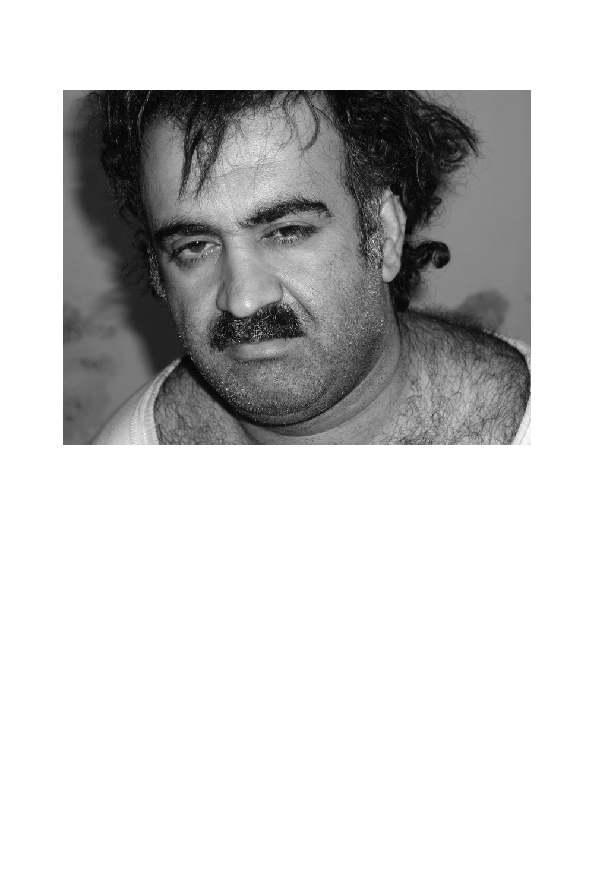
back at his government job in Qatar.Yousef attempted to follow through on
the cargo carriers plan, but he was arrested in Islamabad by Pakistani authori-
ties on February 7, 1995, after an accomplice turned him in.
8
KSM continued to travel among the worldwide jihadist community after
Yousef 's arrest, visiting the Sudan,Yemen, Malaysia, and Brazil in 1995. No clear
evidence connects him to terrorist activities in those locations.While in Sudan,
he reportedly failed in his attempt to meet with Bin Ladin. But KSM did see
Atef, who gave him a contact in Brazil. In January 1996, well aware that U.S.
authorities were chasing him, he left Qatar for good and fled to Afghanistan,
where he renewed his relationship with Rasul Sayyaf.
9
Just as KSM was reestablishing himself in Afghanistan in mid-1996, Bin
Ladin and his colleagues were also completing their migration from Sudan.
Through Atef, KSM arranged a meeting with Bin Ladin in Tora Bora, a moun-
tainous redoubt from the Afghan war days.At the meeting, KSM presented the
al Qaeda leader with a menu of ideas for terrorist operations. According to
KSM, this meeting was the first time he had seen Bin Ladin since 1989.
Although they had fought together in 1987, Bin Ladin and KSM did not yet
enjoy an especially close working relationship. Indeed, KSM has acknowledged
148
THE 9/11 COMMISSION REPORT
Khalid Sheikh Mohammed, mastermind of the 9/11 plot, at the time of his
capture in 2003
Final 5-7.5pp 7/17/04 11:46 AM Page 148

that Bin Ladin likely agreed to meet with him because of the renown of his
nephew,Yousef.
10
At the meeting, KSM briefed Bin Ladin and Atef on the first World Trade
Center bombing, the Manila air plot, the cargo carriers plan, and other activi-
ties pursued by KSM and his colleagues in the Philippines. KSM also presented
a proposal for an operation that would involve training pilots who would crash
planes into buildings in the United States. This proposal eventually would
become the 9/11 operation.
11
KSM knew that the successful staging of such an attack would require per-
sonnel, money, and logistical support that only an extensive and well-funded
organization like al Qaeda could provide. He thought the operation might
appeal to Bin Ladin, who had a long record of denouncing the United States.
12
From KSM's perspective, Bin Ladin was in the process of consolidating his
new position in Afghanistan while hearing out others' ideas, and had not yet
settled on an agenda for future anti-U.S. operations.At the meeting, Bin Ladin
listened to KSM's ideas without much comment, but did ask KSM formally to
join al Qaeda and move his family to Afghanistan.
13
KSM declined. He preferred to remain independent and retain the option
of working with other mujahideen groups still operating in Afghanistan,
including the group led by his old mentor, Sayyaf. Sayyaf was close to Ahmed
Shah Massoud, the leader of the Northern Alliance. Therefore working with
him might be a problem for KSM because Bin Ladin was building ties to the
rival Taliban.
After meeting with Bin Ladin, KSM says he journeyed onward to India,
Indonesia, and Malaysia, where he met with Jemaah Islamiah's Hambali. Ham-
bali was an Indonesian veteran of the Afghan war looking to expand the jihad
into Southeast Asia. In Iran, KSM rejoined his family and arranged to move
them to Karachi; he claims to have relocated by January 1997.
14
After settling his family in Karachi, KSM tried to join the mujahid leader Ibn
al Khattab in Chechnya. Unable to travel through Azerbaijan, KSM returned to
Karachi and then to Afghanistan to renew contacts with Bin Ladin and his col-
leagues.Though KSM may not have been a member of al Qaeda at this time, he
admits traveling frequently between Pakistan and Afghanistan in 1997 and the first
half of 1998, visiting Bin Ladin and cultivating relationships with his lieutenants,
Atef and Sayf al Adl, by assisting them with computer and media projects.
15
According to KSM, the 1998 bombings of the U.S. embassies in Nairobi
and Dar es Salaam marked a watershed in the evolution of the 9/11 plot.
KSM claims these bombings convinced him that Bin Ladin was truly com-
mitted to attacking the United States. He continued to make himself useful,
collecting news articles and helping other al Qaeda members with their out-
dated computer equipment. Bin Ladin, apparently at Atef 's urging, finally
decided to give KSM the green light for the 9/11 operation sometime in late
1998 or early 1999.
16
AL QAEDA AIMS AT THE AMERICAN HOMELAND
149
Final 5-7.5pp 7/17/04 11:46 AM Page 149

KSM then accepted Bin Ladin's standing invitation to move to Kandahar
and work directly with al Qaeda. In addition to supervising the planning and
preparations for the 9/11 operation, KSM worked with and eventually led al
Qaeda's media committee. But KSM states he refused to swear a formal oath
of allegiance to Bin Ladin, thereby retaining a last vestige of his cherished
autonomy.
17
At this point, late 1998 to early 1999, planning for the 9/11 operation began
in earnest.Yet while the 9/11 project occupied the bulk of KSM's attention,
he continued to consider other possibilities for terrorist attacks. For example,
he sent al Qaeda operative Issa al Britani to Kuala Lumpur, Malaysia, to learn
about the jihad in Southeast Asia from Hambali.Thereafter, KSM claims, at Bin
Ladin's direction in early 2001, he sent Britani to the United States to case
potential economic and "Jewish" targets in New York City. Furthermore, dur-
ing the summer of 2001, KSM approached Bin Ladin with the idea of recruit-
ing a Saudi Arabian air force pilot to commandeer a Saudi fighter jet and attack
the Israeli city of Eilat. Bin Ladin reportedly liked this proposal, but he
instructed KSM to concentrate on the 9/11 operation first. Similarly, KSM's
proposals to Atef around this same time for attacks in Thailand, Singapore,
Indonesia, and the Maldives were never executed, although Hambali's Jemaah
Islamiah operatives did some casing of possible targets.
18
KSM appears to have been popular among the al Qaeda rank and file. He
was reportedly regarded as an effective leader, especially after the 9/11 attacks.
Co-workers describe him as an intelligent, efficient, and even-tempered man-
ager who approached his projects with a single-minded dedication that he
expected his colleagues to share. Al Qaeda associate Abu Zubaydah has
expressed more qualified admiration for KSM's innate creativity, emphasiz-
ing instead his ability to incorporate the improvements suggested by others.
Nashiri has been similarly measured, observing that although KSM floated
many general ideas for attacks, he rarely conceived a specific operation him-
self.
19
Perhaps these estimates reflect a touch of jealousy; in any case, KSM
was plainly a capable coordinator, having had years to hone his skills and build
relationships.
Hambali
Al Qaeda's success in fostering terrorism in Southeast Asia stems largely from
its close relationship with Jemaah Islamiah (JI). In that relationship, Hambali
became the key coordinator. Born and educated in Indonesia, Hambali moved
to Malaysia in the early 1980s to find work.There he claims to have become
a follower of the Islamist extremist teachings of various clerics, including one
named Abdullah Sungkar. Sungkar first inspired Hambali to share the vision of
establishing a radical Islamist regime in Southeast Asia, then furthered Ham-
bali's instruction in jihad by sending him to Afghanistan in 1986.After under-
going training at Rasul Sayyaf 's Sada camp (where KSM would later train),
Hambali fought against the Soviets; he eventually returned to Malaysia after 18
150
THE 9/11 COMMISSION REPORT
Final 5-7.5pp 7/17/04 11:46 AM Page 150

months in Afghanistan. By 1998, Hambali would assume responsibility for the
Malaysia/Singapore region within Sungkar's newly formed terrorist organiza-
tion, the JI.
20
Also by 1998, Sungkar and JI spiritual leader Abu Bakar Bashir had accepted
Bin Ladin's offer to ally JI with al Qaeda in waging war against Christians and
Jews.
21
Hambali met with KSM in Karachi to arrange for JI members to receive
training in Afghanistan at al Qaeda's camps. In addition to his close working
relationship with KSM, Hambali soon began dealing with Atef as well. Al
Qaeda began funding JI's increasingly ambitious terrorist plans, which Atef and
KSM sought to expand. Under this arrangement, JI would perform the nec-
essary casing activities and locate bomb-making materials and other supplies.
Al Qaeda would underwrite operations, provide bomb-making expertise, and
deliver suicide operatives.
22
The al QaedaJI partnership yielded a number of proposals that would marry
al Qaeda's financial and technical strengths with JI's access to materials and local
operatives. Here, Hambali played the critical role of coordinator, as he distrib-
uted al Qaeda funds earmarked for the joint operations. In one especially notable
example,Atef turned to Hambali when al Qaeda needed a scientist to take over
its biological weapons program. Hambali obliged by introducing a U.S.-
educated JI member,Yazid Sufaat, to Ayman al Zawahiri in Kandahar. In 2001,
Sufaat would spend several months attempting to cultivate anthrax for al Qaeda
in a laboratory he helped set up near the Kandahar airport.
23
Hambali did not originally orient JI's operations toward attacking the
United States, but his involvement with al Qaeda appears to have inspired him
to pursue American targets. KSM, in his post-capture interrogations, has taken
credit for this shift, claiming to have urged the JI operations chief to concen-
trate on attacks designed to hurt the U.S. economy.
24
Hambali's newfound
interest in striking against the United States manifested itself in a spate of ter-
rorist plans. Fortunately, none came to fruition.
In addition to staging actual terrorist attacks in partnership with
al Qaeda, Hambali and JI assisted al Qaeda operatives passing through Kuala
Lumpur. One important occasion was in December 1999January 2000. Ham-
bali accommodated KSM's requests to help several veterans whom KSM had
just finished training in Karachi.They included Tawfiq bin Attash, also known
as Khallad, who later would help bomb the USS Cole, and future 9/11 hijack-
ers Nawaf al Hazmi and Khalid al Mihdhar. Hambali arranged lodging for them
and helped them purchase airline tickets for their onward travel. Later that year,
Hambali and his crew would provide accommodations and other assistance
(including information on flight schools and help in acquiring ammonium
nitrate) for Zacarias Moussaoui, an al Qaeda operative sent to Malaysia by Atef
and KSM.
25
Hambali used Bin Ladin's Afghan facilities as a training ground for JI
recruits.Though he had a close relationship with Atef and KSM, he maintained
JI's institutional independence from al Qaeda. Hambali insists that he did not
AL QAEDA AIMS AT THE AMERICAN HOMELAND
151
Final 5-7.5pp 7/17/04 11:46 AM Page 151

discuss operations with Bin Ladin or swear allegiance to him, having already
given such a pledge of loyalty to Bashir, Sungkar's successor as JI leader.Thus,
like any powerful bureaucrat defending his domain, Hambali objected when al
Qaeda leadership tried to assign JI members to terrorist projects without noti-
fying him.
26
Abd al Rahim al Nashiri
KSM and Hambali both decided to join forces with al Qaeda because their
terrorist aspirations required the money and manpower that only a robust
organization like al Qaeda could supply. On the other hand, Abd al Rahim al
Nashiri--the mastermind of the Cole bombing and the eventual head of al
Qaeda operations in the Arabian Peninsula--appears to have originally been
recruited to his career as a terrorist by Bin Ladin himself.
Having already participated in the Afghan jihad, Nashiri accompanied a
group of some 30 mujahideen in pursuit of jihad in Tajikistan in 1996.When
serious fighting failed to materialize, the group traveled to Jalalabad and
encountered Bin Ladin, who had recently returned from Sudan. Bin Ladin
addressed them at length, urging the group to join him in a "jihad against the
Americans." Although all were urged to swear loyalty to Bin Ladin, many,
including Nashiri, found the notion distasteful and refused. After several days
of indoctrination that included a barrage of news clippings and television doc-
umentaries, Nashiri left Afghanistan, first returning to his native Saudi Arabia
and then visiting his home in Yemen.There, he says, the idea for his first ter-
rorist operation took shape as he noticed many U.S. and other foreign ships
plying the waters along the southwest coast of Yemen.
27
Nashiri returned to Afghanistan, probably in 1997, primarily to check on rel-
atives fighting there and also to learn about the Taliban. He again encountered
Bin Ladin, still recruiting for "the coming battle with the United States." Nashiri
pursued a more conventional military jihad, joining the Taliban forces in their
fight against Ahmed Massoud's Northern Alliance and shuttling back and forth
between the front and Kandahar, where he would see Bin Ladin and meet with
other mujahideen. During this period, Nashiri also led a plot to smuggle four
Russian-made antitank missiles into Saudi Arabia from Yemen in early 1998 and
helped an embassy bombing operative obtain a Yemeni passport.
28
At some point, Nashiri joined al Qaeda. His cousin, Jihad Mohammad Ali
al Makki, also known as Azzam, was a suicide bomber for the Nairobi attack.
Nashiri traveled between Yemen and Afghanistan. In late 1998, Nashiri pro-
posed mounting an attack against a U.S. vessel. Bin Ladin approved. He directed
Nashiri to start the planning and send operatives to Yemen, and he later pro-
vided money.
29
Nashiri reported directly to Bin Ladin, the only other person who, accord-
ing to Nashiri, knew all the details of the operation.When Nashiri had diffi-
culty finding U.S. naval vessels to attack along the western coast of Yemen, Bin
152
THE 9/11 COMMISSION REPORT
Final 5-7.5pp 7/17/04 11:46 AM Page 152

Ladin reportedly instructed him to case the Port of Aden, on the southern
coast, instead.
30
The eventual result was an attempted attack on the USS The
Sullivans in January 2000 and the successful attack, in October 2000, on the
USS Cole.
Nashiri's success brought him instant status within al Qaeda. He later was
recognized as the chief of al Qaeda operations in and around the Arabian
Peninsula. While Nashiri continued to consult Bin Ladin on the planning of
subsequent terrorist projects, he retained discretion in selecting operatives and
devising attacks. In the two years between the Cole bombing and Nashiri's cap-
ture, he would supervise several more proposed operations for al Qaeda.The
October 6, 2002, bombing of the French tanker Limburg in the Gulf of Aden
also was Nashiri's handiwork. Although Bin Ladin urged Nashiri to continue
plotting strikes against U.S. interests in the Persian Gulf, Nashiri maintains that
he actually delayed one of these projects because of security concerns.
31
Those
concerns, it seems, were well placed, as Nashiri's November 2002 capture in
the United Arab Emirates finally ended his career as a terrorist.
5.2 THE "PLANES OPERATION"
According to KSM, he started to think about attacking the United States after
Yousef returned to Pakistan following the 1993 World Trade Center bombing.
Like Yousef, KSM reasoned he could best influence U.S. policy by targeting the
country's economy. KSM and Yousef reportedly brainstormed together about
what drove the U.S. economy. New York, which KSM considered the eco-
nomic capital of the United States, therefore became the primary target. For
similar reasons, California also became a target for KSM.
32
KSM claims that the earlier bombing of the World Trade Center taught him
that bombs and explosives could be problematic, and that he needed to grad-
uate to a more novel form of attack. He maintains that he and Yousef began
thinking about using aircraft as weapons while working on the Manila
air/Bojinka plot, and speculated about striking the World Trade Center and
CIA headquarters as early as 1995.
33
Certainly KSM was not alone in contemplating new kinds of terrorist oper-
ations.A study reportedly conducted by Atef, while he and Bin Ladin were still
in Sudan, concluded that traditional terrorist hijacking operations did not fit
the needs of al Qaeda, because such hijackings were used to negotiate the
release of prisoners rather than to inflict mass casualties. The study is said to
have considered the feasibility of hijacking planes and blowing them up in
flight, paralleling the Bojinka concept. Such a study, if it actually existed, yields
significant insight into the thinking of al Qaeda's leaders: (1) they rejected
hijackings aimed at gaining the release of imprisoned comrades as too com-
plex, because al Qaeda had no friendly countries in which to land a plane and
AL QAEDA AIMS AT THE AMERICAN HOMELAND
153
Final 5-7.5pp 7/17/04 11:46 AM Page 153

then negotiate; (2) they considered the bombing of commercial flights in
midair--as carried out against Pan Am Flight 103 over Lockerbie, Scotland--
a promising means to inflict massive casualties; and (3) they did not yet con-
sider using hijacked aircraft as weapons against other targets.
34
KSM has insisted to his interrogators that he always contemplated hijack-
ing and crashing large commercial aircraft. Indeed, KSM describes a grandiose
original plan: a total of ten aircraft to be hijacked, nine of which would crash
into targets on both coasts--they included those eventually hit on September
11 plus CIA and FBI headquarters, nuclear power plants, and the tallest build-
ings in California and the state of Washington. KSM himself was to land the
tenth plane at a U.S. airport and, after killing all adult male passengers on board
and alerting the media, deliver a speech excoriating U.S. support for Israel, the
Philippines, and repressive governments in the Arab world. Beyond KSM's
rationalizations about targeting the U.S. economy, this vision gives a better
glimpse of his true ambitions. This is theater, a spectacle of destruction with
KSM as the self-cast star--the superterrorist.
35
KSM concedes that this proposal received a lukewarm response from al
Qaeda leaders skeptical of its scale and complexity.Although Bin Ladin listened
to KSM's proposal, he was not convinced that it was practical. As mentioned
earlier, Bin Ladin was receiving numerous ideas for potential operations--
KSM's proposal to attack U.S. targets with commercial airplanes was only one
of many.
36
KSM presents himself as an entrepreneur seeking venture capital and peo-
ple. He simply wanted al Qaeda to supply the money and operatives needed
for the attack while retaining his independence. It is easy to question such a
statement. Money is one thing; supplying a cadre of trained operatives willing
to die is much more.Thus, although KSM contends he would have been just
as likely to consider working with any comparable terrorist organization, he
gives no indication of what other groups he thought could supply such excep-
tional commodities.
37
KSM acknowledges formally joining al Qaeda, in late 1998 or 1999, and
states that soon afterward, Bin Ladin also made the decision to support his pro-
posal to attack the United States using commercial airplanes as weapons.
Though KSM speculates about how Bin Ladin came to share his preoccupa-
tion with attacking America, Bin Ladin in fact had long been an opponent of
the United States. KSM thinks that Atef may have persuaded Bin Ladin to
approve this specific proposal.Atef 's role in the entire operation is unquestion-
ably very significant but tends to fade into the background, in part because Atef
himself is not available to describe it. He was killed in November 2001 by an
American air strike in Afghanistan.
38
Bin Ladin summoned KSM to Kandahar in March or April 1999 to tell him
that al Qaeda would support his proposal.The plot was now referred to within
al Qaeda as the "planes operation."
39
154
THE 9/11 COMMISSION REPORT
Final 5-7.5pp 7/17/04 11:46 AM Page 154

The Plan Evolves
Bin Ladin reportedly discussed the planes operation with KSM and Atef in a
series of meetings in the spring of 1999 at the al Matar complex near Kanda-
har. KSM's original concept of using one of the hijacked planes to make a media
statement was scrapped, but Bin Ladin considered the basic idea feasible. Bin
Ladin, Atef, and KSM developed an initial list of targets. These included the
White House, the U.S. Capitol, the Pentagon, and the World Trade Center.
According to KSM, Bin Ladin wanted to destroy the White House and the Pen-
tagon, KSM wanted to strike the World Trade Center, and all of them wanted
to hit the Capitol. No one else was involved in the initial selection of targets.
40
Bin Ladin also soon selected four individuals to serve as suicide operatives:
Khalid al Mihdhar, Nawaf al Hazmi, Khallad, and Abu Bara al Yemeni. During
the al Matar meetings, Bin Ladin told KSM that Mihdhar and Hazmi were so
eager to participate in an operation against the United States that they had
already obtained U.S. visas. KSM states that they had done so on their own after
the suicide of their friend Azzam (Nashiri's cousin) in carrying out the Nairobi
bombing. KSM had not met them. His only guidance from Bin Ladin was that
the two should eventually go to the United States for pilot training.
41
Hazmi and Mihdhar were Saudi nationals, born in Mecca. Like the others
in this initial group of selectees, they were already experienced mujahideen.
They had traveled together to fight in Bosnia in a group that journeyed to the
Balkans in 1995. By the time Hazmi and Mihdhar were assigned to the planes
operation in early 1999, they had visited Afghanistan on several occasions.
42
Khallad was another veteran mujahid, like much of his family. His father had
been expelled from Yemen because of his extremist views. Khallad had grown
up in Saudi Arabia, where his father knew Bin Ladin, Abdullah Azzam, and
Omar Abdel Rahman (the "Blind Sheikh"). Khallad departed for Afghanistan
in 1994 at the age of 15.Three years later, he lost his lower right leg in a bat-
tle with the Northern Alliance, a battle in which one of his brothers died.After
this experience, he pledged allegiance to Bin Ladin--whom he had first met
as a child in Jeddah--and volunteered to become a suicide operative.
43
When Khallad applied for a U.S. visa, however, his application was denied.
Earlier in 1999, Bin Ladin had sent Khallad to Yemen to help Nashiri obtain
explosives for the planned ship-bombing and to obtain a visa to visit the United
States, so that he could participate in an operation there. Khallad applied under
another name, using the cover story that he would be visiting a medical clinic
to obtain a new prosthesis for his leg. Another al Qaeda operative gave Khal-
lad the name of a person living in the United States whom Khallad could use
as a point of contact on a visa application. Khallad contacted this individual to
help him get an appointment at a U.S. clinic. While Khallad was waiting for
the letter from the clinic confirming the appointment, however, he was
arrested by Yemeni authorities.The arrest resulted from mistaken identity: Khal-
lad was driving the car of another conspirator in the ship-bombing plot who
was wanted by the Yemeni authorities.
44
AL QAEDA AIMS AT THE AMERICAN HOMELAND
155
Final 5-7.5pp 7/17/04 11:46 AM Page 155

Khallad was released sometime during the summer of 1999, after his father
and Bin Ladin intervened on his behalf. Khallad learned later that the al Qaeda
leader, apparently concerned that Khallad might reveal Nashiri's operation
while under interrogation, had contacted a Yemeni official to demand Khal-
lad's release, suggesting that Bin Ladin would not confront the Yemenis if they
did not confront him. This account has been corroborated by others. Giving
up on acquiring a U.S. visa and concerned that the United States might learn
of his ties to al Qaeda, Khallad returned to Afghanistan.
45
Travel issues thus played a part in al Qaeda's operational planning from the
very start. During the spring and summer of 1999, KSM realized that Khallad
and Abu Bara, both of whom were Yemenis, would not be able to obtain U.S.
visas as easily as Saudi operatives like Mihdhar and Hazmi. Although Khallad
had been unable to acquire a U.S. visa, KSM still wanted him and Abu Bara, as
well as another Yemeni operative from Bin Ladin's security detail, to partici-
pate in the planes operation.Yet because individuals with Saudi passports could
travel much more easily than Yemeni, particularly to the United States, there
were fewer martyrdom opportunities for Yemenis.To overcome this problem,
KSM decided to split the planes operation into two components.
46
The first part of the planes operation--crashing hijacked aircraft into U.S.
targets--would remain as planned, with Mihdhar and Hazmi playing key roles.
The second part, however, would now embrace the idea of using suicide oper-
atives to blow up planes, a refinement of KSM's old Manila air plot.The oper-
atives would hijack U.S.-flagged commercial planes flying Pacific routes across
East Asia and destroy them in midair, possibly with shoe bombs, instead of fly-
ing them into targets. (An alternate scenario apparently involved flying planes
into U.S. targets in Japan, Singapore, or Korea.) This part of the operation has
been confirmed by Khallad, who said that they contemplated hijacking several
planes, probably originating in Thailand, South Korea, Hong Kong, or
Malaysia, and using Yemenis who would not need pilot training because they
would simply down the planes.All the planes hijacked in the United States and
East Asia were to be crashed or exploded at about the same time to maximize
the attack's psychological impact.
47
Training and Deployment to Kuala Lumpur
In the fall of 1999, the four operatives selected by Bin Ladin for the planes oper-
ation were chosen to attend an elite training course at al Qaeda's Mes Aynak
camp in Afghanistan. Bin Ladin personally selected the veteran fighters who
received this training, and several of them were destined for important opera-
tions. One example is Ibrahim al Thawar, or Nibras, who would participate in
the October 12, 2000, suicide attack on the USS Cole.According to KSM, this
training was not given specifically in preparation for the planes operation or
any other particular al Qaeda venture. Although KSM claims not to have been
involved with the training or to have met with the future 9/11 hijackers at Mes
156
THE 9/11 COMMISSION REPORT
Final 5-7.5pp 7/17/04 11:46 AM Page 156

Aynak, he says he did visit the camp while traveling from Kandahar to Kabul
with Bin Ladin and others.
48
The Mes Aynak training camp was located in an abandoned Russian cop-
per mine near Kabul. The camp opened in 1999, after the United States had
destroyed the training camp near Khowst with cruise missiles in August 1998,
and before the Taliban granted al Qaeda permission to open the al Faruq camp
in Kandahar.Thus, for a brief period in 1999, Mes Aynak was the only al Qaeda
camp operating in Afghanistan. It offered a full range of instruction, including
an advanced commando course taught by senior al Qaeda member Sayf al Adl.
Bin Ladin paid particular attention to the 1999 training session.When Salah al
Din, the trainer for the session, complained about the number of trainees and
said that no more than 20 could be handled at once, Bin Ladin insisted that
everyone he had selected receive the training.
49
The special training session at Mes Aynak was rigorous and spared no
expense.The course focused on physical fitness, firearms, close quarters com-
bat, shooting from a motorcycle, and night operations. Although the subjects
taught differed little from those offered at other camps, the course placed
extraordinary physical and mental demands on its participants, who received
the best food and other amenities to enhance their strength and morale.
50
Upon completing the advanced training at Mes Aynak, Hazmi, Khallad, and
Abu Bara went to Karachi, Pakistan.There KSM instructed them on Western
culture and travel. Much of his activity in mid-1999 had revolved around the
collection of training and informational materials for the participants in the
planes operation. For instance, he collected Western aviation magazines; tele-
phone directories for American cities such as San Diego and Long Beach, Cal-
ifornia; brochures for schools; and airline timetables, and he conducted
Internet searches on U.S. flight schools. He also purchased flight simulator soft-
ware and a few movies depicting hijackings.To house his students, KSM rented
a safehouse in Karachi with money provided by Bin Ladin.
51
In early December 1999, Khallad and Abu Bara arrived in Karachi. Hazmi
joined them there a few days later. On his way to Karachi, Hazmi spent a night
in Quetta at a safehouse where, according to KSM, an Egyptian named
Mohamed Atta simultaneously stayed on his way to Afghanistan for jihad
training.
52
Mihdhar did not attend the training in Karachi with the others. KSM says
that he never met with Mihdhar in 1999 but assumed that Bin Ladin and Atef
had briefed Mihdhar on the planes operation and had excused him from the
Karachi training.
53
The course in Karachi apparently lasted about one or two weeks.According
to KSM, he taught the three operatives basic English words and phrases. He
showed them how to read phone books,interpret airline timetables,use the Inter-
net, use code words in communications, make travel reservations, and rent an
apartment. Khallad adds that the training involved using flight simulator com-
AL QAEDA AIMS AT THE AMERICAN HOMELAND
157
Final 5-7.5pp 7/17/04 11:46 AM Page 157

puter games, viewing movies that featured hijackings, and reading flight sched-
ules to determine which flights would be in the air at the same time in different
parts of the world.They used the game software to increase their familiarity with
aircraft models and functions, and to highlight gaps in cabin security.While in
Karachi, they also discussed how to case flights in Southeast Asia. KSM told them
to watch the cabin doors at takeoff and landing, to observe whether the captain
went to the lavatory during the flight, and to note whether the flight attendants
brought food into the cockpit. KSM, Khallad, and Hazmi also visited travel agen-
cies to learn the visa requirements for Asian countries.
54
The four trainees traveled to Kuala Lumpur: Khallad,Abu Bara, and Hazmi
came from Karachi; Mihdhar traveled from Yemen. As discussed in chapter 6,
U.S. intelligence would analyze communications associated with Mihdhar,
whom they identified during this travel, and Hazmi, whom they could have
identified but did not.
55
According to KSM, the four operatives were aware that they had volun-
teered for a suicide operation, either in the United States or in Asia.With dif-
ferent roles, they had different tasks. Hazmi and Mihdhar were sent to Kuala
Lumpur before proceeding to their final destination--the United States.
According to KSM, they were to use Yemeni documents to fly to Malaysia, then
proceed to the United States using their Saudi passports to conceal their prior
travels to and from Pakistan. KSM had doctored Hazmi's Saudi passport so it
would appear as if Hazmi had traveled to Kuala Lumpur from Saudi Arabia via
Dubai. Khallad and Abu Bara went to Kuala Lumpur to study airport security
and conduct casing flights.According to Khallad, he and Abu Bara departed for
Malaysia in mid-December 1999. Hazmi joined them about ten days later after
briefly returning to Afghanistan to attend to some passport issues.
56
Khallad had originally scheduled his trip in order to receive a new prosthe-
sis at a Kuala Lumpur clinic called Endolite, and Bin Ladin suggested that he
use the opportunity to case flights as well.According to Khallad, Malaysia was
an ideal destination because its government did not require citizens of Saudi
Arabia or other Gulf states to have a visa. Malaysian security was reputed to be
lax when it came to Islamist jihadists.Also, other mujahideen wounded in com-
bat had reportedly received treatment at the Endolite clinic and successfully
concealed the origins of their injuries. Khallad said he got the money for the
prosthesis from his father, Bin Ladin, and another al Qaeda colleague.
57
According to Khallad, when he and Abu Bara arrived in Kuala Lumpur they
contacted Hambali to let him know where they were staying, since he was to
be kept informed of al Qaeda activities in Southeast Asia. Hambali picked up
Khallad and Abu Bara and brought them to his home, enlisting the help of a
colleague who spoke better Arabic. Hambali then took them to the clinic.
58
On December 31, Khallad flew from Kuala Lumpur to Bangkok; the next
day, he flew to Hong Kong aboard a U.S. airliner. He flew in first class, which
he realized was a mistake because this seating assignment on that flight did not
afford him a view of the cockpit. He claims to have done what he could to case
158
THE 9/11 COMMISSION REPORT
Final 5-7.5pp 7/17/04 11:46 AM Page 158

the flight, testing security by carrying a box cutter in his toiletries kit onto the
flight to Hong Kong. Khallad returned to Bangkok the following day. At the
airport, the security officials searched his carry-on bag and even opened the toi-
letries kit, but just glanced at the contents and let him pass. On this flight, Khal-
lad waited until most of the first-class passengers were dozing, then got up and
removed the kit from his carry-on. None of the flight attendants took notice.
59
After completing his casing mission, Khallad returned to Kuala Lumpur.
Hazmi arrived in Kuala Lumpur soon thereafter and may even have stayed
briefly with Khallad and Abu Bara at Endolite. Mihdhar arrived on January 5,
probably one day after Hazmi. All four operatives stayed at the apartment of
Yazid Sufaat, the Malaysian JI member who made his home available at Ham-
bali's request. According to Khallad, he and Hazmi spoke about the possibility
of hijacking planes and crashing them or holding passengers as hostages, but
only speculatively. Khallad admits being aware at the time that Hazmi and
Mihdhar were involved in an operation involving planes in the United States
but denies knowing details of the plan.
60
While in Kuala Lumpur, Khallad wanted to go to Singapore to meet Nibras
and Fahd al Quso, two of the operatives in Nashiri's ship-bombing operation.
An attempt to execute that plan by attacking the USS The Sullivans had failed
just a few days earlier. Nibras and Quso were bringing Khallad money from
Yemen, but were stopped in Bangkok because they lacked visas to continue on
to Singapore. Also unable to enter Singapore, Khallad moved the meeting to
Bangkok. Hazmi and Mihdhar decided to go there as well, reportedly because
they thought it would enhance their cover as tourists to have passport stamps
from a popular tourist destination such as Thailand.With Hambali's help, the
three obtained tickets for a flight to Bangkok and left Kuala Lumpur together.
Abu Bara did not have a visa permitting him to return to Pakistan, so he trav-
eled to Yemen instead.
61
In Bangkok, Khallad took Hazmi and Mihdhar to one hotel, then went to
another hotel for his meeting on the maritime attack plan. Hazmi and Mihd-
har soon moved to that same hotel, but Khallad insists that the two sets of oper-
atives never met with each other or anyone else. After conferring with the
ship-bombing operatives, Khallad returned to Karachi and then to Kandahar,
where he reported on his casing mission to Bin Ladin.
62
Bin Ladin canceled the East Asia part of the planes operation in the spring
of 2000. He evidently decided it would be too difficult to coordinate this attack
with the operation in the United States. As for Hazmi and Mihdhar, they had
left Bangkok a few days before Khallad and arrived in Los Angeles on January
15, 2000.
63
Meanwhile, the next group of al Qaeda operatives destined for the planes
operation had just surfaced in Afghanistan. As Hazmi and Mihdhar were
deploying from Asia to the United States, al Qaeda's leadership was recruiting
and training four Western-educated men who had recently arrived in Kanda-
har.Though they hailed from four different countries--Egypt, the United Arab
AL QAEDA AIMS AT THE AMERICAN HOMELAND
159
Final 5-7.5pp 7/17/04 11:46 AM Page 159

Emirates, Lebanon, and Yemen--they had formed a close-knit group as stu-
dents in Hamburg, Germany.The new recruits had come to Afghanistan aspir-
ing to wage jihad in Chechnya. But al Qaeda quickly recognized their
potential and enlisted them in its anti-U.S. jihad.
5.3 THE HAMBURG CONTINGENT
Although Bin Ladin,Atef, and KSM initially contemplated using established al
Qaeda members to execute the planes operation, the late 1999 arrival in Kan-
dahar of four aspiring jihadists from Germany suddenly presented a more
attractive alternative. The Hamburg group shared the anti-U.S. fervor of the
other candidates for the operation, but added the enormous advantages of flu-
ency in English and familiarity with life in the West, based on years that each
member of the group had spent living in Germany. Not surprisingly,
Mohamed Atta, Ramzi Binalshibh, Marwan al Shehhi, and Ziad Jarrah would
all become key players in the 9/11 conspiracy.
Mohamed Atta
Mohamed Atta was born on September 1, 1968, in Kafr el Sheikh, Egypt, to a
middle-class family headed by his father, an attorney. After graduating from
Cairo University with a degree in architectural engineering in 1990, Atta
worked as an urban planner in Cairo for a couple of years. In the fall of 1991,
he asked a German family he had met in Cairo to help him continue his edu-
cation in Germany.They suggested he come to Hamburg and invited him to
live with them there, at least initially.After completing a course in German,Atta
traveled to Germany for the first time in July 1992. He resided briefly in
Stuttgart and then, in the fall of 1992, moved to Hamburg to live with his host
family. After enrolling at the University of Hamburg, he promptly transferred
into the city engineering and planning course at the Technical University of
Hamburg-Harburg, where he would remain registered as a student until the fall
of 1999. He appears to have applied himself fairly seriously to his studies (at least
in comparison to his jihadist friends) and actually received his degree shortly
before traveling to Afghanistan. In school, Atta came across as very intelligent
and reasonably pleasant, with an excellent command of the German language.
64
When Atta arrived in Germany, he appeared religious, but not fanatically
so. This would change, especially as his tendency to assert leadership became
increasingly pronounced.According to Binalshibh, as early as 1995 Atta sought
to organize a Muslim student association in Hamburg. In the fall of 1997, he
joined a working group at the Quds mosque in Hamburg, a group designed
to bridge the gap between Muslims and Christians.Atta proved a poor bridge,
however, because of his abrasive and increasingly dogmatic personality. But
160
THE 9/11 COMMISSION REPORT
Final 5-7.5pp 7/17/04 11:46 AM Page 160

among those who shared his beliefs, Atta stood out as a decisionmaker. Atta's
friends during this period remember him as charismatic, intelligent, and per-
suasive, albeit intolerant of dissent.
65
In his interactions with other students, Atta voiced virulently anti-Semitic
and anti-American opinions, ranging from condemnations of what he
described as a global Jewish movement centered in New York City that sup-
posedly controlled the financial world and the media, to polemics against gov-
ernments of the Arab world.To him, Saddam Hussein was an American stooge
set up to give Washington an excuse to intervene in the Middle East.Within
his circle,Atta advocated violent jihad. He reportedly asked one individual close
to the group if he was "ready to fight for [his] belief " and dismissed him as too
weak for jihad when the person declined. On a visit home to Egypt in 1998,
Atta met one of his college friends. According to this friend, Atta
had changed a great deal, had grown a beard, and had "obviously adopted fun-
damentalism" by that time.
66
Ramzi Binalshibh
Ramzi Binalshibh was born on May 1,1972,in Ghayl Bawazir,Yemen.There does
not seem to be anything remarkable about his family or early background.A friend
who knew Binalshibh in Yemen remembers him as "religious, but not too reli-
gious." From 1987 to 1995, Binalshibh worked as a clerk for the International
Bank of Yemen. He first attempted to leave Yemen in 1995, when he applied for
a U.S. visa. After his application was rejected, he went to Germany and applied
for asylum under the name Ramzi Omar, claiming to be a Sudanese citizen seek-
ing asylum.While his asylum petition was pending, Binalshibh lived in Hamburg
and associated with individuals from several mosques there. In 1997, after his
asylum application was denied, Binalshibh went home to Yemen but returned to
Germany shortly thereafter under his true name, this time registering as a student
in Hamburg. Binalshibh continually had academic problems, failing tests and cut-
ting classes; he was expelled from one school in September 1998.
67
According to Binalshibh, he and Atta first met at a mosque in Hamburg in
1995. The two men became close friends and became identified with their
shared extremist outlook. Like Atta, by the late 1990s Binalshibh was decrying
what he perceived to be a "Jewish world conspiracy." He proclaimed that the
highest duty of every Muslim was to pursue jihad, and that the highest honor
was to die during the jihad. Despite his rhetoric, however, Binalshibh presented
a more amiable figure than the austere Atta, and was known within the com-
munity as being sociable, extroverted, polite, and adventuresome.
68
In 1998, Binalshibh and Atta began sharing an apartment in the Harburg sec-
tion of Hamburg, together with a young student from the United Arab Emi-
rates named Marwan al Shehhi.
69
AL QAEDA AIMS AT THE AMERICAN HOMELAND
161
Final 5-7.5pp 7/17/04 11:46 AM Page 161

Marwan al Shehhi
Marwan al Shehhi was born on May 9, 1978, in Ras al Khaimah, the United
Arab Emirates. His father, who died in 1997, was a prayer leader at the local
mosque. After graduating from high school in 1995, Shehhi joined the Emi-
rati military and received half a year of basic training before gaining admis-
sion to a military scholarship program that would fund his continued study in
Germany.
70
Shehhi first entered Germany in April 1996. After sharing an apartment in
Bonn for two months with three other scholarship students, Shehhi moved in
with a German family, with whom he resided for several months before mov-
ing into his own apartment. During this period, he came across as very reli-
gious, praying five times a day. Friends also remember him as convivial and "a
regular guy," wearing Western clothes and occasionally renting cars for trips to
Berlin, France, and the Netherlands.
71
As a student, Shehhi was less than a success. Upon completing a course in
German, he enrolled at the University of Bonn in a program for technical,
mathematical, and scientific studies. In June 1997, he requested a leave from his
studies, citing the need to attend to unspecified "problems" in his home coun-
try.Although the university denied his request, Shehhi left anyway, and conse-
quently was compelled to repeat the first semester of his studies. In addition to
having academic difficulties at this time, Shehhi appeared to become more
extreme in the practice of his faith; for example, he specifically avoided restau-
rants that cooked with or served alcohol. In late 1997, he applied for permis-
sion to complete his course work in Hamburg, a request apparently motivated
by his desire to join Atta and Binalshibh. Just how and when the three of them
first met remains unclear, although they seemed to know each other already
when Shehhi relocated to Hamburg in early 1998.Atta and Binalshibh moved
into his apartment in April.
72
The transfer to Hamburg did not help Shehhi's academic progress; he was
directed by the scholarship program administrators at the Emirati embassy to
repeat his second semester starting in August 1998, but back in Bonn. Shehhi
initially flouted this directive, however, and did not reenroll at the University
of Bonn until the following January, barely passing his course there. By the end
of July 1999, he had returned to Hamburg, applying to study shipbuilding at
the Technical University and, more significantly, residing once again with Atta
and Binalshibh, in an apartment at 54 Marienstrasse.
73
After Shehhi moved in with Atta and Binalshibh, his evolution toward
Islamic fundamentalism became more pronounced. A fellow Emirati student
who came to Hamburg to visit Shehhi noticed he no longer lived as comfort-
ably as before. Shehhi now occupied an old apartment with a roommate, had
no television, and wore inexpensive clothes.When asked why he was living so
frugally, Shehhi responded that he was living the way the Prophet had lived.
74
Similarly, when someone asked why he and Atta never laughed, Shehhi
retorted,"How can you laugh when people are dying in Palestine?"
75
162
THE 9/11 COMMISSION REPORT
Final 5-7.5pp 7/17/04 11:46 AM Page 162

Ziad Jarrah
Born on May 11, 1975, in Mazraa, Lebanon, Ziad Jarrah came from an afflu-
ent family and attended private, Christian schools. Like Atta, Binalshibh, and
Shehhi, Jarrah aspired to pursue higher education in Germany. In April 1996,
he and a cousin enrolled at a junior college in Greifswald, in northeastern Ger-
many.There Jarrah met and became intimate with Aysel Senguen, the daugh-
ter of Turkish immigrants, who was preparing to study dentistry.
76
Even with the benefit of hindsight, Jarrah hardly seems a likely candidate
for becoming an Islamic extremist. Far from displaying radical beliefs when he
first moved to Germany, he arrived with a reputation for knowing where to
find the best discos and beaches in Beirut, and in Greifswald was known to
enjoy student parties and drinking beer. Although he continued to share an
apartment in Greifswald with his cousin, Jarrah was mostly at Senguen's apart-
ment.Witnesses interviewed by German authorities after 9/11, however, recall
that Jarrah started showing signs of radicalization as early as the end of 1996.
After returning from a trip home to Lebanon, Jarrah started living more strictly
according to the Koran. He read brochures in Arabic about jihad, held forth to
friends on the subject of holy war, and professed disaffection with his previous
life and a desire not to leave the world "in a natural way."
77
In September 1997, Jarrah abruptly switched his intended course of study
from dentistry to aircraft engineering--at the Technical University of
Hamburg-Harburg. His motivation for this decision remains unclear. The
rationale he expressed to Senguen--that he had been interested in aviation
since playing with toy airplanes as a child--rings somewhat hollow. In any
event, Jarrah appears already to have had Hamburg contacts by this time, some
of whom may have played a role in steering him toward Islamic extremism.
78
Following his move to Hamburg that fall, he began visiting Senguen in
Greifswald on weekends, until she moved to the German city of Bochum one
year later to enroll in dental school.Around the same time, he began speaking
increasingly about religion, and his visits to Senguen became less and less fre-
quent. He began criticizing her for not being religious enough and for dress-
ing too provocatively. He grew a full beard and started praying regularly. He
refused to introduce her to his Hamburg friends because, he told her, they were
religious Muslims and her refusal to become more observant embarrassed him.
At some point in 1999, Jarrah told Senguen that he was planning to wage a
jihad because there was no greater honor than to die for Allah. Although Jar-
rah's transformation generated numerous quarrels, their breakups invariably
were followed by reconciliation.
79
Forming a Cell
In Hamburg, Jarrah had a succession of living accommodations, but he appar-
ently never resided with his future co-conspirators. It is not clear how and
when he became part of Atta's circle. He became particularly friendly with
Binalshibh after meeting him at the Quds mosque in Hamburg, which Jarrah
AL QAEDA AIMS AT THE AMERICAN HOMELAND
163
Final 5-7.5pp 7/17/04 11:46 AM Page 163

began attending regularly in late 1997.The worshippers at this mosque featured
an outspoken, flamboyant Islamist named Mohammed Haydar Zammar. A
well-known figure in the Muslim community (and to German and U.S. intel-
ligence agencies by the late 1990s), Zammar had fought in Afghanistan and rel-
ished any opportunity to extol the virtues of violent jihad. Indeed, a witness
has reported hearing Zammar press Binalshibh to fulfill his duty to wage jihad.
Moreover, after 9/11, Zammar reportedly took credit for influencing
not just Binalshibh but the rest of the Hamburg group. In 1998, Zammar
encouraged them to participate in jihad and even convinced them to go to
Afghanistan.
80
Owing to Zammar's persuasion or some other source of inspiration, Atta,
Binalshibh, Shehhi, and Jarrah eventually prepared themselves to translate their
extremist beliefs into action. By late 1999, they were ready to abandon their
student lives in Germany in favor of violent jihad.This final stage in their evo-
lution toward embracing Islamist extremism did not entirely escape the notice
of the people around them.The foursome became core members of a group
of radical Muslims, often hosting sessions at their Marienstrasse apartment that
involved extremely anti-American discussions. Meeting three to four times a
week, the group became something of a "sect" whose members, according to
one participant in the meetings, tended to deal only with each other.
81
Atta's
rent checks for the apartment provide evidence of the importance that the
apartment assumed as a center for the group, as he would write on them the
notation "Dar el Ansar," or "house of the followers."
82
In addition to Atta, Binalshibh, Shehhi, and Jarrah, the group included other
extremists, some of whom also would attend al Qaeda training camps and, in
some instances, would help the 9/11 hijackers as they executed the plot:
· Said Bahaji, son of a Moroccan immigrant, was the only German cit-
izen in the group. Educated in Morocco, Bahaji returned to Germany
to study electrical engineering at the Technical University of
Hamburg-Harburg. He spent five months in the German army
before obtaining a medical discharge, and lived with Atta and Binal-
shibh at 54 Marienstrasse for eight months between November 1998
and July 1999. Described as an insecure follower with no personality
and with limited knowledge of Islam, Bahaji nonetheless professed his
readiness to engage in violence.Atta and Binalshibh used Bahaji's com-
puter for Internet research, as evidenced by documents and diskettes
seized by German authorities after 9/11.
83
· Zakariya Essabar, a Moroccan citizen, moved to Germany in Febru-
ary 1997 and to Hamburg in 1998, where he studied medical tech-
nology. Soon after moving to Hamburg, Essabar met Binalshibh and
the others through a Turkish mosque. Essabar turned extremist fairly
suddenly, probably in 1999, and reportedly pressured one acquain-
tance with physical force to become more religious, grow a beard, and
164
THE 9/11 COMMISSION REPORT
Final 5-7.5pp 7/17/04 11:46 AM Page 164

compel his wife to convert to Islam. Essabar's parents were said to have
made repeated but unsuccessful efforts to sway him from this lifestyle.
Shortly before the 9/11 attacks, he would travel to Afghanistan to
communicate the date for the attacks to the al Qaeda leadership.
84
· Mounir el Motassadeq, another Moroccan, came to Germany in 1993,
moving to Hamburg two years later to study electrical engineering at
the Technical University.A witness has recalled Motassadeq saying that
he would kill his entire family if his religious beliefs demanded it. One
of Motassadeq's roommates recalls him referring to Hitler as a "good
man" and organizing film sessions that included speeches by Bin
Ladin. Motassadeq would help conceal the Hamburg group's trip to
Afghanistan in late 1999.
85
· Abdelghani Mzoudi, also a Moroccan, arrived in Germany in the
summer of 1993, after completing university courses in physics and
chemistry. Mzoudi studied in Dortmund, Bochum, and Muenster
before moving to Hamburg in 1995. Mzoudi described himself as a
weak Muslim when he was home in Morocco, but much more devout
when he was back in Hamburg. In April 1996, Mzoudi and Motas-
sadeq witnessed the execution of Atta's will.
86
During the course of 1999, Atta and his group became ever more extreme
and secretive, speaking only in Arabic to conceal the content of their conver-
sations.
87
When the four core members of the Hamburg cell left Germany to
journey to Afghanistan late that year, it seems unlikely that they already knew
about the planes operation; no evidence connects them to al Qaeda before that
time. Witnesses have attested, however, that their pronouncements reflected
ample predisposition toward taking some action against the United States.
88
In
short, they fit the bill for Bin Ladin, Atef, and KSM.
Going to Afghanistan
The available evidence indicates that in 1999,Atta, Binalshibh, Shehhi, and Jar-
rah decided to fight in Chechnya against the Russians. According to Binal-
shibh, a chance meeting on a train in Germany caused the group to travel to
Afghanistan instead. An individual named Khalid al Masri approached Binal-
shibh and Shehhi (because they were Arabs with beards, Binalshibh thinks) and
struck up a conversation about jihad in Chechnya.When they later called Masri
and expressed interest in going to Chechnya, he told them to contact Abu
Musab in Duisburg, Germany. Abu Musab turned out to be Mohamedou
Ould Slahi, a significant al Qaeda operative who, even then, was well known
to U.S. and German intelligence, though neither government apparently knew
he was operating in Germany in late 1999. When telephoned by Binalshibh
and Shehhi, Slahi reportedly invited these promising recruits to come see him
in Duisburg.
89
Binalshibh, Shehhi, and Jarrah made the trip. When they arrived, Slahi
AL QAEDA AIMS AT THE AMERICAN HOMELAND
165
Final 5-7.5pp 7/17/04 11:46 AM Page 165

explained that it was difficult to get to Chechnya at that time because many
travelers were being detained in Georgia. He recommended they go to
Afghanistan instead, where they could train for jihad before traveling onward
to Chechnya. Slahi instructed them to obtain Pakistani visas and then return
to him for further directions on how to reach Afghanistan. Although Atta did
not attend the meeting, he joined in the plan with the other three.After obtain-
ing the necessary visas, they received Slahi's final instructions on how to travel
to Karachi and then Quetta, where they were to contact someone named Umar
al Masri at the Taliban office.
90
Following Slahi's advice,Atta and Jarrah left Hamburg during the last week
of November 1999, bound for Karachi. Shehhi left for Afghanistan around the
same time; Binalshibh, about two weeks later. Binalshibh remembers that when
he arrived at the Taliban office in Quetta, there was no one named Umar al
Masri.The name, apparently, was simply a code; a group of Afghans from the
office promptly escorted him to Kandahar.There Binalshibh rejoined Atta and
Jarrah, who said they already had pledged loyalty to Bin Ladin and urged him
to do the same.They also informed him that Shehhi had pledged as well and
had already left for the United Arab Emirates to prepare for the mission. Binal-
shibh soon met privately with Bin Ladin, accepted the al Qaeda leader's invi-
tation to work under him, and added his own pledge to those of his Hamburg
colleagues. By this time, Binalshibh claims, he assumed he was volunteering for
a martyrdom operation.
91
Atta, Jarrah, and Binalshibh then met with Atef, who told them they were
about to undertake a highly secret mission. As Binalshibh tells it, Atef
instructed the three to return to Germany and enroll in flight training.Atta--
whom Bin Ladin chose to lead the group--met with Bin Ladin several times
to receive additional instructions, including a preliminary list of approved tar-
gets: the World Trade Center, the Pentagon, and the U.S. Capitol.
92
The new
recruits also learned that an individual named Rabia al Makki (Nawaf al
Hazmi) would be part of the operation.
93
In retrospect, the speed with which Atta, Shehhi, Jarrah, and Binalshibh
became core members of the 9/11 plot--with Atta designated its operational
leader--is remarkable.They had not yet met with KSM when all this occurred.
It is clear, then, that Bin Ladin and Atef were very much in charge of the oper-
ation.That these candidates were selected so quickly--before comprehensive
testing in the training camps or in operations--demonstrates that Bin Ladin
and Atef probably already understood the deficiencies of their initial team,
Hazmi and Mihdhar.The new recruits from Germany possessed an ideal com-
bination of technical skill and knowledge that the original 9/11 operatives, vet-
eran fighters though they were, lacked. Bin Ladin and Atef wasted no time in
assigning the Hamburg group to the most ambitious operation yet planned by
al Qaeda.
Bin Ladin and Atef also plainly judged that Atta was best suited to be the
166
THE 9/11 COMMISSION REPORT
Final 5-7.5pp 7/17/04 11:46 AM Page 166

tactical commander of the operation. Such a quick and critical judgment invites
speculation about whether they had already taken Atta's measure at some ear-
lier meeting. To be sure, some gaps do appear in the record of Atta's known
whereabouts during the preceding years. One such gap is FebruaryMarch
1998, a period for which there is no evidence of his presence in Germany and
when he conceivably could have been in Afghanistan.
94
Yet to date, neither
KSM, Binalshibh, nor any other al Qaeda figure interrogated about the 9/11
plot has claimed that Atta or any other member of the Hamburg group trav-
eled to Afghanistan before the trip in late 1999.
While the four core Hamburg cell members were in Afghanistan, their asso-
ciates back in Hamburg handled their affairs so that their trip could be kept
secret. Motassadeq appears to have done the most. He terminated Shehhi's
apartment lease, telling the landlord that Shehhi had returned to the UAE for
family reasons, and used a power of attorney to pay bills from Shehhi's bank
account.
95
Motassadeq also assisted Jarrah, offering to look after Aysel Senguen
in Jarrah's absence. Said Bahaji attended to similar routine matters for Atta and
Binalshibh, thereby helping them remain abroad without drawing attention to
their absence.
96
Preparing for the Operation
In early 2000,Atta, Jarrah, and Binalshibh returned to Hamburg. Jarrah arrived
first, on January 31, 2000.
97
According to Binalshibh, he and Atta left Kanda-
har together and proceeded first to Karachi, where they met KSM and were
instructed by him on security and on living in the United States. Shehhi appar-
ently had already met with KSM before returning to the UAE. Atta returned
to Hamburg in late February, and Binalshibh arrived shortly thereafter. She-
hhi's travels took him to the UAE (where he acquired a new passport and a
U.S. visa), Saudi Arabia, Bahrain, and one or more other destinations. Shehhi
also returned to Germany, possibly sometime in March.
98
After leaving Afghanistan, the hijackers made clear efforts to avoid appear-
ing radical. Once back in Hamburg, they distanced themselves from conspic-
uous extremists like Zammar, whom they knew attracted unwanted attention
from the authorities.
99
They also changed their appearance and behavior. Atta
wore Western clothing, shaved his beard, and no longer attended extremist
mosques. Jarrah also no longer wore a full beard and, according to Senguen,
acted much more the way he had when she first met him. And when Shehhi,
while still in the UAE in January 2000, held a belated wedding celebration (he
actually had been married in 1999), a friend of his was surprised to see that he
had shaved off his beard and was acting like his old self again.
100
But Jarrah's apparent efforts to appear less radical did not completely con-
ceal his transformation from his Lebanese family, which grew increasingly con-
cerned about his fanaticism. Soon after Jarrah returned to Germany, his father
asked Jarrah's cousin--a close companion from boyhood--to intercede. The
AL QAEDA AIMS AT THE AMERICAN HOMELAND
167
Final 5-7.5pp 7/17/04 11:46 AM Page 167

cousin's ensuing effort to persuade Jarrah to depart from "the path he was tak-
ing" proved unavailing.
101
Yet Jarrah clearly differed from the other hijackers
in that he maintained much closer contact with his family and continued his
intimate relationship with Senguen. These ties may well have caused him to
harbor some doubts about going through with the plot, even as late as the sum-
mer of 2001, as discussed in chapter 7.
After leaving Afghanistan, the four began researching flight schools and avi-
ation training. In early January 2000, Ali Abdul Aziz Ali--a nephew of KSM
living in the UAE who would become an important facilitator in the plot--
used Shehhi's credit card to order a Boeing 747-400 flight simulator program
and a Boeing 767 flight deck video, together with attendant literature;Ali had
all these items shipped to his employer's address. Jarrah soon decided that the
schools in Germany were not acceptable and that he would have to learn to
fly in the United States. Binalshibh also researched flight schools in Europe,
and in the Netherlands he met a flight school director who recommended
flight schools in the United States because they were less expensive and
required shorter training periods.
102
In March 2000, Atta emailed 31 different U.S. flight schools on behalf of a
small group of men from various Arab countries studying in Germany who,
while lacking prior training, were interested in learning to fly in the United
States. Atta requested information about the cost of the training, potential
financing, and accommodations.
103
Before seeking visas to enter the United States, Atta, Shehhi, and Jarrah
obtained new passports, each claiming that his old passport had been lost. Pre-
sumably they were concerned that the Pakistani visas in their old passports
would raise suspicions about possible travel to Afghanistan. Shehhi obtained his
visa on January 18, 2000; Atta, on May 18; and Jarrah, on May 25.
104
Binal-
shibh's visa request was rejected, however, as were his three subsequent appli-
cations.
105
Binalshibh proved unable to obtain a visa, a victim of the
generalized suspicion that visa applicants from Yemen--especially young men
applying in another country (Binalshibh first applied in Berlin)--might join
the ranks of undocumented aliens seeking work in the United States. Before
9/11, security concerns were not a major factor in visa issuance unless the
applicant already was on a terrorist watchlist, and none of these four men was.
Concerns that Binalshibh intended to immigrate to the United States doomed
his chances to participate firsthand in the 9/11 attacks. Although Binalshibh
had to remain behind, he would provide critical assistance from abroad to his
co-conspirators.
Once again, the need for travel documents dictated al Qaeda's plans.
Travel
It should by now be apparent how significant travel was in the planning under-
taken by a terrorist organization as far-flung as al Qaeda.The story of the plot
includes references to dozens of international trips. Operations required travel,
168
THE 9/11 COMMISSION REPORT
Final 5-7.5pp 7/17/04 11:46 AM Page 168

as did basic communications and the movement of money. Where electronic
communications were regarded as insecure, al Qaeda relied even more heavily
on couriers.
KSM and Abu Zubaydah each played key roles in facilitating travel for al
Qaeda operatives. In addition, al Qaeda had an office of passports and host
country issues under its security committee. The office was located at the
Kandahar airport and was managed by Atef. The committee altered papers,
including passports, visas, and identification cards.
106
Moreover, certain al Qaeda members were charged with organizing pass-
port collection schemes to keep the pipeline of fraudulent documents flow-
ing. To this end, al Qaeda required jihadists to turn in their passports before
going to the front lines in Afghanistan. If they were killed, their passports were
recycled for use.
107
The operational mission training course taught operatives
how to forge documents. Certain passport alteration methods, which included
substituting photos and erasing and adding travel cachets, were also taught.
Manuals demonstrating the technique for "cleaning" visas were reportedly cir-
culated among operatives. Mohamed Atta and Zakariya Essabar were reported
to have been trained in passport alteration.
108
The purpose of all this training was twofold: to develop an institutional
capacity for document forgery and to enable operatives to make necessary
adjustments in the field. It was well-known, for example, that if a Saudi trav-
eled to Afghanistan via Pakistan, then on his return to Saudi Arabia his pass-
port, bearing a Pakistani stamp, would be confiscated. So operatives either
erased the Pakistani visas from their passports or traveled through Iran, which
did not stamp visas directly into passports.
109
5.4 A MONEY TRAIL?
Bin Ladin and his aides did not need a very large sum to finance their planned
attack on America. The 9/11 plotters eventually spent somewhere between
$400,000 and $500,000 to plan and conduct their attack. Consistent with the
importance of the project, al Qaeda funded the plotters. KSM provided his
operatives with nearly all the money they needed to travel to the United States,
train, and live. The plotters' tradecraft was not especially sophisticated, but it
was good enough.They moved, stored, and spent their money in ordinary ways,
easily defeating the detection mechanisms in place at the time.
110
The origin
of the funds remains unknown, although we have a general idea of how al
Qaeda financed itself during the period leading up to 9/11.
General Financing
As we explained in chapter 2, Bin Ladin did not fund al Qaeda through a
personal fortune and a network of businesses in Sudan. Instead, al Qaeda
relied primarily on a fund-raising network developed over time. The CIA
AL QAEDA AIMS AT THE AMERICAN HOMELAND
169
Final 5-7.5pp 7/17/04 11:46 AM Page 169

now estimates that it cost al Qaeda about $30 million per year to sustain its
activities before 9/11 and that this money was raised almost entirely through
donations.
111
For many years, the United States thought Bin Ladin financed al Qaeda's
expenses through a vast personal inheritance. Bin Ladin purportedly inherited
approximately $300 million when his father died, and was rumored to have had
access to these funds to wage jihad while in Sudan and Afghanistan and to
secure his leadership position in al Qaeda. In early 2000, the U.S. government
discovered a different reality: roughly from 1970 through 1994, Bin Ladin
received about $1 million per year--a significant sum, to be sure, but not a
$300 million fortune that could be used to fund jihad.
112
Then, as part of a
Saudi government crackdown early in the 1990s, the Bin Ladin family was
forced to find a buyer for Usama's share of the family company in 1994.The
Saudi government subsequently froze the proceeds of the sale.This action had
the effect of divesting Bin Ladin of what otherwise might indeed have been a
large fortune.
113
Nor were Bin Ladin's assets in Sudan a source of money for al Qaeda.When
Bin Ladin lived in Sudan from 1991 to 1996, he owned a number of businesses
and other assets. These could not have provided significant income, as most
were small or not economically viable.When Bin Ladin left in 1996, it appears
that the Sudanese government expropriated all his assets: he left Sudan with
practically nothing. When Bin Ladin arrived in Afghanistan, he relied on the
Taliban until he was able to reinvigorate his fund-raising efforts by drawing on
ties to wealthy Saudi individuals that he had established during the Afghan war
in the 1980s.
114
Al Qaeda appears to have relied on a core group of financial facilitators
who raised money from a variety of donors and other fund-raisers, primarily
in the Gulf countries and particularly in Saudi Arabia.
115
Some individual
donors surely knew, and others did not, the ultimate destination of their dona-
tions. Al Qaeda and its friends took advantage of Islam's strong calls for char-
itable giving, zakat.These financial facilitators also appeared to rely heavily on
certain imams at mosques who were willing to divert zakat donations to al
Qaeda's cause.
116
Al Qaeda also collected money from employees of corrupt charities.
117
It
took two approaches to using charities for fund-raising. One was to rely on al
Qaeda sympathizers in specific foreign branch offices of large, international
charities--particularly those with lax external oversight and ineffective inter-
nal controls, such as the Saudi-based al Haramain Islamic Foundation.
118
Smaller charities in various parts of the globe were funded by these large Gulf
charities and had employees who would siphon the money to al Qaeda.
119
In addition, entire charities, such as the al Wafa organization, may have wit-
tingly participated in funneling money to al Qaeda. In those cases, al Qaeda
operatives controlled the entire organization, including access to bank
170
THE 9/11 COMMISSION REPORT
Final 5-7.5pp 7/17/04 11:46 AM Page 170

accounts.
120
Charities were a source of money and also provided significant
cover, which enabled operatives to travel undetected under the guise of work-
ing for a humanitarian organization.
It does not appear that any government other than the Taliban financially
supported al Qaeda before 9/11, although some governments may have con-
tained al Qaeda sympathizers who turned a blind eye to al Qaeda's fund-
raising activities.
121
Saudi Arabia has long been considered the primary source
of al Qaeda funding, but we have found no evidence that the Saudi govern-
ment as an institution or senior Saudi officials individually funded the organ-
ization. (This conclusion does not exclude the likelihood that charities with
significant Saudi government sponsorship diverted funds to al Qaeda.)
122
Still, al Qaeda found fertile fund-raising ground in Saudi Arabia, where
extreme religious views are common and charitable giving was both essential
to the culture and subject to very limited oversight.
123
Al Qaeda also sought
money from wealthy donors in other Gulf states.
Al Qaeda frequently moved the money it raised by hawala, an informal and
ancient trust-based system for transferring funds.
124
In some ways, al Qaeda had
no choice after its move to Afghanistan in 1996: first, the banking system there
was antiquated and undependable; and second, formal banking was risky due
to the scrutiny that al Qaeda received after the August 1998 East Africa embassy
bombings, including UN resolutions against it and the Taliban.
125
Bin Ladin
relied on the established hawala networks operating in Pakistan, in Dubai, and
throughout the Middle East to transfer funds efficiently. Hawaladars associated
with al Qaeda may have used banks to move and store money, as did various
al Qaeda fund-raisers and operatives outside of Afghanistan, but there is little
evidence that Bin Ladin or core al Qaeda members used banks while in
Afghanistan.
126
Before 9/11, al Qaeda spent funds as quickly as it received them.Actual ter-
rorist operations represented a relatively small part of al Qaeda's estimated $30
million annual operating budget. Al Qaeda funded salaries for jihadists, train-
ing camps, airfields, vehicles, arms, and the development of training manuals.
Bin Ladin provided approximately $10$20 million per year to the Taliban in
return for safe haven. Bin Ladin also may have used money to create alliances
with other terrorist organizations, although it is unlikely that al Qaeda was
funding an overall jihad program. Rather, Bin Ladin selectively provided start-
up funds to new groups or money for specific terrorist operations.
127
Al Qaeda has been alleged to have used a variety of illegitimate means, par-
ticularly drug trafficking and conflict diamonds, to finance itself.While the drug
trade was a source of income for the Taliban, it did not serve the same purpose
for al Qaeda, and there is no reliable evidence that Bin Ladin was involved in
or made his money through drug trafficking.
128
Similarly, we have seen no per-
suasive evidence that al Qaeda funded itself by trading in African conflict dia-
monds.
129
There also have been claims that al Qaeda financed itself through
AL QAEDA AIMS AT THE AMERICAN HOMELAND
171
Final 5-7.5pp 7/17/04 11:46 AM Page 171

manipulation of the stock market based on its advance knowledge of the 9/11
attacks. Exhaustive investigations by the Securities and Exchange Commission,
FBI, and other agencies have uncovered no evidence that anyone with advance
knowledge of the attacks profited through securities transactions.
130
To date, the U.S. government has not been able to determine the origin of
the money used for the 9/11 attacks. Ultimately the question is of little prac-
tical significance.Al Qaeda had many avenues of funding. If a particular fund-
ing source had dried up, al Qaeda could have easily tapped a different source
or diverted funds from another project to fund an operation that cost
$400,000$500,000 over nearly two years.
The Funding of the 9/11 Plot
As noted above, the 9/11 plotters spent somewhere between $400,000 and
$500,000 to plan and conduct their attack.The available evidence indicates that
the 19 operatives were funded by al Qaeda, either through wire transfers or cash
provided by KSM, which they carried into the United States or deposited in for-
eign accounts and accessed from this country. Our investigation has uncovered
no credible evidence that any person in the United States gave the hijackers sub-
stantial financial assistance. Similarly, we have seen no evidence that any foreign
government--or foreign government official--supplied any funding.
131
We have found no evidence that the Hamburg cell members (Atta, Shehhi,
Jarrah, and Binalshibh) received funds from al Qaeda before late 1999. It
appears they supported themselves. KSM, Binalshibh, and another plot facili-
tator, Mustafa al Hawsawi, each received money, in some cases perhaps as much
as $10,000, to perform their roles in the plot.
132
After the Hamburg recruits joined the 9/11 conspiracy, al Qaeda began giv-
ing them money. Our knowledge of the funding during this period, before the
operatives entered the United States, remains murky. According to KSM, the
Hamburg cell members each received $5,000 to pay for their return to Ger-
many from Afghanistan after they had been selected to join the plot, and they
received additional funds for travel from Germany to the United States. Finan-
cial transactions of the plotters are discussed in more detail in chapter 7.
Requirements for a Successful Attack
As some of the core operatives prepared to leave for the United States, al
Qaeda's leaders could have reflected on what they needed to be able to do in
order to organize and conduct a complex international terrorist operation to
inflict catastrophic harm. We believe such a list of requirements would have
included
· leaders able to evaluate, approve, and supervise the planning and direc-
tion of the operation;
· communications sufficient to enable planning and direction of the
operatives and those who would be helping them;
172
THE 9/11 COMMISSION REPORT
Final 5-7.5pp 7/17/04 11:46 AM Page 172

· a personnel system that could recruit candidates, vet them, indoctri-
nate them, and give them necessary training;
· an intelligence effort to gather required information and form assess-
ments of enemy strengths and weaknesses;
· the ability to move people; and
· the ability to raise and move the necessary money.
The information we have presented about the development of
the planes operation shows how, by the spring and summer of 2000, al Qaeda
was able to meet these requirements.
By late May 2000, two operatives assigned to the planes operation were
already in the United States.Three of the four Hamburg cell members would
soon arrive.
AL QAEDA AIMS AT THE AMERICAN HOMELAND
173
Final 5-7.5pp 7/17/04 11:46 AM Page 173

6
FROM THREAT
TO THREAT
174
I n c hap te r s 3 and 4 we described how the U.S. government adjusted its
existing agencies and capacities to address the emerging threat from Usama Bin
Ladin and his associates. After the August 1998 bombings of the American
embassies in Kenya and Tanzania, President Bill Clinton and his chief aides
explored ways of getting Bin Ladin expelled from Afghanistan or possibly cap-
turing or even killing him. Although disruption efforts around the world had
achieved some successes, the core of Bin Ladin's organization remained intact.
President Clinton was deeply concerned about Bin Ladin. He and his
national security advisor, Samuel "Sandy" Berger, ensured they had a special
daily pipeline of reports feeding them the latest updates on Bin Ladin's
reported location.
1
In public, President Clinton spoke repeatedly about the
threat of terrorism, referring to terrorist training camps but saying little about
Bin Ladin and nothing about al Qaeda. He explained to us that this was delib-
erate--intended to avoid enhancing Bin Ladin's stature by giving him unnec-
essary publicity. His speeches focused especially on the danger of nonstate actors
and of chemical and biological weapons.
2
As the millennium approached, the most publicized worries were not
about terrorism but about computer breakdowns--the Y2K scare. Some gov-
ernment officials were concerned that terrorists would take advantage of such
breakdowns.
3
6.1 THE MILLENNIUM CRISIS
"Bodies Will Pile Up in Sacks"
On November 30, 1999, Jordanian intelligence intercepted a telephone call
between Abu Zubaydah, a longtime ally of Bin Ladin, and Khadr Abu Hoshar,
a Palestinian extremist. Abu Zubaydah said, "The time for training is over."
Suspecting that this was a signal for Abu Hoshar to commence a terrorist
Final 5-7.5pp 7/17/04 11:46 AM Page 174

FROM THREAT TO THREAT
175
operation, Jordanian police arrested Abu Hoshar and 15 others and informed
Washington.
4
One of the 16, Raed Hijazi, had been born in California to Palestinian
parents; after spending his childhood in the Middle East, he had returned to
northern California, taken refuge in extremist Islamist beliefs, and then made
his way to Abu Zubaydah's Khaldan camp in Afghanistan, where he learned the
fundamentals of guerrilla warfare. He and his younger brother had been
recruited by Abu Hoshar into a loosely knit plot to attack Jewish and Ameri-
can targets in Jordan.
5
After late 1996, when Abu Hoshar was arrested and jailed, Hijazi moved
back to the United States, worked as a cabdriver in Boston, and sent money
back to his fellow plotters.After Abu Hoshar's release, Hijazi shuttled between
Boston and Jordan gathering money and supplies. With Abu Hoshar, he
recruited in Turkey and Syria as well as Jordan; with Abu Zubaydah's assistance,
Abu Hoshar sent these recruits to Afghanistan for training.
6
In late 1998, Hijazi and Abu Hoshar had settled on a plan.They would first
attack four targets: the SAS Radisson Hotel in downtown Amman, the border
crossings from Jordan into Israel, and two Christian holy sites, at a time when all
these locations were likely to be thronged with American and other tourists.
Next,they would target a local airport and other religious and cultural sites.Hijazi
and Abu Hoshar cased the intended targets and sent reports to Abu Zubaydah,
who approved their plan. Finally, back in Amman from Boston, Hijazi gradually
accumulated bomb-making materials, including sulfuric acid and 5,200 pounds
of nitric acid, which were then stored in an enormous subbasement dug by the
plotters over a period of two months underneath a rented house.
7
In early 1999, Hijazi and Abu Hoshar contacted Khalil Deek, an American
citizen and an associate of Abu Zubaydah who lived in Peshawar, Pakistan, and
who, with Afghanistan-based extremists, had created an electronic version of a
terrorist manual, the Encyclopedia of Jihad. They obtained a CD-ROM of this
encyclopedia from Deek.
8
In June, with help from Deek,Abu Hoshar arranged
with Abu Zubaydah for Hijazi and three others to go to Afghanistan for added
training in handling explosives. In late November 1999, Hijazi reportedly swore
before Abu Zubaydah the bayat to Bin Ladin, committing himself to do any-
thing Bin Ladin ordered. He then departed for Jordan and was at a waypoint
in Syria when Abu Zubaydah sent Abu Hoshar the message that prompted Jor-
danian authorities to roll up the whole cell.
9
After the arrests of Abu Hoshar and 15 others, the Jordanians tracked Deek
to Peshawar, persuaded Pakistan to extradite him, and added him to their catch.
Searches in Amman found the rented house and, among other things, 71 drums
of acids, several forged Saudi passports, detonators, and Deek's Encyclopedia. Six
of the accomplices were sentenced to death. In custody, Hijazi's younger
brother said that the group's motto had been "The season is coming, and bod-
ies will pile up in sacks."
10
Final 5-7.5pp 7/17/04 11:46 AM Page 175

Diplomacy and Disruption
On December 4, as news came in about the discoveries in Jordan, National
Security Council (NSC) Counterterrorism Coordinator Richard Clarke
wrote Berger,"If George's [Tenet's] story about a planned series of UBL attacks
at the Millennium is true, we will need to make some decisions NOW." He
told us he held several conversations with President Clinton during the crisis.
He suggested threatening reprisals against the Taliban in Afghanistan in the
event of any attacks on U.S. interests, anywhere, by Bin Ladin. He further
proposed to Berger that a strike be made during the last week of 1999 against
al Qaeda camps in Afghanistan--a proposal not adopted.
11
Warned by the CIA that the disrupted Jordanian plot was probably part of
a larger series of attacks intended for the millennium, some possibly involving
chemical weapons, the Principals Committee met on the night of Decem-
ber 8 and decided to task Clarke's Counterterrorism Security Group (CSG) to
develop plans to deter and disrupt al Qaeda plots.
12
Michael Sheehan, the State Department member of the CSG, communi-
cated warnings to the Taliban that they would be held responsible for future
al Qaeda attacks."Mike was not diplomatic," Clarke reported to Berger.With
virtually no evidence of a Taliban response, a new approach was made to Pak-
istan.
13
General Anthony Zinni, the commander of Central Command
(CENTCOM), was designated as the President's special envoy and sent to ask
General Musharraf to "take whatever action you deem necessary to resolve the
Bin Laden problem at the earliest possible time." But Zinni came back empty-
handed. As Ambassador William Milam reported from Islamabad, Musharraf
was "unwilling to take the political heat at home."
14
The CIA worked hard with foreign security services to detain or at least
keep an eye on suspected Bin Ladin associates.Tenet spoke to 20 of his foreign
counterparts. Disruption and arrest operations were mounted against terrorists
in eight countries.
15
In mid-December, President Clinton signed a Memoran-
dum of Notification (MON) giving the CIA broader authority to use foreign
proxies to detain Bin Ladin lieutenants, without having to transfer them to U.S.
custody. The authority was to capture, not kill, though lethal force might be
used if necessary.
16
Tenet would later send a message to all CIA personnel over-
seas, saying, "The threat could not be more real. . . . Do whatever is necessary
to disrupt UBL's plans. . . .The American people are counting on you and me
to take every appropriate step to protect them during this period."The State
Department issued a worldwide threat advisory to its posts overseas.
17
Then, on December 14, an Algerian jihadist was caught bringing a load of
explosives into the United States.
Ressam's Arrest
Ahmed Ressam, 23, had illegally immigrated to Canada in 1994. Using a fal-
sified passport and a bogus story about persecution in Algeria, Ressam entered
176
THE 9/11 COMMISSION REPORT
Final 5-7.5pp 7/17/04 11:46 AM Page 176

Montreal and claimed political asylum. For the next few years he supported
himself with petty crime. Recruited by an alumnus of Abu Zubaydah's Khal-
dan camp, Ressam trained in Afghanistan in 1998, learning, among other things,
how to place cyanide near the air intake of a building to achieve maximum
lethality at minimum personal risk. Having joined other Algerians in planning
a possible attack on a U.S. airport or consulate, Ressam left Afghanistan in early
1999 carrying precursor chemicals for explosives disguised in toiletry bottles,
a notebook containing bomb assembly instructions, and $12,000. Back in
Canada, he went about procuring weapons, chemicals, and false papers.
18
In early summer 1999, having learned that not all of his colleagues could get
the travel documents to enter Canada, Ressam decided to carry out the plan
alone. By the end of the summer he had chosen three Los Angelesarea airports
as potential targets, ultimately fixing on Los Angeles International (LAX) as the
largest and easiest to operate in surreptitiously. He bought or stole chemicals and
equipment for his bomb, obtaining advice from three Algerian friends, all of
whom were wanted by authorities in France for their roles in past terrorist attacks
there. Ressam also acquired new confederates. He promised to help a New
Yorkbased partner,Abdelghani Meskini, get training in Afghanistan if Meskini
would help him maneuver in the United States.
19
In December 1999, Ressam began his final preparations. He called an
Afghanistan-based facilitator to inquire into whether Bin Ladin wanted to take
credit for the attack, but he did not get a reply. He spent a week in Vancouver
preparing the explosive components with a close friend.The chemicals were
so caustic that the men kept their windows open, despite the freezing temper-
atures outside, and sucked on cough drops to soothe their irritated throats.
20
While in Vancouver, Ressam also rented a Chrysler sedan for his travel into the
United States, and packed the explosives in the trunk's spare tire well.
21
On December 14, 1999, Ressam drove his rental car onto the ferry from
Victoria, Canada, to Port Angeles, Washington. Ressam planned to drive to
Seattle and meet Meskini, with whom he would travel to Los Angeles and case
FROM THREAT TO THREAT
177
A Case Study in Terrorist Travel
Following a familiar terrorist pattern, Ressam and his associates used
fraudulent passports and immigration fraud to travel. In Ressam's case, this
involved flying from France to Montreal using a photo-substituted
French passport under a false name. Under questioning, Ressam admit-
ted the passport was fraudulent and claimed political asylum. He was
released pending a hearing, which he failed to attend. His political asy-
lum claim was denied. He was arrested again, released again, and given
another hearing date.Again, he did not show. He was arrested four times
Final 5-7.5pp 7/17/04 11:46 AM Page 177

LAX. They planned to detonate the bomb on or around January 1, 2000. At
the Immigration and Naturalization Service (INS) preinspection station in Vic-
toria, Ressam presented officials with his genuine but fraudulently obtained
Canadian passport, from which he had torn the Afghanistan entry and exit
stamps.The INS agent on duty ran the passport through a variety of databases
but, since it was not in Ressam's name, he did not pick up the pending Cana-
dian arrest warrants. After a cursory examination of Ressam's car, the INS
agents allowed Ressam to board the ferry.
26
Late in the afternoon of December 14, Ressam arrived in Port Angeles. He
waited for all the other cars to depart the ferry, assuming (incorrectly) that the
last car off would draw less scrutiny. Customs officers assigned to the port,
noticing Ressam's nervousness, referred him to secondary inspection. When
asked for additional identification, Ressam handed the Customs agent a Price
Costco membership card in the same false name as his passport. As that agent
began an initial pat-down, Ressam panicked and tried to run away.
27
178
THE 9/11 COMMISSION REPORT
for thievery, usually from tourists, but was neither jailed nor deported. He
also supported himself by selling stolen documents to a friend who was
a document broker for Islamist terrorists.
22
Ressam eventually obtained a genuine Canadian passport through a
document vendor who stole a blank baptismal certificate from a
Catholic church.With this document he was able to obtain a Canadian
passport under the name of Benni Antoine Noris.This enabled him to
travel to Pakistan, and from there to Afghanistan for his training, and
then return to Canada. Impressed, Abu Zubaydah asked Ressam to get
more genuine Canadian passports and to send them to him for other
terrorists to use.
23
Another conspirator, Abdelghani Meskini, used a stolen identity to
travel to Seattle on December 11, 1999, at the request of Mokhtar
Haouari, another conspirator. Haouari provided fraudulent passports and
visas to assist Ressam and Meskini's planned getaway from the United
States to Algeria, Pakistan, and Afghanistan.
24
One of Meskini's associ-
ates,Abdel Hakim Tizegha, also filed a claim for political asylum. He was
released pending a hearing, which was adjourned and rescheduled five
times. His claim was finally denied two years after his initial filing. His
attorney appealed the decision, and Tizegha was allowed to remain in the
country pending the appeal. Nine months later, his attorney notified the
court that he could not locate his client. A warrant of deportation was
issued.
25
Final 5-7.5pp 7/17/04 11:46 AM Page 178

Inspectors examining Ressam's rental car found the explosives concealed in
the spare tire well, but at first they assumed the white powder and viscous liq-
uid were drug-related--until an inspector pried apart and identified one of the
four timing devices concealed within black boxes. Ressam was placed under
arrest. Investigators guessed his target was in Seattle.They did not learn about
the Los Angeles airport planning until they reexamined evidence seized in
Montreal in 2000; they obtained further details when Ressam began cooper-
ating in May 2001.
28
Emergency Cooperation
After the disruption of the plot in Amman, it had not escaped notice in Wash-
ington that Hijazi had lived in California and driven a cab in Boston and that
Deek was a naturalized U.S. citizen who, as Berger reminded President Clin-
ton, had been in touch with extremists in the United States as well as abroad.
29
Before Ressam's arrest, Berger saw no need to raise a public alarm at home--
although the FBI put all field offices on alert.
30
Now, following Ressam's arrest, the FBI asked for an unprecedented num-
ber of special wiretaps. Both Berger and Tenet told us that their impression was
that more Foreign Intelligence Surveillance Act (FISA) wiretap requests were
processed during the millennium alert than ever before.
31
The next day, writing about Ressam's arrest and links to a cell in Mon-
treal, Berger informed the President that the FBI would advise police in the
United States to step up activities but would still try to avoid undue public
alarm by stressing that the government had no specific information about
planned attacks.
32
At a December 22 meeting of the Small Group of principals, FBI Director
Louis Freeh briefed officials from the NSC staff, CIA, and Justice on wiretaps
and investigations inside the United States, including a Brooklyn entity tied to
the Ressam arrest, a seemingly unreliable foreign report of possible attacks on
seven U.S. cities, two Algerians detained on the Canadian border, and searches
in Montreal related to a jihadist cell.The Justice Department released a state-
ment on the alert the same day.
33
Clarke's staff warned,"Foreign terrorist sleeper cells are present in the US and attacks
in the US are likely."
34
Clarke asked Berger to try to make sure that the domes-
tic agencies remained alert."Is there a threat to civilian aircraft?" he wrote. Clarke
also asked the principals in late December to discuss a foreign security service
report about a Bin Ladin plan to put bombs on transatlantic flights.
35
The CSG met daily. Berger said that the principals met constantly.
36
Later,
when asked what made her decide to ask Ressam to step out of his vehicle,
Diana Dean, a Customs inspector who referred Ressam to secondary inspec-
tion, testified that it was her "training and experience."
37
It appears that the
heightened sense of alert at the national level played no role in Ressam's
detention.
FROM THREAT TO THREAT
179
Final 5-7.5pp 7/17/04 11:46 AM Page 179

There was a mounting sense of public alarm.The earlier Jordanian arrests
had been covered in the press, and Ressam's arrest was featured on network
evening news broadcasts throughout the Christmas season.
38
The FBI was more communicative during the millennium crisis than it had
ever been.The senior FBI official for counterterrorism, Dale Watson, was a regu-
lar member of the CSG, and Clarke had good relations both with him and with
some of the FBI agents handling al Qaedarelated investigations, including John
O'Neill in New York.As a rule,however,neither Watson nor these agents brought
much information to the group. The FBI simply did not produce the kind of
intelligence reports that other agencies routinely wrote and disseminated.As law
enforcement officers, Bureau agents tended to write up only witness interviews.
Written case analysis usually occurred only in memoranda to supervisors
requesting authority to initiate or expand an investigation.
39
But during the millennium alert, with its direct links into the United States
from Hijazi, Deek, and Ressam, FBI officials were briefing in person about
ongoing investigations, not relying on the dissemination of written reports.
Berger told us that it was hard for FBI officials to hold back information in
front of a cabinet-rank group. After the alert, according to Berger and mem-
bers of the NSC staff, the FBI returned to its normal practice of withholding
written reports and saying little about investigations or witness interviews, tak-
ing the position that any information related to pending investigations might
be presented to a grand jury and hence could not be disclosed under then-
prevailing federal law.
40
The terrorist plots that were broken up at the end of 1999 display the vari-
ety of operations that might be attributed, however indirectly, to al Qaeda.The
Jordanian cell was a loose affiliate; we now know that it sought approval and
training from Afghanistan, and at least one key member swore loyalty to Bin
Ladin. But the cell's plans and preparations were autonomous. Ressam's ties to
al Qaeda were even looser. Though he had been recruited, trained, and pre-
pared in a network affiliated with the organization and its allies, Ressam's own
plans were, nonetheless, essentially independent.
Al Qaeda, and Bin Ladin himself, did have at least one operation of their
very own in mind for the millennium period. In chapter 5 we introduced an
al Qaeda operative named Nashiri.Working with Bin Ladin, he was develop-
ing a plan to attack a ship near Yemen. On January 3, an attempt was made to
attack a U.S. warship in Aden, the USS The Sullivans.The attempt failed when
the small boat, overloaded with explosives, sank.The operatives salvaged their
equipment without the attempt becoming known, and they put off their plans
for another day.
Al Qaeda's "planes operation" was also coming along. In January 2000, the
United States caught a glimpse of its preparations.
180
THE 9/11 COMMISSION REPORT
Final 5-7.5pp 7/17/04 11:46 AM Page 180

A Lost Trail in Southeast Asia
In late 1999, the National Security Agency (NSA) analyzed communications
associated with a suspected terrorist facility in the Middle East, indicating that
several members of "an operational cadre" were planning to travel to Kuala
Lumpur in early January 2000. Initially, only the first names of three were
known--"Nawaf,""Salem," and "Khalid." NSA analysts surmised correctly that
Salem was Nawaf 's younger brother. Seeing links not only with al Qaeda but
specifically with the 1998 embassy bombings, a CIA desk officer guessed that
"something more nefarious [was] afoot."
41
In chapter 5, we discussed the dispatch of two operatives to the United States
for their part in the planes operation--Nawaf al Hazmi and Khalid al Mihd-
har.Two more, Khallad and Abu Bara, went to Southeast Asia to case flights for
the part of the operation that was supposed to unfold there.
42
All made their
way to Southeast Asia from Afghanistan and Pakistan, except for Mihdhar, who
traveled from Yemen.
43
Though Nawaf 's trail was temporarily lost, the CIA soon identified "Khalid"
as Khalid al Mihdhar.
44
He was located leaving Yemen and tracked until he
arrived in Kuala Lumpur on January 5, 2000.
45
Other Arabs, unidentified at the
time, were watched as they gathered with him in the Malaysian capital.
46
On January 8, the surveillance teams reported that three of the Arabs had
suddenly left Kuala Lumpur on a short flight to Bangkok.
47
They identified
one as Mihdhar. They later learned that one of his companions was named
Alhazmi, although it was not yet known that he was "Nawaf."The only iden-
tifier available for the third person was part of a name--Salahsae.
48
In
Bangkok, CIA officers received the information too late to track the three men
as they came in, and the travelers disappeared into the streets of Bangkok.
49
The Counterterrorist Center (CTC) had briefed the CIA leadership on the
gathering in Kuala Lumpur, and the information had been passed on to Berger
and the NSC staff and to Director Freeh and others at the FBI (though the
FBI noted that the CIA had the lead and would let the FBI know if a domes-
tic angle arose).The head of the Bin Ladin unit kept providing updates, unaware
at first even that the Arabs had left Kuala Lumpur, let alone that their trail had
been lost in Bangkok.
50
When this bad news arrived, the names were put on a
Thai watchlist so that Thai authorities could inform the United States if any
of them departed from Thailand.
51
Several weeks later, CIA officers in Kuala Lumpur prodded colleagues in
Bangkok for additional information regarding the three travelers.
52
In early
March 2000, Bangkok reported that Nawaf al Hazmi, now identified for the
first time with his full name, had departed on January 15 on a United Airlines
flight to Los Angeles. As for Khalid al Mihdhar, there was no report of his
departure even though he had accompanied Hazmi on the United flight to Los
Angeles.
53
No one outside of the Counterterrorist Center was told any of this.
The CIA did not try to register Mihdhar or Hazmi with the State Department's
FROM THREAT TO THREAT
181
Final 5-7.5pp 7/17/04 11:46 AM Page 181

TIPOFF watchlist--either in January, when word arrived of Mihdhar's visa, or
in March, when word came that Hazmi, too, had had a U.S. visa and a ticket
to Los Angeles.
54
None of this information--about Mihdhar's U.S. visa or Hazmi's travel to
the United States--went to the FBI, and nothing more was done to track any
of the three until January 2001, when the investigation of another bombing,
that of the USS Cole, reignited interest in Khallad.We will return to that story
in chapter 8.
6.2 POST-CRISIS REFLECTION: AGENDA FOR 2000
After the millennium alert, elements of the U.S. government reviewed their
performance.The CIA's leadership was told that while a number of plots had
been disrupted, the millennium might be only the "kick-off " for a period of
extended attacks.
55
Clarke wrote Berger on January 11, 2000, that the CIA, the
FBI, Justice, and the NSC staff had come to two main conclusions. First, U.S.
disruption efforts thus far had "not put too much of a dent" in Bin Ladin's net-
work. If the United States wanted to "roll back" the threat, disruption would
have to proceed at "a markedly different tempo." Second,"sleeper cells" and "a
variety of terrorist groups" had turned up at home.
56
As one of Clarke's staff
noted, only a "chance discovery" by U.S. Customs had prevented a possible
attack.
57
Berger gave his approval for the NSC staff to commence an "after-
action review," anticipating new budget requests. He also asked DCI Tenet to
review the CIA's counterterrorism strategy and come up with a plan for "where
we go from here."
58
The NSC staff advised Berger that the United States had only been "nib-
bling at the edges" of Bin Ladin's network and that more terror attacks were a
question not of "if " but rather of "when" and "where."
59
The Principals Com-
mittee met on March 10, 2000, to review possible new moves.The principals
ended up agreeing that the government should take three major steps. First,
more money should go to the CIA to accelerate its efforts to "seriously attrit"
al Qaeda. Second, there should be a crackdown on foreign terrorist organiza-
tions in the United States. Third, immigration law enforcement should be
strengthened, and the INS should tighten controls on the Canadian border
(including stepping up U.S.-Canada cooperation).The principals endorsed the
proposed programs; some, like expanding the number of Joint Terrorism Task
Forces, moved forward, and others, like creating a centralized translation unit
for domestic intelligence intercepts in Arabic and other languages, did not.
60
Pressing Pakistan
While this process moved along, diplomacy continued its rounds. Direct pres-
sure on the Taliban had proved unsuccessful. As one NSC staff note put it,
182
THE 9/11 COMMISSION REPORT
Final 5-7.5pp 7/17/04 11:46 AM Page 182

"Under the Taliban, Afghanistan is not so much a state sponsor of terrorism
as it is a state sponsored by terrorists."
61
In early 2000, the United States began
a high-level effort to persuade Pakistan to use its influence over the Taliban.
In January 2000, Assistant Secretary of State Karl Inderfurth and the State
Department's counterterrorism coordinator, Michael Sheehan, met with Gen-
eral Musharraf in Islamabad, dangling before him the possibility of a presidential
visit in March as a reward for Pakistani cooperation. Such a visit was coveted by
Musharraf, partly as a sign of his government's legitimacy. He told the two envoys
that he would meet with Mullah Omar and press him on Bin Ladin.They left,
however, reporting to Washington that Pakistan was unlikely in fact to do any-
thing,"given what it sees as the benefits of Taliban control of Afghanistan."
62
President Clinton was scheduled to travel to India. The State Department
felt that he should not visit India without also visiting Pakistan.The Secret Ser-
vice and the CIA, however, warned in the strongest terms that visiting Pakistan
would risk the President's life. Counterterrorism officials also argued that Pak-
istan had not done enough to merit a presidential visit. But President Clinton
insisted on including Pakistan in the itinerary for his trip to South Asia.
63
His
one-day stopover on March 25, 2000, was the first time a U.S. president had
been there since 1969. At his meeting with Musharraf and others, President
Clinton concentrated on tensions between Pakistan and India and the dangers
of nuclear proliferation, but also discussed Bin Ladin. President Clinton told us
that when he pulled Musharraf aside for a brief, one-on-one meeting, he
pleaded with the general for help regarding Bin Ladin."I offered him the moon
when I went to see him, in terms of better relations with the United States, if
he'd help us get Bin Ladin and deal with another issue or two."
64
The U.S. effort continued. Early in May, President Clinton urged Mushar-
raf to carry through on his promise to visit Afghanistan and press Mullah Omar
to expel Bin Ladin.
65
At the end of the month, Under Secretary of State
Thomas Pickering followed up with a trip to the region.
66
In June, DCI Tenet
traveled to Pakistan with the same general message.
67
By September, the United
States was becoming openly critical of Pakistan for supporting a Taliban mili-
tary offensive aimed at completing the conquest of Afghanistan.
68
In December, taking a step proposed by the State Department some months
earlier, the United States led a campaign for new UN sanctions, which resulted
in UN Security Council Resolution 1333, again calling for Bin Ladin's expul-
sion and forbidding any country to provide the Taliban with arms or military
assistance.
69
This, too, had little if any effect. The Taliban did not expel Bin
Ladin. Pakistani arms continued to flow across the border.
Secretary of State Madeleine Albright told us, "We did not have a strong
hand to play with the Pakistanis. Because of the sanctions required by U.S. law,
we had few carrots to offer."
70
Congress had blocked most economic and mil-
itary aid to Pakistan because of that country's nuclear arms program and
Musharraf 's coup. Sheehan was critical of Musharraf, telling us that the Pak-
istani leader "blew a chance to remake Pakistan."
71
FROM THREAT TO THREAT
183
Final 5-7.5pp 7/17/04 11:46 AM Page 183

Building New Capabilities: The CIA
The after-action review had treated the CIA as the lead agency for any offen-
sive against al Qaeda, and the principals, at their March 10 meeting, had
endorsed strengthening the CIA's capability for that role. To the CTC, that
meant proceeding with "the Plan," which it had put forward half a year
earlier--hiring and training more case officers and building up the capabilities
of foreign security services that provided intelligence via liaison. On occasion,
as in Jordan in December 1999, these liaison services took direct action against
al Qaeda cells.
72
In the CTC and higher up, the CIA's managers believed that they desper-
ately needed funds just to continue their current counterterrorism effort, for
they reckoned that the millennium alert had already used up all of the Cen-
ter's funds for the current fiscal year; the Bin Ladin unit had spent 140 percent
of its allocation.Tenet told us he met with Berger to discuss funding for coun-
terterrorism just two days after the principals' meeting.
73
While Clarke strongly favored giving the CIA more money for counter-
terrorism, he differed sharply with the CIA's managers about where it should
come from.They insisted that the CIA had been shortchanged ever since the
end of the Cold War. Their ability to perform any mission, counterterrorism
included, they argued, depended on preserving what they had, restoring what
they had lost since the beginning of the 1990s, and building from there--with
across-the-board recruitment and training of new case officers, and the
reopening of closed stations.To finance the counterterrorism effort,Tenet had
gone to congressional leaders after the 1998 embassy bombings and persuaded
them to give the CIA a special supplemental appropriation. Now, in the after-
math of the millennium alert,Tenet wanted a boost in overall funds for the CIA
and another supplemental appropriation specifically for counterterrorism.
74
To Clarke, this seemed evidence that the CIA's leadership did not give suffi-
cient priority to the battle against Bin Ladin and al Qaeda. He told us that James
Pavitt, the head of the CIA's Directorate of Operations, "said if there's going
to be money spent on going after Bin Ladin, it should be given to him. . . . My
view was that he had had a lot of money to do it and a long time to do it, and I
didn't want to put more good money after bad."
75
The CIA had a very different
attitude: Pavitt told us that while the CIA's Bin Ladin unit did "extraordinary and
commendable work," his chief of station in London "was just as much part of
the al Qaeda struggle as an officer sitting in [the Bin Ladin unit]."
76
The dispute had large managerial implications, for Clarke had found allies
in the Office of Management and Budget (OMB).They had supplied him with
the figures he used to argue that CIA spending on counterterrorism from its
baseline budget had shown almost no increase.
77
Berger met twice with Tenet in April to try to resolve the dispute. The
Deputies Committee met later in the month to review fiscal year 2000 and
2001 budget priorities and offsets for the CIA and other agencies. In the end,
184
THE 9/11 COMMISSION REPORT
Final 5-7.5pp 7/17/04 11:46 AM Page 184

Tenet obtained a modest supplemental appropriation, which funded counter-
terrorism without requiring much reprogramming of baseline funds. But the
CIA still believed that it remained underfunded for counterterrorism.
78
Terrorist Financing
The second major point on which the principals had agreed on March 10 was
the need to crack down on terrorist organizations and curtail their fund-raising.
The embassy bombings of 1998 had focused attention on al Qaeda's
finances. One result had been the creation of an NSC-led interagency com-
mittee on terrorist financing. On its recommendation, the President had des-
ignated Bin Ladin and al Qaeda as subject to sanctions under the International
Emergency Economic Powers Act.This gave the Treasury Department's Office
of Foreign Assets Control (OFAC) the ability to search for and freeze any Bin
Ladin or al Qaeda assets that reached the U.S. financial system. But since OFAC
had little information to go on, few funds were frozen.
79
In July 1999, the President applied the same designation to the Taliban for
harboring Bin Ladin. Here, OFAC had more success. It blocked more than $34
million in Taliban assets held in U.S. banks. Another $215 million in gold and
$2 million in demand deposits, all belonging to the Afghan central bank and
held by the Federal Reserve Bank of New York, were also frozen.
80
After Octo-
ber 1999, when the State Department formally designated al Qaeda a "foreign
terrorist organization," it became the duty of U.S. banks to block its transac-
tions and seize its funds.
81
Neither this designation nor UN sanctions had much
additional practical effect; the sanctions were easily circumvented, and there
were no multilateral mechanisms to ensure that other countries' financial sys-
tems were not used as conduits for terrorist funding.
82
Attacking the funds of an institution, even the Taliban, was easier than find-
ing and seizing the funds of a clandestine worldwide organization like al Qaeda.
Although the CIA's Bin Ladin unit had originally been inspired by the idea of
studying terrorist financial links, few personnel assigned to it had any experi-
ence in financial investigations. Any terrorist-financing intelligence appeared
to have been collected collaterally, as a consequence of gathering other intel-
ligence.This attitude may have stemmed in large part from the chief of this unit,
who did not believe that simply following the money from point A to point B
revealed much about the terrorists' plans and intentions. As a result, the CIA
placed little emphasis on terrorist financing.
83
Nevertheless, the CIA obtained a general understanding of how al Qaeda
raised money. It knew relatively early, for example, about the loose affiliation
of financial institutions, businesses, and wealthy individuals who supported
extremist Islamic activities.
84
Much of the early reporting on al Qaeda's finan-
cial situation and its structure came from Jamal Ahmed al Fadl, whom we have
mentioned earlier in the report.
85
After the 1998 embassy bombings, the U.S.
government tried to develop a clearer picture of Bin Ladin's finances. A U.S.
FROM THREAT TO THREAT
185
Final 5-7.5pp 7/17/04 11:46 AM Page 185

interagency group traveled to Saudi Arabia twice, in 1999 and 2000, to get
information from the Saudis about their understanding of those finances.The
group eventually concluded that the oft-repeated assertion that Bin Ladin was
funding al Qaeda from his personal fortune was in fact not true.
The officials developed a new theory: al Qaeda was getting its money else-
where, and the United States needed to focus on other sources of funding, such
as charities, wealthy donors, and financial facilitators. Ultimately, although the
intelligence community devoted more resources to the issue and produced
somewhat more intelligence,
86
it remained difficult to distinguish al Qaeda's
financial transactions among the vast sums moving in the international finan-
cial system.The CIA was not able to find or disrupt al Qaeda's money flows.
87
The NSC staff thought that one possible solution to these weaknesses in the
intelligence community was to create an all-source terrorist-financing intelli-
gence analysis center. Clarke pushed for the funding of such a center at Trea-
sury, but neither Treasury nor the CIA was willing to commit the resources.
88
Within the United States, various FBI field offices gathered intelligence on
organizations suspected of raising funds for al Qaeda or other terrorist groups.
By 9/11, FBI agents understood that there were extremist organizations oper-
ating within the United States supporting a global jihadist movement and with
substantial connections to al Qaeda. The FBI operated a web of informants,
conducted electronic surveillance, and had opened significant investigations in
a number of field offices, including New York, Chicago, Detroit, San Diego,
and Minneapolis. On a national level, however, the FBI never used the infor-
mation to gain a systematic or strategic understanding of the nature and extent
of al Qaeda fundraising.
89
Treasury regulators, as well as U.S. financial institutions, were generally
focused on finding and deterring or disrupting the vast flows of U.S. currency
generated by drug trafficking and high-level international fraud. Large-scale
scandals, such as the use of the Bank of New York by Russian money launder-
ers to move millions of dollars out of Russia, captured the attention of the
Department of the Treasury and of Congress.
90
Before 9/11,Treasury did not
consider terrorist financing important enough to mention in its national strat-
egy for money laundering.
91
Border Security
The third point on which the principals had agreed on March 10 was the need
for attention to America's porous borders and the weak enforcement of immi-
gration laws. Drawing on ideas from government officials, Clarke's working
group developed a menu of proposals to bolster border security. Some
reworked or reiterated previous presidential directives.
92
They included
· creating an interagency center to target illegal entry and human
traffickers;
186
THE 9/11 COMMISSION REPORT
Final 5-7.5pp 7/17/04 11:46 AM Page 186

· imposing tighter controls on student visas;
93
· taking legal action to prevent terrorists from coming into the United
States and to remove those already here, detaining them while await-
ing removal proceedings;
94
· further increasing the number of immigration agents to FBI Joint Ter-
rorism Task Forces to help investigate immigration charges against
individuals suspected of terrorism;
95
· activating a special court to enable the use of classified evidence in
immigration-related national security cases;
96
and
· both implementing new security measures for U.S. passports and
working with the United Nations and foreign governments to raise
global security standards for travel documents.
97
Clarke's working group compiled new proposals as well, such as
· undertaking a Joint Perimeter Defense program with Canada to estab-
lish cooperative intelligence and law enforcement programs, leading
to joint operations based on shared visa and immigration data and
joint border patrols;
· staffing land border crossings 24/7 and equipping them with video
cameras, physical barriers, and means to detect weapons of mass
destruction (WMD); and
· addressing the problem of migrants--possibly including terrorists--
who destroy their travel documents so they cannot be returned to
their countries of origin.
98
These proposals were praiseworthy in principle. In practice, however, they
required action by weak, chronically underfunded executive agencies and pow-
erful congressional committees, which were more responsive to well-organ-
ized interest groups than to executive branch interagency committees. The
changes sought by the principals in March 2000 were only beginning to occur
before 9/11.
"Afghan Eyes"
In early March 2000, when President Clinton received an update on U.S. covert
action efforts against Bin Ladin, he wrote in the memo's margin that the United
States could surely do better. Military officers in the Joint Staff told us that they
shared this sense of frustration. Clarke used the President's comment to push
the CSG to brainstorm new ideas, including aid to the Northern Alliance.
99
Back in December 1999, Northern Alliance leader Ahmed Shah Massoud
had offered to stage a rocket attack against Bin Ladin's Derunta training com-
plex. Officers at the CIA had worried that giving him a green light might cross
the line into violation of the assassination ban. Hence, Massoud was told not
FROM THREAT TO THREAT
187
Final 5-7.5pp 7/17/04 11:46 AM Page 187

to take any such action without explicit U.S. authorization.
100
In the spring of
2000, after the CIA had sent out officers to explore possible closer relation-
ships with both the Uzbeks and the Northern Alliance, discussions took place
in Washington between U.S. officials and delegates sent by Massoud.
101
The Americans agreed that Massoud should get some modest technical help
so he could work on U.S. priorities--collecting intelligence on and possibly
acting against al Qaeda. But Massoud wanted the United States both to become
his ally in trying to overthrow the Taliban and to recognize that they were fight-
ing common enemies. Clarke and Cofer Black, the head of the Counterter-
rorist Center, wanted to take this next step. Proposals to help the Northern
Alliance had been debated in the U.S. government since 1999 and, as we men-
tioned in chapter 4, the U.S. government as a whole had been wary of endors-
ing them, largely because of the Northern Alliance's checkered history, its
limited base of popular support in Afghanistan, and Pakistan's objections.
102
CIA officials also began pressing proposals to use their ties with the
Northern Alliance to get American agents on the ground in Afghanistan for
an extended period, setting up their own base for covert intelligence col-
lection and activity in the Panjshir Valley and lessening reliance on foreign
proxies. "There's no substitute for face-to-face," one officer told us.
103
But
the CIA's institutional capacity for such direct action was weak, especially if
it was not working jointly with the U.S. military. The idea was turned down
as too risky.
104
In the meantime, the CIA continued to work with its tribal assets in south-
ern Afghanistan. In early August, the tribals reported an attempt to ambush Bin
Ladin's convoy as he traveled on the road between Kabul and Kandahar city--
their first such reported interdiction attempt in more than a year and a half.
But it was not a success. According to the tribals' own account, when they
approached one of the vehicles, they quickly determined that women and chil-
dren were inside and called off the ambush. Conveying this information to the
NSC staff, the CIA noted that they had no independent corroboration for this
incident, but that the tribals had acted within the terms of the CIA's authori-
ties in Afghanistan.
105
In 2000, plans continued to be developed for potential military operations
in Afghanistan. Navy vessels that could launch missiles into Afghanistan were
still on call in the north Arabian Sea.
106
In the summer, the military refined its
list of strikes and Special Operations possibilities to a set of 13 options within
the Operation Infinite Resolve plan.
107
Yet planning efforts continued to be
limited by the same operational and policy concerns encountered in 1998 and
1999. Although the intelligence community sometimes knew where Bin Ladin
was, it had been unable to provide intelligence considered sufficiently reliable
to launch a strike.Above all, the United States did not have American eyes on
the target.As one military officer put it, we had our hand on the door, but we
couldn't open the door and walk in.
108
188
THE 9/11 COMMISSION REPORT
Final 5-7.5pp 7/17/04 11:46 AM Page 188

At some point during this period, President Clinton expressed his frustra-
tion with the lack of military options to take out Bin Ladin and the al Qaeda
leadership, remarking to General Hugh Shelton,"You know, it would scare the
shit out of al-Qaeda if suddenly a bunch of black ninjas rappelled out of heli-
copters into the middle of their camp."
109
Although Shelton told the Commis-
sion he did not remember the statement, President Clinton recalled this remark
as "one of the many things I said." The President added, however, that he real-
ized nothing would be accomplished if he lashed out in anger. Secretary of
Defense William Cohen thought that the President might have been making
a hypothetical statement. Regardless, he said, the question remained how to get
the "ninjas" into and out of the theater of operations.
110
As discussed in chap-
ter 4, plans of this kind were never carried out before 9/11.
In late 1999 or early 2000, the Joint Staff 's director of operations,Vice Admi-
ral Scott Fry, directed his chief information operations officer, Brigadier Gen-
eral Scott Gration, to develop innovative ways to get better intelligence on Bin
Ladin's whereabouts. Gration and his team worked on a number of different
ideas aimed at getting reliable American eyes on Bin Ladin in a way that would
reduce the lag time between sighting and striking.
111
One option was to use a small, unmanned U.S. Air Force drone called the
Predator, which could survey the territory below and send back video footage.
Another option--eventually dismissed as impractical--was to place a power-
ful long-range telescope on a mountain within range of one of Bin Ladin's
training camps. Both proposals were discussed with General Shelton, the chair-
man of the Joint Chiefs of Staff, and then briefed to Clarke's office at the White
House as the CSG was searching for new ideas. In the spring of 2000, Clarke
brought in the CIA's assistant director for collection, Charles Allen, to work
together with Fry on a joint CIA-Pentagon effort that Clarke dubbed "Afghan
Eyes."
112
After much argument between the CIA and the Defense Department
about who should pay for the program, the White House eventually imposed
a cost-sharing agreement.The CIA agreed to pay for Predator operations as a
60-day "proof of concept" trial run.
113
The Small Group backed Afghan Eyes at the end of June 2000. By mid-July,
testing was completed and the equipment was ready, but legal issues were still
being ironed out.
114
By August 11, the principals had agreed to deploy the
Predator.
115
The NSC staff considered how to use the information the drones
would be relaying from Afghanistan. Clarke's deputy, Roger Cressey, wrote to
Berger that emergency CSG and Principals Committee meetings might be
needed to act on video coming in from the Predator if it proved able to lock
in Bin Ladin's location. In the memo's margin, Berger wrote that before con-
sidering action,"I will want more than verified location: we will need, at least,
data on pattern of movements to provide some assurance he will remain in
place." President Clinton was kept up to date.
116
On September 7, the Predator flew for the first time over Afghanistan.When
FROM THREAT TO THREAT
189
Final 5-7.5pp 7/17/04 11:46 AM Page 189

Clarke saw video taken during the trial flight, he described the imagery to
Berger as "truly astonishing," and he argued immediately for more flights seek-
ing to find Bin Ladin and target him for cruise missile or air attack. Even if Bin
Ladin were not found, Clarke said, Predator missions might identify additional
worthwhile targets, such as other al Qaeda leaders or stocks of chemical or bio-
logical weapons.
117
Clarke was not alone in his enthusiasm. He had backing from Cofer Black
and Charles Allen at the CIA.Ten out of 15 trial missions of the Predator over
Afghanistan were rated successful. On the first flight, a Predator saw a security
detail around a tall man in a white robe at Bin Ladin's Tarnak Farms compound
outside Kandahar. After a second sighting of the "man in white" at the com-
pound on September 28, intelligence community analysts determined that he
was probably Bin Ladin.
118
During at least one trial mission, the Taliban spotted the Predator and scram-
bled MiG fighters to try, without success, to intercept it. Berger worried that a
Predator might be shot down, and warned Clarke that a shootdown would be a
"bonanza" for Bin Ladin and the Taliban.
119
Still, Clarke was optimistic about Predator--as well as progress with dis-
ruptions of al Qaeda cells elsewhere. Berger was more cautious, praising the
NSC staff 's performance but observing that this was no time for compla-
cency. "Unfortunately," he wrote, "the light at the end of the tunnel is
another tunnel."
120
6.3 THE ATTACK ON THE USS COLE
Early in chapter 5 we introduced, along with Khalid Sheikh Mohammed, two
other men who became operational coordinators for al Qaeda: Khallad and
Nashiri. As we explained, both were involved during 1998 and 1999 in prepar-
ing to attack a ship off the coast of Yemen with a boatload of explosives.They
had originally targeted a commercial vessel, specifically an oil tanker, but Bin
Ladin urged them to look for a U.S. warship instead. In January 2000, their team
had attempted to attack a warship in the port of Aden, but the attempt failed
when the suicide boat sank. More than nine months later, on October 12, 2000,
al Qaeda operatives in a small boat laden with explosives attacked a U.S. Navy
destroyer, the USS Cole.The blast ripped a hole in the side of the Cole, killing
17 members of the ship's crew and wounding at least 40.
121
The plot, we now know, was a full-fledged al Qaeda operation, supervised
directly by Bin Ladin. He chose the target and location of the attack, selected
the suicide operatives, and provided the money needed to purchase explosives
and equipment. Nashiri was the field commander and managed the operation
in Yemen. Khallad helped in Yemen until he was arrested in a case of mistaken
190
THE 9/11 COMMISSION REPORT
Final 5-7.5pp 7/17/04 11:46 AM Page 190

identity and freed with Bin Ladin's help, as we also mentioned earlier. Local
al Qaeda coordinators included Jamal al Badawi and Fahd al Quso, who was
supposed to film the attack from a nearby apartment.The two suicide opera-
tives chosen were Hassan al Khamri and Ibrahim al Thawar, also known as
Nibras. Nibras and Quso delivered money to Khallad in Bangkok during Khal-
lad's January 2000 trip to Kuala Lumpur and Bangkok.
122
In September 2000, Bin Ladin reportedly told Nashiri that he wanted to
replace Khamri and Nibras. Nashiri was angry and disagreed, telling others he
would go to Afghanistan and explain to Bin Ladin that the new operatives were
already trained and ready to conduct the attack. Prior to departing, Nashiri gave
Nibras and Khamri instructions to execute the attack on the next U.S. warship
that entered the port of Aden.
123
While Nashiri was in Afghanistan, Nibras and Khamri saw their chance.
They piloted the explosives-laden boat alongside the USS Cole, made friendly
gestures to crew members, and detonated the bomb. Quso did not arrive at the
apartment in time to film the attack.
124
Back in Afghanistan, Bin Ladin anticipated U.S. military retaliation. He
ordered the evacuation of al Qaeda's Kandahar airport compound and fled--
first to the desert area near Kabul, then to Khowst and Jalalabad, and eventu-
ally back to Kandahar. In Kandahar, he rotated between five to six residences,
spending one night at each residence. In addition, he sent his senior advisor,
Mohammed Atef, to a different part of Kandahar and his deputy, Ayman al
Zawahiri, to Kabul so that all three could not be killed in one attack.
125
There was no American strike. In February 2001, a source reported that an
individual whom he identified as the big instructor (probably a reference to
Bin Ladin) complained frequently that the United States had not yet attacked.
According to the source, Bin Ladin wanted the United States to attack, and if
it did not he would launch something bigger.
126
The attack on the USS Cole galvanized al Qaeda's recruitment efforts. Fol-
lowing the attack, Bin Ladin instructed the media committee, then headed by
Khalid Sheikh Mohammed, to produce a propaganda video that included a
reenactment of the attack along with images of the al Qaeda training camps
and training methods; it also highlighted Muslim suffering in Palestine, Kash-
mir, Indonesia, and Chechnya. Al Qaeda's image was very important to Bin
Ladin, and the video was widely disseminated. Portions were aired on Al
Jazeera, CNN, and other television outlets. It was also disseminated among
many young men in Saudi Arabia and Yemen, and caused many extremists to
travel to Afghanistan for training and jihad.Al Qaeda members considered the
video an effective tool in their struggle for preeminence among other Islamist
and jihadist movements.
127
FROM THREAT TO THREAT
191
Final 5-7.5pp 7/17/04 11:46 AM Page 191

Investigating the Attack
Teams from the FBI, the Naval Criminal Investigative Service, and the CIA
were immediately sent to Yemen to investigate the attack.With difficulty, Bar-
bara Bodine, the U.S. ambassador to Yemen, tried to persuade the Yemeni gov-
ernment to accept these visitors and allow them to carry arms, though the
Yemenis balked at letting Americans openly carry long guns (rifles, shotguns,
automatic weapons). Meanwhile, Bodine and the leader of the FBI team, John
O'Neill, clashed repeatedly--to the point that after O'Neill had been rotated
out of Yemen but wanted to return, Bodine refused the request. Despite the
initial tension, the Yemeni and American investigations proceeded.Within a few
weeks, the outline of the story began to emerge.
128
On the day of the Cole attack, a list of suspects was assembled that included
al Qaeda's affiliate Egyptian Islamic Jihad. U.S. counterterrorism officials told
us they immediately assumed that al Qaeda was responsible. But as Deputy DCI
John McLaughlin explained to us, it was not enough for the attack to smell,
look, and taste like an al Qaeda operation.To make a case, the CIA needed not
just a guess but a link to someone known to be an al Qaeda operative.
129
Within the first weeks after the attack, the Yemenis found and arrested both
Badawi and Quso, but did not let the FBI team participate in the interroga-
tions. The CIA described initial Yemeni support after the Cole as "slow and
inadequate." President Clinton, Secretary Albright, and DCI Tenet all inter-
vened to help. Because the information was secondhand, the U.S. team could
not make its own assessment of its reliability.
130
On November 11, the Yemenis provided the FBI with new information
from the interrogations of Badawi and Quso, including descriptions of indi-
viduals from whom the detainees had received operational direction. One of
them was Khallad, who was described as having lost his leg. The detainees
said that Khallad helped direct the Cole operation from Afghanistan or Pak-
istan.The Yemenis (correctly) judged that the man described as Khallad was
Tawfiq bin Attash.
131
An FBI special agent recognized the name Khallad and connected this news
with information from an important al Qaeda source who had been meeting
regularly with CIA and FBI officers.The source had called Khallad Bin Ladin's
"run boy," and described him as having lost one leg in an explosives accident
at a training camp a few years earlier. To confirm the identification, the FBI
agent asked the Yemenis for their photo of Khallad.The Yemenis provided the
photo on November 22, reaffirming their view that Khallad had been an inter-
mediary between the plotters and Bin Ladin. (In a meeting with U.S. officials
a few weeks later, on December 16, the source identified Khallad from the
Yemeni photograph.)
132
U.S. intelligence agencies had already connected Khallad to al Qaeda terror-
ist operations, including the 1998 embassy bombings. By this time the Yeme-
192
THE 9/11 COMMISSION REPORT
Final 5-7.5pp 7/17/04 11:46 AM Page 192

nis also had identified Nashiri, whose links to al Qaeda and the 1998 embassy
bombings were even more well-known.
133
In other words, the Yemenis provided strong evidence connecting the Cole
attack to al Qaeda during the second half of November, identifying individ-
ual operatives whom the United States knew were part of al Qaeda. During
December the United States was able to corroborate this evidence. But the
United States did not have evidence about Bin Ladin's personal involvement
in the attacks until Nashiri and Khallad were captured in 2002 and 2003.
Considering a Response
The Cole attack prompted renewed consideration of what could be done about
al Qaeda. According to Clarke, Berger upbraided DCI Tenet so sharply after the
Cole attack--repeatedly demanding to know why the United States had to put
up with such attacks--that Tenet walked out of a meeting of the principals.
134
The CIA got some additional covert action authorities, adding several other
individuals to the coverage of the July 1999 Memorandum of Notification that
allowed the United States to develop capture operations against al Qaeda lead-
ers in a variety of places and circumstances. Tenet developed additional
options, such as strengthening relationships with the Northern Alliance and the
Uzbeks and slowing recent al Qaedarelated activities in Lebanon.
135
On the diplomatic track, Berger agreed on October 30, 2000, to let the State
Department make another approach to Taliban Deputy Foreign Minister Abdul
Jalil about expelling Bin Ladin.The national security advisor ordered that the
U.S. message "be stern and foreboding." This warning was similar to those issued
in 1998 and 1999. Meanwhile, the administration was working with Russia on
new UN sanctions against Mullah Omar's regime.
136
President Clinton told us that before he could launch further attacks on al
Qaeda in Afghanistan, or deliver an ultimatum to the Taliban threatening strikes
if they did not immediately expel Bin Ladin, the CIA or the FBI had to be sure
enough that they would "be willing to stand up in public and say, we believe
that he [Bin Ladin] did this." He said he was very frustrated that he could not
get a definitive enough answer to do something about the Cole attack.
137
Sim-
ilarly, Berger recalled that to go to war, a president needs to be able to say that
his senior intelligence and law enforcement officers have concluded who is
responsible. He recalled that the intelligence agencies had strong suspicions, but
had reached "no conclusion by the time we left office that it was al Qaeda."
138
Our only sources for what intelligence officials thought at the time are
what they said in informal briefings. Soon after the Cole attack and for the
remainder of the Clinton administration, analysts stopped distributing writ-
ten reports about who was responsible.The topic was obviously sensitive, and
both Ambassador Bodine in Yemen and CIA analysts in Washington presumed
that the government did not want reports circulating around the agencies that
FROM THREAT TO THREAT
193
Final 5-7.5pp 7/17/04 11:46 AM Page 193

might become public, impeding law enforcement actions or backing the Pres-
ident into a corner.
139
Instead the White House and other principals relied on informal updates as
more evidence came in.Though Clarke worried that the CIA might be equiv-
ocating in assigning responsibility to al Qaeda, he wrote Berger on November
7 that the analysts had described their case by saying that "it has web feet, flies,
and quacks." On November 10, CIA analysts briefed the Small Group of prin-
cipals on their preliminary findings that the attack was carried out by a cell of
Yemeni residents with some ties to the transnational mujahideen network.
According to the briefing, these residents likely had some support from al
Qaeda. But the information on outside sponsorship, support, and direction of
the operation was inconclusive.The next day, Berger and Clarke told President
Clinton that while the investigation was continuing, it was becoming increas-
ingly clear that al Qaeda had planned and directed the bombing.
140
In mid-November, as the evidence of al Qaeda involvement mounted,
Berger asked General Shelton to reevaluate military plans to act quickly against
Bin Ladin. General Shelton tasked General Tommy Franks, the new com-
mander of CENTCOM, to look again at the options. Shelton wanted to
demonstrate that the military was imaginative and knowledgeable enough to
move on an array of options, and to show the complexity of the operations.
He briefed Berger on the "Infinite Resolve" strike options developed since
1998, which the Joint Staff and CENTCOM had refined during the summer
into a list of 13 possibilities or combinations. CENTCOM added a new
"phased campaign" concept for wider-ranging strikes, including attacks against
the Taliban. For the first time, these strikes envisioned an air campaign against
Afghanistan of indefinite duration. Military planners did not include contin-
gency planning for an invasion of Afghanistan. The concept was briefed to
Deputy National Security Advisor Donald Kerrick on December 20, and to
other officials.
141
On November 25, Berger and Clarke wrote President Clinton that
although the FBI and CIA investigations had not reached a formal conclu-
sion, they believed the investigations would soon conclude that the attack had
been carried out by a large cell whose senior members belonged to al Qaeda.
Most of those involved had trained in Bin Ladinoperated camps in
Afghanistan, Berger continued. So far, Bin Ladin had not been tied person-
ally to the attack and nobody had heard him directly order it, but two intel-
ligence reports suggested that he was involved. When discussing possible
responses, though, Berger referred to the premise--al Qaeda responsibility--
as an "unproven assumption."
142
In the same November 25 memo, Berger informed President Clinton about
a closely held idea: a last-chance ultimatum for the Taliban. Clarke was devel-
oping the idea with specific demands: immediate extradition of Bin Ladin and
his lieutenants to a legitimate government for trial, observable closure of all ter-
194
THE 9/11 COMMISSION REPORT
Final 5-7.5pp 7/17/04 11:46 AM Page 194

rorist facilities in Afghanistan, and expulsion of all terrorists from Afghanistan
within 90 days. Noncompliance would mean U.S. "force directed at the Tal-
iban itself " and U.S. efforts to ensure that the Taliban would never defeat the
Northern Alliance. No such ultimatum was issued.
143
Nearly a month later, on December 21, the CIA made another presentation
to the Small Group of principals on the investigative team's findings.The CIA's
briefing slides said that their "preliminary judgment" was that Bin Ladin's al
Qaeda group "supported the attack" on the Cole, based on strong circumstan-
tial evidence tying key perpetrators of the attack to al Qaeda.The CIA listed
the key suspects, including Nashiri. In addition, the CIA detailed the timeline
of the operation, from the mid-1999 preparations, to the failed attack on the
USS The Sullivans on January 3, 2000, through a meeting held by the opera-
tives the day before the attack.
144
The slides said that so far the CIA had "no definitive answer on [the] cru-
cial question of outside direction of the attack--how and by whom."The CIA
noted that the Yemenis claimed that Khallad helped direct the operation from
Afghanistan or Pakistan, possibly as Bin Ladin's intermediary, but that it had
not seen the Yemeni evidence. However, the CIA knew from both human
sources and signals intelligence that Khallad was tied to al Qaeda.The prepared
briefing concluded that while some reporting about al Qaeda's role might have
merit, those reports offered few specifics. Intelligence gave some ambiguous
indicators of al Qaeda direction of the attack.
145
This, President Clinton and Berger told us, was not the conclusion they
needed in order to go to war or deliver an ultimatum to the Taliban threaten-
ing war.The election and change of power was not the issue, President Clin-
ton added.There was enough time. If the agencies had given him a definitive
answer, he said, he would have sought a UN Security Council ultimatum and
given the Taliban one, two, or three days before taking further action against
both al Qaeda and the Taliban. But he did not think it would be responsible
for a president to launch an invasion of another country just based on a "pre-
liminary judgment."
146
Other advisers have echoed this concern. Some of Secretary Albright's
advisers warned her at the time to be sure the evidence conclusively linked Bin
Ladin to the Cole before considering any response, especially a military one,
because such action might inflame the Islamic world and increase support for
the Taliban. Defense Secretary Cohen told us it would not have been prudent
to risk killing civilians based only on an assumption that al Qaeda was respon-
sible. General Shelton added that there was an outstanding question as to who
was responsible and what the targets were.
147
Clarke recalled that while the Pentagon and the State Department had reser-
vations about retaliation, the issue never came to a head because the FBI and
the CIA never reached a firm conclusion. He thought they were "holding
back." He said he did not know why, but his impression was that Tenet and
FROM THREAT TO THREAT
195
Final 5-7.5pp 7/17/04 11:46 AM Page 195

Reno possibly thought the White House "didn't really want to know," since
the principals' discussions by November suggested that there was not much
White House interest in conducting further military operations against
Afghanistan in the administration's last weeks. He thought that, instead, Presi-
dent Clinton, Berger, and Secretary Albright were concentrating on a last-
minute push for a peace agreement between the Palestinians and the Israelis.
148
Some of Clarke's fellow counterterrorism officials, such as the State Depart-
ment's Sheehan and the FBI's Watson, shared his disappointment that no mil-
itary response occurred at the time. Clarke recently recalled that an angry
Sheehan asked rhetorically of Defense officials:"Does al Qaeda have to attack
the Pentagon to get their attention?"
149
On the question of evidence,Tenet told us he was surprised to hear that the
White House was awaiting a conclusion from him on responsibility for the Cole
attack before taking action against al Qaeda. He did not recall Berger or anyone
else telling him that they were waiting for the magic words from the CIA and the
FBI. Nor did he remember having any discussions with Berger or the President
about retaliation.Tenet told us he believed that it was up to him to present the
case.Then it was up to the principals to decide if the case was good enough to
justify using force. He believed he laid out what was knowable relatively early in
the investigation, and that this evidence never really changed until after 9/11.
150
A CIA official told us that the CIA's analysts chose the term "preliminary
judgment" because of their notion of how an intelligence standard of proof
differed from a legal standard. Because the attack was the subject of a crim-
inal investigation, they told us, the term preliminary was used to avoid lock-
ing the government in with statements that might later be obtained by
defense lawyers in a future court case. At the time, Clarke was aware of the
problem of distinguishing between an intelligence case and a law enforce-
ment case. Asking U.S. law enforcement officials to concur with an
intelligence-based case before their investigation had been concluded "could
give rise to charges that the administration had acted before final culpability
had been determined."
151
There was no interagency consideration of just what military action might
have looked like in practice--either the Pentagon's new "phased campaign"
concept or a prolonged air campaign in Afghanistan. Defense officials, such as
Under Secretary Walter Slocombe and Vice Admiral Fry, told us the military
response options were still limited. Bin Ladin continued to be elusive.They felt,
just as they had for the past two years, that hitting inexpensive and rudimen-
tary training camps with costly missiles would not do much good and might
even help al Qaeda if the strikes failed to kill Bin Ladin.
152
In late 2000, the CIA and the NSC staff began thinking about the coun-
terterrorism policy agenda they would present to the new administration.The
Counterterrorist Center put down its best ideas for the future, assuming it was
free of any prior policy or financial constraints.The paper was therefore infor-
196
THE 9/11 COMMISSION REPORT
Final 5-7.5pp 7/17/04 11:46 AM Page 196

mally referred to as the "Blue Sky" memo; it was sent to Clarke on December
29.The memo proposed
· A major effort to support the Northern Alliance through intelligence
sharing and increased funding so that it could stave off the Taliban
army and tie down al Qaeda fighters.This effort was not intended to
remove the Taliban from power, a goal that was judged impractical and
too expensive for the CIA alone to attain.
· Increased support to the Uzbeks to strengthen their ability to fight
terrorism and assist the United States in doing so.
· Assistance to anti-Taliban groups and proxies who might be encour-
aged to passively resist the Taliban.
The CIA memo noted that there was "no single `silver bullet' available to
deal with the growing problems in Afghanistan."A multifaceted strategy would
be needed to produce change.
153
No action was taken on these ideas in the few remaining weeks of the Clin-
ton administration. Berger did not recall seeing or being briefed on the Blue
Sky memo. Nor was the memo discussed during the transition with incoming
top Bush administration officials.Tenet and his deputy told us they pressed these
ideas as options after the new team took office.
154
As the Clinton administration drew to a close, Clarke and his staff devel-
oped a policy paper of their own, the first such comprehensive effort since the
Delenda plan of 1998.The resulting paper, entitled "Strategy for Eliminating
the Threat from the Jihadist Networks of al Qida: Status and Prospects,"
reviewed the threat and the record to date, incorporated the CIA's new ideas
from the Blue Sky memo, and posed several near-term policy options.
Clarke and his staff proposed a goal to "roll back" al Qaeda over a period
of three to five years. Over time, the policy should try to weaken and elimi-
nate the network's infrastructure in order to reduce it to a "rump group" like
other formerly feared but now largely defunct terrorist organizations of the
1980s. "Continued anti-al Qida operations at the current level will prevent
some attacks," Clarke's office wrote, "but will not seriously attrit their ability
to plan and conduct attacks." The paper backed covert aid to the Northern
Alliance, covert aid to Uzbekistan, and renewed Predator flights in March
2001. A sentence called for military action to destroy al Qaeda command-and-
control targets and infrastructure and Taliban military and command assets.The
paper also expressed concern about the presence of al Qaeda operatives in the
United States.
155
FROM THREAT TO THREAT
197
Final 5-7.5pp 7/17/04 11:46 AM Page 197

6.4 CHANGE AND CONTINUITY
On November 7, 2000,American voters went to the polls in what turned out
to be one of the closest presidential contests in U.S. history--an election cam-
paign during which there was a notable absence of serious discussion of the
al Qaeda threat or terrorism. Election night became a 36-day legal fight. Until
the Supreme Court's 54 ruling on December 12 and Vice President Al Gore's
concession, no one knew whether Gore or his Republican opponent, Texas
Governor George W. Bush, would become president in 2001.
The dispute over the election and the 36-day delay cut in half the normal
transition period. Given that a presidential election in the United States brings
wholesale change in personnel, this loss of time hampered the new adminis-
tration in identifying, recruiting, clearing, and obtaining Senate confirmation
of key appointees.
From the Old to the New
The principal figures on Bush's White House staff would be National Security
Advisor Condoleezza Rice, who had been a member of the NSC staff in the
administration of George H.W. Bush; Rice's deputy, Stephen Hadley, who had
been an assistant secretary of defense under the first Bush; and Chief of Staff
Andrew Card, who had served that same administration as deputy chief of staff,
then secretary of transportation. For secretary of state, Bush chose General
Colin Powell, who had been national security advisor for President Ronald
Reagan and then chairman of the Joint Chiefs of Staff. For secretary of defense
he selected Donald Rumsfeld, a former member of Congress, White House
chief of staff, and, under President Gerald Ford, already once secretary of
defense. Bush decided fairly soon to keep Tenet as Director of Central Intelli-
gence. Louis Freeh, who had statutory ten-year tenure, would remain director
of the FBI until his voluntary retirement in the summer of 2001.
Bush and his principal advisers had all received briefings on terrorism,
including Bin Ladin. In early September 2000, Acting Deputy Director of Cen-
tral Intelligence John McLaughlin led a team to Bush's ranch in Crawford,
Texas, and gave him a wide-ranging, four-hour review of sensitive informa-
tion. Ben Bonk, deputy chief of the CIA's Counterterrorist Center, used one
of the four hours to deal with terrorism.To highlight the danger of terrorists
obtaining chemical, biological, radiological, or nuclear weapons, Bonk brought
along a mock-up suitcase to evoke the way the Aum Shinrikyo doomsday
cult had spread deadly sarin nerve agent on the Tokyo subway in 1995. Bonk
told Bush that Americans would die from terrorism during the next four
years.
156
During the long contest after election day, the CIA set up an office in
Crawford to pass intelligence to Bush and some of his key advisers.
157
Tenet,
accompanied by his deputy director for operations, James Pavitt, briefed
President-elect Bush at Blair House during the transition. President Bush told
198
THE 9/11 COMMISSION REPORT
Final 5-7.5pp 7/17/04 11:46 AM Page 198

us he asked Tenet whether the CIA could kill Bin Ladin, and Tenet replied that
killing Bin Ladin would have an effect but would not end the threat. President
Bush told us Tenet said to him that the CIA had all the authority it needed.
158
In December, Bush met with Clinton for a two-hour, one-on-one discus-
sion of national security and foreign policy challenges. Clinton recalled saying
to Bush,"I think you will find that by far your biggest threat is Bin Ladin and
the al Qaeda." Clinton told us that he also said,"One of the great regrets of my
presidency is that I didn't get him [Bin Ladin] for you, because I tried to."
159
Bush told the Commission that he felt sure President Clinton had mentioned
terrorism, but did not remember much being said about al Qaeda. Bush recalled
that Clinton had emphasized other issues such as North Korea and the Israeli-
Palestinian peace process.
160
In early January, Clarke briefed Rice on terrorism. He gave similar presen-
tations--describing al Qaeda as both an adaptable global network of jihadist
organizations and a lethal core terrorist organization--to Vice Presidentelect
Cheney, Hadley, and Secretary of Statedesignate Powell. One line in the brief-
ing slides said that al Qaeda had sleeper cells in more than 40 countries, includ-
ing the United States.
161
Berger told us that he made a point of dropping in
on Clarke's briefing of Rice to emphasize the importance of the issue. Later
the same day, Berger met with Rice. He says that he told her the Bush admin-
istration would spend more time on terrorism in general and al Qaeda in par-
ticular than on anything else. Rice's recollection was that Berger told her she
would be surprised at how much more time she was going to spend on ter-
rorism than she expected, but that the bulk of their conversation dealt with the
faltering Middle East peace process and North Korea. Clarke said that the new
team, having been out of government for eight years, had a steep learning curve
to understand al Qaeda and the new transnational terrorist threat.
162
Organizing a New Administration
During the short transition, Rice and Hadley concentrated on staffing and
organizing the NSC.
163
Their policy priorities differed from those of the Clin-
ton administration. Those priorities included China, missile defense, the col-
lapse of the Middle East peace process, and the Persian Gulf.
164
Generally aware
that terrorism had changed since the first Bush administration, they paid par-
ticular attention to the question of how counterterrorism policy should be
coordinated. Rice had asked University of Virginia history professor Philip
Zelikow to advise her on the transition.
165
Hadley and Zelikow asked Clarke
and his deputy, Roger Cressey, for a special briefing on the terrorist threat and
how Clarke's Transnational Threats Directorate and Counterterrorism Security
Group functioned.
166
In the NSC during the first Bush administration, many tough issues were
addressed at the level of the Deputies Committee. Issues did not go to the prin-
cipals unless the deputies had been unable to resolve them. Presidential Deci-
FROM THREAT TO THREAT
199
Final 5-7.5pp 7/17/04 11:46 AM Page 199

sion Directive 62 of the Clinton administration had said specifically that
Clarke's Counterterrorism Security Group should report through the Deputies
Committee or, at Berger's discretion, directly to the principals. Berger had in
practice allowed Clarke's group to function as a parallel deputies committee,
reporting directly to those members of the Principals Committee who sat on
the special Small Group.There, Clarke himself sat as a de facto principal.
Rice decided to change the special structure that had been built to coordi-
nate counterterrorism policy. It was important to sound policymaking, she felt,
that Clarke's interagency committee--like all others--report to the principals
through the deputies.
167
Rice made an initial decision to hold over both Clarke and his entire coun-
terterrorism staff, a decision that she called rare for a new administration. She
decided also that Clarke should retain the title of national counterterrorism
coordinator, although he would no longer be a de facto member of the Prin-
cipals Committee on his issues.The decision to keep Clarke, Rice said, was "not
uncontroversial," since he was known as someone who "broke china," but she
and Hadley wanted an experienced crisis manager. No one else from Berger's
staff had Clarke's detailed knowledge of the levers of government.
168
Clarke was disappointed at what he perceived as a demotion. He also wor-
ried that reporting through the Deputies Committee would slow decisionmak-
ing on counterterrorism.
169
The result, amid all the changes accompanying the transition, was signifi-
cant continuity in counterterrorism policy. Clarke and his Counterterrorism
Security Group would continue to manage coordination. Tenet remained
Director of Central Intelligence and kept the same chief subordinates, includ-
ing Black and his staff at the Counterterrorist Center. Shelton remained chair-
man of the Joint Chiefs, with the Joint Staff largely the same. At the FBI,
Director Freeh and Assistant Director for Counterterrorism Dale Watson
remained.Working-level counterterrorism officials at the State Department and
the Pentagon stayed on, as is typically the case.The changes were at the cabi-
net and subcabinet level and in the CSG's reporting arrangements.At the sub-
cabinet level, there were significant delays in the confirmation of key officials,
particularly at the Defense Department.
The procedures of the Bush administration were to be at once more formal
and less formal than its predecessor's. President Clinton, a voracious reader,
received his daily intelligence briefings in writing. He often scrawled questions
and comments in the margins, eliciting written responses.The new president,
by contrast, reinstated the practice of face-to-face briefings from the DCI. Pres-
ident Bush and Tenet met in the Oval Office at 8:00
A
.
M
., with Vice President
Cheney, Rice, and Card usually also present.The President and the DCI both
told us that these daily sessions provided a useful opportunity for exchanges on
intelligence issues.
170
The President talked with Rice every day, and she in turn talked by phone
at least daily with Powell and Rumsfeld.As a result, the President often felt less
200
THE 9/11 COMMISSION REPORT
Final 5-7.5pp 7/17/04 11:46 AM Page 200

need for formal meetings. If, however, he decided that an event or an issue called
for action, Rice would typically call on Hadley to have the Deputies Commit-
tee develop and review options.The President said that this process often tried
his patience but that he understood the necessity for coordination.
171
Early Decisions
Within the first few days after Bush's inauguration, Clarke approached Rice in
an effort to get her--and the new President--to give terrorism very high pri-
ority and to act on the agenda that he had pushed during the last few months
of the previous administration. After Rice requested that all senior staff iden-
tify desirable major policy reviews or initiatives, Clarke submitted an elaborate
memorandum on January 25, 2001. He attached to it his 1998 Delenda Plan
and the December 2000 strategy paper."We urgently need . . . a Principals level
review on the al Qida network," Clarke wrote.
172
He wanted the Principals Committee to decide whether al Qaeda was "a
first order threat" or a more modest worry being overblown by "chicken lit-
tle" alarmists. Alluding to the transition briefing that he had prepared for Rice,
Clarke wrote that al Qaeda "is not some narrow, little terrorist issue that needs
to be included in broader regional policy." Two key decisions that had been
deferred, he noted, concerned covert aid to keep the Northern Alliance alive
when fighting began again in Afghanistan in the spring, and covert aid to the
Uzbeks. Clarke also suggested that decisions should be made soon on messages
to the Taliban and Pakistan over the al Qaeda sanctuary in Afghanistan, on pos-
sible new money for CIA operations, and on "when and how . . . to respond
to the attack on the USS Cole."
173
The national security advisor did not respond directly to Clarke's memo-
randum. No Principals Committee meeting on al Qaeda was held until Sep-
tember 4, 2001 (although the Principals Committee met frequently on other
subjects, such as the Middle East peace process, Russia, and the Persian
Gulf ).
174
But Rice and Hadley began to address the issues Clarke had listed.
What to do or say about the Cole had been an obvious question since inaugu-
ration day. When the attack occurred, 25 days before the election, candidate
Bush had said to CNN,"I hope that we can gather enough intelligence to fig-
ure out who did the act and take the necessary action.There must be a conse-
quence."
175
Since the Clinton administration had not responded militarily,
what was the Bush administration to do?
On January 25,Tenet briefed the President on the Cole investigation.The writ-
ten briefing repeated for top officials of the new administration what the CIA
had told the Clinton White House in November.This included the "preliminary
judgment" that al Qaeda was responsible, with the caveat that no evidence had
yet been found that Bin Ladin himself ordered the attack.Tenet told us he had
no recollection of a conversation with the President about this briefing.
176
In his January 25 memo, Clarke had advised Rice that the government
should respond to the Cole attack, but "should take advantage of the policy that
FROM THREAT TO THREAT
201
Final 5-7.5pp 7/17/04 11:46 AM Page 201

`we will respond at a time, place and manner of our own choosing' and not be
forced into knee-jerk responses."
177
Before Vice President Cheney visited the
CIA in mid-February, Clarke sent him a memo--outside the usual White
House document-management system--suggesting that he ask CIA officials
"what additional information is needed before CIA can definitively conclude
that al-Qida was responsible" for the Cole.
178
In March 2001, the CIA's brief-
ing slides for Rice were still describing the CIA's "preliminary judgment" that
a "strong circumstantial case" could be made against al Qaeda but noting that
the CIA continued to lack "conclusive information on external command and
control" of the attack.
179
Clarke and his aides continued to provide Rice and
Hadley with evidence reinforcing the case against al Qaeda and urging action.
180
The President explained to us that he had been concerned lest an ineffec-
tual air strike just serve to give Bin Ladin a propaganda advantage. He said he
had not been told about Clinton administration warnings to the Taliban.The
President told us that he had concluded that the United States must use ground
forces for a job like this.
181
Rice told us that there was never a formal, recorded decision not to retali-
ate specifically for the Cole attack. Exchanges with the President, between the
President and Tenet, and between herself and Powell and Rumsfeld had pro-
duced a consensus that "tit-for-tat" responses were likely to be counterproduc-
tive. This had been the case, she thought, with the cruise missile strikes of
August 1998.The new team at the Pentagon did not push for action. On the
contrary, Rumsfeld thought that too much time had passed and his deputy, Paul
Wolfowitz, thought that the Cole attack was "stale." Hadley said that in the end,
the administration's real response to the Cole would be a new, more aggressive
strategy against al Qaeda.
182
The administration decided to propose to Congress a substantial increase in
counterterrorism funding for national security agencies, including the CIA and
the FBI.This included a 27 percent increase in counterterrorism funding for
the CIA.
183
Starting a Review
In early March, the administration postponed action on proposals for increas-
ing aid to the Northern Alliance and the Uzbeks. Rice noted at the time that
a more wide-ranging examination of policy toward Afghanistan was needed
first. She wanted the review very soon.
184
Rice and others recalled the President saying, "I'm tired of swatting at
flies."
185
The President reportedly also said,"I'm tired of playing defense. I want
to play offense. I want to take the fight to the terrorists."
186
President Bush
explained to us that he had become impatient. He apparently had heard propos-
als for rolling back al Qaeda but felt that catching terrorists one by one or even
cell by cell was not an approach likely to succeed in the long run. At the same
time, he said, he understood that policy had to be developed slowly so that diplo-
macy and financial and military measures could mesh with one another.
187
202
THE 9/11 COMMISSION REPORT
Final 5-7.5pp 7/17/04 11:46 AM Page 202

Hadley convened an informal Deputies Committee meeting on March 7,
when some of the deputies had not yet been confirmed. For the first time,
Clarke's various proposals--for aid to the Northern Alliance and the Uzbeks
and for Predator missions--went before the group that, in the Bush NSC,
would do most of the policy work.Though they made no decisions on these
specific proposals, Hadley apparently concluded that there should be a presi-
dential national security policy directive (NSPD) on terrorism.
188
Clarke would later express irritation about the deputies' insistence that a
strategy for coping with al Qaeda be framed within the context of a regional
policy. He doubted that the benefits would compensate for the time lost.The
administration had in fact proceeded with Principals Committee meetings on
topics including Iraq and Sudan without prior contextual review, and Clarke
favored moving ahead similarly with a narrow counterterrorism agenda.
189
But
the President's senior advisers saw the al Qaeda problem as part of a puzzle that
could not be assembled without filling in the pieces for Afghanistan and Pak-
istan. Rice deferred a Principals Committee meeting on al Qaeda until the
deputies had developed a new policy for their consideration.
The full Deputies Committee discussed al Qaeda on April 30. CIA brief-
ing slides described al Qaeda as the "most dangerous group we face," citing its
"leadership, experience, resources, safe haven in Afghanistan, [and] focus on
attacking U.S."The slides warned,"There will be more attacks."
190
At the meeting, the deputies endorsed covert aid to Uzbekistan. Regard-
ing the Northern Alliance, they "agreed to make no major commitment at
this time." Washington would first consider options for aiding other anti-
Taliban groups.
191
Meanwhile, the administration would "initiate a compre-
hensive review of U.S. policy on Pakistan" and explore policy options on
Afghanistan, "including the option of supporting regime change."
192
Working-level officials were also to consider new steps on terrorist financing
and America's perennially troubled public diplomacy efforts in the Muslim
world, where NSC staff warned that "we have by and large ceded the court
of public opinion" to al Qaeda.
While Clarke remained concerned about the pace of the policy review, he
now saw a greater possibility of persuading the deputies to recognize the
changed nature of terrorism.
193
The process of fleshing out that strategy was
under way.
6.5 THE NEW ADMINISTRATION'S APPROACH
The Bush administration in its first months faced many problems other than
terrorism.They included the collapse of the Middle East peace process and, in
April, a crisis over a U.S."spy plane" brought down in Chinese territory. The
new administration also focused heavily on Russia, a new nuclear strategy that
allowed missile defenses, Europe, Mexico, and the Persian Gulf.
FROM THREAT TO THREAT
203
Final 5-7.5pp 7/17/04 11:46 AM Page 203

In the spring, reporting on terrorism surged dramatically. In chapter 8, we
will explore this reporting and the ways agencies responded.These increasingly
alarming reports, briefed to the President and top officials, became part of the
context in which the new administration weighed its options for policy on
al Qaeda.
Except for a few reports that the CSG considered and apparently judged
to be unreliable, none of these pointed specifically to possible al Qaeda
action inside the United States--although the CSG continued to be con-
cerned about the domestic threat. The mosaic of threat intelligence came
from the Counterterrorist Center, which collected only abroad. Its reports
were not supplemented by reports from the FBI. Clarke had expressed con-
cern about an al Qaeda presence in the United States, and he worried about
an attack on the White House by "Hizbollah, Hamas, al Qida and other ter-
rorist organizations."
194
In May, President Bush announced that Vice President Cheney would him-
self lead an effort looking at preparations for managing a possible attack by
weapons of mass destruction and at more general problems of national pre-
paredness.The next few months were mainly spent organizing the effort and
bringing an admiral from the Sixth Fleet back to Washington to manage it.The
Vice President's task force was just getting under way when the 9/11 attack
occurred.
195
On May 29, at Tenet's request, Rice and Tenet converted their usual weekly
meeting into a broader discussion on al Qaeda; participants included Clarke,
CTC chief Cofer Black, and "Richard," a group chief with authority over the
Bin Ladin unit. Rice asked about "taking the offensive" and whether any
approach could be made to influence Bin Ladin or the Taliban. Clarke and
Black replied that the CIA's ongoing disruption activities were "taking the
offensive" and that Bin Ladin could not be deterred. A wide-ranging discus-
sion then ensued about "breaking the back" of Bin Ladin's organization.
196
Tenet emphasized the ambitious plans for covert action that the CIA had
developed in December 2000. In discussing the draft authorities for this pro-
gram in March, CIA officials had pointed out that the spending level envisioned
for these plans was larger than the CIA's entire current budget for counterter-
rorism covert action. It would be a multiyear program, requiring such levels of
spending for about five years.
197
The CIA official, "Richard," told us that Rice "got it." He said she agreed
with his conclusions about what needed to be done, although he complained
to us that the policy process did not follow through quickly enough.
198
Clarke
and Black were asked to develop a range of options for attacking Bin Ladin's
organization, from the least to most ambitious.
199
Rice and Hadley asked Clarke and his staff to draw up the new presiden-
tial directive. On June 7, Hadley circulated the first draft, describing it as "an
admittedly ambitious" program for confronting al Qaeda.
200
The draft
NSPD's goal was to "eliminate the al Qida network of terrorist groups as a
204
THE 9/11 COMMISSION REPORT
Final 5-7.5pp 7/17/04 11:46 AM Page 204

threat to the United States and to friendly governments." It called for a multi-
year effort involving diplomacy, covert action, economic measures, law
enforcement, public diplomacy, and if necessary military efforts. The State
Department was to work with other governments to end all al Qaeda sanctu-
aries, and also to work with the Treasury Department to disrupt terrorist
financing.The CIA was to develop an expanded covert action program includ-
ing significant additional funding and aid to anti-Taliban groups.The draft also
tasked OMB with ensuring that sufficient funds to support this program were
found in U.S. budgets from fiscal years 2002 to 2006.
201
Rice viewed this draft directive as the embodiment of a comprehensive new
strategy employing all instruments of national power to eliminate the al Qaeda
threat. Clarke, however, regarded the new draft as essentially similar to the pro-
posal he had developed in December 2000 and put forward to the new admin-
istration in January 2001.
202
In May or June, Clarke asked to be moved from
his counterterrorism portfolio to a new set of responsibilities for cybersecu-
rity. He told us that he was frustrated with his role and with an administration
that he considered not "serious about al Qaeda."
203
If Clarke was frustrated, he
never expressed it to her, Rice told us.
204
Diplomacy in Blind Alleys
Afghanistan.
The new administration had already begun exploring possible
diplomatic options, retracing many of the paths traveled by its predecessors. U.S.
envoys again pressed the Taliban to turn Bin Ladin "over to a country where
he could face justice" and repeated, yet again, the warning that the Taliban
would be held responsible for any al Qaeda attacks on U.S. interests.
205
The
Taliban's representatives repeated their old arguments. Deputy Secretary of
State Richard Armitage told us that while U.S. diplomats were becoming more
active on Afghanistan through the spring and summer of 2001, "it would be
wrong for anyone to characterize this as a dramatic shift from the previous
administration."
206
In deputies meetings at the end of June,Tenet was tasked to assess the prospects
for Taliban cooperation with the United States on al Qaeda.The NSC staff was
tasked to flesh out options for dealing with the Taliban. Revisiting these issues
tried the patience of some of the officials who felt they had already been down
these roads and who found the NSC's procedures slow."We weren't going fast
enough," Armitage told us. Clarke kept arguing that moves against the Taliban
and al Qaeda should not have to wait months for a larger review of U.S. pol-
icy in South Asia."For the government," Hadley said to us,"we moved it along
as fast as we could move it along."
207
As all hope in moving the Taliban faded, debate revived about giving covert
assistance to the regime's opponents. Clarke and the CIA's Cofer Black
renewed the push to aid the Northern Alliance. Clarke suggested starting with
modest aid, just enough to keep the Northern Alliance in the fight and tie
down al Qaeda terrorists, without aiming to overthrow the Taliban.
208
FROM THREAT TO THREAT
205
Final 5-7.5pp 7/17/04 11:46 AM Page 205

Rice, Hadley, and the NSC staff member for Afghanistan, Zalmay Khalilzad,
told us they opposed giving aid to the Northern Alliance alone.They argued that
the program needed to have a big part for Pashtun opponents of the Taliban.They
also thought the program should be conducted on a larger scale than had been
suggested.Clarke concurred with the idea of a larger program,but he warned that
delay risked the Northern Alliance's final defeat at the hands of the Taliban.
209
During the spring, the CIA, at the NSC's request, had developed draft legal
authorities--a presidential finding--to undertake a large-scale program of
covert assistance to the Taliban's foes.The draft authorities expressly stated that
the goal of the assistance was not to overthrow the Taliban. But even this pro-
gram would be very costly. This was the context for earlier conversations, when
in March Tenet stressed the need to consider the impact of such a large pro-
gram on the political situation in the region and in May Tenet talked to Rice
about the need for a multiyear financial commitment.
210
By July, the deputies were moving toward agreement that some last effort
should be made to convince the Taliban to shift position and then, if that failed,
the administration would move on the significantly enlarged covert action pro-
gram.As the draft presidential directive was circulated in July, the State Depart-
ment sent the deputies a lengthy historical review of U.S. efforts to engage the
Taliban about Bin Ladin from 1996 on. "These talks have been fruitless," the
State Department concluded.
211
Arguments in the summer brought to the surface the more fundamental
issue of whether the U.S. covert action program should seek to overthrow the
regime, intervening decisively in the civil war in order to change Afghanistan's
government. By the end of a deputies meeting on September 10, officials for-
mally agreed on a three-phase strategy. First an envoy would give the Taliban a
last chance. If this failed, continuing diplomatic pressure would be combined
with the planned covert action program encouraging anti-Taliban Afghans of
all major ethnic groups to stalemate the Taliban in the civil war and attack al
Qaeda bases, while the United States developed an international coalition to
undermine the regime. In phase three, if the Taliban's policy still did not change,
the deputies agreed that the United States would try covert action to topple
the Taliban's leadership from within.
212
The deputies agreed to revise the al Qaeda presidential directive, then being
finalized for presidential approval, in order to add this strategy to it. Armitage
explained to us that after months of continuing the previous administration's
policy, he and Powell were bringing the State Department to a policy of over-
throwing the Taliban. From his point of view, once the United States made the
commitment to arm the Northern Alliance, even covertly, it was taking action
to initiate regime change, and it should give those opponents the strength to
achieve complete victory.
213
Pakistan.
The Bush administration immediately encountered the dilemmas
that arose from the varied objectives the United States was trying to accom-
206
THE 9/11 COMMISSION REPORT
Final 5-7.5pp 7/17/04 11:46 AM Page 206

plish in its relationship with Pakistan. In February 2001, President Bush wrote
General Musharraf on a number of matters. He emphasized that Bin Ladin and
al Qaeda were "a direct threat to the United States and its interests that must
be addressed." He urged Musharraf to use his influence with the Taliban on
Bin Ladin and al Qaeda.
214
Powell and Armitage reviewed the possibility of
acquiring more carrots to dangle in front of Pakistan. Given the generally neg-
ative view of Pakistan on Capitol Hill, the idea of lifting sanctions may have
seemed far-fetched, but perhaps no more so than the idea of persuading
Musharraf to antagonize the Islamists in his own government and nation.
215
On June 18, Rice met with the visiting Pakistani foreign minister, Abdul
Sattar. She "really let him have it" about al Qaeda, she told us.
216
Other evi-
dence corroborates her account. But, as she was upbraiding Sattar, Rice
recalled thinking that the Pakistani diplomat seemed to have heard it all before.
Sattar urged senior U.S. policymakers to engage the Taliban, arguing that such
a course would take time but would produce results. In late June, the deputies
agreed to review U.S. objectives. Clarke urged Hadley to split off all other issues
in U.S.-Pakistani relations and just focus on demanding that Pakistan move vig-
orously against terrorism--to push the Pakistanis to do before an al Qaeda attack
what Washington would demand that they do after. He had made similar
requests in the Clinton administration; he had no more success with Rice than
he had with Berger.
217
On August 4, President Bush wrote President Musharraf to request his sup-
port in dealing with terrorism and to urge Pakistan to engage actively against
al Qaeda.The new administration was again registering its concerns, just as its
predecessor had, but it was still searching for new incentives to open up diplo-
matic possibilities. For its part, Pakistan had done little. Assistant Secretary of
State Christina Rocca described the administration's plan to break this logjam
as a move from "half engagement" to "enhanced engagement." The adminis-
tration was not ready to confront Islamabad and threaten to rupture relations.
Deputy Secretary Armitage told us that before 9/11, the envisioned new
approach to Pakistan had not yet been attempted.
218
Saudi Arabia.
The Bush administration did not develop new diplomatic ini-
tiatives on al Qaeda with the Saudi government before 9/11.Vice President
Cheney called Crown Prince Abdullah on July 5, 2001, to seek Saudi help in
preventing threatened attacks on American facilities in the Kingdom. Secre-
tary of State Powell met with the crown prince twice before 9/11.They dis-
cussed topics like Iraq, not al Qaeda. U.S.-Saudi relations in the summer of 2001
were marked by sometimes heated disagreements about ongoing Israeli-
Palestinian violence, not about Bin Ladin.
219
Military Plans
The confirmation of the Pentagon's new leadership was a lengthy process.
Deputy Secretary Wolfowitz was confirmed in March 2001 and Under Secre-
FROM THREAT TO THREAT
207
Final 5-7.5pp 7/17/04 11:46 AM Page 207

tary of Defense for Policy Douglas Feith in July. Though the new officials were
briefed about terrorism and some of the earlier planning, including that for
Operation Infinite Resolve, they were focused, as Secretary Rumsfeld told us,
on creating a twenty-first-century military.
220
At the Joint Chiefs of Staff, General Shelton did not recall much interest by
the new administration in military options against al Qaeda in Afghanistan. He
could not recall any specific guidance on the topic from the secretary. Brian
Sheridan--the outgoing assistant secretary of defense for special operations and
low-intensity conflict (SOLIC), the key counterterrorism policy office in the
Pentagon--never briefed Rumsfeld. He departed on January 20; he had not
been replaced by 9/11.
221
Rumsfeld noted to us his own interest in terrorism, which came up often
in his regular meetings with Tenet. He thought that the Defense Department,
before 9/11, was not organized adequately or prepared to deal with new threats
like terrorism. But his time was consumed with getting new officials in place
and working on the foundation documents of a new defense policy, the quad-
rennial defense review, the defense planning guidance, and the existing contin-
gency plans. He did not recall any particular counterterrorism issue that
engaged his attention before 9/11, other than the development of the Preda-
tor unmanned aircraft system.
222
The commander of Central Command, General Franks, told us that he did
not regard the existing plans as serious.To him a real military plan to address
al Qaeda would need to go all the way, following through the details of a full
campaign (including the political-military issues of where operations would be
based) and securing the rights to fly over neighboring countries.
223
The draft presidential directive circulated in June 2001 began its discussion
of the military by reiterating the Defense Department's lead role in protecting
its forces abroad.The draft included a section directing Secretary Rumsfeld to
"develop contingency plans" to attack both al Qaeda and Taliban targets in
Afghanistan.The new section did not specifically order planning for the use of
ground troops, or clarify how this guidance differed from the existing Infinite
Resolve plans.
224
Hadley told us that by circulating this section, a draft Annex B to the direc-
tive, the White House was putting the Pentagon on notice that it would need
to produce new military plans to address this problem.
225
"The military
didn't particularly want this mission," Rice told us.
226
With this directive still awaiting President Bush's signature, Secretary
Rumsfeld did not order his subordinates to begin preparing any new military
plans against either al Qaeda or the Taliban before 9/11.
President Bush told us that before 9/11, he had not seen good options for
special military operations against Bin Ladin. Suitable bases in neighboring
countries were not available and, even if the U.S. forces were sent in, it was
not clear where they would go to find Bin Ladin.
227
208
THE 9/11 COMMISSION REPORT
Final 5-7.5pp 7/17/04 11:46 AM Page 208

President Bush told us that before 9/11 there was an appetite in the gov-
ernment for killing Bin Ladin, not for war. Looking back in 2004, he equated
the presidential directive with a readiness to invade Afghanistan.The problem,
he said, would have been how to do that if there had not been another attack
on America. To many people, he said, it would have seemed like an ultimate
act of unilateralism. But he said that he was prepared to take that on.
228
Domestic Change and Continuity
During the transition, Bush had chosen John Ashcroft, a former senator from
Missouri, as his attorney general. On his arrival at the Justice Department,
Ashcroft told us, he faced a number of problems spotlighting the need for
reform at the FBI.
229
In February, Clarke briefed Attorney General Ashcroft on his directorate's
issues. He reported that at the time, the attorney general acknowledged a
"steep learning curve," and asked about the progress of the Cole investiga-
tion.
230
Neither Ashcroft nor his predecessors received the President's Daily
Brief. His office did receive the daily intelligence report for senior officials
that, during the spring and summer of 2001, was carrying much of the same
threat information.
The FBI was struggling to build up its institutional capabilities to do more
against terrorism, relying on a strategy called MAXCAP 05 that had been
unveiled in the summer of 2000.The FBI's assistant director for counterterror-
ism, Dale Watson, told us that he felt the new Justice Department leadership
was not supportive of the strategy.Watson had the sense that the Justice Depart-
ment wanted the FBI to get back to the investigative basics: guns, drugs, and
civil rights. The new administration did seek an 8 percent increase in overall
FBI funding in its initial budget proposal for fiscal year 2002, including the
largest proposed percentage increase in the FBI's counterterrorism program
since fiscal year 1997.The additional funds included the FBI's support of the
2002 Winter Olympics in Salt Lake City, Utah (a onetime increase), enhanced
security at FBI facilities, and improvements to the FBI's WMD incident
response capability.
231
In May, the Justice Department began shaping plans for building a budget
for fiscal year 2003, the process that would usually culminate in an administra-
tion proposal at the beginning of 2002. On May 9, the attorney general testi-
fied at a congressional hearing concerning federal efforts to combat terrorism.
He said that "one of the nation's most fundamental responsibilities is to pro-
tect its citizens . . . from terrorist attacks." The budget guidance issued the next
day, however, highlighted gun crimes, narcotics trafficking, and civil rights as
priorities.Watson told us that he almost fell out of his chair when he saw this
memo, because it did not mention counterterrorism. Longtime FBI Director
Louis Freeh left in June 2001, after announcing the indictment in the Khobar
Towers case that he had worked so long to obtain.Thomas Pickard was the act-
FROM THREAT TO THREAT
209
Final 5-7.5pp 7/17/04 11:46 AM Page 209

ing director during the summer. Freeh's successor, Robert Mueller, took office
just before 9/11.
232
The Justice Department prepared a draft fiscal year 2003 budget that main-
tained but did not increase the funding level for counterterrorism in its pend-
ing fiscal year 2002 proposal. Pickard appealed for more counterterrorism
enhancements, an appeal the attorney general denied on September 10.
233
Ashcroft had also inherited an ongoing debate on whether and how to
modify the 1995 procedures governing intelligence sharing between the FBI
and the Justice Department's Criminal Division. But in August 2001,Ashcroft's
deputy, Larry Thompson, issued a memorandum reaffirming the 1995 proce-
dures with the clarification that evidence of "any federal felony" was to be
immediately reported by the FBI to the Criminal Division.The 1995 proce-
dures remained in effect until after 9/11.
234
Covert Action and the Predator
In March 2001, Rice asked the CIA to prepare a new series of authorities
for covert action in Afghanistan. Rice's recollection was that the idea had
come from Clarke and the NSC senior director for intelligence, Mary
McCarthy, and had been linked to the proposal for aid to the Northern
Alliance and the Uzbeks. Rice described the draft document as providing
for "consolidation plus," superseding the various Clinton administration
documents. In fact, the CIA drafted two documents. One was a finding that
did concern aid to opponents of the Taliban regime; the other was a draft
Memorandum of Notification, which included more open-ended language
authorizing possible lethal action in a variety of situations. Tenet delivered
both to Hadley on March 28. The CIA's notes for Tenet advised him that
"in response to the NSC request for drafts that will help the policymakers
review their options, each of the documents has been crafted to provide the
Agency with the broadest possible discretion permissible under the law." At
the meeting, Tenet argued for deciding on a policy before deciding on the
legal authorities to implement it. Hadley accepted this argument, and the
draft MON was put on hold.
235
As the policy review moved forward, the planned covert action program
for Afghanistan was included in the draft presidential directive, as part of an
"Annex A" on intelligence activities to "eliminate the al Qaeda threat."
236
The main debate during the summer of 2001 concentrated on the one new
mechanism for a lethal attack on Bin Ladin--an armed version of the Preda-
tor drone.
In the first months of the new administration, questions concerning the
Predator became more and more a central focus of dispute. Clarke favored
resuming Predator flights over Afghanistan as soon as weather permitted, hop-
ing that they still might provide the elusive "actionable intelligence" to target
Bin Ladin with cruise missiles. Learning that the Air Force was thinking of
210
THE 9/11 COMMISSION REPORT
Final 5-7.5pp 7/17/04 11:46 AM Page 210

equipping Predators with warheads, Clarke became even more enthusiastic
about redeployment.
237
The CTC chief, Cofer Black, argued against deploying the Predator for
reconnaissance purposes. He recalled that the Taliban had spotted a Predator in
the fall of 2000 and scrambled their MiG fighters. Black wanted to wait until
the armed version was ready. "I do not believe the possible recon value out-
weighs the risk of possible program termination when the stakes are raised by
the Taliban parading a charred Predator in front of CNN," he wrote. Military
officers in the Joint Staff shared this concern.
238
There is some dispute as to
whether or not the Deputies Committee endorsed resuming reconnaissance
flights at its April 30, 2001, meeting. In any event, Rice and Hadley ultimately
went along with the CIA and the Pentagon, holding off on reconnaissance
flights until the armed Predator was ready.
239
The CIA's senior management saw problems with the armed Predator as
well, problems that Clarke and even Black and Allen were inclined to mini-
mize. One (which also applied to reconnaissance flights) was money.A Preda-
tor cost about $3 million. If the CIA flew Predators for its own reconnaissance
or covert action purposes, it might be able to borrow them from the Air Force,
but it was not clear that the Air Force would bear the cost if a vehicle went
down. Deputy Secretary of Defense Wolfowitz took the position that the CIA
should have to pay for it; the CIA disagreed.
240
Second, Tenet in particular questioned whether he, as Director of Central
Intelligence, should operate an armed Predator."This was new ground," he told
us.Tenet ticked off key questions:What is the chain of command? Who takes
the shot? Are America's leaders comfortable with the CIA doing this, going
outside of normal military command and control? Charlie Allen told us that
when these questions were discussed at the CIA, he and the Agency's execu-
tive director, A. B. "Buzzy" Krongard, had said that either one of them would
be happy to pull the trigger, but Tenet was appalled, telling them that they had
no authority to do it, nor did he.
241
Third, the Hellfire warhead carried by the Predator needed work. It had
been built to hit tanks, not people. It needed to be designed to explode in a
different way, and even then had to be targeted with extreme precision. In the
configuration planned by the Air Force through mid-2001, the Predator's mis-
sile would not be able to hit a moving vehicle.
242
White House officials had seen the Predator video of the "man in white."
On July 11, Hadley tried to hurry along preparation of the armed system. He
directed McLaughlin, Wolfowitz, and Joint Chiefs Vice Chairman Richard
Myers to deploy Predators capable of being armed no later than September 1.
He also directed that they have cost-sharing arrangements in place by August
1. Rice told us that this attempt by Hadley to dictate a solution had failed and
that she eventually had to intervene herself.
243
On August 1, the Deputies Committee met again to discuss the armed
FROM THREAT TO THREAT
211
Final 5-7.5pp 7/17/04 11:46 AM Page 211

Predator.They concluded that it was legal for the CIA to kill Bin Ladin or one
of his deputies with the Predator. Such strikes would be acts of self-defense that
would not violate the ban on assassinations in Executive Order 12333.The big
issues--who would pay for what, who would authorize strikes, and who would
pull the trigger--were left for the principals to settle.The Defense Department
representatives did not take positions on these issues.
244
The CIA's McLaughlin had also been reticent. When Hadley circulated a
memorandum attempting to prod the deputies to reach agreement, McLaugh-
lin sent it back with a handwritten comment on the cost-sharing: "we ques-
tion whether it is advisable to make such an investment before the decision is
taken on flying an armed Predator." For Clarke, this came close to being a final
straw. He angrily asked Rice to call Tenet."Either al Qida is a threat worth act-
ing against or it is not," Clarke wrote."CIA leadership has to decide which it
is and cease these bi-polar mood swings."
245
These debates, though, had little impact in advancing or delaying efforts to
make the Predator ready for combat.Those were in the hands of military offi-
cers and engineers. General John Jumper had commanded U.S. air forces in
Europe and seen Predators used for reconnaissance in the Balkans. He started
the program to develop an armed version and, after returning in 2000 to head
the Air Combat Command, took direct charge of it.
There were numerous technical problems, especially with the Hellfire mis-
siles. The Air Force tests conducted during the spring were inadequate, so
missile testing needed to continue and modifications needed to be made
during the summer. Even then, Jumper told us, problems with the equipment
persisted. Nevertheless, the Air Force was moving at an extraordinary pace."In
the modern era, since the 1980s," Jumper said to us,"I would be shocked if you
found anything that went faster than this."
246
September 2001
The Principals Committee had its first meeting on al Qaeda on September 4.
On the day of the meeting, Clarke sent Rice an impassioned personal note. He
criticized U.S. counterterrorism efforts past and present. The "real question"
before the principals, he wrote, was "are we serious about dealing with the
al Qida threat? . . . Is al Qida a big deal? . . . Decision makers should imagine them-
selves on a future day when the CSG has not succeeded in stopping al Qida attacks and
hundreds of Americans lay dead in several countries, including the US," Clarke wrote.
"What would those decision makers wish that they had done earlier? That
future day could happen at any time."
247
Clarke then turned to the Cole."The fact that the USS Cole was attacked dur-
ing the last Administration does not absolve us of responding for the attack," he wrote.
"Many in al Qida and the Taliban may have drawn the wrong lesson from the
Cole: that they can kill Americans without there being a US response, with-
out there being a price. . . . One might have thought that with a $250m hole
212
THE 9/11 COMMISSION REPORT
Final 5-7.5pp 7/17/04 11:46 AM Page 212

in a destroyer and 17 dead sailors, the Pentagon might have wanted to respond.
Instead, they have often talked about the fact that there is `nothing worth hit-
ting in Afghanistan' and said `the cruise missiles cost more than the jungle gyms
and mud huts' at terrorist camps." Clarke could not understand "why we con-
tinue to allow the existence of large scale al Qida bases where we know people are being
trained to kill Americans."
248
Turning to the CIA, Clarke warned that its bureaucracy, which was "mas-
terful at passive aggressive behavior," would resist funding the new national
security presidential directive, leaving it a "hollow shell of words without
deeds."The CIA would insist its other priorities were more important. Invok-
ing President Bush's own language, Clarke wrote,"You are left with a modest effort
to swat flies, to try to prevent specific al Qida attacks by using [intelligence] to
detect them and friendly governments' police and intelligence officers to stop
them. You are left waiting for the big attack, with lots of casualties, after which some
major US retaliation will be in order[.]"
249
Rice told us she took Clarke's memo as a warning not to get dragged down
by bureaucratic inertia.
250
While his arguments have force, we also take
Clarke's jeremiad as something more. After nine years on the NSC staff and
more than three years as the president's national coordinator, he had often failed
to persuade these agencies to adopt his views, or to persuade his superiors to
set an agenda of the sort he wanted or that the whole government could sup-
port.
Meanwhile, another counterterrorism veteran, Cofer Black, was preparing
his boss for the principals meeting. He advised Tenet that the draft presidential
directive envisioned an ambitious covert action program, but that the author-
ities for it had not yet been approved and the funding still had not been found.
If the CIA was reluctant to use the Predator, Black did not mention it. He
wanted "a timely decision from the Principals," adding that the window for
missions within 2001 was a short one. The principals would have to decide
whether Rice,Tenet, Rumsfeld, or someone else would give the order to fire.
251
At the September 4 meeting, the principals approved the draft presidential
directive with little discussion.
252
Rice told us that she had, at some point, told
President Bush that she and his other advisers thought it would take three years
or so for their al Qaeda strategy to work.
253
They then discussed the armed
Predator.
Hadley portrayed the Predator as a useful tool, although perhaps not for
immediate use. Rice, who had been advised by her staff that the armed Preda-
tor was not ready for deployment, commented about the potential for using
the armed Predator in the spring of 2002.
254
The State Department supported the armed Predator, although Secretary
Powell was not convinced that Bin Ladin was as easy to target as had been sug-
gested. Treasury Secretary Paul O'Neill was skittish, cautioning about the impli-
cations of trying to kill an individual.
255
FROM THREAT TO THREAT
213
Final 5-7.5pp 7/17/04 11:46 AM Page 213

The Defense Department favored strong action. Deputy Secretary Wol-
fowitz questioned the United States' ability to deliver Bin Ladin and bring him
to justice. He favored going after Bin Ladin as part of a larger air strike, simi-
lar to what had been done in the 1986 U.S. strike against Libya. General Myers
emphasized the Predator's value for surveillance, perhaps enabling broader air
strikes that would go beyond Bin Ladin to attack al Qaeda's training infrastruc-
ture.
256
The principals also discussed which agency--CIA or Defense--should have
the authority to fire a missile from the armed Predator.
257
At the end, Rice summarized the meeting's conclusions.The armed Preda-
tor capability was needed but not ready. The Predator would be available for
the military to consider along with its other options.The CIA should consider
flying reconnaissance-only missions.The principals--including the previously
reluctant Tenet--thought that such reconnaissance flights were a good idea,
combined with other efforts to get actionable intelligence. Tenet deferred an
answer on the additional reconnaissance flights, conferred with his staff after
the meeting, and then directed the CIA to press ahead with them.
258
A few days later, a final version of the draft presidential directive was circu-
lated, incorporating two minor changes made by the principals.
259
On September 9, dramatic news arrived from Afghanistan.The leader of the
Northern Alliance,Ahmed Shah Massoud, had granted an interview in his bun-
galow near the Tajikistan border with two men whom the Northern Alliance
leader had been told were Arab journalists.The supposed reporter and camera-
man--actually al Qaeda assassins--then set off a bomb, riddling Massoud's chest
with shrapnel. He died minutes later.
On September 10, Hadley gathered the deputies to finalize their three-
phase, multiyear plan to pressure and perhaps ultimately topple the Taliban lead-
ership.
260
That same day, Hadley instructed DCI Tenet to have the CIA prepare new
draft legal authorities for the "broad covert action program" envisioned by the
draft presidential directive. Hadley also directed Tenet to prepare a separate sec-
tion "authorizing a broad range of other covert activities, including authority
to capture or to use lethal force" against al Qaeda command-and-control ele-
ments. This section would supersede the Clinton-era documents. Hadley
wanted the authorities to be flexible and broad enough "to cover any additional
UBL-related covert actions contemplated."
261
Funding still needed to be located. The military component remained
unclear. Pakistan remained uncooperative. The domestic policy institutions
were largely uninvolved. But the pieces were coming together for an integrated
policy dealing with al Qaeda, the Taliban, and Pakistan.
214
THE 9/11 COMMISSION REPORT
Final 5-7.5pp 7/17/04 11:46 AM Page 214

7
THE ATTACK LOOMS
215
7.1 FIRST ARRIVALS IN CALIFORNIA
In chapter 5 we described the Southeast Asia travels of Nawaf al Hazmi, Khalid
al Mihdhar, and others in January 2000 on the first part of the "planes opera-
tion." In that chapter we also described how Mihdhar was spotted in Kuala
Lumpur early in January 2000, along with associates who were not identified,
and then was lost to sight when the group passed through Bangkok. On Jan-
uary 15, Hazmi and Mihdhar arrived in Los Angeles. They spent about two
weeks there before moving on to San Diego.
1
Two Weeks in Los Angeles
Why Hazmi and Mihdhar came to California, we do not know for certain.
Khalid Sheikh Mohammed (KSM), the organizer of the planes operation,
explains that California was a convenient point of entry from Asia and had the
added benefit of being far away from the intended target area.
2
Hazmi and Mihdhar were ill-prepared for a mission in the United States.
Their only qualifications for this plot were their devotion to Usama Bin Ladin,
their veteran service, and their ability to get valid U.S. visas. Neither had spent
any substantial time in the West, and neither spoke much, if any, English.
3
It would therefore be plausible that they or KSM would have tried to iden-
tify, in advance, a friendly contact for them in the United States. In detention,
KSM denies that al Qaeda had any agents in Southern California.We do not
credit this denial.
4
We believe it is unlikely that Hazmi and Mihdhar--neither
of whom, in contrast to the Hamburg group, had any prior exposure to life in
the West--would have come to the United States without arranging to receive
assistance from one or more individuals informed in advance of their arrival.
5
KSM says that though he told others involved in the conspiracy to stay away
from mosques and to avoid establishing personal contacts, he made an excep-
tion in this case and instructed Hazmi and Mihdhar to pose as newly arrived
Final 5-7.5pp 7/17/04 11:46 AM Page 215

Saudi students and seek assistance at local mosques. He counted on their break-
ing off any such relationships once they moved to the East Coast.
6
Our inabil-
ity to ascertain the activities of Hazmi and Mihdhar during their first two weeks
in the United States may reflect al Qaeda tradecraft designed to protect the
identity of anyone who may have assisted them during that period.
Hazmi and Mihdhar were directed to enroll in English-language classes upon
arriving in Southern California, so that they could begin pilot training as soon
as possible. KSM claims to have steered the two to San Diego on the basis of his
own research, which supposedly included thumbing through a San Diego phone
book acquired at a Karachi flea market. Contradicting himself, he also says that,
as instructed, they attempted to enroll in three language schools in Los Angeles.
7
After the pair cleared Immigration and Customs at Los Angeles International
Airport, we do not know where they went.
8
They appear to have obtained assis-
tance from the Muslim community, specifically the community surrounding the
King Fahd mosque in Culver City, one of the most prominent mosques in
Southern California.
It is fairly certain that Hazmi and Mihdhar spent time at the King Fahd
mosque and made some acquaintances there. One witness interviewed by the
FBI after the September 11 attacks has said he first met the hijackers at the
mosque in early 2000. Furthermore, one of the people who would befriend
them--a man named Mohdar Abdullah--recalled a trip with Hazmi and
Mihdhar to Los Angeles in June when, on their arrival, the three went to the
King Fahd mosque. There Hazmi and Mihdhar greeted various individuals
whom they appeared to have met previously, including a man named "Khal-
lam." In Abdullah's telling, when Khallam visited the al Qaeda operatives at
their motel that evening,Abdullah was asked to leave the room so that Hazmi,
Mihdhar, and Khallam could meet in private.The identity of Khallam and his
purpose in meeting with Hazmi and Mihdhar remain unknown.
9
To understand what Hazmi and Mihdhar did in their first weeks in the
United States, evidently staying in Los Angeles, we have investigated whether
anyone associated with the King Fahd mosque assisted them.This subject has
received substantial attention in the media. Some have speculated that Fahad
al Thumairy--an imam at the mosque and an accredited diplomat at the Saudi
Arabian consulate from 1996 until 2003--may have played a role in helping
the hijackers establish themselves on their arrival in Los Angeles.This specula-
tion is based, at least in part, on Thumairy's reported leadership of an extrem-
ist faction at the mosque.
10
A well-known figure at the King Fahd mosque and within the Los Ange-
les Muslim community,Thumairy was reputed to be an Islamic fundamental-
ist and a strict adherent to orthodox Wahhabi doctrine. Some Muslims
concerned about his preaching have said he "injected non-Islamic themes into
his guidance/prayers at the [King Fahd] Mosque" and had followers "support-
ive of the events of September 11, 2001."
11
Thumairy appears to have associ-
216
THE 9/11 COMMISSION REPORT
Final 5-7.5pp 7/17/04 11:46 AM Page 216

ated with a particularly radical faction within the community of local worship-
pers, and had a network of contacts in other cities in the United States. After
9/11,Thumairy's conduct was a subject of internal debate among some Saudi
officials. He apparently lost his position at the King Fahd mosque, possibly
because of his immoderate reputation. On May 6, 2003,Thumairy attempted
to reenter the United States from Saudi Arabia but was refused entry, based on
a determination by the State Department that he might be connected with ter-
rorist activity.
12
When interviewed by both the FBI and the Commission staff, Thumairy
has denied preaching anti-Western sermons, much less promoting violent jihad.
More to the point, he claimed not to recognize either Hazmi or Mihdhar. Both
denials are somewhat suspect. (He likewise denied knowing Omar al Bay-
oumi--a man from San Diego we will discuss shortly--even though witnesses
and telephone records establish that the two men had contact with each other.
Similarly,Thumairy's claim not to know Mohdar Abdullah is belied by Abdul-
lah's contrary assertion.) On the other hand,Thumairy undoubtedly met with
and provided religious counseling to countless individuals during his tenure at
the King Fahd mosque, so he might not remember two transients like Hazmi
and Mihdhar several years later.
13
The circumstantial evidence makes Thumairy a logical person to consider
as a possible contact for Hazmi and Mihdhar.Yet, after exploring the available
leads, we have not found evidence that Thumairy provided assistance to the
two operatives.
14
We do not pick up their trail until February 1, 2000, when they encoun-
tered Omar al Bayoumi and Caysan Bin Don at a halal food restaurant on
Venice Boulevard in Culver City, a few blocks away from the King Fahd
mosque. Bayoumi and Bin Don have both told us that they had driven up from
San Diego earlier that day so that Bayoumi could address a visa issue and col-
lect some papers from the Saudi consulate. Bayoumi heard Hazmi and Mih-
dhar speaking in what he recognized to be Gulf Arabic and struck up a
conversation. Since Bin Don knew only a little Arabic, he had to rely heavily
on Bayoumi to translate for him.
15
Mihdhar and Hazmi said they were students from Saudi Arabia who had
just arrived in the United States to study English.They said they were living
in an apartment near the restaurant but did not specify the address. They did
not like Los Angeles and were having a hard time, especially because they did
not know anyone. Bayoumi told them how pleasant San Diego was and offered
to help them settle there.The two pairs then left the restaurant and went their
separate ways.
16
Bayoumi and Bin Don have been interviewed many times about the Feb-
ruary 1, 2000, lunch. For the most part, their respective accounts corroborate
each other. However, Bayoumi has said that he and Bin Don attempted to visit
the King Fahd mosque after lunch but could not find it. Bin Don, on the other
THE ATTACK LOOMS
217
Final 5-7.5pp 7/17/04 11:46 AM Page 217

hand, recalls visiting the mosque twice that day for prayers, both before and
after the meal. Bin Don's recollection is spotty and inconsistent. Bayoumi's ver-
sion can be challenged as well, since the mosque is close to the restaurant and
Bayoumi had visited it, and the surrounding area, on multiple occasions, includ-
ing twice within six weeks of February 1.We do not know whether the lunch
encounter occurred by chance or design.We know about it because Bayoumi
told law enforcement that it happened.
17
Bayoumi, then 42 years old, was in the United States as a business student,
supported by a private contractor for the Saudi Civil Aviation Authority, where
Bayoumi had worked for over 20 years.
18
The object of considerable media
speculation following 9/11, he lives now in Saudi Arabia, well aware of his
notoriety. Both we and the FBI have interviewed him and investigated evi-
dence about him.
Bayoumi is a devout Muslim, obliging and gregarious. He spent much of
his spare time involved in religious study and helping run a mosque in El
Cajon, about 15 miles from San Diego. It is certainly possible that he has dis-
sembled about some aspects of his story, perhaps to counter suspicion. On the
other hand, we have seen no credible evidence that he believed in violent
extremism or knowingly aided extremist groups.
19
Our investigators who have
dealt directly with him and studied his background find him to be an unlikely
candidate for clandestine involvement with Islamist extremists.
The Move to San Diego
By February 4, Hazmi and Mihdhar had come to San Diego from Los Ange-
les, possibly driven by Mohdar Abdullah.Abdullah, a Yemeni university student
in his early 20s, is fluent in both Arabic and English, and was perfectly suited to
assist the hijackers in pursuing their mission.
20
After 9/11,Abdullah was interviewed many times by the FBI. He admitted
knowing of Hazmi and Mihdhar's extremist leanings and Mihdhar's involve-
ment with the Islamic Army of Aden (a group with ties to al Qaeda) back in
Yemen. Abdullah clearly was sympathetic to those extremist views. During a
post-9/11 search of his possessions, the FBI found a notebook (belonging to
someone else) with references to planes falling from the sky, mass killing, and
hijacking. Further, when detained as a material witness following the 9/11
attacks, Abdullah expressed hatred for the U.S. government and "stated that the
U.S. brought `this' on themselves."
21
When interviewed by the FBI after 9/11,Abdullah denied having advance
knowledge of attacks. In May 2004, however, we learned of reports about
Abdullah bragging to fellow inmates at a California prison in September
October 2003 that he had known Hazmi and Mihdhar were planning a ter-
rorist attack.The stories attributed to Abdullah are not entirely consistent with
each other. Specifically, according to one inmate, Abdullah claimed an
unnamed individual had notified him that Hazmi and Mihdhar would be arriv-
218
THE 9/11 COMMISSION REPORT
Final 5-7.5pp 7/17/04 11:46 AM Page 218

ing in Los Angeles with plans to carry out an attack. Abdullah allegedly told
the same inmate that he had driven the two al Qaeda operatives from Los Ange-
les to San Diego, but did not say when this occurred.We have been unable to
corroborate this account.
22
Another inmate has recalled Abdullah claiming he first heard about the
hijackers' terrorist plans after they arrived in San Diego, when they told him
they planned to fly an airplane into a building and invited him to join them
on the plane. According to this inmate, Abdullah also claimed to have found
out about the 9/11 attacks three weeks in advance, a claim that appears to dove-
tail with evidence that Abdullah may have received a phone call from Hazmi
around that time, that he stopped making calls from his telephone after August
25, 2001, and that, according to his friends, he started acting strangely.
23
Although boasts among prison inmates often tend to be unreliable, this evi-
dence is obviously important.To date, neither we nor the FBI have been able
to verify Abdullah's alleged jailhouse statements, despite investigative efforts.
We thus do not know when or how Hazmi and Mihdhar first came to San
Diego. We do know that on February 4, they went to the Islamic Center of
San Diego to find Omar al Bayoumi and take him up on his offer of help. Bay-
oumi obliged by not only locating an apartment but also helping them fill out
the lease application, co-signing the lease and, when the real estate agent refused
to take cash for a deposit, helping them open a bank account (which they did
with a $9,900 deposit); he then provided a certified check from his own
account for which the al Qaeda operatives reimbursed him on the spot for the
deposit. Neither then nor later did Bayoumi give money to either Hazmi or
Mihdhar, who had received money from KSM.
24
Hazmi and Mihdhar moved in with no furniture and practically no posses-
sions. Soon after the move, Bayoumi used their apartment for a party attended
by some 20 male members of the Muslim community. At Bayoumi's request,
Bin Don videotaped the gathering with Bayoumi's video camera. Hazmi and
Mihdhar did not mingle with the other guests and reportedly spent most of
the party by themselves off camera, in a back room.
25
Hazmi and Mihdhar immediately started looking for a different place to stay.
Based on their comment to Bayoumi about the first apartment being expen-
sive, one might infer that they wanted to save money.They may also have been
reconsidering the wisdom of living so close to the video camerawielding Bay-
oumi, who Hazmi seemed to think was some sort of Saudi spy. Just over a week
after moving in, Hazmi and Mihdhar filed a 30-day notice of intention to
vacate. Bayoumi apparently loaned them his cell phone to help them check out
possibilities for new accommodations.
26
Their initial effort to move turned out poorly. An acquaintance arranged
with his landlord to have Mihdhar take over his apartment. Mihdhar put down
a $650 deposit and signed a lease for the apartment effective March 1. Several
weeks later, Mihdhar sought a refund of his deposit, claiming he no longer
THE ATTACK LOOMS
219
Final 5-7.5pp 7/17/04 11:46 AM Page 219

intended to move in because the apartment was too messy.When the landlord
refused to refund the deposit, Mihdhar became belligerent. The landlord
remembers him "ranting and raving" as if he were "psychotic."
27
Hazmi and Mihdhar finally found a room to rent in the home of an indi-
vidual they had met at a mosque in San Diego.According to the homeowner,
the future hijackers moved in on May 10, 2000. Mihdhar moved out after only
about a month. On June 9, he left San Diego to return to Yemen. Hazmi, on
the other hand, stayed at this house for the rest of his time in California, until
mid-December; he would then leave for Arizona with a newly arrived 9/11
hijacker-pilot, Hani Hanjour.
28
While in San Diego, Hazmi and Mihdhar played the part of recently arrived
foreign students.They continued to reach out to members of the Muslim com-
munity for help.At least initially, they found well-meaning new acquaintances
at the Islamic Center of San Diego, which was only a stone's throw from the
apartment where they first lived. For example, when they purchased a used car
(with cash), they bought it from a man who lived across the street from the
Islamic Center and who let them use his address in registering the vehicle, an
accommodation "to help a fellow Muslim brother." Similarly, in April, when
their cash supply may have been dwindling, Hazmi persuaded the administra-
tor of the Islamic Center to let him use the administrator's bank account to
receive a $5,000 wire transfer from someone in Dubai, in the United Arab Emi-
rates (this was KSM's nephew, Ali Abdul Aziz Ali).
29
Hazmi and Mihdhar visited other mosques as well, mixing comfortably as
devout worshippers. During the operatives' critical first weeks in San Diego,
Mohdar Abdullah helped them. Translating between English and Arabic, he
assisted them in obtaining California driver's licenses and with applying to lan-
guage and flight schools.Abdullah also introduced them to his circle of friends;
he shared an apartment with some of those friends near the Rabat mosque in
La Mesa, a few miles from the hijackers' residence.
30
Abdullah has emerged as a key associate of Hazmi and Mihdhar in San
Diego. Detained after 9/11 (first as a material witness, then on immigration
charges), he was deported to Yemen on May 21, 2004, after the U.S. Attorney
for the Southern District of California declined to prosecute him on charges
arising out of his alleged jailhouse admissions concerning the 9/11 operatives.
The Department of Justice declined to delay his removal pending further inves-
tigation of this new information.
31
Other friends of Abdullah also translated for Hazmi and Mihdhar and helped
them adjust to life in San Diego. Some held extremist beliefs or were well
acquainted with known extremists. For example, immediately after 9/11,
Osama Awadallah, a Yemeni whose telephone number was found in Hazmi's
Toyota at Washington Dulles International Airport, was found to possess pho-
tos, videos, and articles relating to Bin Ladin.Awadallah also had lived in a house
where copies of Bin Ladin's fatwas and other similar materials were distributed
220
THE 9/11 COMMISSION REPORT
Final 5-7.5pp 7/17/04 11:46 AM Page 220

to the residents. Omar Bakarbashat, a Saudi, also met Hazmi and Mihdhar at
the Rabat mosque. He admitted helping Hazmi to learn English and taking
over the operatives' first apartment in San Diego after they moved out. Bakar-
bashat apparently had downloaded stridently anti-American Web pages to his
computer's hard drive.
32
Another potentially significant San Diego contact for Hazmi and Mihdhar
was Anwar Aulaqi, an imam at the Rabat mosque. Born in New Mexico and
thus a U.S. citizen, Aulaqi grew up in Yemen and studied in the United States
on a Yemeni government scholarship.We do not know how or when Hazmi
and Mihdhar first met Aulaqi. The operatives may even have met or at least
talked to him the same day they first moved to San Diego. Hazmi and Mih-
dhar reportedly respected Aulaqi as a religious figure and developed a close rela-
tionship with him.
33
When interviewed after 9/11, Aulaqi said he did not recognize Hazmi's
name but did identify his picture. Although Aulaqi admitted meeting with
Hazmi several times, he claimed not to remember any specifics of what they
discussed. He described Hazmi as a soft-spoken Saudi student who used to
appear at the mosque with a companion but who did not have a large circle
of friends.
34
Aulaqi left San Diego in mid-2000, and by early 2001 had relocated to Vir-
ginia.As we will discuss later, Hazmi eventually showed up at Aulaqi's mosque
in Virginia, an appearance that may not have been coincidental.We have been
unable to learn enough about Aulaqi's relationship with Hazmi and Mihdhar
to reach a conclusion.
35
In sum, although the evidence is thin as to specific motivations, our overall
impression is that soon after arriving in California, Hazmi and Mihdhar sought
out and found a group of young and ideologically like-minded Muslims with
roots in Yemen and Saudi Arabia, individuals mainly associated with Mohdar
Abdullah and the Rabat mosque.The al Qaeda operatives lived openly in San
Diego under their true names, listing Hazmi in the telephone directory.They
managed to avoid attracting much attention.
Flight Training Fails; Mihdhar Bails Out
Hazmi and Mihdhar came to the United States to learn English, take flying
lessons, and become pilots as quickly as possible.They turned out, however, to
have no aptitude for English. Even with help and tutoring from Mohdar Abdul-
lah and other bilingual friends, Hazmi and Mihdhar's efforts to learn proved
futile.This lack of language skills in turn became an insurmountable barrier to
learning how to fly.
36
A pilot they consulted at one school, the Sorbi Flying Club in San Diego,
spoke Arabic. He explained to them that their flight instruction would begin
with small planes. Hazmi and Mihdhar emphasized their interest in learning to
fly jets, Boeing aircraft in particular, and asked where they might enroll to train
THE ATTACK LOOMS
221
Final 5-7.5pp 7/17/04 11:46 AM Page 221

on jets right away. Convinced that the two were either joking or dreaming, the
pilot responded that no such school existed. Other instructors who worked
with Hazmi and Mihdhar remember them as poor students who focused on
learning to control the aircraft in flight but took no interest in takeoffs or land-
ings. By the end of May 2000, Hazmi and Mihdhar had given up on learning
how to fly.
37
Mihdhar's mind seems to have been with his family back in Yemen, as evi-
denced by calls he made from the apartment telephone.When news of the birth
of his first child arrived, he could stand life in California no longer. In late May
and early June of 2000, he closed his bank account, transferred the car regis-
tration to Hazmi, and arranged his return to Yemen.According to KSM, Mih-
dhar was bored in San Diego and foresaw no problem in coming back to the
United States since he had not overstayed his visa. Hazmi and Mohdar Abdul-
lah accompanied him to Los Angeles on June 9. After visiting the King Fahd
mosque one last time with his friends, Mihdhar left the country the follow-
ing day.
38
KSM kept in fairly close touch with his operatives, using a variety of meth-
ods. When Bin Ladin called KSM back from Pakistan to Afghanistan in the
spring of 2000, KSM asked Khallad (whom we introduced in chapter 5) to
maintain email contact with Hazmi in the United States. Mihdhar's decision
to strand Hazmi in San Diego enraged KSM, who had not authorized the
departure and feared it would compromise the plan. KSM attempted to drop
Mihdhar from the planes operation and would have done so, he says, had he
not been overruled by Bin Ladin.
39
Following Mihdhar's departure, Hazmi grew lonely and worried that he
would have trouble managing by himself. He prayed with his housemate each
morning at 5:00
A
.
M
. and attended services at the Islamic Center. He borrowed
his housemate's computer for Internet access, following news coverage of fight-
ing in Chechnya and Bosnia.With his housemate's help, Hazmi also used the
Internet to search for a wife (after obtaining KSM's approval to marry). This
search did not succeed. Although he developed a close relationship with his
housemate, Hazmi preferred not to use the house telephone, continuing the
practice he and Mihdhar had adopted of going outside to make phone calls.
40
After Mihdhar left, other students moved into the house. One of these,
Yazeed al Salmi, stands out. In July 2000, Salmi purchased $4,000 in traveler's
checks at a bank in Riyadh, Saudi Arabia. On September 5, Hazmi deposited
$1,900 of the traveler's checks into his bank account, after withdrawing the
same amount in cash. It is possible that Hazmi was simply cashing the traveler's
checks for a friend.We do not know; Salmi claims not to remember the trans-
action.After 9/11, Salmi reportedly confided to Mohdar Abdullah that he had
previously known terrorist pilot Hani Hanjour.After living in the same house
with Hazmi for about a month, Salmi moved to the La Mesa apartment shared
by Abdullah and others.
41
222
THE 9/11 COMMISSION REPORT
Final 5-7.5pp 7/17/04 11:46 AM Page 222

By the fall of 2000, Hazmi no longer even pretended to study English or
take flying lessons. Aware that his co-conspirators in Afghanistan and Pakistan
would be sending him a new colleague shortly, he bided his time and worked
for a few weeks at a gas station in La Mesa where some of his friends, includ-
ing Abdullah, were employed. On one occasion, Hazmi told a fellow employee
that he was planning to find a better job, and let slip a prediction that he would
become famous.
42
On December 8, 2000, Hani Hanjour arrived in San Diego, having traveled
from Dubai via Paris and Cincinnati. Hazmi likely picked up Hanjour at the
airport.We do not know where Hanjour stayed; a few days later, both men left
San Diego. Before departing, they visited the gas station in La Mesa, where
Hazmi reportedly introduced Hanjour as a "long time friend from Saudi Ara-
bia." Hazmi told his housemate that he and his friend "Hani" were headed for
San Jose to take flying lessons and told his friends that he would stay in touch.
Hazmi promised to return to San Diego soon, and he and Hanjour drove off.
43
Hazmi did not sever all contact with his friends in San Diego.According to
Abdullah, after Hazmi left San Diego in December 2000, he telephoned Abdul-
lah twice: in December 2000 or January 2001, Hazmi said he was in San Fran-
cisco and would be attending flight school there; about two weeks later, he said
he was attending flight school in Arizona. Some evidence, which we will dis-
cuss later, indicates that Hazmi contacted Abdullah again, in August 2001. In
addition, during the month following Hazmi's departure from San Diego, he
emailed his housemate three times, including a January 2001 email that Hazmi
signed "Smer," an apparent attempt to conceal his identity that struck the
housemate as strange at the time. Hazmi also telephoned his housemate that
he and his friend had decided to take flight lessons in Arizona, and that Mih-
dhar was now back in Yemen.That was their last contact.When the housemate
emailed Hazmi in February and March of 2001 to find out how he was far-
ing, Hazmi did not reply.
44
The housemate who rented the room to Hazmi and Mihdhar during 2000
is an apparently law-abiding citizen with long-standing, friendly contacts
among local police and FBI personnel. He did not see anything unusual enough
in the behavior of Hazmi or Mihdhar to prompt him to report to his law
enforcement contacts. Nor did those contacts ask him for information about
his tenants/housemates.
7.2 THE 9/11 PILOTS IN THE UNITED STATES
The Hamburg Pilots Arrive in the United States
In the early summer of 2000, the Hamburg group arrived in the United States
to begin flight training. Marwan al Shehhi came on May 29, arriving in Newark
on a flight from Brussels. He went to New York City and waited there for
THE ATTACK LOOMS
223
Final 5-7.5pp 7/17/04 11:46 AM Page 223

Mohamed Atta to join him. On June 2, Atta traveled to the Czech Republic
by bus from Germany and then flew from Prague to Newark the next day.
According to Ramzi Binalshibh,Atta did not meet with anyone in Prague; he
simply believed it would contribute to operational security to fly out of Prague
rather than Hamburg, the departure point for much of his previous interna-
tional travel.
45
Atta and Shehhi had not settled on where they would obtain their flight
training. In contrast, Ziad Jarrah had already arranged to attend the Florida
Flight Training Center (FFTC) in Venice, Florida. Jarrah arrived in Newark on
June 27 and then flew to Venice. He immediately began the private pilot pro-
gram at FFTC, intending to get a multi-engine license. Jarrah moved in with
some of the flight instructors affiliated with his school and bought a car.
46
While Jarrah quickly settled into training in Florida, Atta and Shehhi kept
searching for a flight school. After visiting the Airman Flight School in Nor-
man, Oklahoma (where Zacarias Moussaoui would enroll several months later
and where another al Qaeda operative, Ihab Ali, had taken lessons in the mid-
1990s), Atta started flight instruction at Huffman Aviation in Venice, Florida,
and both Atta and Shehhi subsequently enrolled in the Accelerated Pilot Pro-
gram at that school. By the end of July, both of them took solo flights, and by
mid-August they passed the private pilot airman test.They trained through the
summer at Huffman, while Jarrah continued his training at FFTC.
47
The Hamburg operatives paid for their flight training primarily with funds
wired from Dubai by KSM's nephew,Ali Abdul Aziz Ali. Between June 29 and
September 17, 2000,Ali sent Shehhi and Atta a total of $114,500 in five trans-
fers ranging from $5,000 to $70,000.Ali relied on the unremarkable nature of
his transactions, which were essentially invisible amid the billions of dollars
flowing daily across the globe.
48
Ali was not required to provide identification
in sending this money and the aliases he used were not questioned.
49
In mid-September,Atta and Shehhi applied to change their immigration sta-
tus from tourist to student, stating their intention to study at Huffman until
September 1, 2001. In late September, they decided to enroll at Jones Aviation
in Sarasota, Florida, about 20 miles north of Venice. According to the instruc-
tor at Jones, the two were aggressive, rude, and sometimes even fought with
him to take over the controls during their training flights. In early October,
they took the Stage I exam for instruments rating at Jones Aviation and failed.
Very upset, they said they were in a hurry because jobs awaited them at home.
Atta and Shehhi then returned to Huffman.
50
In the meantime, Jarrah obtained a single-engine private pilot certificate in
early August. Having reached that milestone, he departed on the first of five
foreign trips he would take after first entering the United States. In October,
he flew back to Germany to visit his girlfriend, Aysel Senguen.The two trav-
eled to Paris before Jarrah returned to Florida on October 29. His relationship
with her remained close throughout his time in the United States. In addition
224
THE 9/11 COMMISSION REPORT
Final 5-7.5pp 7/17/04 11:46 AM Page 224

to his trips, Jarrah made hundreds of phone calls to her and communicated fre-
quently by email.
51
Jarrah was supposed to be joined at FFTC by Ramzi Binalshibh, who even
sent the school a deposit. But Binalshibh could not obtain a U.S. visa. His first
applications in May and June 2000 were denied because he lacked established
ties in Germany ensuring his return from a trip to the United States. In Sep-
tember, he went home to Yemen to apply for a visa from there, but was denied
on grounds that he also lacked sufficient ties to Yemen. In October, he tried
one last time, in Berlin, applying for a student visa to attend "aviation language
school," but the prior denials were noted and this application was denied as
well, as incomplete.
52
Unable to participate directly in the operation, Binalshibh instead took on
the role of coordinating between KSM and the operatives in the United States.
Apart from sending a total of about $10,000 in wire transfers to Atta and Sheh-
hi during the summer of 2000, one of Binalshibh's first tasks in his new role as
plot coordinator was to assist another possible pilot, Zacarias Moussaoui.
53
In the fall of 2000, KSM had sent Moussaoui to Malaysia for flight training,
but Moussaoui did not find a school he liked. He worked instead on other ter-
rorist schemes, such as buying four tons of ammonium nitrate for bombs to be
planted on cargo planes flying to the United States.When KSM found out, he
recalled Moussaoui back to Pakistan and directed him to go to the United
States for flight training. In early October, Moussaoui went to London.When
Binalshibh visited London in December, he stayed at the same 16-room dor-
mitory where Moussaoui was still residing. From London, Moussaoui sent
inquiries to the Airman Flight School in Norman, Oklahoma.
54
Confronting training or travel problems with Hazmi, Mihdhar, Binalshibh,
and Moussaoui, al Qaeda was looking for another possible pilot candidate. A
new recruit with just the right background conveniently presented himself in
Afghanistan.
The Fourth Pilot: Hani Hanjour
Hani Hanjour, from Ta'if, Saudi Arabia, first came to the United States in 1991
to study at the Center for English as a Second Language at the University of
Arizona. He seems to have been a rigorously observant Muslim.According to
his older brother, Hani Hanjour went to Afghanistan for the first time in the
late 1980s, as a teenager, to participate in the jihad and, because the Soviets had
already withdrawn, worked for a relief agency there.
55
In 1996, Hanjour returned to the United States to pursue flight training,
after being rejected by a Saudi flight school. He checked out flight schools in
Florida, California, and Arizona; and he briefly started at a couple of them
before returning to Saudi Arabia. In 1997, he returned to Florida and then,
along with two friends, went back to Arizona and began his flight training there
in earnest. After about three months, Hanjour was able to obtain his private
THE ATTACK LOOMS
225
Final 5-7.5pp 7/17/04 11:46 AM Page 225

pilot's license. Several more months of training yielded him a commercial pilot
certificate, issued by the Federal Aviation Administration (FAA) in April 1999.
He then returned to Saudi Arabia.
56
Hanjour reportedly applied to the civil aviation school in Jeddah after
returning home, but was rejected. He stayed home for a while and then told
his family he was going to the United Arab Emirates to work for an airline.
Where Hanjour actually traveled during this time period is unknown. It is pos-
sible he went to the training camps in Afghanistan.
57
The fact that Hanjour spent so much time in Arizona may be significant.A
number of important al Qaeda figures attended the University of Arizona in
Tucson or lived in Tucson in the 1980s and early 1990s.
58
Some of Hanjour's
known Arizona associates from the time of his flight training in the late 1990s
have also raised suspicion.
59
FBI investigators have speculated that al Qaeda may
have directed other extremist Muslims in the Phoenix area to enroll in avia-
tion training. It is clear that when Hanjour lived in Arizona in the 1990s, he
associated with several individuals holding extremist beliefs who have been the
subject of counterterrorism investigations. Some of them trained with Han-
jour to be pilots. Others had apparent connections to al Qaeda, including train-
ing in Afghanistan.
60
By the spring of 2000, Hanjour was back in Afghanistan.According to KSM,
Hanjour was sent to him in Karachi for inclusion in the plot after Hanjour was
identified in al Qaeda's al Faruq camp as a trained pilot, on the basis of back-
ground information he had provided. Hanjour had been at a camp in
Afghanistan for a few weeks when Bin Ladin or Atef apparently realized that
he was a trained pilot; he was told to report to KSM, who then trained Han-
jour for a few days in the use of code words.
61
On June 20, Hanjour returned home to Saudi Arabia. He obtained a U.S.
student visa on September 25 and told his family he was returning to his job
in the UAE. Hanjour did go to the UAE, but to meet facilitator Ali Abdul
Aziz Ali.
62
Ali opened a bank account in Dubai for Hanjour and providing the initial
funds for his trip. On December 8, Hanjour traveled to San Diego. His supposed
destination was an English as a second language program in Oakland, Califor-
nia, which he had scheduled before leaving Saudi Arabia but never attended.
Instead, as mentioned earlier, he joined Nawaf al Hazmi in San Diego.
63
Hazmi and Hanjour left San Diego almost immediately and drove to Ari-
zona. Settling in Mesa, Hanjour began refresher training at his old school,Ari-
zona Aviation. He wanted to train on multi-engine planes, but had difficulties
because his English was not good enough.The instructor advised him to dis-
continue but Hanjour said he could not go home without completing the
training. In early 2001, he started training on a Boeing 737 simulator at Pan
Am International Flight Academy in Mesa.An instructor there found his work
well below standard and discouraged him from continuing.Again, Hanjour per-
226
THE 9/11 COMMISSION REPORT
Final 5-7.5pp 7/17/04 11:46 AM Page 226

severed; he completed the initial training by the end of March 2001. At that
point, Hanjour and Hazmi vacated their apartment and started driving east,
anticipating the arrival of the "muscle hijackers"--the operatives who would
storm the cockpits and control the passengers. By as early as April 4, Hanjour
and Hazmi had arrived in Falls Church,Virginia.
64
The three pilots in Florida continued with their training. Atta and Shehhi
finished up at Huffman and earned their instrument certificates from the FAA
in November. In mid-December 2000, they passed their commercial pilot tests
and received their licenses.They then began training to fly large jets on a flight
simulator. At about the same time, Jarrah began simulator training, also in
Florida but at a different center. By the end of 2000, less than six months after
their arrival, the three pilots on the East Coast were simulating flights on large
jets.
65
Travels in Early 2001
Jarrah, Atta, and Shehhi, having progressed in their training, all took foreign
trips during the holiday period of 20002001. Jarrah flew through Germany
to get home to Beirut.A few weeks later, he returned to Florida via Germany,
with Aysel Senguen. She stayed with him in Florida for ten days, even accom-
panying him to a flight training session. We do not know whether Atta or al
Qaeda leaders knew about Jarrah's trips and Senguen's visit.The other opera-
tives had broken off regular contact with their families. At the end of January
2001, Jarrah again flew to Beirut, to visit his sick father.After staying there for
several weeks, Jarrah visited Senguen in Germany for a few days before return-
ing to the United States at the end of February.
66
While Jarrah took his personal trips,Atta traveled to Germany in early Jan-
uary 2001 for a progress meeting with Ramzi Binalshibh. Binalshibh says Atta
told him to report to the al Qaeda leadership in Afghanistan that the three
Hamburg pilots had completed their flight training and were awaiting orders.
Atta also disclosed that a fourth pilot, Hanjour, had joined Hazmi. Upon
returning to Florida,Atta wired Binalshibh travel money. Binalshibh proceeded
to Afghanistan, made his report, and spent the next several months there and
in Pakistan.
67
When Atta returned to Florida, Shehhi left for Morocco, traveling to
Casablanca in mid-January. Shehhi's family, concerned about not having heard
from him, reported him missing to the UAE government.The UAE embassy
in turn contacted the Hamburg police and a UAE representative tried to find
him in Germany, visiting mosques and Shehhi's last address in Hamburg.After
learning that his family was looking for him, Shehhi telephoned them on Jan-
uary 20 and said he was still living and studying in Hamburg.The UAE gov-
ernment then told the Hamburg police they could call off the search.
68
Atta and Shehhi both encountered some difficulty reentering the United
States, on January 10 and January 18, respectively. Because neither presented a
THE ATTACK LOOMS
227
Final 5-7.5pp 7/17/04 11:46 AM Page 227

228
THE 9/11 COMMISSION REPORT
Atta's Alleged Trip to Prague
Mohamed Atta is known to have been in Prague on two occasions: in
December 1994, when he stayed one night at a transit hotel, and in June
2000, when he was en route to the United States. On the latter occa-
sion, he arrived by bus from Germany, on June 2, and departed for
Newark the following day.
69
The allegation that Atta met with an Iraqi intelligence officer in
Prague in April 2001 originates from the reporting of a single source of
the Czech intelligence service. Shortly after 9/11, the source reported
having seen Atta meet with Ahmad Khalil Ibrahim Samir al Ani, an Iraqi
diplomat, at the Iraqi Embassy in Prague on April 9, 2001, at 11:00
A
.
M
.
This information was passed to CIA headquarters.
The U.S. legal attaché ("Legat") in Prague, the representative of the
FBI, met with the Czech service's source. After the meeting, the assess-
ment of the Legat and the Czech officers present was that they were 70
percent sure that the source was sincere and believed his own story of
the meeting. Subsequently, the Czech intelligence service publicly stated
that there was a 70 percent probability that the meeting between Atta
and Ani had taken place.The Czech Interior Minister also made several
statements to the press about his belief that the meeting had occurred,
and the story was widely reported.
The FBI has gathered evidence indicating that Atta was in Virginia
Beach on April 4 (as evidenced by a bank surveillance camera photo),
and in Coral Springs, Florida on April 11, where he and Shehhi leased
an apartment. On April 6, 9, 10, and 11,Atta's cellular telephone was used
numerous times to call various lodging establishments in Florida from
cell sites within Florida.We cannot confirm that he placed those calls.
But there are no U.S. records indicating that Atta departed the country
during this period. Czech officials have reviewed their flight and bor-
der records as well for any indication that Atta was in the Czech Repub-
lic in April 2001, including records of anyone crossing the border who
even looked Arab.They have also reviewed pictures from the area near
the Iraqi embassy and have not discovered photos of anyone who looked
like Atta. No evidence has been found that Atta was in the Czech
Republic in April 2001.
According to the Czech government,Ani, the Iraqi officer alleged to
have met with Atta, was about 70 miles away from Prague on April 89
and did not return until the afternoon of the ninth, while the source was
firm that the sighting occurred at 11:00
A
.
M
. When questioned about
the reported April 2001 meeting,Ani--now in custody--has denied ever
Final 5-7.5pp 7/17/04 11:46 AM Page 228

student visa, both of them had to persuade INS inspectors that they should be
admitted so that they could continue their flight training. Neither operative
had any problem clearing Customs.
71
After returning to Florida from their trips,Atta and Shehhi visited Georgia,
staying briefly in Norcross and Decatur, and renting a single-engine plane to
fly with an instructor in Lawrenceville. By February 19,Atta and Shehhi were
in Virginia.They rented a mailbox in Virginia Beach, cashed a check, and then
promptly returned to Georgia, staying in Stone Mountain.We have found no
explanation for these travels. In mid-March, Jarrah was in Georgia as well, stay-
ing in Decatur.There is no evidence that the three pilots met, although Jarrah
and Atta apparently spoke on the phone. At the end of the month, Jarrah left
the United States again and visited Senguen in Germany for two weeks. In
early April, Atta and Shehhi returned to Virginia Beach and closed the mail-
box they had opened in February.
72
By the time Atta and Shehhi returned to Virginia Beach from their travels
in Georgia, Hazmi and Hanjour had also arrived in Virginia, in Falls Church.
They made their way to a large mosque there, the Dar al Hijra mosque, some-
time in early April.
73
As we mentioned earlier, one of the imams at this mosque was the same
Anwar Aulaqi with whom Hazmi had spent time at the Rabat mosque in San
Diego. Aulaqi had moved to Virginia in January 2001. He remembers Hazmi
THE ATTACK LOOMS
229
meeting or having any contact with Atta.Ani says that shortly after 9/11,
he became concerned that press stories about the alleged meeting might
hurt his career. Hoping to clear his name, Ani asked his superiors to
approach the Czech government about refuting the allegation. He also
denies knowing of any other Iraqi official having contact with Atta.
These findings cannot absolutely rule out the possibility that Atta was
in Prague on April 9, 2001. He could have used an alias to travel and a
passport under that alias, but this would be an exception to his practice
of using his true name while traveling (as he did in January and would
in July when he took his next overseas trip). The FBI and CIA have
uncovered no evidence that Atta held any fraudulent passports.
KSM and Binalshibh both deny that an Atta-Ani meeting occurred.
There was no reason for such a meeting, especially considering the risk
it would pose to the operation. By April 2001, all four pilots had com-
pleted most of their training, and the muscle hijackers were about to begin
entering the United States.
The available evidence does not support the original Czech report of
an Atta-Ani meeting.
70
Final 5-7.5pp 7/17/04 11:46 AM Page 229

from San Diego but has denied having any contact with Hazmi or Hanjour in
Virginia.
74
At the Dar al Hijra mosque, Hazmi and Hanjour met a Jordanian named
Eyad al Rababah. Rababah says he had gone to the mosque to speak to the
imam, Aulaqi, about finding work. At the conclusion of services, which nor-
mally had 400 to 500 attendees, Rababah says he happened to meet Hazmi
and Hanjour.They were looking for an apartment; Rababah referred them to
a friend who had one to rent. Hazmi and Hanjour moved into the apartment,
which was in Alexandria.
75
Some FBI investigators doubt Rababah's story. Some agents suspect that
Aulaqi may have tasked Rababah to help Hazmi and Hanjour. We share that
suspicion, given the remarkable coincidence of Aulaqi's prior relationship with
Hazmi. As noted above, the Commission was unable to locate and interview
Aulaqi. Rababah has been deported to Jordan, having been convicted after 9/11
in a fraudulent driver's license scheme.
76
Rababah, who had lived in Connecticut, New York, and New Jersey, told
investigators that he had recommended Paterson, New Jersey, as a place with
an Arabic-speaking community where Hazmi and Hanjour might want to set-
tle.They asked for his help in getting them an apartment in Paterson. Rababah
tried without success. He says he then suggested that Hazmi and Hanjour travel
with him to Connecticut where they could look for a place to live.
77
On May 8, Rababah went to Hazmi and Hanjour's apartment to pick them
up for the trip to Connecticut.There he says he found them with new room-
mates--Ahmed al Ghamdi and Majed Moqed.These two men had been sent
to America to serve as muscle hijackers and had arrived at Dulles Airport on
May 2. Rababah drove Hanjour to Fairfield, Connecticut, followed by Hazmi,
who had Moqed and Ghamdi in his car. After a short stay in Connecticut,
where they apparently called area flight schools and real estate agents,
Rababah drove the four to Paterson to have dinner and show them around.
He says that they returned with him to Fairfield that night, and that he never
saw them again.
78
Within a few weeks, Hanjour, Hazmi, and several other operatives moved
to Paterson and rented a one-room apartment. When their landlord later
paid a visit, he found six men living there--Nawaf al Hazmi, now joined by
his younger brother Salem, Hanjour, Moqed, probably Ahmed al Ghamdi,
and Abdul Aziz al Omari; Hazmi's old friend Khalid al Mihdhar would soon
join them.
79
Atta and Shehhi had already returned to Florida. On April 11, they moved
into an apartment in Coral Springs.Atta stayed in Florida, awaiting the arrival
of the first muscle hijackers.
80
Shehhi, on the other hand, bought a ticket to Cairo and flew there from
Miami on April 18. We do not know much more about Shehhi's reason for
traveling to Egypt in April than we know about his January trip to Morocco.
230
THE 9/11 COMMISSION REPORT
Final 5-7.5pp 7/17/04 11:46 AM Page 230

Shehhi did meet with Atta's father, who stated in a post-9/11 interview that
Shehhi just wanted to pick up Atta's international driver's license and some
money.This story is not credible.Atta already had the license with him and pre-
sented it during a traffic stop on April 26 while Shehhi was still abroad. Sheh-
hi spent about two weeks in Egypt, obviously more time than would have been
needed just to meet with Atta's father. Shehhi could have traveled elsewhere
during this time, but no records indicating additional travel have been discov-
ered.
81
Shehhi returned to Miami on May 2. That day, Atta and Jarrah were
together, about 30 miles to the north, visiting a Department of Motor Vehicles
office in Lauderdale Lakes, Florida, to get Florida driver's licenses. Back in Vir-
ginia, Hazmi and Hanjour were about to leave for Connecticut and New Jer-
sey.As the summer approached, the lead operatives were settled in Florida and
New Jersey, waiting for the rest of their contingent to join them.
82
7.3 ASSEMBLING THE TEAMS
During the summer and early autumn of 2000, Bin Ladin and senior al Qaeda
leaders in Afghanistan started selecting the muscle hijackers--the operatives
who would storm the cockpits and control the passengers. Despite the phrase
widely used to describe them, the so-called muscle hijackers were not at all
physically imposing; most were between 5' 5" and 5' 7" in height.
83
Recruitment and Selection for 9/11
Twelve of the 13 muscle hijackers (excluding Nawaf al Hazmi and Mihdhar)
came from Saudi Arabia: Satam al Suqami, Wail al Shehri, Waleed al Shehri,
Abdul Aziz al Omari, Ahmed al Ghamdi, Hamza al Ghamdi, Mohand al
Shehri, Majed Moqed, Salem al Hazmi, Saeed al Ghamdi,Ahmad al Haznawi,
and Ahmed al Nami. The remaining recruit, Fayez Banihammad, came from
the UAE. He appears to have played a unique role among the muscle hijack-
ers because of his work with one of the plot's financial facilitators, Mustafa al
Hawsawi.
84
Saudi authorities interviewed the relatives of these men and have briefed us
on what they found.The muscle hijackers came from a variety of educational
and societal backgrounds. All were between 20 and 28 years old; most were
unemployed with no more than a high school education and were unmarried.
85
Four of them--Ahmed al Ghamdi, Saeed al Ghamdi, Hamza al Ghamdi,
and Ahmad al Haznawi--came from a cluster of three towns in the al Bahah
region, an isolated and underdeveloped area of Saudi Arabia, and shared the
same tribal affiliation. None had a university degree.Their travel patterns and
information from family members suggest that the four may have been in con-
tact with each other as early as the fall of 1999.
86
THE ATTACK LOOMS
231
Final 5-7.5pp 7/17/04 11:46 AM Page 231

Five more--Wail al Shehri,Waleed al Shehri,Abdul Aziz al Omari, Mohand
al Shehri, and Ahmed al Nami--came from Asir Province, a poor region in
southwestern Saudi Arabia that borders Yemen; this weakly policed area is
sometimes called "the wild frontier."Wail and Waleed al Shehri were brothers.
All five in this group had begun university studies. Omari had graduated with
honors from high school, had attained a degree from the Imam Muhammad
Ibn Saud Islamic University, was married, and had a daughter.
87
The three remaining muscle hijackers from Saudi Arabia were Satam al
Suqami, Majed Moqed, and Salem al Hazmi. Suqami came from Riyadh.
Moqed hailed from a small town called Annakhil, west of Medina. Suqami had
very little education, and Moqed had dropped out of university. Neither
Suqami nor Moqed appears to have had ties to the other, or to any of the other
operatives, before getting involved with extremists, probably by 1999.
88
Salem al Hazmi, a younger brother of Nawaf, was born in Mecca. Salem's
family recalled him as a quarrelsome teenager. His brother Nawaf probably rec-
ommended him for recruitment into al Qaeda. One al Qaeda member who
knew them says that Nawaf pleaded with Bin Ladin to allow Salem to partic-
ipate in the 9/11 operation.
89
Detainees have offered varying reasons for the use of so many Saudi oper-
atives. Binalshibh argues that al Qaeda wanted to send a message to the gov-
ernment of Saudi Arabia about its relationship with the United States. Several
other al Qaeda figures, however, have stated that ethnicity generally was not a
factor in the selection of operatives unless it was important for security or oper-
ational reasons.
90
KSM, for instance, denies that Saudis were chosen for the 9/11 plot to drive
a wedge between the United States and Saudi Arabia, and stresses practical rea-
sons for considering ethnic background when selecting operatives. He says that
so many were Saudi because Saudis comprised the largest portion of the pool
of recruits in the al Qaeda training camps. KSM estimates that in any given
camp, 70 percent of the mujahideen were Saudi, 20 percent were Yemeni, and
10 percent were from elsewhere. Although Saudi and Yemeni trainees were
most often willing to volunteer for suicide operations, prior to 9/11 it was eas-
ier for Saudi operatives to get into the United States.
91
Most of the Saudi muscle hijackers developed their ties to extremists two
or three years before the attacks. Their families often did not consider these
young men religious zealots. Some were perceived as devout, others as lacking
in faith. For instance, although Ahmed al Ghamdi, Hamza al Ghamdi, and Saeed
al Ghamdi attended prayer services regularly and Omari often served as an
imam at his mosque in Saudi Arabia, Suqami and Salem al Hazmi appeared
unconcerned with religion and, contrary to Islamic law, were known to drink
alcohol.
92
Like many other al Qaeda operatives, the Saudis who eventually became
the muscle hijackers were targeted for recruitment outside Afghanistan--
probably in Saudi Arabia itself. Al Qaeda recruiters, certain clerics, and--in a
232
THE 9/11 COMMISSION REPORT
Final 5-7.5pp 7/17/04 11:46 AM Page 232

few cases--family members probably all played a role in spotting potential
candidates. Several of the muscle hijackers seem to have been recruited
through contacts at local universities and mosques.
93
According to the head of one of the training camps in Afghanistan, some
were chosen by unnamed Saudi sheikhs who had contacts with al Qaeda.
Omari, for example, is believed to have been a student of a radical Saudi cleric
named Sulayman al Alwan. His mosque, which is located in al Qassim
Province, is known among more moderate clerics as a "terrorist factory."The
province is at the very heart of the strict Wahhabi movement in Saudi Arabia.
Saeed al Ghamdi and Mohand al Shehri also spent time in al Qassim, both
breaking with their families. According to his father, Mohand al Shehri's fre-
quent visits to this area resulted in his failing exams at his university in Riyadh.
Saeed al Ghamdi transferred to a university in al Qassim, but he soon stopped
talking to his family and dropped out of school without informing them.
94
The majority of these Saudi recruits began to break with their families in
late 1999 and early 2000. According to relatives, some recruits began to make
arrangements for extended absences. Others exhibited marked changes in
behavior before disappearing. Salem al Hazmi's father recounted that Salem--
who had had problems with alcohol and petty theft--stopped drinking and
started attending mosque regularly three months before he disappeared.
95
Several family members remembered that their relatives had expressed a
desire to participate in jihad, particularly in Chechnya. None had mentioned
going to Afghanistan.These statements might be true or cover stories.The four
recruits from the al Ghamdi tribe, for example, all told their families that they
were going to Chechnya. Only two--Ahmed al Ghamdi and Saeed al
Ghamdi--had documentation suggesting travel to a Russian republic.
96
Some aspiring Saudi mujahideen, intending to go to Chechnya, encoun-
tered difficulties along the way and diverted to Afghanistan. In 1999, Ibn al
Khattab--the primary commander of Arab nationals in Chechnya--reportedly
had started turning away most foreign mujahideen because of their inexperi-
ence and inability to adjust to the local conditions. KSM states that several of
the 9/11 muscle hijackers faced problems traveling to Chechnya and so went
to Afghanistan, where they were drawn into al Qaeda.
97
Khallad has offered a more detailed story of how such diversions occurred.
According to him, a number of Saudi mujahideen who tried to go to Chech-
nya in 1999 to fight the Russians were stopped at the Turkish-Georgian bor-
der. Upon arriving in Turkey, they received phone calls at guesthouses in places
such as Istanbul and Ankara, informing them that the route to Chechnya via
Georgia had been closed.These Saudis then decided to travel to Afghanistan,
where they could train and wait to make another attempt to enter Chechnya
during the summer of 2000.While training at al Qaeda camps, a dozen of them
heard Bin Ladin's speeches, volunteered to become suicide operatives, and
eventually were selected as muscle hijackers for the planes operation. Khallad
says he met a number of them at the Kandahar airport, where they were help-
THE ATTACK LOOMS
233
Final 5-7.5pp 7/17/04 11:46 AM Page 233

ing to provide extra security. He encouraged Bin Ladin to use them. Khallad
claims to have been closest with Saeed al Ghamdi, whom he convinced to
become a martyr and whom he asked to recruit a friend, Ahmed al Ghamdi,
to the same cause. Although Khallad claims not to recall everyone from this
group who was later chosen for the 9/11 operation, he says they also included
Suqami,Waleed and Wail al Shehri, Omari, Nami, Hamza al Ghamdi, Salem al
Hazmi, and Moqed.
98
According to KSM, operatives volunteered for suicide operations and, for
the most part, were not pressured to martyr themselves. Upon arriving in
Afghanistan, a recruit would fill out an application with standard questions, such
as,What brought you to Afghanistan? How did you travel here? How did you
hear about us? What attracted you to the cause? What is your educational back-
ground? Where have you worked before? Applications were valuable for deter-
mining the potential of new arrivals, for filtering out potential spies from
among them, and for identifying recruits with special skills. For instance, as
pointed out earlier, Hani Hanjour noted his pilot training. Prospective opera-
tives also were asked whether they were prepared to serve as suicide operatives;
those who answered in the affirmative were interviewed by senior al Qaeda
lieutenant Muhammad Atef.
99
KSM claims that the most important quality for any al Qaeda operative
was willingness to martyr himself. Khallad agrees, and claims that this criterion
had preeminence in selecting the planes operation participants. The second
most important criterion was demonstrable patience, Khallad says, because the
planning for such attacks could take years.
100
Khallad claims it did not matter whether the hijackers had fought in jihad
previously, since he believes that U.S. authorities were not looking for such
operatives before 9/11. But KSM asserts that young mujahideen with clean
records were chosen to avoid raising alerts during travel.The al Qaeda train-
ing camp head mentioned above adds that operatives with no prior involve-
ment in activities likely to be known to international security agencies were
purposefully selected for the 9/11 attacks.
101
Most of the muscle hijackers first underwent basic training similar to that
given other al Qaeda recruits. This included training in firearms, heavy
weapons, explosives, and topography. Recruits learned discipline and military
life.They were subjected to artificial stresses to measure their psychological fit-
ness and commitment to jihad.At least seven of the Saudi muscle hijackers took
this basic training regime at the al Faruq camp near Kandahar.This particular
camp appears to have been the preferred location for vetting and training
the potential muscle hijackers because of its proximity to Bin Ladin and
senior al Qaeda leadership.Two others--Suqami and Moqed--trained at Khal-
dan, another large basic training facility located near Kabul, where Mihdhar had
trained in the mid-1990s.
102
By the time operatives for the planes operation were picked in mid-2000,
some of them had been training in Afghanistan for months, others were just
234
THE 9/11 COMMISSION REPORT
Final 5-7.5pp 7/17/04 11:46 AM Page 234

arriving for the first time, and still others may have been returning after prior
visits to the camps. According to KSM, Bin Ladin would travel to the camps
to deliver lectures and meet the trainees personally. If Bin Ladin believed a
trainee held promise for a special operation, that trainee would be invited to
the al Qaeda leader's compound at Tarnak Farms for further meetings.
103
KSM claims that Bin Ladin could assess new trainees very quickly, in about
ten minutes, and that many of the 9/11 hijackers were selected in this manner.
Bin Ladin, assisted by Atef, personally chose all the future muscle hijackers for
the planes operation, primarily between the summer of 2000 and April 2001.
Upon choosing a trainee, Bin Ladin would ask him to swear loyalty for a sui-
cide operation. After the selection and oath-swearing, the operative would be
sent to KSM for training and the filming of a martyrdom video, a function
KSM supervised as head of al Qaeda's media committee.
104
KSM sent the muscle hijacker recruits on to Saudi Arabia to obtain U.S.
visas. He gave them money (about $2,000 each) and instructed them to return
to Afghanistan for more training after obtaining the visas. At this early stage,
the operatives were not told details about the operation.The majority of the
Saudi muscle hijackers obtained U.S. visas in Jeddah or Riyadh between Sep-
tember and November of 2000.
105
KSM told potential hijackers to acquire new "clean" passports in their home
countries before applying for a U.S. visa. This was to avoid raising suspicion
about previous travel to countries where al Qaeda operated. Fourteen of the
19 hijackers, including nine Saudi muscle hijackers, obtained new passports.
Some of these passports were then likely doctored by the al Qaeda passport
division in Kandahar, which would add or erase entry and exit stamps to cre-
ate "false trails" in the passports.
106
In addition to the operatives who eventually participated in the 9/11 attacks
as muscle hijackers, Bin Ladin apparently selected at least nine other Saudis
who, for various reasons, did not end up taking part in the operation:
Mohamed Mani Ahmad al Kahtani, Khalid Saeed Ahmad al Zahrani, Ali Abd
al Rahman al Faqasi al Ghamdi, Saeed al Baluchi, Qutaybah al Najdi, Zuhair
al Thubaiti, Saeed Abdullah Saeed al Ghamdi, Saud al Rashid, and Mushabib
al Hamlan. A tenth individual, a Tunisian with Canadian citizenship named
Abderraouf Jdey, may have been a candidate to participate in 9/11, or he may
have been a candidate for a later attack.These candidate hijackers either backed
out, had trouble obtaining needed travel documents, or were removed from the
operation by the al Qaeda leadership. Khallad believes KSM wanted between
four and six operatives per plane. KSM states that al Qaeda had originally
planned to use 25 or 26 hijackers but ended up with only the 19.
107
Final Training and Deployment to the United States
Having acquired U.S. visas in Saudi Arabia, the muscle hijackers returned to
Afghanistan for special training in late 2000 to early 2001.The training report-
edly was conducted at the al Matar complex by Abu Turab al Jordani, one of
THE ATTACK LOOMS
235
Final 5-7.5pp 7/17/04 11:46 AM Page 235

only a handful of al Qaeda operatives who, according to KSM, was aware of
the full details of the planned planes operation. Abu Turab taught the opera-
tives how to conduct hijackings, disarm air marshals, and handle explosives. He
also trained them in bodybuilding and provided them with a few basic Eng-
lish words and phrases.
108
According to KSM,Abu Turab even had the trainees butcher a sheep and a
camel with a knife to prepare to use knives during the hijackings.The recruits
learned to focus on storming the cockpit at the earliest opportunity when the
doors first opened, and to worry about seizing control over the rest of the plane
later. The operatives were taught about other kinds of attack as well, such as
truck bombing, so that they would not be able to disclose the exact nature of
their operation if they were caught. According to KSM, the muscle did not
learn the full details--including the plan to hijack planes and fly them into
buildings--before reaching the United States.
109
After training in Afghanistan, the operatives went to a safehouse maintained
by KSM in Karachi and stayed there temporarily before being deployed to the
United States via the UAE.The safehouse was run by al Qaeda operative Abd
al Rahim Ghulum Rabbani, also known as Abu Rahmah, a close associate of
KSM who assisted him for three years by finding apartments and lending logis-
tical support to operatives KSM would send.
According to an al Qaeda facilitator, operatives were brought to the safe-
house by a trusted Pakistani al Qaeda courier named Abdullah Sindhi, who
also worked for KSM. The future hijackers usually arrived in groups of two
or three, staying at the safe house for as long as two weeks.The facilitator has
identified each operative whom he assisted at KSM's direction in the spring
of 2001. Before the operatives left Pakistan, each of them received $10,000
from KSM for future expenses.
110
From Pakistan, the operatives transited through the UAE en route to the
United States. In the Emirates they were assisted primarily by al Qaeda oper-
atives Ali Abdul Aziz Ali and Mustafa al Hawsawi. Ali apparently assisted nine
future hijackers between April and June 2001 as they came through Dubai. He
helped them with plane tickets, traveler's checks, and hotel reservations; he also
taught them about everyday aspects of life in the West, such as purchasing
clothes and ordering food. Dubai, a modern city with easy access to a major
airport, travel agencies, hotels, and Western commercial establishments, was an
ideal transit point.
111
Ali reportedly assumed the operatives he was helping were involved in a big
operation in the United States, he did not know the details.
112
When he asked
KSM to send him an assistant, KSM dispatched Hawsawi, who had worked on
al Qaeda's media committee in Kandahar. Hawsawi helped send the last four
operatives (other than Mihdhar) to the United States from the UAE. Hawsawi
would consult with Atta about the hijackers' travel schedules to the United
States and later check with Atta to confirm that each had arrived. Hawsawi told
236
THE 9/11 COMMISSION REPORT
Final 5-7.5pp 7/17/04 11:46 AM Page 236

the muscle hijackers that they would be met by Atta at the airport. Hawsawi
also facilitated some of the operation's financing.
113
The muscle hijackers began arriving in the United States in late April 2001.
In most cases, they traveled in pairs on tourist visas and entered the United
States in Orlando or Miami, Florida; Washington, D.C.; or New York. Those
arriving in Florida were assisted by Atta and Shehhi, while Hazmi and Han-
jour took care of the rest. By the end of June, 14 of the 15 muscle hijackers
had crossed the Atlantic.
114
The muscle hijackers supplied an infusion of funds, which they carried as a
mixture of cash and traveler's checks purchased in the UAE and Saudi Arabia.
Seven muscle hijackers are known to have purchased a total of nearly $50,000
in traveler's checks that were used in the United States. Moreover, substantial
deposits into operatives' U.S. bank accounts immediately followed the entry of
other muscle hijackers, indicating that those newcomers brought money with
them as well. In addition, muscle hijacker Banihammad came to the United
States after opening bank accounts in the UAE into which were deposited the
equivalent of approximately $30,000 on June 25, 2001.After his June 27 arrival
in the United States, Banihammad made Visa and ATM withdrawals from his
UAE accounts.
115
The hijackers made extensive use of banks in the United States, choosing
both branches of major international banks and smaller regional banks. All of
the hijackers opened accounts in their own name, and used passports and other
identification documents that appeared valid on their face. Contrary to numer-
ous published reports, there is no evidence the hijackers ever used false Social
Security numbers to open any bank accounts. While the hijackers were not
experts on the use of the U.S. financial system, nothing they did would have
led the banks to suspect criminal behavior, let alone a terrorist plot to commit
mass murder.
116
The last muscle hijacker to arrive was Khalid al Mihdhar.As mentioned ear-
lier, he had abandoned Hazmi in San Diego in June 2000 and returned to his
family in Yemen. Mihdhar reportedly stayed in Yemen for about a month before
Khallad persuaded him to return to Afghanistan. Mihdhar complained about
life in the United States. He met with KSM, who remained annoyed at his deci-
sion to go AWOL. But KSM's desire to drop him from the operation yielded
to Bin Ladin's insistence to keep him.
117
By late 2000, Mihdhar was in Mecca, staying with a cousin until February
2001, when he went home to visit his family before returning to Afghanistan.
In June 2001, Mihdhar returned once more to Mecca to stay with his cousin
for another month. Mihdhar said that Bin Ladin was planning five attacks on
the United States. Before leaving, Mihdhar asked his cousin to watch over his
home and family because of a job he had to do.
118
On July 4, 2001, Mihdhar left Saudi Arabia to return to the United States,
arriving at John F. Kennedy International Airport in New York. Mihdhar gave
THE ATTACK LOOMS
237
Final 5-7.5pp 7/17/04 11:46 AM Page 237
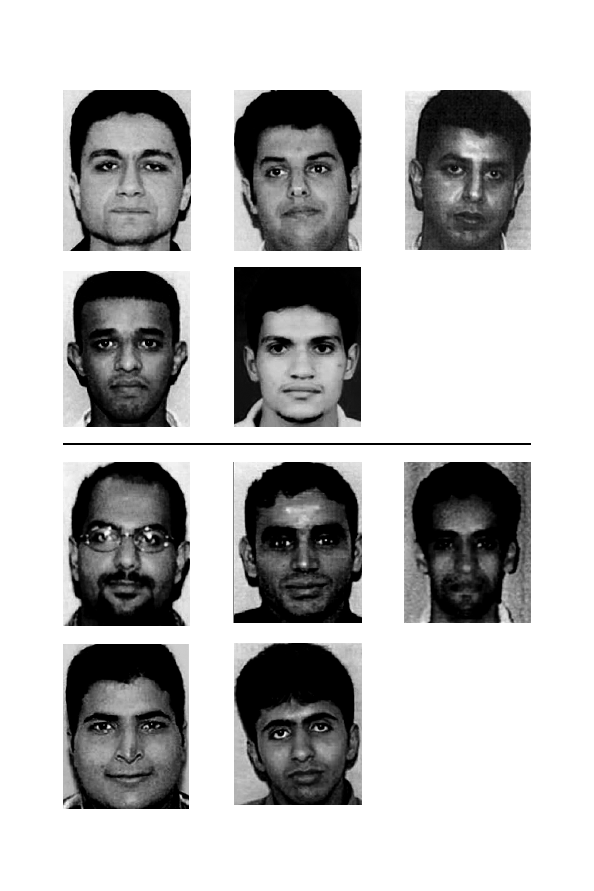
238
THE 9/11 COMMISSION REPORT
American Airlines
Flight 11
Left to right,
Mohamed Atta, pilot;
Waleed al Shehri,
Wail al Shehri,
Satam al Suqami,
Abdulaziz al Omari,
hijackers
United Airlines
Flight 175
Left to right,
Marwan al Shehhi,
pilot; Fayez Baniham-
mad,Ahmed al
Ghamdi, Hamza al
Ghamdi, Mohand al
Shehri, hijackers
Final 5-7.5pp 7/17/04 11:46 AM Page 238
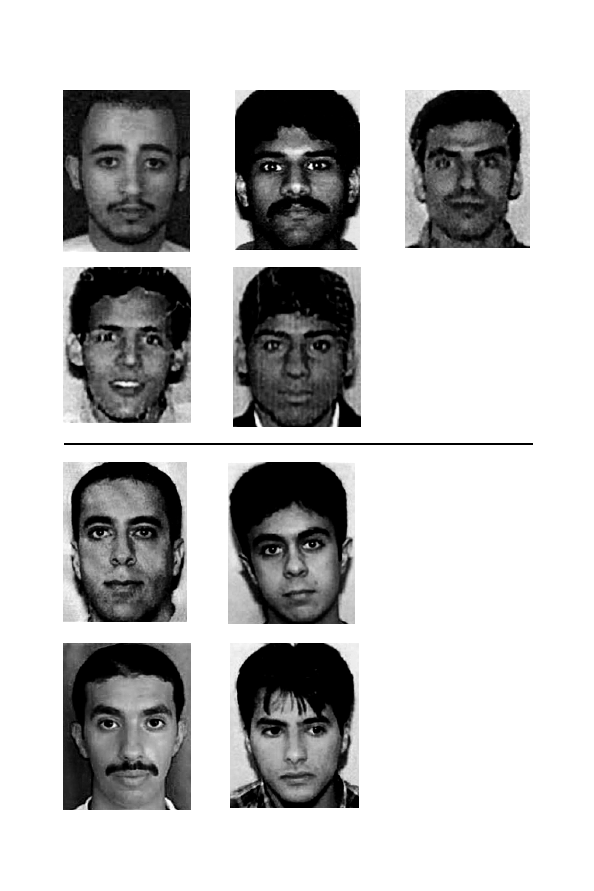
AL QAEDA AIMS AT THE AMERICAN HOMELAND
239
American Airlines
Flight 77
Left to right,
Hani Hanjour, pilot;
Nawaf al Hazmi,
Khalid al Mihdhar,
Majed Moqed, Salem
al Hazmi, hijackers
United Airlines
Flight 93
Left to right,
Ziad Jarrah pilot;
Saeed al Ghamdi,
Ahmad al Haznawi,
Ahmed al Nami,
hijackers
Final 5-7.5pp 7/17/04 11:46 AM Page 239

his intended address as the Marriott Hotel, New York City, but instead spent
one night at another New York hotel. He then joined the group of hijackers
in Paterson, reuniting with Nawaf al Hazmi after more than a year.With two
months remaining, all 19 hijackers were in the United States and ready to take
the final steps toward carrying out the attacks.
119
Assistance from Hezbollah and Iran to al Qaeda
As we mentioned in chapter 2, while in Sudan, senior managers in al Qaeda
maintained contacts with Iran and the Iranian-supported worldwide terrorist
organization Hezbollah, which is based mainly in southern Lebanon and
Beirut. Al Qaeda members received advice and training from Hezbollah.
Intelligence indicates the persistence of contacts between Iranian security
officials and senior al Qaeda figures after Bin Ladin's return to Afghanistan.
Khallad has said that Iran made a concerted effort to strengthen relations with
al Qaeda after the October 2000 attack on the USS Cole, but was rebuffed
because Bin Ladin did not want to alienate his supporters in Saudi Arabia. Khal-
lad and other detainees have described the willingness of Iranian officials to
facilitate the travel of al Qaeda members through Iran, on their way to and from
Afghanistan. For example, Iranian border inspectors would be told not to place
telltale stamps in the passports of these travelers. Such arrangements were par-
ticularly beneficial to Saudi members of al Qaeda.
120
Our knowledge of the international travels of the al Qaeda operatives
selected for the 9/11 operation remains fragmentary. But we now have evi-
dence suggesting that 8 to 10 of the 14 Saudi "muscle" operatives traveled into
or out of Iran between October 2000 and February 2001.
121
In October 2000, a senior operative of Hezbollah visited Saudi Arabia to
coordinate activities there. He also planned to assist individuals in Saudi Ara-
bia in traveling to Iran during November. A top Hezbollah commander and
Saudi Hezbollah contacts were involved.
122
Also in October 2000, two future muscle hijackers, Mohand al Shehri and
Hamza al Ghamdi, flew from Iran to Kuwait. In November, Ahmed al Ghamdi
apparently flew to Beirut, traveling--perhaps by coincidence--on the same
flight as a senior Hezbollah operative.Also in November, Salem al Hazmi appar-
ently flew from Saudi Arabia to Beirut.
123
In mid-November, we believe, three of the future muscle hijackers,Wail al
Shehri,Waleed al Shehri, and Ahmed al Nami, all of whom had obtained their
U.S. visas in late October, traveled in a group from Saudi Arabia to Beirut and
then onward to Iran. An associate of a senior Hezbollah operative was on the
same flight that took the future hijackers to Iran. Hezbollah officials in Beirut
and Iran were expecting the arrival of a group during the same time period.
The travel of this group was important enough to merit the attention of sen-
ior figures in Hezbollah.
124
Later in November, two future muscle hijackers, Satam al Suqami and Majed
240
THE 9/11 COMMISSION REPORT
Final 5-7.5pp 7/17/04 11:46 AM Page 240

Moqed, flew into Iran from Bahrain. In February 2001, Khalid al Mihdhar may
have taken a flight from Syria to Iran, and then traveled further within Iran to
a point near the Afghan border.
125
KSM and Binalshibh have confirmed that several of the 9/11 hijackers (at
least eight, according to Binalshibh) transited Iran on their way to or from
Afghanistan, taking advantage of the Iranian practice of not stamping Saudi
passports.They deny any other reason for the hijackers' travel to Iran.They also
deny any relationship between the hijackers and Hezbollah.
126
In sum, there is strong evidence that Iran facilitated the transit of al Qaeda
members into and out of Afghanistan before 9/11, and that some of these were
future 9/11 hijackers.There also is circumstantial evidence that senior Hezbol-
lah operatives were closely tracking the travel of some of these future muscle
hijackers into Iran in November 2000. However, we cannot rule out the pos-
sibility of a remarkable coincidence--that is, that Hezbollah was actually focus-
ing on some other group of individuals traveling from Saudi Arabia during this
same time frame, rather than the future hijackers.
127
We have found no evidence that Iran or Hezbollah was aware of the plan-
ning for what later became the 9/11 attack.At the time of their travel through
Iran, the al Qaeda operatives themselves were probably not aware of the spe-
cific details of their future operation.
After 9/11, Iran and Hezbollah wished to conceal any past evidence of
cooperation with Sunni terrorists associated with al Qaeda. A senior Hezbol-
lah official disclaimed any Hezbollah involvement in 9/11.
128
We believe this topic requires further investigation by the U.S. government.
7.4 FINAL STRATEGIES AND TACTICS
Final Preparations in the United States
During the early summer of 2001, Atta, assisted by Shehhi, was busy coordi-
nating the arrival of most of the muscle hijackers in southern Florida--pick-
ing them up at the airport, finding them places to stay, and helping them settle
in the United States.
129
The majority settled in Florida. Some opened bank accounts, acquired mail-
boxes, and rented cars. Several also joined local gyms, presumably to stay fit for
the operation. Upon first arriving, most stayed in hotels and motels; but by mid-
June, they settled in shared apartments relatively close to one another and
Atta.
130
Though these muscle hijackers did not travel much after arriving in
the United States, two of them, Waleed al Shehri and Satam al Suqami, took
unusual trips.
On May 19, Shehri and Suqami flew from Fort Lauderdale to Freeport,
the Bahamas, where they had reservations at the Bahamas Princess Resort.The
two were turned away by Bahamian officials on arrival, however, because they
THE ATTACK LOOMS
241
Final 5-7.5pp 7/17/04 11:46 AM Page 241

lacked visas; they returned to Florida that same day. They likely took this trip
to renew Suqami's immigration status, as Suqami's legal stay in the United States
ended May 21.
131
On July 30, Shehri traveled alone from Fort Lauderdale to Boston. He flew
to San Francisco the next day, where he stayed one night before returning via
Las Vegas.While this travel may have been a casing flight--Shehri traveled in
first class on the same type of aircraft he would help hijack on September 11
(a Boeing 767) and the trip included a layover in Las Vegas--Shehri was nei-
ther a pilot nor a plot leader, as were the other hijackers who took surveillance
flights.
132
The three Hamburg pilots--Atta, Shehhi, and Jarrah--took the first of their
cross-country surveillance flights early in the summer. Shehhi flew from New
York to Las Vegas via San Francisco in late May. Jarrah flew from Baltimore to
Las Vegas via Los Angeles in early June.Atta flew from Boston to Las Vegas via
San Francisco at the end of June. Each traveled in first class, on United Airlines.
For the east-west transcontinental leg, each operative flew on the same type of
aircraft he would pilot on September 11 (Atta and Shehhi, a Boeing 767; Jar-
rah, a Boeing 757).
133
Hanjour and Hazmi, as noted below, took similar cross-
country surveillance flights in August.
Jarrah and Hanjour also received additional training and practice flights in
the early summer.A few days before departing on his cross-country test flight,
Jarrah flew from Fort Lauderdale to Philadelphia, where he trained at Hort-
man Aviation and asked to fly the Hudson Corridor, a low-altitude "hallway"
along the Hudson River that passes New York landmarks like the World Trade
Center. Heavy traffic in the area can make the corridor a dangerous route for
an inexperienced pilot. Because Hortman deemed Jarrah unfit to fly solo, he
could fly this route only with an instructor.
134
Hanjour, too, requested to fly the Hudson Corridor about this same time,
at Air Fleet Training Systems in Teterboro, New Jersey, where he started receiv-
ing ground instruction soon after settling in the area with Hazmi. Hanjour flew
the Hudson Corridor, but his instructor declined a second request because of
what he considered Hanjour's poor piloting skills. Shortly thereafter, Hanjour
switched to Caldwell Flight Academy in Fairfield, New Jersey, where he rented
small aircraft on several occasions during June and July. In one such instance
on July 20, Hanjour--likely accompanied by Hazmi--rented a plane from
Caldwell and took a practice flight from Fairfield to Gaithersburg, Maryland,
a route that would have allowed them to fly near Washington, D.C. Other evi-
dence suggests that Hanjour may even have returned to Arizona for flight sim-
ulator training earlier in June.
135
There is no indication that Atta or Shehhi received any additional flight
training in June. Both were likely too busy organizing the newly arrived mus-
cle hijackers and taking their cross-country surveillance flights.Atta, moreover,
needed to coordinate with his second-in-command, Nawaf al Hazmi.
136
242
THE 9/11 COMMISSION REPORT
Final 5-7.5pp 7/17/04 11:46 AM Page 242

Although Atta and Hazmi appear to have been in Virginia at about the same
time in early April, they probably did not meet then.Analysis of late April com-
munications associated with KSM indicates that they had wanted to get
together in April but could not coordinate the meeting.
137
Atta and Hazmi
probably first met in the United States only when Hazmi traveled round-trip
from Newark to Miami between June 19 and June 25.
After he returned to New Jersey, Hazmi's behavior began to closely paral-
lel that of the other hijackers. He and Hanjour, for instance, soon established
new bank accounts, acquired a mailbox, rented cars, and started visiting a gym.
So did the four other hijackers who evidently were staying with them in New
Jersey. Several also obtained new photo identification, first in New Jersey and
then at the Virginia Department of Motor Vehicles, where Hazmi and Hanjour
had obtained such documents months earlier, likely with help from their Jor-
danian friend, Rababah.
138
Atta probably met again with Hazmi in early July. Returning from his ini-
tial cross-country surveillance flight, Atta flew into New York. Rather than
return immediately to Florida, he checked into a New Jersey hotel. He picked
up tickets to travel to Spain at a travel agency in Paterson on July 4 before
departing for Fort Lauderdale. Now that the muscle hijackers had arrived, he
was ready to meet with Ramzi Binalshibh for the last time.
139
The Meeting in Spain
After meeting with Atta in Berlin in January 2001, Binalshibh had spent much
of the spring of 2001 in Afghanistan and Pakistan, helping move the muscle
hijackers as they passed through Karachi. During the Berlin meeting, the two
had agreed to meet later in the year in Kuala Lumpur to discuss the operation
in person again. In late May, Binalshibh reported directly to Bin Ladin at an
al Qaeda facility known as "Compound Six" near Kandahar.
140
Bin Ladin told Binalshibh to instruct Atta and the others to focus on their
security and that of the operation, and to advise Atta to proceed as planned with
the targets discussed before Atta left Afghanistan in early 2000--the World
Trade Center, the Pentagon, the White House, and the Capitol. According
to Binalshibh, Bin Ladin said he preferred the White House over the Capitol,
asking Binalshibh to confirm that Atta understood this preference. Binalshibh
says Bin Ladin had given the same message to Waleed al Shehri for conveyance
to Atta earlier that spring. Binalshibh also received permission to meet Atta in
Malaysia.Atef provided money for the trip, which KSM would help Binalshibh
arrange in Karachi.
141
In early June, Binalshibh traveled by taxi from Kandahar to Quetta, Pakistan,
where al Qaeda courier Abu Rahmah took him to KSM.According to Binal-
shibh, KSM provided a plane ticket to Malaysia and a fraudulent Saudi pass-
port to use for the trip. KSM told him to ask Atta to select a date for the attacks.
Binalshibh was to return to Germany and then inform KSM of the date. KSM
THE ATTACK LOOMS
243
Final 5-7.5pp 7/17/04 11:46 AM Page 243

also gave Binalshibh the email address of Zacarias Moussaoui for future con-
tact. Binalshibh then left for Kuala Lumpur.
142
Binalshibh contacted Atta upon arriving in Malaysia and found a change in
plan. Atta could not travel because he was too busy helping the new arrivals
settle in the United States.After remaining in Malaysia for approximately three
weeks, Binalshibh went to Bangkok for a few days before returning to Ger-
many. He and Atta agreed to meet later at a location to be determined.
143
In early July, Atta called Binalshibh to suggest meeting in Madrid, for rea-
sons Binalshibh claims not to know. He says he preferred Berlin, but that he
and Atta knew too many people in Germany and feared being spotted
together. Unable to buy a ticket to Madrid at the height of the tourist season,
Binalshibh booked a seat on a flight to Reus, near Barcelona, the next day.Atta
was already en route to Madrid, so Binalshibh phoned Shehhi in the United
States to inform him of the change in itinerary.
144
Atta arrived in Madrid on July 8. He spent the night in a hotel and made
three calls from his room, most likely to coordinate with Binalshibh.The next
day, Atta rented a car and drove to Reus to pick up Binalshibh; the two then
drove to the nearby town of Cambrils. Hotel records show Atta renting rooms
in the same area until July 19, when he returned his rental car in Madrid and
flew back to Fort Lauderdale. On July 16, Binalshibh returned to Hamburg,
using a ticket Atta had purchased for him earlier that day. According to Binal-
shibh, they did not meet with anyone else while in Spain.
145
Binalshibh says he told Atta that Bin Ladin wanted the attacks carried out
as soon as possible. Bin Ladin, Binalshibh conveyed, was worried about hav-
ing so many operatives in the United States.Atta replied that he could not yet
provide a date because he was too busy organizing the arriving hijackers and
still needed to coordinate the timing of the flights so that the crashes would
occur simultaneously. Atta said he required about five to six weeks before he
could provide an attack date. Binalshibh advised Atta that Bin Ladin had
directed that the other operatives not be informed of the date until the last
minute.Atta was to provide Binalshibh with advance notice of at least a week
or two so that Binalshibh could travel to Afghanistan and report the date per-
sonally to Bin Ladin.
146
As to targets, Atta understood Bin Ladin's interest in striking the White
House.Atta said he thought this target too difficult, but had tasked Hazmi and
Hanjour to evaluate its feasibility and was awaiting their answer. Atta said that
those two operatives had rented small aircraft and flown reconnaissance flights
near the Pentagon.Atta explained that Hanjour was assigned to attack the Pen-
tagon, Jarrah the Capitol, and that both Atta and Shehhi would hit the World
Trade Center. If any pilot could not reach his intended target, he was to crash
the plane. If Atta could not strike the World Trade Center, he planned to crash
his aircraft directly into the streets of New York.Atta told Binalshibh that each
pilot had volunteered for his assigned target, and that the assignments were sub-
ject to change.
147
244
THE 9/11 COMMISSION REPORT
Final 5-7.5pp 7/17/04 11:46 AM Page 244

During the Spain meeting,Atta also mentioned that he had considered tar-
geting a nuclear facility he had seen during familiarization flights near New
York--a target they referred to as "electrical engineering."According to Binal-
shibh, the other pilots did not like the idea.They thought a nuclear target would
be difficult because the airspace around it was restricted, making reconnaissance
flights impossible and increasing the likelihood that any plane would be shot
down before impact. Moreover, unlike the approved targets, this alternative had
not been discussed with senior al Qaeda leaders and therefore did not have the
requisite blessing. Nor would a nuclear facility have particular symbolic value.
Atta did not ask Binalshibh to pass this idea on to Bin Ladin, Atef, or KSM,
and Binalshibh says he did not mention it to them until after September 11.
148
Binalshibh claims that during their time in Spain, he and Atta also discussed
how the hijackings would be executed. Atta said he, Shehhi, and Jarrah had
encountered no problems carrying box cutters on cross-country surveillance
flights.The best time to storm the cockpit would be about 1015 minutes after
takeoff, when the cockpit doors typically were opened for the first time. Atta
did not believe they would need any other weapons. He had no firm contin-
gency plan in case the cockpit door was locked.While he mentioned general
ideas such as using a hostage or claiming to have a bomb, he was confident the
cockpit doors would be opened and did not consider breaking them down a
viable idea. Atta told Binalshibh he wanted to select planes departing on long
flights because they would be full of fuel, and that he wanted to hijack Boeing
aircraft because he believed them easier to fly than Airbus aircraft, which he
understood had an autopilot feature that did not allow them to be crashed into
the ground.
149
Finally, Atta confirmed that the muscle hijackers had arrived in the United
States without incident.They would be divided into teams according to their
English-speaking ability.That way they could assist each other before the oper-
ation and each team would be able to command the passengers in English.
According to Binalshibh,Atta complained that some of the hijackers wanted to
contact their families to say goodbye, something he had forbidden.Atta, more-
over, was nervous about his future communications with Binalshibh, whom he
instructed to obtain new telephones upon returning to Germany. Before Binal-
shibh left Spain, he gave Atta eight necklaces and eight bracelets that Atta had
asked him to buy when he was recently in Bangkok, believing that if the hijack-
ers were clean shaven and well dressed, others would think them wealthy Saudis
and give them less notice.
150
As directed, upon returning from Spain, Binalshibh obtained two new
phones, one to communicate with Atta and another to communicate with
KSM and others, such as Zacarias Moussaoui. Binalshibh soon contacted KSM
and, using code words, reported the results of his meeting with Atta. This
important exchange occurred in mid-July.
151
The conversation covered various topics. For example, Jarrah was to send
Binalshibh certain personal materials from the hijackers,including copies of their
THE ATTACK LOOMS
245
Final 5-7.5pp 7/17/04 11:46 AM Page 245

passports, which Binalshibh in turn would pass along to KSM, probably for sub-
sequent use in al Qaeda propaganda.
152
The most significant part of the mid-July conversation concerned Jarrah's
troubled relationship with Atta. KSM and Binalshibh both acknowledge that
Jarrah chafed under Atta's authority over him. Binalshibh believes the disagree-
ment arose in part from Jarrah's family visits. Moreover, Jarrah had been on his
own for most of his time in the United States because Binalshibh's visa diffi-
culty had prevented the two of them from training together. Jarrah thus felt
excluded from the decisionmaking. Binalshibh had to act as a broker between
Jarrah and Atta.
153
Concerned that Jarrah might withdraw from the operation at this late stage,
KSM emphasized the importance of Atta and Jarrah's resolving their differ-
ences. Binalshibh claims that such concern was unwarranted, and in their mid-
July discussion reassured KSM that Atta and Jarrah would reconcile and be
ready to move forward in about a month, after Jarrah visited his family. Not-
ing his concern and the potential for delay, KSM at one point instructed Binal-
shibh to send "the skirts" to "Sally"--a coded instruction to Binalshibh to send
funds to Zacarias Moussaoui.While Binalshibh admits KSM did direct him to
send Moussaoui money during the mid-July conversation, he denies knowing
exactly why he received this instruction--though he thought the money was
being provided "within the framework" of the 9/11 operation.
154
KSM may have instructed Binalshibh to send money to Moussaoui in order
to help prepare Moussaoui as a potential substitute pilot for Jarrah. On July 20,
2001, Aysel Senguen, Jarrah's girlfriend, purchased a one-way ticket for Jarrah
from Miami to Dusseldorf. On Jarrah's previous four trips from the United
States to see Senguen and his family in Lebanon, he had always traveled with
a round-trip ticket. When Jarrah departed Miami on July 25, Atta appears to
have driven him to the airport, another unique circumstance.
155
Binalshibh picked up Jarrah at the airport in Dusseldorf on July 25. Jarrah
wanted to see Senguen as soon as possible, so he and Binalshibh arranged to
meet a few days later.When they did, they had an emotional conversation dur-
ing which Binalshibh encouraged Jarrah to see the plan through.
156
While Jarrah was in Germany, Binalshibh and Moussaoui were in contact
to arrange for the transfer of funds. Binalshibh received two wire transfers from
Hawsawi in the UAE totaling $15,000 and, within days, relayed almost all of
this money to Moussaoui in two installments.
157
Moussaoui had been taking flight lessons at the Airman Flight School in
Norman, Oklahoma, since February but stopped in late May.Although at that
point he had only about 50 hours of flight time and no solo flights to his credit,
Moussaoui began making inquiries about flight materials and simulator train-
ing for Boeing 747s. On July 10, he put down a $1,500 deposit for flight sim-
ulator training at Pan Am International Flight Academy in Eagan, Minnesota,
and by the end of the month, he had received a simulator schedule to train from
246
THE 9/11 COMMISSION REPORT
Final 5-7.5pp 7/17/04 11:46 AM Page 246

August 13 through August 20. Moussaoui also purchased two knives and
inquired of two manufacturers of GPS equipment whether their products
could be converted for aeronautical use--activities that closely resembled those
of the 9/11 hijackers during their final preparations for the attacks.
158
On August 10, shortly after getting the money from Binalshibh, Moussaoui
left Oklahoma with a friend and drove to Minnesota.Three days later, Mous-
saoui paid the $6,800 balance owed for his flight simulator training at Pan Am
in cash and began his training. His conduct, however, raised the suspicions of
his flight instructor. It was unusual for a student with so little training to be
learning to fly large jets without any intention of obtaining a pilot's license
or other goal. On August 16, once the instructor reported his suspicion to the
authorities, Moussaoui was arrested by the INS on immigration charges.
159
KSM denies ever considering Moussaoui for the planes operation. Instead
he claims that Moussaoui was slated to participate in a "second wave" of attacks.
KSM also states that Moussaoui had no contact with Atta, and we are unaware
of evidence contradicting this assertion.
160
Yet KSM has also stated that by the summer of 2001, he was too busy with
the planes operation to continue planning for any second-wave attacks. More-
over, he admits that only three potential pilots were ever recruited for the
alleged second wave, Moussaoui plus two others who, by midsummer of 2001,
had backed out of the plot.
161
We therefore believe that the effort to push
Moussaoui forward in August 2001 lends credence to the suspicion that he was
being primed as a possible pilot in the immediate planes operation.
Binalshibh says he assumed Moussaoui was to take his place as another pilot
in the 9/11 operation. Recounting a post-9/11 discussion with KSM in Kan-
dahar, Binalshibh claims KSM mentioned Moussaoui as being part of the 9/11
operation. Although KSM never referred to Moussaoui by name, Binalshibh
understood he was speaking of the operative to whom Binalshibh had wired
money. Binalshibh says KSM did not approve of Moussaoui but believes KSM
did not remove him from the operation only because Moussaoui had been
selected and assigned by Bin Ladin himself.
162
KSM did not hear about Moussaoui's arrest until after September 11.
According to Binalshibh, had Bin Ladin and KSM learned prior to 9/11 that
Moussaoui had been detained, they might have canceled the operation.When
Binalshibh discussed Moussaoui's arrest with KSM after September 11, KSM
congratulated himself on not having Moussaoui contact the other operatives,
which would have compromised the operation. Moussaoui had been in con-
tact with Binalshibh, of course, but this was not discovered until after 9/11.
163
As it turned out, Moussaoui was not needed to replace Jarrah. By the time
Moussaoui was arrested in mid-August, Jarrah had returned to the United
States from his final trip to Germany, his disagreement with Atta apparently
resolved.The operatives began their final preparations for the attacks.
164
THE ATTACK LOOMS
247
Final 5-7.5pp 7/17/04 11:46 AM Page 247

Readying the Attacks
A week after he returned from meeting Binalshibh in Spain, Atta traveled to
Newark, probably to coordinate with Hazmi and give him additional funds.
Atta spent a few days in the area before returning to Florida on July 30.The
month of August was busy, as revealed by a set of contemporaneous Atta-
Binalshibh communications that were recovered after September 11.
165
On August 3, for example, Atta and Binalshibh discussed several matters,
such as the best way for the operatives to purchase plane tickets and the assign-
ment of muscle hijackers to individual teams. Atta and Binalshibh also revis-
ited the question of whether to target the White House.They discussed targets
in coded language, pretending to be students discussing various fields of study:
"architecture" referred to the World Trade Center, "arts" the Pentagon, "law"
the Capitol, and "politics" the White House.
166
Binalshibh reminded Atta that Bin Ladin wanted to target the White House.
Atta again cautioned that this would be difficult. When Binalshibh persisted,
Atta agreed to include the White House but suggested they keep the Capitol
as an alternate target in case the White House proved too difficult. Atta also
suggested that the attacks would not happen until after the first week in Sep-
tember, when Congress reconvened.
167
Atta and Binalshibh also discussed "the friend who is coming as a tourist"--
a cryptic reference to candidate hijacker Mohamed al Kahtani (mentioned
above), whom Hawsawi was sending the next day as "the last one" to "com-
plete the group." On August 4,Atta drove to the Orlando airport to meet Kah-
tani. Upon arrival, however, Kahtani was denied entry by immigration officials
because he had a one-way ticket and little money, could not speak English, and
could not adequately explain what he intended to do in the United States. He
was sent back to Dubai. Hawsawi contacted KSM, who told him to help Kah-
tani return to Pakistan.
168
On August 7,Atta flew from Fort Lauderdale to Newark, probably to coor-
dinate with Hazmi.Two days later,Ahmed al Ghamdi and Abdul Aziz al Omari,
who had been living in New Jersey with Hazmi and Hanjour, flew to
Miami--probably signifying that the four hijacking teams had finally been
assigned.While Atta was in New Jersey, he, Hazmi, and Hanjour all purchased
tickets for another set of surveillance flights. Like Shehhi, Jarrah, Atta, and
Waleed al Shehri before them, Hazmi and Hanjour each flew in first class on
the same type of aircraft they would hijack on 9/11 (a Boeing 757), and on
transcontinental flights that connected to Las Vegas. This time, however, Atta
himself also flew directly to Las Vegas, where all three stayed on August 1314.
Beyond Las Vegas's reputation for welcoming tourists, we have seen no credi-
ble evidence explaining why, on this occasion and others, the operatives flew
to or met in Las Vegas.
169
Through August, the hijackers kept busy with their gym training and the
pilots took frequent practice flights on small rented aircraft.The operatives also
248
THE 9/11 COMMISSION REPORT
Final 5-7.5pp 7/17/04 11:46 AM Page 248

began to make purchases suggesting that the planning was coming to an end.
In mid-August, for example, they bought small knives that may actually have
been used in the attacks. On August 22, moreover, Jarrah attempted to pur-
chase four GPS units from a pilot shop in Miami. He was able to buy only one
unit, which he picked up a few days later when he also purchased three aero-
nautical charts.
170
Perhaps most significant, however, was the purchase of plane tickets for Sep-
tember 11. On August 23, Atta again flew to Newark, probably to meet with
Hazmi and select flights. All 19 tickets were booked and purchased between
August 25 and September 5.
171
It therefore appears that the attack date was selected by the third week of
August. This timing is confirmed by Binalshibh, who claims Atta called him
with the date in mid-August. According to Binalshibh, Atta used a riddle to
convey the date in code--a message of two branches, a slash, and a lollipop (to
non-Americans, 11/9 would be interpreted as September 11). Binalshibh says
he called Atta back to confirm the date before passing it to KSM.
172
KSM apparently received the date from Binalshibh in a message sent
through Binalshibh's old Hamburg associate, Zakariya Essabar. Both Binalshibh
and KSM claim that Essabar was not privy to the meaning of the message and
had no foreknowledge of the attacks.According to Binalshibh, shortly after the
date was chosen, he advised Essabar and another Hamburg associate, Said
Bahaji, that if they wanted to go to Afghanistan, now was the time because it
would soon become more difficult. Essabar made reservations on August 22
and departed Hamburg for Karachi on August 30; Bahaji purchased his tickets
on August 20 and departed Hamburg for Karachi on September 3.
173
Binalshibh also made arrangements to leave for Pakistan during early Sep-
tember, before the attacks, as did Ali and Hawsawi, the plot facilitators in the
UAE. During these final days, Binalshibh and Atta kept in contact by phone,
email, and instant messaging.Although Atta had forbidden the hijackers to con-
tact their families, he apparently placed one last call to his own father on Sep-
tember 9. Atta also asked Binalshibh to contact the family of one hijacker, pass
along goodbyes from others, and give regards to KSM. Jarrah alone appears to
have left a written farewell--a sentimental letter to Aysel Senguen.
174
Hazmi, however, may not have been so discreet. He may have telephoned
his former San Diego companion, Mohdar Abdullah, in late August. Several bits
of evidence indicate that others in Abdullah's circle may have received word
that something big would soon happen. As noted earlier, Abdullah's behavior
reportedly changed noticeably. Prior to September 11, both he and Yazeed
al Salmi suddenly became intent on proceeding with their planned marriages.
One witness quotes Salmi as commenting after the 9/11 attacks,"I knew they
were going to do something, that is why I got married." Moreover, as of August
2001, Iyad Kreiwesh and other employees at the Texaco station where Hazmi
had worked suddenly were anticipating attention from law enforcement
THE ATTACK LOOMS
249
Final 5-7.5pp 7/17/04 11:46 AM Page 249

authorities in the near future. Finally, according to an uncorroborated witness
account, early on the morning of September 10, Abdullah, Osama Awadallah,
Omar Bakarbashat, and others behaved suspiciously at the gas station.Accord-
ing to the witness, after the group met, Awadallah said "it is finally going to
happen" as the others celebrated by giving each other high fives.
175
Dissent within the al Qaeda Leadership
While tactical preparations for the attack were nearing completion, the entire
operation was being questioned at the top, as al Qaeda and the Taliban argued
over strategy for 2001. Our focus has naturally been on the specifics of the
planes operation. But from the perspective of Bin Ladin and Atef, this opera-
tion was only one, admittedly key, element of their unfolding plans for the year.
Living in Afghanistan, interacting constantly with the Taliban, the al Qaeda
leaders would never lose sight of the situation in that country.
Bin Ladin's consistent priority was to launch a major attack directly against
the United States. He wanted the planes operation to proceed as soon as pos-
sible. Mihdhar reportedly told his cousin during the summer of 2001 that Bin
Ladin was reputed to have remarked,"I will make it happen even if I do it by
myself."
176
According to KSM, Bin Ladin had been urging him to advance the date of
the attacks. In 2000, for instance, KSM remembers Bin Ladin pushing him to
launch the attacks amid the controversy after then-Israeli opposition party
leader Ariel Sharon's visit to the Temple Mount in Jerusalem. KSM claims Bin
Ladin told him it would be enough for the hijackers simply to down planes
rather than crash them into specific targets. KSM says he resisted the pressure.
177
KSM claims to have faced similar pressure twice more in 2001. According
to him, Bin Ladin wanted the operation carried out on May 12, 2001, seven
months to the day after the Cole bombing. KSM adds that the 9/11 attacks had
originally been envisioned for May 2001. The second time he was urged to
launch the attacks early was in June or July 2001, supposedly after Bin Ladin
learned from the media that Sharon would be visiting the White House. On
both occasions KSM resisted, asserting that the hijacking teams were not ready.
Bin Ladin pressed particularly strongly for the latter date in two letters stress-
ing the need to attack early.The second letter reportedly was delivered by Bin
Ladin's son-in-law, Aws al Madani.
178
Other evidence corroborates KSM's account. For instance, Mihdhar told
his cousin that the attacks were to happen in May, but were postponed twice,
first to July, then to September. Moreover, one candidate hijacker remembers
a general warning being issued in the al Qaeda camps in July or early August,
just like the warnings issued two weeks before the Cole bombing and ten days
before the eventual 9/11 attacks. During the midsummer alert, al Qaeda
members dispersed with their families, security was increased, and Bin Ladin
disappeared for about 30 days, until the alert was canceled.
179
While the details of the operation were strictly compartmented, by the time
250
THE 9/11 COMMISSION REPORT
Final 5-7.5pp 7/17/04 11:46 AM Page 250

of the alert, word had begun to spread that an attack against the United States
was coming. KSM notes that it was generally well known by the summer of
2001 that he was planning some kind of operation against the United States.
Many were even aware that he had been preparing operatives to go to the
United States, leading some to conclude that al Qaeda was planning a near-
term attack on U.S. soil. Moreover, Bin Ladin had made several remarks that
summer hinting at an upcoming attack and generating rumors throughout the
worldwide jihadist community. Bin Ladin routinely told important visitors to
expect significant attacks against U.S. interests soon and, during a speech at the
al Faruq camp, exhorted trainees to pray for the success of an attack involving
20 martyrs. Others have confirmed hearing indications of an impending attack
and have verified that such news, albeit without specific details, had spread
across al Qaeda.
180
Although Bin Ladin's top priority apparently was to attack the United
States, others had a different view.The Taliban leaders put their main empha-
sis on the year's military offensive against the Northern Alliance, an offensive
that ordinarily would begin in the late spring or summer.They certainly hoped
that this year's offensive would finally finish off their old enemies, driving them
from Afghanistan. From the Taliban's perspective, an attack against the United
States might be counterproductive. It might draw the Americans into the war
against them, just when final victory seemed within their grasp.
181
There is evidence that Mullah Omar initially opposed a major al Qaeda
operation directly against the United States in 2001. Furthermore, by July, with
word spreading of a coming attack, a schism emerged among the senior lead-
ership of al Qaeda. Several senior members reportedly agreed with Mullah
Omar. Those who reportedly sided with Bin Ladin included Atef, Sulayman
Abu Ghayth, and KSM. But those said to have opposed him were weighty fig-
ures in the organization--including Abu Hafs the Mauritanian, Sheikh Saeed
al Masri, and Sayf al Adl. One senior al Qaeda operative claims to recall Bin
Ladin arguing that attacks against the United States needed to be carried out
immediately to support insurgency in the Israeli-occupied territories and
protest the presence of U.S. forces in Saudi Arabia. Beyond these rhetorical
appeals, Bin Ladin also reportedly thought an attack against the United States
would benefit al Qaeda by attracting more suicide operatives, eliciting greater
donations, and increasing the number of sympathizers willing to provide logis-
tical assistance.
182
Mullah Omar is reported to have opposed this course of action for ideo-
logical reasons rather than out of fear of U.S. retaliation. He is said to have pre-
ferred for al Qaeda to attack Jews, not necessarily the United States. KSM
contends that Omar faced pressure from the Pakistani government to keep
al Qaeda from engaging in operations outside Afghanistan. Al Qaeda's chief
financial manager, Sheikh Saeed, argued that al Qaeda should defer to the Tali-
ban's wishes. Another source says that Sheikh Saeed opposed the operation,
both out of deference to Omar and because he feared the U.S. response to an
THE ATTACK LOOMS
251
Final 5-7.5pp 7/17/04 11:46 AM Page 251

attack. Abu Hafs the Mauritanian reportedly even wrote Bin Ladin a message
basing opposition to the attacks on the Qur'an.
183
According to KSM, in late August, when the operation was fully planned,
Bin Ladin formally notified the al Qaeda Shura Council that a major attack
against the United States would take place in the coming weeks.When some
council members objected, Bin Ladin countered that Mullah Omar lacked
authority to prevent al Qaeda from conducting jihad outside Afghanistan.
Though most of the Shura Council reportedly disagreed, Bin Ladin persisted.
The attacks went forward.
184
The story of dissension within al Qaeda regarding the 9/11 attacks is prob-
ably incomplete.The information on which the account is based comes from
sources who were not privy to the full scope of al Qaeda and Taliban planning.
Bin Ladin and Atef, however, probably would have known, at least, that
· The general Taliban offensive against the Northern Alliance would
rely on al Qaeda military support.
· Another significant al Qaeda operation was making progress during
the summer--a plot to assassinate the Northern Alliance leader,
Ahmed Shah Massoud. The operatives, disguised as journalists, were
in Massoud's camp and prepared to kill him sometime in August.Their
appointment to see him was delayed.
185
But on September 9, the Massoud assassination took place.The delayed Tal-
iban offensive against the Northern Alliance was apparently coordinated to
begin as soon as he was killed, and it got under way on September 10.
186
As they deliberated earlier in the year, Bin Ladin and Atef would likely have
remembered that Mullah Omar was dependent on them for the Massoud assas-
sination and for vital support in the Taliban military operations. KSM remem-
bers Atef telling him that al Qaeda had an agreement with the Taliban to
eliminate Massoud, after which the Taliban would begin an offensive to take
over Afghanistan. Atef hoped Massoud's death would also appease the Taliban
when the 9/11 attacks happened. There are also some scant indications that
Omar may have been reconciled to the 9/11 attacks by the time they
occurred.
187
Moving to Departure Positions
In the days just before 9/11, the hijackers returned leftover funds to al Qaeda
and assembled in their departure cities.They sent the excess funds by wire trans-
fer to Hawsawi in the UAE, about $26,000 altogether.
188
The hijackers targeting American Airlines Flight 77, to depart from Dulles,
migrated from New Jersey to Laurel, Maryland, about 20 miles from Washing-
ton, D.C.They stayed in a motel during the first week in September and spent
252
THE 9/11 COMMISSION REPORT
Final 5-7.5pp 7/17/04 11:46 AM Page 252

time working out at a gym. On the final night before the attacks, they lodged
at a hotel in Herndon,Virginia, close to the airport.
189
Further north, the hijackers targeting United Airlines Flight 93, to depart
from Newark, gathered in that city from their base in Florida on September 7.
Just after midnight on September 89, Jarrah received a speeding ticket in Mary-
land as he headed north on I-95. He joined the rest of his team at their hotel.
190
Atta was still busy coordinating the teams. On September 7, he flew from
Fort Lauderdale to Baltimore, presumably to meet with the Flight 77 team in
Laurel. On September 9, he flew from Baltimore to Boston. By then, Shehhi
had arrived there, and Atta was seen with him at his hotel.The next day, Atta
picked up Omari at another hotel, and the two drove to Portland, Maine, for
reasons that remain unknown. In the early morning hours of September 11,
they boarded a commuter flight to Boston to connect to American Airlines
Flight 11. The two spent their last night pursuing ordinary activities: making
ATM withdrawals, eating pizza, and shopping at a convenience store. Their
three fellow hijackers for Flight 11 stayed together in a hotel in Newton, Mass-
achusetts, just outside of Boston.
191
Shehhi and his team targeting United Airlines Flight 175 from Logan Air-
port spent their last hours at two Boston hotels.
192
The plan that started with
a proposal by KSM in 1996 had evolved to overcome numerous obstacles.
Now 19 men waited in nondescript hotel rooms to board four flights the next
morning.
THE ATTACK LOOMS
253
Final 5-7.5pp 7/17/04 11:46 AM Page 253

254
8
"THE SYSTEM WAS
BLINKING RED"
8.1 THE SUMMER OF THREAT
As 2001 began, counterterrorism officials were receiving frequent but fragmen-
tary reports about threats. Indeed, there appeared to be possible threats almost
everywhere the United States had interests--including at home.
To understand how the escalation in threat reporting was handled in the
summer of 2001, it is useful to understand how threat information in general
is collected and conveyed. Information is collected through several methods,
including signals intelligence and interviews of human sources, and gathered
into intelligence reports. Depending on the source and nature of the report-
ing, these reports may be highly classified--and therefore tightly held--or less
sensitive and widely disseminated to state and local law enforcement agencies.
Threat reporting must be disseminated, either through individual reports or
through threat advisories. Such advisories, intended to alert their recipients,
may address a specific threat or be a general warning.
Because the amount of reporting is so voluminous, only a select fraction can
be chosen for briefing the president and senior officials. During 2001, Direc-
tor of Central Intelligence George Tenet was briefed regularly regarding threats
and other operational information relating to Usama Bin Ladin.
1
He in turn
met daily with President Bush, who was briefed by the CIA through what is
known as the President's Daily Brief (PDB). Each PDB consists of a series of
six to eight relatively short articles or briefs covering a broad array of topics;
CIA staff decides which subjects are the most important on any given day.
There were more than 40 intelligence articles in the PDBs from January 20
to September 10, 2001, that related to Bin Ladin. The PDB is considered
highly sensitive and is distributed to only a handful of high-level officials.
2
The Senior Executive Intelligence Brief (SEIB), distributed to a broader
group of officials, has a similar format and generally covers the same subjects
as the PDB. It usually contains less information so as to protect sources and
Final 8-9.5pp 7/17/04 1:24 PM Page 254

methods. Like their predecessors, the Attorney General, the FBI Director, and
Richard Clarke, the National Security Council (NSC) counterterrorism coor-
dinator, all received the SEIB, not the PDB.
3
Clarke and his staff had extensive
access to terrorism reporting, but they did not have access to internal, nondis-
seminated information at the National Security Agency (NSA), CIA, or FBI.
The Drumbeat Begins
In the spring of 2001, the level of reporting on terrorist threats and planned
attacks increased dramatically to its highest level since the millennium alert.At
the end of March, the intelligence community disseminated a terrorist threat
advisory, indicating a heightened threat of Sunni extremist terrorist attacks
against U.S. facilities, personnel, and other interests.
4
On March 23, in connection with discussions about possibly reopening
Pennsylvania Avenue in front of the White House, Clarke warned National
Security Advisor Condoleezza Rice that domestic or foreign terrorists might
use a truck bomb--their "weapon of choice"--on Pennsylvania Avenue.That
would result, he said, in the destruction of the West Wing and parts of the res-
idence.
5
He also told her that he thought there were terrorist cells within the
United States, including al Qaeda.
The next week, Rice was briefed on the activities of Abu Zubaydah and on
CIA efforts to locate him.As pointed out in chapter 6,Abu Zubaydah had been
a major figure in the millennium plots.Over the next few weeks,the CIA repeat-
edly issued warnings--including calls from DCI Tenet to Clarke--that Abu
Zubaydah was planning an operation in the near future.One report cited a source
indicating that Abu Zubaydah was planning an attack in a country that CIA ana-
lysts thought might be Israel, or perhaps Saudi Arabia or India. Clarke relayed
these reports to Rice.
6
In response to these threats, the FBI sent a message to all its field offices on
April 13, summarizing reporting to date. It asked the offices to task all
resources, including human sources and electronic databases, for any informa-
tion pertaining to "current operational activities relating to Sunni extremism."
It did not suggest that there was a domestic threat.
7
The interagency Counterterrorism Security Group (CSG) that Clarke
chaired discussed the Abu Zubaydah reports on April 19.The next day, a brief-
ing to top officials reported "Bin Ladin planning multiple operations." When
the deputies discussed al Qaeda policy on April 30, they began with a briefing
on the threat.
8
In May 2001, the drumbeat of reporting grew louder with reports to top
officials that "Bin Ladin public profile may presage attack" and "Bin Ladin net-
work's plans advancing." In early May, a walk-in to the FBI claimed there was
a plan to launch attacks on London, Boston, and New York.Attorney General
John Ashcroft was briefed by the CIA on May 15 regarding al Qaeda gener-
ally and the current threat reporting specifically. The next day brought a report
"THE SYSTEM WAS BLINKING RED"
255
Final 8-9.5pp 7/17/04 1:24 PM Page 255

that a phone call to a U.S. embassy had warned that Bin Ladin supporters were
planning an attack in the United States using "high explosives." On May 17,
based on the previous day's report, the first item on the CSG's agenda was
"UBL: Operation Planned in U.S."
9
The anonymous caller's tip could not be
corroborated.
Late May brought reports of a possible hostage plot against Americans abroad
to force the release of prisoners, including Sheikh Omar Abdel Rahman, the
"Blind Sheikh," who was serving a life sentence for his role in the 1993 plot to
blow up sites in New York City. The reporting noted that operatives might opt
to hijack an aircraft or storm a U.S. embassy. This report led to a Federal Avia-
tion Administration (FAA) information circular to airlines noting the potential
for "an airline hijacking to free terrorists incarcerated in the United States."
Other reporting mentioned that Abu Zubaydah was planning an attack, possi-
bly against Israel, and expected to carry out several more if things went well.
On May 24 alone, counterterrorism officials grappled with reports alleging plots
in Yemen and Italy, as well as a report about a cell in Canada that an anonymous
caller had claimed might be planning an attack against the United States.
10
Reports similar to many of these were made available to President Bush in
morning intelligence briefings with DCI Tenet, usually attended by Vice Pres-
ident Dick Cheney and National Security Advisor Rice.While these briefings
discussed general threats to attack America and American interests, the specific
threats mentioned in these briefings were all overseas.
On May 29, Clarke suggested that Rice ask DCI Tenet what more the
United States could do to stop Abu Zubaydah from launching "a series of major
terrorist attacks," probably on Israeli targets, but possibly on U.S. facilities.
Clarke wrote to Rice and her deputy, Stephen Hadley, "When these attacks
occur, as they likely will, we will wonder what more we could have done to
stop them." In May, CIA Counterterrorist Center (CTC) Chief Cofer Black
told Rice that the current threat level was a 7 on a scale of 1 to 10, as com-
pared to an 8 during the millennium.
11
High Probability of Near-Term "Spectacular" Attacks
Threat reports surged in June and July, reaching an even higher peak of urgency.
The summer threats seemed to be focused on Saudi Arabia, Israel, Bahrain,
Kuwait, Yemen, and possibly Rome, but the danger could be anywhere--
including a possible attack on the G-8 summit in Genoa.A June 12 CIA report
passing along biographical background information on several terrorists men-
tioned, in commenting on Khalid Sheikh Mohammed, that he was recruiting
people to travel to the United States to meet with colleagues already there so
that they might conduct terrorist attacks on Bin Ladin's behalf. On June 22,
the CIA notified all its station chiefs about intelligence suggesting a possible
al Qaeda suicide attack on a U.S. target over the next few days. DCI Tenet asked
that all U.S. ambassadors be briefed.
12
256
THE 9/11 COMMISSION REPORT
Final 8-9.5pp 7/17/04 1:24 PM Page 256

That same day, the State Department notified all embassies of the terrorist
threat and updated its worldwide public warning. In June, the State Depart-
ment initiated the Visa Express program in Saudi Arabia as a security measure,
in order to keep long lines of foreigners away from vulnerable embassy spaces.
The program permitted visa applications to be made through travel agencies,
instead of directly at the embassy or consulate.
13
A terrorist threat advisory distributed in late June indicated a high proba-
bility of near-term "spectacular" terrorist attacks resulting in numerous casu-
alties. Other reports' titles warned,"Bin Ladin Attacks May be Imminent" and
"Bin Ladin and Associates Making Near-Term Threats." The latter reported
multiple attacks planned over the coming days, including a "severe blow"
against U.S. and Israeli "interests" during the next two weeks.
14
On June 21, near the height of the threat reporting, U.S. Central Command
raised the force protection condition level for U.S. troops in six countries to
the highest possible level, Delta.The U.S. Fifth Fleet moved out of its port in
Bahrain, and a U.S. Marine Corps exercise in Jordan was halted. U.S. embassies
in the Persian Gulf conducted an emergency security review, and the embassy
in Yemen was closed.The CSG had foreign emergency response teams, known
as FESTs, ready to move on four hours' notice and kept up the terrorism alert
posture on a "rolling 24 hour basis."
15
On June 25, Clarke warned Rice and Hadley that six separate intelligence
reports showed al Qaeda personnel warning of a pending attack.An Arabic tel-
evision station reported Bin Ladin's pleasure with al Qaeda leaders who were
saying that the next weeks "will witness important surprises" and that U.S. and
Israeli interests will be targeted.Al Qaeda also released a new recruitment and
fund-raising tape. Clarke wrote that this was all too sophisticated to be merely
a psychological operation to keep the United States on edge, and the CIA
agreed.The intelligence reporting consistently described the upcoming attacks
as occurring on a calamitous level, indicating that they would cause the world
to be in turmoil and that they would consist of possible multiple--but not nec-
essarily simultaneous--attacks.
16
On June 28, Clarke wrote Rice that the pattern of al Qaeda activity indi-
cating attack planning over the past six weeks "had reached a crescendo." "A
series of new reports continue to convince me and analysts at State, CIA, DIA
[Defense Intelligence Agency], and NSA that a major terrorist attack or series
of attacks is likely in July," he noted. One al Qaeda intelligence report warned
that something "very, very, very, very" big was about to happen, and most of
Bin Ladin's network was reportedly anticipating the attack. In late June, the
CIA ordered all its station chiefs to share information on al Qaeda with their
host governments and to push for immediate disruptions of cells.
17
The headline of a June 30 briefing to top officials was stark:"Bin Ladin Plan-
ning High-Profile Attacks." The report stated that Bin Ladin operatives
expected near-term attacks to have dramatic consequences of catastrophic pro-
"THE SYSTEM WAS BLINKING RED"
257
Final 8-9.5pp 7/17/04 1:24 PM Page 257

portions.That same day, Saudi Arabia declared its highest level of terror alert.
Despite evidence of delays possibly caused by heightened U.S. security, the
planning for attacks was continuing.
18
On July 2, the FBI Counterterrorism Division sent a message to federal
agencies and state and local law enforcement agencies summarizing informa-
tion regarding threats from Bin Ladin. It warned that there was an increased
volume of threat reporting, indicating a potential for attacks against U.S. tar-
gets abroad from groups "aligned with or sympathetic to Usama Bin Ladin."
Despite the general warnings, the message further stated, "The FBI has no
information indicating a credible threat of terrorist attack in the United States."
However, it went on to emphasize that the possibility of attack in the United
States could not be discounted. It also noted that the July 4 holiday might
heighten the threats.The report asked recipients to "exercise extreme vigilance"
and "report suspicious activities" to the FBI. It did not suggest specific actions
that they should take to prevent attacks.
19
Disruption operations against al Qaedaaffiliated cells were launched
involving 20 countries. Several terrorist operatives were detained by foreign
governments, possibly disrupting operations in the Gulf and Italy and perhaps
averting attacks against two or three U.S. embassies. Clarke and others told us
of a particular concern about possible attacks on the Fourth of July. After it
passed uneventfully, the CSG decided to maintain the alert.
20
To enlist more international help,Vice President Cheney contacted Saudi
Crown Prince Abdullah on July 5. Hadley apparently called European coun-
terparts, while Clarke worked with senior officials in the Gulf. In late July,
because of threats, Italy closed the airspace over Genoa and mounted antiair-
craft batteries at the Genoa airport during the G-8 summit, which President
Bush attended.
21
At home, the CSG arranged for the CIA to brief intelligence and security
officials from several domestic agencies. On July 5, representatives from the
Immigration and Naturalization Service (INS), the FAA, the Coast Guard, the
Secret Service, Customs, the CIA, and the FBI met with Clarke to discuss the
current threat. Attendees report that they were told not to disseminate the
threat information they received at the meeting. They interpreted this direc-
tion to mean that although they could brief their superiors, they could not send
out advisories to the field.An NSC official recalls a somewhat different empha-
sis, saying that attendees were asked to take the information back to their home
agencies and "do what you can" with it, subject to classification and distribu-
tion restrictions. A representative from the INS asked for a summary of the
information that she could share with field offices. She never received one.
22
That same day, the CIA briefed Attorney General Ashcroft on the al Qaeda
threat, warning that a significant terrorist attack was imminent. Ashcroft was
told that preparations for multiple attacks were in late stages or already com-
258
THE 9/11 COMMISSION REPORT
Final 8-9.5pp 7/17/04 1:24 PM Page 258

plete and that little additional warning could be expected. The briefing
addressed only threats outside the United States.
23
The next day, the CIA representative told the CSG that al Qaeda members
believed the upcoming attack would be "spectacular," qualitatively different
from anything they had done to date.
24
Apparently as a result of the July 5 meeting with Clarke, the interagency
committee on federal building security was tasked to examine security meas-
ures. This committee met on July 9, when 37 officials from 27 agencies and
organizations were briefed on the "current threat level" in the United States.
They were told that not only the threat reports from abroad but also the recent
convictions in the East Africa bombings trial, the conviction of Ahmed
Ressam, and the just-returned Khobar Towers indictments reinforced the need
to "exercise extreme vigilance." Attendees were expected to determine
whether their respective agencies needed enhanced security measures.
25
On July 18, 2001, the State Department provided a warning to the public
regarding possible terrorist attacks in the Arabian Peninsula.
26
Acting FBI Director Thomas Pickard told us he had one of his periodic con-
ference calls with all special agents in charge on July 19. He said one of the
items he mentioned was the need, in light of increased threat reporting, to have
evidence response teams ready to move at a moment's notice, in case of an
attack.
27
He did not task field offices to try to determine whether any plots
were being considered within the United States or to take any action to dis-
rupt any such plots.
In mid-July, reporting started to indicate that Bin Ladin's plans had been
delayed, maybe for as long as two months, but not abandoned. On July 23, the
lead item for CSG discussion was still the al Qaeda threat, and it included men-
tion of suspected terrorist travel to the United States.
28
On July 31, an FAA circular appeared alerting the aviation community to
"reports of possible near-term terrorist operations . . . particularly on the Ara-
bian Peninsula and/or Israel." It stated that the FAA had no credible evidence
of specific plans to attack U.S. civil aviation, though it noted that some of the
"currently active" terrorist groups were known to "plan and train for hijack-
ings" and were able to build and conceal sophisticated explosive devices in lug-
gage and consumer products.
29
Tenet told us that in his world "the system was blinking red." By late July,
Tenet said, it could not "get any worse."
30
Not everyone was convinced. Some
asked whether all these threats might just be deception. On June 30, the SEIB
contained an article titled "Bin Ladin Threats Are Real." Yet Hadley told Tenet
in July that Deputy Secretary of Defense Paul Wolfowitz questioned the report-
ing. Perhaps Bin Ladin was trying to study U.S. reactions.Tenet replied that he
had already addressed the Defense Department's questions on this point; the
reporting was convincing.To give a sense of his anxiety at the time, one senior
"THE SYSTEM WAS BLINKING RED"
259
Final 8-9.5pp 7/17/04 1:24 PM Page 259

official in the Counterterrorist Center told us that he and a colleague were con-
sidering resigning in order to go public with their concerns.
31
The Calm Before the Storm
On July 27, Clarke informed Rice and Hadley that the spike in intelligence
about a near-term al Qaeda attack had stopped. He urged keeping readiness
high during the August vacation period, warning that another report suggested
an attack had just been postponed for a few months "but will still happen."
32
On August 1, the FBI issued an advisory that in light of the increased vol-
ume of threat reporting and the upcoming anniversary of the East Africa
embassy bombings, increased attention should be paid to security planning. It
noted that although most of the reporting indicated a potential for attacks on
U.S. interests abroad, the possibility of an attack in the United States could not
be discounted.
33
On August 3, the intelligence community issued an advisory concluding
that the threat of impending al Qaeda attacks would likely continue indefi-
nitely. Citing threats in the Arabian Peninsula, Jordan, Israel, and Europe, the
advisory suggested that al Qaeda was lying in wait and searching for gaps in
security before moving forward with the planned attacks.
34
During the spring and summer of 2001, President Bush had on several occa-
sions asked his briefers whether any of the threats pointed to the United States.
Reflecting on these questions, the CIA decided to write a briefing article sum-
marizing its understanding of this danger. Two CIA analysts involved in prepar-
ing this briefing article believed it represented an opportunity to communicate
their view that the threat of a Bin Ladin attack in the United States remained
both current and serious.
35
The result was an article in the August 6 Presiden-
tial Daily Brief titled "Bin Ladin Determined to Strike in US." It was the 36th
PDB item briefed so far that year that related to Bin Ladin or al Qaeda, and
the first devoted to the possibility of an attack in the United States.
The President told us the August 6 report was historical in nature. President
Bush said the article told him that al Qaeda was dangerous, which he said he
had known since he had become President. The President said Bin Ladin had
long been talking about his desire to attack America. He recalled some oper-
ational data on the FBI, and remembered thinking it was heartening that 70
investigations were under way.As best he could recollect, Rice had mentioned
that the Yemenis' surveillance of a federal building in New York had been
looked into in May and June, but there was no actionable intelligence.
He did not recall discussing the August 6 report with the Attorney General
or whether Rice had done so. He said that if his advisers had told him there
was a cell in the United States, they would have moved to take care of it. That
never happened.
36
Although the following day's SEIB repeated the title of this PDB, it did not
contain the reference to hijackings, the alert in New York, the alleged casing
260
THE 9/11 COMMISSION REPORT
Final 8-9.5pp 7/17/04 1:24 PM Page 260

"THE SYSTEM WAS BLINKING RED"
261
The following is the text of an item from the Presidential Daily Brief received by
President George W. Bush on August 6, 2001.
37
Redacted material is indicated
by brackets.
Bin Ladin Determined To Strike in US
Clandestine, foreign government, and media reports indicate Bin Ladin
since 1997 has wanted to conduct terrorist attacks in the US.
Bin Ladin
implied in US television interviews in 1997 and 1998 that his followers
would follow the example of World Trade Center bomber Ramzi Yousef
and "bring the fighting to America."
After US missile strikes on his base in Afghanistan in 1998, Bin
Ladin told followers he wanted to retaliate in Washington, accord-
ing to a [--] service.
An Egyptian Islamic Jihad (EIJ) operative told an [--] service
at the same time that Bin Ladin was planning to exploit the oper-
ative's access to the US to mount a terrorist strike.
The millennium plotting in Canada in 1999 may have been part of Bin
Ladin's first serious attempt to implement a terrorist strike in the US.
Convicted plotter Ahmed Ressam has told the FBI that he conceived
the idea to attack Los Angeles International Airport himself, but that Bin
Ladin lieutenant Abu Zubaydah encouraged him and helped facilitate
the operation. Ressam also said that in 1998 Abu Zubaydah was plan-
ning his own US attack.
Ressam says Bin Ladin was aware of the Los Angeles operation.
Although Bin Ladin has not succeeded, his attacks against the US
Embassies in Kenya and Tanzania in 1998 demonstrate that he prepares
operations years in advance and is not deterred by setbacks.
Bin Ladin
associates surveilled our Embassies in Nairobi and Dar es Salaam as early
as 1993, and some members of the Nairobi cell planning the bombings
were arrested and deported in 1997.
Al-Qa'ida members--including some who are US citizens--have resided
in or traveled to the US for years, and the group apparently maintains a
support structure that could aid attacks.
Two al-Qua' da members found
Final 8-9.5pp 7/17/04 1:24 PM Page 261

of buildings in New York, the threat phoned in to the embassy, or the fact that
the FBI had approximately 70 ongoing bin Ladinrelated investigations.
38
No
CSG or other NSC meeting was held to discuss the possible threat of a strike
in the United States as a result of this report.
Late in the month, a foreign service reported that Abu Zubaydah was con-
sidering mounting terrorist attacks in the United States, after postponing pos-
sible operations in Europe. No targets, timing, or method of attack were
provided.
39
We have found no indication of any further discussion before September
11 among the President and his top advisers of the possibility of a threat of an
al Qaeda attack in the United States. DCI Tenet visited President Bush in
Crawford,Texas, on August 17 and participated in PDB briefings of the Pres-
ident between August 31 (after the President had returned to Washington) and
September 10. But Tenet does not recall any discussions with the President of
the domestic threat during this period.
40
Most of the intelligence community recognized in the summer of 2001 that
the number and severity of threat reports were unprecedented. Many officials
told us that they knew something terrible was planned, and they were desper-
ate to stop it. Despite their large number, the threats received contained few
262
THE 9/11 COMMISSION REPORT
guilty in the conspiracy to bomb our embassies in East Africa were US
citizens, and a senior EIJ member lived in California in the mid-1990s.
A clandestine source said in 1998 that a Bin Ladin cell in New York
was recruiting Muslim-American youth for attacks.
We have not been able to corroborate some of the more sensational threat
reporting, such as that from a [--] service in 1998 saying that Bin Ladin
wanted to hijack a US aircraft to gain the release of "Blind Shaykh"
`Umar `Abd al-Rahman and other US-held extremists.
Nevertheless, FBI information since that time indicates patterns of
suspicious activity in this country consistent with preparations for
hijackings or other types of attacks, including recent surveillance of
federal buildings in New York.
The FBI is conducting approximately 70 full field investigations
throughout the US that it considers Bin Ladin-related. CIA and
the FBI are investigating a call to our Embassy in the UAE in May
saying that a group of Bin Ladin supporters was in the US plan-
ning attacks with explosives.
Final 8-9.5pp 7/17/04 1:24 PM Page 262

specifics regarding time, place, method, or target. Most suggested that attacks
were planned against targets overseas; others indicated threats against unspeci-
fied "U.S. interests." We cannot say for certain whether these reports, as dra-
matic as they were, related to the 9/11 attacks.
Government Response to the Threats
National Security Advisor Rice told us that the CSG was the "nerve center"
for running the crisis, although other senior officials were involved over the
course of the summer. In addition to his daily meetings with President Bush,
and weekly meetings to go over other issues with Rice,Tenet was speaking reg-
ularly with Secretary of State Colin Powell and Secretary of Defense Donald
Rumsfeld. The foreign policy principals routinely talked on the telephone
every day on a variety of topics.
41
Hadley told us that before 9/11, he and Rice did not feel they had the job
of coordinating domestic agencies. They felt that Clarke and the CSG (part of
the NSC) were the NSC's bridge between foreign and domestic threats.
42
There was a clear disparity in the levels of response to foreign versus domes-
tic threats. Numerous actions were taken overseas to disrupt possible attacks--
enlisting foreign partners to upset terrorist plans, closing embassies, moving
military assets out of the way of possible harm. Far less was done domestically--
in part, surely, because to the extent that specifics did exist, they pertained to
threats overseas.As noted earlier, a threat against the embassy in Yemen quickly
resulted in its closing. Possible domestic threats were more vague.When reports
did not specify where the attacks were to take place, officials presumed that they
would again be overseas, though they did not rule out a target in the United
States. Each of the FBI threat advisories made this point.
43
Clarke mentioned to National Security Advisor Rice at least twice that al
Qaeda sleeper cells were likely in the United States. In January 2001, Clarke
forwarded a strategy paper to Rice warning that al Qaeda had a presence in
the United States. He noted that two key al Qaeda members in the Jordanian
cell involved in the millennium plot were naturalized U.S. citizens and that one
jihadist suspected in the East Africa bombings had "informed the FBI that an
extensive network of al Qida `sleeper agents' currently exists in the US." He
added that Ressam's abortive December 1999 attack revealed al Qaeda sup-
porters in the United States.
44
His analysis, however, was based not on new
threat reporting but on past experience.
The September 11 attacks fell into the void between the foreign and domes-
tic threats. The foreign intelligence agencies were watching overseas, alert to
foreign threats to U.S. interests there.The domestic agencies were waiting for
evidence of a domestic threat from sleeper cells within the United States. No
one was looking for a foreign threat to domestic targets. The threat that was
coming was not from sleeper cells. It was foreign--but from foreigners who
had infiltrated into the United States.
"THE SYSTEM WAS BLINKING RED"
263
Final 8-9.5pp 7/17/04 1:24 PM Page 263

A second cause of this disparity in response is that domestic agencies did
not know what to do, and no one gave them direction. Cressey told us that the
CSG did not tell the agencies how to respond to the threats. He noted that the
agencies that were operating overseas did not need direction on how to
respond; they had experience with such threats and had a "playbook." In con-
trast, the domestic agencies did not have a game plan. Neither the NSC (includ-
ing the CSG) nor anyone else instructed them to create one.
45
This lack of direction was evident in the July 5 meeting with representa-
tives from the domestic agencies.The briefing focused on overseas threats.The
domestic agencies were not questioned about how they planned to address the
threat and were not told what was expected of them. Indeed, as noted earlier,
they were specifically told they could not issue advisories based on the brief-
ing.
46
The domestic agencies' limited response indicates that they did not per-
ceive a call to action.
Clarke reflected a different perspective in an email to Rice on September
15, 2001. He summarized the steps taken by the CSG to alert domestic agen-
cies to the possibility of an attack in the United States. Clarke concluded that
domestic agencies, including the FAA, knew that the CSG believed a major al
Qaeda attack was coming and could be in the United States.
Although the FAA had authority to issue security directives mandating new
security procedures, none of the few that were released during the summer of
2001 increased security at checkpoints or on board aircraft. The information
circulars mostly urged air carriers to "exercise prudence" and be alert. Prior to
9/11, the FAA did present a CD-ROM to air carriers and airport authorities
describing the increased threat to civil aviation. The presentation mentioned
the possibility of suicide hijackings but said that "fortunately, we have no indi-
cation that any group is currently thinking in that direction."
47
The FAA con-
ducted 27 special security briefings for specific air carriers between May 1,
2001, and September 11, 2001.Two of these briefings discussed the hijacking
threat overseas. None discussed the possibility of suicide hijackings or the use
of aircraft as weapons. No new security measures were instituted.
48
Rice told us she understood that the FBI had tasked its 56 U.S. field offices
to increase surveillance of suspected terrorists and to reach out to informants
who might have information about terrorist plots. An NSC staff document at
the time describes such a tasking as having occurred in late June but does not
indicate whether it was generated by the NSC or the FBI. Other than the pre-
viously described April 13 communication sent to all FBI field offices, how-
ever, the FBI could not find any record of having received such a directive.The
April 13 document asking field offices to gather information on Sunni
extremism did not mention any possible threat within the United States and
did not order surveillance of suspected operatives. The NSC did not specify
what the FBI's directives should contain and did not review what had been
issued earlier.
49
264
THE 9/11 COMMISSION REPORT
Final 8-9.5pp 7/17/04 1:24 PM Page 264

Acting FBI Director Pickard told us that in addition to his July 19 confer-
ence call, he mentioned the heightened terrorist threat in individual calls with
the special agents in charge of field offices during their annual performance
review discussions. In speaking with agents around the country, we found lit-
tle evidence that any such concerns had reached FBI personnel beyond the
New York Field Office.
50
The head of counterterrorism at the FBI, Dale Watson, said he had many
discussions about possible attacks with Cofer Black at the CIA. They had
expected an attack on July 4. Watson said he felt deeply that something was
going to happen. But he told us the threat information was "nebulous." He
wished he had known more. He wished he had had "500 analysts looking at
Usama Bin Ladin threat information instead of two."
51
Attorney General Ashcroft was briefed by the CIA in May and by Pickard
in early July about the danger. Pickard said he met with Ashcroft once a week
in late June, through July, and twice in August. There is a dispute regarding
Ashcroft's interest in Pickard's briefings about the terrorist threat situation.
Pickard told us that after two such briefings Ashcroft told him that he did not
want to hear about the threats anymore. Ashcroft denies Pickard's charge.
Pickard says he continued to present terrorism information during further
briefings that summer, but nothing further on the "chatter" the U.S. govern-
ment was receiving.
52
The Attorney General told us he asked Pickard whether there was intelli-
gence about attacks in the United States and that Pickard said no. Pickard said
he replied that he could not assure Ashcroft that there would be no attacks in
the United States, although the reports of threats were related to overseas tar-
gets. Ashcroft said he therefore assumed the FBI was doing what it needed to
do. He acknowledged that in retrospect, this was a dangerous assumption. He
did not ask the FBI what it was doing in response to the threats and did not
task it to take any specific action. He also did not direct the INS, then still part
of the Department of Justice, to take any specific action.
53
In sum, the domestic agencies never mobilized in response to the threat.
They did not have direction, and did not have a plan to institute.The borders
were not hardened.Transportation systems were not fortified. Electronic sur-
veillance was not targeted against a domestic threat.
54
State and local law
enforcement were not marshaled to augment the FBI's efforts.The public was
not warned.
The terrorists exploited deep institutional failings within our government.
The question is whether extra vigilance might have turned up an opportu-
nity to disrupt the plot. As seen in chapter 7, al Qaeda's operatives made mis-
takes. At least two such mistakes created opportunities during 2001, especially
in late August.
"THE SYSTEM WAS BLINKING RED"
265
Final 8-9.5pp 7/17/04 1:24 PM Page 265

8.2 LATE LEADS--MIHDHAR, MOUSSAOUI, AND KSM
In chapter 6 we discussed how intelligence agencies successfully detected some
of the early travel in the planes operation, picking up the movements of Khalid
al Mihdhar and identifying him, and seeing his travel converge with someone
they perhaps could have identified but did not--Nawaf al Hazmi--as well as with
less easily identifiable people such as Khallad and Abu Bara.These observations
occurred in December 1999 and January 2000.The trail had been lost in Janu-
ary 2000 without a clear realization that it had been lost,and without much effort
to pick it up again. Nor had the CIA placed Mihdhar on the State Department's
watchlist for suspected terrorists, so that either an embassy or a port of entry
might take note if Mihdhar showed up again.
On four occasions in 2001, the CIA, the FBI, or both had apparent oppor-
tunities to refocus on the significance of Hazmi and Mihdhar and reinvigorate
the search for them. After reviewing those episodes we will turn to the han-
dling of the Moussaoui case and some late leads regarding Khalid Sheikh
Mohammed.
January 2001: Identification of Khallad
Almost one year after the original trail had been lost in Bangkok, the FBI and
the CIA were working on the investigation of the Cole bombing.They learned
of the link between a captured conspirator and a person called "Khallad."They
also learned that Khallad was a senior security official for Bin Ladin who had
helped direct the bombing (we introduced Khallad in chapter 5, and returned
to his role in the Cole bombing in chapter 6).
55
One of the members of the FBI's investigative team in Yemen realized that
he had heard of Khallad before, from a joint FBI/CIA source four months ear-
lier.The FBI agent obtained from a foreign government a photo of the person
believed to have directed the Cole bombing. It was shown to the source, and
he confirmed that the man in that photograph was the same Khallad he had
described.
56
In December 2000, on the basis of some links associated with Khalid al
Mihdhar, the CIA's Bin Ladin unit speculated that Khallad and Khalid al Mihd-
har might be one and the same.
57
The CIA asked that a Kuala Lumpur surveillance photo of Mihdhar be
shown to the joint source who had identified Khallad. In early January 2001,
two photographs from the Kuala Lumpur meeting were shown to the source.
One was a known photograph of Mihdhar, the other a photograph of a then
unknown subject.The source did not recognize Mihdhar. But he indicated he
was 90 percent certain that the other individual was Khallad.
58
This meant that Khallad and Mihdhar were two different people. It also
meant that there was a link between Khallad and Mihdhar, making Mihdhar
seem even more suspicious.
59
Yet we found no effort by the CIA to renew the
long-abandoned search for Mihdhar or his travel companions.
266
THE 9/11 COMMISSION REPORT
Final 8-9.5pp 7/17/04 1:24 PM Page 266

In addition, we found that the CIA did not notify the FBI of this identifi-
cation. DCI Tenet and Cofer Black testified before Congress's Joint Inquiry into
9/11 that the FBI had access to this identification from the beginning. But
drawing on an extensive record, including documents that were not available
to the CIA personnel who drafted that testimony, we conclude this was not
the case.The FBI's primary Cole investigators had no knowledge that Khallad
had been in Kuala Lumpur with Mihdhar and others until after the Septem-
ber 11 attacks. Because the FBI had not been informed in January 2000 about
Mihdhar's possession of a U.S. visa, it had not then started looking for him in
the United States. Because it did not know of the links between Khallad and
Mihdhar, it did not start looking for him in January 2001.
60
This incident is an example of how day-to-day gaps in information sharing
can emerge even when there is mutual goodwill.The information was from a
joint FBI/CIA source who spoke essentially no English and whose languages
were not understood by the FBI agent on the scene overseas. Issues of travel
and security necessarily kept short the amount of time spent with the source.
As a result, the CIA officer usually did not translate either questions or answers
for his FBI colleague and friend.
61
For interviews without simultaneous translation, the FBI agent on the scene
received copies of the reports that the CIA disseminated to other agencies
regarding the interviews. But he was not given access to the CIA's internal
operational reports, which contained more detail. It was there--in reporting
to which FBI investigators did not have access--that information regarding the
January 2001 identification of Khallad appeared.The CIA officer does not recall
this particular identification and thus cannot say why it was not shared with
his FBI colleague. He might not have understood the possible significance of
the new identification.
62
In June 2000, Mihdhar left California and returned to Yemen. It is possible
that if, in January 2001, the CIA had resumed its search for him, placed him
on the State Department's TIPOFF watchlist, or provided the FBI with the
information, he might have been found--either before or at the time he
applied for a new visa in June 2001, or when he returned to the United States
on July 4.
Spring 2001: Looking Again at Kuala Lumpur
By mid-May 2001, as the threat reports were surging, a CIA official detailed
to the International Terrorism Operations Section at the FBI wondered where
the attacks might occur.We will call him "John." Recalling the episode about
the Kuala Lumpur travel of Mihdhar and his associates, "John" searched the
CIA's databases for information regarding the travel. On May 15, he and an
official at the CIA reexamined many of the old cables from early 2000, includ-
ing the information that Mihdhar had a U.S. visa, and that Hazmi had come
to Los Angeles on January 15, 2000.
63
The CIA official who reviewed the cables took no action regarding them.
"THE SYSTEM WAS BLINKING RED"
267
Final 8-9.5pp 7/17/04 1:24 PM Page 267

"John," however, began a lengthy exchange with a CIA analyst, whom we will
call "Dave," to figure out what these cables meant. "John" was aware of how
dangerous Khallad was--at one point calling him a "major league killer." He
concluded that "something bad was definitely up." Despite the U.S. links evi-
dent in this traffic, "John" made no effort to determine whether any of these
individuals was in the United States. He did not raise that possibility with his
FBI counterpart. He was focused on Malaysia.
64
"John" described the CIA as an agency that tended to play a "zone defense."
He was worrying solely about Southeast Asia, not the United States. In con-
trast, he told us, the FBI tends to play "man-to-man."
65
Desk officers at the CIA's Bin Ladin unit did not have "cases" in the same
sense as an FBI agent who works an investigation from beginning to end.Thus,
when the trail went cold after the Kuala Lumpur meeting in January 2000, the
desk officer moved on to different things. By the time the March 2000 cable
arrived with information that one of the travelers had flown to Los Angeles,
the case officer was no longer responsible for follow-up.While several individ-
uals at the Bin Ladin unit opened the cable when it arrived in March 2000, no
action was taken.
66
The CIA's zone defense concentrated on "where," not "who." Had its infor-
mation been shared with the FBI, a combination of the CIA's zone defense
and the FBI's man-to-man approach might have been productive.
June 2001: The Meeting in New York
"John's" review of the Kuala Lumpur meeting did set off some more shar-
ing of information, getting the attention of an FBI analyst whom we will call
"Jane." "Jane" was assigned to the FBI's Cole investigation. She knew that
another terrorist involved in that operation, Fahd al Quso, had traveled to
Bangkok in January 2000 to give money to Khallad.
67
"Jane" and the CIA analyst, "Dave," had been working together on Cole-
related issues. Chasing Quso's trail, "Dave" suggested showing some photo-
graphs to FBI agents in New York who were working on the Cole case and had
interviewed Quso.
68
"John" gave three Kuala Lumpur surveillance pictures to "Jane" to show to
the New York agents. She was told that one of the individuals in the photo-
graphs was someone named Khalid al Mihdhar. She did not know why the
photographs had been taken or why the Kuala Lumpur travel might be signif-
icant, and she was not told that someone had identified Khallad in the photo-
graphs. When "Jane" did some research in a database for intelligence reports,
Intelink, she found the original NSA reports on the planning for the meeting.
Because the CIA had not disseminated reports on its tracking of Mihdhar,
"Jane" did not pull up any information about Mihdhar's U.S. visa or about travel
to the United States by Hazmi or Mihdhar.
69
"Jane,""Dave," and an FBI analyst who was on detail to the CIA's Bin Ladin
268
THE 9/11 COMMISSION REPORT
Final 8-9.5pp 7/17/04 1:24 PM Page 268

unit went to New York on June 11 to meet with the agents about the Cole case.
"Jane" brought the surveillance pictures. At some point in the meeting she
showed the photographs to the agents and asked whether they recognized
Quso in any of them. The agents asked questions about the photographs--
Why were they taken? Why were these people being followed? Where are the
rest of the photographs?
70
The only information "Jane" had about the meeting--other than the pho-
tographs--were the NSA reports that she had found on Intelink. These reports,
however, contained caveats that their contents could not be shared with crim-
inal investigators without the permission of the Justice Department's Office of
Intelligence Policy and Review (OIPR).Therefore "Jane" concluded that she
could not pass on information from those reports to the agents.This decision
was potentially significant, because the signals intelligence she did not share
linked Mihdhar to a suspected terrorist facility in the Middle East.The agents
would have established a link to the suspected facility from their work on the
embassy bombings case. This link would have made them very interested in
learning more about Mihdhar.
71
The sad irony is that the agents who found
the source were being kept from obtaining the fruits of their own work.
"Dave," the CIA analyst, knew more about the Kuala Lumpur meeting. He
knew that Mihdhar possessed a U.S. visa, that his visa application indicated that
he intended to travel to New York, that Hazmi had traveled to Los Angeles,
and that a source had put Mihdhar in the company of Khallad. No one at the
meeting asked him what he knew; he did not volunteer anything. He told
investigators that as a CIA analyst, he was not authorized to answer FBI ques-
tions regarding CIA information."Jane" said she assumed that if "Dave" knew
the answers to questions, he would have volunteered them. The New York
agents left the meeting without obtaining information that might have started
them looking for Mihdhar.
72
Mihdhar had been a weak link in al Qaeda's operational planning. He had
left the United States in June 2000, a mistake KSM realized could endanger
the entire plan--for to continue with the operation, Mihdhar would have to
travel to the United States again.And unlike other operatives, Mihdhar was not
"clean": he had jihadist connections. It was just such connections that had
brought him to the attention of U.S. officials.
Nevertheless, in this case KSM's fears were not realized. Mihdhar received
a new U.S. visa two days after the CIA-FBI meeting in New York. He flew
to New York City on July 4. No one was looking for him.
August 2001: The Search for Mihdhar and Hazmi Begins and Fails
During the summer of 2001 "John," following a good instinct but not as part
of any formal assignment, asked "Mary," an FBI analyst detailed to the CIA's
Bin Ladin unit, to review all the Kuala Lumpur materials one more time. She
had been at the New York meeting with "Jane" and "Dave" but had not
"THE SYSTEM WAS BLINKING RED"
269
Final 8-9.5pp 7/17/04 1:24 PM Page 269

looked into the issues yet herself. "John" asked her to do the research in her
free time.
73
"Mary" began her work on July 24.That day, she found the cable reporting
that Mihdhar had a visa to the United States.A week later, she found the cable
reporting that Mihdhar's visa application--what was later discovered to be his
first application--listed New York as his destination. On August 21, she
located the March 2000 cable that "noted with interest" that Hazmi had flown
to Los Angeles in January 2000. She immediately grasped the significance of
this information.
74
"Mary" and "Jane" promptly met with an INS representative at FBI head-
quarters. On August 22, the INS told them that Mihdhar had entered the
United States on January 15, 2000, and again on July 4, 2001. "Jane" and
"Mary" also learned that there was no record that Hazmi had left the coun-
try since January 2000, and they assumed he had left with Mihdhar in June
2000. They decided that if Mihdhar was in the United States, he should be
found.
75
They divided up the work."Mary" asked the Bin Ladin unit to draft a cable
requesting that Mihdhar and Hazmi be put on the TIPOFF watchlist. Both
Hazmi and Mihdhar were added to this watchlist on August 24.
76
"Jane" took responsibility for the search effort inside the United States. As
the information indicated that Mihdhar had last arrived in New York, she began
drafting what is known as a lead for the FBI's New York Field Office. A lead
relays information from one part of the FBI to another and requests that a par-
ticular action be taken. She called an agent in New York to give him a "heads-
up" on the matter, but her draft lead was not sent until August 28. Her email
told the New York agent that she wanted him to get started as soon as possi-
ble, but she labeled the lead as "Routine"--a designation that informs the
receiving office that it has 30 days to respond.
77
The agent who received the lead forwarded it to his squad supervisor.That
same day, the supervisor forwarded the lead to an intelligence agent to open
an intelligence case--an agent who thus was behind "the wall" keeping FBI
intelligence information from being shared with criminal prosecutors. He also
sent it to the Cole case agents and an agent who had spent significant time in
Malaysia searching for another Khalid: Khalid Sheikh Mohammad.
78
The suggested goal of the investigation was to locate Mihdhar, determine
his contacts and reasons for being in the United States, and possibly conduct
an interview. Before sending the lead,"Jane" had discussed it with "John," the
CIA official on detail to the FBI. She had also checked with the acting head
of the FBI's Bin Ladin unit. The discussion seems to have been limited to
whether the search should be classified as an intelligence investigation or as a
criminal one. It appears that no one informed higher levels of management in
either the FBI or CIA about the case.
79
There is no evidence that the lead, or
the search for these terrorist suspects, was substantively discussed at any level
270
THE 9/11 COMMISSION REPORT
Final 8-9.5pp 7/17/04 1:24 PM Page 270

above deputy chief of a section within the Counterterrorism Division at FBI
headquarters.
One of the Cole case agents read the lead with interest, and contacted "Jane"
to obtain more information."Jane" argued, however, that because the agent was
designated a "criminal" FBI agent, not an intelligence FBI agent, the wall kept
him from participating in any search for Mihdhar. In fact, she felt he had to
destroy his copy of the lead because it contained NSA information from reports
that included caveats ordering that the information not be shared without
OIPR's permission.The agent asked "Jane" to get an opinion from the FBI's
National Security Law Unit (NSLU) on whether he could open a criminal
case on Mihdhar.
80
"Jane" sent an email to the Cole case agent explaining that according to the
NSLU, the case could be opened only as an intelligence matter, and that if
Mihdhar was found, only designated intelligence agents could conduct or even
be present at any interview. She appears to have misunderstood the complex
rules that could apply to this situation.
81
The FBI agent angrily responded:
Whatever has happened to this--someday someone will die--and wall
or not--the public will not understand why we were not more effective
and throwing every resource we had at certain "problems."
Let's hope the National Security Law Unit will stand behind their
decisions then, especially since the biggest threat to us now, UBL, is get-
ting the most "protection."
"Jane" replied that she was not making up the rules; she claimed that they
were in the relevant manual and "ordered by the [FISA] Court and every office
of the FBI is required to follow them including FBI NY."
82
It is now clear that everyone involved was confused about the rules govern-
ing the sharing and use of information gathered in intelligence channels.
Because Mihdhar was being sought for his possible connection to or knowl-
edge of the Cole bombing, he could be investigated or tracked under the exist-
ing Cole criminal case. No new criminal case was needed for the criminal agent
to begin searching for Mihdhar. And as NSA had approved the passage of its
information to the criminal agent, he could have conducted a search using all
available information. As a result of this confusion, the criminal agents who
were knowledgeable about al Qaeda and experienced with criminal investiga-
tive techniques, including finding suspects and possible criminal charges, were
thus excluded from the search.
83
The search was assigned to one FBI agent, and it was his very first coun-
terterrorism lead. Because the lead was "routine," he was given 30 days to open
an intelligence case and make some unspecified efforts to locate Mihdhar. He
started the process a few days later. He checked local New York databases for
"THE SYSTEM WAS BLINKING RED"
271
Final 8-9.5pp 7/17/04 1:24 PM Page 271

criminal record and driver's license information and checked the hotel listed
on Mihdhar's U.S. entry form. Finally, on September 11, the agent sent a lead
to Los Angeles, because Mihdhar had initially arrived in Los Angeles in Janu-
ary 2000.
84
We believe that if more resources had been applied and a significantly dif-
ferent approach taken, Mihdhar and Hazmi might have been found.They had
used their true names in the United States. Still, the investigators would have
needed luck as well as skill to find them prior to September 11 even if such
searches had begun as early as August 23, when the lead was first drafted.
85
Many FBI witnesses have suggested that even if Mihdhar had been found,
there was nothing the agents could have done except follow him onto the
planes.We believe this is incorrect. Both Hazmi and Mihdhar could have been
held for immigration violations or as material witnesses in the Cole bombing
case. Investigation or interrogation of them, and investigation of their travel and
financial activities, could have yielded evidence of connections to other par-
ticipants in the 9/11 plot.The simple fact of their detention could have derailed
the plan. In any case, the opportunity did not arise.
Phoenix Memo
The Phoenix memo was investigated thoroughly by the Joint Inquiry and the
Department of Justice Inspector General.
86
We will recap it briefly here. In July
2001, an FBI agent in the Phoenix field office sent a memo to FBI headquar-
ters and to two agents on international terrorism squads in the New York Field
Office, advising of the "possibility of a coordinated effort by Usama Bin Ladin"
to send students to the United States to attend civil aviation schools.The agent
based his theory on the "inordinate number of individuals of investigative inter-
est" attending such schools in Arizona.
87
The agent made four recommendations to FBI headquarters: to compile a
list of civil aviation schools, establish liaison with those schools, discuss his the-
ories about Bin Ladin with the intelligence community, and seek authority to
obtain visa information on persons applying to flight schools. His recommen-
dations were not acted on. His memo was forwarded to one field office. Man-
agers of the Usama Bin Ladin unit and the Radical Fundamentalist unit at FBI
headquarters were addressees, but they did not even see the memo until after
September 11. No managers at headquarters saw the memo before September
11, and the New York Field Office took no action.
88
As its author told investigators, the Phoenix memo was not an alert about
suicide pilots. His worry was more about a Pan Am Flight 103 scenario in
which explosives were placed on an aircraft.The memo's references to aviation
training were broad,including aeronautical engineering.
89
If the memo had been
distributed in a timely fashion and its recommendations acted on promptly, we
do not believe it would have uncovered the plot. It might well, however, have
sensitized the FBI so that it might have taken the Moussaoui matter more seri-
ously the next month.
272
THE 9/11 COMMISSION REPORT
Final 8-9.5pp 7/17/04 1:24 PM Page 272

Zacarias Moussaoui
On August 15, 2001, the Minneapolis FBI Field Office initiated an intelligence
investigation on Zacarias Moussaoui.As mentioned in chapter 7, he had entered
the United States in February 2001, and had begun flight lessons at Airman
Flight School in Norman, Oklahoma. He resumed his training at the Pan Am
International Flight Academy in Eagan, Minnesota, starting on August 13. He
had none of the usual qualifications for flight training on Pan Am's Boeing 747
flight simulators. He said he did not intend to become a commercial pilot but
wanted the training as an "ego boosting thing." Moussaoui stood out because,
with little knowledge of flying, he wanted to learn how to "take off and land"
a Boeing 747.
90
The agent in Minneapolis quickly learned that Moussaoui possessed jihadist
beliefs. Moreover, Moussaoui had $32,000 in a bank account but did not pro-
vide a plausible explanation for this sum of money. He had traveled to Pakistan
but became agitated when asked if he had traveled to nearby countries while
in Pakistan (Pakistan was the customary route to the training camps in
Afghanistan). He planned to receive martial arts training, and intended to pur-
chase a global positioning receiver. The agent also noted that Moussaoui
became extremely agitated whenever he was questioned regarding his religious
beliefs.The agent concluded that Moussaoui was "an Islamic extremist prepar-
ing for some future act in furtherance of radical fundamentalist goals." He also
believed Moussaoui's plan was related to his flight training.
91
Moussaoui can be seen as an al Qaeda mistake and a missed opportunity.
An apparently unreliable operative, he had fallen into the hands of the FBI. As
discussed in chapter 7, Moussaoui had been in contact with and received
money from Ramzi Binalshibh. If Moussaoui had been connected to al
Qaeda, questions should instantly have arisen about a possible al Qaeda plot
that involved piloting airliners, a possibility that had never been seriously ana-
lyzed by the intelligence community.
The FBI agent who handled the case in conjunction with the INS repre-
sentative on the Minneapolis Joint Terrorism Task Force suspected that Mous-
saoui might be planning to hijack a plane. Minneapolis and FBI headquarters
debated whether Moussaoui should be arrested immediately or surveilled to
obtain additional information. Because it was not clear whether Moussaoui
could be imprisoned, the FBI case agent decided the most important thing was
to prevent Moussaoui from obtaining any further training that he could use to
carry out a potential attack.
92
As a French national who had overstayed his visa, Moussaoui could be
detained immediately. The INS arrested Moussaoui on the immigration viola-
tion.A deportation order was signed on August 17, 2001.
93
The agents in Minnesota were concerned that the U.S.Attorney's Office in
Minneapolis would find insufficient probable cause of a crime to obtain a crim-
inal warrant to search Moussaoui's laptop computer.
94
Agents at FBI headquar-
ters believed there was insufficient probable cause. Minneapolis therefore
"THE SYSTEM WAS BLINKING RED"
273
Final 8-9.5pp 7/17/04 1:24 PM Page 273

sought a special warrant under the Foreign Intelligence Surveillance Act to
conduct the search (we introduced FISA in chapter 3).
To do so, however, the FBI needed to demonstrate probable cause that
Moussaoui was an agent of a foreign power, a demonstration that was not
required to obtain a criminal warrant but was a statutory requirement for a
FISA warrant.
95
The case agent did not have sufficient information to connect
Moussaoui to a "foreign power," so he reached out for help, in the United States
and overseas.
The FBI agent's August 18 message requested assistance from the FBI legal
attaché in Paris. Moussaoui had lived in London, so the Minneapolis agent
sought assistance from the legal attaché there as well. By August 24, the Min-
neapolis agent had also contacted an FBI detailee and a CIA desk officer at the
Counterterrorist Center about the case.
96
The FBI legal attaché's office in Paris first contacted the French government
on August 16 or 17, shortly after speaking to the Minneapolis case agent on
the telephone. On August 22 and 27, the French provided information that
made a connection between Moussaoui and a rebel leader in Chechnya, Ibn al
Khattab. This set off a spirited debate between the Minneapolis Field Office,
FBI headquarters, and the CIA as to whether the Chechen rebels and Khattab
were sufficiently associated with a terrorist organization to constitute a "for-
eign power" for purposes of the FISA statute. FBI headquarters did not believe
this was good enough, and its National Security Law Unit declined to submit
a FISA application.
97
After receiving the written request for assistance, the legal attaché in Lon-
don had promptly forwarded it to his counterparts in the British government,
hand-delivering the request on August 21. On August 24, the CIA also sent a
cable to London and Paris regarding "subjects involved in suspicious 747 flight
training" that described Moussaoui as a possible "suicide hijacker." On August
28, the CIA sent a request for information to a different service of the British
government; this communication warned that Moussaoui might be expelled
to Britain by the end of August. The FBI office in London raised the matter
briefly with British officials as an aside, after a meeting about a more urgent
matter on September 3, and sent the British service a written update on Sep-
tember 5. The case was not handled by the British as a priority amid a large
number of other terrorist-related inquiries.
98
On September 4, the FBI sent a teletype to the CIA, the FAA, the Customs
Service, the State Department, the INS, and the Secret Service summarizing
the known facts regarding Moussaoui. It did not report the case agent's per-
sonal assessment that Moussaoui planned to hijack an airplane. It did contain
the FAA's comment that it was not unusual for Middle Easterners to attend
flight training schools in the United States.
99
Although the Minneapolis agents wanted to tell the FAA from the begin-
ning about Moussaoui, FBI headquarters instructed Minneapolis that it could
274
THE 9/11 COMMISSION REPORT
Final 8-9.5pp 7/17/04 1:24 PM Page 274

not share the more complete report the case agent had prepared for the FAA.
The Minneapolis supervisor sent the case agent in person to the local FAA
office to fill in what he thought were gaps in the FBI headquarters teletype.
100
No FAA actions seem to have been taken in response.
There was substantial disagreement between Minneapolis agents and FBI
headquarters as to what Moussaoui was planning to do. In one conversation
between a Minneapolis supervisor and a headquarters agent, the latter com-
plained that Minneapolis's FISA request was couched in a manner intended to
get people "spun up."The supervisor replied that was precisely his intent. He
said he was "trying to keep someone from taking a plane and crashing into the
World Trade Center." The headquarters agent replied that this was not going
to happen and that they did not know if Moussaoui was a terrorist.
101
There is no evidence that either FBI Acting Director Pickard or Assistant
Director for Counterterrorism Dale Watson was briefed on the Moussaoui case
prior to 9/11. Michael Rolince, the FBI assistant director heading the Bureau's
International Terrorism Operations Section (ITOS), recalled being told about
Moussaoui in two passing hallway conversations but only in the context that
he might be receiving telephone calls from Minneapolis complaining about
how headquarters was handling the matter. He never received such a call.
Although the acting special agent in charge of Minneapolis called the ITOS
supervisors to discuss the Moussaoui case on August 27, he declined to go up
the chain of command at FBI headquarters and call Rolince.
102
On August 23, DCI Tenet was briefed about the Moussaoui case in a brief-
ing titled "Islamic Extremist Learns to Fly."
103
Tenet was also told that Mous-
saoui wanted to learn to fly a 747, paid for his training in cash, was interested
to learn the doors do not open in flight, and wanted to fly a simulated flight
from London to New York. He was told that the FBI had arrested Moussaoui
because of a visa overstay and that the CIA was working the case with the FBI.
Tenet told us that no connection to al Qaeda was apparent to him at the time.
Seeing it as an FBI case, he did not discuss the matter with anyone at the White
House or the FBI. No connection was made between Moussaoui's presence in
the United States and the threat reporting during the summer of 2001.
104
On September 11, after the attacks, the FBI office in London renewed their
appeal for information about Moussaoui. In response to U.S. requests, the
British government supplied some basic biographical information about
Moussaoui.The British government informed us that it also immediately tasked
intelligence collection facilities for information about Moussaoui. On Septem-
ber 13, the British government received new, sensitive intelligence that Mous-
saoui had attended an al Qaeda training camp in Afghanistan. It passed this
intelligence to the United States on the same day. Had this information been
available in late August 2001, the Moussaoui case would almost certainly have
received intense, high-level attention.
105
The FBI also learned after 9/11 that the millennium terrorist Ressam, who
"THE SYSTEM WAS BLINKING RED"
275
Final 8-9.5pp 7/17/04 1:24 PM Page 275

by 2001 was cooperating with investigators, recognized Moussaoui as some-
one who had been in the Afghan camps.
106
As mentioned above, before 9/11
the FBI agents in Minneapolis had failed to persuade supervisors at headquar-
ters that there was enough evidence to seek a FISA warrant to search Mous-
saoui's computer hard drive and belongings. Either the British information or
the Ressam identification would have broken the logjam.
A maximum U.S. effort to investigate Moussaoui conceivably could have
unearthed his connections to Binalshibh. Those connections might have
brought investigators to the core of the 9/11 plot.The Binalshibh connection
was recognized shortly after 9/11, though it was not an easy trail to find. Dis-
covering it would have required quick and very substantial cooperation from
the German government, which might well have been difficult to obtain.
However, publicity about Moussaoui's arrest and a possible hijacking threat
might have derailed the plot.
107
With time, the search for Mihdhar and Hazmi
and the investigation of Moussaoui might also have led to a breakthrough that
would have disrupted the plot.
Khalid Sheikh Mohammed
Another late opportunity was presented by a confluence of information
regarding Khalid Sheikh Mohammed received by the intelligence community
in the summer of 2001.The possible links between KSM, Moussaoui, and an
individual only later identified as Ramzi Binalshibh would remain undiscov-
ered, however.
Although we readily equate KSM with al Qaeda today, this was not the case
before 9/11. KSM, who had been indicted in January 1996 for his role in the
Manila air plot, was seen primarily as another freelance terrorist, associated
with Ramzi Yousef. Because the links between KSM and Bin Ladin or al
Qaeda were not recognized at the time, responsibility for KSM remained in
the small Islamic Extremist Branch of the Counterterrorist Center, not in the
Bin Ladin unit.
Moreover, because KSM had already been indicted, he became targeted
for arrest. In 1997, the Counterterrorist Center added a Renditions Branch
to help find wanted fugitives. Responsibility for KSM was transferred to this
branch, which gave the CIA a "man-to-man" focus but was not an analyti-
cal unit.When subsequent information came, more critical for analysis than
for tracking, no unit had the job of following up on what the information
might mean.
108
For example, in September 2000, a source had reported that an individual
named Khalid al-Shaykh al-Ballushi was a key lieutenant in al Qaeda. Al-
Ballushi means "from Baluchistan," and KSM is from Baluchistan. Recogniz-
ing the possible significance of this information, the Bin Ladin unit sought
more information.When no information was forthcoming, the Bin Ladin unit
276
THE 9/11 COMMISSION REPORT
Final 8-9.5pp 7/17/04 1:24 PM Page 276

dropped the matter.
109
When additional pieces of the puzzle arrived in the
spring and summer of 2001, they were not put together.
The first piece of the puzzle concerned some intriguing information asso-
ciated with a person known as "Mukhtar" that the CIA had begun analyzing
in April 2001. The CIA did not know who Mukhtar was at the time--only
that he associated with al Qaeda lieutenant Abu Zubaydah and that, based on
the nature of the information, he was evidently involved in planning possible
terrorist activities.
110
The second piece of the puzzle was some alarming information regarding
KSM. On June 12, 2001, a CIA report said that "Khaled" was actively recruiting
people to travel outside Afghanistan, including to the United States where col-
leagues were reportedly already in the country to meet them, to carry out
terrorist-related activities for Bin Ladin. CIA headquarters presumed from the
details of the reporting that this person was Khalid Sheikh Mohammed. In July,
the same source was shown a series of photographs and identified a photograph
of Khalid Sheikh Mohammed as the Khaled he had previously discussed.
111
The final piece of the puzzle arrived at the CIA's Bin Ladin unit on August
28 in a cable reporting that KSM's nickname was Mukhtar. No one made the
connection to the reports about Mukhtar that had been circulated in the
spring. This connection might also have underscored concern about the June
reporting that KSM was recruiting terrorists to travel, including to the United
States. Only after 9/11 would it be discovered that Muhktar/KSM had com-
municated with a phone that was used by Binalshibh, and that Binalshibh had
used the same phone to communicate with Moussaoui, as discussed in chap-
ter 7.As in the Moussaoui situation already described, the links to Binalshibh
might not have been an easy trail to find and would have required substantial
cooperation from the German government. But time was short, and running
out.
112
Time Runs Out
As Tenet told us, "the system was blinking red" during the summer of 2001.
Officials were alerted across the world. Many were doing everything they pos-
sibly could to respond to the threats.
Yet no one working on these late leads in the summer of 2001 connected
the case in his or her in-box to the threat reports agitating senior officials and
being briefed to the President. Thus, these individual cases did not become
national priorities.As the CIA supervisor "John" told us, no one looked at the
bigger picture; no analytic work foresaw the lightning that could connect the
thundercloud to the ground.
113
We see little evidence that the progress of the plot was disturbed by any gov-
ernment action. The U.S. government was unable to capitalize on mistakes
made by al Qaeda.Time ran out.
"THE SYSTEM WAS BLINKING RED"
277
Final 8-9.5pp 7/17/04 1:24 PM Page 277

9
HEROISM AND
HORROR
278
9.1 PREPAREDNESS AS OF SEPTEMBER 11
Emergency response is a product of preparedness. On the morning of Septem-
ber 11, 2001, the last best hope for the community of people working in or
visiting the World Trade Center rested not with national policymakers but with
private firms and local public servants, especially the first responders: fire, police,
emergency medical service, and building safety professionals.
Building Preparedness
The World Trade Center.
The World Trade Center (WTC) complex was
built for the Port Authority of New York and New Jersey. Construction began
in 1966, and tenants began to occupy its space in 1970.The Twin Towers came
to occupy a unique and symbolic place in the culture of New York City and
America.
The WTC actually consisted of seven buildings, including one hotel, spread
across 16 acres of land.The buildings were connected by an underground mall
(the concourse).The Twin Towers (1 WTC, or the North Tower, and 2 WTC,
or the South Tower) were the signature structures, containing 10.4 million
square feet of office space. Both towers had 110 stories, were about 1,350 feet
high, and were square; each wall measured 208 feet in length. On any given
workday, up to 50,000 office workers occupied the towers, and 40,000 people
passed through the complex.
1
Each tower contained three central stairwells, which ran essentially from top
to bottom, and 99 elevators. Generally, elevators originating in the lobby ran
to "sky lobbies" on higher floors, where additional elevators carried passengers
to the tops of the buildings.
2
Stairwells A and C ran from the 110th floor to the raised mezzanine level
of the lobby. Stairwell B ran from the 107th floor to level B6, six floors below
ground, and was accessible from the West Street lobby level, which was one
Final 8-9.5pp 7/17/04 1:24 PM Page 278
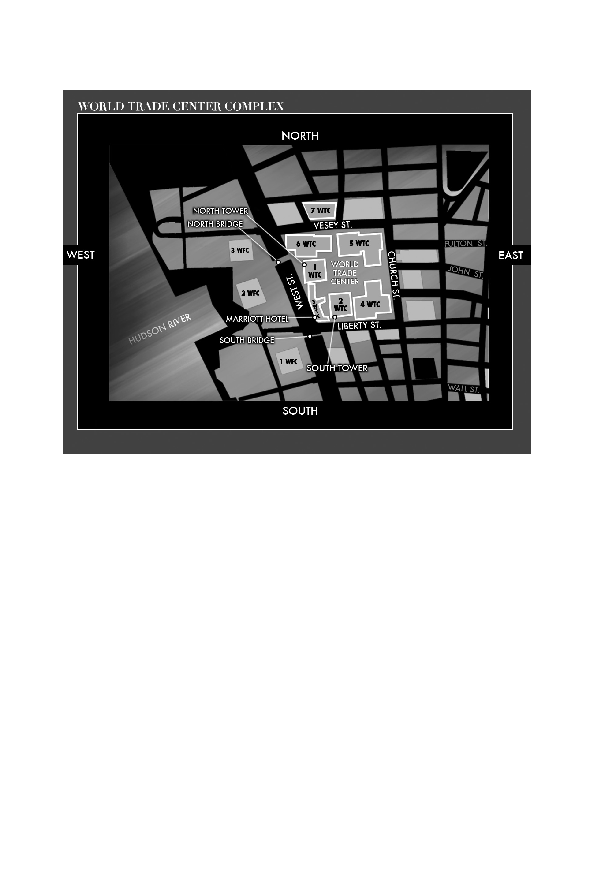
floor below the mezzanine. All three stairwells ran essentially straight up and
down, except for two deviations in stairwells A and C where the staircase jut-
ted out toward the perimeter of the building. On the upper and lower bound-
aries of these deviations were transfer hallways contained within the stairwell
proper. Each hallway contained smoke doors to prevent smoke from rising from
lower to upper portions of the building; they were kept closed but not locked.
Doors leading from tenant space into the stairwells were never kept locked;
reentry from the stairwells was generally possible on at least every fourth floor.
3
Doors leading to the roof were locked. There was no rooftop evacuation
plan. The roofs of both the North Tower and the South Tower were sloped
and cluttered surfaces with radiation hazards, making them impractical for hel-
icopter landings and as staging areas for civilians. Although the South Tower
roof had a helipad, it did not meet 1994 Federal Aviation Administration
guidelines.
4
The 1993 Terrorist Bombing of the WTC and the Port Authority's
Response.
Unlike most of America, New York City and specifically the World
HEROISM AND HORROR
279
The World Trade Center Complex as of 9/11
Rendering by Marco Crupi
Final 8-9.5pp 7/17/04 1:24 PM Page 279

Trade Center had been the target of terrorist attacks before 9/11.At 12:18
P
.
M
.
on February 26, 1993, a 1,500-pound bomb stashed in a rental van was deto-
nated on a parking garage ramp beneath the Twin Towers.The explosion killed
six people, injured about 1,000 more, and exposed vulnerabilities in the World
Trade Center's and the city's emergency preparedness.
5
The towers lost power and communications capability. Generators had to
be shut down to ensure safety, and elevators stopped. The public-address sys-
tem and emergency lighting systems failed. The unlit stairwells filled with
smoke and were so dark as to be impassable. Rescue efforts by the Fire Depart-
ment of New York (FDNY) were hampered by the inability of its radios to
function in buildings as large as the Twin Towers.The 911 emergency call sys-
tem was overwhelmed.The general evacuation of the towers' occupants via the
stairwells took more than four hours.
6
Several small groups of people who were physically unable to descend the
stairs were evacuated from the roof of the South Tower by New York Police
Department (NYPD) helicopters. At least one person was lifted from the
North Tower roof by the NYPD in a dangerous helicopter rappel operation--
15 hours after the bombing. General knowledge that these air rescues had
occurred appears to have left a number of civilians who worked in the Twin
Towers with the false impression that helicopter rescues were part of the WTC
evacuation plan and that rescue from the roof was a viable, if not favored, option
for those who worked on upper floors. Although they were considered after
1993, helicopter evacuations in fact were not incorporated into the WTC fire
safety plan.
7
To address the problems encountered during the response to the 1993
bombing, the Port Authority spent an initial $100 million to make physical,
structural, and technological improvements to the WTC, as well as to enhance
its fire safety plan and reorganize and bolster its fire safety and security staffs.
8
Substantial enhancements were made to power sources and exits. Fluores-
cent signs and markings were added in and near stairwells.The Port Authority
also installed a sophisticated computerized fire alarm system with redundant
electronics and control panels, and state-of-the-art fire command stations were
placed in the lobby of each tower.
9
To manage fire emergency preparedness and operations, the Port Authority
created the dedicated position of fire safety director.The director supervised a
team of deputy fire safety directors, one of whom was on duty at the fire com-
mand station in the lobby of each tower at all times. He or she would be respon-
sible for communicating with building occupants during an emergency.
10
The Port Authority also sought to prepare civilians better for future emer-
gencies. Deputy fire safety directors conducted fire drills at least twice a year,
with advance notice to tenants."Fire safety teams" were selected from among
civilian employees on each floor and consisted of a fire warden, deputy fire war-
dens, and searchers.The standard procedure for fire drills was for fire wardens
280
THE 9/11 COMMISSION REPORT
Final 8-9.5pp 7/17/04 1:24 PM Page 280

to lead co-workers in their respective areas to the center of the floor, where
they would use the emergency intercom phone to obtain specific information
on how to proceed. Some civilians have told us that their evacuation on Sep-
tember 11 was greatly aided by changes and training implemented by the Port
Authority in response to the 1993 bombing.
11
But during these drills, civilians were not directed into the stairwells, or pro-
vided with information about their configuration and about the existence of
transfer hallways and smoke doors. Neither full nor partial evacuation drills
were held. Moreover, participation in drills that were held varied greatly from
tenant to tenant. In general, civilians were never told not to evacuate up.The
standard fire drill announcement advised participants that in the event of an
actual emergency, they would be directed to descend to at least three floors
below the fire. Most civilians recall simply being taught to await the instruc-
tions that would be provided at the time of an emergency. Civilians were not
informed that rooftop evacuations were not part of the evacuation plan, or that
doors to the roof were kept locked.The Port Authority acknowledges that it
had no protocol for rescuing people trapped above a fire in the towers.
12
Six weeks before the September 11 attacks, control of the WTC was trans-
ferred by net lease to a private developer, Silverstein Properties. Select Port
Authority employees were designated to assist with the transition. Others
remained on-site but were no longer part of the official chain of command.
However, on September 11, most Port Authority World Trade Department
employees--including those not on the designated "transition team"--
reported to their regular stations to provide assistance throughout the morn-
ing. Although Silverstein Properties was in charge of the WTC on September
11, the WTC fire safety plan remained essentially the same.
13
Preparedness of First Responders
On 9/11, the principal first responders were from the Fire Department of New
York, the New York Police Department, the Port Authority Police Department
(PAPD), and the Mayor's Office of Emergency Management (OEM).
Port Authority Police Department.
On September 11, 2001, the Port
Authority of New York and New Jersey Police Department consisted of 1,331
officers, many of whom were trained in fire suppression methods as well as in
law enforcement. The PAPD was led by a superintendent. There was a sepa-
rate PAPD command for each of the Port Authority's nine facilities, including
the World Trade Center.
14
Most Port Authority police commands used ultra-high-frequency radios.
Although all the radios were capable of using more than one channel, most
PAPD officers used one local channel. The local channels were low-wattage
and worked only in the immediate vicinity of that command.The PAPD also
had an agencywide channel, but not all commands could access it.
15
HEROISM AND HORROR
281
Final 8-9.5pp 7/17/04 1:24 PM Page 281

As of September 11, the Port Authority lacked any standard operating pro-
cedures to govern how officers from multiple commands would respond to and
then be staged and utilized at a major incident at the WTC. In particular, there
were no standard operating procedures covering how different commands
should communicate via radio during such an incident.
The New York Police Department.
The 40,000-officer NYPD was
headed by a police commissioner, whose duties were not primarily operational
but who retained operational authority. Much of the NYPD's operational
activities were run by the chief of department. In the event of a major emer-
gency, a leading role would be played by the Special Operations Division.This
division included the Aviation Unit, which provided helicopters for surveys and
rescues, and the Emergency Service Unit (ESU), which carried out specialized
rescue missions.The NYPD had specific and detailed standard operating pro-
cedures for the dispatch of officers to an incident, depending on the incident's
magnitude.
16
The NYPD precincts were divided into 35 different radio zones, with a cen-
tral radio dispatcher assigned to each. In addition, there were several radio chan-
nels for citywide operations. Officers had portable radios with 20 or more
available channels, so that the user could respond outside his or her precinct.
ESU teams also had these channels but at an operation would use a separate
point-to-point channel (which was not monitored by a dispatcher).
17
The NYPD also supervised the city's 911 emergency call system. Its
approximately 1,200 operators, radio dispatchers, and supervisors were civil-
ian employees of the NYPD. They were trained in the rudiments of emer-
gency response.When a 911 call concerned a fire, it was transferred to FDNY
dispatch.
18
The Fire Department of New York.
The 11,000-member FDNY was
headed by a fire commissioner who, unlike the police commissioner, lacked
operational authority. Operations were headed by the chief of department--
the sole five-star chief.
19
The FDNY was organized in nine separate geographic divisions. Each divi-
sion was further divided into between four to seven battalions. Each battalion
contained typically between three and four engine companies and two to four
ladder companies. In total, the FDNY had 205 engine companies and 133 lad-
der companies. On-duty ladder companies consisted of a captain or lieutenant
and five firefighters; on-duty engine companies consisted of a captain or lieu-
tenant and normally four firefighters. Ladder companies' primary function was
to conduct rescues; engine companies focused on extinguishing fires.
20
The FDNY's Specialized Operations Command (SOC) contained a lim-
ited number of units that were of particular importance in responding to a
terrorist attack or other major incident.The department's five rescue compa-
nies and seven squad companies performed specialized and highly risky res-
cue operations.
21
282
THE 9/11 COMMISSION REPORT
Final 8-9.5pp 7/17/04 1:24 PM Page 282

The logistics of fire operations were directed by Fire Dispatch Operations
Division, which had a center in each of the five boroughs. All 911 calls concern-
ing fire emergencies were transferred to FDNY dispatch.
22
As of September 11, FDNY companies and chiefs responding to a fire used
analog, point-to-point radios that had six normal operating channels.Typically,
the companies would operate on the same tactical channel, which chiefs on
the scene would monitor and use to communicate with the firefighters. Chiefs
at a fire operation also would use a separate command channel. Because these
point-to-point radios had weak signal strength, communications on them
could be heard only by other FDNY personnel in the immediate vicinity. In
addition, the FDNY had a dispatch frequency for each of the five boroughs;
these were not point-to-point channels and could be monitored from around
the city.
23
The FDNY's radios performed poorly during the 1993 WTC bombing for
two reasons. First, the radios signals often did not succeed in penetrating the
numerous steel and concrete floors that separated companies attempting to
communicate; and second, so many different companies were attempting to use
the same point-to-point channel that communications became unintelligible.
24
The Port Authority installed, at its own expense, a repeater system in 1994
to greatly enhance FDNY radio communications in the difficult high-rise
environment of the Twin Towers. The Port Authority recommended leaving
the repeater system on at all times. The FDNY requested, however, that the
repeater be turned on only when it was actually needed because the channel
could cause interference with other FDNY operations in Lower Manhattan.
The repeater system was installed at the Port Authority police desk in 5 WTC,
to be activated by members of the Port Authority police when the FDNY units
responding to the WTC complex so requested. However, in the spring of 2000
the FDNY asked that an activation console for the repeater system be placed
instead in the lobby fire safety desk of each of the towers, making FDNY per-
sonnel entirely responsible for its activation.The Port Authority complied.
25
Between 1998 and 2000, fewer people died from fires in New York City
than in any three-year period since accurate measurements began in 1946. Fire-
fighter deaths--a total of 22 during the 1990s--compared favorably with the
most tranquil periods in the department's history.
26
Office of Emergency Management and Interagency Preparedness.
In
1996, Mayor Rudolph Giuliani created the Mayor's Office of Emergency Man-
agement, which had three basic functions. First, OEM's Watch Command was
to monitor the city's key communications channels--including radio frequen-
cies of FDNY dispatch and the NYPD--and other data.A second purpose of
the OEM was to improve New York City's response to major incidents, includ-
ing terrorist attacks, by planning and conducting exercises and drills that would
involve multiple city agencies, particularly the NYPD and FDNY. Third, the
OEM would play a crucial role in managing the city's overall response to an
HEROISM AND HORROR
283
Final 8-9.5pp 7/17/04 1:24 PM Page 283
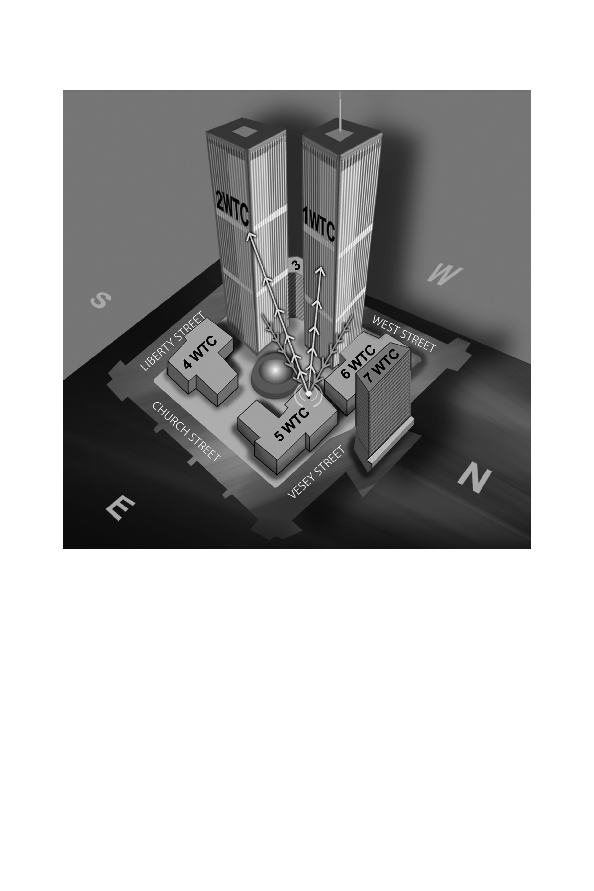
incident.After OEM's Emergency Operations Center was activated, designated
liaisons from relevant agencies, as well as the mayor and his or her senior staff,
would respond there. In addition, an OEM field responder would be sent to
the scene to ensure that the response was coordinated.
27
The OEM's headquarters was located at 7 WTC. Some questioned locating
it both so close to a previous terrorist target and on the 23rd floor of a build-
ing (difficult to access should elevators become inoperable). There was no
backup site.
28
In July 2001, Mayor Giuliani updated a directive titled "Direction and
Control of Emergencies in the City of New York." Its purpose was to elim-
inate "potential conflict among responding agencies which may have areas
284
THE 9/11 COMMISSION REPORT
The World Trade Center Radio Repeater System
Rendering by Marco Crupi
Final 8-9.5pp 7/17/04 1:24 PM Page 284

of overlapping expertise and responsibility."The directive sought to accom-
plish this objective by designating, for different types of emergencies, an
appropriate agency as "Incident Commander." This Incident Commander
would be "responsible for the management of the City's response to the
emergency," while the OEM was "designated the `On Scene Interagency
Coordinator.'"
29
Nevertheless, the FDNY and NYPD each considered itself operationally
autonomous.As of September 11, they were not prepared to comprehensively
coordinate their efforts in responding to a major incident.The OEM had not
overcome this problem.
9.2 SEPTEMBER 11, 2001
As we turn to the events of September 11, we are mindful of the unfair per-
spective afforded by hindsight. Nevertheless, we will try to describe what hap-
pened in the following 102 minutes:
· the 17 minutes from the crash of the hijacked American Airlines Flight
11 into 1 World Trade Center (the North Tower) at 8:46 until the
South Tower was hit
· the 56 minutes from the crash of the hijacked United Airlines Flight
175 into 2 World Trade Center (the South Tower) at 9:03 until the
collapse of the South Tower
· the 29 minutes from the collapse of the South Tower at 9:59 until the
collapse of the North Tower at 10:28
From 8:46 until 9:03
A
.
M
.
At 8:46:40, the hijacked American Airlines Flight 11 flew into the upper por-
tion of the North Tower, cutting through floors 93 to 99. Evidence suggests
that all three of the building's stairwells became impassable from the 92nd floor
up. Hundreds of civilians were killed instantly by the impact. Hundreds more
remained alive but trapped.
30
Civilians, Fire Safety Personnel, and 911 Calls
North Tower.
A jet fuel fireball erupted upon impact and shot down at least
one bank of elevators.The fireball exploded onto numerous lower floors, includ-
ing the 77th and 22nd; the West Street lobby level; and the B4 level, four stories
below ground.The burning jet fuel immediately created thick, black smoke that
enveloped the upper floors and roof of the North Tower.The roof of the South
Tower was also engulfed in smoke because of prevailing light winds from the
northwest.
31
Within minutes, New York City's 911 system was flooded with eyewit-
HEROISM AND HORROR
285
Final 8-9.5pp 7/17/04 1:24 PM Page 285

ness accounts of the event. Most callers correctly identified the target of the
attack. Some identified the plane as a commercial airliner.
32
The first response came from private firms and individuals--the people and
companies in the building. Everything that would happen to them during the
next few minutes would turn on their circumstances and their preparedness,
assisted by building personnel on-site.
Hundreds of civilians trapped on or above the 92nd floor gathered in large
and small groups, primarily between the 103rd and 106th floors.A large group
was reported on the 92nd floor, technically below the impact but unable to
descend. Civilians were also trapped in elevators. Other civilians below the
impact zone--mostly on floors in the 70s and 80s, but also on at least the 47th
and 22nd floors--were either trapped or waiting for assistance.
33
It is unclear when the first full building evacuation order was attempted over
the public-address system. The deputy fire safety director in the lobby, while
immediately aware that a major incident had occurred, did not know for
approximately ten minutes that a commercial jet had directly hit the building.
Following protocol, he initially gave announcements to those floors that had
generated computerized alarms, advising those tenants to descend to points of
safety--at least two floors below the smoke or fire--and to wait there for fur-
ther instructions. The deputy fire safety director has told us that he began
instructing a full evacuation within about ten minutes of the explosion. But
the first FDNY chiefs to arrive in the lobby were advised by the Port Author-
ity fire safety director--who had reported to the lobby although he was no
longer the designated fire safety director--that the full building evacuation
announcement had been made within one minute of the building being hit.
34
Because of damage to building systems caused by the impact of the plane,
public-address announcements were not heard in many locations. For the same
reason, many civilians may have been unable to use the emergency intercom
phones, as they had been advised to do in fire drills. Many called 911.
35
The 911 system was not equipped to handle the enormous volume of calls
it received. Some callers were unable to connect with 911 operators, receiving
an "all circuits busy" message. Standard operating procedure was for calls relat-
ing to fire emergencies to be transferred from 911 operators to FDNY dispatch
operators in the appropriate borough (in this case, Manhattan).Transfers were
often plagued by delays and were in some cases unsuccessful. Many calls were
also prematurely disconnected.
36
The 911 operators and FDNY dispatchers had no information about either
the location or the magnitude of the impact zone and were therefore unable
to provide information as fundamental as whether callers were above or below
the fire. Because the operators were not informed of NYPD Aviation's deter-
mination of the impossibility of rooftop rescues from the Twin Towers on that
day, they could not knowledgeably answer when callers asked whether to go
up or down. In most instances, therefore, the operators and the FDNY dis-
patchers relied on standard operating procedures for high-rise fires--that civil-
286
THE 9/11 COMMISSION REPORT
Final 8-9.5pp 7/17/04 1:24 PM Page 286

ians should stay low, remain where they are, and wait for emergency person-
nel to reach them.This advice was given to callers from the North Tower for
locations both above and below the impact zone. Fire chiefs told us that the
evacuation of tens of thousands of people from skyscrapers can create many
new problems, especially for individuals who are disabled or in poor health.
Many of the injuries after the 1993 bombing occurred during the evacuation.
37
Although the guidance to stay in place may seem understandable in cases
of conventional high-rise fires, FDNY chiefs in the North Tower lobby deter-
mined at once that all building occupants should attempt to evacuate imme-
diately. By 8:57, FDNY chiefs had instructed the PAPD and building
personnel to evacuate the South Tower as well, because of the magnitude of
the damage caused by the first plane's impact.
38
These critical decisions were not conveyed to 911 operators or to FDNY
dispatchers. Departing from protocol, a number of operators told callers that
they could break windows, and several operators advised callers to evacuate if
they could.
39
Civilians who called the Port Authority police desk located at 5
WTC were advised to leave if they could.
40
Most civilians who were not obstructed from proceeding began evacuating
without waiting for instructions over the intercom system. Some remained to
wait for help, as advised by 911 operators. Others simply continued to work or
delayed to collect personal items, but in many cases were urged to leave by oth-
ers. Some Port Authority civilian employees remained on various upper floors
to help civilians who were trapped and to assist in the evacuation.
41
While evacuating, some civilians had trouble reaching the exits because of
damage caused by the impact. Some were confused by deviations in the increas-
ingly crowded stairwells, and impeded by doors that appeared to be locked but
actually were jammed by debris or shifting that resulted from the impact of the
plane. Despite these obstacles, the evacuation was relatively calm and orderly.
42
Within ten minutes of impact, smoke was beginning to rise to the upper
floors in debilitating volumes and isolated fires were reported, although there
were some pockets of refuge. Faced with insufferable heat, smoke, and fire, and
with no prospect for relief, some jumped or fell from the building.
43
South Tower.
Many civilians in the South Tower were initially unaware of
what had happened in the other tower. Some believed an incident had
occurred in their building; others were aware that a major explosion had
occurred on the upper floors of the North Tower. Many people decided to
leave, and some were advised to do so by fire wardens. In addition, Morgan
Stanley, which occupied more than 20 floors of the South Tower, evacuated its
employees by the decision of company security officials.
44
Consistent with protocol, at 8:49 the deputy fire safety director in the South
Tower told his counterpart in the North Tower that he would wait to hear from
"the boss from the Fire Department or somebody" before ordering an evacua-
tion.
45
At about this time, an announcement over the public-address system in
HEROISM AND HORROR
287
Final 8-9.5pp 7/17/04 1:24 PM Page 287
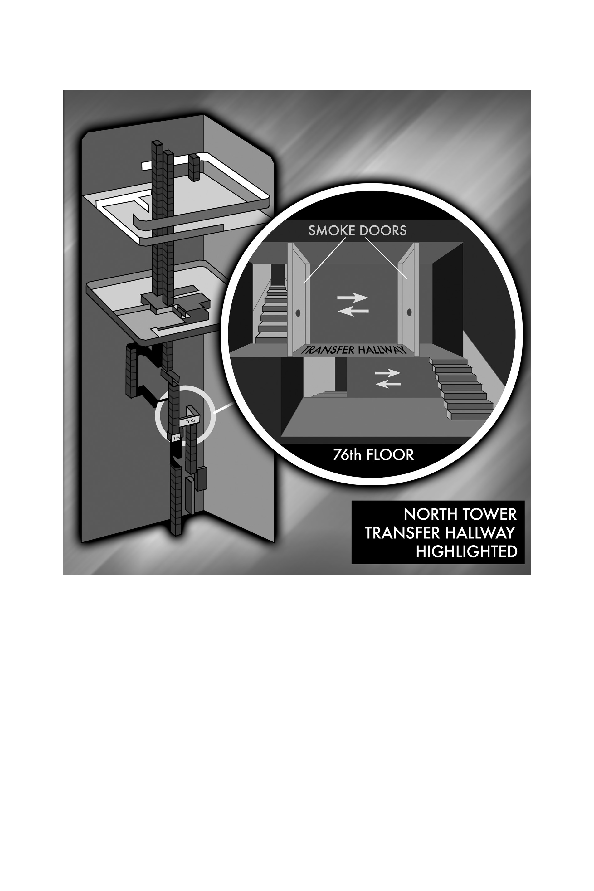
the South Tower stated that the incident had occurred in the other building and
advised tenants,generally,that their building was safe and that they should remain
on or return to their offices or floors. A statement from the deputy fire safety
director informing tenants that the incident had occurred in the other building
was consistent with protocol; the expanded advice did not correspond to any
existing written protocol,and did not reflect any instruction known to have been
given to the deputy fire safety director that day.We do not know the reason for
the announcement, as both the deputy fire safety director believed to have made
it and the director of fire safety for the WTC complex perished in the South
Tower's collapse. Clearly, however, the prospect of another plane hitting the sec-
ond building was beyond the contemplation of anyone giving advice.According
288
THE 9/11 COMMISSION REPORT
The World Trade Center North Tower Stairwell with Deviation
Rendering by Marco Crupi
Final 8-9.5pp 7/17/04 1:24 PM Page 288

to one of the first fire chiefs to arrive, such a scenario was unimaginable,"beyond
our consciousness."As a result of the announcement, many civilians remained on
their floors. Others reversed their evacuation and went back up.
46
Similar advice was given in person by security officials in both the ground-
floor lobby--where a group of 20 that had descended by the elevators was per-
sonally instructed to go back upstairs--and in the upper sky lobby, where many
waited for express elevators to take them down. Security officials who gave this
advice were not part of the fire safety staff.
47
Several South Tower occupants called the Port Authority police desk in 5
WTC. Some were advised to stand by for further instructions; others were
strongly advised to leave.
48
It is not known whether the order by the FDNY to evacuate the South
Tower was received by the deputy fire safety director making announcements
there. However, at approximately 9:02--less than a minute before the building
was hit--an instruction over the South Tower's public-address system advised
civilians, generally, that they could begin an orderly evacuation if conditions
warranted. Like the earlier advice to remain in place, it did not correspond to
any prewritten emergency instruction.
49
FDNY Initial Response
Mobilization.
The FDNY response began within five seconds of the crash.
By 9:00, many senior FDNY leaders, including 7 of the 11 most highly ranked
chiefs in the department, as well as the Commissioner and many of his deputies
and assistants, had begun responding from headquarters in Brooklyn.While en
route over the Brooklyn Bridge, the Chief of Department and the Chief of
Operations had a clear view of the situation on the upper floors of the North
Tower.They determined that because of the fire's magnitude and location near
the top of the building, their mission would be primarily one of rescue.They
called for a fifth alarm, which would bring additional engine and ladder com-
panies, as well as for two more elite rescue units. The Chief of Department
arrived at about 9:00; general FDNY Incident Command was transferred to
his location on the West Side Highway. In all, 22 of the 32 senior chiefs and
commissioners arrived at the WTC before 10:00.
50
As of 9:00, the units that were dispatched (including senior chiefs respond-
ing to headquarters) included approximately 235 firefighters.These units con-
sisted of 21 engine companies, nine ladder companies, four of the department's
elite rescue teams, the department's single Hazmat team, two of the city's elite
squad companies, and support staff. In addition, at 8:53 nine Brooklyn units
were staged on the Brooklyn side of the Brooklyn-Battery Tunnel to await pos-
sible dispatch orders.
51
Operations.
A battalion chief and two ladder and two engine companies
arrived at the North Tower at approximately 8:52. As they entered the lobby,
they encountered badly burned civilians who had been caught in the path of
HEROISM AND HORROR
289
Final 8-9.5pp 7/17/04 1:24 PM Page 289

the fireball. Floor-to-ceiling windows in the northwest corner of the West
Street level of the lobby had been blown out; some large marble tiles had been
dislodged from the walls; one entire elevator bank was destroyed by the fire-
ball. Lights were functioning, however, and the air was clear of smoke.
52
As the highest-ranking officer on the scene, the battalion chief initially was
the FDNY incident commander. Minutes later, the on-duty division chief for
Lower Manhattan arrived and took over. Both chiefs immediately began speak-
ing with the former fire safety director and other building personnel to learn
whether building systems were working.They were advised that all 99 eleva-
tors in the North Tower appeared to be out, and there were no assurances that
sprinklers or standpipes were working on upper floors. Chiefs also spoke with
Port Authority police personnel and an OEM representative.
53
After conferring with the chiefs in the lobby, one engine and one ladder
company began climbing stairwell C at about 8:57, with the goal of approach-
ing the impact zone as scouting units and reporting back to the chiefs in the
lobby.The radio channel they used was tactical 1. Following FDNY high-rise
fire protocols, other units did not begin climbing immediately, as the chiefs
worked to formulate a plan before sending them up. Units began mobilizing
in the lobby, lining up and awaiting their marching orders.
54
Also by approximately 8:57, FDNY chiefs had asked both building person-
nel and a Port Authority police officer to evacuate the South Tower, because
in their judgment the impact of the plane into the North Tower made the entire
complex unsafe--not because of concerns about a possible second plane.
55
The FDNY chiefs in the increasingly crowded North Tower lobby were
confronting critical choices with little to no information.They had ordered units
up the stairs to report back on conditions, but did not know what the impact
floors were; they did not know if any stairwells into the impact zone were clear;
and they did not know whether water for firefighting would be available on
the upper floors.They also did not know what the fire and impact zone looked
like from the outside.
56
They did know that the explosion had been large enough to send down a
fireball that blew out elevators and windows in the lobby and that conditions
were so dire that some civilians on upper floors were jumping or falling from
the building.They also knew from building personnel that some civilians were
trapped in elevators and on specific floors. According to Division Chief for
Lower Manhattan Peter Hayden, "We had a very strong sense we would lose
firefighters and that we were in deep trouble, but we had estimates of 25,000
to 50,000 civilians, and we had to try to rescue them."
57
The chiefs concluded that this would be a rescue operation, not a firefight-
ing operation. One of the chiefs present explained:
We realized that, because of the impact of the plane, that there was some
structural damage to the building, and most likely that the fire suppres-
290
THE 9/11 COMMISSION REPORT
Final 8-9.5pp 7/17/04 1:24 PM Page 290

sion systems within the building were probably damaged and possibly
inoperable. . . .We knew that at the height of the day there were as many
as 50,000 people in this building.We had a large volume of fire on the
upper floors. Each floor was approximately an acre in size. Several floors
of fire would have been beyond the fire-extinguishing capability of the
forces that we had on hand. So we determined, very early on, that this
was going to be strictly a rescue mission. We were going to vacate the
building, get everybody out, and then we were going to get out.
58
The specifics of the mission were harder to determine, as they had almost
no information about the situation 80 or more stories above them.They also
received advice from senior FDNY chiefs that while the building might even-
tually suffer a partial collapse on upper floors, such structural failure was not
imminent. No one anticipated the possibility of a total collapse.
59
Emergency medical services (EMS) personnel were directed to one of four
triage areas being set up around the perimeter of the WTC. Some entered the
lobby to respond to specific casualty reports. In addition, many ambulance para-
medics from private hospitals were rushing to the WTC complex.
60
NYPD Initial Response
Numerous NYPD officers saw the plane strike the North Tower and immedi-
ately reported it to NYPD communications dispatchers.
61
At 8:58, while en route, the NYPD Chief of Department raised the
NYPD's mobilization to level 4, thereby sending to the WTC approximately
22 lieutenants, 100 sergeants, and 800 police officers from all over the city. The
Chief of Department arrived at Church and Vesey at 9:00.
62
At 9:01, the NYPD patrol mobilization point was moved to West and Vesey
in order to handle the greater number of patrol officers dispatched in the
higher-level mobilization. These officers would be stationed around the
perimeter of the complex to direct the evacuation of civilians. Many were
diverted on the way to the scene by intervening emergencies related to the
attack.
63
At 8:50, the Aviation Unit of the NYPD dispatched two helicopters to the
WTC to report on conditions and assess the feasibility of a rooftop landing or
of special rescue operations. En route, the two helicopters communicated with
air traffic controllers at the area's three major airports and informed them of
the commercial airplane crash at the World Trade Center.The air traffic con-
trollers had been unaware of the incident.
64
At 8:56, an NYPD ESU team asked to be picked up at the Wall Street hel-
iport to initiate rooftop rescues. At 8:58, however, after assessing the North
Tower roof, a helicopter pilot advised the ESU team that they could not land
on the roof, because "it is too engulfed in flames and heavy smoke condition."
65
By 9:00, a third NYPD helicopter was responding to the WTC complex.
HEROISM AND HORROR
291
Final 8-9.5pp 7/17/04 1:24 PM Page 291

NYPD helicopters and ESU officers remained on the scene throughout the
morning, prepared to commence rescue operations on the roof if conditions
improved. Both FDNY and NYPD protocols called for FDNY personnel to
be placed in NYPD helicopters in the event of an attempted rooftop rescue at
a high-rise fire. No FDNY personnel were placed in NYPD helicopters on
September 11.
66
The 911 operators and FDNY dispatchers were not advised that rooftop
rescues were not being undertaken.They thus were not able to communicate
this fact to callers, some of whom spoke of attempting to climb to the roof.
67
Two on-duty NYPD officers were on the 20th floor of the North Tower at
8:46.They climbed to the 29th floor, urging civilians to evacuate, but did not
locate a group of civilians trapped on the 22nd floor.
68
Just before 9:00, an ESU team began to walk from Church and Vesey to the
North Tower lobby, with the goal of climbing toward and setting up a triage
center on the upper floors for the severely injured.A second ESU team would
follow them to assist in removing those individuals.
69
Numerous officers responded in order to help injured civilians and to urge
those who could walk to vacate the area immediately. Putting themselves in
danger of falling debris, several officers entered the plaza and successfully res-
cued at least one injured, nonambulatory civilian, and attempted to rescue
others.
70
Also by about 9:00, transit officers began shutting down subway stations
in the vicinity of the World Trade Center and evacuating civilians from those
stations.
71
Around the city, the NYPD cleared major thoroughfares for emergency
vehicles to access the WTC.The NYPD and PAPD coordinated the closing of
bridges and tunnels into Manhattan.
72
PAPD Initial Response
The Port Authority's on-site commanding police officer was standing in the
concourse when a fireball erupted out of elevator shafts and exploded onto the
mall concourse, causing him to dive for cover. The on-duty sergeant initially
instructed the officers in the WTC Command to meet at the police desk in 5
WTC. Soon thereafter, he instructed officers arriving from outside commands
to meet him at the fire safety desk in the North Tower lobby. A few of these
officers from outside commands were given WTC Command radios.
73
One Port Authority police officer at the WTC immediately began climb-
ing stairwell C in the North Tower.
74
Other officers began performing res-
cue and evacuation operations on the ground floors and in the PATH (Port
Authority Trans-Hudson) station below the WTC complex.
Within minutes of impact, Port Authority police officers from the PATH,
bridges, tunnels, and airport commands began responding to the WTC. The
PAPD lacked written standard operating procedures for personnel responding
from outside commands to the WTC during a major incident. In addition, offi-
292
THE 9/11 COMMISSION REPORT
Final 8-9.5pp 7/17/04 1:24 PM Page 292

cers from some PAPD commands lacked interoperable radio frequencies. As a
result, there was no comprehensive coordination of PAPD's overall response.
75
At 9:00, the PAPD commanding officer of the WTC ordered an evacuation
of all civilians in the World Trade Center complex, because of the magnitude
of the calamity in the North Tower. This order was given over WTC police
radio channel W, which could not be heard by the deputy fire safety director
in the South Tower.
76
Also at 9:00, the PAPD Superintendent and Chief of Department arrived
separately and made their way to the North Tower.
77
OEM Initial Response
By 8:48, officials in OEM headquarters on the 23rd floor of 7 WTC--just to
the north of the North Tower--began to activate the Emergency Operations
Center by calling such agencies as the FDNY, NYPD, Department of Health,
and the Greater Hospital Association and instructing them to send their des-
ignated representatives to the OEM. In addition, the Federal Emergency Man-
agement Agency (FEMA) was called and asked to send at least five federal
Urban Search and Rescue Teams (such teams are located throughout the
United States). At approximately 8:50, a senior representative from the OEM
arrived in the lobby of the North Tower and began to act as the OEM field
responder to the incident. He soon was joined by several other OEM officials,
including the OEM Director.
78
Summary
In the 17-minute period between 8:46 and 9:03
A
.
M
. on September 11, New
York City and the Port Authority of New York and New Jersey had mobilized
the largest rescue operation in the city's history. Well over a thousand first
responders had been deployed, an evacuation had begun, and the critical deci-
sion that the fire could not be fought had been made.
Then the second plane hit.
From 9:03 until 9:59
A
.
M
.
At 9:03:11, the hijacked United Airlines Flight 175 hit 2 WTC (the South
Tower) from the south, crashing through the 77th to 85th floors.What had been
the largest and most complicated rescue operation in city history instantly dou-
bled in magnitude.The plane banked as it hit the building, leaving portions of
the building undamaged on impact floors. As a consequence--and in contrast
to the situation in the North Tower--one of the stairwells (A) initially remained
passable from at least the 91st floor down, and likely from top to bottom.
79
Civilians, Fire Safety Personnel, and 911 Calls
South Tower.
At the lower end of the impact, the 78th-floor sky lobby, hun-
dreds had been waiting to evacuate when the plane hit. Many had attempted
but failed to squeeze into packed express elevators. Upon impact, many were
HEROISM AND HORROR
293
Final 8-9.5pp 7/17/04 1:24 PM Page 293

killed or severely injured; others were relatively unharmed.We know of at least
one civilian who seized the initiative and shouted that anyone who could walk
should walk to the stairs, and anyone who could help should help others in
need of assistance. As a result, at least two small groups of civilians descended
from that floor. Others remained on the floor to help the injured and move
victims who were unable to walk to the stairwell to aid their rescue.
80
Still others remained alive in the impact zone above the 78th floor. Dam-
age was extensive, and conditions were highly precarious. The only survivor
known to have escaped from the heart of the impact zone described the 81st
floor--where the wing of the plane had sliced through his office--as a "dem-
olition" site in which everything was "broken up" and the smell of jet fuel was
so strong that it was almost impossible to breathe.This person escaped by means
of an unlikely rescue, aided by a civilian fire warden descending from a higher
floor, who, critically, had been provided with a flashlight.
81
At least four people were able to descend stairwell A from the 81st floor or
above. One left the 84th floor immediately after the building was hit. Even at
that point, the stairway was dark, smoky, and difficult to navigate; glow strips
on the stairs and handrails were a significant help. Several flights down, how-
ever, the evacuee became confused when he reached a smoke door that caused
him to believe the stairway had ended. He was able to exit that stairwell and
switch to another.
82
Many civilians in and above the impact zone ascended the stairs. One small
group reversed its descent down stairwell A after being advised by another civil-
ian that they were approaching a floor "in flames."The only known survivor
has told us that their intention was to exit the stairwell in search of clearer air.
At the 91st floor, joined by others from intervening floors, they perceived
themselves to be trapped in the stairwell and began descending again. By this
time, the stairwell was "pretty black," intensifying smoke caused many to pass
out, and fire had ignited in the 82nd-floor transfer hallway.
83
Others ascended to attempt to reach the roof but were thwarted by locked
doors. At approximately 9:30 a "lock release" order--which would unlock all
areas in the complex controlled by the buildings' computerized security sys-
tem, including doors leading to the roofs--was transmitted to the Security
Command Center located on the 22nd floor of the North Tower. Damage to
the software controlling the system, resulting from the impact of the plane, pre-
vented this order from being executed.
84
Others, attempting to descend, were frustrated by jammed or locked doors
in stairwells or confused by the structure of the stairwell deviations. By the
lower 70s, however, stairwells A and B were well-lit, and conditions were gen-
erally normal.
85
Some civilians remained on affected floors, and at least one ascended from
a lower point into the impact zone, to help evacuate colleagues or assist the
injured.
86
Within 15 minutes after the impact, debilitating smoke had reached at least
294
THE 9/11 COMMISSION REPORT
Final 8-9.5pp 7/17/04 1:24 PM Page 294

one location on the 100th floor, and severe smoke conditions were reported
throughout floors in the 90s and 100s over the course of the following half
hour. By 9:30, a number of civilians who had failed to reach the roof remained
on the 105th floor, likely unable to descend because of intensifying smoke in
the stairwell.There were reports of tremendous smoke on that floor, but at least
one area remained less affected until shortly before the building collapsed.
There were several areas between the impact zone and the uppermost floors
where conditions were better.At least a hundred people remained alive on the
88th and 89th floors, in some cases calling 911 for direction.
87
The 911 system remained plagued by the operators' lack of awareness of
what was occurring. Just as in the North Tower, callers from below and above
the impact zone were advised to remain where they were and wait for help.
The operators were not given any information about the inability to conduct
rooftop rescues and therefore could not advise callers that they had essentially
been ruled out.This lack of information, combined with the general advice to
remain where they were, may have caused civilians above the impact not to
attempt to descend, although stairwell A may have been passable.
88
In addition, the 911 system struggled with the volume of calls and rigid stan-
dard operating procedures according to which calls conveying crucial informa-
tion had to wait to be transferred to either EMS or FDNY dispatch.
89
According
to one civilian who was evacuating down stairwell A from the heart of the impact
zone and who stopped on the 31st floor in order to call 911,
I told them when they answered the phone, where I was, that I had passed
somebody on the 44th floor, injured--they need to get a medic and a
stretcher to this floor, and described the situation in brief, and the per-
son then asked for my phone number, or something, and they said--they
put me on hold. "You gotta talk to one of my supervisors"--and sud-
denly I was on hold. And so I waited a considerable amount of time.
Somebody else came back on the phone, I repeated the story. And then
it happened again. I was on hold a second time, and needed to repeat the
story for a third time. But I told the third person that I am only telling
you once. I am getting out of the building, here are the details, write it
down, and do what you should do.
90
Very few 911 calls were received from floors below the impact, but at least
one person was advised to remain on the 73rd floor despite the caller's protests
that oxygen was running out.The last known 911 call from this location came
at 9:52.
91
Evidence suggests that the public-address system did not continue to func-
tion after the building was hit. A group of people trapped on the 97th floor,
however, made repeated references in calls to 911 to having heard "announce-
ments" to go down the stairs. Evacuation tones were heard in locations both
above and below the impact zone.
92
HEROISM AND HORROR
295
Final 8-9.5pp 7/17/04 1:24 PM Page 295

By 9:35, the West Street lobby level of the South Tower was becoming over-
whelmed by injured people who had descended to the lobby but were having
difficulty going on.Those who could continue were directed to exit north or
east through the concourse and then out of the WTC complex.
93
By 9:59, at least one person had descended from as high as the 91st floor of
that tower, and stairwell A was reported to have been almost empty. Stairwell
B was also reported to have contained only a handful of descending civilians
at an earlier point in the morning. But just before the tower collapsed, a team
of NYPD ESU officers encountered a stream of civilians descending an
unidentified stairwell in the 20s.These civilians may have been descending from
at or above the impact zone.
94
North Tower.
In the North Tower, civilians continued their evacuation. On
the 91st floor, the highest floor with stairway access, all civilians but one were
uninjured and able to descend.While some complained of smoke, heat, fumes,
and crowding in the stairwells, conditions were otherwise fairly normal on
floors below the impact.At least one stairwell was reported to have been "clear
and bright" from the upper 80s down.
95
Those who called 911 from floors below the impact were generally advised
to remain in place. One group trapped on the 83rd floor pleaded repeatedly to
know whether the fire was above or below them, specifically asking if 911 oper-
ators had any information from the outside or from the news.The callers were
transferred back and forth several times and advised to stay put. Evidence sug-
gests that these callers died.
96
At 8:59, the Port Authority police desk at Newark Airport told a third party
that a group of Port Authority civilian employees on the 64th floor should
evacuate. (The third party was not at the WTC, but had been in phone con-
tact with the group on the 64th floor.) At 9:10, in response to an inquiry from
the employees themselves, the Port Authority police desk in Jersey City con-
firmed that employees on the 64th floor should "be careful, stay near the stair-
wells, and wait for the police to come up." When the third party inquired again
at 9:31, the police desk at Newark Airport advised that they "absolutely" evac-
uate.The third party informed the police desk that the employees had previ-
ously received contrary advice from the FDNY, which could only have come
via 911. These workers were not trapped, yet unlike most occupants on the
upper floors, they had chosen not to descend immediately after impact.They
eventually began to descend the stairs, but most of them died in the collapse
of the North Tower.
97
All civilians who reached the lobby were directed by NYPD and PAPD offi-
cers into the concourse, where other police officers guided them to exit the
concourse and complex to the north and east so that they might avoid falling
debris and victims.
98
By 9:55, only a few civilians were descending above the 25th floor in stair-
296
THE 9/11 COMMISSION REPORT
Final 8-9.5pp 7/17/04 1:24 PM Page 296

well B; these primarily were injured, handicapped, elderly, or severely over-
weight civilians, in some cases being assisted by other civilians.
99
By 9:59, tenants from the 91st floor had already descended the stairs and
exited the concourse. However, a number of civilians remained in at least stair-
well C, approaching lower floors. Other evacuees were killed earlier by debris
falling on the street.
100
FDNY Response
Increased Mobilization.
Immediately after the second plane hit, the FDNY
Chief of Department called a second fifth alarm.
101
By 9:15, the number of FDNY personnel en route to or present at the scene
was far greater than the commanding chiefs at the scene had requested. Five
factors account for this disparity. First, while the second fifth alarm had called
for 20 engine and 8 ladder companies, in fact 23 engine and 13 ladder com-
panies were dispatched. Second, several other units self-dispatched. Third,
because the attacks came so close to the 9:00 shift change, many firefighters
just going off duty were given permission by company officers to "ride heavy"
and became part of those on-duty teams, under the leadership of that unit's
officer. Fourth, many off-duty firefighters responded from firehouses separately
from the on-duty unit (in some cases when expressly told not to) or from
home.The arrival of personnel in excess of that dispatched was particularly pro-
nounced in the department's elite units. Fifth, numerous additional FDNY per-
sonnel--such as fire marshals and firefighters in administrative positions--who
lacked a predetermined operating role also reported to the WTC.
102
The Repeater System.
Almost immediately after the South Tower was hit,
senior FDNY chiefs in the North Tower lobby huddled to discuss strategy for
the operations in the two towers. Of particular concern to the chiefs--in light
of FDNY difficulties in responding to the 1993 bombing--was communica-
tions capability. One of the chiefs recommended testing the repeater channel
to see if it would work.
103
Earlier, an FDNY chief had asked building personnel to activate the
repeater channel, which would enable greatly-enhanced FDNY portable radio
communications in the high-rises. One button on the repeater system activa-
tion console in the North Tower was pressed at 8:54, though it is unclear by
whom.As a result of this activation, communication became possible between
FDNY portable radios on the repeater channel. In addition, the repeater's mas-
ter handset at the fire safety desk could hear communications made by FDNY
portable radios on the repeater channel. The activation of transmission on the
master handset required, however, that a second button be pressed. That sec-
ond button was never activated on the morning of September 11.
104
At 9:05, FDNY chiefs tested the WTC complex's repeater system. Because
the second button had not been activated, the chief on the master handset could
HEROISM AND HORROR
297
Final 8-9.5pp 7/17/04 1:24 PM Page 297

not transmit. He was also apparently unable to hear another chief who was
attempting to communicate with him from a portable radio, either because of
a technical problem or because the volume was turned down on the console
(the normal setting when the system was not in use). Because the repeater
channel seemed inoperable--the master handset appeared unable to transmit
or receive communications--the chiefs in the North Tower lobby decided not
to use it.The repeater system was working at least partially, however, on portable
FDNY radios, and firefighters subsequently used repeater channel 7 in the
South Tower.
105
FDNY North Tower Operations.
Command and control decisions were
affected by the lack of knowledge of what was happening 30, 60, 90, and 100
floors above. According to one of the chiefs in the lobby, "One of the most
critical things in a major operation like this is to have information.We didn't
have a lot of information coming in.We didn't receive any reports of what was
seen from the [NYPD] helicopters. It was impossible to know how much dam-
age was done on the upper floors, whether the stairwells were intact or not."
106
According to another chief present, "People watching on TV certainly had
more knowledge of what was happening a hundred floors above us than we
did in the lobby. . . . [W]ithout critical information coming in . . . it's very dif-
ficult to make informed, critical decisions[.]"
107
As a result, chiefs in the lobby disagreed over whether anyone at or above
the impact zone possibly could be rescued, or whether there should be even
limited firefighting for the purpose of cutting exit routes through fire zones.
108
Many units were simply instructed to ascend toward the impact zone and
report back to the lobby via radio. Some units were directed to assist specific
groups of individuals trapped in elevators or in offices well below the impact
zone. One FDNY company successfully rescued some civilians who were
trapped on the 22nd floor as a result of damage caused by the initial fireball.
109
An attempt was made to track responding units' assignments on a magnetic
board, but the number of units and individual firefighters arriving in the lobby
made this an overwhelming task.As the fire companies were not advised to the
contrary, they followed protocol and kept their radios on tactical channel 1,
which would be monitored by the chiefs in the lobby.Those battalion chiefs
who would climb would operate on a separate command channel, which also
would be monitored by the chiefs in the lobby.
110
Fire companies began to ascend stairwell B at approximately 9:07, laden
with about 100 pounds of heavy protective clothing, self-contained breathing
apparatuses, and other equipment (including hoses for engine companies and
heavy tools for ladder companies).
111
Firefighters found the stairways they entered intact, lit, and clear of smoke.
Unbeknownst to the lobby command post, one battalion chief in the North
Tower found a working elevator, which he took to the 16th floor before begin-
ning to climb.
112
298
THE 9/11 COMMISSION REPORT
Final 8-9.5pp 7/17/04 1:24 PM Page 298

In ascending stairwell B, firefighters were passing a steady and heavy stream
of descending civilians. Firemen were impressed with the composure and total
lack of panic shown by almost all civilians. Many civilians were in awe of the
firefighters and found their mere presence to be calming.
113
Firefighters periodically stopped on particular floors and searched to ensure
that no civilians were still on it. In a few instances healthy civilians were found
on floors, either because they still were collecting personal items or for no
apparent reason; they were told to evacuate immediately. Firefighters deputized
healthy civilians to be in charge of others who were struggling or injured.
114
Climbing up the stairs with heavy protective clothing and equipment was
hard work even for physically fit firefighters.As firefighters began to suffer vary-
ing levels of fatigue, some became separated from others in their unit.
115
At 9:32, a senior chief radioed all units in the North Tower to return to the
lobby, either because of a false report of a third plane approaching or because
of his judgment about the deteriorating condition of the building. Once the
rumor of the third plane was debunked, other chiefs continued operations, and
there is no evidence that any units actually returned to the lobby. At the same
time, a chief in the lobby was asked to consider the possibility of a rooftop res-
cue but was unable to reach FDNY dispatch by radio or phone. Out on West
Street, however, the FDNY Chief of Department had already dismissed any
rooftop rescue as impossible.
116
As units climbed higher, their ability to communicate with chiefs on tacti-
cal 1 became more limited and sporadic, both because of the limited effective-
ness of FDNY radios in high-rises and because so many units on tactical 1 were
trying to communicate at once. When attempting to reach a particular unit,
chiefs in the lobby often heard nothing in response.
117
Just prior to 10:00, in the North Tower one engine company had climbed
to the 54th floor, at least two other companies of firefighters had reached the
sky lobby on the 44th floor, and numerous units were located between the 5th
and 37th floors.
118
FDNY South Tower and Marriott Hotel Operations.
Immediately after
the repeater test, a senior chief and a battalion chief commenced operations in
the South Tower lobby. Almost at once they were joined by an OEM field
responder.They were not, however, joined right away by a sizable number of
fire companies, as units that had been in or en route to the North Tower lobby
at 9:03 were not reallocated to the South Tower.
119
A battalion chief and a ladder company found a working elevator to the 40th
floor and from there proceeded to climb stairwell B.Another ladder company
arrived soon thereafter, and began to rescue civilians trapped in an elevator
between the first and second floors. The senior chief in the lobby expressed
frustration about the lack of units he initially had at his disposal for South Tower
operations.
120
Unlike the commanders in the North Tower, the senior chief in the lobby
HEROISM AND HORROR
299
Final 8-9.5pp 7/17/04 1:24 PM Page 299

and the ascending battalion chief kept their radios on repeater channel 7. For
the first 15 minutes of the operations, communications among them and the
ladder company climbing with the battalion chief worked well. Upon learn-
ing from a company security official that the impact zone began at the 78th
floor, a ladder company transmitted this information, and the battalion chief
directed an engine company staged on the 40th floor to attempt to find an ele-
vator to reach that upper level.
121
To our knowledge, no FDNY chiefs outside the South Tower realized that
the repeater channel was functioning and being used by units in that tower.
The senior chief in the South Tower lobby was initially unable to communi-
cate his requests for more units to chiefs either in the North Tower lobby or
at the outdoor command post.
122
From approximately 9:21 on, the ascending battalion chief was unable to
reach the South Tower lobby command post because the senior chief in the
lobby had ceased to communicate on repeater channel 7. The vast majority of
units that entered the South Tower did not communicate on the repeater chan-
nel.
123
The first FDNY fatality of the day occurred at approximately 9:30, when
a civilian landed on and killed a fireman near the intersection of West and Lib-
erty streets.
124
By 9:30, chiefs in charge of the South Tower still were in need of additional
companies. Several factors account for the lag in response. First, only two units
that had been dispatched to the North Tower prior to 9:03 reported immedi-
ately to the South Tower. Second, units were not actually sent until approxi-
mately five minutes after the FDNY Chief of Department ordered their
dispatch. Third, those units that had been ordered at 8:53 to stage at the
Brooklyn-Battery Tunnel--and thus very close to the WTC complex--were
not dispatched after the plane hit the South Tower. Fourth, units parked fur-
ther north on West Street, then proceeded south on foot and stopped at the
overall FDNY command post on West Street, where in some cases they were
told to wait. Fifth, some units responded directly to the North Tower. (Indeed,
radio communications indicated that in certain cases some firemen believed
that the South Tower was 1 WTC when in fact it was 2 WTC.) Sixth, some
units couldn't find the staging area (at West Street south of Liberty) for the
South Tower. Finally, the jumpers and debris that confronted units attempting
to enter the South Tower from its main entrance on Liberty Street caused some
units to search for indirect ways to enter that tower, most often through the
Marriott Hotel, or simply to remain on West Street.
125
A chief at the overall outdoor command post was under the impression that
he was to assist in lobby operations of the South Tower, and in fact his aide
already was in that lobby. But because of his lack of familiarity with the WTC
complex and confusion over how to get to there, he instead ended up in the
Marriott at about 9:35. Here he came across about 14 units, many of which
had been trying to find safe access to the South Tower. He directed them to
300
THE 9/11 COMMISSION REPORT
Final 8-9.5pp 7/17/04 1:24 PM Page 300

secure the elevators and conduct search-and-rescue operations on the upper
floors of the Marriott. Four of these companies searched the spa on the hotel's
top floor--the 22nd floor--for civilians, and found none.
126
Feeling satisfied with the scope of the operation in the Marriott, the chief
in the lobby there directed some units to proceed to what he thought was the
South Tower. In fact, he pointed them to the North Tower. Three of the FDNY
companies who had entered the North Tower from the Marriott found a work-
ing elevator in a bank at the south end of the lobby, which they took to the
23rd floor.
127
In response to the shortage of units in the South Tower, at 9:37 an addi-
tional second alarm was requested by the chief at the West and Liberty streets
staging area. At this time, the units that earlier had been staged on the Brook-
lyn side of the Brooklyn-Battery Tunnel were dispatched to the South Tower;
some had gone through the tunnel already and had responded to the Marriott,
not the South Tower.
128
Between 9:45 and 9:58, the ascending battalion chief continued to lead
FDNY operations on the upper floors of the South Tower.At 9:50, an FDNY
ladder company encountered numerous seriously injured civilians on the 70th
floor.With the assistance of a security guard, at 9:53 a group of civilians trapped
in an elevator on the 78th-floor sky lobby were found by an FDNY company.
They were freed from the elevator at 9:58. By that time the battalion chief had
reached the 78th floor on stairwell A; he reported that it looked open to the
79th floor, well into the impact zone. He also reported numerous civilian fatal-
ities in the area.
129
FDNY Command and Control Outside the Towers.
The overall com-
mand post consisted of senior chiefs, commissioners, the field communications
van (Field Comm), numerous units that began to arrive after the South Tower
was hit, and EMS chiefs and personnel.
130
Field Comm's two main functions were to relay information between the
overall operations command post and FDNY dispatch and to track all units
operating at the scene on a large magnetic board. Both of these missions were
severely compromised by the magnitude of the disaster on September 11.
First, the means of transmitting information were unreliable. For example,
while FDNY dispatch advised Field Comm that 100 people were reported
via 911 to be trapped on the 105th floor of the North Tower, and Field
Comm then attempted to convey that report to chiefs at the outdoor com-
mand post, this information did not reach the North Tower lobby. Second,
Field Comm's ability to keep track of which units were operating where was
limited, because many units reported directly to the North Tower, the South
Tower, or the Marriott.Third, efforts to track units by listening to tactical 1
were severely hampered by the number of units using that channel; as many
people tried to speak at once, their transmissions overlapped and often
became indecipherable. In the opinion of one of the members of the Field
HEROISM AND HORROR
301
Final 8-9.5pp 7/17/04 1:24 PM Page 301

Comm group, tactical 1 simply was not designed to handle the number of
units operating on it that morning.
131
The primary Field Comm van had access to the NYPD's Special Opera-
tions channel (used by NYPD Aviation), but it was in the garage for repairs on
September 11.The backup van lacked that capability.
132
The Chief of Department, along with civilian commissioners and senior
EMS chiefs, organized ambulances on West Street to expedite the transport of
injured civilians to hospitals.
133
To our knowledge, none of the chiefs present believed that a total collapse
of either tower was possible. One senior chief did articulate his concern that
upper floors could begin to collapse in a few hours, and that firefighters thus
should not ascend above floors in the 60s.That opinion was not conveyed to
chiefs in the North Tower lobby, and there is no evidence that it was conveyed
to chiefs in the South Tower lobby either.
134
Although the Chief of Department had general authority over operations,
tactical decisions remained the province of the lobby commanders. The
highest-ranking officer in the North Tower was responsible for communicat-
ing with the Chief of Department. They had two brief conversations. In the
first, the senior lobby chief gave the Chief of Department a status report and
confirmed that this was a rescue, not firefighting, operation. In the second con-
versation, at about 9:45, the Chief of Department suggested that given how the
North Tower appeared to him, the senior lobby chief might want to consider
evacuating FDNY personnel.
135
At 9:46, the Chief of Department called an additional fifth alarm, and at 9:54
an additional 20 engine and 6 ladder companies were sent to the WTC. As a
result, more than one-third of all FDNY companies now had been dispatched
to the WTC.At about 9:57, an EMS paramedic approached the FDNY Chief of
Department and advised that an engineer in front of 7 WTC had just remarked
that the Twin Towers in fact were in imminent danger of a total collapse.
136
NYPD Response
Immediately after the second plane hit, the Chief of Department of the NYPD
ordered a second Level 4 mobilization, bringing the total number of NYPD
officers responding to close to 2,000.
137
The NYPD Chief of Department called for Operation Omega, which
required the protection of sensitive locations around the city. NYPD headquar-
ters were secured and all other government buildings were evacuated.
138
The ESU command post at Church and Vesey streets coordinated all NYPD
ESU rescue teams.After the South Tower was hit, the ESU officer running this
command post decided to send one ESU team (each with approximately six
police officers) up each of the Twin Towers' stairwells.While he continued to
monitor the citywide SOD channel, which NYPD helicopters were using, he
also monitored the point-to-point tactical channel that the ESU teams climb-
ing in the towers would use.
139
302
THE 9/11 COMMISSION REPORT
Final 8-9.5pp 7/17/04 1:24 PM Page 302

The first NYPD ESU team entered the West Streetlevel lobby of the North
Tower and prepared to begin climbing at about 9:15
A
.
M
. They attempted to
check in with the FDNY chiefs present, but were rebuffed. OEM personnel
did not intervene.The ESU team began to climb the stairs. Shortly thereafter,
a second NYPD ESU team entered the South Tower.The OEM field respon-
der present ensured that they check in with the FDNY chief in charge of the
lobby, and it was agreed that the ESU team would ascend and support FDNY
personnel.
140
A third ESU team subsequently entered the North Tower at its elevated
mezzanine lobby level and made no effort to check in with the FDNY com-
mand post.A fourth ESU team entered the South Tower. By 9:59, a fifth ESU
team was next to 6 WTC and preparing to enter the North Tower.
141
By approximately 9:50, the lead ESU team had reached the 31st floor,
observing that there appeared to be no more civilians still descending. This
ESU team encountered a large group of firefighters and administered oxygen
to some of them who were exhausted.
142
At about 9:56, the officer running the ESU command post on Church and
Vesey streets had a final radio communication with one of the ESU teams in
the South Tower. The team then stated that it was ascending via stairs, was
somewhere in the 20s, and was making slow progress because of the numer-
ous descending civilians crowding the stairwell.
143
Three plainclothes NYPD officers without radios or protective gear had
begun ascending either stairwell A or C of the North Tower.They began check-
ing every other floor above the 12th for civilians. Only occasionally did they
find any, and in those few cases they ordered the civilians to evacuate imme-
diately.While checking floors, they used office phones to call their superiors.
In one phone call an NYPD chief instructed them to leave the North Tower,
but they refused to do so.As they climbed higher, they encountered increasing
smoke and heat. Shortly before 10:00 they arrived on the 54th floor.
144
Throughout this period (9:03 to 9:59), a group of NYPD and Port Author-
ity police officers, as well as two Secret Service agents, continued to assist civil-
ians leaving the North Tower. They were positioned around the mezzanine
lobby level of the North Tower, directing civilians leaving stairwells A and C
to evacuate down an escalator to the concourse.The officers instructed those
civilians who seemed composed to evacuate the complex calmly but rapidly.
Other civilians exiting the stairs who were either injured or exhausted collapsed
at the foot of these stairs; officers then assisted them out of the building.
145
When civilians reached the concourse, another NYPD officer stationed at
the bottom of the escalator directed them to exit through the concourse to the
north and east and then out of the WTC complex.This exit route ensured that
civilians would not be endangered by falling debris and people on West Street,
on the plaza between the towers, and on Liberty Street.
146
Some officers positioned themselves at the top of a flight of stairs by 5 WTC
that led down into the concourse, going into the concourse when necessary
HEROISM AND HORROR
303
Final 8-9.5pp 7/17/04 1:24 PM Page 303

to evacuate injured or disoriented civilians. Numerous other NYPD officers
were stationed throughout the concourse, assisting burned, injured, and disori-
ented civilians, as well as directing all civilians to exit to the north and east.
NYPD officers were also in the South Tower lobby to assist in civilian evacu-
ation. NYPD officers stationed on Vesey Street between West Street and
Church Street urged civilians not to remain in the area and instead to keep
walking north.
147
At 9:06, the NYPD Chief of Department instructed that no units were to
land on the roof of either tower. At about 9:30, one of the helicopters present
advised that a rooftop evacuation still would not be possible. One NYPD hel-
icopter pilot believed one portion of the North Tower roof to be free enough
of smoke that a hoist could be lowered in order to rescue people, but there was
no one on the roof. This pilot's helicopter never attempted to hover directly
over the tower. Another helicopter did attempt to do so, and its pilot stated
that the severity of the heat from the jet fuelladen fire in the North Tower
would have made it impossible to hover low enough for a rescue, because the
high temperature would have destabilized the helicopter.
148
At 9:51, an aviation unit warned units of large pieces of debris hanging from
the building. Prior to 9:59, no NYPD helicopter pilot predicted that either
tower would collapse.
149
Interaction of 911 Calls and NYPD Operations.
At 9:37, a civilian on
the 106th floor of the South Tower reported to a 911 operator that a lower
floor--the "90-something floor"--was collapsing. This information was
conveyed inaccurately by the 911 operator to an NYPD dispatcher.The dis-
patcher further confused the substance of the 911 call by telling NYPD offi-
cers at the WTC complex that "the 106th floor is crumbling" at 9:52, 15
minutes after the 911 call was placed. The NYPD dispatcher conveyed this
message on the radio frequency used in precincts in the vicinity of the WTC
and subsequently on the Special Operations Division channel, but not on
City Wide channel 1.
150
PAPD Response
Initial responders from outside PAPD commands proceeded to the police desk
in 5 WTC or to the fire safety desk in the North Tower lobby. Some officers
were then assigned to assist in stairwell evacuations; others were assigned to
expedite evacuation in the plaza, concourse, and PATH station.As information
was received of civilians trapped above ground-level floors of the North Tower,
other PAPD officers were instructed to climb to those floors for rescue efforts.
Still others began climbing toward the impact zone.
151
At 9:11, the PAPD Superintendent and an inspector began walking up stair-
well B of the North Tower to assess damage near and in the impact zone.The
PAPD Chief and several other PAPD officers began ascending a stairwell in
304
THE 9/11 COMMISSION REPORT
Final 8-9.5pp 7/17/04 1:24 PM Page 304

order to reach the Windows on the World restaurant on the 106th floor, from
which calls had been made to the PAPD police desk reporting at least 100 peo-
ple trapped.
152
Many PAPD officers from different commands responded on their own ini-
tiative. By 9:30, the PAPD central police desk requested that responding offi-
cers meet at West and Vesey and await further instructions. In the absence of a
predetermined command structure to deal with an incident of this magnitude,
a number of PAPD inspectors, captains, and lieutenants stepped forward at
around 9:30 to formulate an on-site response plan. They were hampered by
not knowing how many officers were responding to the site and where those
officers were operating. Many of the officers who responded to this command
post lacked suitable protective equipment to enter the complex.
153
By 9:58,one PAPD officer had reached the 44th-floor sky lobby of the North
Tower.Also in the North Tower, one team of PAPD officers was in the mid-20s
and another was in the lower 20s. Numerous PAPD officers were also climbing
in the South Tower, including the PAPD ESU team. Many PAPD officers were
on the ground floors of the complex--some assisting in evacuation, others man-
ning the PAPD desk in 5 WTC or assisting at lobby command posts.
154
OEM Response
After the South Tower was hit, OEM senior leadership decided to remain in
its "bunker" and continue conducting operations, even though all civilians had
been evacuated from 7 WTC. At approximately 9:30, a senior OEM official
ordered the evacuation of the facility, after a Secret Service agent in 7 WTC
advised him that additional commercial planes were not accounted for. Prior
to its evacuation, no outside agency liaisons had reached OEM. OEM field
responders were stationed in each tower's lobby, at the FDNY overall com-
mand post, and, at least for some period of time, at the NYPD command post
at Church and Vesey.
155
Summary
The emergency response effort escalated with the crash of United 175 into the
South Tower. With that escalation, communications as well as command and
control became increasingly critical and increasingly difficult. First responders
assisted thousands of civilians in evacuating the towers, even as incident com-
manders from responding agencies lacked knowledge of what other agencies
and, in some cases, their own responders were doing.
From 9:59 until 10:28
A
.
M
.
At 9:58:59, the South Tower collapsed in ten seconds, killing all civilians and
emergency personnel inside, as well a number of individuals--both first
responders and civilians--in the concourse, in the Marriott, and on neighbor-
ing streets.The building collapsed into itself, causing a ferocious windstorm and
HEROISM AND HORROR
305
Final 8-9.5pp 7/17/04 1:24 PM Page 305

creating a massive debris cloud. The Marriott hotel suffered significant dam-
age as a result of the collapse of the South Tower.
156
Civilian Response in the North Tower
The 911 calls placed from most locations in the North Tower grew increas-
ingly desperate as time went on.As late as 10:28, people remained alive in some
locations, including on the 92nd and 79th floors. Below the impact zone, it is
likely that most civilians who were physically and emotionally capable of
descending had exited the tower.The civilians who were nearing the bottom
of stairwell C were assisted out of the building by NYPD, FDNY, and PAPD
personnel. Others, who experienced difficulty evacuating, were being helped
by first responders on lower floors.
157
FDNY Response
Immediate Impact of the Collapse of the South Tower.
The FDNY
overall command post and posts in the North Tower lobby, the Marriott lobby,
and the staging area on West Street south of Liberty all ceased to operate upon
the collapse of the South Tower, as did EMS staging areas, because of their prox-
imity to the building.
158
Those who had been in the North Tower lobby had no way of knowing
that the South Tower had suffered a complete collapse. Chiefs who had fled
from the overall command post on the west side of West Street took shelter in
the underground parking garage at 2 World Financial Center and were not
available to influence FDNY operations for the next ten minutes or so.
159
When the South Tower collapsed, firefighters on upper floors of the North
Tower heard a violent roar, and many were knocked off their feet; they saw
debris coming up the stairs and observed that the power was lost and emer-
gency lights activated. Nevertheless, those firefighters not standing near win-
dows facing south had no way of knowing that the South Tower had collapsed;
many surmised that a bomb had exploded, or that the North Tower had suf-
fered a partial collapse on its upper floors.
160
We do not know whether the repeater channel continued to function
after 9:59.
161
Initial Evacuation Instructions and Communications.
The South
Tower's total collapse was immediately communicated on the Manhattan dis-
patch channel by an FDNY boat on the Hudson River; but to our knowledge,
no one at the site received this information, because every FDNY command
post had been abandoned--including the overall command post, which
included the Field Comm van. Despite his lack of knowledge of what had hap-
pened to the South Tower, a chief in the process of evacuating the North Tower
lobby sent out an order within a minute of the collapse:"Command to all units
in Tower 1, evacuate the building."Another chief from the North Tower lobby
soon followed with an additional evacuation order issued on tactical 1.
162
306
THE 9/11 COMMISSION REPORT
Final 8-9.5pp 7/17/04 1:24 PM Page 306

Evacuation orders did not follow the protocol for giving instructions when
a building's collapse may be imminent--a protocol that includes constantly
repeating "Mayday, Mayday, Mayday"--during the 29 minutes between the fall
of the South Tower and that of the North Tower. In addition, most of the evac-
uation instructions did not mention that the South Tower had collapsed. How-
ever, at least three firefighters heard evacuation instructions which stated that
the North Tower was in danger of "imminent collapse."
163
FDNY Personnel above the Ground Floors of the North Tower.
Within
minutes, some firefighters began to hear evacuation orders over tactical 1. At
least one chief also gave the evacuation instruction on the command channel
used only by chiefs in the North Tower, which was much less crowded.
164
At least two battalion chiefs on upper floors of the North Tower--one on
the 23rd floor and one on the 35th floor--heard the evacuation instruction on
the command channel and repeated it to everyone they came across.The chief
on the 23rd floor apparently aggressively took charge to ensure that all fire-
fighters on the floors in the immediate area were evacuating. The chief on the
35th floor also heard a separate radio communication stating that the South
Tower had collapsed (which the chief on the 23rd floor may have heard as well).
He subsequently acted with a sense of urgency, and some firefighters heard the
evacuation order for the first time when he repeated it on tactical 1.This chief
also had a bullhorn and traveled to each of the stairwells and shouted the evac-
uation order:"All FDNY, get the fuck out!"As a result of his efforts, many fire-
fighters who had not been in the process of evacuating began to do so.
165
Other firefighters did not receive the evacuation transmissions, for one of
four reasons: First, some FDNY radios did not pick up the transmission because
of the difficulties of radio communications in high-rises. Second, the numbers
trying to use tactical 1 after the South Tower collapsed may have drowned out
some evacuation instructions. According to one FDNY lieutenant who was
on the 31st floor of the North Tower at the time, "[Tactical] channel 1 just
might have been so bogged down that it may have been impossible to get that
order through."
166
Third, some firefighters in the North Tower were off-duty
and did not have radios. Fourth, some firefighters in the North Tower had been
dispatched to the South Tower and likely were on the different tactical chan-
nel assigned to that tower.
167
FDNY personnel in the North Tower who received the evacuation orders
did not respond uniformly. Some units--including one whose officer knew
that the South Tower had collapsed--either delayed or stopped their evacua-
tion in order to assist nonambulatory civilians. Some units whose members had
become separated during the climb attempted to regroup so they could
descend together. Some units began to evacuate but, according to eyewitnesses,
did not hurry. At least several firefighters who survived believed that they and
others would have evacuated more urgently had they known of the South
Tower's complete collapse. Other firefighters continued to sit and rest on floors
HEROISM AND HORROR
307
Final 8-9.5pp 7/17/04 1:24 PM Page 307

while other companies descended past them and reminded them that they were
supposed to evacuate. Some firefighters were determined not to leave the build-
ing while other FDNY personnel remained inside and, in one case, convinced
others to remain with them. In another case, firefighters had successfully
descended to the lobby, where another firefighter then persuaded them to reas-
cend in order to look for specific FDNY personnel.
168
Other FDNY personnel did not hear the evacuation order on their radio
but were advised orally to leave the building by other firefighters and police
who were themselves evacuating.
169
By 10:24, approximately five FDNY companies reached the bottom of stair-
well B and entered the North Tower lobby.They stood in the lobby for more
than a minute, not certain what to do, as no chiefs were present. Finally, one
firefighter--who had earlier seen from a window that the South Tower had col-
lapsed--urged that they all leave, as this tower could fall as well.The units then
proceeded to exit onto West Street.While they were doing so, the North Tower
began its pancake collapse, killing some of these men.
170
Other FDNY Personnel.
The Marriott Hotel suffered significant damage in
the collapse of the South Tower.Those in the lobby were knocked down and
enveloped in the darkness of a debris cloud. Some were hurt but could walk.
Others were more severely injured, and some were trapped. Several firefight-
ers came across a group of about 50 civilians who had been taking shelter in
the restaurant and assisted them in evacuating. Up above, at the time of the
South Tower's collapse four companies were descending the stairs single file in
a line of approximately 20 men. Four survived.
171
At the time of the South Tower's collapse, two FDNY companies were either
at the eastern side of the North Tower lobby, near the mall concourse, or actu-
ally in the mall concourse, trying to reach the South Tower. Many of these men
were thrown off their feet by the collapse of the South Tower; they then
attempted to regroup in the darkness of the debris cloud and evacuate civil-
ians and themselves, not knowing that the South Tower had collapsed. Several
of these firefighters subsequently searched the PATH station below the con-
course--unaware that the PAPD had cleared the area of all civilians by 9:19.
172
At about 10:15, the FDNY Chief of Department and the Chief of Safety,
who had returned to West Street from the parking garage, confirmed that the
South Tower had collapsed.The Chief of Department issued a radio order for
all units to evacuate the North Tower, repeating it about five times. He then
directed that the FDNY command post be moved further north on West Street
and told FDNY units in the area to proceed north on West Street toward
Chambers Street. At approximately 10:25, he radioed for two ladder compa-
nies to respond to the Marriott, where he was aware that both FDNY person-
nel and civilians were trapped.
173
Many chiefs, including several of those who had been in the North Tower
lobby, did not learn that the South Tower had collapsed until 30 minutes or
308
THE 9/11 COMMISSION REPORT
Final 8-9.5pp 7/17/04 1:24 PM Page 308

more after the event. According to two eyewitnesses, however, one senior
FDNY chief who knew that the South Tower had collapsed strongly expressed
the opinion that the North Tower would not collapse, because unlike the South
Tower, it had not been hit on a corner.
174
After the South Tower collapsed, some firefighters on the streets neighbor-
ing the North Tower remained where they were or came closer to the North
Tower. Some of these firefighters did not know that the South Tower had col-
lapsed, but many chose despite that knowledge to remain in an attempt to save
additional lives. According to one such firefighter, a chief who was preparing
to mount a search-and-rescue mission in the Marriott, "I would never think
of myself as a leader of men if I had headed north on West Street after [the]
South Tower collapsed." Just outside the North Tower on West Street one fire-
fighter was directing others exiting the building, telling them when no
jumpers were coming down and it was safe to run out. A senior chief had
grabbed an NYPD bullhorn and was urging firefighters exiting onto West
Street to continue running north, well away from the WTC. Three of the most
senior and respected members of the FDNY were involved in attempting to
rescue civilians and firefighters from the Marriott.
175
NYPD Response
A member of the NYPD Aviation Unit radioed that the South Tower had col-
lapsed immediately after it happened, and further advised that all people in the
WTC complex and nearby areas should be evacuated. At 10:04, NYPD avia-
tion reported that the top 15 stories of the North Tower "were glowing red"
and that they might collapse. At 10:08, a helicopter pilot warned that he did
not believe the North Tower would last much longer.
176
Immediately after the South Tower collapsed, many NYPD radio frequen-
cies became overwhelmed with transmissions relating to injured, trapped, or
missing officers. As a result, NYPD radio communications became strained on
most channels. Nevertheless, they remained effective enough for the two clos-
est NYPD mobilization points to be moved further from the WTC at 10:06.
177
Just like most firefighters, the ESU rescue teams in the North Tower had no
idea that the South Tower had collapsed. However, by 10:00 the ESU officer
running the command post at Church and Vesey ordered the evacuation of all
ESU units from the WTC complex.This officer, who had observed the South
Tower collapse, reported it to ESU units in the North Tower in his evacuation
instruction.
178
This instruction was clearly heard by the two ESU units already in the
North Tower and the other ESU unit preparing to enter the tower.The ESU
team on the 31st floor found the full collapse of the South Tower so unfath-
omable that they radioed back to the ESU officer at the command post and
asked him to repeat his communication. He reiterated his urgent message.
179
The ESU team on the 31st floor conferred with the FDNY personnel there
to ensure that they, too, knew that they had to evacuate, then proceeded down
HEROISM AND HORROR
309
Final 8-9.5pp 7/17/04 1:24 PM Page 309

stairwell B. During the descent, they reported seeing many firefighters who
were resting and did not seem to be in the process of evacuating.They further
reported advising these firefighters to evacuate, but said that at times they were
not acknowledged. In the opinion of one of the ESU officers, some of these
firefighters essentially refused to take orders from cops. At least one firefighter
who was in the North Tower has supported that assessment, stating that he was
not going to take an evacuation instruction from a cop that morning. How-
ever, another firefighter reports that ESU officers ran past him without advis-
ing him to evacuate.
180
The ESU team on the 11th floor began descending stairwell C after receiv-
ing the evacuation order. Once near the mezzanine level--where stairwell C
ended--this team spread out in chain formation, stretching from several floors
down to the mezzanine itself.They used their flashlights to provide a path of
beacons through the darkness and debris for civilians climbing down the stairs.
Eventually, when no one else appeared to be descending, the ESU team exited
the North Tower and ran one at a time to 6 WTC, dodging those who still
were jumping from the upper floors of the North Tower by acting as spotters
for each other.They remained in the area, conducting additional searches for
civilians; all but two of them died.
181
After surviving the South Tower's collapse,the ESU team that had been prepar-
ing to enter the North Tower spread into chain formation and created a path for
civilians (who had exited from the North Tower mezzanine) to evacuate the WTC
complex by descending the stairs on the north side of 5 and 6 WTC, which led
down to Vesey Street.They remained at this post until the North Tower collapsed,
yet all survived.
182
The three plainclothes NYPD officers who had made it up to the 54th floor
of the North Tower felt the building shake violently at 9:59 as the South Tower
collapsed (though they did not know the cause). Immediately thereafter, they
were joined by three firefighters from an FDNY engine company. One of the
firefighters apparently heard an evacuation order on his radio, but responded
in a return radio communication,"We're not fucking coming out!" However,
the firefighters urged the police officers to descend because they lacked the
protective gear and equipment needed to handle the increasing smoke and
heat.The police officers reluctantly began descending, checking that the lower
floors were clear of civilians.They proceeded down stairwell B, poking their
heads into every floor and briefly looking for civilians.
183
Other NYPD officers helping evacuees on the mezzanine level of the North
Tower were enveloped in the debris cloud that resulted from the South Tower's
collapse.They struggled to regroup in the darkness and to evacuate both them-
selves and civilians they encountered.At least one of them died in the collapse
of the North Tower. At least one NYPD officer from this area managed to evac-
uate out toward 5 WTC, where he teamed up with a Port Authority police
officer and acted as a spotter in advising the civilians who were still exiting
310
THE 9/11 COMMISSION REPORT
Final 8-9.5pp 7/17/04 1:24 PM Page 310

when they could safely run from 1 WTC to 5 WTC and avoid being struck
by people and debris falling from the upper floors.
184
At the time of the collapse of the South Tower, there were numerous
NYPD officers in the concourse, some of whom are believed to have died
there. Those who survived struggled to evacuate themselves in darkness,
assisting civilians as they exited the concourse in all directions.
185
Port Authority Response
The collapse of the South Tower forced the evacuation of the PAPD com-
mand post on West and Vesey, compelling PAPD officers to move north.
There is no evidence that PAPD officers without WTC Command radios
received an evacuation order by radio. Some of these officers in the North
Tower decided to evacuate, either on their own or in consultation with other
first responders they came across. Some greatly slowed their own descent in
order to assist nonambulatory civilians.
186
After 10:28
A
.
M
.
The North Tower collapsed at 10:28:25
A
.
M
., killing all civilians alive on upper
floors, an undetermined number below, and scores of first responders. The
FDNY Chief of Department, the Port Authority Police Department Superin-
tendent, and many of their senior staff were killed. Incredibly, twelve firefight-
ers, one PAPD officer, and three civilians who were descending stairwell B of
the North Tower survived its collapse.
187
On September 11, the nation suffered the largest loss of life--2,973--on its
soil as a result of hostile attack in its history. The FDNY suffered 343 fatalities--
the largest loss of life of any emergency response agency in history. The PAPD
suffered 37 fatalities--the largest loss of life of any police force in history.The
NYPD suffered 23 fatalities--the second largest loss of life of any police force
in history, exceeded only by the number of PAPD officers lost the same day.
188
Mayor Giuliani, along with the Police and Fire commissioners and the
OEM director, moved quickly north and established an emergency operations
command post at the Police Academy. Over the coming hours, weeks, and
months, thousands of civilians and city, state, and federal employees devoted
themselves around the clock to putting New York City back on its feet.
189
9.3 EMERGENCY RESPONSE AT THE PENTAGON
If it had happened on any other day, the disaster at the Pentagon would be
remembered as a singular challenge and an extraordinary national story.Yet the
calamity at the World Trade Center that same morning included catastrophic
damage 1,000 feet above the ground that instantly imperiled tens of thousands
of people.The two experiences are not comparable. Nonetheless, broader les-
HEROISM AND HORROR
311
Final 8-9.5pp 7/17/04 1:24 PM Page 311
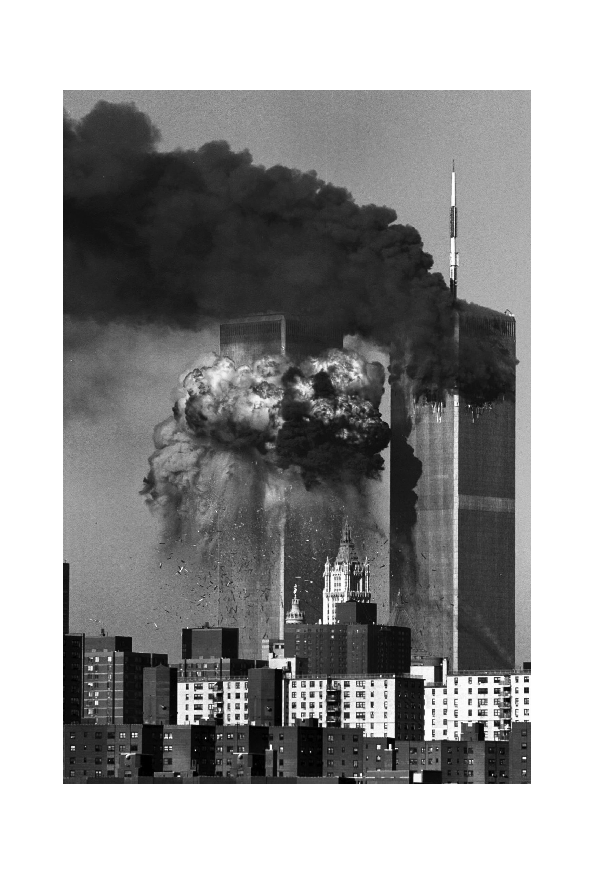
312
THE 9/11 COMMISSION REPORT
© T
amara
Beckwith,
New Y
ork
Post
The Twin Towers following the impact of American Airlines Flight 11 and
United Airlines Flight 175
Final 8-9.5pp 7/17/04 1:24 PM Page 312
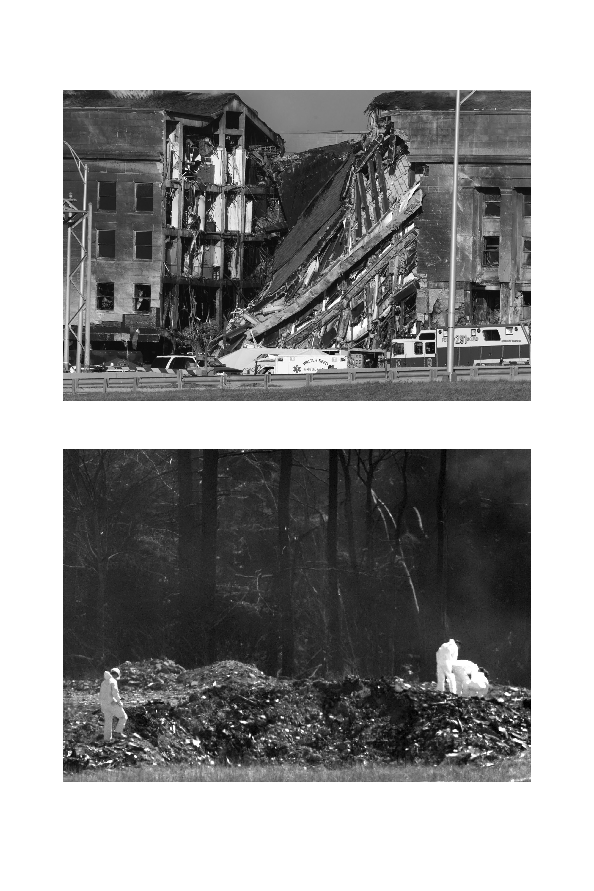
HEROISM AND HORROR
313
© Reuter
s 2004
© Reuter
s 2004
The Pentagon, after being struck by American Airlines Flight 77
United Airlines Flight 93 crash site, Shanksville, Pennsylvania
Final 8-9.5pp 7/17/04 1:24 PM Page 313

sons in integrating multiagency response efforts are apparent when we analyze
the response at the Pentagon.
The emergency response at the Pentagon represented a mix of local, state,
and federal jurisdictions and was generally effective. It overcame the inherent
complications of a response across jurisdictions because the Incident Command
System, a formalized management structure for emergency response, was in
place in the National Capital Region on 9/11.
190
Because of the nature of the event--a plane crash, fire, and partial building
collapse--the Arlington County Fire Department served as incident com-
mander. Different agencies had different roles.The incident required a major
rescue, fire, and medical response from Arlington County at the U.S. military's
headquarters--a facility under the control of the secretary of defense. Since it
was a terrorist attack, the Department of Justice was the lead federal agency in
charge (with authority delegated to the FBI for operational response). Addi-
tionally, the terrorist attack affected the daily operations and emergency
management requirements of Arlington County and all bordering and sur-
rounding jurisdictions.
191
At 9:37, the west wall of the Pentagon was hit by hijacked American Air-
lines Flight 77, a Boeing 757. The crash caused immediate and catastrophic
damage. All 64 people aboard the airliner were killed, as were 125 people inside
the Pentagon (70 civilians and 55 military service members). One hundred six
people were seriously injured and transported to area hospitals.
192
While no emergency response is flawless, the response to the 9/11 terror-
ist attack on the Pentagon was mainly a success for three reasons: first, the strong
professional relationships and trust established among emergency responders;
second, the adoption of the Incident Command System; and third, the pursuit
of a regional approach to response. Many fire and police agencies that
responded had extensive prior experience working together on regional
events and training exercises. Indeed, at the time preparations were under way
at many of these agencies to ensure public safety at the annual meetings of the
International Monetary Fund and the World Bank scheduled to be held later
that month in Washington, D.C.
193
Local, regional, state, and federal agencies immediately responded to the
Pentagon attack. In addition to county fire, police, and sheriff 's departments,
the response was assisted by the Metropolitan Washington Airports Authority,
Ronald Reagan Washington National Airport Fire Department, Fort Myer Fire
Department, the Virginia State Police, the Virginia Department of Emergency
Management, the FBI, FEMA, a National Medical Response Team, the Bureau
of Alcohol,Tobacco, and Firearms, and numerous military personnel within the
Military District of Washington.
194
Command was established at 9:41.At the same time, the Arlington County
Emergency Communications Center contacted the fire departments of Fair-
fax County, Alexandria, and the District of Columbia to request mutual aid.
314
THE 9/11 COMMISSION REPORT
Final 8-9.5pp 7/17/04 1:24 PM Page 314

The incident command post provided a clear view of and access to the crash
site, allowing the incident commander to assess the situation at all times.
195
At 9:55, the incident commander ordered an evacuation of the Pentagon
impact area because a partial collapse was imminent; it occurred at 9:57, and
no first responder was injured.
196
At 10:15, the incident commander ordered a full evacuation of the com-
mand post because of the warning of an approaching hijacked aircraft passed
along by the FBI.This was the first of three evacuations caused by reports of
incoming aircraft, and the evacuation order was well communicated and well
coordinated.
197
Several factors facilitated the response to this incident, and distinguish it
from the far more difficult task in New York.There was a single incident, and
it was not 1,000 feet above ground. The incident site was relatively easy to
secure and contain, and there were no other buildings in the immediate area.
There was no collateral damage beyond the Pentagon.
198
Yet the Pentagon response encountered difficulties that echo those expe-
rienced in New York. As the "Arlington County: After-Action Report" notes,
there were significant problems with both self-dispatching and communica-
tions: "Organizations, response units, and individuals proceeding on their own
initiative directly to an incident site, without the knowledge and permission
of the host jurisdiction and the Incident Commander, complicate the exer-
cise of command, increase the risks faced by bonafide responders, and exac-
erbate the challenge of accountability."With respect to communications, the
report concludes: "Almost all aspects of communications continue to be prob-
lematic, from initial notification to tactical operations. Cellular telephones
were of little value. . . . Radio channels were initially oversaturated. . . . Pagers
seemed to be the most reliable means of notification when available and used,
but most firefighters are not issued pagers."
199
It is a fair inference, given the differing situations in New York City and
Northern Virginia, that the problems in command, control, and communica-
tions that occurred at both sites will likely recur in any emergency of similar
scale. The task looking forward is to enable first responders to respond in a
coordinated manner with the greatest possible awareness of the situation.
9.4 ANALYSIS
Like the national defense effort described in chapter 1, the emergency
response to the attacks on 9/11 was necessarily improvised. In New York, the
FDNY, NYPD, the Port Authority, WTC employees, and the building occu-
pants themselves did their best to cope with the effects of an unimaginable
catastrophe--unfolding furiously over a mere 102 minutes--for which they
were unprepared in terms of both training and mindset. As a result of the
HEROISM AND HORROR
315
Final 8-9.5pp 7/17/04 1:24 PM Page 315

efforts of first responders, assistance from each other, and their own good
instincts and goodwill, the vast majority of civilians below the impact zone
were able to evacuate the towers.
The National Institute of Standards and Technology has provided a prelim-
inary estimation that between 16,400 and 18,800 civilians were in the WTC
complex as of 8:46
A
.
M
. on September 11. At most 2,152 individuals died at
the WTC complex who were not (1) fire or police first responders, (2) secu-
rity or fire safety personnel of the WTC or individual companies, (3) volun-
teer civilians who ran to the WTC after the planes' impact to help others, or
(4) on the two planes that crashed into the Twin Towers. Out of this total num-
ber of fatalities, we can account for the workplace location of 2,052 individu-
als, or 95.35 percent. Of this number, 1,942 or 94.64 percent either worked or
were supposed to attend a meeting at or above the respective impact zones of
the Twin Towers; only 110, or 5.36 percent of those who died, worked below
the impact zone.While a given person's office location at the WTC does not
definitively indicate where that individual died that morning or whether he or
she could have evacuated, these data strongly suggest that the evacuation was
a success for civilians below the impact zone.
200
Several factors influenced the evacuation on September 11. It was aided
greatly by changes made by the Port Authority in response to the 1993 bomb-
ing and by the training of both Port Authority personnel and civilians after
that time. Stairwells remained lit near unaffected floors; some tenants relied on
procedures learned in fire drills to help them to safety; others were guided
down the stairs by fire safety officials based in the lobby. Because of damage
caused by the impact of the planes, the capability of the sophisticated building
systems may have been impaired. Rudimentary improvements, however, such
as the addition of glow strips to the handrails and stairs, were credited by some
as the reason for their survival. The general evacuation time for the towers
dropped from more than four hours in 1993 to under one hour on Septem-
ber 11 for most civilians who were not trapped or physically incapable of
enduring a long descent.
First responders also played a significant role in the success of the evacua-
tion. Some specific rescues are quantifiable, such as an FDNY company's res-
cue of civilians trapped on the 22d floor of the North Tower, or the success of
FDNY, PAPD, and NYPD personnel in carrying nonambulatory civilians out
of both the North and South Towers. In other instances, intangibles combined
to reduce what could have been a much higher death total. It is impossible to
measure how many more civilians who descended to the ground floors would
have died but for the NYPD and PAPD personnel directing them--via safe
exit routes that avoided jumpers and debris--to leave the complex urgently
but calmly. It is impossible to measure how many more civilians would have
died but for the determination of many members of the FDNY, PAPD, and
NYPD to continue assisting civilians after the South Tower collapsed. It is
316
THE 9/11 COMMISSION REPORT
Final 8-9.5pp 7/17/04 1:24 PM Page 316

impossible to measure the calming influence that ascending firefighters had on
descending civilians or whether but for the firefighters' presence the poor
behavior of a very few civilians could have caused a dangerous and panicked
mob flight. But the positive impact of the first responders on the evacuation
came at a tremendous cost of first responder lives lost.
201
Civilian and Private-Sector Challenges
The "first" first responders on 9/11, as in most catastrophes, were private-
sector civilians. Because 85 percent of our nation's critical infrastructure is
controlled not by government but by the private sector, private-sector civil-
ians are likely to be the first responders in any future catastrophes. For that
reason, we have assessed the state of private sector and civilian preparedness
in order to formulate recommendations to address this critical need. Our rec-
ommendations grow out of the experience of the civilians at the World Trade
Center on 9/11.
Lack of Protocol for Rooftop Rescues.
Civilians at or above the impact
zone in the North Tower had the smallest hope of survival. Once the plane
struck, they were prevented from descending because of damage to or impass-
able conditions in the building's three stairwells. The only hope for those on
the upper floors of the North Tower would have been a swift and extensive air
rescue. Several factors made this impossible. Doors leading to the roof were kept
locked for security reasons, and damage to software in the security command
station prevented a lock release order from taking effect. Even if the doors had
not been locked, structural and radiation hazards made the rooftops unsuitable
staging areas for a large number of civilians; and even if conditions permitted
general helicopter evacuations--which was not the case--only several people
could be lifted at a time.
The WTC lacked any plan for evacuation of civilians on upper floors of the
WTC in the event that all stairwells were impassable below.
Lack of Comprehensive Evacuation of South Tower Immediately after
the North Tower Impact.
No decision has been criticized more than the
decision of building personnel not to evacuate the South Tower immediately
after the North Tower was hit.A firm and prompt evacuation order would likely
have led many to safety. Even a strictly "advisory" announcement would not
have dissuaded those who decided for themselves to evacuate. The advice to
stay in place was understandable, however, when considered in its context. At
that moment, no one appears to have thought a second plane could hit the
South Tower. The evacuation of thousands of people was seen as inherently
dangerous. Additionally, conditions were hazardous in some areas outside the
towers.
202
Less understandable, in our view, is the instruction given to some civilians
HEROISM AND HORROR
317
Final 8-9.5pp 7/17/04 1:24 PM Page 317

who had reached the lobby to return to their offices. They could have been
held in the lobby or perhaps directed through the underground concourse.
Despite the initial advice given over its public-address system, the South
Tower was ordered to be evacuated by the FDNY and PAPD within 12 min-
utes of the North Tower's being hit. If not for a second, unanticipated attack,
the evacuation presumably would have proceeded.
Impact of Fire Safety Plan and Fire Drills on Evacuation.
Once the
South Tower was hit, civilians on upper floors wasted time ascending the stairs
instead of searching for a clear path down, when stairwell A was at least ini-
tially passable. Although rooftop rescues had not been conclusively ruled out,
civilians were not informed in fire drills that roof doors were locked, that
rooftop areas were hazardous, and that no helicopter evacuation plan existed.
In both towers, civilians who were able to reach the stairs and descend were
also stymied by the deviations in the stairways and by smoke doors.This con-
fusion delayed the evacuation of some and may have obstructed that of others.
The Port Authority has acknowledged that in the future, tenants should be
made aware of what conditions they will encounter during descent.
Impact of 911 Calls on Evacuation.
The NYPD's 911 operators and
FDNY dispatch were not adequately integrated into the emergency response.
In several ways, the 911 system was not ready to cope with a major disaster.
These operators and dispatchers were one of the only sources of information
for individuals at and above the impact zone of the towers.The FDNY ordered
both towers fully evacuated by 8:57, but this guidance was not conveyed to 911
operators and FDNY dispatchers, who for the next hour often continued to
advise civilians not to self-evacuate, regardless of whether they were above or
below the impact zones. Nor were 911 operators or FDNY dispatchers advised
that rooftop rescues had been ruled out.This failure may have been harmful to
civilians on the upper floors of the South Tower who called 911 and were not
told that their only evacuation hope was to attempt to descend, not to ascend.
In planning for future disasters, it is important to integrate those taking 911
calls into the emergency response team and to involve them in providing up-
to-date information and assistance to the public.
Preparedness of Individual Civilians.
One clear lesson of September 11
is that individual civilians need to take responsibility for maximizing the prob-
ability that they will survive, should disaster strike. Clearly, many building occu-
pants in the World Trade Center did not take preparedness seriously.
Individuals should know the exact location of every stairwell in their work-
place. In addition, they should have access at all times to flashlights, which were
deemed invaluable by some civilians who managed to evacuate the WTC on
September 11.
318
THE 9/11 COMMISSION REPORT
Final 8-9.5pp 7/17/04 1:24 PM Page 318

Challenges Experienced by First Responders
The Challenge of Incident Command.
As noted above, in July 2001,
Mayor Giuliani updated a directive titled "Direction and Control of Emergen-
cies in the City of New York."The directive designated, for different types of
emergencies, an appropriate agency as "Incident Commander"; it would be
"responsible for the management of the City's response to the emergency." The
directive also provided that where incidents are "so multifaceted that no one
agency immediately stands out as the Incident Commander, OEM will assign
the role of Incident Commander to an agency as the situation demands."
203
To some degree, the Mayor's directive for incident command was followed
on 9/11. It was clear that the lead response agency was the FDNY, and that the
other responding local, federal, bistate, and state agencies acted in a supporting
role. There was a tacit understanding that FDNY personnel would have pri-
mary responsibility for evacuating civilians who were above the ground floors
of the Twin Towers, while NYPD and PAPD personnel would be in charge of
evacuating civilians from the WTC complex once they reached ground level.
The NYPD also greatly assisted responding FDNY units by clearing emer-
gency lanes to the WTC.
204
In addition, coordination occurred at high levels of command. For exam-
ple, the Mayor and Police Commissioner consulted with the Chief of the
Department of the FDNY at approximately 9:20.There were other instances
of coordination at operational levels, and information was shared on an ad hoc
basis. For example, an NYPD ESU team passed the news of their evacuation
order to firefighters in the North Tower.
205
It is also clear, however, that the response operations lacked the kind of
integrated communications and unified command contemplated in the
directive. These problems existed both within and among individual
responding agencies.
Command and Control within First Responder Agencies.
For a uni-
fied incident management system to succeed, each participant must have com-
mand and control of its own units and adequate internal communications.This
was not always the case at the WTC on 9/11.
Understandably lacking experience in responding to events of the magni-
tude of the World Trade Center attacks, the FDNY as an institution proved
incapable of coordinating the numbers of units dispatched to different points
within the 16-acre complex.As a result, numerous units were congregating in
the undamaged Marriott Hotel and at the overall command post on West Street
by 9:30, while chiefs in charge of the South Tower still were in desperate need
of units.With better understanding of the resources already available, additional
units might not have been dispatched to the South Tower at 9:37.
The task of accounting for and coordinating the units was rendered diffi-
cult, if not impossible, by internal communications breakdowns resulting from
HEROISM AND HORROR
319
Final 8-9.5pp 7/17/04 1:24 PM Page 319

the limited capabilities of radios in the high-rise environment of the WTC and
from confusion over which personnel were assigned to which frequency. Fur-
thermore, when the South Tower collapsed the overall FDNY command post
ceased to operate, which compromised the FDNY's ability to understand the
situation; an FDNY marine unit's immediate radio communication to FDNY
dispatch that the South Tower had fully collapsed was not conveyed to chiefs
at the scene.The FDNY's inability to coordinate and account for the different
radio channels that would be used in an emergency of this scale contributed
to the early lack of units in the South Tower, whose lobby chief initially could
not communicate with anyone outside that tower.
206
Though almost no one at 9:50 on September 11 was contemplating an
imminent total collapse of the Twin Towers, many first responders and civilians
were contemplating the possibility of imminent additional terrorist attacks
throughout New York City. Had any such attacks occurred, the FDNY's
response would have been severely compromised by the concentration of so
many of its off-duty personnel, particularly its elite personnel, at the WTC.
The Port Authority's response was hampered by the lack of both standard oper-
ating procedures and radios capable of enabling multiple commands to respond
in unified fashion to an incident at the WTC. Many officers reporting from the
tunnel and airport commands could not hear instructions being issued over the
WTC Command frequency. In addition, command and control was complicated
by senior Port Authority Police officials becoming directly involved in frontline
rescue operations.
The NYPD experienced comparatively fewer internal command and con-
trol and communications issues. Because the department has a history of mobi-
lizing thousands of officers for major events requiring crowd control, its
technical radio capability and major incident protocols were more easily
adapted to an incident of the magnitude of 9/11. In addition, its mission that
day lay largely outside the towers themselves. Although there were ESU teams
and a few individual police officers climbing in the towers, the vast majority of
NYPD personnel were staged outside, assisting with crowd control and evacu-
ation and securing other sites in the city. The NYPD ESU division had firm
command and control over its units, in part because there were so few of them
(in comparison to the number of FDNY companies) and all reported to the
same ESU command post. It is unclear, however, whether non-ESU NYPD
officers operating on the ground floors, and in a few cases on upper floors, of
the WTC were as well coordinated.
Significant shortcomings within the FDNY's command and control capa-
bilities were painfully exposed on September 11. To its great credit, the
department has made a substantial effort in the past three years to address
these.While significant problems in the command and control of the PAPD
also were exposed on September 11, it is less clear that the Port Authority
has adopted new training exercises or major incident protocols to address
these shortcomings.
207
320
THE 9/11 COMMISSION REPORT
Final 8-9.5pp 7/17/04 1:24 PM Page 320

Lack of Coordination among First Responder Agencies.
Any attempt
to establish a unified command on 9/11 would have been further frustrated by
the lack of communication and coordination among responding agencies. Cer-
tainly, the FDNY was not "responsible for the management of the City's
response to the emergency," as the Mayor's directive would have required.The
command posts were in different locations, and OEM headquarters, which
could have served as a focal point for information sharing, did not play an inte-
grating role in ensuring that information was shared among agencies on 9/11,
even prior to its evacuation.There was a lack of comprehensive coordination
between FDNY, NYPD, and PAPD personnel climbing above the ground
floors in the Twin Towers.
Information that was critical to informed decisionmaking was not shared
among agencies. FDNY chiefs in leadership roles that morning have told us
that their decision making capability was hampered by a lack of information
from NYPD aviation. At 9:51
A
.
M
., a helicopter pilot cautioned that "large
pieces" of the South Tower appeared to be about to fall and could pose a dan-
ger to those below. Immediately after the tower's collapse, a helicopter pilot
radioed that news.This transmission was followed by communications at 10:08,
10:15, and 10:22 that called into question the condition of the North Tower.
The FDNY chiefs would have benefited greatly had they been able to com-
municate with personnel in a helicopter.
The consequence of the lack of real-time intelligence from NYPD aviation
should not be overstated. Contrary to a widely held misperception, no NYPD
helicopter predicted the fall of either tower before the South Tower collapsed,
and no NYPD personnel began to evacuate the WTC complex prior to that
time. Furthermore, the FDNY, as an institution, was in possession of the knowl-
edge that the South Tower had collapsed as early as the NYPD, as its fall had
been immediately reported by an FDNY boat on a dispatch channel. Because
of internal breakdowns within the department, however, this information was
not disseminated to FDNY personnel on the scene.
The FDNY, PAPD, and NYPD did not coordinate their units that were
searching the WTC complex for civilians. In many cases, redundant searches
of specific floors and areas were conducted. It is unclear whether fewer first
responders in the aggregate would have been in the Twin Towers if there had
been an integrated response, or what impact, if any, redundant searches had on
the total number of first responder fatalities.
Whether the lack of coordination between the FDNY and NYPD on Sep-
tember 11 had a catastrophic effect has been the subject of controversy. We
believe that there are too many variables for us to responsibly quantify those
consequences. It is clear that the lack of coordination did not affect adversely
the evacuation of civilians. It is equally clear, however, that the Incident Com-
mand System did not function to integrate awareness among agencies or to
facilitate interagency response.
208
If New York and other major cities are to be prepared for future terrorist
HEROISM AND HORROR
321
Final 8-9.5pp 7/17/04 1:24 PM Page 321

attacks, different first responder agencies within each city must be fully coordi-
nated, just as different branches of the U.S. military are. Coordination entails a
unified command that comprehensively deploys all dispatched police, fire, and
other first responder resources.
In May 2004, New York City adopted an emergency response plan that
expressly contemplates two or more agencies jointly being lead agency when
responding to a terrorist attack but does not mandate a comprehensive and uni-
fied incident command that can deploy and monitor all first responder
resources from one overall command post. In our judgment, this falls short of
an optimal response plan, which requires clear command and control, common
training, and the trust that such training creates. The experience of the mili-
tary suggests that integrated into such a coordinated response should be a uni-
fied field intelligence unit, which should receive and combine information
from all first responders--including 911 operators. Such a field intelligence unit
could be valuable in large and complex incidents.
Radio Communication Challenges:The Effectiveness and Urgency of
Evacuation Instructions.
As discussed above, the location of the NYPD ESU
command post was crucial in making possible an urgent evacuation order
explaining the South Tower's full collapse. Firefighters most certainly would
have benefited from that information.
A separate matter is the varied success at conveying evacuation instructions
to personnel in the North Tower after the South Tower's collapse.The success
of NYPD ESU instruction is attributable to a combination of (1) the strength
of the radios, (2) the relatively small numbers of individuals using them, and
(3) use of the correct channel by all.
The same three factors worked against successful communication among
FDNY personnel. First, the radios' effectiveness was drastically reduced in the
high-rise environment. Second, tactical channel 1 was simply overwhelmed by
the number of units attempting to communicate on it at 10:00. Third, some
firefighters were on the wrong channel or simply lacked radios altogether.
It is impossible to know what difference it made that units in the North
Tower were not using the repeater channel after 10:00. While the repeater
channel was at least partially operational before the South Tower collapsed, we
do not know whether it continued to be operational after 9:59.
Even without the repeater channel, at least 24 of the at most 32 companies
who were dispatched to and actually in the North Tower received the evacu-
ation instruction--either via radio or directly from other first responders. Nev-
ertheless, many of these firefighters died, either because they delayed their
evacuation to assist civilians, attempted to regroup their units, lacked urgency,
or some combination of these factors. In addition, many other firefighters not
dispatched to the North Tower also died in its collapse. Some had their radios
on the wrong channel. Others were off-duty and lacked radios. In view of these
322
THE 9/11 COMMISSION REPORT
Final 8-9.5pp 7/17/04 1:24 PM Page 322

considerations, we conclude that the technical failure of FDNY radios, while
a contributing factor, was not the primary cause of the many firefighter fatal-
ities in the North Tower.
209
The FDNY has worked hard in the past several years to address its radio
deficiencies.To improve radio capability in high-rises, the FDNY has internally
developed a "post radio" that is small enough for a battalion chief to carry to
the upper floors and that greatly repeats and enhances radio signal strength.
210
The story with respect to Port Authority police officers in the North Tower
is less complicated; most of them lacked access to the radio channel on which
the Port Authority police evacuation order was given. Since September 11, the
Port Authority has worked hard to integrate the radio systems of their differ-
ent commands.
.
.
.
Th e le s s on of 9 / 11 for civilians and first responders can be stated simply:
in the new age of terror, they--we--are the primary targets.The losses Amer-
ica suffered that day demonstrated both the gravity of the terrorist threat and
the commensurate need to prepare ourselves to meet it.
The first responders of today live in a world transformed by the attacks on
9/11. Because no one believes that every conceivable form of attack can be
prevented, civilians and first responders will again find themselves on the front
lines.We must plan for that eventuality. A rededication to preparedness is per-
haps the best way to honor the memories of those we lost that day.
HEROISM AND HORROR
323
Final 8-9.5pp 7/17/04 1:24 PM Page 323

Final 8-9.5pp 7/17/04 1:24 PM Page 324

10
WARTIME
325
A f te r th e at tac k s had occurred, while crisis managers were still sorting
out a number of unnerving false alarms, Air Force One flew to Barksdale Air
Force Base in Louisiana. One of these alarms was of a reported threat against
Air Force One itself, a threat eventually run down to a misunderstood com-
munication in the hectic White House Situation Room that morning.
1
While the plan at the elementary school had been to return to Washington,
by the time Air Force One was airborne at 9:55
A
.
M
. the Secret Service, the
President's advisers, and Vice President Cheney were strongly advising against
it. President Bush reluctantly acceded to this advice and, at about 10:10, Air
Force One changed course and began heading due west.The immediate objec-
tive was to find a safe location--not too far away--where the President could
land and speak to the American people.The Secret Service was also interested
in refueling the aircraft and paring down the size of the traveling party. The
President's military aide, an Air Force officer, quickly researched the options
and, sometime around 10:20, identified Barksdale Air Force Base as an appro-
priate interim destination.
2
When Air Force One landed at Barksdale at about 11:45, personnel from
the local Secret Service office were still en route to the airfield.The motorcade
consisted of a military police lead vehicle and a van; the proposed briefing the-
ater had no phones or electrical outlets. Staff scrambled to prepare another
room for the President's remarks, while the lead Secret Service agent reviewed
the security situation with superiors in Washington.The President completed
his statement, which for security reasons was taped and not broadcast live, and
the traveling party returned to Air Force One. The next destination was dis-
cussed: once again the Secret Service recommended against returning to Wash-
ington, and the Vice President agreed. Offutt Air Force Base in Nebraska was
chosen because of its elaborate command and control facilities, and because it
could accommodate overnight lodging for 50 persons. The Secret Service
wanted a place where the President could spend several days, if necessary.
3
Final 10-11.4pp 7/17/04 4:12 PM Page 325

Air Force One arrived at Offutt at 2:50
P
.
M
. At about 3:15, President Bush
met with his principal advisers through a secure video teleconference.
4
Rice
said President Bush began the meeting with the words, "We're at war,"
5
and
that Director of Central Intelligence George Tenet said the agency was still
assessing who was responsible, but the early signs all pointed to al Qaeda.
6
That
evening the Deputies Committee returned to the pending presidential direc-
tive they had labored over during the summer.
7
The secretary of defense directed the nation's armed forces to Defense Con-
dition 3, an increased state of military readiness.
8
For the first time in history,
all nonemergency civilian aircraft in the United States were grounded, strand-
ing tens of thousands of passengers across the country. Contingency plans for
the continuity of government and the evacuation of leaders had been imple-
mented.
9
The Pentagon had been struck; the White House or the Capitol had
narrowly escaped direct attack. Extraordinary security precautions were put in
place at the nation's borders and ports.
In the late afternoon, the President overruled his aides' continuing reluc-
tance to have him return to Washington and ordered Air Force One back to
Andrews Air Force Base. He was flown by helicopter back to the White House,
passing over the still-smoldering Pentagon.At 8:30 that evening, President Bush
addressed the nation from the White House. After emphasizing that the first
priority was to help the injured and protect against any further attacks, he said:
"We will make no distinction between the terrorists who committed these acts
and those who harbor them." He quoted Psalm 23--"though I walk through
the valley of the shadow of death . . ." No American, he said,"will ever forget
this day."
10
Following his speech, President Bush met again with his National Security
Council (NSC), expanded to include Secretary of Transportation Norman
Mineta and Joseph Allbaugh, the director of the Federal Emergency Manage-
ment Agency. Secretary of State Colin Powell, who had returned from Peru after
hearing of the attacks, joined the discussion.They reviewed the day's events.
11
10.1 IMMEDIATE RESPONSES AT HOME
As the urgent domestic issues accumulated,White House Deputy Chief of Staff
Joshua Bolten chaired a temporary "domestic consequences" group.
12
The
agenda in those first days is worth noting, partly as a checklist for future crisis
planners. It began with problems of how to help victims and stanch the flow-
ing losses to the American economy, such as
· Organizing federal emergency assistance. One question was what kind
of public health advice to give about the air quality in Lower Manhat-
tan in the vicinity of the fallen buildings.
13
326
THE 9/11 COMMISSION REPORT
Final 10-11.4pp 7/17/04 4:12 PM Page 326

· Compensating victims.They evaluated legislative options, eventually
setting up a federal compensation fund and defining the powers of a
special master to run it.
· Determining federal assistance. On September 13, President Bush
promised to provide $20 billion for New York City, in addition to the
$20 billion his budget director had already guessed might be needed
for the country as a whole.
14
· Restoring civil aviation. On the morning of September 13, the
national airspace reopened for use by airports that met newly impro-
vised security standards.
· Reopening the financial markets. After extraordinary emergency
efforts involving the White House, the Treasury Department, and the
Securities and Exchange Commission, aided by unprecedented
cooperation among the usually competitive firms of the financial
industry, the markets reopened on Monday, September 17.
15
· Deciding when and how to return border and port security to more
normal operations.
· Evaluating legislative proposals to bail out the airline industry and cap
its liability.
The very process of reviewing these issues underscored the absence of an
effective government organization dedicated to assessing vulnerabilities and
handling problems of protection and preparedness.Though a number of agen-
cies had some part of the task, none had security as its primary mission.
By September 14,Vice President Cheney had decided to recommend, at
least as a first step, a new White House entity to coordinate all the relevant agen-
cies rather than tackle the challenge of combining them in a new department.
This new White House entity would be a homeland security adviser and
Homeland Security Council--paralleling the National Security Council sys-
tem.Vice President Cheney reviewed the proposal with President Bush and
other advisers. President Bush announced the new post and its first occupant--
Pennsylvania governor Tom Ridge--in his address to a joint session of Con-
gress on September 20.
16
Beginning on September 11, Immigration and Naturalization Service
agents working in cooperation with the FBI began arresting individuals for
immigration violations whom they encountered while following up leads in
the FBI's investigation of the 9/11 attacks. Eventually, 768 aliens were arrested
as "special interest" detainees. Some (such as Zacarias Moussaoui) were actu-
ally in INS custody before 9/11; most were arrested after. Attorney General
John Ashcroft told us that he saw his job in directing this effort as "risk mini-
mization," both to find out who had committed the attacks and to prevent a
subsequent attack. Ashcroft ordered all special interest immigration hearings
closed to the public, family members, and press; directed government attorneys
WARTIME
327
Final 10-11.4pp 7/17/04 4:12 PM Page 327

to seek denial of bond until such time as they were "cleared" of terrorist con-
nections by the FBI and other agencies; and ordered the identity of the
detainees kept secret. INS attorneys charged with prosecuting the immigration
violations had trouble getting information about the detainees and any terror-
ist connections; in the chaos after the attacks, it was very difficult to reach law
enforcement officials, who were following up on other leads. The clearance
process approved by the Justice Department was time-consuming, lasting an
average of about 80 days.
17
We have assessed this effort to detain aliens of "special interest." The
detainees were lawfully held on immigration charges. Records indicate that 531
were deported, 162 were released on bond, 24 received some kind of immi-
gration benefits, 12 had their proceedings terminated, and 8--one of whom
was Moussaoui--were remanded to the custody of the U.S. Marshals Service.
The inspector general of the Justice Department found significant problems in
the way the 9/11 detainees were treated.
18
In response to a request about the
counterterrorism benefits of the 9/11 detainee program, the Justice Depart-
ment cited six individuals on the special interest detainee list, noting that two
(including Moussaoui) were linked directly to a terrorist organization and that
it had obtained new leads helpful to the investigation of the 9/11 terrorist
attacks.
19
A senior al Qaeda detainee has stated that U.S. government efforts
after the 9/11 attacks to monitor the American homeland, including review of
Muslims' immigration files and deportation of nonpermanent residents, forced
al Qaeda to operate less freely in the United States.
20
The government's ability to collect intelligence inside the United States, and
the sharing of such information between the intelligence and law enforcement
communities, was not a priority before 9/11. Guidelines on this subject issued
in August 2001 by Deputy Attorney General Larry Thompson essentially reca-
pitulated prior guidance. However, the attacks of 9/11 changed everything. Less
than one week after September 11, an early version of what was to become the
Patriot Act (officially, the USA PATRIOT Act) began to take shape.
21
A cen-
tral provision of the proposal was the removal of "the wall" on information
sharing between the intelligence and law enforcement communities (discussed
in chapter 3). Ashcroft told us he was determined to take every conceivable
action, within the limits of the Constitution, to identify potential terrorists and
deter additional attacks.
22
The administration developed a proposal that even-
tually passed both houses of Congress by large majorities and was signed into
law on October 26.
23
328
THE 9/11 COMMISSION REPORT
Final 10-11.4pp 7/17/04 4:12 PM Page 328

WARTIME
329
Flights of Saudi Nationals Leaving the United States
Three questions have arisen with respect to the departure of Saudi
nationals from the United States in the immediate aftermath of 9/11:
(1) Did any flights of Saudi nationals take place before national airspace
reopened on September 13, 2001? (2) Was there any political interven-
tion to facilitate the departure of Saudi nationals? (3) Did the FBI
screen Saudi nationals thoroughly before their departure?
First, we found no evidence that any flights of Saudi nationals,
domestic or international, took place before the reopening of national
airspace on the morning of September 13, 2001.
24
To the contrary,
every flight we have identified occurred after national airspace
reopened.
25
Second, we found no evidence of political intervention.We found
no evidence that anyone at the White House above the level of Richard
Clarke participated in a decision on the departure of Saudi nationals.
The issue came up in one of the many video teleconferences of the
interagency group Clarke chaired, and Clarke said he approved of how
the FBI was dealing with the matter when it came up for interagency
discussion at his level. Clarke told us,"I asked the FBI, Dale Watson . . .
to handle that, to check to see if that was all right with them, to see if
they wanted access to any of these people, and to get back to me.And
if they had no objections, it would be fine with me." Clarke added,"I
have no recollection of clearing it with anybody at the White
House."
26
Although White House Chief of Staff Andrew Card remembered
someone telling him about the Saudi request shortly after 9/11, he said
he had not talked to the Saudis and did not ask anyone to do anything
about it.The President and Vice President told us they were not aware
of the issue at all until it surfaced much later in the media. None of the
officials we interviewed recalled any intervention or direction on this
matter from any political appointee.
27
Third, we believe that the FBI conducted a satisfactory screening of
Saudi nationals who left the United States on charter flights.
28
The
Saudi government was advised of and agreed to the FBI's requirements
that passengers be identified and checked against various databases
before the flights departed.
29
The Federal Aviation Administration rep-
resentative working in the FBI operations center made sure that the
Final 10-11.4pp 7/17/04 4:12 PM Page 329

10.2 PLANNING FOR WAR
By late in the evening of September 11, the President had addressed the nation
on the terrible events of the day.Vice President Cheney described the Presi-
dent's mood as somber.
32
The long day was not yet over.When the larger meet-
ing that included his domestic department heads broke up, President Bush
chaired a smaller meeting of top advisers, a group he would later call his "war
council."
33
This group usually included Vice President Cheney,Secretary of State
Powell, Secretary of Defense Donald Rumsfeld, General Hugh Shelton, Vice
Chairman of the Joint Chiefs (later to become chairman) General Myers, DCI
Tenet, Attorney General Ashcroft, and FBI Director Robert Mueller. From the
White House staff, National Security Advisor Condoleezza Rice and Chief of
Staff Card were part of the core group, often joined by their deputies, Stephen
Hadley and Joshua Bolten.
In this restricted National Security Council meeting, the President said it
was a time for self-defense.The United States would punish not just the per-
petrators of the attacks, but also those who harbored them. Secretary Powell
said the United States had to make it clear to Pakistan, Afghanistan, and the
Arab states that the time to act was now. He said we would need to build a
coalition.The President noted that the attacks provided a great opportunity to
engage Russia and China. Secretary Rumsfeld urged the President and the
principals to think broadly about who might have harbored the attackers,
including Iraq, Afghanistan, Libya, Sudan, and Iran. He wondered aloud how
much evidence the United States would need in order to deal with these coun-
tries, pointing out that major strikes could take up to 60 days to assemble.
34
President Bush chaired two more meetings of the NSC on September 12.
In the first meeting, he stressed that the United States was at war with a new
and different kind of enemy.The President tasked principals to go beyond their
pre-9/11 work and develop a strategy to eliminate terrorists and punish those
who support them.As they worked on defining the goals and objectives of the
upcoming campaign, they considered a paper that went beyond al Qaeda to
330
THE 9/11 COMMISSION REPORT
FBI was aware of the flights of Saudi nationals and was able to screen
the passengers before they were allowed to depart.
30
The FBI interviewed all persons of interest on these flights prior to
their departures.They concluded that none of the passengers was con-
nected to the 9/11 attacks and have since found no evidence to change
that conclusion. Our own independent review of the Saudi nationals
involved confirms that no one with known links to terrorism departed
on these flights.
31
Final 10-11.4pp 7/17/04 4:12 PM Page 330

propose the "elimination of terrorism as a threat to our way of life," an aim that
would include pursuing other international terrorist organizations in the Mid-
dle East.
35
Rice chaired a Principals Committee meeting on September 13 in the Sit-
uation Room to refine how the fight against al Qaeda would be conducted.
The principals agreed that the overall message should be that anyone support-
ing al Qaeda would risk harm. The United States would need to integrate
diplomacy, financial measures, intelligence, and military actions into an over-
arching strategy.The principals also focused on Pakistan and what it could do
to turn the Taliban against al Qaeda.They concluded that if Pakistan decided
not to help the United States, it too would be at risk.
36
The same day, Deputy Secretary of State Richard Armitage met with the
Pakistani ambassador to the United States, Maleeha Lodhi, and the visiting head
of Pakistan's military intelligence service, Mahmud Ahmed.Armitage said that
the United States wanted Pakistan to take seven steps:
· to stop al Qaeda operatives at its border and end all logistical support
for Bin Ladin;
· to give the United States blanket overflight and landing rights for all
necessary military and intelligence operations;
· to provide territorial access to U.S. and allied military intelligence and
other personnel to conduct operations against al Qaeda;
· to provide the United States with intelligence information;
· to continue to publicly condemn the terrorist acts;
· to cut off all shipments of fuel to the Taliban and stop recruits from
going to Afghanistan; and,
· if the evidence implicated bin Ladin and al Qaeda and the Taliban
continued to harbor them, to break relations with the Taliban
government.
37
Pakistan made its decision swiftly.That afternoon, Secretary of State Powell
announced at the beginning of an NSC meeting that Pakistani President
Musharraf had agreed to every U.S. request for support in the war on terror-
ism.The next day, the U.S. embassy in Islamabad confirmed that Musharraf and
his top military commanders had agreed to all seven demands. "Pakistan will
need full US support as it proceeds with us," the embassy noted. "Musharraf
said the GOP [government of Pakistan] was making substantial concessions in
allowing use of its territory and that he would pay a domestic price. His stand-
ing in Pakistan was certain to suffer.To counterbalance that he needed to show
that Pakistan was benefiting from his decisions."
38
At the September 13 NSC meeting, when Secretary Powell described Pak-
istan's reply, President Bush led a discussion of an appropriate ultimatum to the
Taliban. He also ordered Secretary Rumsfeld to develop a military plan against
WARTIME
331
Final 10-11.4pp 7/17/04 4:12 PM Page 331

the Taliban.The President wanted the United States to strike the Taliban, step
back, wait to see if they got the message, and hit them hard if they did not. He
made clear that the military should focus on targets that would influence the
Taliban's behavior.
39
President Bush also tasked the State Department, which on the following
day delivered to the White House a paper titled "Game Plan for a Political-
Military Strategy for Pakistan and Afghanistan." The paper took it as a given
that Bin Ladin would continue to act against the United States even while
under Taliban control. It therefore detailed specific U.S. demands for the Tal-
iban: surrender Bin Ladin and his chief lieutenants, including Ayman al
Zawahiri; tell the United States what the Taliban knew about al Qaeda and its
operations; close all terrorist camps; free all imprisoned foreigners; and comply
with all UN Security Council resolutions.
40
The State Department proposed delivering an ultimatum to the Taliban:
produce Bin Ladin and his deputies and shut down al Qaeda camps within 24
to 48 hours, or the United States will use all necessary means to destroy the
terrorist infrastructure. The State Department did not expect the Taliban to
comply. Therefore, State and Defense would plan to build an international
coalition to go into Afghanistan. Both departments would consult with NATO
and other allies and request intelligence, basing, and other support from coun-
tries, according to their capabilities and resources. Finally, the plan detailed a
public U.S. stance: America would use all its resources to eliminate terrorism
as a threat, punish those responsible for the 9/11 attacks, hold states and other
actors responsible for providing sanctuary to terrorists, work with a coalition
to eliminate terrorist groups and networks, and avoid malice toward any peo-
ple, religion, or culture.
41
President Bush recalled that he quickly realized that the administration
would have to invade Afghanistan with ground troops.
42
But the early brief-
ings to the President and Secretary Rumsfeld on military options were disap-
pointing.
43
Tommy Franks, the commanding general of Central Command
(CENTCOM), told us that the President was dissatisfied. The U.S. military,
Franks said, did not have an off-the-shelf plan to eliminate the al Qaeda threat
in Afghanistan. The existing Infinite Resolve options did not, in his view,
amount to such a plan.
44
All these diplomatic and military plans were reviewed over the weekend of
September 1516, as President Bush convened his war council at Camp
David.
45
Present were Vice President Cheney, Rice, Hadley, Powell, Armitage,
Rumsfeld, Ashcroft, Mueller, Tenet, Deputy Secretary of Defense Paul Wol-
fowitz, and Cofer Black, chief of the DCI's Counterterrorist Center.
Tenet described a plan for collecting intelligence and mounting covert oper-
ations. He proposed inserting CIA teams into Afghanistan to work with Afghan
warlords who would join the fight against al Qaeda.
46
These CIA teams would
act jointly with the military's Special Operations units. President Bush later
praised this proposal, saying it had been a turning point in his thinking.
47
332
THE 9/11 COMMISSION REPORT
Final 10-11.4pp 7/17/04 4:12 PM Page 332

General Shelton briefed the principals on the preliminary plan for
Afghanistan that the military had put together. It drew on the Infinite Resolve
"phased campaign" plan the Pentagon had begun developing in November
2000 as an addition to the strike options it had been refining since 1998. But
Shelton added a new element--the possible significant use of ground forces--
and that is where President Bush reportedly focused his attention.
48
After hearing from his senior advisers, President Bush discussed with Rice
the contents of the directives he would issue to set all the plans into motion.
Rice prepared a paper that President Bush then considered with principals
on Monday morning, September 17. "The purpose of this meeting," he
recalled saying,"is to assign tasks for the first wave of the war against terror-
ism. It starts today."
49
In a written set of instructions slightly refined during the morning meet-
ing, President Bush charged Ashcroft, Mueller, and Tenet to develop a plan for
homeland defense. President Bush directed Secretary of State Powell to
deliver an ultimatum to the Taliban along the lines that his department had
originally proposed. The State Department was also tasked to develop a plan
to stabilize Pakistan and to be prepared to notify Russia and countries near
Afghanistan when hostilities were imminent.
50
In addition, Bush and his advisers discussed new legal authorities for covert
action in Afghanistan, including the administration's first Memorandum of
Notification on Bin Ladin. Shortly thereafter, President Bush authorized broad
new authorities for the CIA.
51
President Bush instructed Rumsfeld and Shelton to develop further the
Camp David military plan to attack the Taliban and al Qaeda if the Taliban
rejected the ultimatum. The President also tasked Rumsfeld to ensure that
robust measures to protect American military forces against terrorist attack were
implemented worldwide. Finally, he directed Treasury Secretary Paul O'Neill
to craft a plan to target al Qaeda's funding and seize its assets.
52
NSC staff mem-
bers had begun leading meetings on terrorist fund-raising by September 18.
53
Also by September 18, Powell had contacted 58 of his foreign counterparts
and received offers of general aid, search-and-rescue equipment and person-
nel, and medical assistance teams.
54
On the same day, Deputy Secretary of State
Armitage was called by Mahmud Ahmed regarding a two-day visit to
Afghanistan during which the Pakistani intelligence chief had met with Mul-
lah Omar and conveyed the U.S. demands. Omar's response was "not negative
on all these points."
55
But the administration knew that the Taliban was unlikely
to turn over Bin Ladin.
56
The pre-9/11 draft presidential directive on al Qaeda evolved into a new
directive, National Security Presidential Directive 9, now titled "Defeating the
Terrorist Threat to the United States." The directive would now extend to a
global war on terrorism, not just on al Qaeda. It also incorporated the Presi-
dent's determination not to distinguish between terrorists and those who har-
bor them. It included a determination to use military force if necessary to end
WARTIME
333
Final 10-11.4pp 7/17/04 4:12 PM Page 333

al Qaeda's sanctuary in Afghanistan. The new directive--formally signed on
October 25, after the fighting in Afghanistan had already begun--included new
material followed by annexes discussing each targeted terrorist group.The old
draft directive on al Qaeda became, in effect, the first annex.
57
The United
States would strive to eliminate all terrorist networks, dry up their financial sup-
port, and prevent them from acquiring weapons of mass destruction.The goal
was the "elimination of terrorism as a threat to our way of life."
58
10.3 "PHASE TWO" AND THE QUESTION OF IRAQ
President Bush had wondered immediately after the attack whether Saddam
Hussein's regime might have had a hand in it. Iraq had been an enemy of the
United States for 11 years, and was the only place in the world where the
United States was engaged in ongoing combat operations. As a former pilot,
the President was struck by the apparent sophistication of the operation and
some of the piloting, especially Hanjour's high-speed dive into the Pentagon.
He told us he recalled Iraqi support for Palestinian suicide terrorists as well.
Speculating about other possible states that could be involved, the President
told us he also thought about Iran.
59
Clarke has written that on the evening of September 12, President Bush told
him and some of his staff to explore possible Iraqi links to 9/11. "See if Sad-
dam did this," Clarke recalls the President telling them."See if he's linked in any
way."
60
While he believed the details of Clarke's account to be incorrect, Presi-
dent Bush acknowledged that he might well have spoken to Clarke at some
point, asking him about Iraq.
61
Responding to a presidential tasking, Clarke's office sent a memo to Rice
on September 18, titled "Survey of Intelligence Information on Any Iraq
Involvement in the September 11 Attacks." Rice's chief staffer on Afghanistan,
Zalmay Khalilzad, concurred in its conclusion that only some anecdotal evi-
dence linked Iraq to al Qaeda.The memo found no "compelling case" that Iraq
had either planned or perpetrated the attacks. It passed along a few foreign
intelligence reports, including the Czech report alleging an April 2001 Prague
meeting between Atta and an Iraqi intelligence officer (discussed in chapter 7)
and a Polish report that personnel at the headquarters of Iraqi intelligence in
Baghdad were told before September 11 to go on the streets to gauge crowd
reaction to an unspecified event. Arguing that the case for links between Iraq
and al Qaeda was weak, the memo pointed out that Bin Ladin resented the
secularism of Saddam Hussein's regime. Finally, the memo said, there was no
confirmed reporting on Saddam cooperating with Bin Ladin on unconven-
tional weapons.
62
On the afternoon of 9/11, according to contemporaneous notes, Secretary
Rumsfeld instructed General Myers to obtain quickly as much information as
334
THE 9/11 COMMISSION REPORT
Final 10-11.4pp 7/17/04 4:12 PM Page 334

possible.The notes indicate that he also told Myers that he was not simply inter-
ested in striking empty training sites. He thought the U.S. response should con-
sider a wide range of options and possibilities. The secretary said his instinct
was to hit Saddam Hussein at the same time--not only Bin Ladin. Secretary
Rumsfeld later explained that at the time, he had been considering either one
of them, or perhaps someone else, as the responsible party.
63
According to Rice, the issue of what, if anything, to do about Iraq was really
engaged at Camp David. Briefing papers on Iraq, along with many others, were
in briefing materials for the participants. Rice told us the administration was
concerned that Iraq would take advantage of the 9/11 attacks. She recalled that
in the first Camp David session chaired by the President, Rumsfeld asked what
the administration should do about Iraq. Deputy Secretary Wolfowitz made the
case for striking Iraq during "this round" of the war on terrorism.
64
A Defense Department paper for the Camp David briefing book on the
strategic concept for the war on terrorism specified three priority targets for
initial action: al Qaeda, the Taliban, and Iraq. It argued that of the three, al Qaeda
and Iraq posed a strategic threat to the United States. Iraq's long-standing
involvement in terrorism was cited, along with its interest in weapons of mass
destruction.
65
Secretary Powell recalled that Wolfowitz--not Rumsfeld--argued that Iraq
was ultimately the source of the terrorist problem and should therefore be
attacked.
66
Powell said that Wolfowitz was not able to justify his belief that Iraq
was behind 9/11. "Paul was always of the view that Iraq was a problem that
had to be dealt with," Powell told us."And he saw this as one way of using this
event as a way to deal with the Iraq problem." Powell said that President Bush
did not give Wolfowitz's argument "much weight."
67
Though continuing to
worry about Iraq in the following week, Powell said, President Bush saw
Afghanistan as the priority.
68
President Bush told Bob Woodward that the decision not to invade Iraq was
made at the morning session on September 15. Iraq was not even on the table
during the September 15 afternoon session, which dealt solely with
Afghanistan.
69
Rice said that when President Bush called her on Sunday, Sep-
tember 16, he said the focus would be on Afghanistan, although he still wanted
plans for Iraq should the country take some action or the administration even-
tually determine that it had been involved in the 9/11 attacks.
70
At the September 17 NSC meeting, there was some further discussion of
"phase two" of the war on terrorism.
71
President Bush ordered the Defense
Department to be ready to deal with Iraq if Baghdad acted against U.S. inter-
ests, with plans to include possibly occupying Iraqi oil fields.
72
Within the Pentagon, Deputy Secretary Wolfowitz continued to press the
case for dealing with Iraq.Writing to Rumsfeld on September 17 in a memo
headlined "Preventing More Events," he argued that if there was even a 10 per-
cent chance that Saddam Hussein was behind the 9/11 attack, maximum pri-
WARTIME
335
Final 10-11.4pp 7/17/04 4:12 PM Page 335

ority should be placed on eliminating that threat. Wolfowitz contended that
the odds were "far more" than 1 in 10, citing Saddam's praise for the attack, his
long record of involvement in terrorism, and theories that Ramzi Yousef was
an Iraqi agent and Iraq was behind the 1993 attack on the World Trade Cen-
ter.
73
The next day, Wolfowitz renewed the argument, writing to Rumsfeld
about the interest of Yousef 's co-conspirator in the 1995 Manila air plot in
crashing an explosives-laden plane into CIA headquarters, and about informa-
tion from a foreign government regarding Iraqis' involvement in the attempted
hijacking of a Gulf Air flight. Given this background, he wondered why so lit-
tle thought had been devoted to the danger of suicide pilots, seeing a "failure
of imagination" and a mind-set that dismissed possibilities.
74
On September 19, Rumsfeld offered several thoughts for his commanders
as they worked on their contingency plans.Though he emphasized the world-
wide nature of the conflict, the references to specific enemies or regions named
only the Taliban, al Qaeda, and Afghanistan.
75
Shelton told us the administra-
tion reviewed all the Pentagon's war plans and challenged certain assumptions
underlying them, as any prudent organization or leader should do.
76
General Tommy Franks, the commanding general of Central Command,
recalled receiving Rumsfeld's guidance that each regional commander should
assess what these plans meant for his area of responsibility. He knew he would
soon be striking the Taliban and al Qaeda in Afghanistan. But, he told us, he
now wondered how that action was connected to what might need to be done
in Somalia,Yemen, or Iraq.
77
On September 20, President Bush met with British Prime Minister Tony
Blair, and the two leaders discussed the global conflict ahead.When Blair asked
about Iraq, the President replied that Iraq was not the immediate problem.
Some members of his administration, he commented, had expressed a differ-
ent view, but he was the one responsible for making the decisions.
78
Franks told us that he was pushing independently to do more robust plan-
ning on military responses in Iraq during the summer before 9/11--a request
President Bush denied, arguing that the time was not right. (CENTCOM also
began dusting off plans for a full invasion of Iraq during this period, Franks
said.) The CENTCOM commander told us he renewed his appeal for further
military planning to respond to Iraqi moves shortly after 9/11, both because
he personally felt that Iraq and al Qaeda might be engaged in some form of
collusion and because he worried that Saddam might take advantage of the
attacks to move against his internal enemies in the northern or southern parts
of Iraq, where the United States was flying regular missions to enforce Iraqi
no-fly zones. Franks said that President Bush again turned down the request.
79
.
.
.
H av i ng i s sue d d i re c t ive s to guide his administration's preparations for
war, on Thursday, September 20, President Bush addressed the nation before a
joint session of Congress. "Tonight," he said, "we are a country awakened to
336
THE 9/11 COMMISSION REPORT
Final 10-11.4pp 7/17/04 4:12 PM Page 336

danger."
80
The President blamed al Qaeda for 9/11 and the 1998 embassy
bombings and, for the first time, declared that al Qaeda was "responsible for
bombing the USS Cole."
81
He reiterated the ultimatum that had already been
conveyed privately."The Taliban must act, and act immediately," he said."They
will hand over the terrorists, or they will share in their fate."
82
The President
added that America's quarrel was not with Islam: "The enemy of America is
not our many Muslim friends; it is not our many Arab friends. Our enemy is
a radical network of terrorists, and every government that supports them."
Other regimes faced hard choices, he pointed out: "Every nation, in every
region, now has a decision to make: Either you are with us, or you are with the
terrorists."
83
President Bush argued that the new war went beyond Bin Ladin."Our war
on terror begins with al Qaeda, but it does not end there," he said."It will not
end until every terrorist group of global reach has been found, stopped, and
defeated."The President had a message for the Pentagon: "The hour is com-
ing when America will act, and you will make us proud." He also had a mes-
sage for those outside the United States. "This is civilization's fight," he said.
"We ask every nation to join us."
84
President Bush approved military plans to attack Afghanistan in meetings
with Central Command's General Franks and other advisers on September 21
and October 2. Originally titled "Infinite Justice," the operation's code word
was changed--to avoid the sensibilities of Muslims who associate the power of
infinite justice with God alone--to the operational name still used for opera-
tions in Afghanistan:"Enduring Freedom."
85
The plan had four phases.
· In Phase One, the United States and its allies would move forces into
the region and arrange to operate from or over neighboring coun-
tries such as Uzbekistan and Pakistan.This occurred in the weeks fol-
lowing 9/11, aided by overwhelming international sympathy for the
United States.
· In Phase Two, air strikes and Special Operations attacks would hit key
al Qaeda and Taliban targets. In an innovative joint effort, CIA and
Special Operations forces would be deployed to work together with
each major Afghan faction opposed to the Taliban. The Phase Two
strikes and raids began on October 7.The basing arrangements con-
templated for Phase One were substantially secured--after arduous
effort--by the end of that month.
· In Phase Three, the United States would carry out "decisive operations"
using all elements of national power, including ground troops, to top-
ple the Taliban regime and eliminate al Qaeda's sanctuary in
Afghanistan. Mazar-e-Sharif, in northern Afghanistan, fell to a coali-
tion assault by Afghan and U.S. forces on November 9. Four days later
the Taliban had fled from Kabul. By early December, all major cities
WARTIME
337
Final 10-11.4pp 7/17/04 4:12 PM Page 337

had fallen to the coalition. On December 22, Hamid Karzai, a Pash-
tun leader from Kandahar, was installed as the chairman of
Afghanistan's interim administration. Afghanistan had been liberated
from the rule of the Taliban.
In December 2001, Afghan forces, with limited U.S. support, engaged al
Qaeda elements in a cave complex called Tora Bora. In March 2002, the largest
engagement of the war was fought, in the mountainous Shah-i-Kot area south
of Gardez, against a large force of al Qaeda jihadists.The three-week battle was
substantially successful, and almost all remaining al Qaeda forces took refuge
in Pakistan's equally mountainous and lightly governed frontier provinces. As
of July 2004, Bin Ladin and Zawahiri are still believed to be at large.
· In Phase Four, civilian and military operations turned to the indefinite
task of what the armed forces call "security and stability operations."
Within about two months of the start of combat operations, several hun-
dred CIA operatives and Special Forces soldiers, backed by the striking power
of U.S. aircraft and a much larger infrastructure of intelligence and support
efforts, had combined with Afghan militias and a small number of other coali-
tion soldiers to destroy the Taliban regime and disrupt al Qaeda.They had killed
or captured about a quarter of the enemy's known leaders. Mohammed Atef,
al Qaeda's military commander and a principal figure in the 9/11 plot, had been
killed by a U.S. air strike.According to a senior CIA officer who helped devise
the overall strategy, the CIA provided intelligence, experience, cash, covert
action capabilities, and entrée to tribal allies. In turn, the U.S. military offered
combat expertise, firepower, logistics, and communications.
86
With these ini-
tial victories won by the middle of 2002, the global conflict against Islamist ter-
rorism became a different kind of struggle.
338
THE 9/11 COMMISSION REPORT
Final 10-11.4pp 7/17/04 4:12 PM Page 338

11
FORESIGHT--AND HINDSIGHT
339
I n com p o s i ng th i s narrat ive, we have tried to remember that we write
with the benefit and the handicap of hindsight. Hindsight can sometimes see
the past clearly--with 20/20 vision. But the path of what happened is so
brightly lit that it places everything else more deeply into shadow. Comment-
ing on Pearl Harbor, Roberta Wohlstetter found it "much easier after the event
to sort the relevant from the irrelevant signals.After the event, of course, a sig-
nal is always crystal clear; we can now see what disaster it was signaling since
the disaster has occurred. But before the event it is obscure and pregnant with
conflicting meanings."
1
As time passes, more documents become available, and the bare facts of what
happened become still clearer.Yet the picture of how those things happened
becomes harder to reimagine, as that past world, with its preoccupations and
uncertainty, recedes and the remaining memories of it become colored by what
happened and what was written about it later.With that caution in mind, we
asked ourselves, before we judged others, whether the insights that seem appar-
ent now would really have been meaningful at the time, given the limits of what
people then could reasonably have known or done.
We believe the 9/11 attacks revealed four kinds of failures: in imagination,
policy, capabilities, and management.
11.1 IMAGINATION
Historical Perspective
The 9/11 attack was an event of surpassing disproportion. America had suf-
fered surprise attacks before--Pearl Harbor is one well-known case, the 1950
Chinese attack in Korea another. But these were attacks by major powers.
While by no means as threatening as Japan's act of war, the 9/11 attack was
in some ways more devastating. It was carried out by a tiny group of people,
Final 10-11.4pp 7/17/04 4:12 PM Page 339

not enough to man a full platoon. Measured on a governmental scale, the
resources behind it were trivial.The group itself was dispatched by an organi-
zation based in one of the poorest, most remote, and least industrialized coun-
tries on earth. This organization recruited a mixture of young fanatics and
highly educated zealots who could not find suitable places in their home soci-
eties or were driven from them.
To understand these events, we attempted to reconstruct some of the con-
text of the 1990s. Americans celebrated the end of the Cold War with a mix-
ture of relief and satisfaction.The people of the United States hoped to enjoy
a peace dividend, as U.S. spending on national security was cut following the
end of the Soviet military threat.
The United States emerged into the postCold War world as the globe's pre-
eminent military power. But the vacuum created by the sudden demise of the
Soviet Union created fresh sources of instability and new challenges for the
United States. President George H.W. Bush dealt with the first of these in 1990
and 1991 when he led an international coalition to reverse Iraq's invasion of
Kuwait. Other examples of U.S. leaders' handling new threats included the
removal of nuclear weapons from Ukraine, Belarus, and Kazakhstan; the
Nunn-Lugar threat reduction program to help contain new nuclear dangers;
and international involvement in the wars in Bosnia and Kosovo.
America stood out as an object for admiration, envy, and blame. This cre-
ated a kind of cultural asymmetry.To us, Afghanistan seemed very far away.To
members of al Qaeda, America seemed very close. In a sense, they were more
globalized than we were.
Understanding the Danger
If the government's leaders understood the gravity of the threat they faced and
understood at the same time that their policies to eliminate it were not likely
to succeed any time soon, then history's judgment will be harsh. Did they
understand the gravity of the threat?
The U.S. government responded vigorously when the attack was on our
soil. Both Ramzi Yousef, who organized the 1993 bombing of the World Trade
Center, and Mir Amal Kansi, who in 1993 killed two CIA employees as they
waited to go to work in Langley,Virginia, were the objects of relentless, uncom-
promising, and successful efforts to bring them back to the United States to
stand trial for their crimes.
Before 9/11, al Qaeda and its affiliates had killed fewer than 50 Americans,
including the East Africa embassy bombings and the Cole attack.The U.S. gov-
ernment took the threat seriously, but not in the sense of mustering anything
like the kind of effort that would be gathered to confront an enemy of the first,
second, or even third rank.The modest national effort exerted to contain Ser-
bia and its depredations in the Balkans between 1995 and 1999, for example,
was orders of magnitude larger than that devoted to al Qaeda.
340
THE 9/11 COMMISSION REPORT
Final 10-11.4pp 7/17/04 4:12 PM Page 340

As best we can determine, neither in 2000 nor in the first eight months of
2001 did any polling organization in the United States think the subject of ter-
rorism sufficiently on the minds of the public to warrant asking a question
about it in a major national survey. Bin Ladin, al Qaeda, or even terrorism was
not an important topic in the 2000 presidential campaign. Congress and the
media called little attention to it.
If a president wanted to rally the American people to a warlike effort, he
would need to publicize an assessment of the growing al Qaeda danger. Our
government could spark a full public discussion of who Usama Bin Ladin was,
what kind of organization he led, what Bin Ladin or al Qaeda intended, what
past attacks they had sponsored or encouraged, and what capabilities they were
bringing together for future assaults. We believe American and international
public opinion might have been differentand so might the range of options
for a presidenthad they been informed of these details. Recent examples of
such debates include calls to arms against such threats as Serbian ethnic cleans-
ing, biological attacks, Iraqi weapons of mass destruction, global climate
change, and the HIV/AIDS epidemic.
While we now know that al Qaeda was formed in 1988, at the end of the
Soviet occupation of Afghanistan, the intelligence community did not describe
this organization, at least in documents we have seen, until 1999. A National
Intelligence Estimate distributed in July 1995 predicted future terrorist attacks
against the United States--and in the United States. It warned that this dan-
ger would increase over the next several years. It specified as particular points
of vulnerability the White House, the Capitol, symbols of capitalism such as
Wall Street, critical infrastructure such as power grids, areas where people con-
gregate such as sports arenas, and civil aviation generally. It warned that the
1993 World Trade Center bombing had been intended to kill a lot of people,
not to achieve any more traditional political goal.
This 1995 estimate described the greatest danger as "transient groupings of
individuals" that lacked "strong organization but rather are loose affiliations."
They operate "outside traditional circles but have access to a worldwide net-
work of training facilities and safehavens."
2
This was an excellent summary of
the emerging danger, based on what was then known.
In 19961997, the intelligence community received new information mak-
ing clear that Bin Ladin headed his own terrorist group, with its own target-
ing agenda and operational commanders. Also revealed was the previously
unknown involvement of Bin Ladin's organization in the 1992 attack on a
Yemeni hotel quartering U.S. military personnel, the 1993 shootdown of U.S.
Army Black Hawk helicopters in Somalia, and quite possibly the 1995 Riyadh
bombing of the American training mission to the Saudi National Guard.
The 1997 update of the 1995 estimate did not discuss the new intelligence.
It did state that the terrorist danger depicted in 1995 would persist. In the
update's summary of key points, the only reference to Bin Ladin was this sen-
FORESIGHT--AND HINDSIGHT
341
Final 10-11.4pp 7/17/04 4:12 PM Page 341

tence:"Iran and its surrogates, as well as terrorist financier Usama Bin Ladin and
his followers, have stepped up their threats and surveillance of US facilities
abroad in what also may be a portent of possible additional attacks in the United
States."
3
Bin Ladin was mentioned in only two other sentences in the six-page
report.The al Qaeda organization was not mentioned.The 1997 update was the
last national estimate on the terrorism danger completed before 9/11.
4
From 1998 to 2001, a number of very good analytical papers were distrib-
uted on specific topics. These included Bin Ladin's political philosophy, his
command of a global network, analysis of information from terrorists captured
in Jordan in December 1999, al Qaeda's operational style, and the evolving goals
of the Islamist extremist movement. Many classified articles for morning brief-
ings were prepared for the highest officials in the government with titles such
as "Bin Ladin Threatening to Attack US Aircraft [with antiaircraft missiles]"
(June 1998),"Strains Surface Between Taliban and Bin Ladin" (January 1999),
"Terrorist Threat to US Interests in Caucasus" (June 1999), "Bin Ladin to
Exploit Looser Security During Holidays" (December 1999),"Bin Ladin Evad-
ing Sanctions" (March 2000),"Bin Ladin's Interest in Biological, Radiological
Weapons" (February 2001), "Taliban Holding Firm on Bin Ladin for Now"
(March 2001),"Terrorist Groups Said Cooperating on US Hostage Plot" (May
2001), and "Bin Ladin Determined to Strike in the US" (August 2001).
5
Despite such reports and a 1999 paper on Bin Ladin's command structure
for al Qaeda, there were no complete portraits of his strategy or of the extent
of his organization's involvement in past terrorist attacks. Nor had the intelli-
gence community provided an authoritative depiction of his organization's
relationships with other governments, or the scale of the threat his organiza-
tion posed to the United States.
Though Deputy DCI John McLaughlin said to us that the cumulative out-
put of the Counterterrorist Center (CTC) "dramatically eclipsed" any analy-
sis that could have appeared in a fresh National Intelligence Estimate, he
conceded that most of the work of the Center's 30- to 40-person analytic
group dealt with collection issues.
6
In late 2000, DCI George Tenet recognized
the deficiency of strategic analysis against al Qaeda. To tackle the problem
within the CTC he appointed a senior manager, who briefed him in March
2001 on "creating a strategic assessment capability."The CTC established a new
strategic assessments branch during July 2001.The decision to add about ten
analysts to this effort was seen as a major bureaucratic victory, but the CTC
labored to find them.The new chief of this branch reported for duty on Sep-
tember 10, 2001.
7
Whatever the weaknesses in the CIA's portraiture, both Presidents Bill Clin-
ton and George Bush and their top advisers told us they got the picture--they
understood Bin Ladin was a danger. But given the character and pace of their
policy efforts, we do not believe they fully understood just how many people
342
THE 9/11 COMMISSION REPORT
Final 10-11.4pp 7/17/04 4:12 PM Page 342

al Qaeda might kill, and how soon it might do it.At some level that is hard to
define, we believe the threat had not yet become compelling.
It is hard now to recapture the conventional wisdom before 9/11. For exam-
ple, a New York Times article in April 1999 sought to debunk claims that Bin
Ladin was a terrorist leader, with the headline "U.S. Hard Put to Find Proof
Bin Laden Directed Attacks."
8
The head of analysis at the CTC until 1999 dis-
counted the alarms about a catastrophic threat as relating only to the danger of
chemical, biological, or nuclear attack--and he downplayed even that, writing
several months before 9/11:"It would be a mistake to redefine counterterror-
ism as a task of dealing with `catastrophic,'`grand,' or `super' terrorism, when in
fact these labels do not represent most of the terrorism that the United States
is likely to face or most of the costs that terrorism imposes on U.S. interests."
9
Beneath the acknowledgment that Bin Ladin and al Qaeda presented seri-
ous dangers, there was uncertainty among senior officials about whether this
was just a new and especially venomous version of the ordinary terrorist threat
America had lived with for decades, or was radically new, posing a threat
beyond any yet experienced. Such differences affect calculations about
whether or how to go to war.
Therefore, those government experts who saw Bin Ladin as an unprece-
dented new danger needed a way to win broad support for their views, or at
least spotlight the areas of dispute, and perhaps prompt action across the gov-
ernment.The national estimate has often played this role, and is sometimes con-
troversial for this very reason.
10
Such assessments, which provoke widespread
thought and debate, have a major impact on their recipients, often in a wider
circle of decisionmakers.The National Intelligence Estimate is noticed in the
Congress, for example. But, as we have said, none was produced on terrorism
between 1997 and 9/11.
By 2001 the government still needed a decision at the highest level as to
whether al Qaeda was or was not "a first order threat," Richard Clarke wrote
in his first memo to Condoleezza Rice on January 25, 2001. In his blistering
protest about foot-dragging in the Pentagon and at the CIA, sent to Rice just
a week before 9/11, he repeated that the "real question" for the principals was
"are we serious about dealing with the al Qida threat? . . . Is al Qida a big deal?"
One school of thought, Clarke wrote in this September 4 note, implicitly
argued that the terrorist network was a nuisance that killed a score of Ameri-
cans every 1824 months. If that view was credited, then current policies might
be proportionate. Another school saw al Qaeda as the "point of the spear of
radical Islam." But no one forced the argument into the open by calling for a
national estimate or a broader discussion of the threat. The issue was never
joined as a collective debate by the U.S. government, including the Congress,
before 9/11.
We return to the issue of proportion--and imagination. Even Clarke's note
FORESIGHT--AND HINDSIGHT
343
Final 10-11.4pp 7/17/04 4:12 PM Page 343

challenging Rice to imagine the day after an attack posits a strike that kills
"hundreds" of Americans. He did not write "thousands."
Institutionalizing Imagination:
The Case of Aircraft as Weapons
Imagination is not a gift usually associated with bureaucracies. For example,
before Pearl Harbor the U.S. government had excellent intelligence that a
Japanese attack was coming, especially after peace talks stalemated at the end
of November 1941. These were days, one historian notes, of "excruciating
uncertainty." The most likely targets were judged to be in Southeast Asia. An
attack was coming,"but officials were at a loss to know where the blow would
fall or what more might be done to prevent it."
11
In retrospect, available inter-
cepts pointed to Japanese examination of Hawaii as a possible target. But,
another historian observes,"in the face of a clear warning, alert measures bowed
to routine."
12
It is therefore crucial to find a way of routinizing, even bureaucratizing, the
exercise of imagination. Doing so requires more than finding an expert who can
imagine that aircraft could be used as weapons. Indeed, since al Qaeda and other
groups had already used suicide vehicles, namely truck bombs, the leap to the use
of other vehicles such as boats (the Cole attack) or planes is not far-fetched.
Yet these scenarios were slow to work their way into the thinking of avia-
tion security experts. In 1996, as a result of the TWA Flight 800 crash, Presi-
dent Clinton created a commission under Vice President Al Gore to report on
shortcomings in aviation security in the United States.The Gore Commission's
report, having thoroughly canvassed available expertise in and outside of gov-
ernment, did not mention suicide hijackings or the use of aircraft as weapons.
It focused mainly on the danger of placing bombs onto aircraft--the approach
of the Manila air plot. The Gore Commission did call attention, however, to
lax screening of passengers and what they carried onto planes.
In late 1998, reports came in of a possible al Qaeda plan to hijack a plane.
One, a December 4 Presidential Daily Briefing for President Clinton (reprinted
in chapter 4), brought the focus back to more traditional hostage taking; it
reported Bin Ladin's involvement in planning a hijack operation to free prison-
ers such as the "Blind Sheikh," Omar Abdel Rahman. Had the contents of this
PDB been brought to the attention of a wider group, including key members
of Congress, it might have brought much more attention to the need for per-
manent changes in domestic airport and airline security procedures.
13
Threat reports also mentioned the possibility of using an aircraft filled with
explosives. The most prominent of these mentioned a possible plot to fly an
explosives-laden aircraft into a U.S. city. This report, circulated in September
1998, originated from a source who had walked into an American consulate
in East Asia. In August of the same year, the intelligence community had
received information that a group of Libyans hoped to crash a plane into the
344
THE 9/11 COMMISSION REPORT
Final 10-11.4pp 7/17/04 4:12 PM Page 344

World Trade Center. In neither case could the information be corroborated.
In addition, an Algerian group hijacked an airliner in 1994, most likely intend-
ing to blow it up over Paris, but possibly to crash it into the Eiffel Tower.
14
In 1994, a private airplane had crashed onto the south lawn of the White
House. In early 1995,Abdul Hakim Murad--Ramzi Yousef 's accomplice in the
Manila airlines bombing plot--told Philippine authorities that he and Yousef
had discussed flying a plane into CIA headquarters.
15
Clarke had been concerned about the danger posed by aircraft since at least
the 1996 Atlanta Olympics. There he had tried to create an air defense plan
using assets from the Treasury Department, after the Defense Department
declined to contribute resources.The Secret Service continued to work on the
problem of airborne threats to the Washington region. In 1998, Clarke chaired
an exercise designed to highlight the inadequacy of the solution. This paper
exercise involved a scenario in which a group of terrorists commandeered a
Learjet on the ground in Atlanta, loaded it with explosives, and flew it toward
a target in Washington, D.C. Clarke asked officials from the Pentagon, Federal
Aviation Administration (FAA), and Secret Service what they could do about
the situation. Officials from the Pentagon said they could scramble aircraft from
Langley Air Force Base, but they would need to go to the President for rules
of engagement, and there was no mechanism to do so.There was no clear res-
olution of the problem at the exercise.
16
In late 1999, a great deal of discussion took place in the media about the
crash off the coast of Massachusetts of EgyptAir Flight 990, a Boeing 767.The
most plausible explanation that emerged was that one of the pilots had gone
berserk, seized the controls, and flown the aircraft into the sea. After the
19992000 millennium alerts, when the nation had relaxed, Clarke held a
meeting of his Counterterrorism Security Group devoted largely to the pos-
sibility of a possible airplane hijacking by al Qaeda.
17
In his testimony, Clarke commented that he thought that warning about the
possibility of a suicide hijacking would have been just one more speculative
theory among many, hard to spot since the volume of warnings of "al Qaeda
threats and other terrorist threats, was in the tens of thousands--probably hun-
dreds of thousands."
18
Yet the possibility was imaginable, and imagined. In early
August 1999, the FAA's Civil Aviation Security intelligence office summarized
the Bin Ladin hijacking threat. After a solid recitation of all the information
available on this topic, the paper identified a few principal scenarios, one of
which was a "suicide hijacking operation." The FAA analysts judged such an
operation unlikely, because "it does not offer an opportunity for dialogue to
achieve the key goal of obtaining Rahman and other key captive extremists.
. . . A suicide hijacking is assessed to be an option of last resort."
19
Analysts could have shed some light on what kind of "opportunity for dia-
logue" al Qaeda desired.
20
The CIA did not write any analytical assessments of
possible hijacking scenarios.
FORESIGHT--AND HINDSIGHT
345
Final 10-11.4pp 7/17/04 4:12 PM Page 345

One prescient pre-9/11 analysis of an aircraft plot was written by a Justice
Department trial attorney. The attorney had taken an interest, apparently on
his own initiative, in the legal issues that would be involved in shooting down
a U.S. aircraft in such a situation.
21
The North American Aerospace Defense Command imagined the possible
use of aircraft as weapons, too, and developed exercises to counter such a
threat--from planes coming to the United States from overseas, perhaps car-
rying a weapon of mass destruction. None of this speculation was based on
actual intelligence of such a threat. One idea, intended to test command and
control plans and NORAD's readiness, postulated a hijacked airliner coming
from overseas and crashing into the Pentagon. The idea was put aside in the
early planning of the exercise as too much of a distraction from the main focus
(war in Korea), and as too unrealistic.As we pointed out in chapter 1, the mil-
itary planners assumed that since such aircraft would be coming from overseas;
they would have time to identify the target and scramble interceptors.
22
We can therefore establish that at least some government agencies were con-
cerned about the hijacking danger and had speculated about various scenar-
ios.The challenge was to flesh out and test those scenarios, then figure out a
way to turn a scenario into constructive action.
Since the Pearl Harbor attack of 1941, the intelligence community has
devoted generations of effort to understanding the problem of forestalling a sur-
prise attack. Rigorous analytic methods were developed, focused in particular
on the Soviet Union, and several leading practitioners within the intelligence
community discussed them with us. These methods have been articulated in
many ways, but almost all seem to have at least four elements in common: (1)
think about how surprise attacks might be launched; (2) identify telltale indi-
cators connected to the most dangerous possibilities; (3) where feasible, collect
intelligence on these indicators; and (4) adopt defenses to deflect the most dan-
gerous possibilities or at least trigger an earlier warning.
After the end of the Gulf War, concerns about lack of warning led to a major
study conducted for DCI Robert Gates in 1992 that proposed several recom-
mendations, among them strengthening the national intelligence officer for
warning.We were told that these measures languished under Gates's successors.
Responsibility for warning related to a terrorist attack passed from the national
intelligence officer for warning to the CTC. An Intelligence Community
Counterterrorism Board had the responsibility to issue threat advisories.
23
With the important exception of analysis of al Qaeda efforts in chemical,
biological, radiological, and nuclear weapons, we did not find evidence that the
methods to avoid surprise attack that had been so laboriously developed over
the years were regularly applied.
Considering what was not done suggests possible ways to institutionalize
imagination.To return to the four elements of analysis just mentioned:
346
THE 9/11 COMMISSION REPORT
Final 10-11.4pp 7/17/04 4:12 PM Page 346

1. The CTC did not analyze how an aircraft, hijacked or explosives-
laden, might be used as a weapon. It did not perform this kind of
analysis from the enemy's perspective ("red team" analysis), even
though suicide terrorism had become a principal tactic of Middle
Eastern terrorists. If it had done so, we believe such an analysis would
soon have spotlighted a critical constraint for the terrorists--finding
a suicide operative able to fly large jet aircraft.They had never done
so before 9/11.
2. The CTC did not develop a set of telltale indicators for this method
of attack. For example, one such indicator might be the discovery of
possible terrorists pursuing flight training to fly large jet aircraft, or
seeking to buy advanced flight simulators.
3. The CTC did not propose, and the intelligence community collec-
tion management process did not set, requirements to monitor such
telltale indicators.Therefore the warning system was not looking for
information such as the July 2001 FBI report of potential terrorist
interest in various kinds of aircraft training in Arizona, or the August
2001 arrest of Zacarias Moussaoui because of his suspicious behavior
in a Minnesota flight school. In late August, the Moussaoui arrest was
briefed to the DCI and other top CIA officials under the heading
"Islamic Extremist Learns to Fly."
24
Because the system was not tuned
to comprehend the potential significance of this information, the news
had no effect on warning.
4. Neither the intelligence community nor aviation security experts ana-
lyzed systemic defenses within an aircraft or against terrorist-
controlled aircraft, suicidal or otherwise. The many threat reports
mentioning aircraft were passed to the FAA.While that agency con-
tinued to react to specific, credible threats, it did not try to perform
the broader warning functions we describe here. No one in the gov-
ernment was taking on that role for domestic vulnerabilities.
Richard Clarke told us that he was concerned about the danger
posed by aircraft in the context of protecting the Atlanta Olympics of
1996, the White House complex, and the 2001 G-8 summit in Genoa.
But he attributed his awareness more to Tom Clancy novels than to
warnings from the intelligence community. He did not, or could not,
press the government to work on the systemic issues of how to
strengthen the layered security defenses to protect aircraft against
hijackings or put the adequacy of air defenses against suicide hijack-
ers on the national policy agenda.
The methods for detecting and then warning of surprise attack that the U.S.
government had so painstakingly developed in the decades after Pearl Harbor
FORESIGHT--AND HINDSIGHT
347
Final 10-11.4pp 7/17/04 4:12 PM Page 347

did not fail; instead, they were not really tried.They were not employed to ana-
lyze the enemy that, as the twentieth century closed, was most likely to launch
a surprise attack directly against the United States.
11.2 POLICY
The road to 9/11 again illustrates how the large, unwieldy U.S. government
tended to underestimate a threat that grew ever greater.The terrorism fostered
by Bin Ladin and al Qaeda was different from anything the government had
faced before.The existing mechanisms for handling terrorist acts had been trial
and punishment for acts committed by individuals; sanction, reprisal, deter-
rence, or war for acts by hostile governments.The actions of al Qaeda fit nei-
ther category. Its crimes were on a scale approaching acts of war, but they were
committed by a loose, far-flung, nebulous conspiracy with no territories or cit-
izens or assets that could be readily threatened, overwhelmed, or destroyed.
Early in 2001, DCI Tenet and Deputy Director for Operations James Pavitt
gave an intelligence briefing to President-elect Bush, Vice Presidentelect
Cheney, and Rice; it included the topic of al Qaeda. Pavitt recalled conveying
that Bin Ladin was one of the gravest threats to the country.
25
Bush asked whether killing Bin Ladin would end the problem. Pavitt said
he and the DCI had answered that killing Bin Ladin would have an impact,
but would not stop the threat.The CIA later provided more formal assessments
to the White House reiterating that conclusion. It added that in the long term,
the only way to deal with the threat was to end al Qaeda's ability to use
Afghanistan as a sanctuary for its operations.
26
Perhaps the most incisive of the advisors on terrorism to the new adminis-
tration was the holdover Richard Clarke.Yet he admits that his policy advice,
even if it had been accepted immediately and turned into action, would not
have prevented 9/11.
27
We must then ask when the U.S. government had reasonable opportunities
to mobilize the country for major action against al Qaeda and its Afghan sanc-
tuary. The main opportunities came after the new information the U.S. gov-
ernment received in 19961997, after the embassy bombings of August 1998,
after the discoveries of the Jordanian and Ressam plots in late 1999, and after
the attack on the USS Cole in October 2000.
The U.S. policy response to al Qaeda before 9/11 was essentially defined
following the embassy bombings of August 1998.We described those decisions
in chapter 4. It is worth noting that they were made by the Clinton adminis-
tration under extremely difficult domestic political circumstances. Opponents
were seeking the President's impeachment. In addition, in 199899 President
Clinton was preparing the government for possible war against Serbia, and he
348
THE 9/11 COMMISSION REPORT
Final 10-11.4pp 7/17/04 4:12 PM Page 348

had authorized major air strikes against Iraq.
The tragedy of the embassy bombings provided an opportunity for a full
examination, across the government, of the national security threat that Bin
Ladin posed. Such an examination could have made clear to all that issues were
at stake that were much larger than the domestic politics of the moment. But
the major policy agencies of the government did not meet the threat.
The diplomatic efforts of the Department of State were largely ineffective.
Al Qaeda and terrorism was just one more priority added to already-crowded
agendas with countries like Pakistan and Saudi Arabia. After 9/11 that
changed.
Policymakers turned principally to the CIA and covert action to implement
policy. Before 9/11, no agency had more responsibility--or did more--to
attack al Qaeda, working day and night, than the CIA. But there were limits to
what the CIA was able to achieve in its energetic worldwide efforts to disrupt
terrorist activities or use proxies to try to capture or kill Bin Ladin and his lieu-
tenants. As early as mid-1997, one CIA officer wrote to his supervisor: "All
we're doing is holding the ring until the cavalry gets here."
28
Military measures failed or were not applied. Before 9/11 the Department
of Defense was not given the mission of ending al Qaeda's sanctuary in
Afghanistan.
Officials in both the Clinton and Bush administrations regarded a full U.S.
invasion of Afghanistan as practically inconceivable before 9/11. It was never
the subject of formal interagency deliberation.
Lesser forms of intervention could also have been considered. One would
have been the deployment of U.S. military or intelligence personnel, or special
strike forces, to Afghanistan itself or nearby--openly, clandestinely (secretly),
or covertly (with their connection to the United States hidden). Then the
United States would no longer have been dependent on proxies to gather
actionable intelligence. However, it would have needed to secure basing and
overflight support from neighboring countries.A significant political, military,
and intelligence effort would have been required, extending over months and
perhaps years, with associated costs and risks. Given how hard it has proved to
locate Bin Ladin even today when there are substantial ground forces in
Afghanistan, its odds of sucess are hard to calculate.We have found no indica-
tion that President Clinton was offered such an intermediate choice, or that
this option was given any more consideration than the idea of invasion.
These policy challenges are linked to the problem of imagination we have
already discussed. Since we believe that both President Clinton and President
Bush were genuinely concerned about the danger posed by al Qaeda,
approaches involving more direct intervention against the sanctuary in
Afghanistan apparently must have seemed--if they were considered at all--to
be disproportionate to the threat.
FORESIGHT--AND HINDSIGHT
349
Final 10-11.4pp 7/17/04 4:12 PM Page 349

Insight for the future is thus not easy to apply in practice. It is hardest to
mount a major effort while a problem still seems minor. Once the danger has
fully materialized, evident to all, mobilizing action is easier--but it then may
be too late.
Another possibility, short of putting U.S. personnel on the ground, was to
issue a blunt ultimatum to the Taliban, backed by a readiness to at least launch
an indefinite air campaign to disable that regime's limited military capabilities
and tip the balance in Afghanistan's ongoing civil war.The United States had
warned the Taliban that they would be held accountable for further attacks by
Bin Ladin against Afghanistan's U.S. interests.The warning had been given in
1998, again in late 1999, once more in the fall of 2000, and again in the sum-
mer of 2001. Delivering it repeatedly did not make it more effective.
As evidence of al Qaeda's responsibility for the Cole attack came in during
November 2000, National Security Advisor Samuel Berger asked the Penta-
gon to develop a plan for a sustained air campaign against the Taliban. Clarke
developed a paper laying out a formal, specific ultimatum. But Clarke's plan
apparently did not advance to formal consideration by the Small Group of
principals.We have found no indication that the idea was briefed to the new
administration or that Clarke passed his paper to them, although the same team
of career officials spanned both administrations.
After 9/11, President Bush announced that al Qaeda was responsible for the
attack on the USS Cole. Before 9/11, neither president took any action. Bin
Ladin's inference may well have been that attacks, at least at the level of the
Cole, were risk free.
29
11.3 CAPABILITIES
Earlier chapters describe in detail the actions decided on by the Clinton and
Bush administrations. Each president considered or authorized covert actions,
a process that consumed considerable time--especially in the Clinton admin-
istration--and achieved little success beyond the collection of intelligence.After
the August 1998 missile strikes in Afghanistan, naval vessels remained on sta-
tion in or near the region, prepared to fire cruise missiles. General Hugh Shel-
ton developed as many as 13 different strike options, and did not recommend
any of them. The most extended debate on counterterrorism in the Bush
administration before 9/11 had to do with missions for the unmanned Preda-
tor--whether to use it just to locate Bin Ladin or to wait until it was armed
with a missile, so that it could find him and also attack him. Looking back, we
are struck with the narrow and unimaginative menu of options for action
offered to both President Clinton and President Bush.
Before 9/11, the United States tried to solve the al Qaeda problem with the
350
THE 9/11 COMMISSION REPORT
Final 10-11.4pp 7/17/04 4:12 PM Page 350

same government institutions and capabilities it had used in the last stages of
the Cold War and its immediate aftermath.These capabilities were insufficient,
but little was done to expand or reform them.
For covert action, of course, the White House depended on the Countert-
errorist Center and the CIA's Directorate of Operations. Though some offi-
cers, particularly in the Bin Ladin unit, were eager for the mission, most were
not.The higher management of the directorate was unenthusiastic.The CIA's
capacity to conduct paramilitary operations with its own personnel was not
large, and the Agency did not seek a large-scale general expansion of these capa-
bilities before 9/11. James Pavitt, the head of this directorate, remembered that
covert action, promoted by the White House, had gotten the Clandestine Ser-
vice into trouble in the past. He had no desire to see this happen again. He
thought, not unreasonably, that a truly serious counterterrorism campaign
against an enemy of this magnitude would be business primarily for the mili-
tary, not the Clandestine Service.
30
As for the Department of Defense, some officers in the Joint Staff were keen
to help. Some in the Special Operations Command have told us that they
worked on plans for using Special Operations Forces in Afghanistan and that
they hoped for action orders. JCS Chairman General Shelton and General
Anthony Zinni at Central Command had a different view. Shelton felt that the
August 1998 attacks had proved a waste of good ordnance and thereafter con-
sistently opposed firing expensive Tomahawk missiles merely at "jungle gym"
terrorist training infrastructure.
31
In this view, he had complete support from
Defense Secretary William Cohen. Shelton was prepared to plan other options,
but he was also prepared to make perfectly clear his own strong doubts about
the wisdom of any military action that risked U.S. lives unless the intelligence
was "actionable."
32
The high price of keeping counterterrorism policy within the restricted cir-
cle of the Counterterrorism Security Group and the highest-level principals
was nowhere more apparent than in the military establishment.After the August
1998 missile strike, other members of the JCS let the press know their unhap-
piness that, in conformity with the Goldwater-Nichols reforms, Shelton had
been the only member of the JCS to be consulted. Although follow-on mili-
tary options were briefed more widely, the vice director of operations on the
Joint Staff commented to us that intelligence and planning documents relating
to al Qaeda arrived in a ziplock red package and that many flag and general
officers never had the clearances to see its contents.
33
At no point before 9/11 was the Department of Defense fully engaged in
the mission of countering al Qaeda, though this was perhaps the most danger-
ous foreign enemy then threatening the United States.The Clinton adminis-
tration effectively relied on the CIA to take the lead in preparing long-term
offensive plans against an enemy sanctuary. The Bush administration adopted
this approach, although its emerging new strategy envisioned some yet unde-
FORESIGHT--AND HINDSIGHT
351
Final 10-11.4pp 7/17/04 4:12 PM Page 351

fined further role for the military in addressing the problem.Within Defense,
both Secretary Cohen and Secretary Donald Rumsfeld gave their principal
attention to other challenges.
America's homeland defenders faced outward. NORAD itself was barely
able to retain any alert bases. Its planning scenarios occasionally considered the
danger of hijacked aircraft being guided to American targets, but only aircraft
that were coming from overseas. We recognize that a costly change in
NORAD's defense posture to deal with the danger of suicide hijackers, before
such a threat had ever actually been realized, would have been a tough sell. But
NORAD did not canvass available intelligence and try to make the case.
The most serious weaknesses in agency capabilities were in the domestic
arena. In chapter 3 we discussed these institutions--the FBI, the Immigration
and Naturalization Service, the FAA, and others.The major pre-9/11 effort to
strengthen domestic agency capabilities came in 2000, as part of a millennium
after-action review. President Clinton and his principal advisers paid consider-
able attention then to border security problems, but were not able to bring
about significant improvements before leaving office.The NSC-led interagency
process did not effectively bring along the leadership of the Justice and Trans-
portation departments in an agenda for institutional change.
The FBI did not have the capability to link the collective knowledge of
agents in the field to national priorities.The acting director of the FBI did not
learn of his Bureau's hunt for two possible al Qaeda operatives in the United
States or about his Bureau's arrest of an Islamic extremist taking flight training
until September 11.The director of central intelligence knew about the FBI's
Moussaoui investigation weeks before word of it made its way even to the FBI's
own assistant director for counterterrorism.
Other agencies deferred to the FBI. In the August 6 PDB reporting to Pres-
ident Bush of 70 full-field investigations related to al Qaeda, news the Presi-
dent said he found heartening, the CIA had simply restated what the FBI had
said. No one looked behind the curtain.
The FAA's capabilities to take aggressive, anticipatory security measures
were especially weak.Any serious policy examination of a suicide hijacking sce-
nario, critiquing each of the layers of the security system, could have suggested
changes to fix glaring vulnerabilities--expanding no-fly lists, searching passen-
gers identified by the CAPPS screening system, deploying Federal Air Marshals
domestically, hardening cockpit doors, alerting air crew to a different kind of
hijacking than what they had been trained to expect, or adjusting the training
of controllers and managers in the FAA and NORAD.
Government agencies also sometimes display a tendency to match capabil-
ities to mission by defining away the hardest part of their job.They are often
passive, accepting what are viewed as givens, including that efforts to identify
and fix glaring vulnerabilities to dangerous threats would be too costly, too
controversial, or too disruptive.
352
THE 9/11 COMMISSION REPORT
Final 10-11.4pp 7/17/04 4:12 PM Page 352

11.4 MANAGEMENT
Operational Management
Earlier in this report we detailed various missed opportunities to thwart the
9/11 plot. Information was not shared, sometimes inadvertently or because of
legal misunderstandings.Analysis was not pooled. Effective operations were not
launched. Often the handoffs of information were lost across the divide sepa-
rating the foreign and domestic agencies of the government.
However the specific problems are labeled, we believe they are symptoms
of the government's broader inability to adapt how it manages problems to the
new challenges of the twenty-first century.The agencies are like a set of spe-
cialists in a hospital, each ordering tests, looking for symptoms, and prescrib-
ing medications.What is missing is the attending physician who makes sure they
work as a team.
One missing element was effective management of transnational operations.
Action officers should have drawn on all available knowledge in the govern-
ment.This management should have ensured that information was shared and
duties were clearly assigned across agencies, and across the foreign-domestic
divide.
Consider, for example, the case of Mihdhar, Hazmi, and their January 2000
trip to Kuala Lumpur, detailed in chapter 6. In late 1999, the National Secu-
rity Agency (NSA) analyzed communications associated with a man named
Khalid, a man named Nawaf, and a man named Salem.Working-level officials
in the intelligence community knew little more than this. But they correctly
concluded that "Nawaf " and "Khalid" might be part of "an operational cadre"
and that "something nefarious might be afoot."
The NSA did not think its job was to research these identities. It saw itself
as an agency to support intelligence consumers, such as CIA.The NSA tried
to respond energetically to any request made. But it waited to be asked.
If NSA had been asked to try to identify these people, the agency would
have started by checking its own database of earlier information from these
same sources. Some of this information had been reported; some had not. But
it was all readily accessible in the database. NSA's analysts would promptly have
discovered who Nawaf was, that his full name might be Nawaf al Hazmi, and
that he was an old friend of Khalid.
With this information and more that was available, managers could have
more effectively tracked the movement of these operatives in southeast Asia.
With the name "Nawaf al Hazmi," a manager could then have asked the State
Department also to check that name. State would promptly have found its own
record on Nawaf al Hazmi, showing that he too had been issued a visa to visit
the United States. Officials would have learned that the visa had been issued
at the same place--Jeddah--and on almost the same day as the one given to
Khalid al Mihdhar.
FORESIGHT--AND HINDSIGHT
353
Final 10-11.4pp 7/17/04 4:12 PM Page 353

When the travelers left Kuala Lumpur for Bangkok, local officials were able
to identify one of the travelers as Khalid al Mihdhar. After the flight left, they
learned that one of his companions had the name Alhazmi. But the officials did
not know what that name meant.
The information arrived at Bangkok too late to track these travelers as they
came in. Had the authorities there already been keeping an eye out for Khalid
al Mihdhar as part of a general regional or worldwide alert, they might have
tracked him coming in. Had they been alerted to look for a possible compan-
ion named Nawaf al Hazmi, they might have noticed him too. Instead, they
were notified only after Kuala Lumpur sounded the alarm. By that time, the
travelers had already disappeared into the streets of Bangkok.
On January 12, the head of the CIA's al Qaeda unit told his bosses that sur-
veillance in Kuala Lumpur was continuing. He may not have known that in
fact Mihdhar and his companions had dispersed and the tracking was falling
apart. U.S. officials in Bangkok regretfully reported the bad news on January
13. The names they had were put on a watchlist in Bangkok, so that Thai
authorities might notice if the men left the country. On January 14, the head
of the CIA's al Qaeda unit again updated his bosses, telling them that officials
were continuing to track the suspicious individuals who had now dispersed to
various countries.
Unfortunately, there is no evidence of any tracking efforts actually being
undertaken by anyone after the Arabs disappeared into Bangkok. No other
effort was made to create other opportunities to spot these Arab travelers in
case the screen in Bangkok failed. Just from the evidence in Mihdhar's pass-
port, one of the logical possible destinations and interdiction points would have
been the United States.Yet no one alerted the INS or the FBI to look for these
individuals.They arrived, unnoticed, in Los Angeles on January 15.
In early March 2000, Bangkok reported that Nawaf al Hazmi, now identi-
fied for the first time with his full name, had departed on January 15 on a
United Airlines flight to Los Angeles. Since the CIA did not appreciate the sig-
nificance of that name or notice the cable, we have found no evidence that this
information was sent to the FBI.
Even if watchlisting had prevented or at least alerted U.S. officials to the
entry of Hazmi and Mihdhar, we do not think it is likely that watchlisting, by
itself, have prevented the 9/11 attacks.Al Qaeda adapted to the failure of some
of its operatives to gain entry into the United States. None of these future
hijackers was a pilot. Alternatively, had they been permitted entry and sur-
veilled, some larger results might have been possible had the FBI been patient.
These are difficult what-ifs.The intelligence community might have judged
that the risks of conducting such a prolonged intelligence operation were too
high--potential terrorists might have been lost track of, for example.The pre-
9/11 FBI might not have been judged capable of conducting such an opera-
tion. But surely the intelligence community would have preferred to have the
chance to make these choices.
354
THE 9/11 COMMISSION REPORT
Final 10-11.4pp 7/17/04 4:12 PM Page 354

From the details of this case, or from the other opportunities we catalogue
in the text box, one can see how hard it is for the intelligence community to
assemble enough of the puzzle pieces gathered by different agencies to make
some sense of them and then develop a fully informed joint plan.Accomplish-
ing all this is especially difficult in a transnational case.We sympathize with the
working-level officers, drowning in information and trying to decide what is
important or what needs to be done when no particular action has been
requested of them.
Who had the job of managing the case to make sure these things were done?
One answer is that everyone had the job.The CIA's deputy director for oper-
ations, James Pavitt, stressed to us that the responsibility resided with all
involved. Above all he emphasized the primacy of the field.The field had the
lead in managing operations.The job of headquarters, he stressed, was to sup-
port the field, and do so without delay. If the field asked for information or
other support, the job of headquarters was to get it--right away.
34
This is a traditional perspective on operations and, traditionally, it has had
great merit. It reminded us of the FBI's pre-9/11 emphasis on the primacy of
its field offices.When asked about how this traditional structure would adapt
to the challenge of managing a transnational case, one that hopped from place
to place as this one did, the deputy director argued that all involved were
FORESIGHT--AND HINDSIGHT
355
Operational Opportunities
1. January 2000: the CIA does not watchlist Khalid al Mihdhar or
notify the FBI when it learned Mihdhar possessed a valid U.S.
visa.
2. January 2000: the CIA does not develop a transnational plan for
tracking Mihdhar and his associates so that they could be fol-
lowed to Bangkok and onward, including the United States.
3. March 2000: the CIA does not watchlist Nawaf al Hazmi or
notify the FBI when it learned that he possessed a U.S. visa and
had flown to Los Angeles on January 15, 2000.
4. January 2001: the CIA does not inform the FBI that a source
had identified Khallad, or Tawfiq bin Attash, a major figure in
the October 2000 bombing of the USS Cole, as having
attended the meeting in Kuala Lumpur with Khalid al Mihd-
har.
5. May 2001: a CIA official does not notify the FBI about Mihd-
har's U.S. visa, Hazmi's U.S. travel, or Khallad's having attended
the Kuala Lumpur meeting (identified when he reviewed all of
the relevant traffic because of the high level of threats).
Final 10-11.4pp 7/17/04 4:12 PM Page 355

responsible for making it work. Pavitt underscored the responsibility of the par-
ticular field location where the suspects were being tracked at any given time.
On the other hand, he also said that the Counterterrorist Center was supposed
to manage all the moving parts, while what happened on the ground was the
responsibility of managers in the field.
35
Headquarters tended to support and facilitate, trying to make sure every-
one was in the loop. From time to time a particular post would push one way,
or headquarters would urge someone to do something. But headquarters never
really took responsibility for the successful management of this case. Hence the
managers at CIA headquarters did not realize that omissions in planning had
occurred, and they scarcely knew that the case had fallen apart.
The director of the Counterterrorist Center at the time, Cofer Black,
recalled to us that this operation was one among many and that, at the time, it
was "considered interesting, but not heavy water yet." He recalled the failure
to get the word to Bangkok fast enough, but has no evident recollection of
why the case then dissolved, unnoticed.
36
356
THE 9/11 COMMISSION REPORT
6. June 2001: FBI and CIA officials do not ensure that all relevant
information regarding the Kuala Lumpur meeting was shared
with the Cole investigators at the June 11 meeting.
7. August 2001: the FBI does not recognize the significance of the
information regarding Mihdhar and Hazmi's possible arrival in
the United States and thus does not take adequate action to
share information, assign resources, and give sufficient priority
to the search.
8. August 2001: FBI headquarters does not recognize the signifi-
cance of the information regarding Moussaoui's training and
beliefs and thus does not take adequate action to share infor-
mation, involve higher-level officials across agencies, obtain
information regarding Moussaoui's ties to al Qaeda, and give
sufficient priority to determining what Moussaoui might be
planning.
9. August 2001: the CIA does not focus on information that
Khalid Sheikh Mohammed is a key al Qaeda lieutenant or con-
nect information identifying KSM as the "Mukhtar" mentioned
in other reports to the analysis that could have linked
"Mukhtar" with Ramzi Binalshibh and Moussaoui.
10.August 2001: the CIA and FBI do not connect the presence of
Mihdhar, Hazmi, and Moussaoui to the general threat report-
ing about imminent attacks.
Final 10-11.4pp 7/17/04 4:12 PM Page 356

The next level down, the director of the al Qaeda unit in CIA at the time
recalled that he did not think it was his job to direct what should or should
not be done. He did not pay attention when the individuals dispersed and
things fell apart. There was no conscious decision to stop the operation after
the trail was temporarily lost in Bangkok. He acknowledged, however, that per-
haps there had been a letdown for his overworked staff after the extreme ten-
sion and long hours in the period of the millennium alert.
37
The details of this case illuminate real management challenges, past and
future.The U.S. government must find a way of pooling intelligence and using
it to guide the planning of and assignment of responsibilities for joint operations
involving organizations as disparate as the CIA, the FBI, the State Department,
the military, and the agencies involved in homeland security.
Institutional Management
Beyond those day-to-day tasks of bridging the foreign-domestic divide and
matching intelligence with plans, the challenges include broader management
issues pertaining to how the top leaders of the government set priorities and
allocate resources. Once again it is useful to illustrate the problem by examin-
ing the CIA, since before 9/11 this agency's role was so central in the govern-
ment's counterterrorism efforts.
On December 4, 1998, DCI Tenet issued a directive to several CIA officials
and his deputy for community management, stating:"We are at war. I want no
resources or people spared in this effort, either inside CIA or the Community."
38
The memorandum had little overall effect on mobilizing the CIA or the intel-
ligence community.
39
The memo was addressed only to CIA officials and the deputy for commu-
nity management, Joan Dempsey. She faxed the memo to the heads of the
major intelligence agencies after removing covert action sections. Only a hand-
ful of people received it. The NSA director at the time, Lieutenant General
Kenneth Minihan, believed the memo applied only to the CIA and not the
NSA, because no one had informed him of any NSA shortcomings. For their
part, CIA officials thought the memorandum was intended for the rest of the
intelligence community, given that they were already doing all they could and
believed that the rest of the community needed to pull its weight.
40
The episode indicates some of the limitations of the DCI's authority over
the direction and priorities of the intelligence community, especially its ele-
ments within the Department of Defense.The DCI has to direct agencies with-
out controlling them. He does not receive an appropriation for their activities,
and therefore does not control their purse strings. He has little insight into how
they spend their resources. Congress attempted to strengthen the DCI's
authority in 1996 by creating the positions of deputy DCI for community
management and assistant DCIs for collection, analysis and production, and
administration. But the authority of these positions is limited, and the vision
of central management clearly has not been realized.
FORESIGHT--AND HINDSIGHT
357
Final 10-11.4pp 7/17/04 4:12 PM Page 357

The DCI did not develop a management strategy for a war against Islamist
terrorism before 9/11. Such a management strategy would define the capabil-
ities the intelligence community must acquire for such a war--from language
training to collection systems to analysts. Such a management strategy would
necessarily extend beyond the CTC to the components that feed its expertise
and support its operations, linked transparently to counterterrorism objectives.
It would then detail the proposed expenditures and organizational changes
required to acquire and implement these capabilities.
DCI Tenet and his deputy director for operations told us they did have a
management strategy for a war on terrorism. It was to rebuild the CIA.They
said the CIA as a whole had been badly damaged by prior budget constraints
and that capabilities needed to be restored across the board. Indeed, the CTC
budget had not been cut while the budgets had been slashed in many other
parts of the Agency. By restoring funding across the CIA, a rising tide would
lift all boats.They also stressed the synergy between improvements of every part
of the Agency and the capabilities that the CTC or stations overseas could draw
on in the war on terror.
41
As some officials pointed out to us, there is a tradeoff in this management
approach. In an attempt to rebuild everything at once, the highest priority
efforts might not get the maximum support that they need. Furthermore, this
approach attempted to channel relatively strong outside support for combat-
ing terrorism into backing for across-the-board funding increases. Proponents
of the counterterrorism agenda might respond by being less inclined to loosen
the purse strings than they would have been if offered a convincing countert-
errorism budget strategy. The DCI's management strategy was also focused
mainly on the CIA.
Lacking a management strategy for the war on terrorism or ways to see how
funds were being spent across the community, DCI Tenet and his aides found
it difficult to develop an overall intelligence community budget for a war on
terrorism.
Responsibility for domestic intelligence gathering on terrorism was vested
solely in the FBI, yet during almost all of the Clinton administration the rela-
tionship between the FBI Director and the President was nearly nonexistent.
The FBI Director would not communicate directly with the President. His key
personnel shared very little information with the National Security Council
and the rest of the national security community. As a consequence, one of the
critical working relationships in the counterterrorism effort was broken.
The Millennium Exception
Before concluding our narrative, we offer a reminder, and an explanation, of
the one period in which the government as a whole seemed to be acting in
concert to deal with terrorism--the last weeks of December 1999 preceding
the millennium.
358
THE 9/11 COMMISSION REPORT
Final 10-11.4pp 7/17/04 4:12 PM Page 358

In the period between December 1999 and early January 2000, informa-
tion about terrorism flowed widely and abundantly.The flow from the FBI was
particularly remarkable because the FBI at other times shared almost no infor-
mation. That from the intelligence community was also remarkable, because
some of it reached officials--local airport managers and local police depart-
ments--who had not seen such information before and would not see it again
before 9/11, if then. And the terrorist threat, in the United States even more
than abroad, engaged the frequent attention of high officials in the executive
branch and leaders in both houses of Congress.
Why was this so? Most obviously, it was because everyone was already on
edge with the millennium and possible computer programming glitches
("Y2K") that might obliterate records, shut down power and communication
lines, or otherwise disrupt daily life.Then, Jordanian authorities arrested 16 al
Qaeda terrorists planning a number of bombings in that country.Those in cus-
tody included two U.S. citizens. Soon after, an alert Customs agent caught
Ahmed Ressam bringing explosives across the Canadian border with the
apparent intention of blowing up Los Angeles airport. He was found to have
confederates on both sides of the border.
These were not events whispered about in highly classified intelligence
dailies or FBI interview memos.The information was in all major newspapers
and highlighted in network television news.Though the Jordanian arrests only
made page 13 of the New York Times, they were featured on every evening news-
cast. The arrest of Ressam was on front pages, and the original story and its
follow-ups dominated television news for a week. FBI field offices around the
country were swamped by calls from concerned citizens. Representatives of the
Justice Department, the FAA, local police departments, and major airports had
microphones in their faces whenever they showed themselves.
42
After the millennium alert, the government relaxed. Counterterrorism
went back to being a secret preserve for segments of the FBI, the Countert-
errorist Center, and the Counterterrorism Security Group. But the experi-
ence showed that the government was capable of mobilizing itself for an alert
against terrorism.While one factor was the preexistence of widespread con-
cern about Y2K, another, at least equally important, was simply shared infor-
mation. Everyone knew not only of an abstract threat but of at least one
terrorist who had been arrested in the United States.Terrorism had a face--that
of Ahmed Ressam--and Americans from Vermont to southern California
went on the watch for his like.
In the summer of 2001, DCI Tenet, the Counterterrorist Center, and the
Counterterrorism Security Group did their utmost to sound a loud alarm, its
basis being intelligence indicating that al Qaeda planned something big. But
the millennium phenomenon was not repeated. FBI field offices apparently saw
no abnormal terrorist activity, and headquarters was not shaking them up.
Between May 2001 and September 11, there was very little in newspapers
FORESIGHT--AND HINDSIGHT
359
Final 10-11.4pp 7/17/04 4:12 PM Page 359

or on television to heighten anyone's concern about terrorism. Front-page sto-
ries touching on the subject dealt with the windup of trials dealing with the
East Africa embassy bombings and Ressam.All this reportage looked backward,
describing problems satisfactorily resolved. Back-page notices told of tightened
security at embassies and military installations abroad and government cautions
against travel to the Arabian Peninsula. All the rest was secret.
360
THE 9/11 COMMISSION REPORT
Final 10-11.4pp 7/17/04 4:12 PM Page 360

12
WHAT TO DO?
A GLOBAL STRATEGY
361
12.1 REFLECTING ON A GENERATIONAL CHALLENGE
Th re e year s a f te r 9/11, Americans are still thinking and talking about
how to protect our nation in this new era.The national debate continues.
Countering terrorism has become, beyond any doubt, the top national
security priority for the United States. This shift has occurred with the full
support of the Congress, both major political parties, the media, and the Amer-
ican people.
The nation has committed enormous resources to national security and to
countering terrorism. Between fiscal year 2001, the last budget adopted before
9/11, and the present fiscal year 2004, total federal spending on defense (includ-
ing expenditures on both Iraq and Afghanistan), homeland security, and inter-
national affairs rose more than 50 percent, from $354 billion to about $547
billion.The United States has not experienced such a rapid surge in national
security spending since the Korean War.
1
This pattern has occurred before in American history. The United States
faces a sudden crisis and summons a tremendous exertion of national energy.
Then, as that surge transforms the landscape, comes a time for reflection and
reevaluation. Some programs and even agencies are discarded; others are
invented or redesigned. Private firms and engaged citizens redefine their rela-
tionships with government, working through the processes of the American
republic.
Now is the time for that reflection and reevaluation.The United States should
consider what to do--the shape and objectives of a strategy. Americans should
also consider how to do it--organizing their government in a different way.
Defining the Threat
In the post-9/11 world, threats are defined more by the fault lines within soci-
eties than by the territorial boundaries between them. From terrorism to global
FinalCh12_13.4pp 7/17/04 4:14 PM Page 361

disease or environmental degradation, the challenges have become transnational
rather than international. That is the defining quality of world politics in the
twenty-first century.
National security used to be considered by studying foreign frontiers,
weighing opposing groups of states, and measuring industrial might.To be dan-
gerous, an enemy had to muster large armies. Threats emerged slowly, often
visibly, as weapons were forged, armies conscripted, and units trained and
moved into place. Because large states were more powerful, they also had more
to lose.They could be deterred.
Now threats can emerge quickly.An organization like al Qaeda, headquar-
tered in a country on the other side of the earth, in a region so poor that elec-
tricity or telephones were scarce, could nonetheless scheme to wield weapons
of unprecedented destructive power in the largest cities of the United States.
In this sense, 9/11 has taught us that terrorism against American interests
"over there" should be regarded just as we regard terrorism against America
"over here." In this same sense, the American homeland is the planet.
But the enemy is not just "terrorism," some generic evil.
2
This vagueness
blurs the strategy.The catastrophic threat at this moment in history is more spe-
cific. It is the threat posed by Islamist terrorism--especially the al Qaeda net-
work, its affiliates, and its ideology.
3
As we mentioned in chapter 2, Usama Bin Ladin and other Islamist terror-
ist leaders draw on a long tradition of extreme intolerance within one stream
of Islam (a minority tradition), from at least Ibn Taimiyyah, through the
founders of Wahhabism, through the Muslim Brotherhood, to Sayyid Qutb.
That stream is motivated by religion and does not distinguish politics from reli-
gion, thus distorting both. It is further fed by grievances stressed by Bin Ladin
and widely felt throughout the Muslim world--against the U.S. military pres-
ence in the Middle East, policies perceived as anti-Arab and anti-Muslim, and
support of Israel. Bin Ladin and Islamist terrorists mean exactly what they say:
to them America is the font of all evil, the "head of the snake," and it must be
converted or destroyed.
It is not a position with which Americans can bargain or negotiate.With it
there is no common ground--not even respect for life--on which to begin a
dialogue. It can only be destroyed or utterly isolated.
Because the Muslim world has fallen behind the West politically, economi-
cally, and militarily for the past three centuries, and because few tolerant or sec-
ular Muslim democracies provide alternative models for the future, Bin Ladin's
message finds receptive ears. It has attracted active support from thousands of
disaffected young Muslims and resonates powerfully with a far larger number
who do not actively support his methods.The resentment of America and the
West is deep, even among leaders of relatively successful Muslim states.
4
Tolerance, the rule of law, political and economic openness, the extension
362
THE 9/11 COMMISSION REPORT
FinalCh12_13.4pp 7/17/04 4:14 PM Page 362

of greater opportunities to women--these cures must come from within Mus-
lim societies themselves.The United States must support such developments.
But this process is likely to be measured in decades, not years. It is a process
that will be violently opposed by Islamist terrorist organizations, both inside
Muslim countries and in attacks on the United States and other Western
nations.The United States finds itself caught up in a clash within a civilization.
That clash arises from particular conditions in the Muslim world, conditions
that spill over into expatriate Muslim communities in non-Muslim countries.
Our enemy is twofold: al Qaeda, a stateless network of terrorists that struck
us on 9/11; and a radical ideological movement in the Islamic world, inspired
in part by al Qaeda, which has spawned terrorist groups and violence across
the globe.The first enemy is weakened, but continues to pose a grave threat.
The second enemy is gathering, and will menace Americans and American
interests long after Usama Bin Ladin and his cohorts are killed or captured.Thus
our strategy must match our means to two ends: dismantling the al Qaeda net-
work and prevailing in the longer term over the ideology that gives rise to
Islamist terrorism.
Islam is not the enemy. It is not synonymous with terror. Nor does Islam
teach terror.America and its friends oppose a perversion of Islam, not the great
world faith itself. Lives guided by religious faith, including literal beliefs in holy
scriptures, are common to every religion, and represent no threat to us.
Other religions have experienced violent internal struggles.With so many
diverse adherents, every major religion will spawn violent zealots.Yet under-
standing and tolerance among people of different faiths can and must prevail.
The present transnational danger is Islamist terrorism.What is needed is a
broad political-military strategy that rests on a firm tripod of policies to
· attack terrorists and their organizations;
· prevent the continued growth of Islamist terrorism; and
· protect against and prepare for terrorist attacks.
More Than a War on Terrorism
Terrorism is a tactic used by individuals and organizations to kill and destroy.
Our efforts should be directed at those individuals and organizations.
Calling this struggle a war accurately describes the use of American and
allied armed forces to find and destroy terrorist groups and their allies in the
field, notably in Afghanistan.The language of war also evokes the mobilization
for a national effort.Yet the strategy should be balanced.
The first phase of our post-9/11 efforts rightly included military action to
topple the Taliban and pursue al Qaeda.This work continues. But long-term
success demands the use of all elements of national power: diplomacy, intelli-
WHAT TO DO? A GLOBAL STRATEGY
363
FinalCh12_13.4pp 7/17/04 4:14 PM Page 363

gence, covert action, law enforcement, economic policy, foreign aid, public
diplomacy, and homeland defense. If we favor one tool while neglecting oth-
ers, we leave ourselves vulnerable and weaken our national effort.
Certainly the strategy should include offensive operations to counter ter-
rorism. Terrorists should no longer find safe haven where their organizations
can grow and flourish. America's strategy should be a coalition strategy, that
includes Muslim nations as partners in its development and implementation.
Our effort should be accompanied by a preventive strategy that is as much,
or more, political as it is military.The strategy must focus clearly on the Arab
and Muslim world, in all its variety.
Our strategy should also include defenses.America can be attacked in many
ways and has many vulnerabilities. No defenses are perfect. But risks must be
calculated; hard choices must be made about allocating resources. Responsi-
bilities for America's defense should be clearly defined. Planning does make a
difference, identifying where a little money might have a large effect. Defenses
also complicate the plans of attackers, increasing their risks of discovery and
failure. Finally, the nation must prepare to deal with attacks that are not
stopped.
Measuring Success
What should Americans expect from their government in the struggle against
Islamist terrorism? The goals seem unlimited: Defeat terrorism anywhere in the
world. But Americans have also been told to expect the worst: An attack is
probably coming; it may be terrible.
With such benchmarks, the justifications for action and spending seem lim-
itless. Goals are good.Yet effective public policies also need concrete objectives.
Agencies need to be able to measure success.
These measurements do not need to be quantitative: government cannot
measure success in the ways that private firms can. But the targets should be
specific enough so that reasonable observers--in the White House, the Con-
gress, the media, or the general public--can judge whether or not the objec-
tives have been attained.
Vague goals match an amorphous picture of the enemy. Al Qaeda and its
affiliates are popularly described as being all over the world, adaptable, resilient,
needing little higher-level organization, and capable of anything.The Ameri-
can people are thus given the picture of an omnipotent, unslayable hydra of
destruction.This image lowers expectations for government effectiveness.
It should not lower them too far. Our report shows a determined and capa-
ble group of plotters.Yet the group was fragile, dependent on a few key per-
sonalities, and occasionally left vulnerable by the marginal, unstable people
often attracted to such causes.The enemy made mistakes--like Khalid al Mihd-
har's unauthorized departure from the United States that required him to enter
the country again in July 2001, or the selection of Zacarias Moussaoui as a par-
364
THE 9/11 COMMISSION REPORT
FinalCh12_13.4pp 7/17/04 4:14 PM Page 364

ticipant and Ramzi Binalshibh's transfer of money to him. The U.S. govern-
ment was not able to capitalize on those mistakes in time to prevent 9/11.
We do not believe it is possible to defeat all terrorist attacks against Ameri-
cans, every time and everywhere.A president should tell the American people:
· No president can promise that a catastrophic attack like that of 9/11
will not happen again. History has shown that even the most vigilant
and expert agencies cannot always prevent determined, suicidal
attackers from reaching a target.
· But the American people are entitled to expect their government to
do its very best. They should expect that officials will have realistic
objectives, clear guidance, and effective organization. They are enti-
tled to see some standards for performance so they can judge, with
the help of their elected representatives, whether the objectives are
being met.
12.2 ATTACK TERRORISTS
AND THEIR ORGANIZATIONS
The U.S. government, joined by other governments around the world, is work-
ing through intelligence, law enforcement, military, financial, and diplomatic
channels to identify, disrupt, capture, or kill individual terrorists.This effort was
going on before 9/11 and it continues on a vastly enlarged scale. But to catch
terrorists, a U.S. or foreign agency needs to be able to find and reach them.
No Sanctuaries
The 9/11 attack was a complex international operation, the product of years
of planning. Bombings like those in Bali in 2003 or Madrid in 2004, while able
to take hundreds of lives, can be mounted locally. Their requirements are far
more modest in size and complexity.They are more difficult to thwart. But the
U.S. government must build the capacities to prevent a 9/11-scale plot from
succeeding, and those capabilities will help greatly to cope with lesser but still
devastating attacks.
A complex international terrorist operation aimed at launching a cata-
strophic attack cannot be mounted by just anyone in any place. Such opera-
tions appear to require
· time, space, and ability to perform competent planning and staff work;
· a command structure able to make necessary decisions and possessing
the authority and contacts to assemble needed people, money, and
materials;
WHAT TO DO? A GLOBAL STRATEGY
365
FinalCh12_13.4pp 7/17/04 4:14 PM Page 365

· opportunity and space to recruit, train, and select operatives with the
needed skills and dedication, providing the time and structure
required to socialize them into the terrorist cause, judge their trust-
worthiness, and hone their skills;
· a logistics network able to securely manage the travel of operatives,
move money, and transport resources (like explosives) where they
need to go;
· access, in the case of certain weapons, to the special materials needed
for a nuclear, chemical, radiological, or biological attack;
· reliable communications between coordinators and operatives; and
· opportunity to test the workability of the plan.
Many details in chapters 2, 5, and 7 illustrate the direct and indirect value of
the Afghan sanctuary to al Qaeda in preparing the 9/11 attack and other oper-
ations.The organization cemented personal ties among veteran jihadists work-
ing together there for years. It had the operational space to gather and sift
recruits, indoctrinating them in isolated, desert camps. It built up logistical net-
works, running through Pakistan and the United Arab Emirates.
Al Qaeda also exploited relatively lax internal security environments in West-
ern countries, especially Germany. It considered the environment in the United
States so hospitable that the 9/11 operatives used America as their staging area
for further training and exercises--traveling into, out of, and around the coun-
try and complacently using their real names with little fear of capture.
To find sanctuary, terrorist organizations have fled to some of the least gov-
erned, most lawless places in the world.The intelligence community has pre-
pared a world map that highlights possible terrorist havens, using no secret
intelligence--just indicating areas that combine rugged terrain, weak gover-
nance, room to hide or receive supplies, and low population density with a town
or city near enough to allow necessary interaction with the outside world. Large
areas scattered around the world meet these criteria.
5
In talking with American and foreign government officials and military offi-
cers on the front lines fighting terrorists today, we asked them: If you were a
terrorist leader today, where would you locate your base? Some of the same
places come up again and again on their lists:
· western Pakistan and the Pakistan-Afghanistan border region
· southern or western Afghanistan
· the Arabian Peninsula, especially Saudi Arabia and Yemen, and the
nearby Horn of Africa, including Somalia and extending southwest
into Kenya
· Southeast Asia, from Thailand to the southern Philippines to Indonesia
· West Africa, including Nigeria and Mali
· European cities with expatriate Muslim communities, especially cities
366
THE 9/11 COMMISSION REPORT
FinalCh12_13.4pp 7/17/04 4:14 PM Page 366

in central and eastern Europe where security forces and border con-
trols are less effective
In the twentieth century, strategists focused on the world's great industrial
heartlands. In the twenty-first, the focus is in the opposite direction, toward
remote regions and failing states. The United States has had to find ways to
extend its reach, straining the limits of its influence.
Every policy decision we make needs to be seen through this lens. If, for
example, Iraq becomes a failed state, it will go to the top of the list of places
that are breeding grounds for attacks against Americans at home. Similarly, if
we are paying insufficient attention to Afghanistan, the rule of the Taliban or
warlords and narcotraffickers may reemerge and its countryside could once
again offer refuge to al Qaeda, or its successor.
Recommendation:The U.S. government must identify and prioritize
actual or potential terrorist sanctuaries. For each, it should have a
realistic strategy to keep possible terrorists insecure and on the run,
using all elements of national power. We should reach out, listen to,
and work with other countries that can help.
We offer three illustrations that are particularly applicable today, in 2004: Pak-
istan, Afghanistan, and Saudi Arabia.
Pakistan
Pakistan's endemic poverty, widespread corruption, and often ineffective gov-
ernment create opportunities for Islamist recruitment. Poor education is a par-
ticular concern. Millions of families, especially those with little money, send
their children to religious schools, or madrassahs. Many of these schools are
the only opportunity available for an education, but some have been used as
incubators for violent extremism. According to Karachi's police commander,
there are 859 madrassahs teaching more than 200,000 youngsters in his city
alone.
6
It is hard to overstate the importance of Pakistan in the struggle against
Islamist terrorism.Within Pakistan's borders are 150 million Muslims, scores of
al Qaeda terrorists, many Taliban fighters, and--perhaps--Usama Bin Ladin.
Pakistan possesses nuclear weapons and has come frighteningly close to war
with nuclear-armed India over the disputed territory of Kashmir. A political
battle among anti-American Islamic fundamentalists, the Pakistani military, and
more moderate mainstream political forces has already spilled over into vio-
lence, and there have been repeated recent attempts to kill Pakistan's president,
Pervez Musharraf.
In recent years, the United States has had three basic problems in its rela-
tionship with Pakistan:
WHAT TO DO? A GLOBAL STRATEGY
367
FinalCh12_13.4pp 7/17/04 4:14 PM Page 367

· On terrorism, Pakistan helped nurture the Taliban.The Pakistani army
and intelligence services, especially below the top ranks, have long
been ambivalent about confronting Islamist extremists. Many in the
government have sympathized with or provided support to the
extremists. Musharraf agreed that Bin Ladin was bad. But before 9/11,
preserving good relations with the Taliban took precedence.
· On proliferation, Musharraf has repeatedly said that Pakistan does not
barter with its nuclear technology. But proliferation concerns have
been long-standing and very serious. Most recently, the Pakistani gov-
ernment has claimed not to have known that one of its nuclear
weapons developers, a national figure, was leading the most danger-
ous nuclear smuggling ring ever disclosed.
· Finally, Pakistan has made little progress toward the return of demo-
cratic rule at the national level, although that turbulent process does
continue to function at the provincial level and the Pakistani press
remains relatively free.
Immediately after 9/11, confronted by the United States with a stark choice,
Pakistan made a strategic decision. Its government stood aside and allowed the
U.S.-led coalition to destroy the Taliban regime. In other ways, Pakistan actively
assisted: its authorities arrested more than 500 al Qaeda operatives and Taliban
members, and Pakistani forces played a leading part in tracking down KSM,
Abu Zubaydah, and other key al Qaeda figures.
7
In the following two years, the Pakistani government tried to walk the fence,
helping against al Qaeda while seeking to avoid a larger confrontation with Tal-
iban remnants and other Islamic extremists. When al Qaeda and its Pakistani
allies repeatedly tried to assassinate Musharraf, almost succeeding, the battle
came home.
The country's vast unpoliced regions make Pakistan attractive to extremists
seeking refuge and recruits and also provide a base for operations against coali-
tion forces in Afghanistan. Almost all the 9/11 attackers traveled the north-
south nexus of KandaharQuettaKarachi.The Baluchistan region of Pakistan
(KSM's ethnic home) and the sprawling city of Karachi remain centers of
Islamist extremism where the U.S. and Pakistani security and intelligence pres-
ence has been weak. The U.S. consulate in Karachi is a makeshift fortress,
reflecting the gravity of the surrounding threat.
8
During the winter of 20032004, Musharraf made another strategic deci-
sion. He ordered the Pakistani army into the frontier provinces of northwest
Pakistan along the Afghan border, where Bin Ladin and Ayman al Zawahiri have
reportedly taken refuge. The army is confronting groups of al Qaeda fighters
and their local allies in very difficult terrain. On the other side of the frontier,
U.S. forces in Afghanistan have found it challenging to organize effective joint
368
THE 9/11 COMMISSION REPORT
FinalCh12_13.4pp 7/17/04 4:14 PM Page 368

operations, given Pakistan's limited capabilities and reluctance to permit U.S.
military operations on its soil.Yet in 2004, it is clear that the Pakistani govern-
ment is trying harder than ever before in the battle against Islamist terrorists.
9
Acknowledging these problems and Musharraf 's own part in the story, we
believe that Musharraf 's government represents the best hope for stability in
Pakistan and Afghanistan.
· In an extraordinary public essay asking how Muslims can "drag our-
selves out of the pit we find ourselves in, to raise ourselves up,"
Musharraf has called for a strategy of "enlightened moderation."The
Muslim world, he said, should shun militancy and extremism; the
West--and the United States in particular--should seek to resolve dis-
putes with justice and help better the Muslim world.
10
· Having come close to war in 2002 and 2003, Pakistan and India have
recently made significant progress in peacefully discussing their long-
standing differences.The United States has been and should remain a
key supporter of that process.
· The constant refrain of Pakistanis is that the United States long treated
them as allies of convenience.As the United States makes fresh com-
mitments now, it should make promises it is prepared to keep, for years
to come.
Recommendation: If Musharraf stands for enlightened moderation in
a fight for his life and for the life of his country, the United States
should be willing to make hard choices too, and make the difficult
long-term commitment to the future of Pakistan. Sustaining the cur-
rent scale of aid to Pakistan, the United States should support Pak-
istan's government in its struggle against extremists with a
comprehensive effort that extends from military aid to support for
better education, so long as Pakistan's leaders remain willing to make
difficult choices of their own.
Afghanistan
Afghanistan was the incubator for al Qaeda and for the 9/11 attacks. In the fall
of 2001, the U.S.-led international coalition and its Afghan allies toppled the
Taliban and ended the regime's protection of al Qaeda. Notable progress has
been made. International cooperation has been strong, with a clear UN man-
date and a NATO-led peacekeeping force (the International Security Assis-
tance Force, or ISAF). More than 10,000 American soldiers are deployed today
in Afghanistan, joined by soldiers from NATO allies and Muslim states.A cen-
tral government has been established in Kabul, with a democratic constitution,
new currency, and a new army. Most Afghans enjoy greater freedom, women
WHAT TO DO? A GLOBAL STRATEGY
369
FinalCh12_13.4pp 7/17/04 4:14 PM Page 369

and girls are emerging from subjugation, and 3 million children have returned
to school. For the first time in many years, Afghans have reason to hope.
11
But grave challenges remain.Taliban and al Qaeda fighters have regrouped
in the south and southeast. Warlords control much of the country beyond
Kabul, and the land is awash in weapons. Economic development remains a dis-
tant hope.The narcotics trade--long a massive sector of the Afghan economy--
is again booming. Even the most hardened aid workers refuse to operate in
many regions, and some warn that Afghanistan is near the brink of chaos.
12
Battered Afghanistan has a chance. Elections are being prepared. It is reveal-
ing that in June 2004,Taliban fighters resorted to slaughtering 16 Afghans on
a bus, apparently for no reason other than their boldness in carrying an
unprecedented Afghan weapon: a voter registration card.
Afghanistan's president, Hamid Karzai, is brave and committed. He is trying
to build genuinely national institutions that can overcome the tradition of allo-
cating powers among ethnic communities.Yet even if his efforts are successful
and elections bring a democratic government to Afghanistan, the United States
faces some difficult choices.
After paying relatively little attention to rebuilding Afghanistan during the
military campaign, U.S. policies changed noticeably during 2003. Greater con-
sideration of the political dimension and congressional support for a substan-
tial package of assistance signaled a longer-term commitment to Afghanistan's
future. One Afghan regional official plaintively told us the country finally has
a good government. He begged the United States to keep its promise and not
abandon Afghanistan again, as it had in the 1990s.Another Afghan leader noted
that if the United States leaves,"we will lose all that we have gained."
13
Most difficult is to define the security mission in Afghanistan.There is con-
tinuing political controversy about whether military operations in Iraq have
had any effect on the scale of America's commitment to the future of
Afghanistan. The United States has largely stayed out of the central govern-
ment's struggles with dissident warlords and it has largely avoided confronting
the related problem of narcotrafficking.
14
Recommendation:The President and the Congress deserve praise for
their efforts in Afghanistan so far. Now the United States and the
international community should make a long-term commitment to
a secure and stable Afghanistan, in order to give the government a
reasonable opportunity to improve the life of the Afghan people.
Afghanistan must not again become a sanctuary for international
crime and terrorism. The United States and the international com-
munity should help the Afghan government extend its authority over
the country, with a strategy and nation-by-nation commitments to
achieve their objectives.
370
THE 9/11 COMMISSION REPORT
FinalCh12_13.4pp 7/17/04 4:14 PM Page 370

· This is an ambitious recommendation. It would mean a redoubled
effort to secure the country, disarm militias, and curtail the age of war-
lord rule. But the United States and NATO have already committed
themselves to the future of this region--wisely, as the 9/11 story
shows--and failed half-measures could be worse than useless.
· NATO in particular has made Afghanistan a test of the Alliance's abil-
ity to adapt to current security challenges of the future. NATO must
pass this test. Currently, the United States and the international com-
munity envision enough support so that the central government can
build a truly national army and extend essential infrastructure and min-
imum public services to major towns and regions.The effort relies in
part on foreign civil-military teams, arranged under various national
flags. The institutional commitments of NATO and the United
Nations to these enterprises are weak. NATO member states are not
following through; some of the other states around the world that have
pledged assistance to Afghanistan are not fulfilling their pledges.
· The U.S. presence in Afghanistan is overwhelmingly oriented toward
military and security work. The State Department presence is woe-
fully understaffed, and the military mission is narrowly focused on al
Qaeda and Taliban remnants in the south and southeast.The U.S. gov-
ernment can do its part if the international community decides on a
joint effort to restore the rule of law and contain rampant crime and
narcotics trafficking in this crossroads of Central Asia.
15
We heard again and again that the money for assistance is allocated so rigidly
that, on the ground, one U.S. agency often cannot improvise or pitch in to help
another agency, even in small ways when a few thousand dollars could make a
great difference.
The U.S. government should allocate money so that lower-level officials
have more flexibility to get the job done across agency lines, adjusting to the
circumstances they find in the field.This should include discretionary funds for
expenditures by military units that often encounter opportunities to help the
local population.
Saudi Arabia
Saudi Arabia has been a problematic ally in combating Islamic extremism.At the
level of high policy, Saudi Arabia's leaders cooperated with American diplomatic
initiatives aimed at the Taliban or Pakistan before 9/11. At the same time, Saudi
Arabia's society was a place where al Qaeda raised money directly from indi-
viduals and through charities. It was the society that produced 15 of the 19
hijackers.
WHAT TO DO? A GLOBAL STRATEGY
371
FinalCh12_13.4pp 7/17/04 4:14 PM Page 371

The Kingdom is one of the world's most religiously conservative societies,
and its identity is closely bound to its religious links, especially its position as the
guardian of Islam's two holiest sites. Charitable giving, or zakat, is one of the five
pillars of Islam. It is broader and more pervasive than Western ideas of charity--
functioning also as a form of income tax, educational assistance, foreign aid, and
a source of political influence.The Western notion of the separation of civic and
religious duty does not exist in Islamic cultures. Funding charitable works is an
integral function of the governments in the Islamic world. It is so ingrained in
Islamic culture that in Saudi Arabia, for example, a department within the Saudi
Ministry of Finance and National Economy collects zakat directly, much as the
U.S. Internal Revenue Service collects payroll withholding tax. Closely tied to
zakat is the dedication of the government to propagating the Islamic faith, par-
ticularly the Wahhabi sect that flourishes in Saudi Arabia.
Traditionally, throughout the Muslim world, there is no formal oversight
mechanism for donations. As Saudi wealth increased, the amounts contributed
by individuals and the state grew dramatically. Substantial sums went to finance
Islamic charities of every kind.
While Saudi domestic charities are regulated by the Ministry of Labor and
Social Welfare, charities and international relief agencies, such as the World
Assembly of Muslim Youth (WAMY), are currently regulated by the Ministry
of Islamic Affairs.This ministry uses zakat and government funds to spread Wah-
habi beliefs throughout the world, including in mosques and schools. Often
these schools provide the only education available; even in affluent countries,
Saudi-funded Wahhabi schools are often the only Islamic schools. Some
Wahhabi-funded organizations have been exploited by extremists to further
their goal of violent jihad against non-Muslims. One such organization has
been the al Haramain Islamic Foundation; the assets of some branch offices have
been frozen by the U.S. and Saudi governments.
Until 9/11, few Saudis would have considered government oversight of
charitable donations necessary; many would have perceived it as interference
in the exercise of their faith. At the same time, the government's ability to
finance most state expenditures with energy revenues has delayed the need for
a modern income tax system.As a result, there have been strong religious, cul-
tural, and administrative barriers to monitoring charitable spending. That
appears to be changing, however, now that the goal of violent jihad also extends
to overthrowing Sunni governments (such as the House of Saud) that are not
living up to the ideals of the Islamist extremists.
16
The leaders of the United States and the rulers of Saudi Arabia have long
had friendly relations, rooted in fundamentally common interests against the
Soviet Union during the Cold War, in American hopes that Saudi oil supplies
would stabilize the supply and price of oil in world markets, and in Saudi hopes
that America could help protect the Kingdom against foreign threats.
In 1990, the Kingdom hosted U.S. armed forces before the first U.S.-led war
372
THE 9/11 COMMISSION REPORT
FinalCh12_13.4pp 7/17/04 4:14 PM Page 372

against Iraq. American soldiers and airmen have given their lives to help pro-
tect Saudi Arabia. The Saudi government has difficulty acknowledging this.
American military bases remained there until 2003, as part of an international
commitment to contain Iraq.
For many years, leaders on both sides preferred to keep their ties quiet and
behind the scenes. As a result, neither the U.S. nor the Saudi people appreci-
ated all the dimensions of the bilateral relationship, including the Saudi role in
U.S. strategies to promote the Middle East peace process. In each country, polit-
ical figures find it difficult to publicly defend good relations with the other.
Today, mutual recriminations flow. Many Americans see Saudi Arabia as an
enemy, not as an embattled ally. They perceive an autocratic government that
oppresses women, dominated by a wealthy and indolent elite. Saudi contacts
with American politicians are frequently invoked as accusations in partisan polit-
ical arguments.Americans are often appalled by the intolerance, anti-Semitism,
and anti-American arguments taught in schools and preached in mosques.
Saudis are angry too. Many educated Saudis who were sympathetic to
America now perceive the United States as an unfriendly state. One Saudi
reformer noted to us that the demonization of Saudi Arabia in the U.S. media
gives ammunition to radicals, who accuse reformers of being U.S. lackeys.Tens
of thousands of Saudis who once regularly traveled to (and often had homes
in) the United States now go elsewhere.
17
Among Saudis, the United States is seen as aligned with Israel in its conflict
with the Palestinians, with whom Saudis ardently sympathize.Although Saudi
Arabia's cooperation against terrorism improved to some extent after the Sep-
tember 11 attacks, significant problems remained. Many in the Kingdom ini-
tially reacted with disbelief and denial. In the following months, as the truth
became clear, some leading Saudis quietly acknowledged the problem but still
did not see their own regime as threatened, and thus often did not respond
promptly to U.S. requests for help. Though Saddam Hussein was widely
detested, many Saudis are sympathetic to the anti-U.S. insurgents in Iraq,
although majorities also condemn jihadist attacks in the Kingdom.
18
As in Pakistan,Yemen, and other countries, attitudes changed when the ter-
rorism came home. Cooperation had already become significant, but after the
bombings in Riyadh on May 12, 2003, it improved much more.The Kingdom
openly discussed the problem of radicalism, criticized the terrorists as reli-
giously deviant, reduced official support for religious activity overseas, closed
suspect charitable foundations, and publicized arrests--very public moves for
a government that has preferred to keep internal problems quiet.
The Kingdom of Saudi Arabia is now locked in mortal combat with al Qaeda.
Saudi police are regularly being killed in shootouts with terrorists. In June
2004, the Saudi ambassador to the United States called publicly--in the Saudi
press--for his government to wage a jihad of its own against the terrorists."We
must all, as a state and as a people, recognize the truth about these criminals,"
WHAT TO DO? A GLOBAL STRATEGY
373
FinalCh12_13.4pp 7/17/04 4:14 PM Page 373

he declared, "[i]f we do not declare a general mobilization--we will lose this
war on terrorism."
19
Saudi Arabia is a troubled country. Although regarded as very wealthy, in
fact per capita income has dropped from $28,000 at its height to the present
level of about $8,000. Social and religious traditions complicate adjustment to
modern economic activity and limit employment opportunities for young
Saudis.Women find their education and employment sharply limited.
President Clinton offered us a perceptive analysis of Saudi Arabia, contend-
ing that fundamentally friendly rulers have been constrained by their desire to
preserve the status quo. He, like others, made the case for pragmatic reform
instead. He hopes the rulers will envision what they want their Kingdom to
become in 10 or 20 years, and start a process in which their friends can help
them change.
20
There are signs that Saudi Arabia's royal family is trying to build a consensus
for political reform, though uncertain about how fast and how far to go. Crown
Prince Abdullah wants the Kingdom to join the World Trade Organization to
accelerate economic liberalization. He has embraced the Arab Human Develop-
ment Report, which was highly critical of the Arab world's political, economic,
and social failings and called for greater economic and political reform.
21
Cooperation with Saudi Arabia against Islamist terrorism is very much in
the U.S. interest. Such cooperation can exist for a time largely in secret, as it
does now, but it cannot grow and thrive there. Nor, on either side, can friend-
ship be unconditional.
Recommendation:The problems in the U.S.-Saudi relationship must
be confronted, openly. The United States and Saudi Arabia must
determine if they can build a relationship that political leaders on
both sides are prepared to publicly defend--a relationship about more
than oil. It should include a shared commitment to political and eco-
nomic reform, as Saudis make common cause with the outside world.
It should include a shared interest in greater tolerance and cultural
respect, translating into a commitment to fight the violent extrem-
ists who foment hatred.
12.3
PREVENT THE CONTINUED GROWTH OF
ISLAMIST TERRORISM
In October 2003, reflecting on progress after two years of waging the global
war on terrorism, Defense Secretary Donald Rumsfeld asked his advisers:"Are
we capturing, killing or deterring and dissuading more terrorists every day than
the madrassas and the radical clerics are recruiting, training and deploying
374
THE 9/11 COMMISSION REPORT
FinalCh12_13.4pp 7/17/04 4:14 PM Page 374

against us? Does the US need to fashion a broad, integrated plan to stop the
next generation of terrorists? The US is putting relatively little effort into a
long-range plan, but we are putting a great deal of effort into trying to stop
terrorists. The cost-benefit ratio is against us! Our cost is billions against the
terrorists' costs of millions."
22
These are the right questions. Our answer is that we need short-term action
on a long-range strategy, one that invigorates our foreign policy with the atten-
tion that the President and Congress have given to the military and intelligence
parts of the conflict against Islamist terrorism.
Engage the Struggle of Ideas
The United States is heavily engaged in the Muslim world and will be for many
years to come.This American engagement is resented. Polls in 2002 found that
among America's friends, like Egypt--the recipient of more U.S. aid for the
past 20 years than any other Muslim country--only 15 percent of the popu-
lation had a favorable opinion of the United States. In Saudi Arabia the num-
ber was 12 percent.And two-thirds of those surveyed in 2003 in countries from
Indonesia to Turkey (a NATO ally) were very or somewhat fearful that the
United States may attack them.
23
Support for the United States has plummeted. Polls taken in Islamic coun-
tries after 9/11 suggested that many or most people thought the United States
was doing the right thing in its fight against terrorism; few people saw popu-
lar support for al Qaeda; half of those surveyed said that ordinary people had a
favorable view of the United States. By 2003, polls showed that "the bottom
has fallen out of support for America in most of the Muslim world. Negative
views of the U.S. among Muslims, which had been largely limited to countries
in the Middle East, have spread. . . . Since last summer, favorable ratings for the
U.S. have fallen from 61% to 15% in Indonesia and from 71% to 38% among
Muslims in Nigeria."
24
Many of these views are at best uninformed about the United States and,
at worst, informed by cartoonish stereotypes, the coarse expression of a fash-
ionable "Occidentalism" among intellectuals who caricature U.S. values and
policies. Local newspapers and the few influential satellite broadcasters--like
al Jazeera--often reinforce the jihadist theme that portrays the United States
as anti-Muslim.
25
The small percentage of Muslims who are fully committed to Usama Bin
Ladin's version of Islam are impervious to persuasion. It is among the large
majority of Arabs and Muslims that we must encourage reform, freedom,
democracy, and opportunity, even though our own promotion of these mes-
sages is limited in its effectiveness simply because we are its carriers. Muslims
themselves will have to reflect upon such basic issues as the concept of jihad,
the position of women, and the place of non-Muslim minorities.The United
WHAT TO DO? A GLOBAL STRATEGY
375
FinalCh12_13.4pp 7/17/04 4:14 PM Page 375

States can promote moderation, but cannot ensure its ascendancy. Only Mus-
lims can do this.
The setting is difficult.The combined gross domestic product of the 22 coun-
tries in the Arab League is less than the GDP of Spain. Forty percent of adult
Arabs are illiterate, two-thirds of them women. One-third of the broader Mid-
dle East lives on less than two dollars a day. Less than 2 percent of the popula-
tion has access to the Internet. The majority of older Arab youths have
expressed a desire to emigrate to other countries, particularly those in Europe.
26
In short, the United States has to help defeat an ideology, not just a group of
people, and we must do so under difficult circumstances. How can the United
States and its friends help moderate Muslims combat the extremist ideas?
Recommendation: The U.S. government must define what the mes-
sage is, what it stands for.We should offer an example of moral lead-
ership in the world, committed to treat people humanely, abide by
the rule of law, and be generous and caring to our neighbors. Amer-
ica and Muslim friends can agree on respect for human dignity and
opportunity. To Muslim parents, terrorists like Bin Ladin have noth-
ing to offer their children but visions of violence and death. America
and its friends have a crucial advantage--we can offer these parents
a vision that might give their children a better future. If we heed the
views of thoughtful leaders in the Arab and Muslim world, a moder-
ate consensus can be found.
That vision of the future should stress life over death: individual educational
and economic opportunity. This vision includes widespread political participa-
tion and contempt for indiscriminate violence. It includes respect for the rule of
law, openness in discussing differences, and tolerance for opposing points of view.
Recommendation: Where Muslim governments, even those who are
friends, do not respect these principles, the United States must stand
for a better future. One of the lessons of the long Cold War was that
short-term gains in cooperating with the most repressive and brutal
governments were too often outweighed by long-term setbacks for
America's stature and interests.
American foreign policy is part of the message. America's policy choices
have consequences. Right or wrong, it is simply a fact that American policy
regarding the Israeli-Palestinian conflict and American actions in Iraq are dom-
inant staples of popular commentary across the Arab and Muslim world.That
does not mean U.S. choices have been wrong. It means those choices must be
integrated with America's message of opportunity to the Arab and Muslim
376
THE 9/11 COMMISSION REPORT
FinalCh12_13.4pp 7/17/04 4:14 PM Page 376

world. Neither Israel nor the new Iraq will be safer if worldwide Islamist ter-
rorism grows stronger.
The United States must do more to communicate its message. Reflecting
on Bin Ladin's success in reaching Muslim audiences, Richard Holbrooke won-
dered, "How can a man in a cave outcommunicate the world's leading com-
munications society?" Deputy Secretary of State Richard Armitage worried to
us that Americans have been "exporting our fears and our anger," not our vision
of opportunity and hope.
27
Recommendation: Just as we did in the Cold War, we need to defend
our ideals abroad vigorously. America does stand up for its values.
The United States defended, and still defends, Muslims against
tyrants and criminals in Somalia, Bosnia, Kosovo, Afghanistan, and
Iraq. If the United States does not act aggressively to define itself in
the Islamic world, the extremists will gladly do the job for us.
· Recognizing that Arab and Muslim audiences rely on satellite
television and radio, the government has begun some prom-
ising initiatives in television and radio broadcasting to the
Arab world, Iran, and Afghanistan.These efforts are beginning
to reach large audiences. The Broadcasting Board of Gover-
nors has asked for much larger resources. It should get them.
· The United States should rebuild the scholarship, exchange,
and library programs that reach out to young people and
offer them knowledge and hope.Where such assistance is pro-
vided, it should be identified as coming from the citizens of
the United States.
An Agenda of Opportunity
The United States and its friends can stress educational and economic oppor-
tunity.The United Nations has rightly equated "literacy as freedom."
· The international community is moving toward setting a concrete
goal--to cut the Middle East region's illiteracy rate in half by 2010,
targeting women and girls and supporting programs for adult literacy.
· Unglamorous help is needed to support the basics, such as textbooks
that translate more of the world's knowledge into local languages and
libraries to house such materials. Education about the outside world,
or other cultures, is weak.
WHAT TO DO? A GLOBAL STRATEGY
377
FinalCh12_13.4pp 7/17/04 4:14 PM Page 377

· More vocational education is needed, too, in trades and business skills.
The Middle East can also benefit from some of the programs to bridge
the digital divide and increase Internet access that have already been
developed for other regions of the world.
Education that teaches tolerance, the dignity and value of each individual, and
respect for different beliefs is a key element in any global strategy to eliminate
Islamist terrorism.
Recommendation: The U.S. government should offer to join with
other nations in generously supporting a new International Youth
Opportunity Fund. Funds will be spent directly for building and
operating primary and secondary schools in those Muslim states that
commit to sensibly investing their own money in public education.
Economic openness is essential.Terrorism is not caused by poverty. Indeed,
many terrorists come from relatively well-off families.Yet when people lose
hope, when societies break down, when countries fragment, the breeding
grounds for terrorism are created. Backward economic policies and repressive
political regimes slip into societies that are without hope, where ambition and
passions have no constructive outlet.
The policies that support economic development and reform also have
political implications. Economic and political liberties tend to be linked. Com-
merce, especially international commerce, requires ongoing cooperation and
compromise, the exchange of ideas across cultures, and the peaceful resolution
of differences through negotiation or the rule of law. Economic growth
expands the middle class, a constituency for further reform. Successful
economies rely on vibrant private sectors, which have an interest in curbing
indiscriminate government power.Those who develop the practice of control-
ling their own economic destiny soon desire a voice in their communities and
political societies.
The U.S. government has announced the goal of working toward a Middle
East Free Trade Area, or MEFTA, by 2013.The United States has been seek-
ing comprehensive free trade agreements (FTAs) with the Middle Eastern
nations most firmly on the path to reform.The U.S.-Israeli FTA was enacted
in 1985, and Congress implemented an FTA with Jordan in 2001. Both agree-
ments have expanded trade and investment, thereby supporting domestic eco-
nomic reform. In 2004, new FTAs were signed with Morocco and Bahrain,
and are awaiting congressional approval.These models are drawing the inter-
est of their neighbors. Muslim countries can become full participants in the
rules-based global trading system, as the United States considers lowering its
trade barriers with the poorest Arab nations.
378
THE 9/11 COMMISSION REPORT
FinalCh12_13.4pp 7/17/04 4:14 PM Page 378

Recommendation: A comprehensive U.S. strategy to counter terror-
ism should include economic policies that encourage development,
more open societies, and opportunities for people to improve the lives
of their families and to enhance prospects for their children's future.
Turning a National Strategy into a Coalition Strategy
Practically every aspect of U.S. counterterrorism strategy relies on international
cooperation. Since 9/11, these contacts concerning military, law enforcement,
intelligence, travel and customs, and financial matters have expanded so dra-
matically, and often in an ad hoc way, that it is difficult to track these efforts,
much less integrate them.
Recommendation: The United States should engage other nations in
developing a comprehensive coalition strategy against Islamist terror-
ism. There are several multilateral institutions in which such issues
should be addressed. But the most important policies should be dis-
cussed and coordinated in a flexible contact group of leading coalition
governments.This is a good place, for example, to develop joint strate-
gies for targeting terrorist travel, or for hammering out a common
strategy for the places where terrorists may be finding sanctuary.
Presently the Muslim and Arab states meet with each other, in organizations
such as the Islamic Conference and the Arab League.The Western states meet
with each other in organizations such as NATO and the Group of Eight sum-
mit of leading industrial nations.A recent G-8 summit initiative to begin a dia-
logue about reform may be a start toward finding a place where leading Muslim
states can discuss--and be seen to discuss--critical policy issues with the lead-
ing Western powers committed to the future of the Arab and Muslim world.
These new international efforts can create durable habits of visible cooper-
ation, as states willing to step up to their responsibilities join together in con-
structive efforts to direct assistance and coordinate action.
Coalition warfare also requires coalition policies on what to do with enemy
captives.Allegations that the United States abused prisoners in its custody make
it harder to build the diplomatic, political, and military alliances the government
will need. The United States should work with friends to develop mutually
agreed-on principles for the detention and humane treatment of captured inter-
national terrorists who are not being held under a particular country's criminal
laws. Countries such as Britain,Australia, and Muslim friends, are committed to
fighting terrorists.America should be able to reconcile its views on how to bal-
ance humanity and security with our nation's commitment to these same goals.
The United States and some of its allies do not accept the application of full
Geneva Convention treatment of prisoners of war to captured terrorists.Those
WHAT TO DO? A GLOBAL STRATEGY
379
FinalCh12_13.4pp 7/17/04 4:14 PM Page 379

Conventions establish a minimum set of standards for prisoners in internal con-
flicts. Since the international struggle against Islamist terrorism is not internal,
those provisions do not formally apply, but they are commonly accepted as basic
standards for humane treatment.
Recommendation: The United States should engage its friends to
develop a common coalition approach toward the detention and
humane treatment of captured terrorists. New principles might draw
upon Article 3 of the Geneva Conventions on the law of armed con-
flict. That article was specifically designed for those cases in which
the usual laws of war did not apply. Its minimum standards are gen-
erally accepted throughout the world as customary international law.
Proliferation of Weapons of Mass Destruction
The greatest danger of another catastrophic attack in the United States will
materialize if the world's most dangerous terrorists acquire the world's most
dangerous weapons. As we note in chapter 2, al Qaeda has tried to acquire or
make nuclear weapons for at least ten years. In chapter 4, we mentioned offi-
cials worriedly discussing, in 1998, reports that Bin Ladin's associates thought
their leader was intent on carrying out a "Hiroshima."
These ambitions continue. In the public portion of his February 2004
worldwide threat assessment to Congress, DCI Tenet noted that Bin Ladin con-
sidered the acquisition of weapons of mass destruction to be a "religious obli-
gation." He warned that al Qaeda "continues to pursue its strategic goal of
obtaining a nuclear capability."Tenet added that "more than two dozen other
terrorist groups are pursuing CBRN [chemical, biological, radiological, and
nuclear] materials."
28
A nuclear bomb can be built with a relatively small amount of nuclear mate-
rial. A trained nuclear engineer with an amount of highly enriched uranium
or plutonium about the size of a grapefruit or an orange, together with com-
mercially available material, could fashion a nuclear device that would fit in a
van like the one Ramzi Yousef parked in the garage of the World Trade Cen-
ter in 1993. Such a bomb would level Lower Manhattan.
29
The coalition strategies we have discussed to combat Islamist terrorism
should therefore be combined with a parallel, vital effort to prevent and counter
the proliferation of weapons of mass destruction (WMD).We recommend sev-
eral initiatives in this area.
Strengthen Counterproliferation Efforts
. While efforts to shut down
Libya's illegal nuclear program have been generally successful, Pakistan's illicit
trade and the nuclear smuggling networks of Pakistani scientist A.Q. Khan have
revealed that the spread of nuclear weapons is a problem of global dimensions.
Attempts to deal with Iran's nuclear program are still underway.Therefore, the
380
THE 9/11 COMMISSION REPORT
FinalCh12_13.4pp 7/17/04 4:14 PM Page 380

United States should work with the international community to develop laws
and an international legal regime with universal jurisdiction to enable the cap-
ture, interdiction, and prosecution of such smugglers by any state in the world
where they do not disclose their activities.
Expand the Proliferation Security Initiative
. In May 2003, the Bush
administration announced the Proliferation Security Initiative (PSI): nations in
a willing partnership combining their national capabilities to use military, eco-
nomic, and diplomatic tools to interdict threatening shipments of WMD and
missile-related technology.
The PSI can be more effective if it uses intelligence and planning resources
of the NATO alliance. Moreover, PSI membership should be open to non-
NATO countries. Russia and China should be encouraged to participate.
Support the Cooperative Threat Reduction Program.
Outside experts
are deeply worried about the U.S. government's commitment and approach to
securing the weapons and highly dangerous materials still scattered in Russia
and other countries of the Soviet Union.The government's main instrument
in this area, the Cooperative Threat Reduction Program (usually referred to as
"Nunn-Lugar," after the senators who sponsored the legislation in 1991), is
now in need of expansion, improvement, and resources.The U.S. government
has recently redoubled its international commitments to support this program,
and we recommend that the United States do all it can, if Russia and other
countries will do their part. The government should weigh the value of this
investment against the catastrophic cost America would face should such
weapons find their way to the terrorists who are so anxious to acquire them.
Recommendation: Our report shows that al Qaeda has tried to
acquire or make weapons of mass destruction for at least ten years.
There is no doubt the United States would be a prime target. Pre-
venting the proliferation of these weapons warrants a maximum
effort--by strengthening counterproliferation efforts, expanding the
Proliferation Security Initiative, and supporting the Cooperative
Threat Reduction program.
Targeting Terrorist Money
The general public sees attacks on terrorist finance as a way to "starve the ter-
rorists of money." So, initially, did the U.S. government.After 9/11, the United
States took aggressive actions to designate terrorist financiers and freeze their
money, in the United States and through resolutions of the United Nations.
These actions appeared to have little effect and, when confronted by legal chal-
lenges, the United States and the United Nations were often forced to
unfreeze assets.
WHAT TO DO? A GLOBAL STRATEGY
381
FinalCh12_13.4pp 7/17/04 4:14 PM Page 381

The difficulty, understood later, was that even if the intelligence commu-
nity might "link" someone to a terrorist group through acquaintances or com-
munications, the task of tracing the money from that individual to the terrorist
group, or otherwise showing complicity, was far more difficult. It was harder
still to do so without disclosing secrets.
These early missteps made other countries unwilling to freeze assets or
otherwise act merely on the basis of a U.S. action. Multilateral freezing mech-
anisms now require waiting periods before being put into effect, eliminating
the element of surprise and thus virtually ensuring that little money is actually
frozen. Worldwide asset freezes have not been adequately enforced and have
been easily circumvented, often within weeks, by simple methods.
But trying to starve the terrorists of money is like trying to catch one kind
of fish by draining the ocean. A better strategy has evolved since those early
months, as the government learned more about how al Qaeda raises, moves,
and spends money.
Recommendation:Vigorous efforts to track terrorist financing must
remain front and center in U.S. counterterrorism efforts.The govern-
ment has recognized that information about terrorist money helps
us to understand their networks, search them out, and disrupt their
operations. Intelligence and law enforcement have targeted the rela-
tively small number of financial facilitators--individuals al Qaeda
relied on for their ability to raise and deliver money--at the core of
al Qaeda's revenue stream. These efforts have worked. The death or
capture of several important facilitators has decreased the amount of
money available to al Qaeda and has increased its costs and difficulty
in raising and moving that money. Captures have additionally pro-
vided a windfall of intelligence that can be used to continue the cycle
of disruption.
The U.S. financial community and some international financial institutions
have generally provided law enforcement and intelligence agencies with
extraordinary cooperation, particularly in supplying information to support
quickly developing investigations. Obvious vulnerabilities in the U.S. financial
system have been corrected.The United States has been less successful in per-
suading other countries to adopt financial regulations that would permit the
tracing of financial transactions.
Public designation of terrorist financiers and organizations is still part of the
fight, but it is not the primary weapon. Designations are instead a form of diplo-
macy, as governments join together to identify named individuals and groups
as terrorists.They also prevent open fundraising. Some charities that have been
identified as likely avenues for terrorist financing have seen their donations
382
THE 9/11 COMMISSION REPORT
FinalCh12_13.4pp 7/17/04 4:14 PM Page 382

diminish and their activities come under more scrutiny, and others have been
put out of business, although controlling overseas branches of Gulf-area char-
ities remains a challenge. The Saudi crackdown after the May 2003 terrorist
attacks in Riyadh has apparently reduced the funds available to al Qaeda--per-
haps drastically--but it is too soon to know if this reduction will last.
Though progress apparently has been made, terrorists have shown consid-
erable creativity in their methods of moving money. If al Qaeda is replaced by
smaller, decentralized terrorist groups, the premise behind the government's
efforts--that terrorists need a financial support network--may become out-
dated. Moreover, some terrorist operations do not rely on outside sources of
money and may now be self-funding, either through legitimate employment
or low-level criminal activity.
30
12.4
PROTECT AGAINST AND PREPARE
FOR TERRORIST ATTACKS
In the nearly three years since 9/11, Americans have become better protected
against terrorist attack. Some of the changes are due to government action, such
as new precautions to protect aircraft.A portion can be attributed to the sheer
scale of spending and effort. Publicity and the vigilance of ordinary Americans
also make a difference.
But the President and other officials acknowledge that although Americans
may be safer, they are not safe. Our report shows that the terrorists analyze
defenses.They plan accordingly.
Defenses cannot achieve perfect safety.They make targets harder to attack
successfully, and they deter attacks by making capture more likely. Just increas-
ing the attacker's odds of failure may make the difference between a plan
attempted, or a plan discarded.The enemy also may have to develop more elab-
orate plans, thereby increasing the danger of exposure or defeat.
Protective measures also prepare for the attacks that may get through, con-
taining the damage and saving lives.
Terrorist Travel
More than 500 million people annually cross U.S. borders at legal entry points,
about 330 million of them noncitizens. Another 500,000 or more enter ille-
gally without inspection across America's thousands of miles of land borders or
remain in the country past the expiration of their permitted stay.The challenge
for national security in an age of terrorism is to prevent the very few people
who may pose overwhelming risks from entering or remaining in the United
States undetected.
31
In the decade before September 11, 2001, border security--encompassing
WHAT TO DO? A GLOBAL STRATEGY
383
FinalCh12_13.4pp 7/17/04 4:14 PM Page 383

travel, entry, and immigration--was not seen as a national security matter. Pub-
lic figures voiced concern about the "war on drugs," the right level and kind
of immigration, problems along the southwest border, migration crises origi-
nating in the Caribbean and elsewhere, or the growing criminal traffic in
humans.The immigration system as a whole was widely viewed as increasingly
dysfunctional and badly in need of reform. In national security circles, how-
ever, only smuggling of weapons of mass destruction carried weight, not the
entry of terrorists who might use such weapons or the presence of associated
foreign-born terrorists.
For terrorists, travel documents are as important as weapons.Terrorists must
travel clandestinely to meet, train, plan, case targets, and gain access to attack.
To them, international travel presents great danger, because they must surface
to pass through regulated channels, present themselves to border security offi-
cials, or attempt to circumvent inspection points.
In their travels, terrorists use evasive methods, such as altered and counter-
feit passports and visas, specific travel methods and routes, liaisons with corrupt
government officials, human smuggling networks, supportive travel agencies,
and immigration and identity fraud.These can sometimes be detected.
Before 9/11, no agency of the U.S. government systematically analyzed ter-
rorists' travel strategies. Had they done so, they could have discovered the ways
in which the terrorist predecessors to al Qaeda had been systematically but
detectably exploiting weaknesses in our border security since the early 1990s.
We found that as many as 15 of the 19 hijackers were potentially vulnera-
ble to interception by border authorities. Analyzing their characteristic travel
documents and travel patterns could have allowed authorities to intercept 4 to
15 hijackers and more effective use of information available in U.S. govern-
ment databases could have identified up to 3 hijackers.
32
Looking back, we can also see that the routine operations of our immigra-
tion laws--that is, aspects of those laws not specifically aimed at protecting
against terrorism--inevitably shaped al Qaeda's planning and opportunities.
Because they were deemed not to be bona fide tourists or students as they
claimed, five conspirators that we know of tried to get visas and failed, and one
was denied entry by an inspector.We also found that had the immigration sys-
tem set a higher bar for determining whether individuals are who or what they
claim to be--and ensuring routine consequences for violations--it could poten-
tially have excluded, removed, or come into further contact with several hijack-
ers who did not appear to meet the terms for admitting short-term visitors.
33
Our investigation showed that two systemic weaknesses came together in
our border system's inability to contribute to an effective defense against the
9/11 attacks: a lack of well-developed counterterrorism measures as a part of
border security and an immigration system not able to deliver on its basic com-
mitments, much less support counterterrorism. These weaknesses have been
reduced but are far from being overcome.
384
THE 9/11 COMMISSION REPORT
FinalCh12_13.4pp 7/17/04 4:14 PM Page 384

Recommendation: Targeting travel is at least as powerful a weapon
against terrorists as targeting their money. The United States should
combine terrorist travel intelligence, operations, and law enforcement
in a strategy to intercept terrorists, find terrorist travel facilitators,
and constrain terrorist mobility.
Since 9/11, significant improvements have been made to create an integrated
watchlist that makes terrorist name information available to border and law
enforcement authorities. However, in the already difficult process of merging
border agencies in the new Department of Homeland Security--"changing the
engine while flying" as one official put it
34
--new insights into terrorist travel
have not yet been integrated into the front lines of border security.
The small terrorist travel intelligence collection and analysis program cur-
rently in place has produced disproportionately useful results. It should be
expanded. Since officials at the borders encounter travelers and their documents
first and investigate travel facilitators, they must work closely with intelligence
officials.
Internationally and in the United States, constraining terrorist travel should
become a vital part of counterterrorism strategy. Better technology and train-
ing to detect terrorist travel documents are the most important immediate steps
to reduce America's vulnerability to clandestine entry. Every stage of our bor-
der and immigration system should have as a part of its operations the detec-
tion of terrorist indicators on travel documents. Information systems able to
authenticate travel documents and detect potential terrorist indicators should
be used at consulates, at primary border inspection lines, in immigration serv-
ices offices, and in intelligence and enforcement units. All frontline personnel
should receive some training. Dedicated specialists and ongoing linkages with
the intelligence community are also required.The Homeland Security Depart-
ment's Directorate of Information Analysis and Infrastructure Protection
should receive more resources to accomplish its mission as the bridge between
the frontline border agencies and the rest of the government counterterrorism
community.
A Biometric Screening System
When people travel internationally, they usually move through defined chan-
nels, or portals.They may seek to acquire a passport.They may apply for a visa.
They stop at ticket counters, gates, and exit controls at airports and seaports.
Upon arrival, they pass through inspection points.They may transit to another
gate to get on an airplane. Once inside the country, they may seek another form
of identification and try to enter a government or private facility. They may
seek to change immigration status in order to remain.
Each of these checkpoints or portals is a screening--a chance to establish
that people are who they say they are and are seeking access for their stated
purpose, to intercept identifiable suspects, and to take effective action.
WHAT TO DO? A GLOBAL STRATEGY
385
FinalCh12_13.4pp 7/17/04 4:14 PM Page 385

The job of protection is shared among these many defined checkpoints. By
taking advantage of them all, we need not depend on any one point in the sys-
tem to do the whole job.The challenge is to see the common problem across
agencies and functions and develop a conceptual framework--an architec-
ture--for an effective screening system.
35
Throughout government, and indeed in private enterprise, agencies and
firms at these portals confront recurring judgments that balance security, effi-
ciency, and civil liberties.These problems should be addressed systemically, not
in an ad hoc, fragmented way. For example:
What information is an individual required to present and in what
form?
A fundamental problem, now beginning to be addressed, is the lack of
standardized information in "feeder" documents used in identifying individu-
als. Biometric identifiers that measure unique physical characteristics, such as
facial features, fingerprints, or iris scans, and reduce them to digitized, numer-
ical statements called algorithms, are just beginning to be used.Travel history,
however, is still recorded in passports with entry-exit stamps called cachets,
which al Qaeda has trained its operatives to forge and use to conceal their ter-
rorist activities.
How will the individual and the information be checked?
There are
many databases just in the United States--for terrorist, criminal, and immigra-
tion history, as well as financial information, for instance. Each is set up for dif-
ferent purposes and stores different kinds of data, under varying rules of access.
Nor is access always guaranteed. Acquiring information held by foreign gov-
ernments may require painstaking negotiations, and records that are not yet dig-
itized are difficult to search or analyze.The development of terrorist indicators
has hardly begun, and behavioral cues remain important.
Who will screen individuals, and what will they be trained to do?
A
wide range of border, immigration, and law enforcement officials encounter
visitors and immigrants and they are given little training in terrorist travel intel-
ligence. Fraudulent travel documents, for instance, are usually returned to trav-
elers who are denied entry without further examination for terrorist
trademarks, investigation as to their source, or legal process.
What are the consequences of finding a suspicious indicator, and who
will take action?
One risk is that responses may be ineffective or produce no
further information. Four of the 9/11 attackers were pulled into secondary bor-
der inspection, but then admitted. More than half of the 19 hijackers were
flagged by the Federal Aviation Administration's profiling system when they
arrived for their flights, but the consequence was that bags, not people, were
386
THE 9/11 COMMISSION REPORT
FinalCh12_13.4pp 7/17/04 4:14 PM Page 386

checked. Competing risks include "false positives," or the danger that rules may
be applied with insufficient training or judgment. Overreactions can impose
high costs too--on individuals, our economy, and our beliefs about justice.
· A special note on the importance of trusting subjective judgment:
One potential hijacker was turned back by an immigration inspector
as he tried to enter the United States. The inspector relied on intu-
itive experience to ask questions more than he relied on any objec-
tive factor that could be detected by "scores" or a machine. Good
people who have worked in such jobs for a long time understand this
phenomenon well. Other evidence we obtained confirmed the
importance of letting experienced gate agents or security screeners ask
questions and use their judgment.This is not an invitation to arbitrary
exclusions. But any effective system has to grant some scope, perhaps
in a little extra inspection or one more check, to the instincts and dis-
cretion of well trained human beings.
Recommendation: The U.S. border security system should be inte-
grated into a larger network of screening points that includes our trans-
portation system and access to vital facilities, such as nuclear reactors.
The President should direct the Department of Homeland Security to
lead the effort to design a comprehensive screening system, addressing
common problems and setting common standards with systemwide
goals in mind. Extending those standards among other governments
could dramatically strengthen America and the world's collective abil-
ity to intercept individuals who pose catastrophic threats.
We advocate a system for screening, not categorical profiling. A screening
system looks for particular, identifiable suspects or indicators of risk. It does not
involve guesswork about who might be dangerous. It requires frontline border
officials who have the tools and resources to establish that people are who they
say they are, intercept identifiable suspects, and disrupt terrorist operations.
The U.S. Border Screening System
The border and immigration system of the United States must remain a visible
manifestation of our belief in freedom, democracy, global economic growth, and
the rule of law, yet serve equally well as a vital element of counterterrorism. Inte-
grating terrorist travel information in the ways we have described is the most
immediate need. But the underlying system must also be sound.
Since September 11, the United States has built the first phase of a biomet-
ric screening program, called US VISIT (the United States Visitor and Immi-
grant Status Indicator Technology program). It takes two biometric
WHAT TO DO? A GLOBAL STRATEGY
387
FinalCh12_13.4pp 7/17/04 4:14 PM Page 387

identifiers--digital photographs and prints of two index fingers--from travel-
ers. False identities are used by terrorists to avoid being detected on a watch-
list.These biometric identifiers make such evasions far more difficult.
So far, however, only visitors who acquire visas to travel to the United States
are covered. While visitors from "visa waiver" countries will be added to the
program, beginning this year, covered travelers will still constitute only about
12 percent of all noncitizens crossing U.S. borders. Moreover, exit data are not
uniformly collected and entry data are not fully automated. It is not clear the
system can be installed before 2010, but even this timetable may be too slow,
given the possible security dangers.
36
· Americans should not be exempt from carrying biometric passports
or otherwise enabling their identities to be securely verified when
they enter the United States; nor should Canadians or Mexicans. Cur-
rently U.S. persons are exempt from carrying passports when return-
ing from Canada, Mexico, and the Caribbean. The current system
enables non-U.S. citizens to gain entry by showing minimal identifi-
cation. The 9/11 experience shows that terrorists study and exploit
America's vulnerabilities.
· To balance this measure, programs to speed known travelers should
be a higher priority, permitting inspectors to focus on greater risks.
The daily commuter should not be subject to the same measures as
first-time travelers.An individual should be able to preenroll, with his
or her identity verified in passage. Updates of database information
and other checks can ensure ongoing reliability. The solution, requir-
ing more research and development, is likely to combine radio fre-
quency technology with biometric identifiers.
37
· The current patchwork of border screening systems, including several
frequent traveler programs, should be consolidated with the US VISIT
system to enable the development of an integrated system, which in
turn can become part of the wider screening plan we suggest.
· The program allowing individuals to travel from foreign countries
through the United States to a third country, without having to obtain
a U.S. visa, has been suspended. Because "transit without visa" can be
exploited by terrorists to enter the United States, the program should
not be reinstated unless and until transit passage areas can be fully
secured to prevent passengers from illegally exiting the airport.
Inspectors adjudicating entries of the 9/11 hijackers lacked adequate infor-
mation and knowledge of the rules. All points in the border system--from con-
sular offices to immigration services offices--will need appropriate electronic
access to an individual's file. Scattered units at Homeland Security and the State
388
THE 9/11 COMMISSION REPORT
FinalCh12_13.4pp 7/17/04 4:14 PM Page 388

Department perform screening and data mining: instead, a government-wide
team of border and transportation officials should be working together.A mod-
ern border and immigration system should combine a biometric entry-exit sys-
tem with accessible files on visitors and immigrants, along with intelligence on
indicators of terrorist travel.
Our border screening system should check people efficiently and welcome
friends. Admitting large numbers of students, scholars, businesspeople, and
tourists fuels our economy, cultural vitality, and political reach. There is evi-
dence that the present system is disrupting travel to the United States. Over-
all, visa applications in 2003 were down over 32 percent since 2001. In the
Middle East, they declined about 46 percent.Training and the design of secu-
rity measures should be continuously adjusted.
38
Recommendation: The Department of Homeland Security, properly
supported by the Congress, should complete, as quickly as possible,
a biometric entry-exit screening system, including a single system for
speeding qualified travelers. It should be integrated with the system
that provides benefits to foreigners seeking to stay in the United
States. Linking biometric passports to good data systems and deci-
sionmaking is a fundamental goal. No one can hide his or her debt
by acquiring a credit card with a slightly different name.Yet today, a
terrorist can defeat the link to electronic records by tossing away an
old passport and slightly altering the name in the new one.
Completion of the entry-exit system is a major and expensive challenge.
Biometrics have been introduced into an antiquated computer environment.
Replacement of these systems and improved biometric systems will be
required. Nonetheless, funding and completing a biometrics-based entry-exit
system is an essential investment in our national security.
Exchanging terrorist information with other countries, consistent with pri-
vacy requirements, along with listings of lost and stolen passports, will have
immediate security benefits.We should move toward real-time verification of
passports with issuing authorities. The further away from our borders that
screening occurs, the more security benefits we gain. At least some screening
should occur before a passenger departs on a flight destined for the United
States.We should also work with other countries to ensure effective inspection
regimes at all airports.
39
The international community arrives at international standards for the
design of passports through the International Civil Aviation Organization
(ICAO). The global standard for identification is a digital photograph; finger-
prints are optional.We must work with others to improve passport standards and
provide foreign assistance to countries that need help in making the transition.
40
WHAT TO DO? A GLOBAL STRATEGY
389
FinalCh12_13.4pp 7/17/04 4:14 PM Page 389

Recommendation: The U.S. government cannot meet its own obli-
gations to the American people to prevent the entry of terrorists
without a major effort to collaborate with other governments. We
should do more to exchange terrorist information with trusted allies,
and raise U.S. and global border security standards for travel and bor-
der crossing over the medium and long term through extensive inter-
national cooperation.
Immigration Law and Enforcement
Our borders and immigration system, including law enforcement, ought to
send a message of welcome, tolerance, and justice to members of immigrant
communities in the United States and in their countries of origin.We should
reach out to immigrant communities. Good immigration services are one way
of doing so that is valuable in every way--including intelligence.
It is elemental to border security to know who is coming into the country.
Today more than 9 million people are in the United States outside the legal
immigration system.We must also be able to monitor and respond to entrances
between our ports of entry, working with Canada and Mexico as much as pos-
sible.
There is a growing role for state and local law enforcement agencies.They
need more training and work with federal agencies so that they can cooperate
more effectively with those federal authorities in identifying terrorist suspects.
All but one of the 9/11 hijackers acquired some form of U.S. identification
document, some by fraud. Acquisition of these forms of identification would
have assisted them in boarding commercial flights, renting cars, and other nec-
essary activities.
Recommendation: Secure identification should begin in the United
States. The federal government should set standards for the issuance
of birth certificates and sources of identification, such as drivers
licenses. Fraud in identification documents is no longer just a prob-
lem of theft. At many entry points to vulnerable facilities, including
gates for boarding aircraft, sources of identification are the last oppor-
tunity to ensure that people are who they say they are and to check
whether they are terrorists.
41
Strategies for Aviation and Transportation Security
The U.S. transportation system is vast and, in an open society, impossible to
secure completely against terrorist attacks.There are hundreds of commercial
airports, thousands of planes, and tens of thousands of daily flights carrying
more than half a billion passengers a year. Millions of containers are imported
annually through more than 300 sea and river ports served by more than 3,700
cargo and passenger terminals. About 6,000 agencies provide transit services
390
THE 9/11 COMMISSION REPORT
FinalCh12_13.4pp 7/17/04 4:14 PM Page 390

through buses, subways, ferries, and light-rail service to about 14 million Amer-
icans each weekday.
42
In November 2001, Congress passed and the President signed the Aviation
and Transportation Security Act. This act created the Transportation Security
Administration (TSA), which is now part of the Homeland Security Depart-
ment. In November 2002, both the Homeland Security Act and the Maritime
Transportation Security Act followed.These laws required the development of
strategic plans to describe how the new department and TSA would provide
security for critical parts of the U.S. transportation sector.
Over 90 percent of the nation's $5.3 billion annual investment in the TSA
goes to aviation--to fight the last war. The money has been spent mainly to
meet congressional mandates to federalize the security checkpoint screeners
and to deploy existing security methods and technologies at airports.The cur-
rent efforts do not yet reflect a forward-looking strategic plan systematically
analyzing assets, risks, costs, and benefits. Lacking such a plan, we are not con-
vinced that our transportation security resources are being allocated to the
greatest risks in a cost-effective way.
· Major vulnerabilities still exist in cargo and general aviation security.
These, together with inadequate screening and access controls, con-
tinue to present aviation security challenges.
· While commercial aviation remains a possible target, terrorists may
turn their attention to other modes. Opportunities to do harm are as
great, or greater, in maritime or surface transportation. Initiatives to
secure shipping containers have just begun. Surface transportation sys-
tems such as railroads and mass transit remain hard to protect because
they are so accessible and extensive.
Despite congressional deadlines, the TSA has developed neither an integrated
strategic plan for the transportation sector nor specific plans for the various
modes--air, sea, and ground.
Recommendation: Hard choices must be made in allocating limited
resources. The U.S. government should identify and evaluate the
transportation assets that need to be protected, set risk-based prior-
ities for defending them, select the most practical and cost-effective
ways of doing so, and then develop a plan, budget, and funding to
implement the effort. The plan should assign roles and missions to
the relevant authorities (federal, state, regional, and local) and to pri-
vate stakeholders. In measuring effectiveness, perfection is unattain-
able. But terrorists should perceive that potential targets are
defended. They may be deterred by a significant chance of failure.
WHAT TO DO? A GLOBAL STRATEGY
391
FinalCh12_13.4pp 7/17/04 4:14 PM Page 391

Congress should set a specific date for the completion of these plans and
hold the Department of Homeland Security and TSA accountable for achiev-
ing them.
The most powerful investments may be for improvements in technologies
with applications across the transportation modes, such as scanning technolo-
gies designed to screen containers that can be transported by plane, ship, truck,
or rail. Though such technologies are becoming available now, widespread
deployment is still years away.
In the meantime, the best protective measures may be to combine improved
methods of identifying and tracking the high-risk containers, operators, and
facilities that require added scrutiny with further efforts to integrate intelligence
analysis, effective procedures for transmitting threat information to transporta-
tion authorities, and vigilance by transportation authorities and the public.
A Layered Security System
No single security measure is foolproof.Accordingly, the TSA must have mul-
tiple layers of security in place to defeat the more plausible and dangerous forms
of attack against public transportation.
· The plan must take into consideration the full array of possible enemy
tactics, such as use of insiders, suicide terrorism, or standoff attack.
Each layer must be effective in its own right. Each must be supported
by other layers that are redundant and coordinated.
· The TSA should be able to identify for Congress the array of poten-
tial terrorist attacks, the layers of security in place, and the reliability
provided by each layer.TSA must develop a plan as described above
to improve weak individual layers and the effectiveness of the layered
systems it deploys.
On 9/11, the 19 hijackers were screened by a computer-assisted screening sys-
tem called CAPPS. More than half were identified for further inspection, which
applied only to their checked luggage.
Under current practices, air carriers enforce government orders to stop cer-
tain known and suspected terrorists from boarding commercial flights and to
apply secondary screening procedures to others.The "no-fly" and "automatic
selectee" lists include only those individuals who the U.S. government believes
pose a direct threat of attacking aviation.
Because air carriers implement the program, concerns about sharing intel-
ligence information with private firms and foreign countries keep the U.S. gov-
ernment from listing all terrorist and terrorist suspects who should be
included. The TSA has planned to take over this function when it deploys a
new screening system to take the place of CAPPS.The deployment of this sys-
tem has been delayed because of claims it may violate civil liberties.
392
THE 9/11 COMMISSION REPORT
FinalCh12_13.4pp 7/17/04 4:14 PM Page 392

Recommendation: Improved use of "no-fly" and "automatic
selectee" lists should not be delayed while the argument about a suc-
cessor to CAPPS continues. This screening function should be per-
formed by the TSA, and it should utilize the larger set of watchlists
maintained by the federal government. Air carriers should be
required to supply the information needed to test and implement this
new system.
CAPPS is still part of the screening process, still profiling passengers, with
the consequences of selection now including personal searches of the individ-
ual and carry-on bags.The TSA is dealing with the kind of screening issues that
are being encountered by other agencies.As we mentioned earlier, these screen-
ing issues need to be elevated for high-level attention and addressed promptly
by the government. Working through these problems can help clear the way
for the TSA's screening improvements and would help many other agencies too.
The next layer is the screening checkpoint itself. As the screening system
tries to stop dangerous people, the checkpoint needs to be able to find danger-
ous items. Two reforms are needed soon: (1) screening people for explosives,
not just their carry-on bags, and (2) improving screener performance.
Recommendation: The TSA and the Congress must give priority
attention to improving the ability of screening checkpoints to detect
explosives on passengers. As a start, each individual selected for spe-
cial screening should be screened for explosives. Further, the TSA
should conduct a human factors study, a method often used in the
private sector, to understand problems in screener performance and
set attainable objectives for individual screeners and for the check-
points where screening takes place.
Concerns also remain regarding the screening and transport of checked bags
and cargo. More attention and resources should be directed to reducing or mit-
igating the threat posed by explosives in vessels' cargo holds. The TSA should
expedite the installation of advanced (in-line) baggage-screening equipment.
Because the aviation industry will derive substantial benefits from this deploy-
ment, it should pay a fair share of the costs.The TSA should require that every
passenger aircraft carrying cargo must deploy at least one hardened container to
carry any suspect cargo. TSA also needs to intensify its efforts to identify, track,
and appropriately screen potentially dangerous cargo in both the aviation and
maritime sectors.
The Protection of Civil Liberties
Many of our recommendations call for the government to increase its presence
in our lives--for example, by creating standards for the issuance of forms of
WHAT TO DO? A GLOBAL STRATEGY
393
FinalCh12_13.4pp 7/17/04 4:14 PM Page 393

identification, by better securing our borders, by sharing information gathered
by many different agencies.We also recommend the consolidation of author-
ity over the now far-flung entities constituting the intelligence community.The
Patriot Act vests substantial powers in our federal government. We have seen
the government use the immigration laws as a tool in its counterterrorism
effort. Even without the changes we recommend, the American public has
vested enormous authority in the U.S. government.
At our first public hearing on March 31, 2003, we noted the need for balance
as our government responds to the real and ongoing threat of terrorist attacks.
The terrorists have used our open society against us.In wartime,government calls
for greater powers,and then the need for those powers recedes after the war ends.
This struggle will go on.Therefore, while protecting our homeland, Americans
should be mindful of threats to vital personal and civil liberties.This balancing is
no easy task, but we must constantly strive to keep it right.
This shift of power and authority to the government calls for an enhanced
system of checks and balances to protect the precious liberties that are vital to
our way of life.We therefore make three recommendations.
First, as we will discuss in chapter 13, to open up the sharing of informa-
tion across so many agencies and with the private sector, the President should
take responsibility for determining what information can be shared by which
agencies and under what conditions. Protection of privacy rights should be one
key element of this determination.
Recommendation: As the President determines the guidelines for
information sharing among government agencies and by those agen-
cies with the private sector, he should safeguard the privacy of indi-
viduals about whom information is shared.
Second, Congress responded, in the immediate aftermath of 9/11, with the
Patriot Act, which vested substantial new powers in the investigative agencies
of the government. Some of the most controversial provisions of the Patriot
Act are to "sunset" at the end of 2005. Many of the act's provisions are rela-
tively noncontroversial, updating America's surveillance laws to reflect techno-
logical developments in a digital age. Some executive actions that have been
criticized are unrelated to the Patriot Act.The provisions in the act that facil-
itate the sharing of information among intelligence agencies and between law
enforcement and intelligence appear, on balance, to be beneficial. Because of
concerns regarding the shifting balance of power to the government, we think
that a full and informed debate on the Patriot Act would be healthy.
Recommendation:The burden of proof for retaining a particular gov-
ernmental power should be on the executive, to explain (a) that the
power actually materially enhances security and (b) that there is ade-
394
THE 9/11 COMMISSION REPORT
FinalCh12_13.4pp 7/17/04 4:14 PM Page 394

quate supervision of the executive's use of the powers to ensure pro-
tection of civil liberties. If the power is granted, there must be ade-
quate guidelines and oversight to properly confine its use.
Third, during the course of our inquiry, we were told that there is no office
within the government whose job it is to look across the government at the
actions we are taking to protect ourselves to ensure that liberty concerns are
appropriately considered. If, as we recommend, there is substantial change in
the way we collect and share intelligence, there should be a voice within the
executive branch for those concerns. Many agencies have privacy offices, albeit
of limited scope.The Intelligence Oversight Board of the President's Foreign
Intelligence Advisory Board has, in the past, had the job of overseeing certain
activities of the intelligence community.
Recommendation: At this time of increased and consolidated gov-
ernment authority, there should be a board within the executive
branch to oversee adherence to the guidelines we recommend and
the commitment the government makes to defend our civil liberties.
We must find ways of reconciling security with liberty, since the success of
one helps protect the other.The choice between security and liberty is a false
choice, as nothing is more likely to endanger America's liberties than the suc-
cess of a terrorist attack at home. Our history has shown us that insecurity
threatens liberty.Yet, if our liberties are curtailed, we lose the values that we are
struggling to defend.
Setting Priorities for National Preparedness
Before 9/11, no executive department had, as its first priority, the job of defend-
ing America from domestic attack.That changed with the 2002 creation of the
Department of Homeland Security.This department now has the lead respon-
sibility for problems that feature so prominently in the 9/11 story, such as pro-
tecting borders, securing transportation and other parts of our critical
infrastructure, organizing emergency assistance, and working with the private
sector to assess vulnerabilities.
Throughout the government, nothing has been harder for officials--exec-
utive or legislative--than to set priorities, making hard choices in allocating
limited resources.These difficulties have certainly afflicted the Department of
Homeland Security, hamstrung by its many congressional overseers. In deliv-
ering assistance to state and local governments, we heard--especially in New
York--about imbalances in the allocation of money. The argument concen-
trates on two questions.
First, how much money should be set aside for criteria not directly related
to risk? Currently a major portion of the billions of dollars appropriated for
WHAT TO DO? A GLOBAL STRATEGY
395
FinalCh12_13.4pp 7/17/04 4:14 PM Page 395

state and local assistance is allocated so that each state gets a certain amount, or
an allocation based on its population--wherever they live.
Recommendation: Homeland security assistance should be based
strictly on an assessment of risks and vulnerabilities. Now, in 2004,
Washington, D.C., and New York City are certainly at the top of any
such list.We understand the contention that every state and city needs
to have some minimum infrastructure for emergency response. But
federal homeland security assistance should not remain a program
for general revenue sharing. It should supplement state and local
resources based on the risks or vulnerabilities that merit additional
support. Congress should not use this money as a pork barrel.
The second question is, Can useful criteria to measure risk and vulnerabil-
ity be developed that assess all the many variables? The allocation of funds
should be based on an assessment of threats and vulnerabilities.That assessment
should consider such factors as population, population density, vulnerability, and
the presence of critical infrastructure within each state. In addition, the federal
government should require each state receiving federal emergency prepared-
ness funds to provide an analysis based on the same criteria to justify the dis-
tribution of funds in that state.
In a free-for-all over money, it is understandable that representatives will
work to protect the interests of their home states or districts. But this issue is
too important for politics as usual to prevail. Resources must be allocated
according to vulnerabilities.We recommend that a panel of security experts be
convened to develop written benchmarks for evaluating community needs.We
further recommend that federal homeland security funds be allocated in accor-
dance with those benchmarks, and that states be required to abide by those
benchmarks in disbursing the federal funds.The benchmarks will be imperfect
and subjective; they will continually evolve. But hard choices must be made.
Those who would allocate money on a different basis should then defend their
view of the national interest.
Command, Control, and Communications
The attacks on 9/11 demonstrated that even the most robust emergency
response capabilities can be overwhelmed if an attack is large enough.Team-
work, collaboration, and cooperation at an incident site are critical to a suc-
cessful response. Key decisionmakers who are represented at the incident
command level help to ensure an effective response, the efficient use of
resources, and responder safety. Regular joint training at all levels is, moreover,
essential to ensuring close coordination during an actual incident.
396
THE 9/11 COMMISSION REPORT
FinalCh12_13.4pp 7/17/04 4:14 PM Page 396

Recommendation: Emergency response agencies nationwide should
adopt the Incident Command System (ICS).When multiple agencies
or multiple jurisdictions are involved, they should adopt a unified
command. Both are proven frameworks for emergency response. We
strongly support the decision that federal homeland security funding
will be contingent, as of October 1, 2004, upon the adoption and reg-
ular use of ICS and unified command procedures. In the future, the
Department of Homeland Security should consider making funding
contingent on aggressive and realistic training in accordance with ICS
and unified command procedures.
The attacks of September 11, 2001 overwhelmed the response capacity of
most of the local jurisdictions where the hijacked airliners crashed.While many
jurisdictions have established mutual aid compacts, a serious obstacle to multi-
jurisdictional response has been the lack of indemnification for mutual-aid
responders in areas such as the National Capital Region.
Public safety organizations, chief administrative officers, state emergency
management agencies, and the Department of Homeland Security should
develop a regional focus within the emergency responder community and pro-
mote multi-jurisdictional mutual assistance compacts. Where such compacts
already exist, training in accordance with their terms should be required. Con-
gress should pass legislation to remedy the long-standing indemnification and
liability impediments to the provision of public safety mutual aid in the
National Capital Region and where applicable throughout the nation.
The inability to communicate was a critical element at the World Trade
Center, Pentagon, and Somerset County, Pennsylvania, crash sites, where mul-
tiple agencies and multiple jurisdictions responded. The occurrence of this
problem at three very different sites is strong evidence that compatible and ade-
quate communications among public safety organizations at the local, state, and
federal levels remains an important problem.
Recommendation: Congress should support pending legislation
which provides for the expedited and increased assignment of radio
spectrum for public safety purposes. Furthermore, high-risk urban
areas such as New York City and Washington, D.C., should establish
signal corps units to ensure communications connectivity between
and among civilian authorities, local first responders, and the
National Guard. Federal funding of such units should be given high
priority by Congress.
Private-Sector Preparedness
The mandate of the Department of Homeland Security does not end with
government; the department is also responsible for working with the private
WHAT TO DO? A GLOBAL STRATEGY
397
FinalCh12_13.4pp 7/17/04 4:14 PM Page 397

sector to ensure preparedness.This is entirely appropriate, for the private sec-
tor controls 85 percent of the critical infrastructure in the nation. Indeed, unless
a terrorist's target is a military or other secure government facility, the "first"
first responders will almost certainly be civilians. Homeland security and
national preparedness therefore often begins with the private sector.
Preparedness in the private sector and public sector for rescue, restart, and
recovery of operations should include (1) a plan for evacuation, (2) adequate
communications capabilities, and (3) a plan for continuity of operations. As we
examined the emergency response to 9/11, witness after witness told us that
despite 9/11, the private sector remains largely unprepared for a terrorist attack.
We were also advised that the lack of a widely embraced private-sector prepared-
ness standard was a principal contributing factor to this lack of preparedness.
We responded by asking the American National Standards Institute (ANSI)
to develop a consensus on a "National Standard for Preparedness" for the pri-
vate sector. ANSI convened safety, security, and business continuity experts
from a wide range of industries and associations, as well as from federal, state,
and local government stakeholders, to consider the need for standards for pri-
vate sector emergency preparedness and business continuity.
The result of these sessions was ANSI's recommendation that the Commis-
sion endorse a voluntary National Preparedness Standard. Based on the exist-
ing American National Standard on Disaster/Emergency Management and
Business Continuity Programs (NFPA 1600), the proposed National Prepared-
ness Standard establishes a common set of criteria and terminology for pre-
paredness, disaster management, emergency management, and business
continuity programs.The experience of the private sector in the World Trade
Center emergency demonstrated the need for these standards.
Recommendation: We endorse the American National Standards
Institute's recommended standard for private preparedness. We were
encouraged by Secretary Tom Ridge's praise of the standard, and urge
the Department of Homeland Security to promote its adoption. We
also encourage the insurance and credit-rating industries to look
closely at a company's compliance with the ANSI standard in assess-
ing its insurability and creditworthiness. We believe that compliance
with the standard should define the standard of care owed by a com-
pany to its employees and the public for legal purposes. Private-sec-
tor preparedness is not a luxury; it is a cost of doing business in the
post-9/11 world. It is ignored at a tremendous potential cost in lives,
money, and national security.
398
THE 9/11 COMMISSION REPORT
FinalCh12_13.4pp 7/17/04 4:14 PM Page 398

13
HOW TO DO IT? A DIFFERENT WAY OF
ORGANIZING THE GOVERNMENT
399
A s p re se nt ly conf i g ure d, the national security institutions of the U.S.
government are still the institutions constructed to win the Cold War. The
United States confronts a very different world today. Instead of facing a few
very dangerous adversaries, the United States confronts a number of less visi-
ble challenges that surpass the boundaries of traditional nation-states and call
for quick, imaginative, and agile responses.
The men and women of the World War II generation rose to the challenges of
the 1940s and 1950s. They restructured the government so that it could protect
the country. That is now the job of the generation that experienced 9/11.
Those attacks showed, emphatically, that ways of doing business rooted in a dif-
ferent era are just not good enough. Americans should not settle for incremen-
tal, ad hoc adjustments to a system designed generations ago for a world that no
longer exists.
We recommend significant changes in the organization of the government.
We know that the quality of the people is more important than the quality of
the wiring diagrams. Some of the saddest aspects of the 9/11 story are the out-
standing efforts of so many individual officials straining, often without success,
against the boundaries of the possible. Good people can overcome bad struc-
tures.They should not have to.
The United States has the resources and the people.The government should
combine them more effectively, achieving unity of effort.We offer five major
recommendations to do that:
· unifying strategic intelligence and operational planning against
Islamist terrorists across the foreign-domestic divide with a National
Counterterrorism Center;
· unifying the intelligence community with a new National Intelli-
gence Director;
FinalCh12_13.4pp 7/17/04 4:14 PM Page 399

· unifying the many participants in the counterterrorism effort and
their knowledge in a network-based information-sharing system that
transcends traditional governmental boundaries;
· unifying and strengthening congressional oversight to improve qual-
ity and accountability; and
· strengthening the FBI and homeland defenders.
13.1 UNITY OF EFFORT ACROSS THE
FOREIGN-DOMESTIC DIVIDE
Joint Action
Much of the public commentary about the 9/11 attacks has dealt with "lost
opportunities," some of which we reviewed in chapter 11.These are often char-
acterized as problems of "watchlisting," of "information sharing," or of "con-
necting the dots." In chapter 11 we explained that these labels are too narrow.
They describe the symptoms, not the disease.
In each of our examples, no one was firmly in charge of managing the case
and able to draw relevant intelligence from anywhere in the government, assign
responsibilities across the agencies (foreign or domestic), track progress, and
quickly bring obstacles up to the level where they could be resolved. Respon-
sibility and accountability were diffuse.
The agencies cooperated, some of the time. But even such cooperation as
there was is not the same thing as joint action.When agencies cooperate, one
defines the problem and seeks help with it.When they act jointly, the problem
and options for action are defined differently from the start. Individuals from
different backgrounds come together in analyzing a case and planning how to
manage it.
In our hearings we regularly asked witnesses:Who is the quarterback? The
other players are in their positions, doing their jobs. But who is calling the play
that assigns roles to help them execute as a team?
Since 9/11, those issues have not been resolved. In some ways joint work
has gotten better, and in some ways worse.The effort of fighting terrorism has
flooded over many of the usual agency boundaries because of its sheer quan-
tity and energy. Attitudes have changed. Officials are keenly conscious of try-
ing to avoid the mistakes of 9/11. They try to share information. They
circulate--even to the President--practically every reported threat, however
dubious.
Partly because of all this effort, the challenge of coordinating it has multi-
plied. Before 9/11, the CIA was plainly the lead agency confronting al Qaeda.
The FBI played a very secondary role.The engagement of the departments of
Defense and State was more episodic.
400
THE 9/11 COMMISSION REPORT
FinalCh12_13.4pp 7/17/04 4:14 PM Page 400

· Today the CIA is still central. But the FBI is much more active, along
with other parts of the Justice Department.
· The Defense Department effort is now enormous.Three of its uni-
fied commands, each headed by a four-star general, have counterter-
rorism as a primary mission: Special Operations Command, Central
Command (both headquartered in Florida), and Northern Command
(headquartered in Colorado).
· A new Department of Homeland Security combines formidable
resources in border and transportation security, along with analysis of
domestic vulnerability and other tasks.
· The State Department has the lead on many of the foreign policy tasks
we described in chapter 12.
· At the White House, the National Security Council (NSC) now is
joined by a parallel presidential advisory structure, the Homeland
Security Council.
So far we have mentioned two reasons for joint action--the virtue of joint
planning and the advantage of having someone in charge to ensure a unified
effort.There is a third: the simple shortage of experts with sufficient skills.The
limited pool of critical experts--for example, skilled counterterrorism analysts
and linguists--is being depleted. Expanding these capabilities will require not
just money, but time.
Primary responsibility for terrorism analysis has been assigned to the Ter-
rorist Threat Integration Center (TTIC), created in 2003, based at the CIA
headquarters but staffed with representatives of many agencies, reporting
directly to the Director of Central Intelligence.Yet the CIA houses another
intelligence "fusion" center: the Counterterrorist Center that played such a
key role before 9/11.A third major analytic unit is at Defense, in the Defense
Intelligence Agency. A fourth, concentrating more on homeland vulnerabili-
ties, is at the Department of Homeland Security.The FBI is in the process of
building the analytic capability it has long lacked, and it also has the Terrorist
Screening Center.
1
The U.S. government cannot afford so much duplication of effort.There are
not enough experienced experts to go around.The duplication also places extra
demands on already hard-pressed single-source national technical intelligence
collectors like the National Security Agency.
Combining Joint Intelligence and Joint Action
A "smart"government would integrate all sources of information to see the enemy
as a whole. Integrated all-source analysis should also inform and shape strategies
to collect more intelligence.Yet the Terrorist Threat Integration Center, while it
has primary responsibility for terrorism analysis, is formally proscribed from hav-
HOW TO DO IT?
401
FinalCh12_13.4pp 7/17/04 4:14 PM Page 401

ing any oversight or operational authority and is not part of any operational
entity, other than reporting to the director of central intelligence.
2
The government now tries to handle the problem of joint management,
informed by analysis of intelligence from all sources, in two ways.
· First, agencies with lead responsibility for certain problems have con-
structed their own interagency entities and task forces in order to get
cooperation. The Counterterrorist Center at CIA, for example,
recruits liaison officers from throughout the intelligence community.
The military's Central Command has its own interagency center,
recruiting liaison officers from all the agencies from which it might
need help.The FBI has Joint Terrorism Task Forces in 84 locations to
coordinate the activities of other agencies when action may be
required.
· Second, the problem of joint operational planning is often passed to
the White House, where the NSC staff tries to play this role. The
national security staff at the White House (both NSC and new Home-
land Security Council staff) has already become 50 percent larger since
9/11. But our impression, after talking to serving officials, is that even
this enlarged staff is consumed by meetings on day-to-day issues, sift-
ing each day's threat information and trying to coordinate everyday
operations.
Even as it crowds into every square inch of available office space, the NSC
staff is still not sized or funded to be an executive agency. In chapter 3 we
described some of the problems that arose in the 1980s when a White House
staff, constitutionally insulated from the usual mechanisms of oversight,
became involved in direct operations. During the 1990s Richard Clarke occa-
sionally tried to exercise such authority, sometimes successfully, but often caus-
ing friction.
Yet a subtler and more serious danger is that as the NSC staff is consumed
by these day-to-day tasks, it has less capacity to find the time and detachment
needed to advise a president on larger policy issues. That means less time to
work on major new initiatives, help with legislative management to steer
needed bills through Congress, and track the design and implementation of the
strategic plans for regions, countries, and issues that we discuss in chapter 12.
Much of the job of operational coordination remains with the agencies,
especially the CIA.There DCI Tenet and his chief aides ran interagency meet-
ings nearly every day to coordinate much of the government's day-to-day
work. The DCI insisted he did not make policy and only oversaw its imple-
mentation. In the struggle against terrorism these distinctions seem increasingly
artificial. Also, as the DCI becomes a lead coordinator of the government's
402
THE 9/11 COMMISSION REPORT
FinalCh12_13.4pp 7/17/04 4:14 PM Page 402

operations, it becomes harder to play all the position's other roles, including
that of analyst in chief.
The problem is nearly intractable because of the way the government is cur-
rently structured. Lines of operational authority run to the expanding execu-
tive departments, and they are guarded for understandable reasons: the DCI
commands the CIA's personnel overseas; the secretary of defense will not yield
to others in conveying commands to military forces; the Justice Department
will not give up the responsibility of deciding whether to seek arrest warrants.
But the result is that each agency or department needs its own intelligence
apparatus to support the performance of its duties. It is hard to "break down
stovepipes" when there are so many stoves that are legally and politically enti-
tled to have cast-iron pipes of their own.
Recalling the Goldwater-Nichols legislation of 1986, Secretary Rumsfeld
reminded us that to achieve better joint capability, each of the armed services
had to "give up some of their turf and authorities and prerogatives."Today, he
said, the executive branch is "stove-piped much like the four services were
nearly 20 years ago." He wondered if it might be appropriate to ask agencies
to "give up some of their existing turf and authority in exchange for a stronger,
faster, more efficient government wide joint effort."
3
Privately, other key offi-
cials have made the same point to us.
We therefore propose a new institution: a civilian-led unified joint com-
mand for counterterrorism. It should combine strategic intelligence and joint
operational planning.
In the Pentagon's Joint Staff, which serves the chairman of the Joint Chiefs
of Staff, intelligence is handled by the J-2 directorate, operational planning by
J-3, and overall policy by J-5. Our concept combines the J-2 and J-3 functions
(intelligence and operational planning) in one agency, keeping overall policy
coordination where it belongs, in the National Security Council.
Recommendation: We recommend the establishment of a National
Counterterrorism Center (NCTC), built on the foundation of the
existing Terrorist Threat Integration Center (TTIC). Breaking the
older mold of national government organization, this NCTC should
be a center for joint operational planning and joint intelligence, staffed
by personnel from the various agencies. The head of the NCTC
should have authority to evaluate the performance of the people
assigned to the Center.
· Such a joint center should be developed in the same spirit that guided
the military's creation of unified joint commands, or the shaping of
earlier national agencies like the National Reconnaissance Office,
which was formed to organize the work of the CIA and several
defense agencies in space.
HOW TO DO IT?
403
FinalCh12_13.4pp 7/17/04 4:14 PM Page 403

NCTC--Intelligence. The NCTC should lead strategic analysis,
pooling all-source intelligence, foreign and domestic, about transna-
tional terrorist organizations with global reach. It should develop net
assessments (comparing enemy capabilities and intentions against
U.S. defenses and countermeasures). It should also provide warning.
It should do this work by drawing on the efforts of the CIA, FBI,
Homeland Security, and other departments and agencies. It should
task collection requirements both inside and outside the United
States.
· The intelligence function (J-2) should build on the existing TTIC
structure and remain distinct, as a national intelligence center, within
the NCTC. As the government's principal knowledge bank on
Islamist terrorism, with the main responsibility for strategic analysis and
net assessment, it should absorb a significant portion of the analytical
talent now residing in the CIA's Counterterrorist Center and the DIA's
Joint Intelligence Task Force--Combatting Terrorism (JITF-CT).
NCTC--Operations. The NCTC should perform joint planning.
The plans would assign operational responsibilities to lead agencies,
such as State, the CIA, the FBI, Defense and its combatant commands,
Homeland Security, and other agencies.The NCTC should not direct
the actual execution of these operations, leaving that job to the agen-
cies. The NCTC would then track implementation; it would look
across the foreign-domestic divide and across agency boundaries,
updating plans to follow through on cases.
4
· The joint operational planning function (J-3) will be new to the TTIC
structure.The NCTC can draw on analogous work now being done
in the CIA and every other involved department of the government,
as well as reaching out to knowledgeable officials in state and local
agencies throughout the United States.
· The NCTC should not be a policymaking body. Its operations and
planning should follow the policy direction of the president and the
National Security Council.
404
THE 9/11 COMMISSION REPORT
Consider this hypothetical case.The NSA discovers that a suspected ter-
rorist is traveling to Bangkok and Kuala Lumpur. The NCTC should
draw on joint intelligence resources, including its own NSA counter-
terrorism experts, to analyze the identities and possible destinations of
FinalCh12_13.4pp 7/17/04 4:14 PM Page 404

NCTC--Authorities. The head of the NCTC should be appointed by the
president, and should be equivalent in rank to a deputy head of a cabinet
department.The head of the NCTC would report to the national intelligence
director, an office whose creation we recommend below, placed in the Exec-
utive Office of the President.The head of the NCTC would thus also report
indirectly to the president.This official's nomination should be confirmed by
the Senate and he or she should testify to the Congress, as is the case now with
other statutory presidential offices, like the U.S. trade representative.
· To avoid the fate of other entities with great nominal authority and
little real power, the head of the NCTC must have the right to con-
cur in the choices of personnel to lead the operating entities of the
departments and agencies focused on counterterrorism, specifically
including the head of the Counterterrorist Center, the head of the
FBI's Counterterrorism Division, the commanders of the Defense
Department's Special Operations Command and Northern Com-
mand, and the State Department's coordinator for counterterrorism.
5
The head of the NCTC should also work with the director of the
Office of Management and Budget in developing the president's
counterterrorism budget.
HOW TO DO IT?
405
these individuals. Informed by this analysis, the NCTC would then
organize and plan the management of the case, drawing on the talents
and differing kinds of experience among the several agency represen-
tatives assigned to it--assigning tasks to the CIA overseas, to Homeland
Security watching entry points into the United States, and to the FBI.
If military assistance might be needed, the Special Operations Com-
mand could be asked to develop an appropriate concept for such an
operation.The NCTC would be accountable for tracking the progress
of the case, ensuring that the plan evolved with it, and integrating the
information into a warning.The NCTC would be responsible for being
sure that intelligence gathered from the activities in the field became
part of the government's institutional memory about Islamist terrorist
personalities, organizations, and possible means of attack.
In each case the involved agency would make its own senior man-
agers aware of what it was being asked to do. If those agency heads
objected, and the issue could not easily be resolved, then the disagree-
ment about roles and missions could be brought before the National
Security Council and the president.
FinalCh12_13.4pp 7/17/04 4:14 PM Page 405

· There are precedents for surrendering authority for joint planning
while preserving an agency's operational control. In the international
context, NATO commanders may get line authority over forces
assigned by other nations. In U.S. unified commands, commanders
plan operations that may involve units belonging to one of the serv-
ices. In each case, procedures are worked out, formal and informal, to
define the limits of the joint commander's authority.
The most serious disadvantage of the NCTC is the reverse of its greatest virtue.
The struggle against Islamist terrorism is so important that any clear-cut cen-
tralization of authority to manage and be accountable for it may concentrate
too much power in one place. The proposed NCTC would be given the
authority of planning the activities of other agencies. Law or executive order
must define the scope of such line authority.
The NCTC would not eliminate interagency policy disputes.These would
still go to the National Security Council.To improve coordination at the White
House, we believe the existing Homeland Security Council should soon be
merged into a single National Security Council. The creation of the NCTC
should help the NSC staff concentrate on its core duties of assisting the pres-
ident and supporting interdepartmental policymaking.
We recognize that this is a new and difficult idea precisely because the
authorities we recommend for the NCTC really would, as Secretary Rums-
feld foresaw, ask strong agencies to "give up some of their turf and authority in
exchange for a stronger, faster, more efficient government wide joint effort."
Countering transnational Islamist terrorism will test whether the U.S. govern-
ment can fashion more flexible models of management needed to deal with
the twenty-first-century world.
An argument against change is that the nation is at war, and cannot afford
to reorganize in midstream. But some of the main innovations of the 1940s and
1950s, including the creation of the Joint Chiefs of Staff and even the construc-
tion of the Pentagon itself, were undertaken in the midst of war. Surely the
country cannot wait until the struggle against Islamist terrorism is over.
"Surprise, when it happens to a government, is likely to be a complicated,
diffuse, bureaucratic thing. It includes neglect of responsibility, but also respon-
sibility so poorly defined or so ambiguously delegated that action gets lost."
6
That comment was made more than 40 years ago, about Pearl Harbor.We hope
another commission, writing in the future about another attack, does not again
find this quotation to be so apt.
406
THE 9/11 COMMISSION REPORT
FinalCh12_13.4pp 7/17/04 4:14 PM Page 406

13.2 UNITY OF EFFORT IN THE
INTELLIGENCE COMMUNITY
In our first section, we concentrated on counterterrorism, discussing how to
combine the analysis of information from all sources of intelligence with the
joint planning of operations that draw on that analysis. In this section, we step
back from looking just at the counterterrorism problem. We reflect on
whether the government is organized adequately to direct resources and build
the intelligence capabilities it will need not just for countering terrorism, but
for the broader range of national security challenges in the decades ahead.
The Need for a Change
During the Cold War, intelligence agencies did not depend on seamless inte-
gration to track and count the thousands of military targets--such as tanks and
missiles--fielded by the Soviet Union and other adversary states. Each agency
concentrated on its specialized mission, acquiring its own information and then
sharing it via formal, finished reports.The Department of Defense had given
birth to and dominated the main agencies for technical collection of intelli-
gence. Resources were shifted at an incremental pace, coping with challenges
that arose over years, even decades.
We summarized the resulting organization of the intelligence community
in chapter 3. It is outlined below.
HOW TO DO IT?
407
Members of the U.S. Intelligence Community
Office of the Director of Central Intelligence, which includes the Office
of the Deputy Director of Central Intelligence for Community Man-
agement, the Community Management Staff, the Terrorism Threat Inte-
gration Center, the National Intelligence Council, and other
community offices
The Central Intelligence Agency (CIA), which performs human source
collection, all-source analysis, and advanced science and technology
National intelligence agencies:
· National Security Agency (NSA), which performs signals
collection and analysis
· National Geospatial-Intelligence Agency (NGA), which
performs imagery collection and analysis
FinalCh12_13.4pp 7/17/04 4:14 PM Page 407

The need to restructure the intelligence community grows out of six prob-
lems that have become apparent before and after 9/11:
· Structural barriers to performing joint intelligence work. National intelli-
gence is still organized around the collection disciplines of the home
agencies, not the joint mission. The importance of integrated, all-
source analysis cannot be overstated. Without it, it is not possible to
"connect the dots." No one component holds all the relevant infor-
mation.
By contrast, in organizing national defense, the Goldwater-
Nichols legislation of 1986 created joint commands for operations in
the field, the Unified Command Plan.The services--the Army, Navy,
Air Force, and Marine Corps--organize, train, and equip their peo-
ple and units to perform their missions. Then they assign personnel
and units to the joint combatant commander, like the commanding
general of the Central Command (CENTCOM). The Goldwater-
Nichols Act required officers to serve tours outside their service in
order to win promotion.The culture of the Defense Department was
408
THE 9/11 COMMISSION REPORT
· National Reconnaissance Office (NRO), which develops,
acquires,and launches space systems for intelligence collection
· Other national reconnaissance programs
Departmental intelligence agencies:
· Defense Intelligence Agency (DIA) of the Department of
Defense
· Intelligence entities of the Army, Navy, Air Force, and
Marines
· Bureau of Intelligence and Research (INR) of the Depart-
ment of State
· Office of Terrorism and Finance Intelligence of the Depart-
ment of Treasury
· Office of Intelligence and the Counterterrorism and Coun-
terintelligence Divisions of the Federal Bureau of Investiga-
tion of the Department of Justice
· Office of Intelligence of the Department of Energy
· Directorate of Information Analysis and Infrastructure Pro-
tection (IAIP) and Directorate of Coast Guard Intelligence
of the Department of Homeland Security
FinalCh12_13.4pp 7/17/04 4:14 PM Page 408

transformed, its collective mind-set moved from service-specific to
"joint," and its operations became more integrated.
7
· Lack of common standards and practices across the foreign-domestic divide.The
leadership of the intelligence community should be able to pool infor-
mation gathered overseas with information gathered in the United
States, holding the work--wherever it is done--to a common stan-
dard of quality in how it is collected, processed (e.g., translated),
reported, shared, and analyzed. A common set of personnel standards
for intelligence can create a group of professionals better able to oper-
ate in joint activities, transcending their own service-specific mind-sets.
· Divided management of national intelligence capabilities. While the CIA
was once "central" to our national intelligence capabilities, following
the end of the Cold War it has been less able to influence the use of
the nation's imagery and signals intelligence capabilities in three
national agencies housed within the Department of Defense: the
National Security Agency, the National Geospatial-Intelligence
Agency, and the National Reconnaissance Office. One of the lessons
learned from the 1991 Gulf War was the value of national intelligence
systems (satellites in particular) in precision warfare. Since that war,
the department has appropriately drawn these agencies into its trans-
formation of the military. Helping to orchestrate this transformation
is the under secretary of defense for intelligence, a position established
by Congress after 9/11. An unintended consequence of these devel-
opments has been the far greater demand made by Defense on tech-
nical systems, leaving the DCI less able to influence how these
technical resources are allocated and used.
· Weak capacity to set priorities and move resources.The agencies are mainly
organized around what they collect or the way they collect it. But the
priorities for collection are national. As the DCI makes hard choices
about moving resources, he or she must have the power to reach across
agencies and reallocate effort.
· Too many jobs.The DCI now has at least three jobs. He is expected to
run a particular agency, the CIA. He is expected to manage the loose
confederation of agencies that is the intelligence community. He is
expected to be the analyst in chief for the government, sifting evi-
dence and directly briefing the President as his principal intelligence
adviser. No recent DCI has been able to do all three effectively. Usu-
ally what loses out is management of the intelligence community, a
difficult task even in the best case because the DCI's current author-
ities are weak.With so much to do, the DCI often has not used even
the authority he has.
HOW TO DO IT?
409
FinalCh12_13.4pp 7/17/04 4:14 PM Page 409

· Too complex and secret. Over the decades, the agencies and the rules sur-
rounding the intelligence community have accumulated to a depth
that practically defies public comprehension.There are now 15 agen-
cies or parts of agencies in the intelligence community.The commu-
nity and the DCI's authorities have become arcane matters,
understood only by initiates after long study. Even the most basic
information about how much money is actually allocated to or within
the intelligence community and most of its key components is
shrouded from public view.
The current DCI is responsible for community performance but lacks the three
authorities critical for any agency head or chief executive officer: (1) control
over purse strings, (2) the ability to hire or fire senior managers, and (3) the
ability to set standards for the information infrastructure and personnel.
8
The only budget power of the DCI over agencies other than the CIA lies
in coordinating the budget requests of the various intelligence agencies into a
single program for submission to Congress.The overall funding request of the
15 intelligence entities in this program is then presented to the president and
Congress in 15 separate volumes.
When Congress passes an appropriations bill to allocate money to intelli-
gence agencies, most of their funding is hidden in the Defense Department in
order to keep intelligence spending secret.Therefore, although the House and
Senate Intelligence committees are the authorizing committees for funding of
the intelligence community, the final budget review is handled in the Defense
Subcommittee of the Appropriations committees.Those committees have no
subcommittees just for intelligence, and only a few members and staff review
the requests.
The appropriations for the CIA and the national intelligence agencies--
NSA, NGA, and NRO--are then given to the secretary of defense.The sec-
retary transfers the CIA's money to the DCI but disburses the national
agencies' money directly. Money for the FBI's national security components
falls within the appropriations for Commerce, Justice, and State and goes to the
attorney general.
9
In addition,the DCI lacks hire-and-fire authority over most of the intelligence
community's senior managers. For the national intelligence agencies housed in
the Defense Department, the secretary of defense must seek the DCI's concur-
rence regarding the nomination of these directors, who are presidentially
appointed.But the secretary may submit recommendations to the president with-
out receiving this concurrence.The DCI cannot fire these officials.The DCI has
even less influence over the head of the FBI's national security component, who
is appointed by the attorney general in consultation with the DCI.
10
410
THE 9/11 COMMISSION REPORT
FinalCh12_13.4pp 7/17/04 4:14 PM Page 410

Combining Joint Work with Stronger Management
We have received recommendations on the topic of intelligence reform from
many sources. Other commissions have been over this same ground.Thought-
ful bills have been introduced, most recently a bill by the chairman of the
House Intelligence Committee Porter Goss (R-Fla.), and another by the rank-
ing minority member, Jane Harman (D-Calif.). In the Senate, Senators Bob
Graham (D-Fla.) and Dianne Feinstein (D-Calif.) have introduced reform pro-
posals as well. Past efforts have foundered, because the president did not sup-
port them; because the DCI, the secretary of defense, or both opposed them;
and because some proposals lacked merit.We have tried to take stock of these
experiences, and borrow from strong elements in many of the ideas that have
already been developed by others.
Recommendation:The current position of Director of Central Intel-
ligence should be replaced by a National Intelligence Director with
two main areas of responsibility: (1) to oversee national intelligence
centers on specific subjects of interest across the U.S. government and
(2) to manage the national intelligence program and oversee the
agencies that contribute to it.
First, the National Intelligence Director should oversee national intelligence
centers to provide all-source analysis and plan intelligence operations for the
whole government on major problems.
· One such problem is counterterrorism. In this case, we believe that
the center should be the intelligence entity (formerly TTIC) inside
the National Counterterrorism Center we have proposed. It would
sit there alongside the operations management unit we described ear-
lier, with both making up the NCTC, in the Executive Office of the
President. Other national intelligence centers--for instance, on
counterproliferation, crime and narcotics, and China--would be
housed in whatever department or agency is best suited for them.
· The National Intelligence Director would retain the present DCI's
role as the principal intelligence adviser to the president.We hope the
president will come to look directly to the directors of the national
intelligence centers to provide all-source analysis in their areas of
responsibility, balancing the advice of these intelligence chiefs against
the contrasting viewpoints that may be offered by department heads
at State, Defense, Homeland Security, Justice, and other agencies.
HOW TO DO IT?
411
FinalCh12_13.4pp 7/17/04 4:14 PM Page 411

Second, the National Intelligence Director should manage the national
intelligence program and oversee the component agencies of the intelligence
community. (See diagram.)
11
· The National Intelligence Director would submit a unified budget for
national intelligence that reflects priorities chosen by the National
Security Council, an appropriate balance among the varieties of tech-
nical and human intelligence collection, and analysis. He or she would
receive an appropriation for national intelligence and apportion the
funds to the appropriate agencies, in line with that budget, and with
authority to reprogram funds among the national intelligence agen-
cies to meet any new priority (as counterterrorism was in the 1990s).
The National Intelligence Director should approve and submit nom-
inations to the president of the individuals who would lead the CIA,
DIA, FBI Intelligence Office, NSA, NGA, NRO, Information Analy-
sis and Infrastructure Protection Directorate of the Department of
Homeland Security, and other national intelligence capabilities.
12
· The National Intelligence Director would manage this national effort
with the help of three deputies, each of whom would also hold a key
position in one of the component agencies.
13
· foreign intelligence (the head of the CIA)
· defense intelligence (the under secretary of defense for intelli-
gence)
14
· homeland intelligence (the FBI's executive assistant director for
intelligence or the under secretary of homeland security for
information analysis and infrastructure protection)
Other agencies in the intelligence community would coordinate
their work within each of these three areas, largely staying housed in
the same departments or agencies that support them now.
Returning to the analogy of the Defense Department's organiza-
tion, these three deputies--like the leaders of the Army, Navy, Air
Force, or Marines--would have the job of acquiring the systems,
training the people, and executing the operations planned by the
national intelligence centers.
And, just as the combatant commanders also report to the secre-
tary of defense, the directors of the national intelligence centers--e.g.,
for counterproliferation, crime and narcotics, and the rest--also
would report to the National Intelligence Director.
· The Defense Department's military intelligence programs--the joint
military intelligence program (JMIP) and the tactical intelligence and
related activities program (TIARA)--would remain part of that
department's responsibility.
412
THE 9/11 COMMISSION REPORT
FinalCh12_13.4pp 7/17/04 4:14 PM Page 412
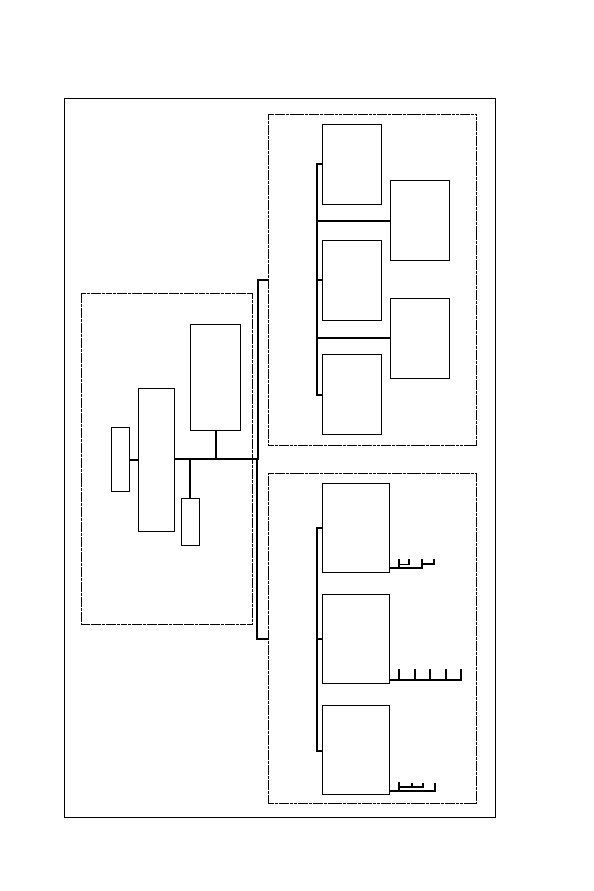
Ex
ecuti
v
e
Office of the Pr
esident
PO
TUS
National Intelligence
Dir
ector
Staff
National
Counter
ter
r
o
r
i
sm
Center
Hir
e
,
T
rain,
Acquir
e
,
Equip & Field
(agencies suppor
t / staff the Nat'l Intel Center
s)
Deputy NID
F
o
r
eign
Intelligence
(CIA Dir
.)
Deputy NID
Defense
Intelligence
(USD Intelligence)
Deputy NID
Homeland
Intelligence
(FBI/Intel Dir
.)
National Intelligence Center
s
(conduct
"joint"
collection and analysis -
illustr
ativ
e
)
WMD
Pr
oliferation
Int'l Cr
ime
&
Nar
cotics
China /
East Asia
Middle
East
Russia /
Eurasia
CIA
Clandestine Ser
vices
All-Sour
ce Analysis
Open Sour
ce
Agency (ne
w)
DIA
NSA
NGA
NR
O
Other
FBI
Intel & CT / CI
DHS / IAIP
Other DHS (e
.g.,
CBP
,
TSA,
Nat'l
Labs,
Coast Guar
d,
etc
.)
Unity of Effor
t in Managing Intelligence
FinalCh12_13.4pp 7/17/04 4:14 PM Page 413

· The National Intelligence Director would set personnel policies to
establish standards for education and training and facilitate assignments
at the national intelligence centers and across agency lines. The
National Intelligence Director also would set information sharing and
information technology policies to maximize data sharing, as well as
policies to protect the security of information.
· Too many agencies now have an opportunity to say no to change.The
National Intelligence Director should participate in an NSC execu-
tive committee that can resolve differences in priorities among the
agencies and bring the major disputes to the president for decision.
The National Intelligence Director should be located in the Executive Office
of the President. This official, who would be confirmed by the Senate and
would testify before Congress, would have a relatively small staff of several hun-
dred people, taking the place of the existing community management offices
housed at the CIA.
In managing the whole community, the National Intelligence Director is still
providing a service function.With the partial exception of his or her responsi-
bilities for overseeing the NCTC, the National Intelligence Director should
support the consumers of national intelligence--the president and policymak-
ing advisers such as the secretaries of state, defense, and homeland security and
the attorney general.
We are wary of too easily equating government management problems with
those of the private sector. But we have noticed that some very large private
firms rely on a powerful CEO who has significant control over how money is
spent and can hire or fire leaders of the major divisions, assisted by a relatively
modest staff, while leaving responsibility for execution in the operating divisions.
There are disadvantages to separating the position of National Intelligence
Director from the job of heading the CIA. For example, the National Intelli-
gence Director will not head a major agency of his or her own and may have
a weaker base of support. But we believe that these disadvantages are out-
weighed by several other considerations:
· The National Intelligence Director must be able to directly oversee intel-
ligence collection inside the United States.Yet law and custom has coun-
seled against giving such a plain domestic role to the head of the CIA.
· The CIA will be one among several claimants for funds in setting
national priorities.The National Intelligence Director should not be
both one of the advocates and the judge of them all.
· Covert operations tend to be highly tactical, requiring close attention.
The National Intelligence Director should rely on the relevant joint
414
THE 9/11 COMMISSION REPORT
FinalCh12_13.4pp 7/17/04 4:14 PM Page 414

mission center to oversee these details, helping to coordinate closely
with the White House.The CIA will be able to concentrate on build-
ing the capabilities to carry out such operations and on providing the
personnel who will be directing and executing such operations in the
field.
· Rebuilding the analytic and human intelligence collection capabili-
ties of the CIA should be a full-time effort, and the director of the
CIA should focus on extending its comparative advantages.
Recommendation: The CIA Director should emphasize (a) rebuild-
ing the CIA's analytic capabilities; (b) transforming the clandestine
service by building its human intelligence capabilities; (c) developing
a stronger language program, with high standards and sufficient
financial incentives; (d) renewing emphasis on recruiting diversity
among operations officers so they can blend more easily in foreign
cities; (e) ensuring a seamless relationship between human source col-
lection and signals collection at the operational level; and (f) stress-
ing a better balance between unilateral and liaison operations.
The CIA should retain responsibility for the direction and execution of clan-
destine and covert operations, as assigned by the relevant national intelligence
center and authorized by the National Intelligence Director and the president.
This would include propaganda, renditions, and nonmilitary disruption. We
believe, however, that one important area of responsibility should change.
Recommendation: Lead responsibility for directing and executing
paramilitary operations, whether clandestine or covert, should shift
to the Defense Department.There it should be consolidated with the
capabilities for training, direction, and execution of such operations
already being developed in the Special Operations Command.
· Before 9/11, the CIA did not invest in developing a robust capability
to conduct paramilitary operations with U.S. personnel. It relied on
proxies instead, organized by CIA operatives without the requisite
military training.The results were unsatisfactory.
· Whether the price is measured in either money or people, the United
States cannot afford to build two separate capabilities for carrying out
secret military operations, secretly operating standoff missiles, and
secretly training foreign military or paramilitary forces. The United
States should concentrate responsibility and necessary legal authori-
ties in one entity.
HOW TO DO IT?
415
FinalCh12_13.4pp 7/17/04 4:14 PM Page 415

· The post-9/11 Afghanistan precedent of using joint CIA-military
teams for covert and clandestine operations was a good one. We
believe this proposal to be consistent with it. Each agency would con-
centrate on its comparative advantages in building capabilities for joint
missions.The operation itself would be planned in common.
· The CIA has a reputation for agility in operations.The military has a
reputation for being methodical and cumbersome.We do not know
if these stereotypes match current reality; they may also be one more
symptom of the civil-military misunderstandings we described in
chapter 4. It is a problem to be resolved in policy guidance and agency
management, not in the creation of redundant, overlapping capabili-
ties and authorities in such sensitive work.The CIA's experts should
be integrated into the military's training, exercises, and planning. To
quote a CIA official now serving in the field:"One fight, one team."
Recommendation: Finally, to combat the secrecy and complexity we
have described, the overall amounts of money being appropriated for
national intelligence and to its component agencies should no longer
be kept secret. Congress should pass a separate appropriations act for
intelligence, defending the broad allocation of how these tens of bil-
lions of dollars have been assigned among the varieties of intelligence
work.
The specifics of the intelligence appropriation would remain classified, as
they are today. Opponents of declassification argue that America's enemies
could learn about intelligence capabilities by tracking the top-line appropria-
tions figure.Yet the top-line figure by itself provides little insight into U.S. intel-
ligence sources and methods. The U.S. government readily provides copious
information about spending on its military forces, including military intelli-
gence.The intelligence community should not be subject to that much disclo-
sure. But when even aggregate categorical numbers remain hidden, it is hard
to judge priorities and foster accountability.
13.3 UNITY OF EFFORT IN SHARING INFORMATION
Information Sharing
We have already stressed the importance of intelligence analysis that can draw
on all relevant sources of information. The biggest impediment to all-source
analysis--to a greater likelihood of connecting the dots--is the human or sys-
temic resistance to sharing information.
The U.S. government has access to a vast amount of information. When
databases not usually thought of as "intelligence," such as customs or immigra-
416
THE 9/11 COMMISSION REPORT
FinalCh12_13.4pp 7/17/04 4:14 PM Page 416

tion information, are included, the storehouse is immense. But the U.S. gov-
ernment has a weak system for processing and using what it has. In interviews
around the government, official after official urged us to call attention to frus-
trations with the unglamorous "back office" side of government operations.
In the 9/11 story, for example, we sometimes see examples of information
that could be accessed--like the undistributed NSA information that would
have helped identify Nawaf al Hazmi in January 2000. But someone had to ask
for it. In that case, no one did. Or, as in the episodes we describe in chapter 8,
the information is distributed, but in a compartmented channel. Or the infor-
mation is available, and someone does ask, but it cannot be shared.
What all these stories have in common is a system that requires a demon-
strated "need to know" before sharing.This approach assumes it is possible to
know, in advance, who will need to use the information. Such a system implic-
itly assumes that the risk of inadvertent disclosure outweighs the benefits of
wider sharing.Those Cold War assumptions are no longer appropriate.The cul-
ture of agencies feeling they own the information they gathered at taxpayer
expense must be replaced by a culture in which the agencies instead feel they
have a duty to the information--to repay the taxpayers' investment by making
that information available.
Each intelligence agency has its own security practices, outgrowths of the
Cold War.We certainly understand the reason for these practices. Counterin-
telligence concerns are still real, even if the old Soviet enemy has been replaced
by other spies.
But the security concerns need to be weighed against the costs. Current
security requirements nurture overclassification and excessive compartmenta-
tion of information among agencies. Each agency's incentive structure opposes
sharing, with risks (criminal, civil, and internal administrative sanctions) but few
rewards for sharing information. No one has to pay the long-term costs of over-
classifying information, though these costs--even in literal financial terms--
are substantial.There are no punishments for not sharing information.Agencies
uphold a "need-to-know" culture of information protection rather than pro-
moting a "need-to-share" culture of integration.
15
Recommendation: Information procedures should provide incentives
for sharing, to restore a better balance between security and shared
knowledge.
Intelligence gathered about transnational terrorism should be processed,
turned into reports, and distributed according to the same quality standards,
whether it is collected in Pakistan or in Texas.
The logical objection is that sources and methods may vary greatly in dif-
ferent locations.We therefore propose that when a report is first created, its data
be separated from the sources and methods by which they are obtained. The
HOW TO DO IT?
417
FinalCh12_13.4pp 7/17/04 4:14 PM Page 417

report should begin with the information in its most shareable, but still mean-
ingful, form. Therefore the maximum number of recipients can access some
form of that information. If knowledge of further details becomes important,
any user can query further, with access granted or denied according to the rules
set for the network--and with queries leaving an audit trail in order to deter-
mine who accessed the information. But the questions may not come at all
unless experts at the "edge" of the network can readily discover the clues that
prompt to them.
16
We propose that information be shared horizontally, across new networks
that transcend individual agencies.
· The current system is structured on an old mainframe, or hub-and-
spoke, concept. In this older approach, each agency has its own data-
base. Agency users send information to the database and then can
retrieve it from the database.
· A decentralized network model, the concept behind much of the
information revolution, shares data horizontally too. Agencies would
still have their own databases, but those databases would be searchable
across agency lines. In this system, secrets are protected through the
design of the network and an "information rights management"
approach that controls access to the data, not access to the whole net-
work.An outstanding conceptual framework for this kind of "trusted
information network" has been developed by a task force of leading
professionals in national security, information technology, and law
assembled by the Markle Foundation. Its report has been widely dis-
cussed throughout the U.S. government, but has not yet been con-
verted into action.
17
Recommendation: The president should lead the government-wide
effort to bring the major national security institutions into the infor-
mation revolution. He should coordinate the resolution of the legal,
policy, and technical issues across agencies to create a "trusted infor-
mation network."
· No one agency can do it alone. Well-meaning agency officials are
under tremendous pressure to update their systems. Alone, they may
only be able to modernize the stovepipes, not replace them.
· Only presidential leadership can develop government-wide concepts
and standards. Currently, no one is doing this job. Backed by the Office
of Management and Budget, a new National Intelligence Director
empowered to set common standards for information use throughout
the community, and a secretary of homeland security who helps
418
THE 9/11 COMMISSION REPORT
FinalCh12_13.4pp 7/17/04 4:14 PM Page 418

extend the system to public agencies and relevant private-sector data-
bases, a government-wide initiative can succeed.
· White House leadership is also needed because the policy and legal
issues are harder than the technical ones. The necessary technology
already exists. What does not are the rules for acquiring, accessing,
sharing, and using the vast stores of public and private data that may
be available. When information sharing works, it is a powerful tool.
Therefore the sharing and uses of information must be guided by a
set of practical policy guidelines that simultaneously empower and
constrain officials, telling them clearly what is and is not permitted.
"This is government acting in new ways, to face new threats," the most
recent Markle report explains."And while such change is necessary, it must be
accomplished while engendering the people's trust that privacy and other civil
liberties are being protected, that businesses are not being unduly burdened
with requests for extraneous or useless information, that taxpayer money is
being well spent, and that, ultimately, the network will be effective in protect-
ing our security."The authors add: "Leadership is emerging from all levels of
government and from many places in the private sector.What is needed now
is a plan to accelerate these efforts, and public debate and consensus on the
goals."
18
13.4 UNITY OF EFFORT IN THE CONGRESS
Strengthen Congressional Oversight of Intelligence and Homeland
Security
Of all our recommendations, strengthening congressional oversight may be
among the most difficult and important. So long as oversight is governed by
current congressional rules and resolutions, we believe the American people
will not get the security they want and need.The United States needs a strong,
stable, and capable congressional committee structure to give America's
national intelligence agencies oversight, support, and leadership.
Few things are more difficult to change in Washington than congressional
committee jurisdiction and prerogatives. To a member, these assignments are
almost as important as the map of his or her congressional district.The Amer-
ican people may have to insist that these changes occur, or they may well not
happen. Having interviewed numerous members of Congress from both par-
ties, as well as congressional staff members, we found that dissatisfaction with
congressional oversight remains widespread.
The future challenges of America's intelligence agencies are daunting.They
include the need to develop leading-edge technologies that give our policy-
HOW TO DO IT?
419
FinalCh12_13.4pp 7/17/04 4:14 PM Page 419

makers and warfighters a decisive edge in any conflict where the interests of
the United States are vital. Not only does good intelligence win wars, but the
best intelligence enables us to prevent them from happening altogether.
Under the terms of existing rules and resolutions the House and Senate
intelligence committees lack the power, influence, and sustained capability to
meet this challenge.While few members of Congress have the broad knowl-
edge of intelligence activities or the know-how about the technologies
employed, all members need to feel assured that good oversight is happening.
When their unfamiliarity with the subject is combined with the need to pre-
serve security, a mandate emerges for substantial change.
Tinkering with the existing structure is not sufficient. Either Congress
should create a joint committee for intelligence, using the Joint Atomic Energy
Committee as its model, or it should create House and Senate committees with
combined authorizing and appropriations powers.
Whichever of these two forms are chosen, the goal should be a structure--
codified by resolution with powers expressly granted and carefully limited--
allowing a relatively small group of members of Congress, given time and
reason to master the subject and the agencies, to conduct oversight of the intel-
ligence establishment and be clearly accountable for their work. The staff of
this committee should be nonpartisan and work for the entire committee and
not for individual members.
The other reforms we have suggested--for a National Counterterrorism
Center and a National Intelligence Director--will not work if congressional
oversight does not change too. Unity of effort in executive management can
be lost if it is fractured by divided congressional oversight.
Recommendation: Congressional oversight for intelligence--and
counterterrorism--is now dysfunctional. Congress should address this
problem.We have considered various alternatives: A joint committee
on the old model of the Joint Committee on Atomic Energy is one.
A single committee in each house of Congress, combining authoriz-
ing and appropriating authorities, is another.
· The new committee or committees should conduct continuing stud-
ies of the activities of the intelligence agencies and report problems
relating to the development and use of intelligence to all members of
the House and Senate.
· We have already recommended that the total level of funding for intel-
ligence be made public, and that the national intelligence program be
appropriated to the National Intelligence Director, not to the secre-
tary of defense.
19
420
THE 9/11 COMMISSION REPORT
FinalCh12_13.4pp 7/17/04 4:14 PM Page 420

· We also recommend that the intelligence committee should have a
subcommittee specifically dedicated to oversight, freed from the con-
suming responsibility of working on the budget.
· The resolution creating the new intelligence committee structure
should grant subpoena authority to the committee or committees.
The majority party's representation on this committee should never
exceed the minority's representation by more than one.
· Four of the members appointed to this committee or committees
should be a member who also serves on each of the following addi-
tional committees:Armed Services, Judiciary, Foreign Affairs, and the
Defense Appropriations subcommittee. In this way the other major
congressional interests can be brought together in the new commit-
tee's work.
· Members should serve indefinitely on the intelligence committees,
without set terms, thereby letting them accumulate expertise.
· The committees should be smaller--perhaps seven or nine members
in each house--so that each member feels a greater sense of respon-
sibility, and accountability, for the quality of the committee's work.
The leaders of the Department of Homeland Security now appear before 88
committees and subcommittees of Congress. One expert witness (not a mem-
ber of the administration) told us that this is perhaps the single largest obstacle
impeding the department's successful development.The one attempt to con-
solidate such committee authority, the House Select Committee on Home-
land Security, may be eliminated.The Senate does not have even this.
Congress needs to establish for the Department of Homeland Security the
kind of clear authority and responsibility that exist to enable the Justice Depart-
ment to deal with crime and the Defense Department to deal with threats to
national security.Through not more than one authorizing committee and one
appropriating subcommittee in each house, Congress should be able to ask the
secretary of homeland security whether he or she has the resources to provide
reasonable security against major terrorist acts within the United States and to
hold the secretary accountable for the department's performance.
Recommendation: Congress should create a single, principal point of
oversight and review for homeland security. Congressional leaders are
best able to judge what committee should have jurisdiction over this
department and its duties. But we believe that Congress does have
the obligation to choose one in the House and one in the Senate, and
that this committee should be a permanent standing committee with
a nonpartisan staff.
HOW TO DO IT?
421
FinalCh12_13.4pp 7/17/04 4:14 PM Page 421

Improve the Transitions between Administrations
In chapter 6, we described the transition of 20002001. Beyond the policy
issues we described, the new administration did not have its deputy cabinet offi-
cers in place until the spring of 2001, and the critical subcabinet officials were
not confirmed until the summer--if then. In other words, the new adminis-
tration--like others before it--did not have its team on the job until at least
six months after it took office.
Recommendation: Since a catastrophic attack could occur with lit-
tle or no notice, we should minimize as much as possible the disrup-
tion of national security policymaking during the change of
administrations by accelerating the process for national security
appointments. We think the process could be improved significantly
so transitions can work more effectively and allow new officials to
assume their new responsibilities as quickly as possible.
· Before the election, candidates should submit the names of selected
members of their prospective transition teams to the FBI so that, if
necessary, those team members can obtain security clearances imme-
diately after the election is over.
· A president-elect should submit lists of possible candidates for
national security positions to begin obtaining security clearances
immediately after the election, so that their background investigations
can be complete before January 20.
· A single federal agency should be responsible for providing and main-
taining security clearances, ensuring uniform standardsincluding
uniform security questionnaires and financial report requirements, and
maintaining a single database.This agency can also be responsible for
administering polygraph tests on behalf of organizations that require
them.
· A president-elect should submit the nominations of the entire new
national security team, through the level of under secretary of cabi-
net departments, not later than January 20. The Senate, in return,
should adopt special rules requiring hearings and votes to confirm or
reject national security nominees within 30 days of their submission.
The Senate should not require confirmation of such executive
appointees below Executive Level 3.
· The outgoing administration should provide the president-elect, as
soon as possible after election day, with a classified, compartmented
list that catalogues specific, operational threats to national security;
major military or covert operations; and pending decisions on the pos-
422
THE 9/11 COMMISSION REPORT
FinalCh12_13.4pp 7/17/04 4:14 PM Page 422

sible use of force. Such a document could provide both notice and a
checklist, inviting a president-elect to inquire and learn more.
13.5 ORGANIZING AMERICA'S DEFENSES IN THE
UNITED STATES
The Future Role of the FBI
We have considered proposals for a new agency dedicated to intelligence col-
lection in the United States. Some call this a proposal for an "American MI-
5," although the analogy is weak--the actual British Security Service is a
relatively small worldwide agency that combines duties assigned in the U.S.
government to the Terrorist Threat Integration Center, the CIA, the FBI, and
the Department of Homeland Security.
The concern about the FBI is that it has long favored its criminal justice
mission over its national security mission. Part of the reason for this is the
demand around the country for FBI help on criminal matters. The FBI was
criticized, rightly, for the overzealous domestic intelligence investigations dis-
closed during the 1970s.The pendulum swung away from those types of inves-
tigations during the 1980s and 1990s, though the FBI maintained an active
counterintelligence function and was the lead agency for the investigation of
foreign terrorist groups operating inside the United States.
We do not recommend the creation of a new domestic intelligence agency.
It is not needed if our other recommendations are adopted--to establish a
strong national intelligence center, part of the NCTC, that will oversee coun-
terterrorism intelligence work, foreign and domestic, and to create a National
Intelligence Director who can set and enforce standards for the collection, pro-
cessing, and reporting of information.
Under the structures we recommend, the FBI's role is focused, but still vital.
The FBI does need to be able to direct its thousands of agents and other
employees to collect intelligence in America's cities and towns--interviewing
informants, conducting surveillance and searches, tracking individuals, work-
ing collaboratively with local authorities, and doing so with meticulous atten-
tion to detail and compliance with the law.The FBI's job in the streets of the
United States would thus be a domestic equivalent, operating under the U.S.
Constitution and quite different laws and rules, to the job of the CIA's opera-
tions officers abroad.
Creating a new domestic intelligence agency has other drawbacks.
· The FBI is accustomed to carrying out sensitive intelligence collec-
tion operations in compliance with the law. If a new domestic intel-
ligence agency were outside of the Department of Justice, the process
of legal oversight--never easy--could become even more difficult.
HOW TO DO IT?
423
FinalCh12_13.4pp 7/17/04 4:14 PM Page 423

Abuses of civil liberties could create a backlash that would impair the
collection of needed intelligence.
· Creating a new domestic intelligence agency would divert attention
of the officials most responsible for current counterterrorism efforts
while the threat remains high. Putting a new player into the mix of
federal agencies with counterterrorism responsibilities would exacer-
bate existing information-sharing problems.
· A new domestic intelligence agency would need to acquire assets and
personnel.The FBI already has 28,000 employees; 56 field offices, 400
satellite offices, and 47 legal attaché offices; a laboratory, operations
center, and training facility; an existing network of informants, coop-
erating defendants, and other sources; and relationships with state and
local law enforcement, the CIA, and foreign intelligence and law
enforcement agencies.
· Counterterrorism investigations in the United States very quickly
become matters that involve violations of criminal law and possible
law enforcement action. Because the FBI can have agents working
criminal matters and agents working intelligence investigations con-
cerning the same international terrorism target, the full range of inves-
tigative tools against a suspected terrorist can be considered within
one agency. The removal of "the wall" that existed before 9/11
between intelligence and law enforcement has opened up new
opportunities for cooperative action within the FBI.
· Counterterrorism investigations often overlap or are cued by other
criminal investigations, such as money laundering or the smuggling
of contraband. In the field, the close connection to criminal work has
many benefits.
Our recommendation to leave counterterrorism intelligence collection in the
United States with the FBI still depends on an assessment that the FBI--if it
makes an all-out effort to institutionalize change--can do the job.As we men-
tioned in chapter 3, we have been impressed by the determination that agents
display in tracking down details, patiently going the extra mile and working
the extra month, to put facts in the place of speculation. In our report we have
shown how agents in Phoenix, Minneapolis, and New York displayed initiative
in pressing their investigations.
FBI agents and analysts in the field need to have sustained support and ded-
icated resources to become stronger intelligence officers. They need to be
rewarded for acquiring informants and for gathering and disseminating infor-
mation differently and more broadly than usual in a traditional criminal inves-
424
THE 9/11 COMMISSION REPORT
FinalCh12_13.4pp 7/17/04 4:14 PM Page 424

tigation. FBI employees need to report and analyze what they have learned in
ways the Bureau has never done before.
Under Director Robert Mueller, the Bureau has made significant progress
in improving its intelligence capabilities. It now has an Office of Intelligence,
overseen by the top tier of FBI management. Field intelligence groups have
been created in all field offices to put FBI priorities and the emphasis on intel-
ligence into practice. Advances have been made in improving the Bureau's
information technology systems and in increasing connectivity and informa-
tion sharing with intelligence community agencies.
Director Mueller has also recognized that the FBI's reforms are far from
complete. He has outlined a number of areas where added measures may be
necessary. Specifically, he has recognized that the FBI needs to recruit from a
broader pool of candidates, that agents and analysts working on national secu-
rity matters require specialized training, and that agents should specialize within
programs after obtaining a generalist foundation.The FBI is developing career
tracks for agents to specialize in counterterrorism/counterintelligence, cyber
crimes, criminal investigations, or intelligence. It is establishing a program for
certifying agents as intelligence officers, a certification that will be a prerequi-
site for promotion to the senior ranks of the Bureau. New training programs
have been instituted for intelligence-related subjects.
The Director of the FBI has proposed creating an Intelligence Directorate
as a further refinement of the FBI intelligence program.This directorate would
include units for intelligence planning and policy and for the direction of ana-
lysts and linguists.
We want to ensure that the Bureau's shift to a preventive counterterrorism
posture is more fully institutionalized so that it survives beyond Director
Mueller's tenure.We have found that in the past the Bureau has announced its
willingness to reform and restructure itself to address transnational security
threats, but has fallen short--failing to effect the necessary institutional and cul-
tural changes organization-wide.We want to ensure that this does not happen
again. Despite having found acceptance of the Director's clear message that
counterterrorism is now the FBI's top priority, two years after 9/11 we also
found gaps between some of the announced reforms and the reality in the field.
We are concerned that management in the field offices still can allocate peo-
ple and resources to local concerns that diverge from the national security mis-
sion.This system could revert to a focus on lower-priority criminal justice cases
over national security requirements.
Recommendation: A specialized and integrated national security
workforce should be established at the FBI consisting of agents, ana-
lysts, linguists, and surveillance specialists who are recruited, trained,
rewarded, and retained to ensure the development of an institutional
HOW TO DO IT?
425
FinalCh12_13.4pp 7/17/04 4:14 PM Page 425

culture imbued with a deep expertise in intelligence and national
security.
· The president, by executive order or directive, should direct the FBI
to develop this intelligence cadre.
· Recognizing that cross-fertilization between the criminal justice and
national security disciplines is vital to the success of both missions, all
new agents should receive basic training in both areas. Furthermore,
new agents should begin their careers with meaningful assignments
in both areas.
· Agents and analysts should then specialize in one of these disciplines
and have the option to work such matters for their entire career with
the Bureau. Certain advanced training courses and assignments to
other intelligence agencies should be required to advance within the
national security discipline.
· In the interest of cross-fertilization, all senior FBI managers, includ-
ing those working on law enforcement matters, should be certified
intelligence officers.
· The FBI should fully implement a recruiting, hiring, and selection
process for agents and analysts that enhances its ability to target and
attract individuals with educational and professional backgrounds in
intelligence, international relations, language, technology, and other
relevant skills.
· The FBI should institute the integration of analysts,agents,linguists,and
surveillance personnel in the field so that a dedicated team approach is
brought to bear on national security intelligence operations.
· Each field office should have an official at the field office's deputy level
for national security matters.This individual would have management
oversight and ensure that the national priorities are carried out in the
field.
· The FBI should align its budget structure according to its four main
programs--intelligence, counterterrorism and counterintelligence,
criminal, and criminal justice services--to ensure better transparency
on program costs, management of resources, and protection of the
intelligence program.
20
· The FBI should report regularly to Congress in its semiannual pro-
gram reviews designed to identify whether each field office is appro-
priately addressing FBI and national program priorities.
426
THE 9/11 COMMISSION REPORT
FinalCh12_13.4pp 7/17/04 4:14 PM Page 426

· The FBI should report regularly to Congress in detail on the qualifi-
cations, status, and roles of analysts in the field and at headquarters.
Congress should ensure that analysts are afforded training and career
opportunities on a par with those offered analysts in other intelligence
community agencies.
· The Congress should make sure funding is available to accelerate the
expansion of secure facilities in FBI field offices so as to increase their
ability to use secure email systems and classified intelligence product
exchanges. The Congress should monitor whether the FBI's
information-sharing principles are implemented in practice.
The FBI is just a small fraction of the national law enforcement commu-
nity in the United States, a community comprised mainly of state and local
agencies.The network designed for sharing information, and the work of the
FBI through local Joint Terrorism Task Forces, should build a reciprocal rela-
tionship, in which state and local agents understand what information they are
looking for and, in return, receive some of the information being developed
about what is happening, or may happen, in their communities. In this rela-
tionship, the Department of Homeland Security also will play an important
part.
The Homeland Security Act of 2002 gave the under secretary for informa-
tion analysis and infrastructure protection broad responsibilities. In practice, this
directorate has the job to map "terrorist threats to the homeland against our
assessed vulnerabilities in order to drive our efforts to protect against terrorist
threats."
21
These capabilities are still embryonic. The directorate has not yet
developed the capacity to perform one of its assigned jobs, which is to assim-
ilate and analyze information from Homeland Security's own component
agencies, such as the Coast Guard, Secret Service, Transportation Security
Administration, Immigration and Customs Enforcement, and Customs and
Border Protection.The secretary of homeland security must ensure that these
components work with the Information Analysis and Infrastructure Protection
Directorate so that this office can perform its mission.
22
Homeland Defense
At several points in our inquiry, we asked, "Who is responsible for defending
us at home?" Our national defense at home is the responsibility, first, of the
Department of Defense and, second, of the Department of Homeland Secu-
rity.They must have clear delineations of responsibility and authority.
We found that NORAD, which had been given the responsibility for
defending U.S. airspace, had construed that mission to focus on threats com-
ing from outside America's borders. It did not adjust its focus even though the
intelligence community had gathered intelligence on the possibility that ter-
HOW TO DO IT?
427
FinalCh12_13.4pp 7/17/04 4:14 PM Page 427

rorists might turn to hijacking and even use of planes as missiles.We have been
assured that NORAD has now embraced the full mission. Northern Com-
mand has been established to assume responsibility for the defense of the
domestic United States.
Recommendation: The Department of Defense and its oversight
committees should regularly assess the adequacy of Northern Com-
mand's strategies and planning to defend the United States against
military threats to the homeland.
The Department of Homeland Security was established to consolidate all
of the domestic agencies responsible for securing America's borders and
national infrastructure, most of which is in private hands. It should identify
those elements of our transportation, energy, communications, financial, and
other institutions that need to be protected, develop plans to protect that infra-
structure, and exercise the mechanisms to enhance preparedness. This means
going well beyond the preexisting jobs of the agencies that have been brought
together inside the department.
Recommendation: The Department of Homeland Security and its
oversight committees should regularly assess the types of threats the
country faces to determine (a) the adequacy of the government's
plans--and the progress against those plans--to protect America's
critical infrastructure and (b) the readiness of the government to
respond to the threats that the United States might face.
.
.
.
We look forward to a national debate on the merits of what we have recom-
mended, and we will participate vigorously in that debate.
428
THE 9/11 COMMISSION REPORT
FinalCh12_13.4pp 7/17/04 4:14 PM Page 428

APPENDIX A
COMMON ABBREVIATIONS
429
CAP
combat air patrol
CAPPS
Computer Assisted Passenger Prescreening System
CENTCOM
Central Command
CIA
Central Intelligence Agency
CONR
Continental U.S. NORAD Region
CSG
Counterterrorism Security Group
CTC
Counterterrorist Center
DIA
Defense Intelligence Agency
DCI
Director of Central Intelligence
ESU
Emergency Service Unit (NYPD)
FAA
Federal Aviation Administration
FBI
Federal Bureau of Investigation
FDNY
Fire Department of New York
FFTC
Florida Flight Training Center
FISA
Foreign Intelligence Surveillance Act
FISC
Foreign Intelligence Surveillance Court
INS
Immigration and Naturalization Service
ISID
Inter-Services Intelligence Directorate (Pakistan)
JCS
Joint Chiefs of Staff
JI
Jemaah Islamiah
JTTF
Joint Terrorism Task Force
KSM
Khalid Sheikh Mohammed
Legat
legal attaché
MAK
Mektab al Khidmat
MON
memorandum of notification
NEADS
Northeast Air Defense Sector
NCTC
National Counterterrorism Center
NGO
nongovernmental organization
NMCC
National Military Command Center
Final Appen.4pp 7/17/04 4:21 PM Page 429

NORAD
North American Aerospace Defense Command
NTSB
National Transportation Safety Board
NSA
National Security Agency
NSC
National Security Council
NSPD
national security policy directive
NYPD
New York Police Department
OEM
Office of Emergency Management (New York City)
OFAC
Office of Foreign Assets Control
OIPR
Office of Intelligence Policy and Review
OMB
Office of Management and Budget
PAPD
Port Authority Police Department
PDD
presidential decision directive
PEOC
Presidential Emergency Operations Center
SEC
Securities and Exchange Commission
TSA
Transportation Security Administration
TTIC
Terrorist Threat Integration Center
UBL
Usama Bin Ladin
WMD
weapons of mass destruction
WTC
World Trade Center
WTO
World Trade Organization
430
APPENDIX
Final Appen.4pp 7/17/04 4:21 PM Page 430

APPENDIX B
TABLE OF NAMES
431
U.S. OFFICIALS
Madeleine Albright
Secretary of State, 19972001
Charles Allen
Assistant Director of Central Intelligence for Col-
lection, 1998
Richard Armitage
Deputy Secretary of State, 2001
Larry Arnold
Commander, First Air Force and Commander of
the Continental U.S. North American Aero-
space Defense Command (NORAD) Region,
19972002
John Ashcroft
Attorney General, 2001
Monte Belger
Acting Deputy Administrator, Federal Aviation
Administration 19972002
Samuel "Sandy" Berger
National Security Advisor, 19972001; Deputy
National Security Advisor 19931997
J. Cofer Black
Director, DCI Counterterrorist Center, 19992002
Joshua Bolten
White House Deputy Chief of Staff, 20012003
Robert "Bear" Bryant
Deputy Director, Federal Bureau of Investigation,
19971999
George H.W. Bush
41st President of the United States, 19891993;
Vice President, 19811989
George W. Bush
43rd President of the United States, 2001
Andrew Card, Jr.
White House Chief of Staff, 2001
Richard B. Cheney
Vice President of the United States, 2001
Richard Clarke
National Counterterrorism Coordinator, NSC,
19972001
William J. Clinton
42nd President of the United States, 19932001
William Cohen
Secretary of Defense, 19972001
Final Appen.4pp 7/17/04 4:21 PM Page 431

Roger Cressey
NSC counterterrorism official, 19992001
Ralph Eberhart
Commander in Chief, NORAD and U.S. Space
Command, 2000
Tommy Franks
Commander, U.S. Central Command (CENT-
COM), 20012003
Louis Freeh
Director, Federal Bureau of Investigation, 19932001
Scott Fry
Director of Operations for the Joint Chiefs of
Staff, 19982000
Jane Garvey
Administrator, Federal Aviation Administration,
19972002
Newt Gingrich
Speaker of the House, 19951999
Rudolph Giuliani
Mayor, City of New York, 19942001
John Gordon
Deputy Director of Central Intelligence, 19972000
Al Gore, Jr.
Vice President of the United States,19932001
Scott Gration
Fry's Chief Information Operations Officer,
20002001
Stephen Hadley
Deputy National Security Advisor, 2001
Dennis Hastert
Speaker of the House, 1999
Karl Inderfurth
Assistant Secretary of State for South Asia,
19972001
Donald Kerrick
Deputy National Security Advisor, 20002001
Zalmay Khalilzad
NSC Senior Director for Near East and South
Asia and Special Envoy to Afghanistan,
20012003
Anthony Lake
National Security Advisor, 19931997
Trent Lott
Senate Majority Leader, 19962001
Mary McCarthy
NSC senior director for intelligence, 19982001
John McLaughlin
Deputy Director of Central Intelligence,
20002004
William Milam
U.S. Ambassador to Pakistan, 19982001
Norman Mineta
Secretary of Transportation, 2001
Robert Mueller
Director, Federal Bureau of Investigation, 2001
Richard Myers
Chairman of the Joint Chiefs, September 2001;
Joint Chiefs Vice Chairman, 20002001
John O'Neill
FBI Special Agent in Charge for National Secu-
rity, New York Field Office, 19972001; Chief
of Security of the World Trade Center, killed
on 9/11
Paul O'Neill
Secretary of the Treasury, 20012002
James Pavitt
Deputy Director of Operations, CIA,
19992004
Thomas Pickard
Acting Director, Federal Bureau of Investigation,
June 25, 2001September 4, 2001
432
APPENDIX
Final Appen.4pp 7/17/04 4:21 PM Page 432

APPENDIX
433
Thomas Pickering
Under Secretary of State, 19972000
Colin Powell
Secretary of State, 2001
Ronald Reagan
40th President of the United States, 19811989
Janet Reno
Attorney General, 19932001
Condoleezza Rice
National Security Advisor, 2001
Bill Richardson
Ambassador to the United Nations, 19971998
Thomas Ridge
First Secretary of Homeland Security, 2003;
Homeland Security Advisor, 20012003
Bruce Riedel
Senior Director for Near East and South Asia,
NSC, 19972001
Christina Rocca
Assistant Secretary of State for South Asia, 2001
Michael Rolince
FBI Section Chief, International Terrorism Oper-
ations Section, 19982002
Donald Rumsfeld
Secretary of Defense, 2001
Peter Schoomaker
Commander, Special Operations Command,
19972000
Gary Schroen
CIA Station Chief, Islamabad, 19961999
Michael Sheehan
Counterterrorism Coordinator, U.S. Department
of State, 19982000
Hugh Shelton
Chairman of the Joint Chiefs of Staff, 19972001
Walter Slocombe
Under Secretary of Defense for Policy, 19942001
James Steinberg
Deputy National Security Advisor, 19962000
Strobe Talbott
Deputy Secretary of State, 19942001
George Tenet
Director of Central Intelligence, 19972004
Larry Thompson
Deputy Attorney General, 20012003
Dale Watson
Executive Assistant Director for Counterterrorism
and Counterintelligence, FBI, 20012002
Paul Wolfowitz
Deputy Secretary of Defense, 2001
Anthony Zinni
Commander, U.S. Central Command (CENT-
COM), 19972000
OTHERS
Abdullah bin Abdul Aziz Crown Prince and de facto regent of Saudi Ara-
bia, 1995
Mohdar Abdullah
Yemeni; student in San Diego who assisted two
9/11 hijackers
Sayf al Adl
Egyptian; high-ranking member of al Qaeda mili-
tary committee
Mahmud Ahmed
Director General of Pakistan's Inter-Services
Intelligence Directorate, 19992001
Mohammed Farrah
Somali warlord who challenged U.S. presence in
Aidid
Somalia in the early 1990s (deceased)
Final Appen.4pp 7/17/04 4:21 PM Page 433

Ali Abdul Aziz Ali
(a.k.a.Ammar al Baluchi) Pakistani; KSM's nephew;
financial and travel facilitator for 9/11 plot
Ahmad Khalil Ibrahim
Iraqi intelligence officer who allegedly met with
Samir al Ani
Atta in Prague, Czech Republic; currently in
U.S. custody
Mohamed Atta
Egyptian; tactical leader of 9/11 plot;
pilot/hijacker (AA 11) (deceased)
Mohammed Atef
(a.k.a. Abu Hafs al Masri) Egyptian; al Qaeda mili-
tary commander (deceased)
Tawfiq bin Attash
(a.k.a. Khallad,Waleed bin Attash) Yemeni; senior
al Qaeda operative connected to the U.S.
embassy bombings, the USS Cole attack, and
the 9/11 attacks; currently in U.S. custody
Anwar Aulaqi
U.S. citizen; Imam at Rabat mosque (San Diego,
CA) and later at Dar al Hijra mosque (Falls
Church,VA), who associated with two 9/11
hijackers
Abdullah Azzam
Palestinian; founder of the Maktab al Khidmat,
which provided logistical support to mujahi-
deen in Afghanistan (deceased)
Jamal al Badawi
Yemeni; co-conspirator arrested in Yemen for the
USS Cole attack
Said Bahaji
German son of Moroccan immigrant; Hamburg
cell associate
Saeed al Baluchi
Saudi; candidate 9/11 hijacker
Fayez Banihammad
Emirati; 9/11 hijacker (UA 175) (deceased)
Abu Ubaidah al Banshiri Egyptian; al Qaeda military commander until
1996 (deceased)
Abu Bara al Yemeni
(a.k.a. Abu al Bara al Ta'izi, Suhail Shurabi, and
Barakat) Yemeni; potential suicide bomber in
original 9/11 plot
Ramzi Binalshibh
Yemeni; Hamburg cell member; coordinator for
9/11 plot; currently in U.S. custody
Omar Hassan Ahmed
President of Sudan, 1989
al Bashir
Abu Bakar Bashir
Indonesian; spiritual leader and founder of Jemaah
Islamiya, al Qaedaaffiliated terrorist group in
Southeast Asia
Omar al Bayoumi
Saudi; assisted two 9/11 hijackers in San Diego,
CA
Khalil Deek
U.S. citizen; created electronic version of Encyclo-
pedia of Jihad; believed to be involved in millen-
434
APPENDIX
Final Appen.4pp 7/17/04 4:21 PM Page 434

nium plot to destroy tourist landmarks in Jor-
dan
Caysan Bin Don
(a.k.a Isamu Dyson, a.k.a Clayton Morgan) U.S.
citizen; met two 9/11 hijackers in Los Angeles
and San Diego, CA
Zakariya Essabar
Moroccan; Hamburg cell associate
Jamal Ahmed Mohamed
Sudanese; al Qaeda member who defected to the
al Fadl
United States in 1996
Ahmed al Ghamdi
Saudi; 9/11 hijacker (UA 175) (deceased)
Ali Abd al Rahman al
(a.k.a. Abu Bakr al Azdi) Saudi; candidate 9/11
Faqasi al Ghamdi
hijacker; currently in U.S. custody
Hamza al Ghamdi
Saudi; 9/11 hijacker (UA 175) (deceased)
Saeed al Ghamdi
Saudi; 9/11 hijacker (UA 93) (deceased)
Saeed ("Jihad") al
Saudi; candidate 9/11 hijacker
Ghamdi
Hassan Ghul
Pakistani; al Qaeda facilitator; currently in U.S.
custody
Abu Hafs al Masri
see Mohammed Atef
Abu Hafs al Mauritani
Mauritanian; senior al Qaeda theologian
Wadi al Hage
U.S. citizen; al Qaeda operative; Bin Ladin's per-
sonal assistant; convicted in embassy bomb-
ings trial
Mushabib al Hamlan
Saudi; candidate 9/11 hijacker
Hani Hanjour
Saudi; 9/11 pilot/hijacker (AA 77) (deceased)
Mustafa al Hawsawi
Saudi; al Qaeda media committee member; finan-
cial and travel facilitator for 9/11 plot
Nawaf al Hazmi
Saudi; 9/11 hijacker (AA 77) (deceased)
Salem al Hazmi
Saudi; 9/11 hijacker (AA 77) (deceased)
Ahmad al Haznawi
Saudi; 9/11 hijacker (UA 93) (deceased)
Gulbuddin Hekmatyar
Afghani; founder and leader of the Hizb-e-Islami,
a Taliban opposition group; Prime Minister of
Afghanistan, 19931994; 1996
Saddam Hussein
President of Iraq, 1979-2003
Zein al Abideen
(a.k.a. Abu Zubaydah) Palestinian; al Qaeda asso
Mohamed Hussein
ciate; currently in U.S. custody
Abu Hajer al Iraqi
see Mamdouh Mahmud Salim
Riduan Isamuddin
(a.k.a. Hambali) Indonesian; operational leader of
Jemaah Islamiya; currently in U.S. custody
Ziad Jarrah
Lebanese; 9/11 pilot/hijacker (UA 93)
(deceased)
Abderraouf Jdey
(a.k.a. Faruq al Tunisi) Tunisian/Canadian; candi-
date 9/11 hijacker
APPENDIX
435
Final Appen.4pp 7/17/04 4:21 PM Page 435

436
APPENDIX
Mohamed al Kahtani
Saudi; candidate 9/11 hijacker; currently in U.S.
custody
Mir Amal Kansi
Pakistani; extremist who killed two CIA em-
ployees at CIA headquarters in Virginia in
1993 (executed)
Hamid Karzai
Interim Leader and later President of Afghanistan,
Dec. 2001
Younis Khalis
Afghani; leader of Hizb-e-Islami; hosted UBL
upon his return to Afghanistan in 1996
Khallad
see Tawfiq bin Attash
Wali Khan Amin Shah
(a.k.a. Osama Asmurai) Turkmen; early associate of
Usama Bin Ladin; convicted in Manila air
(Bojinka) plot
Ibn al Khattab
Saudi; mujahid leader in Chechnya
L'Houssaine Kherchtou
(a.k.a. Joe the Moroccan, Abu Talal) Moroccan;
former al Qaeda member who broke with
Bin Ladin and became a U.S. government
informant
Usama Bin Ladin
(UBL) Saudi; head of al Qaeda
Ibn al Shaykh al Libi
Libyan; head of jihadist training camp in Afghan-
istan
Ahmed al Nami
Saudi; 9/11 hijacker (UA 93) (deceased)
Sheikh Saeed al Masri
Egyptian; head of al Qaeda finance committee
Ahmed Shah Massoud
Leader of Afghanistan's Northern Alliance, a Tal-
iban opposition group (assassinated Sept. 9,
2001)
Khalid al Mihdhar
Saudi; 9/11 hijacker (AA 77) (deceased)
Khalid Sheikh
(KSM) (a.k.a. Mukhtar) Pakistani; mastermind of
Mohammed
9/11 attacks; currently in U.S. custody
Majed Moqed
Saudi; 9/11 hijacker (AA 77) (deceased)
Mounir el Motassadeq
Moroccan; Hamburg cell associate
Zacarias Moussaoui
French; arrested in the U.S. in connection with
the 9/11 attacks
Hosni Mubarak
President of Egypt, 1981
Pervez Musharraf
Leader of Pakistan, 1999
Abdelghani Mzoudi
Moroccan; Hamburg cell associate
Qutaybah al Najdi
Saudi; candidate 9/11 hijacker
Abd al Rahim al Nashiri (a.k.a. Mullah Bilal) Saudi; mastermind of USS
Cole attack; currently in U.S. custody
Mullah Mohammed
Leader of Afghanistan's Taliban, which ruled most
Omar
of the country from 1996 to 2001
Abdul Aziz al Omari
Saudi; 9/11 hijacker (AA 11) (deceased)
Muammar Qadhafi
Leader of Libya, 1970
Final Appen.4pp 7/17/04 4:21 PM Page 436

APPENDIX
437
Fahd al Quso
Yemeni; al Qaeda co-conspirator arrested in
Yemen for the USS Cole attack
Sayyid Qutb
Egyptian writer; member of Muslim Brotherhood
(deceased)
Eyad al Rababah
Jordanian;Virginia resident who helped Hazmi
and Hanjour
Abd al Rahim Ghulum
(a.k.a. Abu Rahmah) Saudi; al Qaeda member
Rabbani
who worked closely with KSM in Karachi and
assisted many of the 9/11 hijackers
Sheikh Omar Abdel
(a.k.a. the Blind Sheikh) Egyptian cleric;
Rahman
convicted for crimes related to 1993 World
Trade Center bombing and 1995 plots against
other NY landmarks
Saud al Rashid
Saudi; candidate 9/11 hijacker
Ahmed Ressam
(a.k.a. Benni Antoine Noris) Algerian; convicted
in millennium plot to bomb Los Angeles Inter-
national Airport
Mamdouh Mahmud
(a.k.a. Abu Hajer al Iraqi) Iraqi; chief procurement
Salim
officer for al Qaeda in Sudan; arrested in con-
nection with 1998 embassy bombings
Yazeed al Salmi
Saudi; briefly a housemate of a 9/11 hijacker in
San Diego
Abdul Rasul Sayyaf
Afghani; head of the Hizbul-Ittihad El-Islami, and
KSM's mentor
Aysel Senguen
German; fiancée of 9/11 hijacker Jarrah
Nawaz Sharif
Pakistani Prime Minister, 19901993,
19971999
Marwan al Shehhi
Emirati; 9/11 pilot/hijacker (UA 175)
(deceased)
Mohand al Shehri
Saudi; 9/11 hijacker (UA 175) (deceased)
Wail al Shehri
Saudi; 9/11 hijacker (AA 11) (deceased)
Waleed al Shehri
Saudi; 9/11 hijacker (AA 11) (deceased)
Mohamedou Ould Slahi (a.k.a. Abu Musab) Mauritanian; recruited 9/11
hijackers in Germany
Yazid Sufaat
Malaysian; member of Jemaah Islamiya
Satam al Suqami
Saudi; 9/11 hijacker (AA 11) (deceased)
Madani al Tayyib
Saudi; former head of al Qaeda finance committee
Zuhair al Thubaiti
Saudi; candidate 9/11 hijacker
Fahad al Thumairy
Saudi; Imam of King Fahd mosque in Los Ange-
les; accredited diplomat at Saudi Consulate in
Los Angeles
Hassan al Turabi
Sudan's longtime hard-line ideological leader and
Speaker of the country's National Assembly
Final Appen.4pp 7/17/04 4:21 PM Page 437

during the 1990s
Prince Turki bin Faisal
Saudi intelligence chief prior to 9/11
Ramzi Yousef
(a.k.a. Abdul Basit) Pakistani; convicted master-
mind of and co-conspirator in 1993 WTC
bombing and Manila air (Bojinka) plots
Khalid Saeed Ahmad
Saudi; candidate 9/11 hijacker
al Zahrani
Mohammed Haydar
German citizen from Syria; jihadist; possible
Zammar
recruiter of Hamburg cell members
Ayman al Zawahiri
Egyptian; UBL's deputy and leader of Egyptian
Islamic Jihad terrorist group
Hamdan Bin Zayid
Emirati; Minister of State for Foreign Affairs of
the United Arab Emirates
Abu Zubaydah
see Zein al Abideen Mohamed Hussein
438
APPENDIX
Final Appen.4pp 7/17/04 4:21 PM Page 438

APPENDIX C
COMMISSION HEARINGS
439
The Commission held 12 public hearings during the course of its investiga-
tion, convening for a total of 19 days and receiving testimony from 160 wit-
nesses. The following is a list of hearings and witnesses in order of their
appearance. All witnesses appearing during the 2004 calendar year testified
under oath.
FIRST PUBLIC HEARING
Alexander Hamilton Customs House, New York, N.Y.
March 31April 1, 2003
The Honorable George Pataki, Governor, State of New York
The Honorable Michael R. Bloomberg, Mayor, City of New York
The Experience of the Attack
Harry Waizer, survivor, Cantor Fitzgerald, LP
David Lim, Police Department, Port Authority of New York and New Jersey
Lee Ielpi, Fire Department of New York (retired)
Lieutenant Colonel Brian Birdwell, United States Army
Craig Sincock, United States Army (retired)
Representatives of the Victims
Stephen Push, Families of September 11
Mary Fetchet,Voices of September 11
Mindy Kleinberg, September 11 Advocates
Allison Vadhan, Families of Flight 93
The Attackers, Intelligence, and Counterterrorism Policy
Daniel Byman, Georgetown University
Abraham D. Sofaer, Hoover Institution
Brian Jenkins, RAND Corporation
Magnus Ranstorp, University of St. Andrews
Final Appen.4pp 7/17/04 4:21 PM Page 439

Borders, Money, and Transportation Security
Glenn Fine, Inspector General, U.S. Department of Justice
Lee Wolosky, Boies, Schiller & Flexner LLP
Gerald Dillingham, Director, Civil Aviation Issues, General Accounting Office
Law Enforcement, Domestic Intelligence, and
Homeland Security
Michael Wermuth, RAND Corporation
Steven Brill, Author, After: How America Confronted the September 12 Era
Zoë Baird, Markle Foundation
Randy Larsen, ANSER Institute for Homeland Security
Immediate Response to the Attacks
Shawn Kelley, Assistant Chief, Arlington County Fire Department
William Baker, American Society of Civil Engineers
Ken Holden, Commissioner, New York City Department of
Design and Construction
SECOND PUBLIC HEARING
Congress and Civil Aviation Security
Hart Senate Office Building,Washington, D.C.
May 2223, 2003
Congressional Oversight
Representative Nancy Pelosi (D-Calif.)
Senator John McCain (R-Az.)
Senator Joseph Lieberman (D-Conn.)
Intelligence Oversight and the Joint Inquiry
Senator Bob Graham (D-Fla.)
Senator Richard Shelby (R-Ala.)
Representative Porter Goss (R-Fla.)
Representative Jane Harman (D-Calif.)
Affected Constituencies
Senator Charles Schumer (D-N.Y.)
Senator Hillary Rodham Clinton (D-N.Y.)
Senator Jon Corzine (D-N.J.)
Senator Frank Lautenberg (D-N.J.)
Representative Jerrold Nadler (D-N.Y.)
Representative Christopher Shays (R-Conn.)
State of the System: Civil Aviation Security
on September 11
Jane Garvey, former Administrator, Federal Aviation Administration
Kenneth Mead, Inspector General, Department of Transportation
James May, Air Transport Association of America
440
APPENDIX
Final Appen.4pp 7/17/04 4:21 PM Page 440

Bogdan Dzakovic, Civil Aviation Security Inspector,
Transportation Security Agency
September 11, 2001: The Attacks and the Response
The Honorable Norman Mineta, Secretary of Transportation
Major General Craig McKinley, Commander, 1st Air Force and the
Continental United States NORAD Region (CONR)
Lieutenant General Mike Canavan (retired), former Associate Administrator for
Civil Aviation Security, Federal Aviation Administrator
Reforming Civil Aviation Security: Next Steps
Stephen McHale, Deputy Administrator,Transportation Security Agency
Major General O.K. Steele (retired), former Associate Administrator for
Civil Aviation Security, Federal Aviation Administration
Mary Schiavo, former Inspector General, Department of Transportation
THIRD PUBLIC HEARING
Terrorism, al Qaeda, and the Muslim World
Russell Senate Office Building,Washington, D.C.
July 9, 2003
Al Qaeda
Rohan Gunaratna, Institute for Defence and Strategic Studies
Mamoun Fandy, United States Institute of Peace
Marc Sageman, University of Pennsylvania
States and Terrorism
Laurie Mylroie, American Enterprise Institute
Judith Yaphe, National Defense University
Murhaf Jouejati, Middle East Institute and George Washington University
Mark Gasiorowski, Louisiana State University
The Challenge within the Muslim World
Rachel Bronson, Council on Foreign Relations
Steven Emerson,The Investigative Project
Gilles Kepel, Institute of Political Studies, Paris
Dennis Ross,Washington Institute for Near East Policy
FOURTH PUBLIC HEARING
Intelligence and the War on Terrorism
Russell Senate Office Building,Washington, D.C.
October 14, 2003
Leadership of U.S. Intelligence
James R. Schlesinger, former Director of Central Intelligence and
Secretary of Defense
APPENDIX
441
Final Appen.4pp 7/17/04 4:21 PM Page 441

John M. Deutch, former Director of Central Intelligence and
Deputy Secretary of Defense
Intelligence and National Security Policy
James B. Steinberg,The Brookings Institution and former Deputy
National Security Advisor
Warning of Transnational Threats
Richard Kerr, former Deputy Director of Central Intelligence
Mary O. McCarthy, former National Intelligence Officer for Warning,
Central Intelligence Agency
John Gannon, Staff Director, House Select Committee on Homeland Security
FIFTH PUBLIC HEARING
Private/Public Sector Partnerships for Emergency Preparedness
Drew University, Madison, N.J.
November 19, 2003
Highlights of New Jersey's Public/Private Sector Partnerships
The Honorable James E. McGreevey, Governor, State of New Jersey
The Challenge of Private Sector Preparedness
John Degnan,The Chubb Corporation
Skyscraper Safety Issues from 9/11 Family Members
Monica Gabrielle, Skyscraper Safety Campaign
Sally Regenhard, Skyscraper Safety Campaign
Public/Private Initiatives Since 9/11
Michael F. Byrne, Director, Office of National Capital Region Coordination,
Department of Homeland Security
Dennis J. Reimer, Oklahoma National Memorial Institute for
Prevention of Terrorism
Richard A. Andrews, National Center for Crisis and Continuity Coordination
Private Sector Experience on 9/11
William Y.Yun, Fiduciary Trust Company International
Standards for Emergency Management and
Business Continuity
Glenn Corbett, John Jay College of Criminal Justice
Randall Yim, Director, National Preparedness Team, General Accounting Office
Future Strategies for Private Sector Preparedness
William G. Raisch, Greater New York Safety Council
Peter R. Orszag,The Brookings Institution
James Haviaris, Rockefeller Group Development Corporation
Thomas Susman, Ropes & Gray
442
APPENDIX
Final Appen.4pp 7/17/04 4:21 PM Page 442

APPENDIX
443
SIXTH PUBLIC HEARING
Security and Liberty
Russell Senate Office Building,Washington, D.C.
December 8, 2003
Intelligence Collection within the United States
Larry D.Thompson, former Deputy Attorney General of the United States
Philip B. Heymann, former Deputy Attorney General of the United States
Stephen J. Schulhofer, New York University, School of Law
Protecting Privacy, Preventing Terrorism
Judith A. Miller, former General Counsel, Department of Defense
Stewart A. Baker, former General Counsel, National Security Agency
Marc Rotenberg, Electronic Privacy Information Center
Preventive Detention: Use of Immigration Laws and Enemy Combatant Des-
ignations to Combat Terrorism
Jan Ting,Temple University
Khaled Medhat Abou El Fadl, UCLA School of Law
David Martin, University of Virginia School of Law and former General
Counsel, Immigration and Naturalization Service, Department of Justice
Government Organization and Domestic Intelligence
The Honorable William P. Barr, former Attorney General of the United States
John J. Hamre, former Deputy Secretary of Defense
John MacGaffin, former Associate Deputy Director for Operations,
Central Intelligence Agency
SEVENTH PUBLIC HEARING
Borders,Transportation, and Managing Risk
Hart Senate Office Building,Washington, D.C.
January 2627, 2004
The Border Security System Prior to September 11
Mary A. Ryan, former Assistant Secretary for Consular Affairs,
Department of State
Doris Meissner, former Commissioner, Immigration and Naturalization Service,
Department of Justice
An Incident in Florida
Jose E. Melendez-Perez, Inspector, Customs and Border Protection,
Department of Homeland Security
Visas and Watchlisting Today
Maura Harty, Assistant Secretary for Consular Affairs, Department of State
Russell E.Travers, Deputy Director, Information Sharing and Knowledge
Final Appen.4pp 7/17/04 4:21 PM Page 443

444
APPENDIX
Management Department,Terrorist Threat Integration Center,
Central Intelligence Agency
Donna A. Bucella, Director,Terrorist Screening Center, Federal Bureau
of Investigation
The Response to September 11 on the Borders
James Ziglar, former Commissioner, Immigration and Naturalization Service,
Department of Justice
Robert C. Bonner, Commissioner, Customs and Border Protection,
Department of Homeland Security
Peter F.Verga, Principal Deputy Assistant Secretary for Homeland Defense,
Department of Defense
Aviation Security on 9/11: The Regulators
Jane F. Garvey, former Administrator, Federal Aviation Administration
Cathal L."Irish" Flynn, former Associate Administrator of Civil Aviation
Security, Federal Aviation Administration
Claudio Manno, Assistant Administrator for Intelligence,Transportation
Security Administration
Aviation Security on 9/11: The Airlines
Edmond L. Soliday, former Vice President of Safety, Quality Assurance, and
Security, United Airlines
Andrew P. Studdert, former Chief Operating Officer, United Airlines
Gerard J. Arpey, Chief Executive Officer, American Airlines
Timothy J. Ahern,Vice PresidentDFW Hub, and former Vice President of
Safety, Security, and Environmental, American Airlines
Acts of Courage in the Sky
Nydia Gonzalez, Manager, Southeast Reservations Center, American Airlines
Risk Management after September 11
James M. Loy, Deputy Secretary, Department of Homeland Security
EIGHTH PUBLIC HEARING
Counterterrorism Policy
Hart Senate Office Building,Washington, D.C.
March 2324, 2004
Diplomacy
The Honorable Madeleine K. Albright, former Secretary of State
The Honorable Colin L. Powell, Secretary of State
The Military
The Honorable William S. Cohen, former Secretary of Defense
The Honorable Donald H. Rumsfeld, Secretary of Defense
Intelligence Policy
The Honorable George J.Tenet, Director of Central Intelligence
Final Appen.4pp 7/17/04 4:21 PM Page 444

APPENDIX
445
National Policy Coordination
The Honorable Samuel R. Berger, former Assistant to the President for
National Security Affairs
Richard A. Clarke, former National Coordinator for Counterterrorism,
National Security Council
Richard L. Armitage, Deputy Secretary of State
NINTH PUBLIC HEARING
Hart Senate Office Building,Washington, D.C.
April 8, 2004
The Honorable Condoleezza Rice, Assistant to the President for
National Security Affairs
TENTH PUBLIC HEARING
Law Enforcement and Intelligence
Hart Senate Office Building,Washington, D.C.
April 1314, 2004
Law Enforcement, Counterterrorism, and Intelligence Collection in
the United States Prior to 9/11
The Honorable Louis J. Freeh, former Director, Federal Bureau of Investigation
The Honorable Janet Reno, former Attorney General of the United States
Threats and Responses in 2001
Thomas J. Pickard, former Acting Director, Federal Bureau of Investigation
Ambassador J. Cofer Black, former Director, Counterterrorism Center,
Central Intelligence Agency
The Honorable John Ashcroft, Attorney General of the United States
The Performance of the Intelligence Community
The Honorable George J.Tenet, Director of Central Intelligence
Preventing Future Attacks Inside the United States
John O. Brennan, Director,Terrorist Threat Integration Center,
Central Intelligence Agency
Lieutenant General Patrick M. Hughes, Assistant Secretary for Information
Analysis, Department of Homeland Security
John S. Pistole, Executive Assistant Director for Counterterrorism and
Counterintelligence, Federal Bureau of Investigation
James L. Pavitt, Deputy Director of Operations, Central Intelligence Agency
FBI Leadership and Initiatives Post-9/11
The Honorable Robert S. Mueller III, Director, Federal Bureau of Investigation
Maureen Baginski, Executive Assistant Director for Intelligence,
Federal Bureau of Investigation
Final Appen.4pp 7/17/04 4:21 PM Page 445

ELEVENTH PUBLIC HEARING
Emergency Response
New School University, New York, N.Y.
May 1819, 2004
Alan Reiss, former Director,World Trade Center, Port Authority of
New York and New Jersey
Joseph Morris, former Chief, Port Authority of New York and
New Jersey Police Department
Bernard B. Kerik, former Commissioner, New York Police Department
Thomas Von Essen, former Commissioner, Fire Department of New York
Richard Sheirer, former Director, New York City Office of
Emergency Management
Raymond W. Kelly, Commissioner, New York Police Department
Nicholas Scoppetta, Commissioner, Fire Department of New York
Joseph F. Bruno, Director, New York City Office of Emergency Management
The Honorable Rudolph W. Giuliani, former Mayor, City of New York
Dennis Smith, Author, Report from Ground Zero
Jerome M. Hauer, former Commissioner, New York City Office of
Emergency Management
Edward P. Plaugher, Chief, Arlington County Fire Department
The Honorable Michael R. Bloomberg, Mayor, City of New York
The Honorable Thomas J. Ridge, Secretary of Homeland Security
TWELFTH PUBLIC HEARING
The 9/11 Plot and National Crisis Management
National Transportation Safety Board Conference Center,
Washington, D.C.
June 1617, 2004
Al Qaeda
Mary Deborah Doran, Special Agent, Federal Bureau of Investigation
Patrick J. Fitzgerald, U.S. Attorney for the Northern District of Illinois
CIA Officials
Outline of the 9/11 Plot
Jacqueline Maguire, Special Agent, Federal Bureau of Investigation
James N. Fitzgerald, Special Agent, Federal Bureau of Investigation
Adam B. Drucker, Supervisory Special Agent, Federal Bureau of Investigation
CIA Officials
Military Response on 9/11
General Richard B. Myers, United States Air Force, Chairman,
Joint Chiefs of Staff
446
APPENDIX
Final Appen.4pp 7/17/04 4:21 PM Page 446

Admiral (select) Charles Joseph Leidig, United States Navy,
Deputy Director for Operations, National Military Command Center
General Ralph E. Eberhart, United States Air Force, Commander,
North American Aerospace Defense Command (NORAD) and
United States Northern Command
Major General Larry Arnold, United States Air Force (retired),
former Commander, Continental United States NORAD Region (CONR)
FAA Response on 9/11
Monte R. Belger, former Acting Deputy Administrator, Federal Aviation
Administration
Jeff Griffith, former Deputy Director, Air Traffic Control,
Federal Aviation Administration
John S.White, former Facility Manager, Air Traffic Control Systems
Command Center, Federal Aviation Administration
Benedict Sliney, Operations Manager, New York Terminal Radar Approach
Control, Federal Aviation Administration
APPENDIX
447
Final Appen.4pp 7/17/04 4:21 PM Page 447

Final Appen.4pp 7/17/04 4:21 PM Page 448

NOTES
449
For s i m p l i c i ty, we have adopted the following citation conventions in
these endnotes.
Dozens of government agencies and other entities provided the Commis-
sion with more than 2.5 million pages of documents and other materials,
including more than 1,000 hours of audiotapes. In general, we cite docu-
ments and other materials by providing the agency or entity of origin, the
type of document (e.g., memo, email, report, or record), the author and recip-
ient, the title (in quotes) or a description of the subject, and the date.We use
the following abbreviations for the agencies and entities that produced the
bulk of these documents: AAL--American Airlines; CIA--Central Intelli-
gence Agency; DCI--Director of Central Intelligence; DHS--Department
of Homeland Security; DOD--Department of Defense; DOJ--Department
of Justice; DOS--Department of State; DOT--Department of Transporta-
tion; EPA--Environmental Protection Agency; FAA--Federal Aviation
Administration; FBI--Federal Bureau of Investigation; FDNY--Fire
Department of New York; GAO--General Accounting Office; INS--Immi-
gration and Naturalization Service; NEADS--Northeast Air Defense Sec-
tor; NSA--National Security Agency; NSC--National Security Council;
NTSB--National Transportation Safety Board; NYPD--New York Police
Department; OEM--Office of Emergency Management, City of New York;
PANYNJ or Port Authority--Port Authority of New York and New Jersey;
PAPD--Port Authority Police Department; SEC--Securities and Exchange
Commission; Treasury--Department of Treasury; TSA--Transportation
Security Administration; UAL--United Air Lines; USSS--United States
Secret Service.
Interviews, meetings, briefings, and site visits conducted by Commission-
ers or by members of the Commission staff are cited, for example, as "George
Tenet interview (Jan. 22, 2004)." Testimony by witnesses at one of the Com-
FinalNotes.4pp 7/17/04 4:26 PM Page 449

mission's 12 public hearings is cited as "Condoleezza Rice testimony, Apr. 8,
2004."Written statements for the record provided by witnesses at one of our
public hearings are cited as "Thomas Ridge prepared statement, May 19,
2004."
At the request of intelligence community agencies (including the FBI),
we use the first name and last initial, only the first name, or in a few instances
an alias or title when referring to working-level employees in those agencies.
At the request of several intelligence agencies, we cite most reports from the
CIA and other intelligence agencies generically as "Intelligence report," fol-
lowed by a description of the subject and date. In a few instances in which
we were given access to highly sensitive documents or information, we cite
generically to documents or information provided to the Commission.
Our investigation built on the work of many others, including the Joint
Inquiry of the Senate Select Committee on Intelligence and the House Per-
manent Select Committee on Intelligence into Intelligence Community
Activities Before and After the Terrorist Attacks of September 11, 2001, which
we refer to as the "Joint Inquiry."We cite as "Joint Inquiry report, Dec. 2002"
the Report of the U.S. Senate Select Committee on Intelligence and U.S.
House Permanent Select Committee on Intelligence, S. Rep. No. 107-351,
H.R. Rep. No. 107-792, 107th Cong., 2d sess. (2002), indicating "classified
version" where appropriate.Testimony presented during hearings conducted
by the Joint Inquiry is cited as "Joint Inquiry testimony of George Tenet, Oct.
17, 2002," indicating "closed hearing" where appropriate.We cite interviews
conducted by the Joint Inquiry staff as "Joint Inquiry interview of Cofer
Black," with the date of the interview.
Another major source for our investigation were the thousands of inter-
views conducted by the Federal Bureau of Investigation during its investiga-
tion of the 9/11 attacks, which it refers to as "Penttbom." FBI agents write
up their interviews on forms called 302s, which we cite as "FBI report of
investigation, interview of John Smith, Oct. 4, 2001," using the date of the
interview.We cite interviews conducted by other agencies by agency name
and date of the interview; for example, an interview conducted by the
Department of Justice Office of Inspector General is cited as "DOJ Inspec-
tor General interview of Mary Jones, July 9, 2002."
450
NOTES
FinalNotes.4pp 7/17/04 4:26 PM Page 450

1 "We Have Some Planes"
1. No physical, documentary, or analytical evidence provides a convincing explanation of why Atta and Omari
drove to Portland, Maine, from Boston on the morning of September 10, only to return to Logan on Flight 5930
on the morning of September 11. However,Atta reacted negatively when informed in Portland that he would have
to check in again in Boston. Michael Touhey interview (May 27, 2004).Whatever their reason, the Portland Jet-
port was the nearest airport to Boston with a 9/11 flight that would have arrived at Logan in time for the passen-
gers to transfer to American Airlines Flight 11, which had a scheduled departure time of 7:45
A
.
M
. See Tom Kinton
interview (Nov. 6, 2003); Portland International Jetport site visit (Aug. 18, 2003).
Like the other two airports used by the 9/11 hijackers (Newark Liberty International Airport and Washing-
ton Dulles International Airport), Boston's Logan International Airport was a "Category X" airport: i.e., among the
largest facilities liable to highest threat, and generally subject to greater security requirements. See FAA report,"Civil
Aviation Security Reference Handbook," May 1999, pp. 117118.Though Logan was selected for two of the hijack-
ings (as were both American and United Airlines), we found no evidence that the terrorists targeted particular air-
ports or airlines. Nothing stands out about any of them with respect to the only security layer that was relevant to
the actual hijackings: checkpoint screening. See FAA briefing materials, "Assessment and Testing Data for BOS,
EWR, and IAD," Oct. 24, 2001. Despite security problems at Logan (see, e.g., two local Fox 25 television inves-
tigative reports in February and April 2001, and an email in August 2001 from a former FAA special agent to the
agency's leadership regarding his concerns about lax security at the airport), no evidence suggests that such issues
entered into the terrorists' targeting: they simply booked heavily fueled east-to-west transcontinental flights of the
large Boeing aircraft they trained to fly that were scheduled to take off at nearly the same time. See Matt Carroll,
"Fighting Terror Sense of Alarm; Airlines Foiled Police Logan Probe," Boston Globe, Oct. 17, 2001, p. B1.
2. CAPPS was an FAA-approved automated system run by the airlines that scored each passenger's profile to
identify those who might pose a threat to civil aviation.The system also chose passengers at random to receive addi-
tional security scrutiny. Ten out of the 19 hijackers (including 9 out of 10 on the two American Airlines flights)
were identified via the CAPPS system.According to the procedures in place on 9/11, in addition to those flagged
by the CAPPS algorithm, American's ticket agents were to mark as "selectees" those passengers who did not pro-
vide correct responses to the required security questions, failed to show proper identification, or met other crite-
ria. See FAA report,"Air Carrier Standard Security Program," May 2001, pp. 7576; FAA record of interview, Donna
Thompson, Sept. 23, 2001; Chuck Severance interview (Apr. 15, 2004); Jim Dillon interview (Apr. 15, 2004); Diane
Graney interview (Apr. 16, 2004). It appears that Atta was selected at random. See Al Hickson briefing (June 8,
2004).
3.The call was placed from a pay phone in Terminal C (between the screening checkpoint and United 175's
boarding gate). We presume Shehhi made the call, but we cannot be sure. Logan International Airport site visit
(Aug. 15, 2003); see also FBI response to Commission briefing request no. 6, undated (topic 11).
4. Flight 11 pushed back from Gate 32 in Terminal B at 7:40. See AAL response to the Commission's Febru-
ary 3, 2004, requests, Mar. 15, 2004.
5. See UAL letter, "Flight 175--11Sep01 Passenger ACI Check-in History," July 11, 2002. Customer service
representative Gail Jawahir recalled that her encounter with the Ghamdis occurred at "shortly before 7
A
.
M
.," and
when shown photos of the hijackers, she indicated that Mohand al Shehri resembled one of the two she checked
in (suggesting they were Banihammad and Shehri). However, she also recalled that the men had the same last name
and had assigned seats on row 9 (i.e., the Ghamdis), and that account has been adopted here. In either case, she
almost certainly was dealing with one set of the Flight 175 hijackers. See FBI reports of investigation, interviews
of Gail Jawahir, Sept. 21, 2001; Sept. 28, 2001. Even had the hijackers been unable to understand and answer the
two standard security questions, the only consequence would have been the screening of their carry-on and checked
bags for explosives. See FAA report,"Air Carrier Standard Security Program," May 2001, p. 76.
6. For Flight 11, two checkpoints provided access to the gate.The second was opened at 7:15
A
.
M
. The FAA
conducted many screener evaluations between September 11, 1999, and September 11, 2001.At the primary check-
points, in aggregate, screeners met or exceeded the average for overall, physical search, and X-ray detection, while
falling below the norm for metal detection. No FAA Special Assessments (by "red teams") were done at Logan
security checkpoints during the two years prior to September 11, 2001. See FAA briefing materials, "Assessment
and Testing Data for BOS, EWR, and IAD," Oct. 24, 2001.
7. See Air Transport Association/Regional Airlines Association (ATA/RAA) report,"Air Carriers Checkpoint
Operations Guide," Aug. 1999; FAA report,"Air Carrier Standard Security Program,"May 2001, appendix VI.
8. Mary Carol Turano interview (Mar. 11, 2004); FBI reports of investigation, interview of Nilda Cora, Oct. 4,
2001; interview of William Thomas, Sept. 14, 2001; interview of Jennifer Gore, Sept. 12, 2001; interview of Clau-
dia Richey, Sept. 15, 2001; interview of Rosarito Rivera, Sept. 25, 2001.
9. See TSA report,"Selectee Status of September 11th Hijackers," undated. For boarding and seating informa-
tion, see AAL record, SABRE information on Flight 11, Sept. 11, 2001.These boarding times from the American
system are approximate only; for Flight 11, they indicated that some passengers "boarded" after the aircraft had
pushed back from the gate. See AAL response to the Commission's February 3, 2004, requests, Mar. 15, 2004.
NOTES TO CHAPTER 1
451
FinalNotes.4pp 7/17/04 4:26 PM Page 451

10. See TSA report,"Selectee Status of September 11th Hijackers," undated; see also UAL letter,"Flight 175--
11 Sep01 Passenger ACI Check-in History," July 11, 2002.
11.The Hazmis checked in at 7:29; the airline has not yet been able to confirm the time of Hanjour's check-
in. However, it had to have taken place by 7:35, when he appears on the checkpoint videotape. See AAL record,
SABRE information for Flight 77, Sept. 11, 2001; AAL response to the Commission's February 3, 2004, requests,
Mar. 15, 2004; Metropolitan Washington Airports Authority videotape, Dulles main terminal checkpoints, Sept. 11,
2001.
12. See TSA report,"Selectee Status of September 11th Hijackers," undated; see also FAA report,"Selectee List
AALA #77," undated; FBI report of investigation, interview of Vaughn Allex, Sept. 12, 2001;Vaughn Allex inter-
view (July 13, 2004).
13.The FAA conducted many screener evaluations at Dulles between September 11, 1999, and September 11,
2001.While the test results for physical search exceeded the national average, both the metal detector and X-ray
results were below average. See FAA briefing materials, "Assessment and Testing Data for BOS, EWR, and IAD,"
Oct. 24, 2001.
14. Metropolitan Washington Airports Authority videotape, Dulles main terminal checkpoints, Sept. 11, 2001;
see also Tim Jackson interview (Apr. 12, 2004).
15. Metropolitan Washington Airports Authority videotape, Dulles main terminal checkpoints, Sept. 11, 2001;
see also Tim Jackson interview (Apr. 12, 2004).
16. For investigation findings, see FAA report, "American Airlines Flight #77: Hijacking and Crash into the
Pentagon, Sept. 11, 2001," undated. For screener evaluations, see Tim Jackson interview (Apr. 12, 2004).
17. See AAL record, SABRE information for Flight 77, Sept. 11, 2001;AAL response to the Commission's Feb-
ruary 3, 2004, requests, Mar. 15, 2004.
18. UAL record, Flight 93 EWR bag loading status, Sept. 11, 2001; UAL record, Flight 93 EWR ACI passen-
ger history, Sept. 11, 2001; UAL record, Flight 93 EWR full bag history, Sept. 11, 2001;TSA report,"Selectee Sta-
tus of September 11th Hijackers," undated; FBI report,"The Final 24 Hours," Dec. 8, 2003.
19.The FAA conducted many screener evaluations at Newark between September 11, 1999, and September
11, 2001. Detection rates for metal detection, physical searches, and X-rays all met or exceeded the national aver-
ages. See FAA briefing materials,"Assessment and Testing Data for BOS, EWR, and IAD," Oct. 24, 2001; see also
FAA report,"United Airlines Flight 93, September 11, 2001, Executive Report," Jan. 30, 2002.
20. UAL record, Flight 93 EWR ACI passenger history, Sept. 11, 2001; see also FBI report, "The Final 24
Hours," Dec. 8, 2003.
21.While Flights 11 and 77 were at or slightly above the average number of passengers for the respective flights
that summer, Flights 175 and 93 were well below their averages.We found no evidence to indicate that the hijack-
ers manipulated the passenger loads on the aircraft they hijacked. Financial records did not reveal the purchase of
any tickets beyond those the hijackers used for themselves. See FBI response to Commission briefing request no.
6, undated (topic 8);AAL report,"Average Load Factor by Day-of-Week," undated (for Flights 11 and 77 from June
11, 2001, to Sept. 9, 2001);AAL response to the Commission's supplemental document requests, Jan. 20, 2004; UAL
report, Flight 175 BOS-LAX Load Factors, undated (from June 1, 2001, to Sept. 11, 2001); UAL report,"Explana-
tion of Load Factors," undated.
22. See AAL response to the Commission's February 3, 2004, requests, Mar. 15, 2004; AAL record, Dispatch
Environmental Control/Weekly Flight Summary for Flight 11, Sept. 11, 2001;AAL report,"Flight Attendant Jump
Seat Locations During Takeoff And Flight Attendant Typical Cabin Positions During Start of Cabin Service,"
undated; AAL report,"Passenger Name List, Flight 11/September 11," undated.
23. Commission analysis of NTSB and FAA air traffic control and radar data. See AAL record, Dispatch Envi-
ronmental Control/Weekly Flight Summary for Flight 11, Sept. 11, 2001; NTSB report,"Flight Path Study--Amer-
ican Airlines Flight 11," Feb. 19, 2002; Bill Halleck and Peggy Houck interview (Jan. 8, 2004).The initial service
assignments for flight attendants on American 11 would have placed Karen Martin and Bobbi Arestegui in first
class; Sara Low and Jean Roger in business class; Dianne Snyder in the midcabin galley; Betty Ong and Amy Sweeney
in coach; and Karen Nicosia in the aft galley. Jeffrey Collman would have been assigned to work in coach, but to
assist in first class if needed. See AAL report, "Flight Attendant Jump Seat Locations During Takeoff And Flight
Attendant Typical Cabin Positions During Start of Cabin Service," undated; Bob Jordan briefing (Nov. 20, 2003).
24. NTSB report, Air Traffic Control Recording--American Airlines Flight 11, Dec. 21, 2001; NTSB report,
Air Traffic Control Recording--United Airlines Flight 175, Dec. 21, 2001. Given that the cockpit crew of Ameri-
can 11 had been acknowledging all previous instructions from air traffic control that morning within a matter of
seconds, and that when the first reporting of the hijacking was received a short time later (the 8:19 call from Betty
Ong) a number of actions had already been taken by the hijackers, it is most likely that the hijacking occurred at
8:14
A
.
M
.
25.An early draft of an executive summary prepared by FAA security staff for the agency's leadership referred
to an alleged report of a shooting aboard Flight 11.We believe this report was erroneous for a number of reasons--
there is no evidence that the hijackers purchased firearms, use of a gun would be inconsistent with the otherwise
452
NOTES TO CHAPTER 1
FinalNotes.4pp 7/17/04 4:26 PM Page 452

common tactics employed by the hijackers, the alleged shooting victim was seated where witness accounts place
the stabbing victim (9B), and, most important, neither Betty Ong nor Amy Sweeney, the only two people who
communicated to the ground from aboard the aircraft, reported the presence of a gun or a shooting. Both reported
knives and stabbings.AAL transcript, telephone call from Betty Ong to Nydia Gonzalez, Sept. 11, 2001;AAL tran-
script, telephone call from Nydia Gonzalez to Craig Marquis, Sept. 11, 2001; AAL transcript, telephone call from
Nancy Wyatt to Ray Howland, Sept. 11, 2001; Michael Woodward interview (Jan. 25, 2004).The General Account-
ing Office looked into the gun story and was unable to corroborate it. GAO report, summary of briefing re inves-
tigation, Aug. 30, 2002.
26. Craig Marquis interview (Nov. 19, 2003); Michael Woodward interview (Jan. 25, 2004); Jim Dillon inter-
view (Apr. 15, 2004). See also AAL transcript, telephone call from Betty Ong to Nydia Gonzalez, Sept. 11, 2001.
At the time of the hijacking,American Airlines flight attendants all carried cockpit keys on their person. See Craig
Marquis, Craig Parfitt, Joe Bertapelle, and Mike Mulcahy interview (Nov. 19, 2003).
27. AAL transcript, telephone call from Nydia Gonzalez to Craig Marquis, Sept. 11, 2001; Obituary, "Daniel
Lewin," Washington Post, Sept. 22, 2001, p. B7.
28. AAL transcript, telephone call from Betty Ong to Nydia Gonzalez, Sept. 11, 2001; AAL transcript, tele-
phone call from Nydia Gonzalez to Craig Marquis, Sept. 11, 2001. Regarding the claim of a bomb, see Michael
Woodward interview (Jan. 25, 2004).
29. Calls to American's reservations office are routed to the first open line at one of several facilities, among
them the center in Cary, N.C. See Nydia Gonzalez interview (Nov. 19, 2003). On standard emergency training,
see FAA report,"Air Carrier Standard Security Program," May 2001, pp. 139j139o; Don Dillman briefing (Nov.
18, 2003); Bob Jordan briefing (Nov. 20, 2003).The call from Ong was received initially by Vanessa Minter and then
taken over by Winston Sadler; realizing the urgency of the situation, he pushed an emergency button that simul-
taneously initiated a tape recording of the call and sent an alarm notifying Nydia Gonzalez, a supervisor, to pick
up on the line. Gonzalez was paged to respond to the alarm and joined the call a short time later. Only the first
four minutes of the phone call between Ong and the reservations center (Minter, Sadler, and Gonzalez) was recorded
because of the time limit on the recently installed system. See Nydia Gonzalez interview (Nov. 19, 2003); Nydia
Gonzalez testimony, Jan. 27, 2004.
30. AAL transcript, telephone call from Betty Ong to Nydia Gonzalez, Sept. 11, 2001.
31. See Nydia Gonzalez interview (Nov. 19, 2003); Craig Marquis interviews (Nov. 19, 2003; Apr. 26, 2004);
AAL record, Dispatch Environmental Control/Weekly Flight Summary for Flight 11, Sept. 11, 2001; AAL tran-
script, telephone call from Bill Halleck to BOS ATC, Sept. 11, 2001.The Air Carrier Standard Security Program
required airlines to immediately notify the FAA and FBI upon receiving information that an act or suspected act
of airplane piracy was being committed.
32. See FAA recording, Boston Air Route Traffic Control Center, position 46R, at 8:25
A
.
M
.;Air Traffic Con-
trol Recording--American Airlines Flight 11, Dec. 21, 2001. Starting at 8:22,Amy Sweeney attempted by airphone
to contact the American Airlines flight services office at Logan, which managed the scheduling and operation of
flight attendants. Sweeney's first attempt failed, as did a second at 8:24.When she got through to Nunez, the latter
thought she had reported her flight number as 12. Michael Woodward, supervisor at the Boston office, hearing that
a problem had been reported aboard an American airplane, went to American's gate area at Logan with his col-
league Beth Williams.Woodward noted that the morning bank of flights had all departed Boston and the gate area
was quiet. He further realized that Flight 12 had not even departed yet, so he and Williams returned to the office
to try to clarify the situation. See FBI report,"American Airlines Airphone Usage," Sept. 20, 2001; Michael Wood-
ward interview (Jan. 25, 2004).The phone call between Sweeney and Woodward lasted about 12 minutes (8:328:44)
and was not taped. See AAL email,Woodward to Schmidt,"Flight 11 Account of events," Sept. 19, 2001;AAL notes,
Michael Woodward handwritten notes, Sept. 11, 2001; FBI report of investigation, interview of Michael Wood-
ward, Sept. 13, 2001; AAL report, interview of Michael Woodward, Sept. 11, 2001; AAL transcript, telephone call
from Nancy Wyatt to Ray Howland, Sept. 11, 2001.
33. See AAL transcript, telephone call from Nydia Gonzalez to Craig Marquis, Sept. 11, 2001; NTSB report,
"Flight Path Study--American Airlines Flight 11," Feb. 19, 2002.AAL transcript, telephone call from Nydia Gon-
zalez to Craig Marquis, Sept. 11, 2001; AAL transcript, telephone call from Nancy Wyatt to Ray Howland, Sept.
11, 2001.
34. Michael Woodward interview (Jan. 25, 2004).
35.AAL transcript, telephone call from Nydia Gonzalez to Craig Marquis, Sept. 11, 2001; Michael Woodward
interview (Jan. 25, 2004);AAL, Michael Woodward notes, Sept. 11, 2001.Also at this time American Airlines com-
pleted its "lockout" procedure for Flight 11, which restricted access to information about a hijacked flight in accor-
dance with the Air Carrier Standard Security program. See FAA report,"Air Carrier Standard Security Program,"
May 2001, p. 110.
36.AAL transcript, telephone call from Nancy Wyatt to Ray Howland, Sept. 11, 2001; Michael Woodward inter-
view (Jan. 25, 2004).
37. AAL transcript, telephone call from Nydia Gonzalez to Craig Marquis, Sept. 11, 2001.
NOTES TO CHAPTER 1
453
FinalNotes.4pp 7/17/04 4:26 PM Page 453

38. Ibid.; Michael Woodward interview (Jan. 25, 2004).
39. NTSB report,"Flight Path Study--American Airlines Flight 11," Feb. 19, 2002.
40.The 56 passengers represented a load factor of 33.33 percent of the airplane's seating capacity of 168, below
the 49.22 percent for Flight 175 on Tuesdays in the three-month period prior to September 11, 2001. See UAL
report, Flight 175 BOS-LAX Load Factors, undated (from June 1, 2001, to Sept. 11, 2001). Nine passengers hold-
ing reservations for Flight 175 did not show for the flight.They were interviewed and cleared by the FBI. FAA report,
"Executive Summary," Sept. 12, 2001; FAA report,"Executive Summary, Chronology of a Multiple Hijacking Cri-
sis, September 11, 2001," Sept. 17, 2001; UAL record, Flight 175 ACARS report, Sept. 11, 2001; UAL record, Flight
175 Flight Data Recap, Sept. 11, 2001.
41. FAA report,"Executive Summary," Sept. 12, 2001; FAA report,"Executive Summary, Chronology of a Mul-
tiple Hijacking Crisis, September 11, 2001," Sept. 17, 2001; NTSB report,"Flight Path Study--United Airlines 175,"
Feb. 19, 2002; NTSB report,Air Traffic Control Recording--United Airlines Flight 175, Dec. 21, 2001. At or around
this time, flight attendants Kathryn Laborie and Alfred Marchand would have begun cabin service in first class; with
Amy King and Robert Fangman in business class; and with Michael Tarrou, Amy Jarret, and Alicia Titus in econ-
omy class. See UAL report, "Flight 175 Flight Attendant Positions/Jumpseats," undated. United flight attendants,
unlike those at American, did not carry cockpit keys. Instead, such keys were stowed in the cabin--on Flight 175,
in the overhead bin above seats 1A and 1B in first class. See Don Dillman briefing (Nov. 18, 2003); Bob Jordan
briefing (Nov. 20, 2003).
42.Asked by air traffic controllers at 8:37 to look for an American Airlines 767 (Flight 11), United 175 reported
spotting the aircraft at 8:38. At 8:41, the flight crew reported having "heard a suspicious transmission" from another
aircraft shortly after takeoff,"like someone keyed the mike and said everyone stay in your seats." See NTSB report,
Air Traffic Control Recording--United Airlines Flight 175, Dec. 21, 2001.
43. See Marc Policastro interview (Nov. 21, 2003); FBI reports of investigation, interview of Lee Hanson, Sept.
11, 2001; interview of Marc Policastro, Sept. 11, 2001; interview of Louise Sweeney, Sept. 28, 2001; interview of
Ronald May, Sept. 11, 2001. On both American 11 and United 175, Boeing 767 double-aisled aircraft, the hijack-
ers arrayed themselves similarly: two seated in first class close to the cockpit door, the pilot hijacker seated close
behind them, and at least one other hijacker seated close behind the pilot hijacker. Hijackers were seated next to
both the left and right aisles. On American 77 and United 93, Boeing 757 single-aisle aircraft, the pilot hijacker sat
in the first row, closest to the cockpit door. See FBI report, "Summary of Penttbom Investigation," Feb. 29, 2004,
pp. 67-69; AAL schematics for Flight 11 and Flight 77; UAL schematics for Flight 175 and Flight 93.
44. NTSB report,"Flight Path Study--United Airlines 175," Feb. 19, 2002; NTSB report, Air Traffic Control
Recording--United Airlines Flight 175, Dec. 21, 2001.
45. See FBI report of investigation, interview of Lee Hanson, Sept. 11, 2001.
46. Flight crew on board UAL aircraft could contact the United office in San Francisco (SAMC) simply by
dialing *349 on an airphone. See FBI report of investigation, interview of David Price, Jan. 24, 2002.At some point
before 9:00, SAMC notified United's headquarters of the emergency call from the flight attendant. See Marc Poli-
castro interview (Nov. 21, 2003); FBI report of investigation, interview of Marc Policastro, Sept.11, 2001; Rich Miles
interiew (Nov. 21, 2003).
47. NTSB report,"Flight Path Study--United Airlines 175," Feb. 19, 2002.
48. See FBI reports of investigation, interview of Julie Sweeney, Oct. 2, 2001; interview of Louise Sweeney,
Sept. 28, 2001.
49. See FBI report of investigation, interview of Lee Hanson, Sept. 11, 2001.
50. See ibid.; interview of Louise Sweeney, Sept. 28, 2001.
51. NTSB report,"Flight Path Study--United Airlines 175," Feb. 19, 2002.
52. AAL report, "Flight Attendant Jump Seat Locations During Takeoff And Flight Attendant Typical Cabin
Positions During Start of Cabin Service," undated;AAL email,Young to Clark,"Flight Crews," Sept. 12, 2001;AAL
record, Dispatch Environmental Control/Weekly Flight Summary for Flight 11, Sept. 11, 2001.
53.AAL record, System Operations Command Center (SOCC) log, Sept. 11, 2001, p. 2; NTSB report,"Flight
Path Study--American Airlines Flight 77," Feb. 19, 2002. Flight attendant Renee May would likely have started
working in the first-class galley; Michele Heidenberger would have been in the aft galley; Jennifer Lewis would
have been in first class; and Kenneth Lewis would have been in the main cabin. On cabin service, see AAL report,
"Flight Attendant Jump Seat Locations During Takeoff And Flight Attendant Typical Cabin Positions During Start
of Cabin Service," undated. For cruising altitude, see NTSB report,"Flight Path Study--American Airlines Flight
77," Feb. 19, 2002. On events in the cabin, see FAA recording, Indianapolis Air Traffic Control Center, position
HNN R, Sept. 11, 2001; FBI report of investigation, interview of Theodore Olson, Sept. 11, 2001; FBI report of
investigation, interview of Ronald and Nancy May, Sept. 12, 2001; AAL record, Dispatch Environmental
Control/Weekly Flight Summary for Flight 11, Sept. 11, 2001.
54.Air traffic control notified American's headquarters of the problem, and the airline began attempts to con-
tact the flight by 8:59 via ACARS. See NTSB report, "Flight Path Study--American Airlines Flight 77," Feb. 19,
2002. On American 11, the transponder signal was turned off at 8:21; on United 175, the code was changed at 8:47;
on American 77, the signal was turned off at 8:56; and on United 93, the signal was turned off at 9:41. See FAA
report,"Summary of Air Traffic Hijack Events: September 11, 2001," Sept. 17, 2001; Richard Byard interview (Sept.
454
NOTES TO CHAPTER 1
FinalNotes.4pp 7/17/04 4:26 PM Page 454

24, 2003); Linda Povinelli interview (Sept. 24, 2003); see also NTSB report,Air Traffic Control Recording--Amer-
ican Airlines Flight 77, Dec. 21, 2001; AAL record, Dispatch Environmental Control/Weekly Flight Summary for
Flight 11, Sept. 11, 2001.
55. Gerard Arpey interview (Jan. 8, 2004); Larry Wansley interview (Jan. 8, 2004);AAL record, System Opera-
tions Command Center (SOCC) log, Sept. 11, 2001.
56. FBI report,"American Airlines Airphone Usage," Sept. 20, 2001; FBI report of investigation, interview of
Ronald and Nancy May, Sept. 12, 2001.
57.The records available for the phone calls from American 77 do not allow for a determination of which of
four "connected calls to unknown numbers" represent the two between Barbara and Ted Olson, although the FBI
and DOJ believe that all four represent communications between Barbara Olson and her husband's office (all fam-
ily members of the Flight 77 passengers and crew were canvassed to see if they had received any phone calls from
the hijacked flight, and only Renee May's parents and Ted Olson indicated that they had received such calls).The
four calls were at 9:15:34 for 1 minute, 42 seconds; 9:20:15 for 4 minutes, 34 seconds; 9:25:48 for 2 minutes, 34
seconds; and 9:30:56 for 4 minutes, 20 seconds. FBI report, "American Airlines Airphone Usage," Sept. 20, 2001;
FBI report of investigation, interview of Theodore Olson, Sept. 11, 2001; FBI report of investigation, interview of
Helen Voss, Sept. 14, 2001; AAL response to the Commission's supplemental document request, Jan. 20, 2004.
58. FBI report,"American Airlines Airphone Usage," Sept. 20, 2001; FBI report of investigation, interview of
Theodore Olson, Sept. 11, 2001.
59. See FAA report,"Report of Aircraft Accident," Nov. 13, 2001; John Hendershot interview (Dec. 22, 2003);
FAA report, "Summary of Air Traffic Hijack Events: September 11, 2001," Sept. 17, 2001; NTSB report, "Flight
Path Study--American Airlines Flight 77," Feb. 19, 2002; Commission analysis of radar data.
60. See FAA report,"Summary of Air Traffic Hijack Events: September 11, 2001," Sept. 17, 2001; NTSB report,
"Flight Path Study--American Airlines Flight 77," Feb. 19, 2002; FAA report,"Report of Aircraft Accident," Nov.
13, 2001.
61. See NTSB report, "Flight Path Study--American Airlines Flight 77," Feb. 19, 2002;TSA report, "Crimi-
nal Acts Against Civil Aviation for 2001," Aug. 20, 2002, p. 41.
62. The flight attendant assignments and seating included Chief Flight Attendant Deborah Welsh (first class,
seat J1 at takeoff); Sandra Bradshaw (coach, seat J5);Wanda Green (first class, seat J4); Lorraine Bay (coach, seat J3);
and CeeCee Lyles (coach, seat J6). See UAL response to Commission questions for the record, Apr. 5, 2004; FAA
report, "Chronology of the September 11 Attacks and Subsequent Events Through October 24, 2001," undated;
UAL records, copies of electronic boarding passes for Flight 93, Sept. 11, 2001; Bob Varcadipane interview (May 4,
2004); Newark Tower briefing (May 4, 2004).
63. Although the flight schedule indicates an 8:00
A
.
M
. "departure," this was the time the plane left the gate
area. Taxiing from the gate to the runway normally took about 15 minutes. Bob Varcadipane interview (May 4,
2004); Newark Tower briefing (May 4, 2004).
64. Commission analysis of FAA air traffic control data. On the FAA's awareness of multiple hijackings, see
AAL transcript, telephone call from Nydia Gonzalez to Craig Marquis, Sept. 11, 2001; Craig Marquis interview
(Nov. 19, 2003);AAL record, System Operations Command Center (SOCC) log, Sept. 11, 2001; UAL System Oper-
ations Control briefing (Nov. 20, 2003); Rich Miles interview (Nov. 21, 2003); UAL report, "Timeline:
Dispatch/SMFDO Activities--Terrorist Crisis," undated.
65. FAA audio file, Boston Center, position 46R, 8:24:38 and 8:24:56; Peter Zalewski interview (Sept. 23, 2003).
66. On September 6, 1970, members of the Popular Front for the Liberation of Palestine hijacked a Pan Amer-
ican Boeing 747, a TWA Boeing 707, and a Swissair DC-8. On September 9, a British airliner was hijacked as well.
An attempt to hijack an Israeli airliner was thwarted.The Pan American plane landed in Cairo and was blown up
after its passengers were released. The other three aircraft were flown to Dawson Field, near Amman, Jordan; the
passengers were held captive, and the planes were destroyed.The international hijacking crisis turned into a civil
war, as the Jordanian government used force to restore its control of the country. See FAA report, Civil Aviation
Reference Handbook, May 1999, appendix D.
The FAA knew or strongly suspected that Flight 11 was a hijacking 11 minutes after it was taken over; Flight
175, 9 minutes after it was taken over. There is no evidence to indicate that the FAA recognized Flight 77 as a
hijacking until it crashed into the Pentagon.
67. FAA audio file, Herndon Command Center, line 5114, 9:07:13; FAA audio file, Herndon Command Cen-
ter, position 15, 9:19. At 9:07, Boston Air Traffic Control Center recommended to the FAA Command Center that
a cockpit warning be sent to the pilots of all commercial aircraft to secure their cockpits.While Boston Center sent
out such warnings to the commercial flights in its sector, we could find no evidence that a nationwide warning
was issued by the ATC system.
68. Ellen King interview (Apr. 5, 2004). FAA air traffic control tapes indicate that at 9:19 the FAA Air Traffic
Control System Command Center in Herndon ordered controllers to send a cockpit warning to Delta 1989
because, like American 11 and United 175, it was a transcontinental flight departing Boston's Logan Airport.
69. For American Airlines' response, see AAL briefing (Apr. 26, 2004). For Ballinger's warnings, see Ed Ballinger
interview (Apr. 14, 2004). A companywide order for dispatchers to warn cockpits was not issued until 9:21. See
UAL report, "Timeline: Dispatch/SMFDO Activities--Terrorist Crisis," undated. While one of Ballinger's col-
NOTES TO CHAPTER 1
455
FinalNotes.4pp 7/17/04 4:26 PM Page 455

leagues assisted him, Ballinger remained responsible for multiple flights. See Ed Ballinger interview (Apr. 14, 2004).
American Airlines' policy called for the flight dispatcher to manage only the hijacked flight, relieving him of respon-
sibilities for all other flights. On American Airlines' policy, see Craig Marquis, Craig Parfitt, Joe Bertapelle, and Mike
Mulcahy interview (Nov. 19, 2003). United Airlines had no such "isolation" policy. UAL System Operations Con-
trol briefing (Nov. 20, 2003).
70. On FDR, see NTSB report,"Specialist's Factual Report of Investigation--Digital Flight Data Recorder"
for United Airlines Flight 93, Feb. 15, 2002; on CVR, see FBI report,"CVR from UA Flight #93," Dec. 4, 2003;
Commission review of Aircraft Communication and Reporting System (ACARS) messages sent to and from Flight
93 (which indicate time of message transmission and receipt); see UAL record, Ed Ballinger ACARS log, Sept. 11,
2001. At 9:22, after learning of the events at the World Trade Center, Melody Homer, the wife of co-pilot Leroy
Homer, had an ACARS message sent to her husband in the cockpit asking if he was okay. See UAL record,ACARS
message, Sept. 11, 2001.
71. On FDR, see NTSB report,"Specialist's Factual Report of Investigation--Digital Flight Data Recorder"
for United Airlines Flight 93, Feb. 15, 2002; on CVR, see FBI report,"CVR from UA Flight #93," Dec. 4, 2003;
FAA report, "Summary of Air Traffic Hijack Events: September 11, 2001," Sept. 17, 2001; NTSB report, Air Traf-
fic Control Recording--United Airlines Flight 93, Dec. 21, 2001.
72.The 37 passengers represented a load factor of 20.33 percent of the plane's seating capacity of 182, consid-
erably below the 52.09 percent for Flight 93 on Tuesdays in the three-month period prior to September 11 (June
11September 4, 2001). See UAL report, Flight 93 EWR-SFO load factors, undated. Five passengers holding reser-
vations for Flight 93 did not show for the flight.All five were interviewed and cleared by the FBI. FBI report,"Flight
#93 `No Show' Passengers from 9/11/01," Sept. 18, 2001.
73. INS record,Withdrawal of Application for Admission for Mohamed al Kahtani, Aug. 4, 2001.
74. See FAA regulations,Admission to flight deck, 14 C.F.R. § 121.547 (2001); UAL records, copies of board-
ing passes for United 93, Sept. 11, 2001. One passenger reported that ten first-class passengers were aboard the flight.
If that number is accurate, it would include the four hijackers. FBI report of investigation, interview of Lisa Jeffer-
son, Sept. 11, 2001; UAL record, Flight 93 passenger manifest, Sept. 11, 2001.All but one of the six passengers seated
in the first-class cabin communicated with the ground during the flight, and none mentioned anyone from their
cabin having gone into the cockpit before the hijacking. Moreover, it is unlikely that the highly regarded and expe-
rienced pilot and co-pilot of Flight 93 would have allowed an observer into the cockpit before or after takeoff who
had not obtained the proper permission. See UAL records, personnel files of Flight 93 pilots. For jumpseat infor-
mation, see UAL record,Weight and Balance Information for Flight 93 and Flight 175, Sept. 11, 2001;AAL records,
Dispatch Environmental Control/Weekly Flight Summary for Flight 11 and Flight 77, Sept. 11, 2001.
75. Like Atta on Flight 11, Jarrah apparently did not know how to operate the communication radios; thus his
attempts to communicate with the passengers were broadcast on the ATC channel. See FBI report, "CVR from
UA Flight #93," Dec. 4, 2003.Also, by 9:32 FAA notified United's headquarters that the flight was not responding
to radio calls.According to United, the flight's nonresponse and its turn to the east led the airline to believe by 9:36
that the plane was hijacked. See Rich Miles interview (Nov. 21, 2003); UAL report, "United dispatch SMFDO
activities--terrorist crisis," Sept. 11, 2001.
76. In accordance with FAA regulations, United 93's cockpit voice recorder recorded the last 31 minutes of
sounds from the cockpit via microphones in the pilots' headsets, as well as in the overhead panel of the flight deck.
This is the only recorder from the four hijacked airplanes to survive the impact and ensuing fire.The CVRs and
FDRs from American 11 and United 175 were not found, and the CVR from American Flight 77 was badly burned
and not recoverable. See FBI report,"CVR from UA Flight #93," Dec. 4, 2003; see also FAA regulations, 14 C.F.R.
§§ 25.1457, 91.609, 91.1045, 121.359; Flight 93 CVR data. A transcript of the CVR recording was prepared by
the NTSB and the FBI.
77. All calls placed on airphones were from the rear of the aircraft.There was one airphone installed in each
row of seats on both sides of the aisle.The airphone system was capable of transmitting only eight calls at any one
time. See FBI report of investigation, airphone records for flights UAL 93 and UAL 175 on Sept. 11, 2001, Sept.
18, 2001.
78. FAA audio file, Cleveland Center, position Lorain Radar; Flight 93 CVR data; FBI report,"CVR from UA
Flight #93," Dec. 4, 2003.
79. FBI reports of investigation, interviews of recipients of calls from Todd Beamer, Sept. 11, 2001, through
June 11, 2002; FBI reports of investigation, interviews of recipients of calls from Sandy Bradshaw, Sept. 11, 2001,
through Oct. 4, 2001.Text messages warning the cockpit of Flight 93 were sent to the aircraft by Ed Ballinger at
9:24. See UAL record, Ed Ballinger's ACARS log, Sept. 11, 2001.
80.We have relied mainly on the record of FBI interviews with the people who received calls.The FBI inter-
views were conducted while memories were still fresh and were less likely to have been affected by reading the
accounts of others or hearing stories in the media. In some cases we have conducted our own interviews to sup-
plement or verify the record. See FBI reports of investigation, interviews of recipients of calls from Todd Beamer,
Mark Bingham, Sandy Bradshaw, Marion Britton,Thomas Burnett, Joseph DeLuca, Edward Felt, Jeremy Glick, Lau-
ren Grandcolas, Linda Gronlund, CeeCee Lyles, Honor Wainio.
456
NOTES TO CHAPTER 1
FinalNotes.4pp 7/17/04 4:26 PM Page 456

81. FBI reports of investigation, interviews of recipients of calls from Thomas Burnett, Sept. 11, 2001; FBI
reports of investigation, interviews of recipients of calls from Marion Britton, Sept. 14, 2001, through Nov. 8, 2001;
Lisa Jefferson interview (May 11, 2004); FBI report of investigation, interview of Lisa Jefferson, Sept. 11, 2001;
Richard Belme interview (Nov. 21, 2003).
82. See Jere Longman, Among the Heroes--United Flight 93 and the Passengers and Crew Who Fought Back (Harper-
Collins, 2002), p. 107; Deena Burnett interview (Apr. 26, 2004); FBI reports of investigation, interviews of recipi-
ents of calls from Jeremy Glick, Sept. 11, 2001, through Sept. 12, 2001; Lyzbeth Glick interview (Apr. 22, 2004).
Experts told us that a gunshot would definitely be audible on the CVR.The FBI found no evidence of a firearm
at the crash site of Flight 93. See FBI response to Commission briefing request no. 6, undated (topic 11).The FBI
collected 14 knives or portions of knives at the Flight 93 crash site. FBI report,"Knives Found at the UA Flight 93
Crash Site," undated.
83. FBI response to Commission briefing request no. 6, undated (topic 11); FBI reports of investigation, inter-
views of recipients of calls from Jeremy Glick, Sept. 11, 2001, through Sept. 12, 2001.
84. See FBI reports of investigation, interviews of recipients of calls from United 93.
85. FBI reports of investigation, interviews of recipients of calls from United 93. For quote, see FBI report of
investigation, interview of Philip Bradshaw, Sept. 11, 2001; Philip Bradshaw interview (June 15, 2004); Flight 93
FDR and CVR data.At 9:55:11 Jarrah dialed in the VHF Omni-directional Range (VOR) frequency for the VOR
navigational aid at Washington Reagan National Airport, further indicating that the attack was planned for the
nation's capital.
86. Flight 93 FDR and CVR data.
87. Ibid.
88. Ibid.
89. Ibid.The CVR clearly captured the words of the hijackers, including words in Arabic from the microphone
in the pilot headset up to the end of the flight.The hijackers' statements, the clarity of the recording, the position
of the microphone in the pilot headset, and the corresponding manipulations of flight controls provide the evi-
dence.The quotes are taken from our listening to the CVR, aided by an Arabic speaker.
90. In 1993, a Lufthansa aircraft was hijacked from its Frankfurt to Cairo route and diverted to JFK Airport in
New York.The event lasted for 11 hours and was resolved without incident.Tamara Jones and John J. Goldman,
"11-Hour Hijack Ends Without Injury in N.Y.," Los Angeles Times, Feb. 12, 1993, p. A1.
91.The second half of the twentieth century witnessed a tremendous growth of the air transport industry, and
the FAA's corresponding responsibilities grew enormously from the 1960s through 2001.Throughout that time,
the FAA focused on setting and maintaining safety and efficiency standards. Since no plane had been hijacked inside
the United States since 1991, sabotage was perceived as the most significant threat to civil aviation. For a broader
discussion of the perception of the threat, see section 3.3.
92. FAA report, "Administrator's Fact Book," July 2001; Benedict Sliney interview (May 21, 2004); John
McCartney interview (Dec. 17, 2003).
93. FAA regulations,Air Traffic Control transponder and altitude reporting equipment and use, 14 CFR § 91.215
(2001).
94. DOD radar files, 84th Radar Evaluation Squadron, "9/11 Autoplay," undated; Charles Thomas interview
(May 4, 2004); John Thomas interview (May 4, 2004); Joseph Cooper interview (Sept. 22, 2003);Tim Spence inter-
view (Sept. 30, 2003). For general information on approaching terminals, see FAA report,"Aeronautical Informa-
tion Manual," Feb. 19, 2004. Times assigned to audio transmissions were derived by the Commission from files
provided by the FAA and the Northeast Air Defense Sector (NEADS) based on audio time stamps contained within
the files provided by the sender. FAA tapes are certified accurate to Universal Coordinated Time by quality assur-
ance specialists at FAA air traffic facilities. NEADS files are time-stamped as accurate to the Naval Observatory
clock.We also compared audio times to certified transcripts when available.
95. FAA Boston Center site visit (Sept. 2224, 2003).
96. NORAD's mission is set forth in a series of renewable agreements between the United States and Canada.
According to the agreement in effect on 9/11, the "primary missions" of NORAD were "aerospace warning" and
"aerospace control" for North America. Aerospace warning was defined as "the monitoring of man-made objects in
space and the detection, validation, and warning of attack against North America whether by aircraft, missiles, or
space vehicles." Aerospace control was defined as "providing surveillance and control of the airspace of Canada and
the United States." See DOS memo, Exchange of Notes Between Canada and the United States Regarding Exten-
sion of the NORAD Agreement, Mar. 28, 1996; see also DOS press release,"Extension of NORAD Agreement,"
June 16, 2000 (regarding the extension of the 1996 Agreement unchanged). For NORAD's defining its job as
defending against external attacks, see Ralph Eberhart interview (Mar. 1, 2004).
97. DOD report,"NORAD Strategy Review: Final Report," July 1992, p. 55.
98. For assumptions of exercise planners, see Paul Goddard and Ken Merchant interview (Mar. 4, 2004). For
the authority to shoot down a commercial aircraft prior to 9/11, granted to NORAD but not used against Payne
Stewart's plane in 1999 after the pilot and passengers lost consciousness, see Richard Myers interview (Feb. 17,
2004). A 1998 White House tabletop exercise chaired by Richard Clarke included a scenario in which a terrorist
NOTES TO CHAPTER 1
457
FinalNotes.4pp 7/17/04 4:26 PM Page 457

group loaded a Learjet with explosives and took off for a suicide mission to Washington. Military officials said they
could scramble fighter jets from Langley Air Force Base to chase the aircraft, but they would need "executive" orders
to shoot it down. Chuck Green interview (Apr. 21, 2004). For no recognition of this threat, see Ralph Eberhart
interview (Mar. 1, 2004).
99. Richard Myers interview (Feb. 17, 2004).
100. Donald Quenneville interview (Jan. 7, 2004); Langley Air Force Base 119th Fighter Wing briefing (Oct.
67, 2003).
101. Collin Scoggins interviews (Sept. 22, 2003; Jan. 8, 2004); FAA report,"Crisis Management Handbook for
Significant Events," Feb. 15, 2000; DOD memo, CJCS instruction,"Aircraft Piracy (Hijacking) and Destruction of
Derelict Airborne Objects," June 1, 2001.
102. See FAA regulations, Hijacked Aircraft, Order 7110.65M, para.10-2-6 (2001); David Bottiglia interview
(Oct. 1, 2003); FAA report,"Crisis Management Handbook for Significant Events," Feb. 15, 2000. From interviews
of controllers at various FAA centers, we learned that an air traffic controller's first response to an aircraft incident
is to notify a supervisor, who then notifies the traffic management unit and the operations manager in charge.The
FAA center next notifies the appropriate regional operations center (ROC), which in turn contacts FAA head-
quarters. Biggio stated that for American 11, the combination of three factors--loss of radio contact, loss of
transponder signal, and course deviation--was serious enough for him to contact the ROC in Burlington, Mass.
However, without hearing the threatening communication from the cockpit, he doubts Boston Center would have
recognized or labeled American 11 "a hijack." Terry Biggio interview (Sept. 22, 2003); see also Shirley Miller inter-
view (Mar. 30, 2004); Monte Belger interview (Apr. 20, 2004).
103. FAA regulations, Special Military Operations, Requests for Service, Order 7610.4J, paras. 7-1-1, 7-1-2
(2001); DOD memo, CJCS instruction, "Aircraft Piracy (Hijacking) and Destruction of Derelict Airborne
Objects," June 1, 2001.
104. Ralph Eberhart interview (Mar. 1, 2004);Alan Scott interview (Feb. 4, 2004); Robert Marr interview (Jan.
23, 2004); FAA regulations, Position Reports within NORAD Radar Coverage, Order 7610.4J, para. 7-4-2 (2001);
DOD memo, CJCS instruction,"Aircraft Piracy (Hijacking) and Destruction of Derelict Airborne Objects," June
1, 2001.
105. FAA regulations,Air/Ground Communications Security, Order 7610.4J, para. 7-1-6 (2001); FAA regula-
tions,Vectors, Order 7610.4J, para. 7-2-3 (2001).
106. Peter Zalewski interview (Sept. 22, 2003);Terry Biggio interviews (Sept. 22, 2003; Jan. 8, 2004); Collin
Scoggins interview (Sept. 22, 2003); Daniel Bueno interview (Sept. 22, 2003). For evidence of the numerous
attempts by air traffic control to raise American 11, see FAA memo,"Full Transcript;Aircraft Accident;AAL11; New
York, NY; September 11, 2001," Feb. 15, 2002, p. 7.
107. DOD radar files, 84th Radar Evaluation Squadron, "9/11 Autoplay," undated; Peter Zalewski interview
(Sept. 22, 2003); John Schippani interview (Sept. 22, 2003).
108. Peter Zalewski interview (Sept. 22, 2003); John Schippani interview (Sept. 22, 2003).
109. FAA memo,"Full Transcript;Aircraft Accident;AAL11; New York, NY; September 11, 2001," Feb. 15, 2002,
p. 11; Peter Zalewski interview (Sept. 23, 2003).
110. Peter Zalewski interview (Sept. 23, 2003); John Schippani interview (Sept. 22, 2003);Terry Biggio inter-
views (Sept. 22, 2003; Jan. 8, 2004); Robert Jones interview (Sept. 22, 2003).
111. FAA memo,"Full Transcript;Aircraft Accident;AAL11; New York, NY; September 11, 2001,"Apr. 19, 2002,
p. 2; FAA record, Boston Center daily record of facility operation, Sept. 11, 2001;Terry Biggio interviews (Sept.
22, 2003; Jan. 8, 2004); Daniel Bueno interview (Sept. 22, 2004). See also FAA memo,"Transcription of 9/11 Tapes,"
Oct. 2, 2003, p. 2; FAA audio file, Herndon Command Center, line 4525, 8:328:33.
112. See FAA memo,"Transcription of 9/11 Tapes," Oct. 2, 2003, pp. 23; FAA record, New England Region
Daily Log, Sept. 11, 2001; Daniel Bueno interview (Sept. 22, 2003);Terry Biggio interviews (Sept. 22, 2003; Jan. 8,
2004).
113. FAA memo,"Full Transcript;Aircraft Accident;AAL11; New York, NY; September 11, 2001," Feb. 15, 2002,
p. 12.
114. FAA memo,"Full Transcript;Aircraft Accident;AAL11; New York, NY; September 11, 2001," Jan. 28, 2002,
p. 5.
115. FAA memo,"Full Transcript;Aircraft Accident;AAL11; New York, NY; September 11, 2001,"Apr. 19, 2002,
p. 5;Terry Biggio interview (Sept. 22, 2003); Collin Scoggins interviews (Sept. 22, 2003; Jan. 8, 2004); Daniel Bueno
interview (Sept. 22, 2003).
116. On 9/11, NORAD was scheduled to conduct a military exercise,Vigilant Guardian, which postulated a
bomber attack from the former Soviet Union. We investigated whether military preparations for the large-scale
exercise compromised the military's response to the real-world terrorist attack on 9/11. According to General Eber-
hart,"it took about 30 seconds" to make the adjustment to the real-world situation. Ralph Eberhart testimony, June
17, 2004.We found that the response was, if anything, expedited by the increased number of staff at the sectors and
at NORAD because of the scheduled exercise. See Robert Marr interview (Jan. 23, 2004).
458
NOTES TO CHAPTER 1
FinalNotes.4pp 7/17/04 4:26 PM Page 458

117. For the distance between Otis Air Force Base and New York City, see William Scott testimony, May 23,
2003. For the order from NEADS to Otis to place F-15s at battle stations, see NEADS audio file,Weapons Direc-
tor Technician position, channel 14, 8:37:15. See also interviews with Otis and NEADS personnel: Jeremy Powell
interview (Oct. 27, 2003); Michael Kelly interview (Oct. 14, 2003); Donald Quenneville interview (Jan. 7, 2004),
and interviews with Otis fighter pilots: Daniel Nash interview (Oct. 14, 2003); Timothy Duffy interview (Jan. 7,
2004). According to Joseph Cooper from Boston Center,"I coordinated with Huntress ["Huntress" is the call sign
for NEADS]. I advised Huntress we had a hijacked aircraft. I requested some assistance. Huntress requested and I
supplied pertinent information. I was advised aircraft might be sent from Otis." FAA record, Personnel Statement of
Joseph Cooper, Oct. 30, 2001.
118. Robert Marr interview (Jan. 23, 2004); Leslie Filson, Air War Over America (First Air Force, 2003), p. 56;
Larry Arnold interview (Feb. 3, 2004).
119. NEADS audio file, Weapons Director Technician position, channel 14; 8:45:54; Daniel Nash interview
(Oct. 14, 2003); Michael Kelly interview (Oct. 14, 2003); Donald Quenneville interview (Jan. 7, 2004);Timothy
Duffy interview (Jan. 7, 2004); NEADS audio file, Mission Crew Commander position, channel 2, 8:44:58; NEADS
audio file, Identification Technician position, channel 5, 8:51:13.
120. FAA audio file, Boston Center, position 31R; NEADS audio file, Mission Crew Commander position,
channel 2, 8:58:00; NEADS audio file, Mission Crew Commander position, channel 2, 8:54:55. Because of a tech-
nical issue, there are no NEADS recordings available of the NEADS senior weapons director and weapons direc-
tor technician position responsible for controlling the Otis scramble.We found a single communication from the
weapons director or his technician on the Guard frequency at approximately 9:11, cautioning the Otis fighters:
"remain at current position [holding pattern] until FAA requests assistance." See NEADS audio file, channel 24.
That corresponds to the time after the Otis fighters entered the holding pattern and before they headed for New
York. NEADS controllers were simultaneously working with a tanker to relocate close to the Otis fighters.At 9:10,
the senior director on the NEADS floor told the weapons director,"I want those fighters closer in." NEADS audio
file, Identification Technician position, channel 5. At 9:10:22, the Otis fighters were told by Boston Center that the
second tower had been struck. At 9:12:54, the Otis fighters told their Boston Center controller that they needed
to establish a combat air patrol over New York, and they immediately headed for New York City. See FAA audio
files, Boston Center, position 31R. This series of communications explains why the Otis fighters briefly entered
and then soon departed the holding pattern, as the radar reconstruction of their flight shows. DOD radar files, 84th
Radar Evaluation Squadron,"9/11 Autoplay," undated.
121. In response to allegations that NORAD responded more quickly to the October 25, 1999, plane crash
that killed Payne Stewart than it did to the hijacking of American 11, we compared NORAD's response time for
each incident.The last normal transmission from the Stewart flight was at 9:27:10
A
.
M
. Eastern Daylight Time. The
Southeast Air Defense Sector was notified of the event at 9:55, 28 minutes later. In the case of American 11, the
last normal communication from the plane was at 8:13
A
.
M
. EDT. NEADS was notified at 8:38, 25 minutes later.
We have concluded there is no significant difference in NORAD's reaction to the two incidents. See NTSB memo,
Aircraft Accident Brief for Payne Stewart incident, Oct. 25, 1999; FAA email, Gahris to Myers,"ZJX Timeline for
N47BA accident," Feb. 17, 2004.
122. FAA memo, "Full Transcript; Aircraft Accident; UAL175; New York, NY; September 11, 2001," May 8,
2002, pp. 56.
123. FAA audio file, New York Center, position R42, 8:428:45; FAA memo, "Full Transcript; Aircraft Acci-
dent; UAL175; New York, NY; September 11, 2001," May 8, 2002, pp. 68; DOD radar files, 84th Radar Evalua-
tion Squadron,"9/11 Autoplay," undated.The FAA-produced timeline notes,"Based on coordination received from
[Boston Center] indicating a possible hijack, most of the controller's attention is focused on AAL 11." See FAA
report,"Summary of Air Traffic Hijack Events September 11, 2001," Sept. 17, 2001; see also David Bottiglia inter-
view (Oct. 1, 2003); FAA memo,"Full Transcript;Aircraft Accident; UAL175; New York, NY; September 11, 2001,"
May 8, 2002, p. 9.
124. FAA audio file, Herndon Command Center, New York Center position, line 5114, 8:48.
125. FAA memo, "Full Transcript; Aircraft Accident; UAL175; New York, NY; September 11, 2001," May 8,
2002, pp. 12, 14.
126. Ibid., p. 15. At 8:57, the following exchange between controllers occurred:"I got some handoffs for you.
We got some incidents going over here. Is Delta 2433 going to be okay at thirty-three? I had to climb him for traf-
fic. I let you United 175 just took off out of think we might have a hijack over here.Two of them." See FAA memo,
"Full Transcript; Aircraft Accident; UAL175; New York, NY; September 11, 2001," May 8, 2002.
127. See FAA report,"Summary of Air Traffic Hijack Events September 11, 2001," Sept. 17, 2001; Evanna Dowis
interview (Sept. 30, 2004); Michael McCormick interview (Dec. 15, 2003); FAA record, Personnel Statement of
Michael McCormick, Oct. 17, 2001. See also FAA memo,"Full Transcript;Aircraft Accident; UAL175; New York,
NY; September 11, 2001," May 8, 2002, p. 17.
128. FAA memo,"Full Transcript; Command Center; NOM Operational Position; September 11, 2001," Oct.
14, 2003, pp. 1517.
NOTES TO CHAPTER 1
459
FinalNotes.4pp 7/17/04 4:26 PM Page 459

129. FAA memo, "Full Transcript; Aircraft Accident; UAL175; New York, NY; September 11, 2001," Jan. 17,
2002, p. 3.
130."N90 [New York Terminal Radar Approach] controller stated `at approximately 9:00 a.m., I observed an
unknown aircraft south of the Newark, New Jersey Airport, northeast bound and descending out of twelve thou-
sand nine hundred feet in a rapid rate of descent, the radar target terminated at the World Trade Center.'" FAA
report,"Summary of Air Traffic Hijack Events September 11, 2001," Sept. 17, 2001. Former NORAD official Alan
Scott testified that the time of impact of United 175 was 9:02. William Scott testimony, May 23, 2003. We have
determined that the impact time was 9:03:11 based on our analysis of FAA radar data and air traffic control soft-
ware logic.
131. FAA audio file, Herndon Command Center, New York Center position, line 5114, 9:02:34.
132. Ibid., 9:03; FAA audio file, Herndon Command Center, Cleveland/Boston position, line 5115, 9:05;
Michael McCormick interview (Oct. 1, 2003); David LaCates interview (Oct. 2, 2003).
133. FAA Audio File, Herndon Command Center, Boston Center position, line 5115, 9:059:07.
134. Joseph McCain interview (Oct. 28, 2003); Robert Marr (Jan. 23, 2004); James Fox interview (Oct. 29,
2003); Dawne Deskins interview (Oct. 30, 2003).
135. NEADS audio file, Mission Crew Commander position, channel 2, 9:07:32.
136. Daniel Nash interview (Oct. 14, 2003);Timothy Duffy interview (Jan. 7, 2004).
137. Because the Otis fighters had expended a great deal of fuel in flying first to military airspace and then to
New York, the battle commanders were concerned about refueling. As NEADS personnel looked for refueling
tankers in the vicinity of New York, the mission crew commander considered scrambling the Langley fighters to
New York to provide backup for the Otis fighters until the NEADS Battle Cab (the command area that overlooks
the operations floor) ordered "battle stations only at Langley." The alert fighters at Langley Air Force Base were
ordered to battle stations at 9:09. Colonel Marr, the battle commander at NEADS, and General Arnold, the CONR
commander, both recall that the planes were held on battle stations, as opposed to scrambling, because they might
be called on to relieve the Otis fighters over New York City if a refueling tanker was not located, and also because
of the general uncertainty of the situation in the sky.According to William Scott at the Commission's May 23, 2003,
hearing,"At 9:09, Langley F-16s are directed to battle stations, just based on the general situation and the breaking
news, and the general developing feeling about what's going on." See NEADS audio file, Mission Crew Comman-
der, channel 2, 9:08:36; Robert Marr interview (Oct. 27, 2003); Larry Arnold interview (Feb. 3, 2004). See also
Colonel Marr's statement that "[t]he plan was to protect New York City." Filson, Air War Over America, p. 60.
138. Commission analysis of FAA radar data and air traffic control transmissions.
139.The Indianapolis Center controller advised other Indianapolis Center personnel of the developing situa-
tion.They agreed to "sterilize" the airspace along the flight's westerly route so the safety of other planes would not
be affected. John Thomas interview (May 4, 2004).
140. John Thomas interview (Sept. 24, 2003). According to the FAA-produced timeline, at 9:09 Indianapolis
Center "notified Great Lakes Regional Operations Center a possible aircraft accident of AMERICAN 77 due to
the simultaneous loss of radio communications and radar identification." FAA report,"Summary of Air Traffic Hijack
Events September 11, 2001," Sept. 17, 2001.
141. FAA audio file, Herndon Command Center, National Operations Manager position, line 4525; FAA audio
file, Herndon Command Center, National Traffic Management Officer east position, line 4530; FAA memo,"Full
Transcription; Air Traffic Control System Command Center, National Traffic Management Officer, East Position;
September 11, 2001," Oct. 21, 2003, p. 13.
142. Primary radar contact for Flight 77 was lost because the "preferred" radar in this geographic area had no
primary radar system, the "supplemental" radar had poor primary coverage, and the FAA ATC software did not
allow the display of primary radar data from the "tertiary" and "quadrary" radars.
143. David Boone interview (May 4, 2004); Charles Thomas interview (May 4, 2004); John Thomas interview
(May 4, 2004); Commission analysis of FAA radar data and air traffic control software logic.
144. John Thomas interview (May 4, 2004); Charles Thomas interview (May 4, 2004). We have reviewed all
FAA documents, transcripts, and tape recordings related to American 77 and have found no evidence that FAA
headquarters issued a directive to surrounding centers to search for primary radar targets. Review of the same mate-
rials also indicates that no one within FAA located American 77 until the aircraft was identified by Dulles con-
trollers at 9:32. For much of that time, American 77 was traveling through Washington Center's airspace. The
Washington Center's controllers were looking for the flight, but they were not told to look for primary radar returns.
145. John White interview (May 7, 2004); Ellen King interview (Apr. 5, 2004); Linda Schuessler interview (Apr.
6, 2004); Benedict Sliney interview (May 21, 2004); FAA memo, "Full Transcription; Air Traffic Control System
Command Center, National Traffic Management Officer, East Position; September 11, 2001," Oct. 21, 2003, pp.
14, 27.
146. John Hendershot interview (Dec. 22, 2003).
147. FAA memo, "Partial Transcript; Aircraft Accident; AAL77; Washington, DC; September 11, 2001," Sept.
20, 2001, p. 7.
460
NOTES TO CHAPTER 1
FinalNotes.4pp 7/17/04 4:26 PM Page 460

148. NEADS audio file, Identification Technician position, channel 7, 9:21:10.
149. NEADS audio file, Mission Crew Commander, channel 2, 9:21:50; Kevin Nasypany interview (Jan. 2223,
2004).
150. NEADS audio file, Mission Crew Commander, Channel 2, 9:22:34.The mission commander thought to
put the Langley scramble over Baltimore and place a "barrier cap" between the hijack and Washington, D.C. Kevin
Nasypany interview (Jan. 2223, 2004).
151. NEADS audio file, Identification Technician position, channel 5, 9:32:10; ibid., 9:33:58.
152. For first quote, see NEADS audio file, Identification Technician position, channel 5, 9:35:50. For second
quote, see NEADS audio file, Identification Technician position,channel 7, 9:36:34; Kevin Nasypany interview (Jan.
2223, 2004). For the third quote, see NEADS audio file, Mission Crew Commander, channel 2, 9:39; 9:39:37;
Kevin Nasypany interview (Jan. 2223, 2004).
153. Dean Eckmann interview (Dec. 1, 2003); FAA memo,"Partial Transcript; Scramble Aircraft; QUIT25; Sep-
tember 11, 2001," Sept. 4, 2003, pp. 24 (Peninsular Radar position); FAA memo,"Partial Transcript; Scramble Air-
craft; QUIT25; September 11, 2001," Sept. 4, 2003, pp. 25 (East Feeder Radar position).
154. NEADS audio file, Mission Crew Commander, channel 2, 9:38:02; Dawne Deskins interview (Oct. 30,
2003).The estimated time of impact of Flight 77 into the Pentagon is based on Commission analysis of FDR, air
traffic control, radar, and Pentagon elevation and impact site data.
155. Joseph Cooper interview (Sept. 22, 2003); NEADS audio file, Identification Technician position, recorder
1, channel 7, 9:41.
156. NEADS audio file, Mission Crew Commander position, channel 2, 9:42:08.
157. FAA memo, "Full Transcript; Aircraft Accident; N591UA (UAL93); Somerset, PA; September 11, 2001,"
May 10, 2002, p. 10.
158.The United 93 timeline in FAA report,"Summary of Air Traffic Hijack Events September 11, 2001," Sept.
17, 2001, states that at 9:28:17 "a radio transmission of unintelligible sounds of possible screaming or a struggle from
an unknown origin was heard over the ZOB [Cleveland Center] radio." See FAA memo,"Full Transcript; Aircraft
Accident; N591UA (UAL93); Somerset, PA; September 11, 2001," May 10, 2002, p. 11.
159.The United 93 timeline in FAA report,"Summary of Air Traffic Hijack Events September 11, 2001," Sept.
17, 2001, states that at 9:28:54 a "second radio transmission, mostly unintelligible, again with sounds of possible
screaming or a struggle and a statement,`get out of here, get out of here' from an unknown origin was heard over
the ZOB [Cleveland Center] radio." FAA audio file, Cleveland Center, Lorain Radar position; FAA memo, "Full
Transcript; Aircraft Accident; N591UA (UAL93); Somerset, PA; September 11, 2001," May 10, 2002, p. 11. At
9:31:48, ExecJet 56 also called in, reporting that "we're just answering your call.We did hear that, uh, yelling too."
The FAA responded at 9:31:51,"Okay, thanks.We're just trying to figure out what's going on." FAA memo,"Full
Transcript; Aircraft Accident; N591UA (UAL93); Somerset, PA; September 11, 2001," May 10, 2002, p. 15.
160. FAA memo, "Full Transcript; Aircraft Accident; N591UA (UAL93); Somerset, PA; September 11, 2001,"
May 10, 2002, p. 15.
161. FAA memo,"Full Transcription;Air Traffic Control System Command Center, National Traffic Manage-
ment Officer, East Position; September 11, 2001," Oct. 21, 2003, pp. 10, 13; FAA audio file, Herndon Command
Center, New York Center position, line 5154.
162. FAA memo, "Full Transcript; Aircraft Accident; N591UA (UAL93); Somerset, PA; September 11, 2001,"
May 10, 2002, p. 19.
163. Ibid., p. 23.
164. FAA memo,"Full Transcription;Air Traffic Control System Command Center, National Traffic Manage-
ment Officer, East Position; September 11, 2001," Oct. 21, 2003, pp. 1617; FAA audio file, Cleveland Center, Lorain
Radar position; FAA memo, "Full Transcript; Aircraft Accident; N591UA (UAL93); Somerset, PA; September 11,
2001," May 10, 2002, pp. 2632.
165. FAA memo,"Full Transcription;Air Traffic Control System Command Center, National Traffic Manage-
ment Officer, East Position; September 11, 2001," Oct. 21, 2003, pp. 1719.
166. For 9:46 quotation, see ibid., pp. 1920. For 9:49 discussion about military assistance, see ibid., p. 21.
167. For 9:53 discussion about scrambling aircraft, see ibid., p. 23. Neither Monte Belger nor the deputy direc-
tor for air traffic services could recall this discussion in their interviews with us. Monte Belger interview (Apr. 20,
2004); Peter Challan interview (Mar. 26, 2004). Subsequently Belger told us he does not believe the conversation
occurred. Monte Belger, email to the Commission, July 12, 2004. However, tapes from the morning reveal that at
9:53 a staff person from headquarters told the Command Center "Peter's talking to Monte now about scrambling."
FAA memo,"Full Transcription;Air Traffic Control System Command Center, National Traffic Management Offi-
cer, East Position; September 11, 2001," Oct. 21, 2003, p. 23. For discussions about the status of United 93, see ibid.,
pp. 2427.
168. Ibid., pp. 2327.We also reviewed a report regarding seismic observations on September 11, 2001, whose
authors conclude that the impact time of United 93 was "10:06:05±5 (EDT)."Won-Young Kim and G. R. Baum,
"Seismic Observations during September 11, 2001,Terrorist Attack," spring 2002 (report to the Maryland Depart-
NOTES TO CHAPTER 1
461
FinalNotes.4pp 7/17/04 4:26 PM Page 461

ment of Natural Resources). But the seismic data on which they based this estimate are far too weak in signal-to-
noise ratio and far too speculative in terms of signal source to be used as a means of contradicting the impact time
established by the very accurate combination of FDR, CVR, ATC, radar, and impact site data sets.These data sets
constrain United 93's impact time to within 1 second, are airplane- and crash-site specific, and are based on time
codes automatically recorded in the ATC audiotapes for the FAA centers and correlated with each data set in a
process internationally accepted within the aviation accident investigation community. Furthermore, one of the
study's principal authors now concedes that "seismic data is not definitive for the impact of UA 93." Email from
Won-Young Kim to the Commission,"Re: UA Flight 93," July 7, 2004; see also Won-Young Kim,"Seismic Obser-
vations for UA Flight 93 Crash near Shanksville, Pennsylvania during September 11, 2001," July 5, 2004.
169. FAA memo,"Full Transcription;Air Traffic Control System Command Center, National Traffic Manage-
ment Officer, East Position; September 11, 2001," Oct. 21, 2003, p. 31.
170. For 10:17 discussion, see ibid., p. 34. For communication regarding "black smoke," see FAA memo,"Full
Transcript; Aircraft Accident; N591UA (UAL93) Somerset, PA; September 11, 2001," May 10, 2002, pp. 1618
(Cleveland Center, Imperial Radar position).This report from the C-130H was recorded on ATC audio about 1
minute and 37 seconds after the impact time of United 93 as established by NTSB and Commission analysis of
FDR, CVR, radar, and impact data sets--more than a minute before the earliest impact time originally posited by
the authors of the seismic data report.
171. NEADS audio file, Identification Technician, channel 5, 10:07.
172. NEADS audio file, Mission Crew Commander, channel 2, 10:10.
173. NEADS audio file, Identification Technician, channel 4, 10:14.
174. DOD record, NEADS MCC/T Log Book, Sept. 11, 2001.
175.William Scott testimony, May 23, 2003.
176. Larry Arnold testimony, May 23, 2003.
177. See DOD record, NEADS MCC/T Log Book, Sept. 11, 2001.The entry in this NEADS log records the
tail number not of American 77 but of American 11:"American Airlines #N334AA hijacked." See also DOD record,
Surveillance Log Book, Sept. 11, 2001.
178.William Scott testimony, May 23, 2003; DOD briefing materials,"Noble Eagle; 9-11 Timeline," undated.
179. For lack of knowledge about the hijacking, see, e.g.,White House transcript, Card interview with Ron
Fournier of the Associated Press, Aug. 7, 2002. For information on the hijacking within the FAA, see the discus-
sion of American 11 in section 1.2.
180. See White House record, Situation Room Log, Sept. 11, 2001;White House record, Presidential Emer-
gency Operations Center (PEOC) Watch Log, Sept. 11, 2001; DOD record, Senior Operations Officer log, Sept.
11, 2001.
181. Jane Garvey interview (Jun. 30, 2004); Monte Belger interview (Apr. 20, 2004).
182. For notifications, see DOD record, Assistant Deputy Director Operations Passdown Log, Sept. 11, 2001.
For the call to the FAA, see DOD record, Senior Operations Officer log, Sept. 11, 2001 ("9:00 NMCC called FAA,
briefed of explosion at WTC possibly from aircraft crash.Also, hijacking of American Flight 11 from Boston to LA,
now enroute to Kennedy"). For the scrambling of jets not being discussed, see Ryan Gonsalves interview (May 14,
2004).
183. Secret Service records show the motorcade arriving between 8:50 and 8:55. USSS record, shift log, Sept.
11, 2001 (8:55); USSS record, Command Post Protectee Log, Sept. 11, 2001 (8:50). For Andrew Card's recollec-
tion, see Andrew Card meeting (Mar. 31, 2004). For the President's reaction, see Andrew Card meeting (Mar. 31,
2004);White House transcript, President Bush interview with Bob Schieffer of CBS News, Apr. 17, 2002.
184.White House transcript, Rice interview with Evan Thomas of Newsweek, Nov. 1, 2001, p. 2; see also White
House record, President's Daily Diary, Sept. 11, 2001.
185.White House transcript,Vice President Cheney interview with Newsweek, Nov. 19, 2001, p. 1.
186. For Rice's meeting, see White House transcript, Rice interview with Bob Woodward of the Washington
Post, Oct. 24, 2001, pp. 360361. For White House staff monitoring the news, see, e.g., White House transcript,
Rice interview with Evan Thomas, Nov. 11, 2001, p. 388.
187. On White House staff reaction, see White House transcript, Rice interview with Bob Woodward, Oct.
24, 2001, p. 361; Andrew Card meeting (Mar. 31, 2004). On security enhancements, see USSS memo, interview
with Carl Truscott, Oct. 1, 2001, p. 1. On security measures being precautionary, see Carl Truscott interview (Apr.
15, 2004).
188. For the time of the teleconference, see FAA record, Chronology ADA-30, Sept. 11, 2001. For recollec-
tions of the NMCC officer, see Charles Chambers interview (Apr. 23, 2004). For recollections of the FAA man-
ager, see Michael Weikert interview (May 7, 2004). For Belger's reaction, see Monte Belger testimony, June 17,
2004.
189. For the times of the video teleconference, see White House record, Situation Room Communications Log,
Sept. 11, 2001 (9:25 start); CIA notes, Cofer Black timeline, Sept. 11, 2001 (CIA representatives joining at 9:40); FAA
record, Chronology ADA-30, Sept. 11, 2001 (FAA representatives joining at 9:40).
462
NOTES TO CHAPTER 1
FinalNotes.4pp 7/17/04 4:26 PM Page 462

190. Patrick Gardner interview (May 12, 2004). For participants, see Jane Garvey interview (Oct. 21, 2003);
Monte Belger interview (Apr. 20, 2004); Jeff Griffith interview (Mar. 31, 2004). On the absence of Defense offi-
cials, see John Brunderman interview (May 17, 2004).The White House video teleconference was not connected
into the area of the NMCC where the crisis was being managed.Thus the director of the operations team--who
was on the phone with NORAD--did not have the benefit of information being shared on the video teleconfer-
ence. See, e.g., Charles Leidig interview (Apr. 29, 2004); Montague Winfield interview (Apr. 26, 2004); Patrick Gard-
ner interview (May 12, 2004). Moreover, when the Secretary and Vice Chairman later participated in the White
House video teleconference, they were necessarily absent from the NMCC and unable to provide guidance to the
operations team. See DOD report, OT-2 Analysis of NMCC Response to Terrorist Attack on 11 SEP 01, Oct. 4,
2001; John Brunderman interview (May 17, 2004).
191. NSC notes, Paul Kurtz notes, Sept. 11, 2001; Paul Kurtz meeting (Dec. 22, 2003). For shootdown author-
ity having already been conveyed, see DOD transcript,Air Threat Conference Call, Sept. 11, 2001.
192. Charles Leidig interview (Apr. 29, 2004). For the job of the NMCC in an emergency, see NMCC brief-
ing (July 21, 2003).
193. For the Secretary's activities, see DOD memo, interview of Donald Rumsfeld, Dec. 23, 2002; Stephen
Cambone interview (July 8, 2004).
194. Charles Leidig interview (Apr. 29, 2004). Secure teleconferences are the NMCC's primary means of coor-
dinating emergencies, and they fall into two categories:"event" and "threat." Event conferences seek to gather infor-
mation. If the situation escalates, a threat conference may be convened. On 9/11, there was no preset teleconference
for a domestic terrorist attack. NMCC and National Military Joint Intelligence Center (NMJIC) briefing (July 21,
2003). For the content of the conferences on 9/11, see DOD transcript,Air Threat Conference Call, Sept. 11, 2001.
195. See DOD transcript, Air Threat Conference Call, Sept. 11, 2001; see also White House notes, Thomas
Gould notes, Sept. 11, 2001.
196. On difficulties in including the FAA, see NMCC and NMJIC briefing (July 21, 2003); John Brunderman
interview (May 17, 2004). On NORAD and the time of the FAA's joining, see DOD transcript, Air Threat Con-
ference Call, Sept. 11, 2001. For the FAA representative, see Rayford Brooks interview (Apr. 15, 2004).
197. Richard Myers interview (Feb. 17, 2004); Charles Leidig interview (Apr. 29, 2004).
198. DOD transcript, Air Threat Conference Call, Sept. 11, 2001.
199. On the briefing, see ibid.The Vice Chairman was on Capitol Hill when the Pentagon was struck, and he
saw smoke as his car made its way back to the building. Richard Myers interview (Feb. 17, 2004). For the Chair-
man being out of the country, see DOD record, Deputy Director for Operations Passdown Log, Sept. 11, 2001.
200. DOD transcript, Air Threat Conference Call, Sept. 11, 2001.
201. Ibid.
202. Ibid.
203. For the President being informed at 9:05, see White House record, President's Daily Diary, Sept. 11, 2001.
For Card's statement, see White House transcript, Card interview with Ron Fournier, Aug. 7, 2002. For the Pres-
ident's reaction, see President Bush and Vice President Cheney meeting (Apr. 29, 2004).
204. For the President's activities, see Education Channel videotape,"Raw Footage of President Bush at Emma
E. Booker Elementary School," Sept. 11, 2001 (remaining in classroom); Deborah Loewer meeting (Feb. 6, 2004)
(in the holding room). For his calls, see White House record, President's Daily Diary, Sept. 11, 2001 (9:15 call to
Vice President); Deborah Loewer meeting (Feb. 6, 2004) (call to Rice); President Bush and Vice President Cheney
meeting (Apr. 29, 2004) (call to Pataki); White House record, Secure Switchboard Log, Sept. 11, 2001 (call to
Mueller). For the decision to make a statement, see Ari Fleischer interview (Apr. 22, 2004). For the Secret Service's
perspective, see Edward Marinzel interview (Apr. 21, 2004).
205. On the return to Washington, see Deborah Loewer meeting (Feb. 6, 2004); Andrew Card meeting (Mar.
31, 2004). On consulting with senior advisers, see Ari Fleischer interview (Apr. 22, 2004). On information about
additional aircraft, see, e.g., Andrew Card meeting (Mar. 31, 2004). On decisions and the focus on the President's
speech, see President Bush and Vice President Cheney meeting (Apr. 29, 2004); Ari Fleischer interview (Apr. 22,
2004); Andrew Card meeting (Mar. 31, 2004).
206. On the motorcade, see USSS record, shift log, Sept. 11, 2001 (departing 9:35, arriving 9:45); USSS record,
Command Post Protectee Log, Sept. 11, 2001 (departing 9:36, arriving 9:42). Fleischer deduced from his notes that
the President learned about the Pentagon while in the motorcade.Ari Fleischer interview (Apr. 22, 2004). For the
President's actions and statements to the Vice President, see Ari Fleischer interview (Apr. 22, 2004);White House
notes, Ari Fleischer notes, Sept. 11, 2001.
207. On not returning to Washington, see Edward Marinzel interview (Apr. 21, 2004); USSS memo, interview
of Edward Marinzel, Oct. 3, 2001;Andrew Card meeting (Mar. 31, 2004). For additional sources on the President's
desire to return, see White House transcript,Vice President Cheney interview with Newsweek, Nov. 19, 2001, p. 5.
For the Vice President's recollection, see President Bush and Vice President Cheney meeting (Apr. 29, 2004). For
time of departure, see USSS record, Command Post Protectee Log, Sept. 11, 2001. On Air Force One's objectives
on takeoff, see Edward Marinzel interview (Apr. 21, 2004).
NOTES TO CHAPTER 1
463
FinalNotes.4pp 7/17/04 4:26 PM Page 463

208. USSS memo, interview of Gregory LaDow, Oct. 1, 2001, p. 1. Shortly after the second attack in New York,
a senior Secret Service agent charged with coordinating the President's movements established an open line with
his counterpart at the FAA, who soon told him that there were more planes unaccounted for--possibly hijacked--
in addition to the two that had already crashed.Though the senior agent told someone to convey this information
to the Secret Service's operations center, it either was not passed on or was passed on but not disseminated; it failed
to reach agents assigned to the Vice President, and the Vice President was not evacuated at that time. See Nelson
Garabito interview (Mar. 11, 2004); USSS memo, interview of Nelson Garabito, Oct. 1, 2001; see also Terry Van
Steenbergen interview (Mar. 30, 2004).
209. American 77's route has been determined through Commission analysis of FAA and military radar data.
For the evacuation of the Vice President, see White House transcript, Vice President Cheney interview with
Newsweek, Nov. 19, 2001, p. 2; USSS memo, interview of Rocco Delmonico, Oct. 1, 2001 (evacuation of the White
House); see also White House notes, Mary Matalin notes, Sept. 11, 2001. On the time of entering the tunnel, see
USSS report,"Executive Summary: U.S. Secret Service Timeline of Events, September 11October 3, 2001," Oct.
3, 2001, p. 2. Secret Service personnel told us that the 9:37 entry time in their timeline was based on alarm data,
which is no longer retrievable. USSS briefing (Jan. 29, 2004).
210.White House transcript,Vice President Cheney interview with Newsweek, Nov. 19, 2001, p. 4; President
Bush and Vice President Cheney meeting (Apr. 29, 2004).
211. On Mrs. Cheney, see USSS report, "Executive Summary: U.S. Secret Service Timeline of Events, Sep-
tember 11October 3, 2001," Oct. 3, 2001, p. 2 (time of arrival); White House transcript, Lynne Cheney inter-
view with Newsweek, Nov. 9, 2001, p. 2 (joining the Vice President). For the contemporaneous notes, see White
House notes, Lynne Cheney notes, Sept. 11, 2001. On the content of the Vice President's call, see White House
transcript,Vice President Cheney interview with Newsweek, Nov. 19, 2001, p. 5. According to the Vice President,
there was "one phone call from the tunnel. And basically I called to let him know that we were a target and I
strongly urged him not to return to Washington right away, that he delay his return until we could find out what
the hell was going on." For their subsequent movements, see White House transcript,Vice President Cheney inter-
view with Newsweek, Nov. 19, 2001, p. 5;White House transcript, Lynne Cheney interview with Newsweek, Nov.
9, 2001, p. 2.
212. On communications problems, see, e.g., President Bush and Vice President Cheney meeting (Apr. 29,
2004). On lack of an open line, see, e.g., Deborah Loewer meeting (Feb. 6, 2004).
213. On the Vice President's call, see President Bush and Vice President Cheney meeting (Apr. 29, 2004). For
the Vice President's time of arrival in the shelter conference room, see White House record, PEOC Shelter Log,
Sept. 11, 2001 (9:58); USSS memo, OVP 9/11 Timeline, Nov. 17, 2001 (9:52; Mrs. Cheney arrived White House
and joined him in tunnel);White House notes, Lynne Cheney notes (9:55; he is on phone with President);White
House transcript, Lynne Cheney interview with Newsweek, Nov. 9, 2001, p. 2 ("And when I got there, he was on
the phone with the President . . . But from that first place where I ran into him, I moved with him into what they
call the PEOC"); White House transcript,Vice President Cheney interview with Newsweek, Nov. 19, 2001, p. 4
(9:35 or 9:36 arrival; he estimated a 15-minute stay); Carl Truscott interview (Apr. 15, 2004) (arrived with Rice
and the Vice President in conference room; called headquarters immediately; call logged at 10:00); President Bush
and Vice President Cheney meeting,Apr. 29, 2004 (Vice President viewed television footage of Pentagon ablaze in
tunnel);White House transcript, Rice interview with Evan Thomas, Nov. 1, 2001, p. 388 (Rice viewed television
footage of Pentagon ablaze in Situation Room). For the Vice President's recollection about the combat air patrol,
see President Bush and Vice President Cheney meeting (Apr. 29, 2004); White House transcript, President Bush
interview with Bob Woodward and Dan Balz, Dec. 17, 2001, p. 16.
214. President Bush and Vice President Cheney meeting (Apr. 29, 2004); see also White House transcript,Vice
President Cheney interview with Newsweek, Nov. 19, 2001, pp. 78.
215. Douglas Cochrane meeting (Apr. 16, 2004); Condeleeza Rice meeting (Feb. 7, 2004). For Rice entering
after the Vice President, see USSS report,"Executive Summary: U.S. Secret Service Timeline of Events, September
11October 3, 2001," Oct. 3, 2001, p. 2; Carl Truscott interview (Apr. 15, 2004).
216. In reconstructing events that occurred in the PEOC on the morning of 9/11, we relied on (1) phone logs
of the White House switchboard; (2) notes of Lewis Libby, Mrs. Cheney, and Ari Fleischer; (3) the tape (and then
transcript) of the air threat conference call; and (4) Secret Service and White House Situation Room logs, as well
as four separate White House Military Office logs (the PEOC Watch Log, the PEOC Shelter Log, the Communi-
cations Log, and the 9/11 Log).
217. DOD transcript, Air Threat Conference Call, Sept. 11, 2001. For one open line between the Secret Ser-
vice and the FAA, see note 208. At Secret Service headquarters, personnel from the intelligence division were also
on a phone conference with FAA headquarters. Chuck Green interview (Mar. 10, 2004). For notification of an
inbound aircraft at 10:02, see USSS record, Intelligence Division timeline, Sept. 11, 2001; USSS record, Crisis Cen-
ter Incident Monitor, Sept. 11, 2001. For the FAA's projection, see Tim Grovack interview (Apr. 8, 2004). For Secret
Service updates, see DOD transcript, Air Threat Conference Call, Sept. 11, 2001.
218.White House notes, Lynne Cheney notes, Sept. 11, 2001;White House notes, Lewis Libby notes, Sept.
11, 2001.
464
NOTES TO CHAPTER 1
FinalNotes.4pp 7/17/04 4:26 PM Page 464

219. For Libby's characterization, see White House transcript, Scooter Libby interview with Newsweek, Nov.
2001. For the Vice President's statement, see President Bush and Vice President Cheney meeting (Apr. 29, 2004).
For the second authorization, see White House notes, Lynne Cheney notes, Sept. 11, 2001; White House notes,
Lewis Libby notes, Sept. 11, 2001.
220. Joshua Bolten meeting (Mar. 18, 2004); see also White House notes, Lewis Libby notes, Sept. 11, 2001
("10:1518:Aircraft 60 miles out, confirmed as hijack--engage? VP:Yes. JB [Joshua Bolten]: Get President and con-
firm engage order").
221. For the Vice President's call, see White House record, Secure Switchboard Log, Sept. 11, 2001;White House
record, President's Daily Diary, Sept. 11, 2001; White House notes, Lewis Libby notes, Sept. 11, 2001. Fleischer's
10:20 note is the first mention of shootdown authority. See White House notes,Ari Fleischer notes, Sept. 11, 2001;
see also Ari Fleischer interview (Apr. 22, 2004).
222. DOD transcript, Air Threat Conference Call, Sept. 11, 2001.
223. On reports of another plane, see White House notes, Lynne Cheney notes, Sept. 11, 2001;White House
notes, Lewis Libby notes, Sept. 11, 2001. On the Vice President's authorization, see ibid.; DOD transcript,Air Threat
Conference Call, Sept. 11, 2001. For Hadley's statement, see DOD transcript, Air Threat Conference Call, Sept.
11, 2001.
224. For the quotation, see White House transcript, Libby interview with Newsweek, Nov. 2001. On the air-
craft's identity, see White House record,White House Military Office Log, Sept. 11, 2001.
225. On the NMCC, see DOD transcript,Air Threat Conference Call, Sept. 11, 2001. On the Secret Service's
contacts with the FAA, see notes 208, 217. On the Secret Service conveying information to the White House, see
DOD transcript, Air Threat Conference Call, Sept. 11, 2001; Nelson Garabito interview (Mar. 11, 2004).
226. DOD transcript, Air Threat Conference Call, Sept. 11, 2001.
227. Ibid.
228. Ralph Eberhart interview (Mar. 1, 2004). On the morning of 9/11, General Eberhart was in his office at
headquarters--roughly 30 minutes away from Cheyenne Mountain, where the operations center is located.
229. DOD record, Continental Region chat log, Sept. 11, 2001.
230. NEADS audio file, Mission Crew Commander position, channel 2, 10:32:12. For the text of the chat log
message, see DOD record, Continental Region chat log, Sept. 11, 2001.
231. For the statements of NEADS personnel, see Robert Marr interview (Jan. 23, 2004) (NEADS com-
mander); Kevin Nasypany interview (Jan. 22, 2004) (mission commander); James Fox interview (Oct. 29, 2004)
(senior weapons director). On the understanding of leaders in Washington, see DOD transcript, Air Threat Con-
ference Call, Sept. 11, 2001. For the orders to Langley pilots, see NEADS audio file, Weapons Director position,
recorder 1, channel 2, 10:1011.
232. For evidence of the President speaking to Rumsfeld, see White House notes,Ari Fleischer notes, Sept. 11,
2001. On inability to recall this conversation, see Donald Rumsfeld interview (Jan. 30, 2004).
233. DOD note, transcript of Air Threat Conference Call, Sept. 11, 2001.
234. Donald Rumsfeld interview (Jan. 30, 2004).At 11:15, Secretary Rumsfeld spoke to the President and told
him DOD was working on refining the rules of engagement so pilots would have a better understanding of the
circumstances under which an aircraft could be shot down. See, e.g., DOD notes, Stephen Cambone notes, Sept.
11, 2001. DOD did not circulate written rules of engagement until sometime after 1:00
P
.
M
. See DOD memo,
rules of engagement, Sept. 11, 2001 (faxed to Andrews Air Force Base at 1:45
P
.
M
.).
235. David Wherley interview (Feb. 27, 2004).
236.The 113th Wing first learned from the FAA tower at Andrews that the Secret Service wanted fighters air-
borne.The FAA tower had been contacted by personnel at FAA headquarters, who were on an open line with sen-
ior agents from the President's detail. See Nelson Garabito interview (Mar. 11, 2004); Terry Van Steenbergen
interview (Mar. 30, 2004). On the Secret Service agent relaying instructions, see USSS memo, Beauchamp to AD-
Inspection, September 11 experience, Feb. 23, 2004. On the order to fly weapons free, see David Wherley inter-
view (Feb. 27, 2004); DOD memo, interview of David Wherley, Oct. 3, 2001, p. 12.
237. President Bush and Vice President Cheney meeting (Apr. 29, 2004).
238. These estimates are based on analysis of Boeing 757 maximum operating speed data, FAA and military
radar data, and assumptions regarding how the airplane would be operated en route to the Washington, D.C., area.
The shortest time frame assumes maximum speed without regard to overspeed warnings, a straight-line path, and
no time allowed for maneuvering or slowing to aim and crash the airplane into its target.The probable time frame
allows for speeds consistent with the observed operation of the airplane prior to its final maneuvers and crash, as
well as for maneuvers and slowing in the D.C. area to take aim. According to radar data, the fighters from Langley
Air Force Base arrived over Washington at about 10:00
A
.
M
. Two of the three Langley fighters were fully armed
(i.e., with missiles and guns); the third fighter carried only guns. Craig Borgstrom interview (Dec. 1, 2003).
239. For the pilots' awareness, see Dean Eckmann interview (Dec. 1, 2003); Bradley Derrig interview (Dec. 1,
2003); Craig Borgstrom interview (Dec. 1, 2003). For the quotation, see Dean Eckmann interview (Dec. 1, 2003).
240. For no authority at 10:10, see NEADS audio file, Mission Crew Commander, channel 2. For shootdown
NOTES TO CHAPTER 1
465
FinalNotes.4pp 7/17/04 4:26 PM Page 465

authority at 10:31, see DOD record, Continental Region chat log, Sept. 11, 2001. For possibility of ordering a shoot-
down, see Larry Arnold interview (Feb. 2, 2004).
241. NEADS audio file, Identification Technician position, recorder 1, channel 4, 10:02:22.
2 The Foundation of the New Terrorism
1. "Text of World Islamic Front's Statement Urging Jihad Against Jews and Crusaders," Al Quds al Arabi, Feb.
23, 1998 (trans. Foreign Broadcast Information Service), which was published for a large Arab world audience and
signed by Usama Bin Ladin,Ayman al Zawahiri (emir of the Egyptian Islamic Jihad),Abu Yasir Rifa'i Ahmad Taha
(leader of the Egyptian Islamic Group), Mir Hamzah (secretary of the Jamiat ul Ulema e Pakistan), and Fazlul Rah-
man (head of the Jihad Movement in Bangladesh).
2. "Hunting Bin Ladin," PBS Frontline broadcast, May 1998 (online at www.pbs.org/wgbh/pages/frontline/
shows/binladen/who/interview.html).
3. Usama Bin Ladin,"Declaration of War Against the Americans Occupying the Land of the Two Holy Places,"
Aug. 23, 1996 (trans., online at www.terrorismfiles.org/individuals/declaration_of_jihad1.html).
4."Hunting Bin Ladin," PBS Frontline broadcast, May 1998.
5. Ibid.
6. For a classic passage conveying the nostalgic view of Islam's spread, see Henri Pirenne, A History of Europe,
trans. Bernard Miall (University Books, 1956), pp. 2526.
7. See Martin Marty and R. Scott Appleby, eds., Fundamentalism Observed, vol. 1 (Univ. of Chicago Press, 1994).
8. See Emmanuel Sivan, Radical Islam: Medieval Theology and Modern Politics, enlarged ed. (Yale Univ. Press, 1990).
9. From the perspective of Islamic, not Arab, history, the Baghdad Caliphate's destruction by the Mongols in
1292 marks the end not of Islamic greatness but of Arab dominance of the Muslim world. Moghul India, Safavid
Persia, and, above all, the Ottoman Empire were great Islamic powers that arose long after the Baghdad Caliphate
fell.
10. Bin Ladin,"Declaration of War," Aug. 23, 1996.
11.The Muslim Brotherhood, which arose in Egypt in 1928 as a Sunni religious/nationalist opposition to the
British-backed Egyptian monarchy, spread throughout the Arab world in the midtwentieth century. In some coun-
tries, its oppositional role is nonviolent; in others, especially Egypt, it has alternated between violent and nonvio-
lent struggle with the regime.
12. Sayyid Qutb, Milestones (American Trust Publications, 1990). Qutb found sin everywhere, even in rural mid-
western churches. Qutb's views were best set out in Sayyid Qutb,"The America I Have Seen" (1949), reprinted in
Kamal Abdel-Malek, ed., America in an Arab Mirror: Images of America in Arabic Travel Literature:An Anthology (Palgrave,
2000).
13. For a good introduction to Qutb, see National Public Radio broadcast, "Sayyid Qutb's America," May 6,
2003 (online at www.npr.org/display_pages/features/feature_1253796.html).
14. "Bin Laden's `Letter to America,'" Observer Worldview, Nov. 24, 2002 (trans., online at
http://observer.guardian.co.uk/worldview/story/0,11581,845725,00.html). The al Qaeda letter was released in
conjunction with the release of an audio message from Bin Ladin himself.
15. Ibid.
16. See Arab Human Development Report 2003 (United Nations, 2003), a report prepared by Arabs that exam-
ines not only standard statistical data but also more sensitive social indicators recently identified by the Nobel
Prizewinning economist Amartya Sen. It says little, however, about the political dimensions of economic and social
trends. See Mark LeVine, "The UN Arab Human Development Report: A Critique," Middle East Report, July 26,
2002 (online at www.merip.org/mero/mer0072602.html).
17. President Bush, remarks at roundtable with Arab- and Muslim-American leaders, Sept. 10, 2002 (online at
www.whitehouse.gov/news/releases/2002/09/20020910-7.html).
18. See, e.g., Intelligence report, interrogation of Zubaydah, Oct. 29, 2002; CIA analytic report, "Bin Ladin's
Terrorist Operations: Meticulous and Adaptable," CTC 00-40017CSH, Nov. 2, 2000.
19."Open resistance flared so quickly that only two months after the invasion . . . almost the entire population
of Kabul climbed on their rooftops and chanted with one voice,`God is great.'This open defiance of the Russian
generals who could physically destroy their city was matched throughout the countryside." General (Ret.)
Mohammed Yahya Nawwroz and Lester W. Grau,"The Soviet War in Afghanistan; History and Harbinger of Future
War?" Military Review (Fort Leavenworth Foreign Military Studies Office), Sept./Oct. 1995, p. 2.
20. Rohan Gunaratna, Inside Al Qaeda: Global Network of Terror (Columbia Univ. Press, 2002), pp. 1623. Regard-
ing UBL's access to his family's fortune, see Rick Newcomb interview (Feb. 4, 2004);William Wechsler interview
(Jan. 7, 2004).
21. Government's Evidentiary Proffer Supporting the Admissibility of Co-Conspirator Statements, United States
v. Enaam Arnaout, No. 02-CR-892 (N.D. Ill. filed Jan. 6, 2003).
22. Intelligence report,Terrorism: Usama Bin Ladin's Historical Links to `Abdallah Azzam, Apr. 18, 1997. By
466
NOTES TO CHAPTER 1
FinalNotes.4pp 7/17/04 4:26 PM Page 466

most accounts, Bin Ladin initially viewed Azzam as a mentor, and became in effect his partner by providing finan-
cial backing for the MAK.
23. In his memoir,Ayman al Zawahiri contemptuously rejects the claim that the Arab mujahideen were financed
(even "one penny") or trained by the United States. See Zawahiri,"Knights Under the Prophet's Banner," Al Sharq
al Awsat, Dec. 2, 2001. CIA officials involved in aiding the Afghan resistance regard Bin Ladin and his "Arab Afghans"
as having been militarily insignificant in the war and recall having little to do with him. Gary Schroen interview
(Mar. 3, 2003).
24. See Abdullah Azzam,"Al Qaeda al Sulbah" (The solid foundation), Al Jihad, Apr. 1988, p. 46.
25. A wealth of information on al Qaeda's evolution and history has been obtained from materials seized in
recent years, including files labeled "Tareekh Usama" (Usama's history) and "Tareekh al Musadat" (History of the
Services Bureau). For descriptions of and substantial excerpts from these files, see Government's Evidentiary Prof-
fer Supporting the Admissibility of Co-Conspirator Statements, United States v.Arnaout, Jan. 6, 2003. See also Intel-
ligence report,Terrorism: Historical Background of the Islamic Army and bin Ladin's Move from Afghanistan to
Sudan, Nov. 26, 1996; DOD document, "Al-Qaeda," AFGP-2002-000080 (translated). For a particularly useful
insight into the evolution of al Qaeda--written by an early Bin Ladin associate, Adel Batterjee, under a pseudo-
nym--see Basil Muhammad, Al Ansar al Arab fi Afghanistan (The Arab volunteers in Afghanistan) (Benevolence Inter-
national Foundation (BIF) and World Association of Muslim Youth, 1991).
26. Government's Evidentiary Proffer Supporting the Admissibility of Co-Conspirator Statements, United States
v.Arnaout, Jan. 6, 2003.
27. See FBI report of investigation, interview of Jamal al Fadl, Nov. 10, 1996; Gunaratna, Inside Al Qaeda, p. 23.
28. Daniel Benjamin and Steven Simon, The Age of Sacred Terror (Random House, 2002), pp. 67, 5763, 8385;
United States v. Rahman, 189 F.3d 88, 104105, 123124 (2d Cir. Aug. 16, 1996).
29. Gunaratna, Inside Al Qaeda, pp. 2527; DOD document,"Union Agreement between Jama'at Qaedat Ansar
Allah (The Base Group of Allah Supporters) and Jama'at Al-Jihad (Jihad Group)," AFGP-2002-000081, undated;
Benjamin and Simon, Age of Sacred Terror, p. 103.
30.Trial testimony of Jamal al Fadl, United States v. Usama bin Laden, No. S(7) 98 Cr. 1023 (S.D. N.Y.), Feb. 6,
2001 (transcript pp. 218219, 233); Feb. 13, 2001 (transcript pp. 514516); Feb. 20, 2001 (transcript p. 890). Fadl
says this invitation was delivered by a Sudanese delegation that visited Bin Ladin in Afghanistan. See also CIA ana-
lytic report, "Al-Qa'ida in Sudan, 19921996: Old School Ties Lead Down Dangerous Paths," CTC 2003-
40028CHX, Mar. 10, 2003.
31. See Intelligence report,Terrorism: Historical Background of the Islamic Army and bin Ladin's Move from
Afghanistan to Sudan, Nov. 26, 1996.
32.Trial testimony of Fadl, United States v. bin Laden, Feb. 6, 2001 (transcript pp. 220224).
33. For Bin Ladin's confrontation with the Saudi regime, see, e.g., Peter L. Bergen, Holy War Inc.: Inside the Secret
World of Osama bin Ladin (Touchstone, 2001), pp. 8082. On aid provided by a dissident member of the royal fam-
ily, see Intelligence report, interrogation of KSM, Sept. 27, 2003; Intelligence report, interrogation of Khallad, Sept.
26, 2003. See also FBI report of investigation, interview of Fadl, Nov. 10, 1996.
34. Gunaratna, Inside Al Qaeda, p. 34.
35. Intelligence report, Bin Ladin's business activities in 1992, Mar. 31, 1994; Intelligence report, Terrorism:
Historical Background of the Islamic Army and bin Ladin's Move from Afghanistan to Sudan, Nov. 26, 1996; CIA
analytic report,"Old School Ties," Mar. 10, 2003.
36.Trial testimony of Fadl, United States v. bin Laden, Feb. 6, 2001 (transcript pp. 301302, 305306, 315317,
367368); Intelligence report,Terrorism: Historical Background of the Islamic Army and bin Ladin's Move from
Afghanistan to Sudan, Nov. 26, 1996; CIA analytic report,"Old School Ties," Mar. 10, 2003.
37. See Intelligence report, Bin Ladin's business activities in 1992, Mar. 31, 1994; Intelligence report, Shipment
of Arms and Boats to Yemen for Use by an Islamic Extremist,Aug. 9, 1996; Intelligence report,Terrorism: Respon-
sibilities and Background of Islamic Army Shura Council, Dec. 19, 1996; CIA analytic report, "Old School Ties,"
Mar. 10, 2003; FBI reports of investigation, interviews of Fadl, Nov. 10, 1996; Nov. 12, 1996; CIA analytic report,
"Usama Bin Ladin:Al-Qa'ida's Business and Financial Links in Southeast Asia," CTC 2002-40066CH, June 6, 2002.
For Bin Ladin's involvement in the Bosnian conflicts, see Evan F. Kohlmann, Al-Qaida's Jihad in Europe:The Afghan-
Bosnian Network (Berg, 2004).
38.Trial testimony of Fadl, United States v. bin Laden, Feb. 7, 2001 (transcript p. 354); FBI reports of investiga-
tion, interviews of Fadl, Nov. 10, 1996; Dec. 21, 1998;"RP Cops Aware of Long-Term Rightwing Muslim Con-
nection," Manila Times, Apr. 26, 2002.
39.Trial testimony of Fadl, United States v. bin Laden, Feb. 7, 2001 (transcript pp. 354355); FBI report of inves-
tigation, interview of Fadl, Feb. 4, 1998. See also Republic of Singapore, Ministry of Home Affairs, Report to Par-
liament, "The Jemaah Islamiyah Arrests and the Threat of Terrorism," Jan. 7, 2003.
40. Benjamin and Simon, Age of Sacred Terror, pp. 100, 235.
41. See CIA analytic report, "Arizona: Long-Term Nexus For Islamic Extremists," CTC 2002-30037H, May
15, 2002; Steven Emerson, American Jihad (Free Press, 2002), pp. 129137.
NOTES TO CHAPTER 2
467
FinalNotes.4pp 7/17/04 4:26 PM Page 467

42. Intelligence report, Fatwa to attack U.S. interests in Saudi Arabia and movement of explosives to Saudi Ara-
bia, Jan. 8 1997; trial testimony of Fadl, United States v. bin Laden, Feb. 6, 2001 (transcript pp. 265266); trial testi-
mony of L'Houssaine Kherchtou, United States v. bin Laden, Feb. 21, 2001 (transcript p. 1163); FBI reports of
investigation, interviews of Fadl, Nov. 10, 1996; Nov. 12, 1996; FBI report of investigation, interview of confiden-
tial source, Sept. 16, 1999.
43. On Wali Khan's relationship with Bin Ladin, see Intelligence report, Usama Bin Ladin's Historical Links to
`Abdallah Azzam,Apr. 18, 1997; FBI report of investigation, interview of Fadl, Nov. 10, 1996; Muhammad, Al Ansar
al Arab fi Afghanistan. On the Blind Sheikh, Bin Ladin eventually spoke publicly of his admiration. See ABC News
interview, "To Terror's Source," May 28, 1998. In late 1992, Abu Zubaydah confided to his diary that he was get-
ting ready to go to one of al Qaeda's military camps:"Perhaps later I will tell you about the Qa'ida and Bin Ladin
group." Intelligence report, translation of Abu Zubaydah's diary, June 9, 2002. Ramzi Yousef and Khalid Sheikh
Mohammed masterminded the 1995 Manila air plot, and KSM helped fund Yousef 's attempt to blow up the World
Trade Center in 1993. Intelligence report, interrogation of KSM, Jan. 9, 2004.The Blind Sheikh was linked to Yousef
and the 1993 World Trade Center attack, while Wali Khan was convicted together with Yousef for the Manila air
conspiracy.
44. Intelligence report, Usama Bin Ladin Links to a Southern Yemeni Group, Mar. 5, 1997; FBI report of inves-
tigation, interview of Fadl, Nov. 10, 1996; CIA analytic report,"Old School Ties," Mar. 10, 2003, p. 4.
45. U.S. intelligence did not learn of al Qaeda's role in Somalia until 1996. Intelligence report, Bin Ladin's Activ-
ities in Somalia and Sudanese NIF Support, Apr. 30, 1997.
46. Intelligence report, Bin Ladin's Activities in Eritrea, Mar. 10, 1997; FBI report of investigation, interview
of confidential source, Sept. 16, 1999; FBI report of investigation, interview of Essam Mohamed al Ridi, Dec. 7,
1999; trial testimony of Essam Mohamed al Ridi, United States v. bin Laden, Feb. 14, 2001 (transcript pp. 578593);
trial testimony of Fadl, United States v. bin Laden, Feb. 6, 2001 (transcript pp. 279285). In June 1998, Bin Ladin was
indicted on charges arising out of the Somalia attack in the U.S. District Court for the Southern District of New
York.
47. For background about the attack on the training facility, see, e.g., Benjamin and Simon, Age of Sacred Terror,
pp. 132, 242. On the proposed attack in Saudi Arabia, see Intelligence report, Fatwa to attack U.S. interests in Saudi
Arabia and movement of explosives to Saudi Arabia, Jan. 8, 1997; FBI reports of investigation, interviews of Fadl,
Nov. 12, 1996; Feb. 13, 1998. On associates taking credit, see Intelligence report made available to the Commission.
48. CIA analytic report, "Khobar Bombing: Saudi Shia, Iran, and Usama Bin Ladin All Suspects," CTC 96-
30015, July 5, 1996; DIA analytic report, Defense Intelligence Threat Review 96-007, July 1996; Intelligence report
made available to the Commission. See also Benjamin and Simon, Age of Sacred Terror, pp. 224225, 300302.
49. Intelligence report, Usama Bin Ladin's Attempts to Acquire Uranium, Mar. 18, 1997; CIA analytic report,
"Usama Bin Ladin Trying to Develop WMD Capability?" CTC 97-30002, Jan. 6, 1997; trial testimony of Fadl,
United States v. bin Laden, Feb. 7, 2001 (transcript pp. 357366); Feb. 13, 2001 (transcript pp. 528529); Feb. 20, 2001
(transcript pp. 982985).
50.Trial testimony of Fadl, United States v. bin Laden, Feb. 13, 2001 (transcript p. 528).
51. CIA analytic report,"Old School Ties," Mar. 10, 2003.
52. Intelligence report, Establishment of a Tripartite Agreement Among Usama Bin Ladin, Iran, and the NIF,
Jan. 31, 1997; Intelligence report, Cooperation Among Usama Bin Ladin's Islamic Army, Iran, and the NIF, Jan. 31
1997; FBI report of investigation, interview of Fadl, Nov. 10, 1996; trial testimony of Fadl, United States v. bin Laden,
Feb. 6, 2001 (transcript pp. 290293); FBI report of investigation, interview of confidential source, Sept. 16, 1999.
53. CIA analytic report,"Ansar al-Islam:Al Qa'ida's Ally in Northeastern Iraq," CTC 2003-40011CX, Feb. 1,
2003.
54. Ibid.; Intelligence report, al Qaeda and Iraq, Aug. 1, 1997.
55. Intelligence reports, interrogations of detainee, May 22, 2003; May 24, 2003. At least one of these reports
dates the meeting to 1994, but other evidence indicates the meeting may have occurred in February 1995. Greg
interview (June 25, 2004).
Two CIA memoranda of information from a foreign government report that the chief of Iraq's intelligence
service and a military expert in bomb making met with Bin Ladin at his farm outside Khartoum on July 30, 1996.
The source claimed that Bin Ladin asked for and received assistance from the bomb-making expert, who remained
there giving training until September 1996, which is when the information was passed to the United States. See
Intelligence reports made available to the Commission.The information is puzzling, since Bin Ladin left Sudan for
Afghanistan in May 1996, and there is no evidence he ventured back there (or anywhere else) for a visit. In exam-
ining the source material, the reports note that the information was received "third hand," passed from the foreign
government service that "does not meet directly with the ultimate source of the information, but obtains the infor-
mation from him through two unidentified intermediaries, one of whom merely delivers the information to the
Service." The same source claims that the bomb-making expert had been seen in the area of Bin Ladin's Sudan
farm in December 1995.
56. Intelligence report, Possible Islamic Army Foreknowledge of an "Egyptian Operation" and Logistical and
468
NOTES TO CHAPTER 2
FinalNotes.4pp 7/17/04 4:26 PM Page 468

Security Assistance Provided for the Attackers, Feb. 13, 1997; FBI report of investigation, interview of Fadl, Nov. 4,
1997.
57.Tim Carney interview (Dec. 4, 2003).
58. Trial testimony of L'Houssaine Kherchtou, United States v. bin Laden, Feb. 21, 2001 (transcript pp.
12801282).
59. On the Sudanese economy, see, e.g., Benjamin and Simon, Age of Sacred Terror, pp. 114115, 132133. For
details about Saudi pressure on the Bin Ladin family, see, e.g., Frank G. interview (Mar. 2, 2004). Regarding man-
agement of Bin Ladin's finances, see CIA analytic report,"Usama Bin Ladin:Al-Qa'ida's Financial Facilitators," OTI
IA 2001-134-HXC, Oct. 18, 2001; CIA analytic report,"Shaykh Sa'id:Al-Qa'ida's Loyal Senior Accountant," CTC
2003-30072H, July 2, 2003; Intelligence reports, interrogations of detainee, Sept. 17, 1998; Aug. 4, 1999. On the
financial crisis in al Qaeda at this time, see trial testimony of L'Houssaine Kherchtou, United States v. bin Laden, Feb.
21, 2001 (transcript pp. 12821284).
60.Trial testimony of Fadl, United States v. bin Laden, Feb. 6, 2001 (transcript pp. 165174, 190205, 255258);
Feb. 7, 2001 (transcript pp. 382391); trial testimony of L'Houssaine Kherchtou, United States v. bin Laden, Feb. 21,
2001 (transcript pp. 12821284).
61. Because the U.S. embassy in Khartoum had been closed in response to terrorist threats, the U.S. Ambas-
sador to Sudan was working out of the embassy in Nairobi.The Sudanese regime notified him there by fax. See
Tim Carney interview (Dec. 4, 2003); Donald Petterson interview (Sept. 30, 2003); DOS cable, Nairobi 7020,
"Sudan: Foreign Minister on Developments re Terrorism and Peace," May 21, 1996. On the attempted assassina-
tion of Bin Ladin, see FBI report of investigation, interview of L'Houssaine Kherchtou, Oct. 15, 2000; FBI report
of investigation, interview of confidential source, Sept. 16, 1999.
62. Intelligence report, interrogation of KSM, July 23, 2003.
63. Ahmed Rashid, Taliban: Militant Islam, Oil and Fundamentalism in Central Asia (Yale Univ. Press, 2000), p.
133; Steve Coll, Ghost Wars:The Secret History of the CIA, Afghanistan, and bin Laden, from the Soviet Invasion to Sep-
tember 10, 2001 (Penguin, 2004), p. 9; Intelligence reports, interrogations of KSM, July 12, 2003; Sept. 27, 2003;
Intelligence report, interrogation of Khallad, Sept. 27, 2003.The current Afghan Foreign Minister told us that one
of Bin Ladin's planes landed in Islamabad for refueling. See Abdullah Abdullah interview (Oct. 23, 2003).
64. Rashid, Taliban, pp. 8890.
65. See Owen Bennet Jones, Pakistan: Eye of the Storm (Yale Univ. Press, 2002); Raffat Pasha interview (Oct.
25, 2003); Rashid, Taliban;Waleed Ziad,"How the Holy Warriors Learned to Hate," New York Times, June 18, 2004,
p. A31.
66. See, e.g., Marvin Weinbaum interview (Aug. 12, 2003);William Milam interview (Dec. 29, 2003). Milam
described "strategic depth" as Pakistan's need for a friendly, pliable neighbor on the west due to its hostile relation-
ship with India on the east.
67. On Pakistan's consent, see Ahmed Rashid interview (Oct. 27, 2003); see also Rashid, Taliban, p. 139; Intel-
ligence report,Terrorism: Activities of Bin Ladin's in Pakistan, Afghanistan, and India, July 14, 1997; FBI investiga-
tion, interview of former al Qaeda associate, Mar. 19, 2001, p. 26. On the Afghanistan-Pakistan-centered network
of guesthouses and training camps, see CIA analytic report, "Sketch of a South AsiaBased Terrorist Training and
Logistic Network," DI TR 95-12, Dec. 1995; CIA analytic report,"The Rise of UBL and Al-Qa'ida and the Intel-
ligence Community Response," Mar. 19, 2004 (draft), p. 11.
68. On Bin Ladin's money problems, see trial testimony of L'Houssaine Kherchtou, United States v. bin Laden,
Feb. 21, 2003 (transcript pp. 12821286); Frank G. and Mary S. briefing (July 15, 2003); DOS cable, Nairobi 11468,
"Sudan: Major Usama Bin Ladin Asset Deregistered,"Aug. 6, 1996; Intelligence report, interrogation of KSM, July
30, 2003. See also Robert Block, "In War on Terrorism, Sudan Struck a Blow by Fleecing Bin Laden," Wall Street
Journal, Dec. 3, 2001, p. A1.
69. FBI report of investigation, interview of confidential source, Sept. 16, 1999; trial testimony of Ashif Juma,
United States v. bin Laden, Feb. 15, 2001 (transcript pp. 626627); trial testimony of L'Houssaine Kherchtou, United
States v. bin Laden, Feb. 22, 2001 (transcript pp. 12641267); FBI report of investigation, interview of L'Houssaine
Kherchtou, Aug. 28, 2000. See also Intelligence report, interrogation of Khallad, Sept. 27, 2003.
70. See trial testimony of L'Houssaine Kherchtou, United States v. bin Laden, Feb. 22, 2001 (transcript pp.
12821286).
71. Intelligence report, interrogation of KSM, July 12, 2003; Gunaratna, Inside Al Qaeda, p. 41; Rashid, Taliban,
pp. 1921, 133.
72. For Bin Ladin's 1996 fatwa, see Bin Ladin, "Declaration of War," Aug. 23, 1996. On constraints from the
Sudanese, see Intelligence report, interrogation of KSM, Feb. 20, 2004. On warnings from the Saudi monarchy, see
Intelligence report,Timeline of events from 1993 bombing of World Trade Center through 9/11 (citing cables from
Apr. 1997).
73. On Bin Ladin's promise to Taliban leaders, see government exhibit no. 1559-T, United States v. bin Laden.
For the Bin Ladin interview, see CNN broadcast, interview of Bin Ladin by Peter Arnett on Mar. 20, 1997, May
9, 1997 (available online at http://news.findlaw.com/cnn/docs/binladen/binladenintvw-cnn.pdf). According to
NOTES TO CHAPTER 2
469
FinalNotes.4pp 7/17/04 4:26 PM Page 469

KSM, Bin Ladin moved to Kandahar "by order of Emir Al-Mouminin," that is, Mullah Omar. See Intelligence
report, interrogation of KSM, July 12, 2003. On the Taliban's invitation to UBL, see Mike briefing (Dec. 12, 2003);
Rashid, Taliban, p. 129. Rashid has also described the move as part of Bin Ladin's plan to solidify his relationship
with, and eventually gain control over, the Taliban. Ahmed Rashid interview (Oct. 27, 2003).
74. Intelligence report, unsuccessful Bin Ladin probes for contact with Iraq, July 24, 1998; Intelligence report,
Saddam Hussein's efforts to repair relations with Saudi government, 2001.
75. Intelligence report, Iraq approach to Bin Ladin, Mar. 16, 1999.
76. CIA analytic report,"Ansar al-Islam:Al Qa'ida's Ally in Northeastern Iraq," CTC 2003-40011CX, Feb. 1,
2003. See also DIA analytic report,"Special Analysis: Iraq's Inconclusive Ties to Al-Qaida," July 31, 2002; CIA ana-
lytic report,"Old School Ties," Mar. 10, 2003.We have seen other intelligence reports at the CIA about 1999 con-
tacts.They are consistent with the conclusions we provide in the text, and their reliability is uncertain. Although
there have been suggestions of contacts between Iraq and al Qaeda regarding chemical weapons and explosives
training, the most detailed information alleging such ties came from an al Qaeda operative who recanted much of
his original information. Intelligence report, interrogation of al Qaeda operative, Feb. 14, 2004.Two senior Bin Ladin
associates have adamantly denied that any such ties existed between al Qaeda and Iraq. Intelligence reports, inter-
rogations of KSM and Zubaydah, 2003 (cited in CIA letter, response to Douglas Feith memorandum,"Requested
Modifications to `Summary of Body of Intelligence Reporting on Iraqal Qaida Contacts (19902003),'" Dec. 10,
2003, p. 5).
77. On Gulf-based donors to Bin Ladin, see Frank G. and Mary S. briefing (July 15, 2003); CIA analytic report,
"Saudi-Based Financial Support for Terrorist Organizations," CTC 2002-40117CH, Nov. 14, 2002. On the rela-
tionship between Bin Ladin and Omar, see Intelligence report, interrogation of detainee, Feb. 20, 2002. On rela-
tions between the Arabs in Afghanistan and the Taliban, see ibid. On financial relations, see CIA analytic report,
"Ariana Afghan Airlines: Assets and Activities," OTI IR 1999-170CX, July 29, 1999; CIA, NID,"Near East: UAE:
Imposition of Sanctions Could Disrupt Bin Ladin's Finances," June 9, 1999.
78. CIA analytic report,"Afghanistan:An Incubator for International Terrorism," CTC 01-40004, Mar. 27,
2001; CIA analytic report, "Al-Qa'ida Still Well Positioned to Recruit Terrorists," July 1, 2002, p. 1.
79.The number of actual al Qaeda members seems to have been relatively small during the period before 9/11,
although estimates vary considerably, from the low hundreds to as many as 5,000. For the low hundreds, see Intel-
ligence report, interrogation of KSM, Dec. 3, 2003. For 5,000, see Intelligence report, interrogation of Khallad,
Nov. 26, 2003. Khallad added that because pledging bayat was secret, the number of al Qaeda members can only
be speculative. On al Qaeda's training and indoctrination, see minutes from the August 1988 meeting leading to
the official formation of al Qaeda, cited in Government's Evidentiary Proffer Supporting the Admissibility of Co-
conspirator Statements, United States v.Arnaout, Jan. 6, 2003, p. 36.
80. By 1996, al Qaeda apparently had established cooperative relationships with at least 20 Sunni Islamic extrem-
ist groups in the Middle East, South Asia, Africa, and East Asia, as well as with elements of the Saudi opposition.
See CIA analytic report, "Old School Ties," Mar. 10, 2003, p. 3. On ties with Southeast Asia and the Malaysian-
Indonesian JI, see, e.g., Intelligence report, interrogation of Hambali, Sept. 5, 2003. On Pakistani militant ties to Bin
Ladin, see CIA analytic report,"Terrorism: Extremists Planning Attacks Against US Interests in Pakistan," Nov. 29,
2001, p. 1 and appendix B; see also Gunaratna, Inside Al Qaeda, pp. 169171, 199; Benjamin and Simon, Age of Sacred
Terror, pp. 286287. On Europe, see, e.g., trial testimony of Fadl, United States v. bin Laden, Feb. 6, 2001 (transcript
pp. 301, 315316), Feb. 7, 2001 (transcript p. 368). On London, see, e.g., Intelligence report, interrogation of detainee,
Sept. 17, 1997. On Balkans, see Government's Evidentiary Proffer Supporting the Admissibility of Co-Conspira-
tor Statements, United States v.Arnaout, Jan. 6, 2003; Kohlmann, Al-Qaida's Jihad in Europe.
81. See, e.g.,"Tareekh Usama" and "Tareekh al Musadat" (described in note 25). See also FBI report of inves-
tigation, interviews of Mohammad Rashed Daoud al `Owhali,Aug. 2225, 1998; FBI report of investigation, inter-
view of Nasser Ahmad Nasser al Bahri, Oct. 3, 2001, p. 8.
82.The merger was de facto complete by February 1998, although the formal "contract" would not be signed
until June 2001. See Intelligence report, Incorporation of Zawahiri's Organization into Bin Ladin's Al-Qa'ida, and
Recent [1998] Activities of Egyptian Associates of Al-Qa'ida, Sept. 22, 1998; see also Intelligence report, interro-
gation of detainee, Feb. 8, 2002.
83. FBI report of investigation, interview of confidential source, Sept. 16, 1999; FBI report of investigation,
interview of L'Houssaine Kherchtou, Aug. 28, 2000; Benjamin and Simon, Age of Sacred Terror, pp. 123124.
84. On the group's surveillance and photography activities, see trial testimony of L'Houssaine Kherchtou, United
States v. bin Laden, Feb. 21, 2001 (transcript pp. 14991500); FBI reports of investigation, interviews of L'Houssaine
Kherchtou,Aug. 18, 2000; Oct. 18, 2000; see also FBI report of investigation, interview of confidential source, Sept.
16, 1999. On Bin Ladin's use of technical equipment to promote his intelligence/security capabilities, see Intelli-
gence report,Terrorism: Usama Bin Ladin's Intelligence Capabilities and Techniques, Dec. 5, 1996.
85. On the surveillance reports and the Hezbollah training camps, see FBI report of investigation, interview of
confidential source, Sept. 16, 1999; see also Intelligence report,Al Qaeda Targeting Study of U.S. Embassy Nairobi,
prepared 23 December 1993, Apr. 5, 1999; Intelligence report, Establishment of a Tripartite Agreement Among
470
NOTES TO CHAPTER 2
FinalNotes.4pp 7/17/04 4:26 PM Page 470

Usama Bin Ladin, Iran, and the NIF, Jan. 31, 1997; Intelligence report, Cooperation Among Usama Bin Ladin's
Islamic Army, Iran, and the NIF, Jan. 31 1997; FBI report of investigation, interview of Fadl, Nov. 10, 1996. Bin
Ladin told his operatives he wanted them to study Hezbollah's 1983 truck bombing of U.S. marines in Lebanon
that killed 241 and led to the American pullout from Lebanon. See, e.g., statement of Ali Mohamed in support of
change of plea, United States v.Ali Mohamed, No. S(7) 98 Cr. 1023 (S.D. N.Y.), Oct. 20, 2000 (transcript p. 30); trial
testimony of Fadl, United States v. bin Laden, Feb. 6, 2001 (transcript pp. 292293); FBI report of investigation, inter-
view of Fadl, Mar. 10, 1997; FBI report of investigation, interview of confidential source, Sept. 16, 1999.
86. Hugh Davies,"Saudis Detain Member of Anti-American Terror Group," Daily Telegraph (London), Aug. 2,
1997.
87. For general information on Hage, see Oriana Gill, "Hunting Bin Laden: A Portrait of Wadih El Hage,
Accused Terrorist," PBS Frontline broadcast, Sept. 12, 2001. On returning to the United States, Hage was met at the
airport by FBI agents, interrogated, and called the next day before the federal grand jury then investigating Bin
Ladin. Because he lied to the grand jury about his association with Bin Ladin and al Qaeda, he was arrested imme-
diately after the embassy bombings a year later.Testimony of Patrick Fitzgerald before the Senate Judiciary Com-
mittee, Oct. 21, 2003, pp. 34. On Hage's phone taps, see introduction of stipulation (government exhibit no. 36),
United States v. bin Laden, Feb. 27, 2001 (transcript pp. 15751576). For Harun's fax, see government exhibit no.
300A-T, United States v. bin Laden.
88."World Islamic Front's Statement Urging Jihad," Al Quds al Arabi, Feb. 23, 1998; closing statement by Asst.
U.S.Attorney Ken Karas, United States v. bin Laden, May 1, 2001 (transcript pp. 5369, 53765377). On related activ-
ities in Kenya and Tanzania, see FBI report of investigation, interviews of Mohamed Sadeeq Odeh, Aug. 1528,
1998.
89. FBI report of investigation, interviews of Mohamed Sadeeq Odeh,Aug. 1528, 1998; closing statement by
Asst. U.S. Attorney Ken Karas, United States v. bin Laden, May 1, 2001 (transcript pp. 5239, 5408, 5417).
90. For the Atef fax, see government exhibit no. 1636-T, United States v. bin Laden. For the fatwa, see govern-
ment exhibit no. 1602-T, United States v. bin Laden (translation of "Clergymen in Afghanistan Issue a Fatwa calling
for the Removal of American Forces from the Gulf," Al Quds al Arabi, May 14, 1998). For the interview, see ABC
News interview,"To Terror's Source," May 28, 1998.
91. See closing statement by Asst. U.S. Attorney Ken Karas, United States v. bin Laden, May 2, 2001 (transcript
pp. 54265439); see also FBI report of investigation, interviews of Mohammad Rashed Daoud al `Owhali, Aug.
2225, 1998, p. 9. Copies of the declarations issued by "The Islamic Army for the Liberation of the Holy Places"
taking credit for the operation were recovered from a raid in Baku, Azerbaijan, after the bombings in September
1998. See also government exhibit no. 1557C-T, United States v. bin Laden ("The formation of the Islamic Army
for the Liberation of the Holy Places"); government exhibit no. 1557D-T, United States v. bin Laden ("Al-Aqsa
Mosque operation"); government exhibit no. 1557E-T, United States v. bin Laden ("The Holy Ka'ba operation").
92. Closing statement by Asst. U.S. Attorney Ken Karas, United States v. bin Laden, May 2, 2001 (transcript p.
5445).
93. ABC News interview, "Terror Suspect: An Interview with Osama Bin Laden," Dec. 22, 1998 (conducted
in Afghanistan by ABC News producer Rahimullah Yousafsai).
3 Counterterrorism Evolves
1. Brief of the United States, United States v. Ramzi Ahmed Yousef, Lead No. 98-1041 (2d Cir. filed Aug. 25, 2000),
pp. 4243; John Miller and Michael Stone, with Chris Mitchell, The Cell: Inside the 9/11 Plot, and Why the FBI and
CIA Failed to Stop It (Hyperion, 2002), pp. 95, 99.
2. On President Clinton's tasking the NSC, see Richard Clarke interview (Dec. 18, 2003). On the role of dif-
ferent U.S. government agencies, see Steve Coll, Ghost War:The Secret History of the CIA,Afghanistan, and bin Laden,
from the Soviet Invasion to September 10, 2001 (Penguin, 2004), p. 251.
3.Trial testimony of Brian Parr, United States v.Yousef, No. S12 93 CR 180 (KTD) (S.D. N.Y.), Oct. 22, 1997
(transcript p. 4694).
4. On the process of identification, see Joseph Malone interview (May 25, 2004).
5. United States v. Salameh, 152 F.3d 88, 107108 (2d Cir. 1998); Miller and Stone, The Cell, pp. 104105, 107,
109. Abouhalima had fled to the Middle East after the bombing, and was picked up by Egyptian authorities and
returned to the United States in late March 1993. Brief of the United States, United States v. Mohammed A. Salameh,
Lead No. 94-1312 (2d Cir. filed Jan. 17, 1997), p. 64 and n. ***.
6. United States v. Salameh, 152 F.3d at 107108, n. 2; United States v.Yousef, 327 F.3d 56, 7879 (2d Cir. 2003);
Miller and Stone, The Cell, p. 119; Daniel Benjamin and Steven Simon, The Age of Sacred Terror (Random House,
2002), p. 12.
7. On Rahman's ties to the Farouq mosque, see Miller and Stone, The Cell, pp. 5455. On Rahman's message,
see United States v. Rahman, 189 F.3d 88, 104 (2d Cir. 1999); Brief for the United States, United States v. Siddig Ibrahim
Siddig Ali, Lead No. 96-1044 (2d Cir. filed July 3, 1997), pp. 10, 15. See also DOS Inspector General report,"Review
NOTES TO CHAPTER 2
471
FinalNotes.4pp 7/17/04 4:26 PM Page 471

of the Visa-Issuance Process Phase I: Circumstances Surrounding the Issuance of Visas to Sheikh Omar Ali Ahmed
Abdel Rahman," Mar. 1994, pp. 6, 8, 36. On the informant's reports, see United States v. Rahman, 189 F.3d at 106107.
On the landmarks plot, see United States v. Rahman, 189 F.3d at 108111, 123127; Miller and Stone, The Cell, p.
116.
8.These prosecutions also had the unintended consequence of alerting some al Qaeda members to the U.S.
government's interest in them. In February 1995, the government filed a confidential court document listing Usama
Bin Ladin and scores of other people as possible co-conspirators in the New York City landmarks plot. Ali
Mohamed, who was on the list, obtained a copy and faxed it to a close Bin Ladin aide for distribution. Statement
of Ali Mohamed in support of change of plea, United States v.Ali Mohamed, No. S(7) 98 Cr. 1023 (S.D. N.Y.), Oct.
20, 2000 (transcript p. 29); Statements of Prosecutor and Judge, United States v. Bin Laden, No. S(7) 98 Cr. 1023 (S.D.
N.Y.), Mar. 26, 2001 (transcript pp. 33383339); Patrick Fitzgerald interview (Jan. 28, 2004).
9. On Ajaj's travels to Khaldan and interactions with KSM, see United States v. Salameh, 152 F.3d at 107108.
Ajaj had entered the United States on a B-2 tourist visa at New York City on September 9, 1991. INS alien file,
No. A72215823, Sept. 9, 1991.
10. On Yousef 's capture and the Manila air plot, see United States v.Yousef, 327 F.3d at 7982. On KSM, see Joint
Inquiry report (classified version), pp. 324328; CIA analytical report, "WTC 1993:The Solid Case for al-Qa'ida
Involvement," CTC 2002-40084H, July 11, 2002; Intelligence report, interrogation of KSM, May 27, 2003; James
Risen and David Johnston,"Threats and Reponses: Counterterrorism; Qaeda Aide Slipped Away Long Before Sept.
11 Attack," New York Times, Mar. 8, 2003, p. A12.
11. For a general history of the FBI, supporting the subsequent text (unless otherwise noted), see Athan G.
Theoharis, et al., The FBI: A Comprehensive Reference Guide (Onyx Press, 1999); the FBI's authorized history, FBI
report,"History of the FBI" (online at www.fbi.gov/libref/historic/history/historymain.htm); the FBI's history as
told by the Federation of American Scientists, "History of the FBI," updated June 18, 2003 (online at
www.fas.org/irp/agency/doj/fbi/fbi_hist.htm). For discussion of field office autonomy,see FBI letter,Kalish to Wolf,
responses to questions posed by the Subcommittee on Commerce, Justice, State, and Judiciary of the House Appro-
priations Committee, May 24, 2004, pp. 4748.
12. See, e.g., Dan C. interview (Aug. 27, 2003); Ruben Garcia interview (Apr. 29, 2004); DOJ Inspector Gen-
eral interview of William Gore, Oct. 24, 2002.
13.The Washington Field Office was originally assigned the East Africa bombings case because it generally has
responsibility for investigating crimes overseas.When the attack was determined to be al Qaedarelated, responsi-
bility shifted to the New York Field Office. See generally Kevin C. interview (Aug. 25, 2003).This created signifi-
cant friction between agents in the respective offices. Edward Curran and Sidney Caspersen interview (Jan. 20,
2004). On the concept of the office of origin, see FBI memo, Kalish to Wolf, responses to questions from the Sub-
committee on Commerce, Justice, State, and Judiciary of the House Appropriations Committee, pp. 4748; testi-
mony of Robert S. Mueller III before the Subcommittee on the Departments of Commerce, Justice, and State, the
Judiciary and Related Agencies of the House Appropriations Committee, June 18, 2003; FBI report,"Counterter-
rorism Program Since September 2001," Apr. 14, 2004, p. 20.
14. On the impact of Watergate, see generally Kathryn Olmsted, Challenging the Secret Government:The Post-
Watergate Investigations of the CIA and FBI (Univ. of North Carolina Press, 1996).
15. David M.Alpern with Anthony Marro and Stephan Lesher,"This Is Your New FBI," Newsweek, Jan. 5, 1976,
p. 14.
16. On the Levi guidelines and the Smith modifications, see John T. Elliff,"Symposium: National Security and
Civil Liberties:The Attorney General's Guidelines for FBI Investigations," Cornell Law Review, vol. 69 (Apr. 1984),
p. 785. On the line between church and state, see Floyd Abrams,"The First Amendment and the War against Ter-
rorism," University of Pennsylvania Journal of Constitutional Law, vol. 5 (Oct. 2002).
17. On Pan Am bombing investigation, see Commission analysis of U.S. counterterrorism strategy from 1968
to 1993; FBI report,"History of the FBI."
18. Louis Freeh interview (Jan. 6, 2004); Federation of American Scientists,"History of the FBI;" DOJ Inspec-
tor General report,"Federal Bureau of Investigation Casework and Human Resource Allocation," Sept. 2003, pp.
iv, vi, viii, x, xiii.
19. For quote, see FBI report, "Congressional Budget Justification Book Fiscal Year 1995," undated, p. 6. On
Freeh's efforts, see Howard M. Shapiro, "The FBI in the 21st Century," Cornell International Law Journal, vol. 28
(1995), pp. 219228; Louis Freeh interview (Jan. 6, 2004). On Freeh's budget request, see FBI report, "Congres-
sional Budget Justification Book Fiscal Year 1995," undated.
20. Janet Reno interview (Dec.16, 2003); Dale Watson interview (Feb. 5, 2004); Stephen Colgate interview
(May 19, 2004); OMB budget examiner interview (Apr. 27, 2004).
21. On the plan, see FBI report,"Strategic Plan: 19982003,`Keeping Tomorrow Safe,'" May 8, 1998. For Wat-
son's recollections, see Dale Watson interview (Jan. 6, 2004).
22. For the mid-1990s numbers, see FBI memo, Freeh to Reno,"Reorganization of FBI Headquarters--Estab-
lishment of Counterterrorism Division and Investigative Services Division," Apr. 22, 1999. For the 19982001 num-
472
NOTES TO CHAPTER 3
FinalNotes.4pp 7/17/04 4:26 PM Page 472

bers, see DOJ Inspector General report, "Review of the Federal Bureau of Investigation's Counterterrorism Pro-
gram:Threat Assessment, Strategic Planning, and Resource Management," Sept. 2002, p. 67. For the failure to shift
resources, see DOJ Inspector General report,"FBI Casework and Human Resource Allocation," Sept. 2003, pp. iv,
vi, viii, x, xiii. For the comparison to drug agents, see testimony of Dick Thornburgh before the Subcommittee on
Commerce, State, Justice, the Judiciary, and Related Agencies of the House Appropriations Committee, June 18,
2003, p. 20.
23. Dale Watson interview (Feb. 5, 2004);Virginia Bollinger interview (Feb. 2, 2004); Robert Bryant interview
(Dec. 18, 2003).
24. On the state of information technology at FBI, see Virginia Bollinger interview (Jan. 28, 2004); Mark Miller
interview (Dec. 23, 2003). On the lack of an overall assessment, see DOJ Inspector General report,"Review of the
FBI's Counterterrorism Program," Sept. 2002, pp. iiiii.
25. For training statistics, see DOJ Inspector General report,"Review of the FBI's Counterterrorism Program,"
Sept. 2002, p. 74. For translation resources, see FBI report,"FY 2002 Counterterrorism Division Program Plan Sum-
mary," undated, p. 4. Since 9/11, the FBI has recruited and processed more than 30,000 translator applicants.This
has resulted in the addition of nearly 700 new translators. FBI report,"The FBI's Counterterrorism Program Since
September 2001,"Apr. 14, 2004.The FBI's hiring process includes language testing, a personnel security interview,
polygraph, and a full background investigation.The FBI must maintain rigorous security and proficiency standards
with respect to its permanent and contract employees. Even as the FBI has increased its language services cadre,
the demand for translation services has also greatly increased.Thus, the FBI must not only continue to bring on
board more linguists, it must also continue to take advantage of technology and best practices to prioritize its work-
flow, enhance its capabilities, and ensure compliance with its quality control program. FBI linguists interviews (July
31, 2003May 10, 2004); Margaret Gulotta interview (May 10, 2004). See DOJ Inspector General report,"A Review
of the FBI's Actions in Connection with Allegations Raised by Contract Linguist Sibel Edmonds," July 1, 2004;
Sibel Edmonds interview (Feb. 11, 2004).
26.Wilson Lowery interview (Jan. 28, 2004); Janet Reno testimony,Apr. 13, 2004; Helen S. interview (Dec. 29,
2003); Stephen Colgate interview (May 19, 2004); Robert Dies interview (Feb. 4, 2004).
27. FBI report,"Director's Report on Counterterrorism," Sept. 1, 2001, pp. I-1I-14. On FBI reorganization,
see FBI memo, Freeh to Reno,"Reorganization of FBI Headquarters--Establishment of Counterterrorism Divi-
sion and Investigative Services Division,"Apr. 22, 1999. On Watson's observation, see Dale Watson interview (Feb.
4, 2004). On MAXCAP 05, see FBI memo, description of MAXCAP 05, undated (draft likely prepared after Aug.
31, 2001, for incoming Director Mueller). On field executives' views, see FBI report, Counterterrorism Division,
International Terrorism Program,"Strategic Program Plan, FY 200106," undated, p. 30.
28. International terrorism intelligence cases were designated as 199 matters; international terrorism criminal
cases were designated as 265 matters. In 2003, these designations were eliminated; all international terrorism mat-
ters now receive the same designation, 315.
29. For historical information on FISA, see Americo R. Cinquegrana, "The Walls (and Wires) have Ears:The
Background and First Ten Years of the Foreign Intelligence Surveillance Act of 1978," University of Pennsylvania Law
Review, vol. 137 (1989), pp. 793, 802805. For the statute, see 50 U.S.C. §§ 1801 et seq. As enacted in 1978, FISA
permitted orders authorizing electronic surveillance. It did not refer to physical searches. In 1994, the statute was
amended to permit orders authorizing physical searches. See Pub. L. No. 103-359, 108 Stat. 3423, 3443 (Oct. 14,
1994); 50 U.S.C. §§ 18211829. See generally, William C. Banks and M. E. Bowman, "Executive Authority for
National Security Surveillance," American University Law Review, vol. 50 (2000), pp. 1130.
30. On the history of courts applying the primary purpose standard, see In re Sealed Case, 310 F.3d 717, 725726
(FISC Ct. Rev. 2002), in which the FISC Court of Review concluded that these courts had ruled in error. See also
DOJ report,"Final Report of the Attorney General's Review Team on the Handling of the Los Alamos National
Laboratory Investigation" (hereinafter "Bellows Report"), May 2000, appendix D. On DOJ interpretation of FISA,
see DOJ memo, Dellinger to Vatis,"Standards for Searchers Under Foreign Intelligence Act," Feb. 14, 1995; Royce
Lamberth interview (Mar. 26, 2004); Bellows Report, pp. 711712; DOJ Inspector General interview of Marion
Bowman, May 28, 2003.
31. Bellows Report, pp. 711712; DOJ Inspector General interview of Marion Bowman, May 28, 2003.
32. Bellows Report, pp. 712714, n. 947, appendix D tabs 2, 3; Richard Scruggs interview (May 26, 2004);
Larry Parkinson interview (Feb. 24, 2004). Because OIPR had ultimate authority to decide what was presented to
the FISA Court, it wielded extraordinary power in the FISA process.
33.The group included representatives from the FBI, OIPR, and the Criminal Division. In addition, the U.S.
Attorney for the Southern District of New York was given an opportunity to comment on the procedures. The
procedures that were eventually issued were agreed to by all involved in the drafting process. As a member of the
Commission, Gorelick has recused herself from participation in this aspect of our work.
34. On Reno's July 1995 memo, see DOJ Inspector General report,"A Review of the FBI's Handling of Intel-
ligence Information Related to the September 11 Attacks," July 2004, pp. 2734; Bellows Report, p. 709, appen-
NOTES TO CHAPTER 3
473
FinalNotes.4pp 7/17/04 4:26 PM Page 473

dix D tab 23. Some barriers were proposed by OIPR in the FISA applications and subsequently adopted by the
FISC; others, less formally recorded, were believed by the FBI to be equally applicable.
35. On the misapplication of the procedures and the role of OIPR, see Bellows Report, pp. 721722; Marion
Bowman interview (Mar. 6, 2004); Fran Fragos Townsend meeting (Feb. 13, 2004). On the OIPR as gatekeeper,
see Michael Vatis interview (Jan. 21, 2004); Larry Parkinson interview (Feb. 24, 2004). On OIPR's stated defense,
see David Kris interview (May 19, 2004); Richard Scruggs interview (May 26, 2004). On OIPR's threat, see Larry
Parkinson interview (Feb. 24, 2004); Thomas A. interview (Mar. 16, 2004). On the lack of information flow, see
Bellows Report, pp. 722, 724725, 729731.
36. For Bryant's comment, see David Kris interview (Jan. 15, 2004); Bellows Report, p. 714. On barriers between
agents on same squads, see Larry Parkinson interview (Feb. 24, 2004); Michael Vatis interview (Jan. 21, 2004); DOJ
Inspector General interview of Thomas A., May 28, 2003. On incorrect interpretation by field agents, see Joint
Inquiry report, pp. 363, 367368; Larry Parkinson interview (Feb. 24, 2004); Michael Vatis interview (Jan. 21, 2004);
DOJ Inspector General interview of Thomas A., May 28, 2003; DOJ Inspector General interview of Jane, Nov. 4,
2002.
37. For an example of the barriers between agents, see DOJ emails, Jane to Steve B., interpreting the wall to
apply to non-FISA information,Aug. 29, 2001; David Kris interview (Jan. 15, 2004). On the NSA barriers, see DOJ
Inspector General interview of Jane, Nov. 4, 2002.These barriers were reinforced by caveats NSA began placing
on all of its Bin Ladinrelated reports and later on all of its counterterrorism-related reports--whether or not the
information was subject to the attorney general's order--which required approval before the report's contents could
be shared with criminal investigators. Ibid. On the several reviews of the process, see Bellows Report, pp. 709, 722;
DOJ Inspector General report,"The Handling of FBI Intelligence Information Related to the Justice Department's
Campaign Finance Investigation," July 1999, pp. 1516, 255, 256, 328330, 340, 344; GAO report, "FBI Intelli-
gence Investigations: Coordination Within Justice on Counterintelligence Criminal Matters Is Limited," July 2001,
pp. 35.
38. In December 1999, NSA began placing caveats on all of its Bin Ladin reports that precluded sharing of any
of the reports' contents with criminal prosecutors or FBI agents investigating criminal matters without first obtain-
ing OIPR's permission.These caveats were initially created at the direction of Attorney General Reno and applied
solely to reports of information gathered from three specific surveillances she had authorized. Because NSA decided
it was administratively too difficult to determine whether particular reports derived from the specific surveillances
authorized by the attorney general, NSA decided to place this caveat on all its terrorism-related reports. In Novem-
ber 2000, in response to direction from the FISA Court, NSA modified these caveats to require that consent for
sharing the information with prosecutors or criminal agents be obtained from NSA's Customer Needs and Deliv-
ery Services group. See DOJ memo, Reno to Freeh, E.O. 12333 authorized surveillance of a suspected al Qaeda
operative, Dec. 24, 1999; NSA email,William L. to Brian C.,"dissemination of terrorism reporting," Dec. 29, 1999;
NSA memo,Ann D. to others,"Reporting Guidance," Dec. 30. 1999; Intelligence report, Nov. 6, 2000. See also dis-
cussion of the history of the NSA caveats in the notes to Chapter 8.
39. See DEA report, "DEA Staffing & Budget" (figures for 1972 to 2003) (online at www.usdoj.gov/dea/
agency/staffing.htm). For USMS staffing, see DOJ information provided to the Commission.
40. On the number of agents, see INS newsletter, "INS Commissioner Meissner Announces Departure," Jan.
2001; INS news release,"INS to Hire More than 800 Immigration Inspectors Nationwide," Jan. 12, 2001; Gregory
Bednarz prepared statement, Oct. 9, 2003, p. 5. On the INS's main challenges, see, e.g., Eric Holder interview (Jan.
28, 2004); Jamie Gorelick interview (Jan. 13, 2004); Doris Meissner interview (Nov. 25, 2003). On the White House
views, see, e.g.,White House press release,"Fact Sheet on Immigration Enforcement Act," May 3, 1995. On DOJ's
concerns, see INS newsletter, Remarks of Attorney General Reno on Oct. 24, 2000, Jan. 2001, pp. 16, 26.To assess
congressional views, we reviewed all conference and committee reports relating to congressional action on INS
budget requests for fiscal years 1995 through 2001 and all Senate and House immigration hearings from 1993 to
2001. On outdated technology, see Gus de la Vina interview (Nov. 19, 2003); Doris Meissner interview (Nov. 25,
2003).
41. On Meissner's response, see Doris Meissner interview (Nov. 25, 2003). On the lookout unit, see Tim G.
interview (Oct. 1, 2002). On the number of denials of entry, see Majority Staff Report, Hearing on "Foreign Ter-
rorists in America: Five Years after the World Trade Center" before the Subcommittee on Technology, Terrorism,
and Government Information of the Senate Judiciary Committee, Feb. 24, 1998, p. 145.
42. Majority Staff Report, Hearing on "Foreign Terrorists in America: Five Years after the World Trade Cen-
ter," Feb. 24, 1998, p. 152; 8 U.S.C. § 1534(e)(1)(A). On the low level of removals, see Daniel Cadman interview
(Oct. 9, 2003); Rocky Concepcion interview (June 15, 2004).
43. On the 1986 plan, see INS report, Investigations Division, "Alien Terrorists and Undesirables: A Contin-
gency Plan," May 1986; Daniel Cadman interview (Oct. 17, 2003). On the 1995 plan, see INS memo, Bramhall to
Bednarz and Hurst,"Draft Counter-Terrorism Strategy Outline,"Aug. 11, 1995. On the 1997 plan, see INS email,
Cadman to others,"EAC briefing document," Dec. 5, 1997 (attachment titled "Counterterrorism/National Secu-
474
NOTES TO CHAPTER 3
FinalNotes.4pp 7/17/04 4:26 PM Page 474

rity Strategy and Casework Oversight"). On the work of the National Security Unit and the Intelligence Unit, see
Daniel Cadman interview (Oct. 17, 2003); Cliff Landesman interview (Oct. 27, 2003).
44. For number of agents on Canadian border, the Canadian situation generally, and the inspector general's rec-
ommendations, see INS report,"Northern Border Strategy," Jan. 9, 2001; DOJ Inspector General report,"Follow-
up Review of the Border Patrol Efforts Along the Northern Border," Apr. 2000 (inspection plan). On terrorists
entering the United States via Canada, see, e.g., INS record, Record of Deportable Alien,Abu Mezer, June 24, 1996.
Mezer was able to stay in the United States despite apprehensions for his illegal entries along the northern border.
45.The inspectors' views are drawn from our interviews with 26 border inspectors who had contact with the
9/11 hijackers. On the incomplete INS projects, see Illegal Immigration Reform and Immigrant Responsibility
Act, Pub. L. No. 104-208, 110 Stat. 3009 (1996), §§ 110, 641.
46. For the 1996 law, see 8 U.S.C. § 1357 (1996). On unauthorized immigration, see Migration Policy Insti-
tute report, "Immigration Facts: Unauthorized Immigration to the United States," Oct. 2003 (online at
www.migrationpolicy.org/pubs/two_unauthorized_immigration_us.pdf). On the initiation of city noncoopera-
tion, see New York Mayor Ed Koch's 1987 order prohibiting city line workers, but not police or the Department
of Corrections, from transmitting information respecting any alien to federal immigration authorities. On back-
logs, see testimony of Dr. Demetrios G. Papademetriou before the Subcommittee on Immigration, Border Secu-
rity and Claims of the House Judiciary Committee, Mar. 11, 2004. On the overwhelmed INS, see James Ziglar
testimony, Jan. 26, 2004.
47. On the relationship between the FBI and state and local police forces, see William Bratton et al. interview
(Nov. 20, 2003); David Cohen interview (Feb. 4, 2004). On the New York JTTF, see Mary Jo White,"Prosecuting
Terrorism in New York," Middle East Quarterly, spring 2001 (online at www.meforum.org/article/25). On the pre-
9/11 number of JTTFs, see Louis Freeh prepared statement for the Joint Inquiry, Oct. 8, 2002, p. 18. On the effec-
tiveness of JTTFs, see Washington Field Office agent interview (Aug.4, 2003); Phoenix JTTF member interview
(Oct. 20, 2003); Phoenix Field Office agent interview (Oct. 21, 2003); Art C. interview (Dec. 4, 2003).
48. Treasury report, "1995 Highlights of The Bureau of Alcohol, Tobacco and Firearms," undated (online at
www.atf.gov/pub/gen_pub/annualrpt/1995/index.htm); ATF report, "ATF Snapshot," Jan. 30, 1998 (online at
www.atf.gov/about/snap1998.htm).
49. Dale Watson interview (Feb. 4, 2004); Frank P. interview (Aug. 26, 2003); Dan C. interview (Aug. 27, 2003);
Louis Freeh interview (Jan. 8. 2004).
50. See Federal Aviation Reauthorization Act, Pub. L. No. 104-264, 110 Stat. 3213 (1996), codified at 49 U.S.C.
§ 40101; Federal Aviation Authorization Act, H.R. Rep. No. 104-848, 104th Cong., 2d sess. (1996) (notes on con-
ference substitute for § 401). On responsibility for protection, see 49 U.S.C. § 44903(b). On sabotage, see FAA
report, Aviation Security Advisory Committee, "Domestic Security Baseline Final Report," Dec. 12, 1996; FAA
report,"Civil Aviation Security: Objectives and Priorities," Mar. 18, 1999 (staff working paper). See also Jane Gar-
vey prepared statement, May 22, 2003; Report of the President's Commission on Aviation Security and Terrorism (Pan
Am/Lockerbie Commission), May 15, 1990, pp. 113114; Final Report of the White House Commission on Aviation
Safety and Security (Gore Commission), Feb. 12, 1997.While the sabotage of commercial aircraft, including Pan Am
103 in 1998, had claimed many lives, hijackings had also been deadly, including the 1985 hijacking of an Egypt Air
flight in which 60 people were killed and 35 injured; the 1986 hijacking of Pan Am 73 in which 22 people were
killed and 125 injured; and the 1996 hijacking of an Ethiopian Airlines flight in which 123 people were killed. See
FAA report,"Civil Aviation Security Reference Handbook," May 1999. Commissioners Ben-Veniste, Gorelick, and
Thompson have recused themselves from our work on aviation security matters.
51. See GAO report,"Aviation Security:Additional Actions Needed to Meet Domestic and International Chal-
lenges," Jan. 27, 1994; GAO report,"Aviation Security: Urgent Issues Need to Be Addressed," Sept. 11, 1996; GAO
report,"Aviation Security: Slow Progress in Addressing Long-Standing Screener Performance Problems," Mar. 16,
2000; GAO report,"Aviation Security: Long-Standing Problems Impair Airport Screeners' Performance," June 28,
2000; testimony of Kenneth M. Mead, DOT Inspector General, Joint Hearing on Actions Needed to Improve Avi-
ation Security before the Subcommittee on Oversight of Government Management, Restructuring and the Dis-
trict of Columbia of the Senate Governmental Affairs Committee, Sept. 25, 2001. On rules regulating access to
security sensitive areas of commercial airports, see FAA regulations,"Airport Security," 14 C.F.R. § 107; FAA report,
"Air Carrier Standard Security Program," May 2001.
52.The FAA maintained formal agreements with the CIA, FBI, Department of State, Department of Defense,
and NSA to receive data of interest as outlined in the agreement. In addition, the FAA posted liaisons with the CIA,
FBI, and Department of State to facilitate the flow of intelligence and threat information. See Claudio Manno inter-
view (Oct. 1, 2003); Matt K. interview (Feb. 13, 2004). FAA civil aviation security officials reported that the agency's
intelligence watch received about 200 pieces of intelligence per day. See Claudio Manno interview (Oct. 1, 2003).
The analysis regarding the passage of FBI information was based on a review of the FAA's Intelligence Case Files.The
FBI analyst who worked on the 1998 tasking indicated that the information was shared with the FAA liaison to the
Bureau, but the liaison did not recall having seen it. Cathal Flynn interview (Sept. 9, 2003); Matt K. interview (Feb.
13, 2004).
NOTES TO CHAPTER 3
475
FinalNotes.4pp 7/17/04 4:26 PM Page 475

53. Regarding intelligence reports, the Daily Intelligence Summary (DIS) prepared by the FAA's Office of Civil
Aviation Intelligence was reviewed first by an assistant to Acting Deputy Administrator Belger, who would inform
him of any information that she felt merited his attention. Belger in turn would determine whether the informa-
tion needed to be raised with Administrator Garvey. Garvey told us that she maintained an open door policy and
counted on her security staff to keep her informed on any pressing issues. Jane Garvey interview (Oct. 21, 2003);
Monte Belger interview (Nov. 24, 2003); Cathal Flynn interview (Sept. 9, 2003); Shirley Miller interview (Mar. 30,
2004); Claudio Manno interview (Oct. 1, 2003). Regarding the intelligence unit, see Nicholas Grant interview
(May 26, 2004); Claudio Manno interview (Oct. 1, 2003); Mike Canavan interview (Nov. 4, 2003); Alexander T.
Wells, Commercial Aviation Safety (McGraw-Hill, 2001), p. 308.
54. On the threat to civil aviation, see Lee Longmire interview (Oct. 28, 2003). On CAPPS, also known as
CAPS (Computer Assisted Profiling System), see FAA security directive,"Threat to Air Carriers," SD 97-01, Oct.
27, 1997.The profile was derived from information on the Passenger Name Record and did not include factors
such as race, creed, color, or national origin. In addition to those chosen by the algorithm, a number of other pas-
sengers were selected at random, both to address concerns about discrimination and to deter terrorists from figur-
ing out the algorithm and gaming the system. On no-fly lists, see FAA security directive, "Threat to U.S. Air
Carriers," SD 95, Apr. 24, 2000. Some of the individuals on the no-fly list were in U.S. custody as of 9/11. See
Kevin G. Hall,Alfonso Chardy, and Juan O.Tamayo,"Mix-Up Almost Permitted Deportation of Men Suspected of
Terrorist Activities," Miami Herald, Sept. 19, 2001; FAA security directive, "Threat to U.S. Aircraft Operators," SD
108-1, Aug. 28, 2001. On the Gore Commission, see Final Report of the White House Commission on Aviation Safety
and Security, Feb. 12, 1997, p. 28. On the TIPOFF database (used to screen visa applicants and persons seeking per-
mission to enter the United States against the names of known or suspected terrorists), see DOS cable, State 182167,
"Fighting Terrorism:Visas Viper Procedures," Oct. 19, 2001. Finally, on the watchlist, officials told us that large lists
were difficult to implement, particularly when they weren't accompanied by numeric data such as date of birth that
would enable an air carrier to distinguish the terrorist from others around the world who had his or her name. In
addition, the U.S. intelligence community was required to approve the "no-fly" listing of an individual in order to
protect sources and methods. Matt Kormann interview (Feb. 13, 2004).
55. On selectees, see James Padgett interview (Oct. 7, 2003).Their bags were either screened for explosives or
held off their flight until they were confirmed to be aboard. See FAA security directive,"Threat to Air Carriers,"
SD 97-01 Oct. 27, 1997. Under the previous noncomputerized profiling system, selectees were subject to second-
ary screening of their carry-on belongings, and checked baggage. See FAA security directive,"Threat to Air Car-
riers," SD 96-05, Aug. 19, 1996.
56. FAA report, "Air Carrier Standard Security Program," May 2001; FAA regulations, "Screening of Passen-
gers and Property," 14 C.F.R. § 108.9 (1999); Leo Boivin interview (Sept. 17, 2003).
57."Knives with blades under 4 inches, such as Swiss Army Knives, scout knives, pocket utility knives, etc. may
be allowed to enter the sterile area. However, some knives with blades under 4 inches could be considered by a
reasonable person to be a `menacing knife' and/or may be illegal under local law and should not be allowed to enter
the sterile area." See FAA regulations,Air Carriers Checkpoint Operations Guide,Aug. 1999; see also Air Transport
Association Regional Airlines Association report,"Checkpoint Operations Guide,"Aug. 1999; Cathal Flynn inter-
view (Sept. 9, 2003); Lee Longmire interview (Oct. 28, 2003); Leo Boivin interview (Sept. 17, 2003). A 1994 FAA
assessment of the threat to civil aviation in the United States stated that "system vulnerabilities also exist with respect
to hijackings . . . aircraft can be hijacked with either fake weapons or hoax explosive devices. Cabin crew or pas-
sengers can also be threatened with objects such as short blade knives, which are allowable on board aircraft." See
FAA report,"The Threat to U.S. Civil Aviation in the United States," Sept. 1994.
58. On random and continuous screening, see Janet Riffe interview (Feb. 26, 2004); FAA report,"Air Carrier
Standard Security Program," May 2001. On the 9/11 hijackers, see Intelligence report, interrogation of Ramzi
Binalshibh, Oct. 1, 2002; FAA records, Intelligence Case File 9896.
59. Courtney Tucker interview (June 3, 2004); Kenneth Mead prepared statement, May 22, 2003. Some air car-
rier officials, however, enjoyed a strong reputation for leadership in aviation security, including United Airlines' Ed
Soliday. Bruce Butterworth interview (Sept. 29, 2003); Cathal Flynn interview (Sept. 9, 2003); Steven Jenkins inter-
view (Feb. 24, 2004).
60. Mike Morse interview (Sept. 15, 2003). Regarding training, see FAA report, "Air Carrier Standard Secu-
rity Program," May 2001.
61. On a hardened cockpit door making little difference, see Tim Ahern interview (Oct. 8, 2004). For regula-
tions governing the doors, see FAA regulations,"Miscellaneous Equipment" (emergency exit), 14 C.F.R. § 121.313
(2001); FAA regulations,"Closing and locking of flight crew compartment door," 14 C.F.R. § 121.587 (2001). Also
compromising cockpit security was the use of common locks (one key fit the cockpits of all Boeing aircraft) and
the absence of procedures to properly manage and safeguard cockpit keys. Michael Woodward interview (Jan. 25,
2004). For the quote on reinforced cockpit doors, see Byron Okada,"Air Rage Prompts Call for Safety Measures:
The FAA Is Expected to Release a Report Today," Fort Worth Star-Telegram, Jan. 10, 2001, p. 1.
62. James Underwood interview (Sept. 17, 2004); Mike Canavan interview (Nov. 4, 2003).
476
NOTES TO CHAPTER 3
FinalNotes.4pp 7/17/04 4:26 PM Page 476

63. Jane Garvey interview (Oct. 21, 2003).
64.As defined by statute, covert action "means an activity or activities of the United States Government to influ-
ence political, economic, or military conditions abroad, where it is intended that the role of the United States Gov-
ernment will not be apparent or acknowledged publicly, but does not include--(1) activities the primary purpose
of which is to acquire intelligence[.]" 50 U.S.C. § 413b(e). Executive Order 12333, titled "United States Intelli-
gence Activities," terms covert action "special activities," defined as "activities conducted in support of national for-
eign policy objectives abroad which are planned and executed so that the role of the United States Government is
not apparent or acknowledged publicly, and functions in support of such activities[.]" E.O. 12333 § 3.4(h). Pur-
suant to that order, the CIA has primary responsibility for covert action; another nonmilitary agency may conduct
covert action only if the president determines that it "is more likely to achieve a particular objective." Ibid. § 1.8(e).
65. See 50 U.S.C. § 401a(4).
66. DCI report,"National Foreign Intelligence Program Historical Data FY 1985 to FY 2003," Feb. 11, 2004.
67. For quote, see Joint Inquiry testimony of Michael Hayden, June 18, 2002; see also Michael Hayden inter-
view (Dec. 10, 2003).
68. Michael Hayden interview (Dec. 10, 2003).
69. For the CIA's early years, see John Ranelagh, The Agency:The Rise and Decline of the CIA (Simon & Schus-
ter, 1986). For the Agency's more recent history, see Robert M. Gates, From the Shadows:The Ultimate Insider's Story
of Five Presidents and How They Won the Cold War (Simon & Schuster, 1996).
70. Regarding the dissolution of the OSS and creation of the CIG, see Michael Warner, Central Intelligence: Ori-
gin and Evolution (Center for the Study of Intelligence, 2001); Executive Order 9621, "Termination of the Office
of Strategic Services and Disposition of its Functions," Sept. 20, 1945; "Presidential Directive on Coordination of
Foreign Intelligence Activities," Jan. 22, 1946 (11 Fed. Reg. 1337, 1339).
71. Regarding fears of creating a U.S. Gestapo, see Amy Zegart, Flawed by Design:The Evolution of the CIA, JCS
and NSC (Stanford Univ. Press, 1999), p. 268, n. 6.
72. National Security Act of 1947, Pub. L. No. 80-253, § 102(d)(3), codified at 50 U.S.C. § 403-3(d)(1).
73. On plausible deniability, see, e.g., Ranelagh, The Agency, pp. 341345; Evan Thomas, The Very Best Men: Four
Who Dared:The Early Years of the CIA (Simon & Schuster, 1995), pp. 230235.
74. James Pavitt interview (Jan. 8, 2004).
75. Steve Kappes interview (May 7, 2004); James Pavitt interview (Jan. 8, 2004).
76. Jami Miscik interview (Aug. 29, 2003).
77. Mary McCarthy, Fritz Ermarth, and Charles Allen briefing (Aug. 14, 2003).
78. See Tom Mangold, Cold Warrior: James Jesus Angleton, the CIA's Master Spy Hunter (Simon & Schuster, 1991).
79. Ruth David interview (June 10, 2003).
80. "According to the 2002 Integrated Postsecondary Education Data System statistics, American colleges
granted only six degrees in Arabic in the survey year." Joint Inquiry report (unclassified version), p. 344.
81. Leo Hazelwood interview (Aug. 25, 2003); Duane Clarridge interview (Sept. 16, 2003).
82. Charles Allen interview (Sept. 22, 2003); Duane Clarridge interview (Sept. 16, 2003); David Carey inter-
view (Oct. 31, 2003); Leo Hazelwood interview (Aug. 25, 2003); John Helgerson interview (Sept. 5, 2003); Robert
Vickers interview (Sept. 17, 2003); CIA Inspector General report, "The Agency's Counterterrorism Effort," Oct.
1994.
83. Cofer Black testimony, Apr. 13, 2004.
84. James Pavitt interview (Jan. 8, 2004).
85. George Tenet testimony, Mar. 24, 2004; George Tenet testimony, Apr. 14, 2004.
86. Richard Armitage interview (Jan. 12, 2004).
87. See Dana Priest, The Mission:Waging War and Keeping Peace with America's Military (W.W. Norton, 2003).
88. Michael Sheehan interview (Dec. 16, 2003).
89. See DOS report, Bureau of Consular Affairs,"1990 Report of the Visa Office," Oct. 1991; DOS Inspector
General report, "Review of the Visa-Issuing Process; Phase I: Circumstances Surrounding the Issuance of Visas to
Sheik Omar Ahmed Ali Abdel Rahman," Mar. 1994; Mary Ryan interviews (Sept. 29, 2003; Oct. 9, 2003); DOS
briefing materials, presentation on consular systems delivered to the Information Resources Management Program
Board, Apr. 26, 1995; DOS report, "History of the Department of State During the Clinton Presidency
(19932001)," undated (online at www.state.gov/r/pa/ho/pubs/c6059.htm); Foreign Relations Authorization Act,
Pub. L. No. 103-236 (1994), § 140(a).
90. See Gordon N. Lederman, Reorganizing the Joint Chiefs of Staff:The Goldwater-Nichols Act of 1986 (Green-
wood, 1999).
91.William Cohen interview (Feb. 5, 2004); John Hamre interview (Dec. 9, 2003); Hugh Shelton interview
(Dec. 5, 2004); Cohen Group meeting (Dec. 12, 2003).
92. See Monterey Institute of International Studies report, "Nunn-Lugar-Domenici Domestic Preparedness
and WMD Civil Support Teams," Oct. 2001 (online at http://cns.miis.edu/research/cbw/120city.htm); National
Defense Authorization Act for Fiscal Year 1997, Pub. L. No. 104-201, 110 Stat. 2422 (1996); DOD report,"Domes-
NOTES TO CHAPTER 3
477
FinalNotes.4pp 7/17/04 4:26 PM Page 477

tic Preparedness Program in the Defense Against Weapons of Mass Destruction," May 1, 1997 (online at
www.defenselink.mil/pubs/domestic/toc.html).
93. John Hamre interview (Dec. 9, 2003); Henry Allen Holmes interview (Nov. 10, 2003); Brian Sheridan inter-
view (Feb. 25, 2004).
94. Charles Allen interview (Jan. 27, 2004).
95. Commission analysis of U.S. counterterrorism strategy from 1968 to 1993.
96. President Reagan, "Remarks at the Annual Convention of the American Bar Association," July 8, 1985
(online at www.reagan.utexas.edu/resource/speeches/1985/70885a.htm).
97. See Report of the President's Special Review Board (Tower Commission) (GPO, 1987); Theodore Draper, A
Very Thin Line:The Iran-Contra Affairs (Simon & Schuster, 1991).
98. James Pavitt interview (Jan. 8, 2004).
99. President Clinton,"Address to the Nation on the Strike on Iraqi Intelligence Headquarters," June 26, 1993.
100. President Clinton, "Address Before a Joint Session of the Congress on the State of the Union," Jan. 24,
1995; President Clinton,"Message to the Congress Transmitting Proposed Legislation To Combat Terrorism," Feb.
9, 1995; President Clinton, "Message to the Congress Transmitting Proposed Legislation To Combat Terrorism,"
May 3, 1995.
101. Presidential Decision Directive/NSC-39,"U.S. Policy on Counterterrorism," June 21, 1995.
102. President Clinton,"Remarks by the President in a Congressional Meeting," July 29, 1996.
103. President Clinton, "Remarks Announcing the Second Term National Security Team and an Exchange
With Reporters," Dec. 5, 1996.
104. Presidential Decision Directive/NSC-62,"Protection Against Unconventional Threats to the Homeland
and Americans Overseas," May 22, 1998; Presidential Decision Directive/NSC-63,"Critical Infrastructure Protec-
tion," May 22, 1998.
105. President Clinton, "Commencement Address at the United States Naval Academy in Annapolis, Mary-
land," May 22, 1998.
106. See Ernest R. May,"Intelligence: Backing into the Future," Foreign Affairs, Summer 1992.
107. For Congress's domestic orientation, see Lee H. Hamilton, How Congress Works and Why You Should Care
(Indiana Univ. Press, 2004), pp.1819. For presidential focus prior to 9/11, see President Clinton, "Commence-
ment Address at the United States Naval Academy in Annapolis, Maryland," May 22, 1998; President Clinton,"Keep-
ing America Secure for the 21st Century," Jan. 22, 1999.
108. Hamilton, How Congress Works, p. 17. Our review of the classified schedules of authorization from 1995
to 2001 found that Congress generally supported the top line requests made by the administration for intelligence,
never reducing it by more than 2 or 3 percent; however, the congressional oversight committees did reallocate the
administration's requests significantly, sometimes increasing programs like counterterrorism that they believed were
being underfunded. On the intelligence budget, see George Tenet prepared statement, Mar. 24, 2004, pp. 2326.
The DCI added that frustrations with getting additional funding requests arose mainly from the administration.
See ibid.
109. Joint Committee on the Organization of Congress, Final Report, Dec. 1993; "Contract with America,"
1994; Statement of Rep. Saxby Chambliss, Hearing on Intelligence Gaps in Counterterrorism before the Special
Oversight Panel on Terrorism of the House Armed Services Committee, Sept. 5, 2002.
110. Hamilton, How Congress Works, p. 106; Richard Durbin interview (Apr. 27, 2004); Dianne Feinstein inter-
view (June 1, 2004); Peter Hoekstra interview (June 2, 2004); Chris Shays interview (June 2, 2004); Dana Priest,
"Congressional Oversight of Intelligence Criticized," Washington Post, Apr. 27, 2004, p. A1. For Tenet quote, see
George Tenet testimony, Mar. 24, 2004.
111. For neglect of airline security, see Commission analysis of the Congressional Daily Digest and the Congres-
sional Record using the search term "aviation security." See also FAA briefing materials, "FAA Hearing/Briefing
Activity Prior to September 11, 2001," undated. For the focus on the Southwest border, see Commission analysis
of the hearing records of the subcommittees on immigration of the House and Senate Judiciary committees from
1993 through 2001. On restricting the FBI's appropriations, see Robert Dies interview (Feb. 4, 2004); Stephen Col-
gate interview (May 19, 2004). On sanctions on Pakistan, see Strobe Talbott interview (Jan. 15, 2004); Karl Inder-
furth interview (Feb. 18, 2004); Christina Rocca interview (Jan. 29, 2004). On the lack of time for oversight, see
Hamilton, How Congress Works, p. 112; see also Center for Strategic and International Studies meeting (July 23, 2003);
Jay Rockefeller meeting (Oct. 16, 2003). On the Senate Appropriations Committee, the long-serving Chair (Ted
Stevens) and Ranking Minority Member (Daniel Inouye) of the Defense Appropriations Subcommittee conduct
at least weekly oversight sessions of the intelligence community, always behind closed doors, the effectiveness of
which we cannot judge.
112. Although some members of the House sought the creation of a Select Committee on Terrorism in the
beginning of 2001, the Speaker asked the intelligence ccommittee to set up a terrorism working group instead.
Under Rep. Saxby Chambliss and Rep. Jane Harman, it held several briefings before 9/11 and became a subcom-
mittee of the Intelligence Committee immediately afterward.
478
NOTES TO CHAPTER 4
FinalNotes.4pp 7/17/04 4:26 PM Page 478

113. Rep. Christopher Shays of Connecticut, chairman of the National Security Subcommittee of the Gov-
ernment Reform Committee, held 12 wide-ranging hearings on terrorism between 1999 and July 2001, with spe-
cial attention on domestic preparedness and response to terrorist attack.Though the intelligence oversight panels'
work was largely secret, the intelligence community's annual worldwide threat testimony before the Senate Select
Committee on Intelligence was public testimony (typically followed by a closed session). From 1997 through 2001,
the threat of terrorism rose on the priority list from third (19971998) to second (19992000) to first in 2001. See
Commission analysis of congressional hearings on terrorism.
114. Congress created three commissions in 1998. One, chaired jointly by former senators Gary Hart and War-
ren Rudman, examined national security challenges for the twenty-first century.This commission included stark
warnings about possible domestic terrorist attacks and recommended a new institution devoted to identifying and
defending vulnerabilities in homeland security. See Phase III Report of the U.S. Commission on National Secu-
rity/21st Century,"Road Map for National Security: Imperative for Change," Feb. 15, 2001. A second, chaired by
former governor James G. Gilmore of Virginia, studied domestic preparedness to cope with attacks using weapons
of mass destruction and presented five reports. See, e.g., Fifth Annual Report to the President and the Congress of
the Advisory Panel to Assess Domestic Response Capabilities for Terrorism Involving Weapons of Mass Destruc-
tion,"Forging America's New Normalcy: Securing our Homeland, Preserving our Liberty," Dec. 15, 2003.The third,
chaired by L. Paul Bremer, the former State Department counterterrorism coordinator, with vice chair Maurice
Sonnenberg, a member of the President's Foreign Intelligence Advisory Board, focused specifically on terrorist
threats and what could be done to prepare for them. See Report of the National Commission on Terrorism,"Coun-
tering the Threat of International Terrorism," June 2000.
4 Responses to Al Qaeda's Initial Assaults
1. On financing of Egyptian terrorists, see Intelligence report, Sudanese links to Egypt's Gama'at al-Islamiya
and training of Egyptians, July 14, 1993; Intelligence report, funding by Bin Ladin of Gama'at al-Islamiya by Bin
Ladin and composition of its Sudanese wing, July 22, 1993. On aid to Yemeni terrorists, see DOS memo, attached
to Bin Ladin "Viper" file,Aug. 28, 1993. CTC documents describing Bin Ladin as an "extremist financier" include
Intelligence report, Bin Ladin links to materials related to WMD, Mar. 20, 1997; Intelligence report, Bin Ladin's
financial support to Egyptian, Algerian, and Libyan extremists, June 17, 1997.
2. Richard Clarke interview (Dec. 18. 2003). Of the 200 people at the Center, the new Bin Ladin unit had
about 12. Mike interview (Dec. 11, 2003). Staffing of the UBL unit had risen to 4050 employees by Sept. 11,
2001, out of about 390 CTC employees. Richard interview (Dec. 11, 2003); CIA response to Commission ques-
tions for the record, Jan. 21, 2004.
3. On Fadl, see, e.g., Intelligence reports on historical background of Bin Ladin's army (Nov. 26, 1996;Apr. 18,
1997); on the structure of al Qaeda and leadership composition (Dec. 18, 1996; Dec. 19, 1996; Dec. 19, 1996); on
roles and responsibilities of the organizational component (Dec. 19, 1996); on objectives and direction (Jan. 8, 1997;
Jan. 27, 1997); on the financial infrastructure and networks (Dec. 30, 1996; Jan. 3, 1997); on connections and col-
laboration with other terrorist groups and supporters (Jan 8, 1997; Jan. 31, 1997; Jan 31, 1997; Feb. 7, 1997); on
activities in Somalia (Apr. 30, 1997); on Bin Ladin's efforts to acquire WMD materials (Mar. 18, 1997). On the other
walk-in source, see CIA cable, Jan. 3, 1997. Material from the Nairobi cell was introduced into evidence during the
testimony of FBI Special Agent Daniel Coleman, United States v. Usama Bin Laden, No. S(7) 98 Cr. 1023 (S.D. N.Y.),
Feb. 21, 2001 (transcript pp. 10781088, 10961102).
4. Mike interview (Dec. 11, 2003).
5. Daniel Benjamin and Steven Simon, The Age of Sacred Terror (Random House, 2002), pp. 269270; Mike inter-
view (Dec. 11, 2003); Richard Clarke interview (Dec. 18, 2003); George Tenet interview (Jan. 22, 2004).
6. On Sudanese discussions with Saudi officials, see Frank interview (Mar. 18, 2004); Ron interview (Mar. 18,
2004).Timothy Carney believed the Saudis told Sudan that they did not want Bin Ladin.Timothy Carney inter-
view (Dec. 4, 2003).
7. The CIA official who held one-on-one discussions with Erwa said that Erwa never offered to expel Bin
Ladin to the United States or render him to another country. Mark interview (May 12, 2004). For Carney's instruc-
tions and the lack of a U.S. indictment, see Timothy Carney interview (Dec. 4, 2003). On the indictment issue and
the supposed Sudanese offer to give up Bin Ladin, see Samuel Berger interview (Jan. 14, 2004).
In early May 1996, the CIA received intelligence that Bin Ladin might be leaving Sudan.Though this report-
ing was described as "very spotty," it would have been passed along to the DCI's office because of high concern
about Bin Ladin at the time. But it did not lead to plans for a U.S. operation to snatch Bin Ladin, because there
was no indictment against him. Ron interview (Mar. 18, 2004); Frank interview (Mar. 18, 2004). It appears, how-
ever, that if another country had been willing to imprison Bin Ladin, the CIA might have tried to work out a sce-
nario for apprehending him. CIA cable, May 8, 1996.The Sudanese government did not notify the United States
that Bin Ladin had left the country until about two days after his departure. DOS cable, Nairobi 07020, "Sudan:
Foreign Minister on Developments," May 21, 1996.
NOTES TO CHAPTER 3
479
FinalNotes.4pp 7/17/04 4:26 PM Page 479

President Clinton, in a February 2002 speech to the Long Island Association, said that the United States did
not accept a Sudanese offer and take Bin Ladin because there was no indictment. President Clinton speech to the
Long Island Association, Feb. 15, 2002 (videotape of speech). But the President told us that he had "misspoken"
and was, wrongly, recounting a number of press stories he had read. After reviewing this matter in preparation for
his Commission meeting, President Clinton told us that Sudan never offered to turn Bin Ladin over to the United
States. President Clinton meeting (Apr. 8, 2004). Berger told us that he saw no chance that Sudan would have handed
Bin Ladin over and also noted that in 1996, the U.S. government still did not know of any al Qaeda attacks on U.S.
citizens. Samuel Berger interview (Jan. 14, 2004).
Alleged Sudanese offers to cooperate on counterterrorism have been the subject of much recent controversy.
After repeatedly demanding that Sudan stop supporting terrorist groups, in 1993 the U.S. government designated
the country a state sponsor of terrorism. Diplomatic discussions continued but had little impact on Sudanese sup-
port for terrorism or on other issues, such as human rights. In the fall of 1995, the United States conducted a Sudan
policy review and, supported by a vocal segment of Congress, the White House sought to pressure and isolate the
Sudanese. Susan Rice interview (Jan. 9, 2004).
After Bin Ladin left Sudan in May 1996, some State Department officials, including Ambassador Carney, crit-
icized the NSC's hard-line policy, which he felt provided no "carrots" for Sudanese moderates to cooperate on
counterterrorism. He also faulted the NSC for not reopening the U.S. embassy in Khartoum (closed in early 1996)
when security concerns there were reevaluated. State's Sudan desk officer agreed, noting that the embassy was an
excellent vehicle for gathering information on terrorists.According to one State official, NSC policymakers' views
were too firmly set to engage and test the Sudanese on counterterrorism.Timothy Carney interview (Dec. 4, 2003);
David Shinn interview (Aug. 29, 2003); Stephen Schwartz interview (Dec. 30, 2003).
But supporters of the tough line, such as the NSC's Susan Rice, argued that any conciliatory statements from
Khartoum belied its unhelpful actions. For example, she noted, though Sudan did eventually expel Bin Ladin, his
al Qaeda network retained a presence in the country. Susan Rice interview (Jan. 9, 2004). In addition, the CIA's
Africa Division, whose operatives had engaged the Sudanese on counterterrorism in early 1996, would conclude
that "there is no indication that Sudanese involvement with terrorism has decreased in the past year."They saw the
Sudanese gestures toward cooperating as "tactical retreats" aimed at deceiving Washington in hopes of having sanc-
tions removed. CIA memo,Walter to Acting DCI, "Africa Division's Recommendations Regarding Sudan," Dec.
17, 1996.The CIA official who ran the Sudanese portfolio and met with the Sudanese on numerous occasions told
us the Sudanese were not going to deliver, and the perceived moderates "were just flat-out lying." Mark interview
(May 12, 2004).
In February 1997, the Sudanese sent letters to President Clinton and Secretary of State Albright, extending an
invitation for a U.S. counterterrorism inspection mission to visit Sudan.The Sudanese also used private U.S. citi-
zens to pass along offers to cooperate. Mansoor Ijaz interview (May 7, 2004); Janet McElligot interview (Oct. 20,
2003). But these offers were dismissed because the NSC viewed Sudan as all talk and little action. U.S. officials also
feared that the Sudanese would exploit any positive American responses, including trips to the region by U.S. offi-
cials, for their own political purposes. See Joint Inquiry interview of David Williams, June 26, 2002.Today, Sudan
is still listed as a state sponsor of terrorism.
8. Mike interview (Dec. 11, 2003). On local contacts, see Gary Schroen interview (Mar. 3, 2004). On "Jeff 's"
views, see CIA memo,"DCI Talking Points Regarding Operations Against Usama Bin Ladin," Aug. 25, 1997.
9. See Joint Inquiry briefing by Mike, Sept. 12, 2002. For briefings to the NSC, see NSC email, Clarke to Berger,
"Threat Warning: Usama bin Ladin," Mar. 7, 1998; Mary McCarthy interview (Dec. 8, 2003); CIA memos, sum-
mary of weekly Berger/Tenet meeting, May 1, 1998.
10. CIA memos, summary of weekly Berger/Tenet meeting, May 1, 1998.
11. Karl Inderfurth interview (Feb. 18, 2004).
12. Peter Tomsen interview (Oct. 8, 2003).
13. For State Department officials' views, see Strobe Talbott interview (Jan. 15, 2004); Karl Inderfurth inter-
view (Feb. 18, 2004).
14. On the civil war and UNOCAL, see Karl Inderfurth interview (Feb. 18, 2004); Robin Raphel interview
(Dec. 8, 2003).The former UNOCAL chief for the pipeline project, Marty Miller, denied working exclusively with
the Taliban and told us that his company sought to work with all Afghan factions to bring about the necessary sta-
bility to proceed with the project. Marty Miller interview (Nov. 7, 2003). UNOCAL hired, among others, Robert
Oakley, the former ambassador to Pakistan. Oakley told us that he counseled the company about the internal
dynamics of Afghanistan and Pakistan but never lobbied the State Department on UNOCAL's behalf. Robert Oak-
ley interview (Sept. 7, 2003); see also "Advisory Consulting Agreement" between UNOCAL and Oakley, Oct. 1996.
On giving the Taliban a chance, see Marvin Weinbaum interview (Aug. 12, 2003).
15. See Madeleine Albright, speech at Nashir Bagh refugee camp in western Pakistan, Nov. 18, 1997. For a
description of the Richardson mission, see Bill Richardson interview (Dec. 15, 2003); Karl Inderfurth interview
(Feb. 18, 2004).
16. Marvin Weinbaum interview (Aug. 12, 2003). See also Strobe Talbott interview (Jan. 15, 2004). For Zinni's
480
NOTES TO CHAPTER 4
FinalNotes.4pp 7/17/04 4:26 PM Page 480

view, see Anthony Zinni interview (Jan. 29, 2004).
17. Gary Schroen interview (Mar. 3, 2004). For more details, see Steve Coll, Ghost Wars:The Secret History of the
CIA,Afghanistan, and bin Laden, from the Soviet Invasion to September 10, 2001 (Penguin, 2004), p. 379.
18. Coll, Ghost Wars, pp. 343, 391; Gary Schroen interview (Mar. 3, 2004); Joint Inquiry briefing by Mike, Sept.
12, 2002.
19. For a description of the plan, the content of briefing papers, and the Berger-Tenet meeting, see CIA memo,
Jeff to Tenet,"Information Paper on Usama Bin Ladin," Feb. 12, 1998 (with attached paper for Tenet's meeting with
Berger on Feb. 13, 1998, "Next Steps Against Usama Bin Ladin").The paper also briefly noted other options the
CIA could be pursuing against Bin Ladin: paramilitary or sabotage attacks--possibly lethal--against Bin Ladin's
facilities in Kandahar and Sudan, or even intelligence support for U.S. military strikes. On the Kansi operation, see
Coll, Ghost Wars, p. 373.
20. NSC note, Simon to Berger, update on Feb. 24 meeting, Feb. 27, 1998.
21. Joint Inquiry briefing by Mike, Sept. 12, 2002; NSC email, Clarke to Berger,"Threat Warning: Usama Bin
Ladin," Mar. 7, 1998.
22. Mike interview (Jan. 6, 2004); CIA email, Schroen to Mike,"Capture Op," May 5, 1998; CIA cable,"Com-
ments on [Tribals'] Planning for UBL Rendition," May 6, 1998. For the modification of the plan, see CIA memo,
"Tentative Timeline for the Bin Ladin Capture Operation," May 19, 1998. For details on some CIA officers' con-
cerns, see Coll, Ghost Wars, pp. 393394.
23. CIA cable,"19 May 98 Briefing for JSOC," May 27, 1998; CIA cable,"Developments in the [Tribals'] Oper-
ation at the HQs End," May 26, 1998; Joint Inquiry interview of Michael Canavan, Sept. 3, 2002.
24. CIA memos, summary of weekly Berger/Tenet meeting, May 1, 1998.
25. CIA memo, summary of Covert Action Planning Group meeting, May 18, 1998; CIA memo, "Tentative
Timeline for the Bin Ladin Capture Operation," May 19, 1998.The summary of the meeting notes that the ini-
tiative was not an assassination, despite the inaccurate comments of some in the NSC.
26. Mike interviews (Dec. 11, 2003; Jan. 6, 2004); Jeff interview (Dec. 17, 2003); Mary Jo White interview (May
17, 2004).
27. CIA cable, "2024 May 98 Full Mission Profile of the U.S. Side of the Bin Ladin Capture Operation,"
May 27, 1998; CIA cable, "Developments in the [Tribals'] Operation at the HQs End," May 26, 1998.
28. CIA memo, summary of weekly Berger/Tenet meeting, May 20, 1998. It is unclear if a decision had been
made at this point on where to bring Bin Ladin.
29. Mike interview (Dec. 11, 2003); CIA cable,"The [Tribals] Operations," May 29, 1998.
30. Richard Clarke interview (Dec. 18, 2003), in which he also noted that Tenet did not approve of the plan.
For Clarke's comments to the NSC, see CIA cable,"Info from State on Status of Political Approvals for [Tribals],"
May 29, 1998. See Jeff interview (Dec. 17, 2003); James Pavitt interview (Jan. 8, 2004); George Tenet interview (Jan.
22, 2004), in which he also said he did not tell the Principals Committee his reasons for canceling the operation
because there was no reason for the principals to hear details of an unsound plan. See also Samuel Berger inter-
view (Jan. 14, 2004).
31. CIA memo, DDO to Berger,"Timing of the UBL Rendition Operation," June 15, 1998; for Schroen, see
CIA cable,"Comments on [Tribals'] Planning for UBL Rendition," May 6, 1998.
32. See, e.g., Samuel Berger interview (Jan. 14, 2004).
33. On Saudi disruptions generally, see CIA report,"Additional Background on the Saudi discovery of an UBL
Network in Saudi Arabia," undated (appears to be May 1998). On the DCI's visits to Saudi Arabia, see Intelligence
reports made available to the Commission.
34. See Intelligence reports made available to the Commission.
35. Coll, Ghost Wars, pp. 400402.
36. CIA note, Pillar to Wentworth/Ramanujam, summary of Aug. 5, 1998, CSG meeting on Bin Ladin, Aug.
6, 1998.
37. See, e.g., CIA briefing materials,"Bombings in Nairobi and Dar es Salaam--An Update," Aug. 14, 1998.
38. DOD memo,"Chronology of Planning," Dec. 14, 1998.
39. Richard Clarke interview (Dec. 18, 2003).
40. NSC email, Clarke to Berger,Aug. 8, 1998; Samuel Berger interview (Jan. 14, 2004); CIA memo,"Khowst
and the Meeting of Islamic Extremist Leaders on 20 Aug.," Aug. 17, 1998.
41. NSC notes, checklist re military strikes,Aug. 14, 1998 (author appears to be Clarke). On the military plans,
see DOD memo,"Chronology of Planning," Dec. 14, 1998.
42. President Clinton meeting (Apr. 8, 2004); Samuel Berger interview (Jan. 14, 2004).
43. NSC emails, Simon to Kerrick,Aug. 5, 1998. For the report of Bin Ladin's comment, see, e.g., NSC email,
Clarke to Berger, July 15, 1998. EMPTA stands for O-ethyl methylphosphonothioic acid.
44. NSC memo, McCarthy to Berger, re Shifa,Aug. 11, 1998; Samuel Berger interview (Jan. 14, 2004).
45. For a timeline of the decisionmaking events, see NSC memo to Steinberg et al., Aug. 17, 1999.The list of
concurrences is drawn from talking points prepared for Berger's use with the main four leaders of the House and
NOTES TO CHAPTER 4
481
FinalNotes.4pp 7/17/04 4:26 PM Page 481

Senate; the list explicitly mentions the Attorney General. NSC email, Clarke to Berger, Aug. 19, 1998. Reno told
us she did not mention her concerns to the President but discussed them with Berger,Tenet,White House Coun-
sel Charles Ruff, and DOJ staff. Janet Reno interview (Dec. 16, 2003).
46. NSC email, Clarke to Kerrick,"Timeline,"Aug. 19, 1998; Samuel Berger interview (Jan. 14, 2004).We did
not find documentation on the after-action review mentioned by Berger. On Vice Chairman Joseph Ralston's mis-
sion in Pakistan, see William Cohen interview (Feb. 5, 2004). For speculation on tipping off the Taliban, see, e.g.,
Richard Clarke interview (Dec. 18, 2003).
47. NSC email, Clarke to Kerrick,"Timeline," Aug. 19, 1998.
48. For initial support by Gingrich and Lott, see, e.g., Steven Thomma and Richard Parker,"U.S. Strikes Afghan,
Sudan Sites, Retaliating for Embassy Attacks," Philadelphia Inquirer, Aug. 21, 1998, p. A1. For a reaction to the later
criticism by Gingrich's office, see NSC email, Simon to Berger, Sept. 10, 1998.
49. Editorial,"Punish and Be Damned," Economist,Aug. 29, 1998, p. 16. For a summary of skeptical public reac-
tion, see Benjamin and Simon, Age of Sacred Terror, pp. 354363.
50. See NSC memo, McCarthy and Clarke to Berger, Apr. 17, 2000, reporting that on balance, they think the
CIA claim was valid. See also President Clinton meeting (Apr. 8, 2004);Vice President Gore meeting (Apr. 9, 2004);
Samuel Berger interview (Jan. 14, 2004); George Tenet interview (Jan. 22, 2004); Richard Clarke interview (Dec.
19, 2003).
51. Samuel Berger interview (Jan. 22, 2004). President Clinton told us that he had directed his national secu-
rity team to focus exclusively on responding to the embassy bombings. President Clinton meeting (Apr. 8, 2004).
See also William Cohen testimony, Mar. 23, 2004. When "wag the dog" allegations were again raised during the
December 1998 Desert Fox campaign over Iraq, Defense Secretary Cohen, formerly a Republican senator, told
members of Congress that he would have resigned if he believed the President was using the military for any pur-
pose other than national security.William Cohen interview (Feb. 5, 2004).
52. Samuel Berger interview (Jan. 22, 2004).
53. CIA analytic report,"Foreign Terrorist Threat in the U.S.: Revisiting our 1995 Estimate," Apr. 1997.
54. Daniel Benjamin interview (Dec. 4, 2003).
55. On the Balkan crises, see Tim Judah, The Serbs: History, Myth and the Destruction of Yugoslavia (Yale Univ.
Press, 2000).
56. On Clarke's obsession with terrorism and Bin Ladin, see Richard Clarke interview (Feb. 3, 2004); Richard
A. Clarke, Against All Enemies: Inside America's War on Terror (Free Press, 2004), p. 234. On the CSG and the Small
Group, see Samuel Berger interview (Jan. 11, 2004).
57. NSC memo, "Political Military Plan DELENDA," Sept. 1998 (attached to NSC memo, Clarke to Rice,
Jan. 25, 2001).
58. Ibid. See also NSC memo, Clarke to Berger, Sept. 7, 1998.
59. Handwritten note from Steinberg on NSC memo, Clarke to Berger,Apr. 14, 2000. For the views of Small
Group members, see William Cohen interview (Feb. 5, 2004); Hugh Shelton interview (Feb. 5, 2004); President
Clinton meeting (Apr. 8, 2004); Samuel Berger interview (Jan. 14, 2004); Madeleine Albright interview (Jan. 7,
2004); James Steinberg interview (Dec. 5, 2003).
60. Richard Clarke interview (Jan. 12, 2004); DOD memo, Slocombe to Cohen, Aug. 27, 1998.
61. DOD memo, "Towards a More Aggressive Counterterrorism Posture," undated, pp. 1, 7. The principal
author of this paper was Thomas Kuster, a career civil servant and former special forces officer. He told us that this
paper was drafted in September 1998. On this episode, see Thomas Kuster interviews (Dec. 9, 2003; Mar. 5, 2004);
Allen Holmes interview (Mar. 10, 2004); Jan Lodal interview (Mar. 5, 2004).
62. DOS cable, Islamabad 06863,"Afghanistan: Demarche to Taliban on New Bin Ladin Threat," Sept. 14, 1998.
See also NSC memo, Clarke to principals,"Possible New Attacks on US by UBL Network," Sept. 12, 1998, which
suggested language for the demarche, including a warning that future attacks would bring "severe consequences."
NSC email, Clarke to Berger, Sept. 19, 1998, indicates that the State Department used both its embassy in Islam-
abad and a direct call to Mullah Omar's office to deliver the warning.
63. DOS memo,"Mullah Omar's 8/22 Contact with State Department," Aug. 22, 1998.
64. DOS cable, Islamabad 007665,"High-Level Taliban Official Gives the Standard Line on Bin Ladin with a
Couple of Nuances," Oct. 12, 1998.
65. NSC memo, Sept. 24, 1998; Coll, Ghost Wars, p. 414.
66.The CIA in particular pressed the Saudis hard on intelligence sharing. DCI Tenet met with Crown Prince
Abdullah,Ambassador Bandar, the minister of defense and aviation, and other senior officials repeatedly and pressed
them on counterterrorism. See, e.g., CIA memo,Tenet to Berger,Tenet's meeting with Crown Prince Abdullah in
Jeddah, June 7, 1998. As late as July 3, 2001, the DCI was pressing Bandar, conveying the urgent need for informa-
tion. CIA cable, DCI meeting with Bandar, July 3, 2001.
67. See, e.g., Mike interview (Dec. 11, 2003).The Saudis, however, were reluctant to provide details of incom-
plete investigations and highly sensitive to any information related to Saudi nationals, particularly those in the King-
dom. See CIA memo, Saudi CT Cooperation, June 18, 1998.
68. CIA talking points,Vice President's meeting with Crown Prince Abdullah, Sept. 24, 1998; NSC memo,
482
NOTES TO CHAPTER 4
FinalNotes.4pp 7/17/04 4:26 PM Page 482

Simon to Berger,"Talking Points for Lott-Gingrich Meeting," Sept. 24, 1998.
69. NSC memo, Wechsler, summary of conclusions of Nov. 16, 1998, meeting of Working Group on UBL's
Finances.
70. Rick Newcomb interview (Feb. 4, 2004);Treasury memo, Office of Foreign Asset Control to DOS,"Draft
Cable on Meeting with Two of UBL's Brothers," May 19, 2000; DOS cable, State 035243,"January 2000 Meeting
Regarding UBL Finances," Feb. 27, 2000; Frank G. interview (Mar. 2, 2004).The U.S. government team learned
that the Bin Ladin family sold UBL's share of the inheritance and, at the direction of the Saudi government, placed
the money into a specified account then frozen by the Saudi government in 1994.
71. NSC memo, Clarke to Berger, Roadmap, Nov. 3, 1998. According to Clarke,Tenet's deputy, John Gordon,
agreed that there was no senior CIA manager to answer these questions and promised to fix that.
72. DOS memo, McKune to Albright,"State Sponsorship of Terrorism: Pakistan," Feb. 1998. For the rejection
of the proposed designation, see handwritten notes on the McKune memo.
73. Madeleine Albright interview (Jan. 7, 2004).
74. NSC memo, Simon to NSC officials, Oct. 6, 1998. Links between Pakistan's military intelligence service
and Harakat ul Ansar trainees at Bin Ladin camps near Khowst were also discussed in DOS memo, Inderfurth to
Talbott,"Pakistani Links to Kashmiri Militants," Aug. 23, 1998.
75.William Milam interview (Dec. 29, 2003).
76. By the fall of 1999, the Glenn, Pressler, and Symington amendments prohibited most economic and mili-
tary assistance to Pakistan. Clinton administration officials told us that these sanctions made it impossible to offer
"carrots" to Pakistan, and that before 9/11, waiving sanctions was not feasible because of the Musharraf coup, non-
proliferation concerns, and Congress's pro-India orientation. Karl Inderfurth interview (Feb. 18, 2004); Strobe Tal-
bott interview (Feb. 8, 2004).
77. Strobe Talbott interview (Feb. 8, 2004). Berger agreed with Talbott that using other sticks, such as block-
ing loans from international financial institutions, would have risked a collapse of the Pakistani government and
the rise of Islamists to power in a nuclear-armed country. Samuel Berger interview (Jan. 14, 2004).
78. DOS memo, Pickering to Albright,"Berger meeting on UBL," Nov. 3, 1998.
79.White House reports made available to the Commission. President Clinton met with Prime Minister Sharif
on December 2, 1999, and called him on December 18, 1999.
80. NSC email, Clarke to Berger, Dec. 9, 1998.The event described in the intelligence report was said to have
occurred on November 17, 1998. Intelligence officials now tell us that there are some doubts about the accuracy
of the report.
81. Michael Sheehan interview (Dec. 16, 2003). For Sheehan's background, see Madeleine Albright, with Bill
Woodward, Madam Secretary (Miramax, 2003), pp. 369370. For one of Sheehan's warnings, see DOS cable, Abu
Dhabi 002212,"Messages for the Taliban," Apr. 9, 1999.
82. Michael Sheehan interviews (Dec. 16, 2003; March 2004). For Albright's views, see Madeleine Albright
interview (Jan. 7, 2004). NSC memo, Principals' Decision Paper, Mar. 8, 1999. In May 1999, Albright approved a
State Department diplomatic strategy calling for increased high-level pressure on the Taliban and the three coun-
tries that recognized it--and for unilateral sanctions if this failed. DOS memo, Inderfurth, Indyk, and Sheehan to
Albright,"A New Bin Ladin Strategy," May 15, 1999.
83. NSC email, Riedel to Berger and Clarke, June 8, 1999.
84. See Karl Inderfurth interview (Feb. 18, 2004); DOS memo, Inderfurth to Albright, May 6, 1999; Michael
Sheehan interview (Dec. 16, 2003). Although Sheehan told us he was initially skeptical about supporting the North-
ern Alliance, he eventually came around in the fall of 2000.
85. For aid to the exile groups, see Karl Inderfurth interview (Feb. 18, 2004); Peter Tomsen interview (July 14,
2004).The aid was later cut because of alleged accounting deficiencies. For the diplomat's views, see Christina Rocca
interview (Jan. 29, 2004). But Peter Tomsen, the State Department's special envoy to the Afghan resistance in the
late 1980s, believed that neither administration did enough to assemble an anti-Taliban ruling coalition inside and
outside Afghanistan. Peter Tomsen interview (Oct. 8, 2003); see also letter from Peter Tomsen to the Commission,
June 30, 2004.
86. NSC memo, Clarke to Berger, Roadmap, May 18, 1999.
87. DOS memo, Inderfurth to Albright, May 6, 1999; DOS memo, Oakley to Pickering,"Designating the Tal-
iban a FTO," Apr. 22, 1999; Executive Order 13129, July 4, 1999. Since 1979, the secretary of state has had the
authority to name "state sponsors of terrorism," subjecting such countries to significant economic sanctions. Being
designated a "foreign terrorist organization" also brings sanctions and stigmatizes a regime.While the U.S. govern-
ment did not use either designation against the Taliban, the sanctions under this executive order mimicked the sanc-
tions that would have been implemented under them.
88. UN Security Council Resolution (UNSCR) 1267, Oct. 15, 1999. UNSCR 1267 demanded that the Tal-
iban render Bin Ladin to justice within 30 days; upon noncompliance, UN member states were called on to restrict
takeoff and landing rights of Taliban-owned aircraft.The sanctions also required member states to freeze Taliban
funds and financial resources. But Taliban "charter flights" continued to fly between Afghanistan and the UAE.
Judy Pasternak and Stephen Braun, "Emirates Looked Other Way While Al Qaeda Funds Flowed," Los Angeles
NOTES TO CHAPTER 4
483
FinalNotes.4pp 7/17/04 4:26 PM Page 483

Times, Jan. 20, 2002, p. A1. Enforcing the financial restrictions also proved a challenge--especially in the Middle
East. Anthony Wayne interview (Jan. 14, 2004); Frank G. interview (Mar. 2, 2004); DOS report,"Usama Bin Ladin
Intelligence Update," Nov. 19, 1999.
89. NSC email, Clarke to Berger, Oct. 30, 1999.
90. Ibid.; NSC memo, Benjamin to CSG, Nov. 12, 1999. Earlier, Clarke had worried that the expulsion of Bin
Ladin might mean he would move to Somalia or Libya, where he might be even harder to target. NSC email, Clarke
to Berger, Oct. 8, 1998.
91. See Intelligence report, relations between al Qaeda and the Taliban, Feb. 20, 2002.
92. Intelligence report, March 2000.
93. UNSCR 1333, Dec. 19, 2000.
94. Edmund Hull interview (Oct. 18, 2003).
95.Ambassador Milam characterized UNSCR 1267 and UNSCR 1333 as "punchless." DOS cable, Islamabad
000656, "Options for dealing with Afghan terrorism problem," Feb. 6, 2001. But Ambassador Sheehan indicated
that even if UNSCR 1333 failed to stop the arms flow from Pakistan to the Taliban, it had enormous symbolic
importance. He also noted that UNSCR 1333 must have stigmatized the Taliban because they "went ballistic over
the sanctions." Sheehan added that UNSCR 1333 made Saudi Arabia and the UAE "very nervous" about their
relationships with the Taliban. Michael Sheehan interview (Dec. 16, 2003).
96.White House cable to U.S. Embassy, Islamabad, message to Prime Minister Sharif, June 16, 1999; Madeleine
Albright prepared statement, Mar. 24, 2004.
97.White House cable to U.S. Embassy, Islamabad, message to Prime Minister Sharif, June 16, 1999; Samuel
Berger interview (Jan. 14, 2004); President Clinton meeting (Apr. 8, 2004); NSC memo, Clarke and McCarthy to
Berger, Aug. 2, 1999.
98. President Clinton meeting (Apr. 8, 2004); DOS memo, Sheehan to Albright, "S/CT Update on Critical
Issues," July 9, 1999.
99. Samuel Berger interview (Jan. 14, 2004); President Clinton meeting (Apr. 8, 2004).
100.Thomas Pickering interview (Dec. 22, 2003).
101. See Executive Order 13099, Aug. 20, 1998.
102. CIA talking points, information on Bin Ladin for the DCI's Sept. 2, 1998, briefing to the Senate Select
Committee on Intelligence, Sept. 2, 1998.
103. For the Tirana raid and resulting operations, see Benjamin and Simon, Age of Sacred Terror, pp. 261, 264;
Clarke, Against All Enemies, p. 183; CIA talking points,"CIA Operation Results in Capture of Two Bin Ladin Oper-
atives," July 7, 1998; CIA memo, Jeff to Tenet, "Biweekly Developments in CT Policy," July 15, 1998. For other
operations, see NSC memo, Benjamin to Berger, Oct. 9, 1998. For the arrest of Abu Hajer, see CIA report,"Appre-
hension of Senior UBL Lieutenant in Germany," Sept. 22, 1998; NSC memo, Benjamin to Berger, Oct. 9, 1998;
NSC email, Clarke to Berger, Sept. 17, 1998. For an overview of the CIA's efforts to disrupt al Qaeda, see Joint
Inquiry testimony of George Tenet, Oct. 17, 2002. For Clarke's comment to Berger, see NSC email, Clarke to
Berger, Sept. 25, 1998.
104. For ambush attempts, see Joint Inquiry report (classified version), pp. 312313; CIA memo,"Status of the
Bin Ladin Capture Operation," Sept. 30, 1998 (part of materials for Small Group meeting). For CIA officials' doubts,
see James Pavitt interview (Jan. 8, 2004); Jeff interview (Dec. 17, 2003). On the quality of the tribals' reporting, see
Charles Allen interview (Jan. 27, 2004).The tribals' extensive reporting on Bin Ladin's location is reflected in near
daily UBL Situation Reports prepared for the DCI from December 1998 to January 2001.
105. See Martin Sieff, "Terrorist Is Driven by Hatred for U.S., Israel," Washington Times, Aug. 21, 1998, p. 1.
Regarding the leak, see Mary C. interview (Oct. 25, 2003); Richard Taylor interview (Dec. 10, 2003); Don Kerr
interview (Sept. 9, 2003).
106. NSC memo, Clarke to Berger, Roadmap, Nov. 3, 1998; NSC talking points, Nov. 3, 1998. The quoted
sentence is in boldface.
107. NSC memo, summary of conclusions of Oct. 26, 1998, CSG Meeting, Oct. 28, 1998; NSC notes, CSG
Agenda:"Bin Ladin Penetration of the United States," Oct. 26, 1998. For the threat against Washington, see NSC
memo, Clarke to Berger,Weekly Report, July 3, 1998; NSC email, Clarke to various NSC staff, Sept. 7, 1998; NSC
memo, Clarke to Berger, Roadmap, Nov. 3, 1998.
108. NSC memo, summary of conclusions of Oct. 26, 1998, CSG meeting, Oct. 28, 1998.
109. Indictment, United States v. Usama Bin Laden, No. 98 Cr. (S.D. N.Y. unsealed Nov. 4, 1998), p. 3. For the
reports concerning Derunta, see NSC memo, Clarke to Berger, Roadmap, Nov. 3, 1998.
110. NSC email, Clarke to Berger, Nov. 4, 1998. Evidence on Iraqi ties to al Qaeda is summarized in chapter 2.
111. Patrick Fitzgerald testimony, June 16, 2004.
112.The PDB was a summary of Intelligence report, planning by UBL to hijack U.S. airplane, Dec. 4, 1998.
For the immediate responses, see NSC memo, summary of conclusions of Dec. 4, 1998, CSG meeting; FAA secu-
rity directive, "Threat to Air Carriers," SD 108-98, Dec. 8, 1998.We requested declassification of this document;
the declassified document was delivered on July 13, 2004.
484
NOTES TO CHAPTER 4
FinalNotes.4pp 7/17/04 4:26 PM Page 484

113. On further information, see Intelligence report, possible arrest of persons involved in hijacking plan, Dec.
18, 1998; Intelligence report, timeframe for completion of hijacking operation, Dec. 24, 1998; Intelligence report,
claim that Bin Ladin postponed hijacking, Jan. 8, 1999; CIA analytic report,"Reporting on Al-Qaida plans to Use
Aircraft as Terrorist Weapons,"Aug. 26, 2002.After 9/11, the U.S. government checked again with the foreign gov-
ernment to determine if there could be any connection between the attacks and these 19981999 reports.The for-
eign government had no intelligence of such links, but judged that the 1998 plan could have influenced planning
for the 9/11 operation. Ibid.
On the FBI followup in 19981999, see FBI memo, Jack S. to FAA ACI, "FBI Investigative Efforts," Jan. 27,
1999; FAA records, information in FAA Intelligence Case File 98-0199B. A Saudi who had just completed pilot
training, boarding a flight to return to Saudi Arabia, had been arrested at JFK Airport in late November 1998. He
had been carrying an inert hand grenade, which was detected by a checkpoint screener.The terminal was evacu-
ated, and police found miscellaneous gun parts, pistol ammunition, and military paraphernalia in the man's checked
bags. FAA record, "Security Summary NY-99-007," undated. The man was released after a few days in jail and,
assisted by the local Saudi consulate, had returned to Saudi Arabia.The new threat information caused the FBI and
the CIA to look again at this case. FBI agents found that the man's statements about his flight training were true
and that his firearms were legally registered.The Saudi investigators reported that the Saudi had enjoyed shooting
at a gun club in Texas, where he had completed his flight training for a commercial pilot's license.The Saudis fur-
ther indicated that the man had no apparent political motive, and the results of a security investigation in the King-
dom were negative. FAA memo, Matthew K. to Jack S. and Tom K., Saudi national, Jan. 17, 1999; FBI memo, Jack
S. to FAA ACI,"FBI Investigative Efforts," Jan. 27, 1999; Intelligence report (to FAA), Saudi information, Apr. 13,
1999. For the expiration of the FAA security directive, see FAA security directive, SD 108-95; FAA record,"SD/EA
Status: 108 Security Directives," May 20, 2002.
114. NSC notes, Clarke briefing notes for Berger for Small Group, Dec. 17, 1998; CIA memo,"Bin Ladin Ready
to Attack," Dec. 18, 1998.
115. NSC notes, Clarke briefing notes for Berger for Small Group, Dec. 17, 1998; NSC memo, Benjamin to
Berger, Dec. 18, 1998; DOD memo, "UBL Campaign:Talking Points for Qandahar Attack," Jan. 11, 1999; Hugh
Shelton interview (Feb. 5, 2004).
116. NSC memo, Benjamin to Berger, Dec. 18, 1998; DOD order, Execute Order (EXORD), Dec. 18, 1998.
117. NSC memo, Benjamin to Berger, Dec. 18, 1998; Mike interview (Jan. 6, 2004); CIA emails, Mike to
Schroen,"Urgent re UBL," and Schroen's response, Dec. 20, 1998.
118. John Maher III interview (Apr. 4, 2004). Maher said he found General Zinni's figures to be "shockingly
high." On the principals' decision against recommending an attack, see NSC memo, Clarke to Berger, Jan. 12, 1999.
See also George Tenet interview (Jan. 22, 2004); Mike interview (Feb. 6, 2004).
119. CIA email, Mike to Schroen, "Your Note," Dec. 21, 1998; CIA email, Schroen to Mike, "Re Urgent re
UBL," Dec. 20, 1998.
120. John Maher III interview (Apr. 22, 2004).
121. CIA report, "Further Options Available Against UBL," Nov. 18, 1998; CIA talking points, "Options for
Attacking the Usama Bin Ladin Problem," Nov. 24, 1998. On the MON, see Randy Moss interview (Feb. 6, 2004);
James Baker interview (Feb. 4, 2004).
122. NSC note, Dec. 20, 1998.There is no indication as to who wrote this note or to whom it was directed.
It was cleared with Berger, Reno, Assistant Attorney General Randy Moss, and CTC's "Jeff," and briefed in sub-
stance to Leon Fuerth, national security adviser to Vice President Gore, and to Deputy DCI Gordon. See also
attached CIA memo, Gordon to Berger, Dec. 21, 1998; NSC memo, Berger to President Clinton, Dec. 24, 1998.
123. NSC memo, Berger to President Clinton, Dec. 24, 1998; Randy Moss interview (Feb. 6, 2004); James Baker
interview (Feb. 4, 2004). Both Moss and Baker told us they concluded that killing Bin Ladin did not violate the
assassination ban contained in Executive Order 12333.
124. NSC memo, Berger to President Clinton, Dec. 24, 1998; Janet Reno interview (Dec. 16, 2003). See also
Randy Moss interview (Feb. 6, 2004).Tenent told us he does not recall this episode.
125. CIA cable, message from the DCI, Dec. 26, 1998.
126. CIA cable, instructions passed to tribals and response, Dec. 27, 1998.
127. CIA cable, comments on tribals' response, Dec. 27, 1998. "Mike" noted that the tribals' reaction had
"attracted a good deal of attention" back at CIA headquarters. CIA cable, comments from Schroen, Dec. 28, 1998.
Schroen commented that the tribals' response was an effort to appear statesmanlike and take the moral high ground.
128. See President Clinton meeting (Apr. 8, 2004); Samuel Berger interview (Jan. 1, 2004); Richard Clarke
interview (Jan. 12, 2004). For a CIA senior intelligence manager, operator, and lawyer's view, see George Tenet inter-
view (Jan. 22, 2004); Gary Schroen interview (Jan. 6, 2004); Doug B. interview (Nov. 17, 2003); Mike interview
(Jan. 6, 2004).
129. James Baker interview (Feb. 4, 2004); President Clinton meeting (Apr. 8, 2004).
130. NSC memo, McCarthy to CIA, Dec. 1999.
131. NSC memo, Clarke to Berger, Jan. 12, 1999.
NOTES TO CHAPTER 4
485
FinalNotes.4pp 7/17/04 4:26 PM Page 485

132. NSC email,Ward to Clarke and others, Jan. 5, 1999.
133. NSC memo, Clarke to Berger, Jan. 12, 1999.
134. NSC email, Clarke to Kerrick, Feb. 10, 1999; Charles Allen interview (Jan. 27, 2004).
135. NSC email, Clarke to Berger, Feb. 11, 1999.The email in fact misspells "boogie" as "boggie."
136. NSC email, Riedel to NSC front office, Feb. 16, 1999.The email does not provide Riedel's source. For
Berger's authorization, see NSC notes,TNT note, Feb. 12, 1999.
137. DOD memo,"Chronology of Planning," Dec. 14, 1998.
138. DOS cable,Washington 157093,"Aug. 21 telephone conversation between POTUS and Prime Minister
Sharif," Aug. 26, 1998. Sharif was cordial but disagreed with the U.S. decision to strike.
139. Anthony Zinni interview (Jan. 29, 2004).
140. Ibid.
141. DOD memo, Headquarters SOC, "Planning Directive for Infinite Resolve," Dec. 23, 1998. On basing
options, see DOD memo,"Summary of Conclusions: AC-130 Deployment Decision Paper," Jan. 12, 1999.
142. NSC memo, Clarke to Berger and Steinberg, Roadmap for Feb. 2, 1999, Small Group meeting, undated;
John Maher III interview (Apr. 22, 2004); Anthony Zinni interview (Jan. 29, 2004); Peter Schoomaker interview
(Feb. 19, 2004).
143. Peter Schoomaker interview (Feb. 19, 2004);William Boykin interview (Nov. 7, 2003).
144. Hugh Shelton interview (Feb. 5, 2004).
145. President Clinton meeting (Apr. 8, 2004);William Cohen interview (Feb. 5, 2004).
146. Hugh Shelton interview (Feb. 5, 2004);William Boykin interview (Nov. 7, 2003).
147. General Zinni reminded us that in addition to severing military-to-military relations with Pakistan after
the 1998 nuclear test, the United States had not shipped to Pakistan the F-16s Pakistan had bought prior to the
test. Instead, the United States kept the money Pakistan paid for the F-16s to fund storage of the aircraft. Mean-
while, Pakistani pilots were crashing and dying."Guess how they [felt] about the United States of America," Zinni
said. Nevertheless, Zinni told us that Musharraf was someone who would actually work with the United States if
he was given the chance to do so. Anthony Zinni interview (Jan. 29, 2004).
148.William Boykin interview (Nov. 7, 2003).
149. Richard Clarke interview (Jan. 12, 2004).
150.William Cohen testimony (Mar. 23, 2004).
151. CIA report,"UBL Situation Report," Feb. 2, 1999. Public sources include Coll, Ghost Wars, pp. 447449;
Benjamin and Simon, Age of Sacred Terror, p. 281.
152. CIA cable,"Update on Location of an Activity at Sheikh Ali's Camps," Feb. 7, 1999.
153. DOD order, MOD 001 to CJCS warning order, Feb. 8, 1999.
154. CIA reports,"UBL Situation Report," Feb. 610, 1999.
155. CIA cable,"Support for Military Contingency Planning," Feb. 10, 1999.
156. NSC email, Clarke to Kerrick, Feb. 10, 1999.
157. CIA talking points,"CIA Operations Against UBL," Feb. 10, 1999.
158. CIA reports,"UBL Situation Reports," Feb. 1112, 1999.
159. John Maher III interview (Apr. 22, 2004); Richard Clarke interview (Jan. 12, 2004); Gary Schroen inter-
view (Mar. 3, 2004); Mike interview (Jan. 6, 2004).
160. Mike briefing (Mar. 11, 2004); John Maher III interview (Apr. 22, 2004).
161. NSC memo, Clarke, secure teleconference between UAE Chief of Staff Muhammad bin Zayid and Clarke,
Mar. 7, 1999.
162. Mike interview (Jan. 6, 2004). Maher told us he thinks it "almost impossible" that the CIA cleared Clarke's
call. John Maher III interview (Apr. 22, 2004).
163. Days before overhead imagery confirmed the location of the hunting camp, Clarke had returned from a visit
to the UAE, where he had been working on counterterrorism cooperation and following up on a May 1998 UAE
agreement to buy F-16 aircraft from the United States. His visit included one-on-one meetings with Army Chief of
Staff bin Zayid, as well as talks with Sheikh Muhammad bin Rashid, the ruler of Dubai. Both agreed to try to work
with the United States in their efforts against Bin Ladin. NSC memo, Clarke to Berger,Trip Report, Feb. 8, 1999;
Theodore Kattouf interview (Apr.21,2004).On February 10,as the United States considered striking the camp,Clarke
reported that during his visit bin Zayid had vehemently denied rumors that high-level UAE officials were in
Afghanistan. NSC email, Clarke to Kerrick, UBL update, Feb. 10, 1999. Subsequent reporting, however, suggested that
high-level UAE officials had indeed been at the desert camp. CIA memo, "Recent High Level UAE Visits to
Afghanistan," Feb. 19, 1999. General Shelton also told us that his UAE counterpart said he had been hunting at a desert
camp in Afghanistan at about this time. Hugh Shelton interview (Feb. 5, 2004).
164. Mike briefing (Mar. 3, 2004).Talking points for the DCI to use at a late March Small Group meeting
note that concurrently with the UAE being "tipped off " to the CIA's knowledge of the camp, one of the tribal
network's major subsources (within Bin Ladin's Taliban security detail) was dispatched to the north, further hand-
icapping reporting efforts. CIA talking points, "Locating Bin Ladin," Mar. 29, 1999.
486
NOTES TO CHAPTER 4
FinalNotes.4pp 7/17/04 4:26 PM Page 486

165.Theodore Kattouf interview (Apr. 21, 2004). Kattouf was the U.S. ambassador to the UAE from 1999 to
2001. He indicated that high-level UAE officials would agree to restrict Afghan flights but told him that the gov-
ernment had a difficult time enforcing this. For communications with the UAE, see White House letter, President
Clinton to bin Zayid, July 23, 1999; DOS memo, Sheehan to Albright, "Signs of Progress on our UBL strategy,"
Sept. 12, 1999.
166. DOS memo, Indyk and Sheehan to Albright,"UAE Gives Ultimatum to Taliban on Bin Laden," July 16,
1999, and attached transcript of conversation between Hamdan bin Zayid and Mullah Mutawakkil,"Informal Trans-
lation of UAE Note," July 14, 1999; DOS cable, Abu Dhabi 04644, "Taliban Refuse to Expel Bin Ladin Despite
UAEG Ultimatum: Need to Stiffen UAE Resolve to Take the Necessary Next Steps," July 19, 1999.
167. DOS memo, Indyk and Sheehan to Albright,"UAE Gives Ultimatum to Taliban on Bin Laden," July 16,
1999.
168. Jeff interview (Dec. 17, 2003). Schroen, however, told us that the tribals' reporting was 5060 percent accu-
rate. Gary Schroen interview (Mar. 3, 2004).
169. For discussion of the Taliban generally, see Ahmed Rashid, Taliban: Militant Islam, Oil and Fundamentalism
in Central Asia (Yale Univ. Press, 2000).
170. Ibid.; Benjamin and Simon, Age of Sacred Terror, pp. 338399; George Tenet interview (Jan. 22, 2004).
171. George Tenet interview (Jan. 22, 2004).
172. Richard interview (Dec. 12, 2003); Gary Schroen interview (Mar. 3, 2004).
173. John Maher III interview (Apr. 22, 2004). For an account of the reporting from this period written by
Mike, see CIA memo, Jeff to Tenet,"Tracking Usama Bin Ladin, 1420 May 1999," May 21, 1999. Mike's account
was also used to prepare the DCI for a May 25, 1999, Principals Committee meeting. CIA briefing materials,"Back-
ground Information: Evaluating the Quality of Intelligence on Bin Ladin (UBL) in Qandahar, 1320 May, 1999,"
undated (probably May 25, 1999).
174. CIA email, Mike to Schroen,"Re:Your Note," May 17, 1999.
175. John Maher III interview (Apr. 22, 2004).
176. George Tenet interview (Jan. 22, 2004); John Gordon interview (May 13, 2004).
177. Samuel Berger interview (Jan. 14, 2004).
178. The May 1999 intelligence on Bin Ladin's location in Kandahar came as criticism of the CIA over the
recent bombing of the Chinese embassy in Belgrade was at its peak.The DCI later testified that this bombing was
the result of a CIA mistake.Testimony of George Tenet before the House Permanent Select Committee on Intel-
ligence, July 22, 1999. On Bin Ladin's whereabouts during the December 1998 episode, see John Maher III inter-
view (Apr. 22, 2004).
179. Cruise missiles were readied for another possible strike in early July 1999. But none of the officials we
have interviewed recalled that an opportunity arose at that time justifying the consideration of a strike. See, e.g.,
John Maher III interview (Apr. 22, 2004).
180. Hugh Shelton interview (Feb. 5, 2004); DOD briefing materials, UBL JCS Focused Campaign, undated.
181. NSC memo, Benjamin to Berger and Steinberg, Apr. 29, 1999; NSC email, Clarke to Berger, May 26,
1999.
182. NSC memo, Clarke to Berger, June 24, 1999. For Clarke's request to Berger to convene the Small Group,
see NSC memo, Clarke to Berger, Analysis/Options re UBL, Jun. 13, 1999. See also NSC email, Storey to Berger
and Clarke, June 24, 1999.
183. Berger notes on NSC memo, Clarke to Berger, June 24, 1999.
184. NSC memo, Clarke to Berger, June 24, 1999.
185. NSC memo, Clarke to Berger, UBL review for Dec. 3, 1999, Small Group meeting, Dec. 2, 1999.
186. NSC memo, CSG agenda, Sept. 24, 1999.
187. According to CTC talking points for the CSG in June 1999, more than 40 members of al Qaeda had
been imprisoned over the past year. CIA talking points, C/CTC TPs/Backgrounder for CSG, June 7, 1999. Fig-
ures cited in the DCI's letter to President Clinton in October, however, are slightly different: CTC had helped ren-
der 32 terrorists to justice since July 1998, more than half of whom were al Qaeda. CIA letter,Tenet to President
Clinton,"CIA's Counterterrorism Efforts," Oct. 16, 1999.
188. See CIA cable,"Usama Bin Ladin:The Way Ahead,"Aug. 25, 1999, soliciting comments from various sta-
tions on "possible new approaches to capturing UBL and disrupting operations." The evolution of some of this
thinking can be seen throughout the summer of 1999. See, e.g., CIA briefing materials, CTC UBL Update:"Must
Do Some Fundamental Rethinking," July 20, 1999 (Afghan assets are not capable of mounting a UBL capture oper-
ation or ambush); CIA briefing materials, CTC UBL Update:"Problems with Capturing UBL,"Aug. 3, 1999 (trib-
als are good reporters but are unlikely to capture Bin Ladin because of the risks involved, so there is a need to
identify a new group to undertake a capture operation).
189. July 1999 Memorandum of Notification.
190. See James Baker interview (Feb. 4, 2004); Janet Reno interview (Dec. 16, 2003); Randy Moss interview
(Jan. 22, 2004); George Tenet interview (Jan. 22, 2004). On the Pakistani and Uzbek capture teams, see CIA memo,
NOTES TO CHAPTER 4
487
FinalNotes.4pp 7/17/04 4:26 PM Page 487

"Outline of Program to Build Pakistan Team to Seek the Capture and Rendition of Usama Bin Ladin and his Lieu-
tenants," July 27, 1999; CIA memo, CIA Outline of Program to Build Uzbek and other teams to Seek the Cap-
ture and Rendition of Usama Bin Ladin and his Lieutenants, July 27, 1999; CIA briefing materials, talking points
for the DCI for the Aug. 3 Small Group meeting,Aug. 3, 1999 (Other Pakistani Involvement in Efforts to Capture
UBL; Uzbek and other programs). On the Uzbeks' readiness, see CIA briefing materials,"Executive Summary for
UBL Conference," Sept. 16, 1999.
191. CIA briefing materials, "Executive Summary for UBL Conference," Sept. 16, 1999. For its preface, the
Plan quoted a memo Tenet had sent to the CIA's senior management in December 1998: "We are at war with
Usama bin Ladin."
192. Ibid. See also the following briefings of the Plan: CIA briefing materials, CTC/NSC Briefing on the Plan,
Sept. 29, 1999; CIA briefing materials, Executive Summary: UBL Conference, prepared for Berger, Nov. 30, 1999;
CIA briefing materials, CTC briefing for the NSC Small Group, Dec. 2/3, 1999.
193.This figure increased through the fall of 1999, from less than 5 percent on September 16 to less than 10
percent by November 30, and finally to less than 15 percent by early December. CIA briefing materials, "Execu-
tive Summary for UBL Conference," Sept. 16, 1999; CIA briefing materials, Executive Summary: UBL Confer-
ence, prepared for Berger, Nov. 30, 1999; CIA briefing materials, CTC briefing for the NSC Small Group, Dec.
2/3, 1999. On Massoud, see also CIA briefing materials,"DDCI UBL Update," Oct. 29, 1999; CIA briefing mate-
rials,"DCI UBL Update," Nov. 12, 1999.
194. CIA briefing materials, "Executive Summary for UBL Conference," Sept. 16, 1999. For the JSOC esti-
mate, see CIA briefing materials, Executive Summary: UBL Conference, prepared for Berger, Nov. 30, 1999.
5 Al Qaeda Aims at the American Homeland
1.Though KSM and Bin Ladin knew each other from the anti-Soviet campaign of the 1980s, KSM apparently
did not begin working with al Qaeda until after the 1998 East Africa embassy bombings. Intelligence reports, inter-
rogations of KSM, Nov. 21, 2003; Jan. 9, 2004; Feb. 19, 2004.
2.Those detainees are Khalid Sheikh Mohammed, Abu Zubaydah, Riduan Isamuddin (also known as Ham-
bali), Abd al Rahim al Nashiri,Tawfiq bin Attash (also known as Khallad), Ramzi Binalshibh, Mohamed al Kah-
tani,Ahmad Khalil Ibrahim Samir al Ani,Ali Abd al Rahman al Faqasi al Ghamdi (also known as Abu Bakr al Azdi),
and Hassan Ghul.
3. On KSM's relationship to Yousef and his ethnicity, see CIA analytic report, Khalid Sheik Muhammad's
Nephews, CTC 2003-300013, Jan. 31, 2003. On KSM's biography, see Intelligence report, interrogation of KSM,
July 12, 2003; FBI electronic communication, requests for information on KSM colleges/universities, June 10, 2002.
4. In an uncorroborated post-capture claim that may be mere bravado, KSM has stated that he considered assas-
sinating Rabbi Meir Kahane when Kahane lectured in Greensboro at some point between 1984 and 1986. Intel-
ligence report, interrogation of KSM, July 12, 2003. On KSM's connection to Sayyaf, see Intelligence reports,
interrogations of KSM, July 3, 2003; July 12, 2003; FBI electronic communication,"Summary of Information . . .
with regard to . . . KSM," July 8, 1999. On KSM's battle experience and his electronics work, see Intelligence reports,
interrogations of KSM, July 3, 2003; July 12, 2003. On KSM's anti-Soviet activities, see Intelligence report, inter-
rogation of KSM, Feb. 17, 2004 (in which KSM says he apparently met Bin Ladin for the first time when the Sayyaf
group and Bin Ladin's Arab mujahideen group were next to each other along the front line).
5. Intelligence report, interrogation of KSM, July 12, 2003 (in which KSM also notes that his group contin-
ued fighting in the Jalalabad area, and his brother Abid was killed there). KSM claims that Ramzi Yousef visited the
NGO's establishment in Jalalabad while Yousef was undergoing training. KSM adds that between 1993 and 1996,
he traveled to China, the Philippines, Pakistan, Bosnia (a second time), Brazil, Sudan, and Malaysia. Most, if not all,
of this travel appears to have been related to his abiding interest in carrying out terrorist operations.Although KSM
claims that Sheikh Abdallah was not a member, financier, or supporter of al Qaeda, he admits that Abdallah under-
wrote a 1995 trip KSM took to join the Bosnia jihad. Intelligence report, interrogation of KSM, July 23, 2003.
6. On KSM's learning of Yousef 's plans, see Intelligence report, interrogation of KSM, Jan. 9, 2004 (in which
KSM also contends that Yousef never divulged to him the intended target of the attack). On KSM/Yousef phone
conversations, see Intelligence report, interrogation of KSM, Feb. 17, 2004 (in which KSM also says that most of
his phone conversations with Yousef were social in nature, but that Yousef did discuss mixing explosives ingredients
once or twice and that on one occasion,Yousef asked him to send the passport Yousef had in his true name,Abdul
Basit). On KSM's money transfer, see FBI report,Tradebom investigation, Mar. 20, 1993.
7. Evidence gathered at the time of Yousef 's February 1995 arrest included dolls wearing clothes containing
nitrocellulose. FBI evidence, Manila air investigation. On KSM's rationale for attacking the United States, see Intel-
ligence report, interrogation of KSM, Sept. 5, 2003 (in this regard, KSM's statements echo those of Yousef, who
delivered an extensive polemic against U.S. foreign policy at his January 1998 sentencing). On the Manila air plot,
see Intelligence reports, interrogations of KSM,Apr. 17, 2003; July 12, 2003 (in which KSM also says bojinka is not
Serbo-Croatian for "big bang," as has been widely reported, but rather a nonsense word he adopted after hearing
488
NOTES TO CHAPTER 4
FinalNotes.4pp 7/17/04 4:26 PM Page 488

it on the front lines in Afghanistan).According to KSM, the plot was to receive financing from a variety of sources,
including associates of co-conspirator Wali Khan and KSM's own funds. Intelligence reports, interrogations of KSM,
Nov. 26, 2003; Jan. 9, 2004; Feb. 19, 2004. On activities during the summer of 1994, see Intelligence reports, inter-
rogations of KSM, May 3, 2003; July 12, 2003; Nov. 10, 2003; Feb. 21, 2004; Feb. 24, 2004.
8. On recruiting Wali Khan in Karachi, see FBI report of investigation, interview of Abdul Hakim Murad,Apr.
13, 1995; Intelligence report, interrogation of KSM, July 12, 2003 (in which KSM recounts how he knew Wali
Khan from Afghanistan). On the testing of the timer, see Brief for the United States of America, United States v.
Ramzi Ahmed Yousef, No. 98-1041(L) (2d Cir. filed Aug. 25, 2000), pp. 8586, 8891.The latter explosion caused
the death of a passenger and extensive damage to the aircraft, which was forced to make an emergency landing in
Okinawa. In 1996,Yousef was convicted on charges arising out of the Bojinka plot, including the bombing of the
Philippine Airlines flight. See ibid., p. 8. On KSM's travels, see generally Intelligence report, interrogation of KSM,
July 12, 2003.Yousef managed to escape to Pakistan, but his accomplice, Murad--whom KSM claims to have sent
to Yousef with $3,000 to help fund the operation--was arrested and disclosed details of the plot while under inter-
rogation. Contrary to Murad's confession, in which he described his intended role as one of the five operatives who
would plant bombs on board the targeted aircraft, KSM has said that Murad's role was limited to carrying the $3,000
from Dubai to Manila. Intelligence reports, interrogations of KSM, Feb. 19, 2004; (two reports); Feb. 24, 2004;Apr.
2, 2004.This aspect of KSM's account is not credible, as it conflicts not just with Murad's confession but also with
physical evidence tying Murad to the very core of the plot, and with KSM's own statements elsewhere that Murad
was involved in planning and executing the operation. Intelligence reports, interrogations of KSM, Aug. 18, 2003;
Jan. 9, 2004; Feb. 24, 2004 (in which KSM also claims that while he was in Qatar in February 1995, he and Yousef
consulted by telephone regarding the cargo carrier plan, and Yousef proceeded with the operation despite KSM's
advice that he hide instead).We have uncovered no evidence that KSM was present at the guesthouse in Islamabad
where Yousef 's arrest took place, as has been suggested in the press.
9. Intelligence report, interrogation of KSM, July 12, 2003. KSM's presence in Bosnia coincided with a police
station bombing in Zagreb where the timing device of the bomb (a modified Casio watch) resembled those man-
ufactured by KSM and Yousef in the Philippines for the Manila air operation. FBI report, Manila air investigation,
May 23, 1999. On the Sudanese trip and Afghanistan, see Intelligence report, interrogation of SM, July 12, 2003
(in which KSM also claims to have encountered Sayf al Adl while in Yemen; apparently KSM has not divulged the
substance of this meeting).
10. Intelligence report, interrogation of KSM, Jan. 9, 2004. In another interrogation report, however, KSM
downplays the significance of his relationship to Yousef in enabling him to meet with Bin Ladin. Specifically, KSM
notes that Yousef was not a member of al Qaeda and that Yousef never met Bin Ladin. Intelligence report, interro-
gation of KSM, Feb. 19, 2004.
11. Intelligence reports, interrogations of KSM, July 12, 2003; Jan. 9, 2004; Feb. 19, 2004.With respect to KSM's
additional proposal to bomb cargo planes by shipping jackets containing nitrocellulose, KSM states that Bin Ladin
expressed interest in changing the operation so that it would involve a suicide operative. Intelligence report, inter-
rogation of KSM, Nov. 10, 2003.
12. Intelligence report, interrogation of KSM, Feb. 19, 2004.
13. Probably inflating his own role, KSM says he and a small group of colleagues, including Yousef and Wali
Khan, were among the earliest advocates of attacking the United States. KSM asserts that Bin Ladin and some of
the other jihadist leaders concentrated on overthrowing Arab regimes and argued for limiting confrontation with
the United States to places like Somalia. On KSM's description of Bin Ladin's agenda, see Intelligence report, inter-
rogation of KSM, Nov. 13, 2003. As discussed in chapter 2, we do not agree with this assessment. On Bin Ladin's
reactions to KSM's proposal, see Intelligence reports, interrogations of KSM, July 12, 2003; Jan. 9, 2004; Feb. 19,
2004. On KSM's intent to target the United States and Bin Ladin's interest in Somalia, see Intelligence report, inter-
rogation of KSM, Nov. 13, 2003.
14. On KSM's independence, see Intelligence report, interrogation of KSM, Jan. 9, 2004. Even after he began
working with Bin Ladin and al Qaeda, KSM concealed from them his ongoing relationship with Sayyaf. Intelli-
gence report, interrogation of KSM, July 30, 2003. Although KSM says he would have accepted the support of
another organization to stage a 9/11-type operation, there is no evidence he ever peddled this idea to any other
group. Intelligence report, interrogation of KSM, Feb. 19, 2004. On his travels after meeting Bin Ladin, see Intel-
ligence report, interrogation of KSM, July 12, 2003. Hambali also was one of the founders of Konsojaya, a Malaysian
company run by a close associate of Wali Khan. FBI report, Manila air investigation, May 23, 1999. Hambali claims
he was asked to serve on the company's board of directors as a formality and insists that he did not recognize the
"Arabs" who were to run the company or play any role in its operations. Intelligence report, interrogation of Ham-
bali, Nov. 19, 2003.
15. Intelligence reports, interrogations of KSM, July 12, 2003; Feb. 19, 2004 (two reports). KSM maintains that
he provided similar services for other mujahideen groups at this time, including the Libyan Islamic Fighting Group
and a group headed by Abu Zubaydah. Intelligence report, interrogation of KSM, Feb. 19, 2004.
16. On KSM's understanding of Bin Ladin's commitment, see Intelligence report, interrogation of KSM, Feb.
NOTES TO CHAPTER 5
489
FinalNotes.4pp 7/17/04 4:26 PM Page 489

19, 2004. On KSM's assistance to al Qaeda, see Intelligence reports, interrogations of KSM, July 12, 2003 (two
reports). On Bin Ladin's decision to approve 9/11 operation, see Intelligence report, interrogation of KSM, Jan. 9,
2004. KSM has observed that the East Africa bombings and the subsequent bombing of the USS Cole yielded a
recruiting bonanza for al Qaeda, as increasing numbers of Arab youth became enamored of the idea of waging jihad
against the United States. Intelligence report, interrogation of KSM, Sept. 5, 2003.
17. On KSM's decision to move to Kandahar, see Intelligence report, interrogation of KSM, Jan. 9, 2004. On
the media committee, see Intelligence report, interrogation of KSM, July 12, 2003 (in which KSM also says that as
head of the media committee, he would take charge of producing the propaganda video al Qaeda issued follow-
ing the bombing of the USS Cole). On the oath, see Intelligence report, interrogation of KSM, Nov. 13, 2003 (in
which KSM also claims his reluctance stemmed from a concern that he would lose the ability to persevere with
the 9/11 operation should Bin Ladin subsequently decide to cancel it).
18. On a possible Southeast Asian operation, see Intelligence report, interrogation of Hambali, Sept. 4, 2003.
On a possible U.S. operation, see Intelligence reports, interrogations of KSM, June 27, 2003; July 14, 2003. On a
possible Israeli operation, see Intelligence report, interrogation of KSM, June 30, 2003. On other possible targets
discussed with Atef, see Intelligence report, interrogation of Hambali, Sept. 4, 2003 (Thailand); Intelligence report,
interrogation of KSM, Apr. 4, 2004 (Singapore, Indonesia, Maldives).
19. For an example of KSM's popularity, see Intelligence report, interrogation of al Qaeda facilitator, Oct. 11,
2002. See also Intelligence report, interrogation of Abu Zubaydah, Nov. 7, 2002; Intelligence report, interrogation
of Nashiri, Feb. 10, 2003.
20. Intelligence reports, interrogations of Hambali, Jan. 14, 2003; Mar. 5, 2004.
21. Rohan Gunaratna, Inside Al Qaeda: Global Network of Terror (Columbia Univ. Press, 2002), pp. 187, 199.
22. On the trip to Karachi, see Intelligence report, interrogation of Hambali, Sept. 12, 2003. On Hambali's rela-
tionship with Atef and receipt of al Qaeda funds, see Intelligence report, interrogation of Hambali, Mar. 5, 2004.
Al Qaeda began providing funds to JI for terrorist operations as early as 1999. Intelligence report, interrogation of
detainee, Mar. 3, 2004.
23. On Hambali's role as coordinator, see Intelligence report, interrogation of detainee, Mar. 4, 2004. On Sufaat,
see Intelligence report, interrogation of KSM,Apr. 12, 2003; Intelligence report, interrogation of detainee,Apr. 30,
2003. In 1987, Sufaat received a bachelor's degree in biological sciences, with a minor in chemistry, from Califor-
nia State University, Sacramento. Sufaat did not start on the al Qaeda biological weapons program until after JI's
December 2000 church bombings in Indonesia, in which he was involved. Intelligence report, interrogation of
Hambali, Sept. 8, 2003. On Sufaat's schooling, see Intelligence report, interrogation of detainee, Dec. 14, 2001.
24. Intelligence report, interrogation of KSM, June 9, 2003. KSM also maintains that he persuaded Hambali
to focus on "soft" targets in Singapore, such as oil tankers, the U.S. and Israeli embassies, and Western airlines. Intel-
ligence report, interrogation of KSM, June 24, 2003.
25. As discussed in greater detail in section 5.2, Khallad was sent by Bin Ladin to Kuala Lumpur to case U.S.
airline flights in the Far East for possible future attacks there, whereas Hazmi and Mihdhar were on the first leg of
their travel from Karachi to Los Angeles, where they would arrive on January 15, 2000. Intelligence report, inter-
rogation of KSM, July 31, 2003. On Hambali's assistance at KSM's request, see Intelligence report, interrogation of
KSM, July 31, 2003; Intelligence report, interrogation of Khallad, Aug. 8, 2003. On assistance to Moussaoui, see
Intelligence report, interrogation of KSM, Mar. 24, 2003; Intelligence report, interrogation of detainee,Apr. 9, 2002.
According to statements attributed to Hambali and Sufaat, in each of these instances the al Qaeda guests were lodged
at Sufaat's condominium, an apartment on the outskirts of Kuala Lumpur. Intelligence report, interrogation of
detainee, Jan. 22, 2002; Intelligence reports, interrogations of Hambali, Sept. 8, 2003; Sept. 12, 2003.
26. On Hambali's relationship with Bin Ladin, see Intelligence reports, interrogations of Hambali,Aug. 29, 2003;
Sept. 5, 2003 (in which Hambali also explains his relationship with al Qaeda as follows: he received his marching
orders from JI, but al Qaeda would lead any joint operation involving members of both organizations). On Ham-
bali's objections, see Intelligence report, interrogation of KSM, July 8, 2003. On KSM's coordination with Ham-
bali, see Intelligence report, interrogation of KSM,Apr. 17, 2003. On KSM's recognition of Hambali's domain, see
Intelligence report, interrogation of KSM, Aug. 18, 2003. According to KSM, his close relationship with Hambali
prompted criticism from Bashir, the JI leader, who thought Hambali should focus more directly on Indonesia and
Malaysia instead of involving himself in al Qaeda's broader terrorist program. Indeed, KSM describes Hambali as
an al Qaeda member working in Malaysia. Intelligence report, interrogation of KSM,Aug. 18, 2003. Nashiri observes
that al Qaeda's standard security practice dictated that no senior member could manage terrorist activities in a loca-
tion where another senior member was operating. Intelligence report, interrogation of Nashiri, Jan. 14, 2003.Yet
al Qaeda's deference to Hambali's turf apparently had limits. Khallad says he and Hambali never discussed the
intended Southeast Asia portion of the original 9/11 plan. Intelligence report, interrogation of Khallad, Apr. 27,
2004.
27. On Nashiri's recruitment, see FBI report of investigation, interview of Nasser Ahmad Naser al Bahri, a.k.a.
Abu Jandal, Sept. 17Oct. 2, 2001. On Nashiri's refusal to swear allegiance, see Intelligence report, interrogation of
490
NOTES TO CHAPTER 5
FinalNotes.4pp 7/17/04 4:26 PM Page 490

KSM, Nov. 21, 2003. On Nashiri's idea for his first terrorist operation and his travels, see Intelligence reports, inter-
rogations of Nashiri, Nov. 21, 2002; Dec. 26, 2002.
28. Intelligence report, interrogation of Nashiri, Dec. 26, 2002.Although Nashiri's account of this episode dates
his return to Afghanistan in 1996, the 1997 date is likely more accurate. On Nashiri's involvement in the missile-
smuggling and embassy-bombing plots, see Intelligence report, seizure of antitank missiles in Saudi Arabia, June 14,
1998; FBI report of investigation, interview of Mohammad Rashed Daoud al Owahli, Sept. 9, 1998, p. 6.
29. For Nashiri's version, which may not be true, see Intelligence report, interrogation of Nashiri, Dec. 26,
2002. On communication between Nashiri and Bin Ladin about attacking U.S. vessels, see Intelligence report, inter-
rogation of Nashiri, Nov. 21, 2002.The reporting of Nashiri's statements on this subject is somewhat inconsistent,
especially as to the exact timing of the original proposal. Some corroboration does exist, however, for Nashiri's
claim that the original proposal was his. A detainee says that 9/11 hijacker Khalid al Mihdhar told him about the
maritime operation sometime in late 1999 and credited Nashiri as its originator. Intelligence report, interrogation
of detainee, Dec. 2, 2001.
30. Intelligence report, interrogation of Nashiri, Jan. 27, 2003. Nashiri claims not to have had any telephone
or email contact with Bin Ladin while planning the Cole operation; rather, whenever Bin Ladin wanted to meet,
he would have an al Qaeda member travel to Pakistan to summon Nashiri by telephone. Ibid.
31.As an example of Nashiri's status, see FBI report of investigation, interview of Abu Jandal, Sept. 17Oct. 2,
2001 (in which Nashiri is described as widely known to be one of al Qaeda's most committed terrorists and, accord-
ing to one of his mujahideen colleagues, so extreme in his ferocity in waging jihad that he "would commit a ter-
rorist act `in Mecca inside the Ka'aba itself ' [the holiest site in Islam] if he believed there was a need to do so"). On
Nashiri's role on the Arabian Peninsula, see Intelligence report, interrogation of Khallad, Jan. 14, 2004. Nashiri also
enjoyed a reputation as a productive recruiter for al Qaeda. See Intelligence report, interrogation of Abu Zubay-
dah, Aug. 29, 2002. On Nashiri's discretion, see, e.g., Intelligence report, interrogation of Nashiri, Nov. 20, 2002.
On Nashiri seeking Bin Ladin's approval, see Intelligence report, interrogation of KSM, Jan. 14, 2004. On the Lim-
burg operation, see Intelligence report, interrogation of Nashiri, May 21, 2003. On Nashiri's security concerns, see
Intelligence report, interrogation of Nashiri, Feb. 20, 2003.
32. See Intelligence reports, interrogations of KSM, July 1, 2003; Sept. 5, 2003.
33. For KSM's learning from the first World Trade Center bombing and his interest in a more novel form of
attack, see Intelligence report, interrogation of KSM, July 1, 2003. For KSM's interest in aircraft as weapons and
speculation about striking the World Trade Center and CIA, see Intelligence report, interrogation of KSM, Feb. 19,
2004. KSM has stated that he and Yousef at this time never advanced the notion of using aircraft as weapons past
the idea stage. Intelligence report, interrogation of KSM, Apr. 2, 2004.
After 9/11, some Philippine government officials claimed that while in Philippine custody in February 1995,
KSM's Manila air plot co-conspirator Abdul Hakim Murad had confessed having discussed with Yousef the idea of
attacking targets, including the World Trade Center, with hijacked commercial airliners flown by U.S.-trained Mid-
dle Eastern pilots. See Peter Lance, 1000 Years for Revenge: International Terrorism and the FBI--the Untold Story
(HarperCollins, 2003), pp. 278280. In Murad's initial taped confession, he referred to an idea of crashing a plane
into CIA headquarters. Lance gave us his copy of an apparent 1995 Philippine National Police document on an
interrogation of Murad.That document reports Murad describing his idea of crashing a plane into CIA headquar-
ters, but in this report Murad claims he was thinking of hijacking a commercial aircraft to do it, saying the idea had
come up in a casual conversation with Yousef with no specific plan for its execution. We have seen no pre-9/11
evidence that Murad referred in interrogations to the training of other pilots, or referred in this casual conversa-
tion to targets other than the CIA. According to Lance, the Philippine police officer, who after 9/11 offered the
much more elaborate account of Murad's statements reported in Lance's book, claims to have passed this added
information to U.S. officials. But Lance states the Philippine officer declined to identify these officials. Peter Lance
interview (Mar. 15, 2004). If such information was provided to a U.S. official, we have seen no indication that it
was written down or disseminated within the U.S. government. Incidentally, KSM says he never discussed his idea
for the planes operation with Murad, a person KSM regarded as a minor figure. Intelligence report, interrogation
of KSM, Apr. 2, 2004.
34. Intelligence report, 1996 Atef study on airplane hijacking operations, Sept. 26, 2001.
35. Intelligence reports, interrogations of KSM, July 12, 2003; Nov. 6, 2003.Abu Zubaydah, who worked closely
with the al Qaeda leadership, has stated that KSM originally presented Bin Ladin with a scaled-down version of
the 9/11 plan, and that Bin Ladin urged KSM to expand the operation with the comment, "Why do you use an
axe when you can use a bulldozer?" Intelligence report, interrogation of Abu Zubaydah, May 16, 2003.The only
possible corroboration we have found for Abu Zubaydah's statement is Khallad's suggestion that Bin Ladin may
have expanded KSM's original idea for an attack using planes. Intelligence report, interrogation of Khallad,Apr. 22,
2004. Neither Abu Zubaydah nor Khallad claims to have been present when KSM says he first pitched his proposal
to Bin Ladin in 1996.
36. For the scheme's lukewarm reception, see Intelligence report, interrogation of KSM, Nov. 6, 2003. For Bin
Ladin's response, see Intelligence reports, interrogations of KSM, Aug. 18, 2003; Feb. 19, 2004.
NOTES TO CHAPTER 5
491
FinalNotes.4pp 7/17/04 4:26 PM Page 491

37. Intelligence report, interrogation of KSM, Feb. 19, 2004.
38. For KSM's joining al Qaeda, see Intelligence report, interrogation of KSM, Nov. 13, 2003. KSM has pro-
vided inconsistent information about whether Bin Ladin first approved his proposal for what became the 9/11
attacks in late 1998 or in early 1999. Compare Intelligence reports, interrogations of KSM, Aug. 18, 2003; Jan. 9,
2004; Feb. 19, 2004; Apr. 3, 2004. For KSM's antipathy to the United States, see Intelligence report, interrogation
of KSM, Feb. 19, 2004. For Atef 's role, see Intelligence report, interrogation of KSM, Jan. 9, 2004. For Atef 's death,
see DOS report,"Comprehensive List of Terrorists and Groups Identified Under Executive Order 13224," Dec. 31,
2001.
39. Intelligence report, interrogation of KSM, Aug. 18, 2003.
40. Intelligence reports, interrogations of KSM, Aug. 18, 2003; Feb. 20, 2004; Apr. 30, 2004. An earlier KSM
interrogation report, however, states that Bin Ladin preferred the Capitol over the White House as a target. Intel-
ligence report, interrogation of KSM,Apr. 17, 2003. KSM has admitted that his statement in a post-9/11 interview
with Al Jazeera reporter Yosri Fouda--that an al Qaeda "reconnaissance committee" had identified 30 potential tar-
gets in the United States during the late 1990s--was a lie designed to inflate the perceived scale of the 9/11 oper-
ation. Intelligence report, interrogation of KSM, Feb. 23, 2004. For the specific targets, see Intelligence report,
selection of 9/11 targets, Aug. 13, 2003 (citing KSM interrogation).
41. For the four individuals, see Intelligence report, interrogation of KSM, Aug. 18, 2003. Abu Bara al Yemeni
is also known by the names Abu al Bara al Taizi, Suhail Shurabi, and Barakat. Ibid. KSM has also stated that he did
not learn of the selection of Hazmi and Mihdhar for the planes operation until November 1999. Intelligence report,
interrogation of KSM, Apr. 2, 2004. For Mihdhar's and Hazmi's eagerness, see Intelligence reports, interrogations
of KSM, Jan. 9, 2004; Feb. 20, 2004 . For Bin Ladin's instruction, see Intelligence report, interrogation of KSM, Feb.
20, 2004. Hazmi obtained a B-1/B-2 multiple-entry visa issued at Jiddah, Saudi Arabia, on April 3, 1999; Mihdhar
obtained the same type of visa at the same location on April 7, 1999. DOS records, NIV applicant details for Hazmi
and Mihdhar, Nov. 8, 2001. Hazmi and Mihdhar both obtained new passports shortly before they applied for visas.
FBI report,"Summary of Penttbom Investigation," Jan. 31, 2003, p. 9.
42. For Hazmi and Mihdhar's city of birth, see CIA analytic report,"11 September:The Plot and the Plotters,"
CTC 2003-40044HC, June 1, 2003, pp. 4950. For their travel to Bosnia, see Intelligence report, interrogation of
Saudi al Qaeda member, Oct. 3, 2001. For their visits to Afghanistan, see Intelligence reports, interrogations of
detainee, Feb. 5, 2002; Feb. 11, 2002; Intelligence reports, interrogations of Saudi al Qaeda member, Oct. 2, 2001;
Oct. 18, 2001.
43. Intelligence reports, interrogations of Khallad, June 25, 2003; Sept. 5, 2003.
44. For Khallad's visa application under a false name and its rejection, see DOS record, visa application of Salah
Saeed Mohammed bin Yousaf (alias for Khallad), Apr. 3, 1999; Intelligence report, interrogation of Khallad, Aug.
20, 2003. Khallad's visa denial was based not on terrorism concerns but apparently on his failure to submit suffi-
cient documentation in support of his application. See DOS record, NIV applicant detail, Mar. 31, 2004. For Khal-
lad's 1999 mission to Yemen, see Intelligence report, interrogation of Khallad, Aug. 20, 2003. For the U.S. point of
contact, see Intelligence report, interrogation of Khallad, Aug. 22, 2003. Khallad claims he cannot remember his
U.S. contact's full name but says it sounded like "Barzan." According to the CIA, "Barzan" is possibly identifiable
with Sarbarz Mohammed, the person who resided at the address in Bothell,Washington, that Khallad listed on his
visa application as his final destination. Ibid. For his contacts with "Barzan" and his arrest, see ibid.; Intelligence
report, interrogation of Khallad,Aug. 20, 2003. Nashiri has confirmed that Khallad had been assigned to help pro-
cure explosives for the ship-bombing plot, and that his arrest caused work on the operation to stop temporarily.
Intelligence report, interrogation of Nashiri, Feb. 21, 2004.
45. For the interventions, see Intelligence report, interrogation of Khallad,Aug. 20, 2003. Khallad has provided
inconsistent information as to his release date. Ibid. (June 1999); Intelligence report, interrogation of Khallad, Jan.
6, 2004 (August 1999). Khallad's brother reportedly has confirmed that Khallad was released from custody only
after negotiations with the Yemeni director for political security in which a deal was struck prohibiting Khallad and
his associates from conducting operations in Yemen. Intelligence report, interrogation of detainee, Oct. 1, 2002. For
his giving up on a visa and his return to Afghanistan, see Intelligence reports, interrogations of Khallad, July 31,
2003; Aug. 22, 2003.
46. For KSM's realization of visa complications, see Intelligence report, interrogation of KSM, Aug. 18, 2003.
According to both KSM and Khallad, Abu Bara never applied for a U.S. visa. Intelligence report, interrogation of
KSM, Feb. 20, 2004; Intelligence report, interrogation of Khallad, Feb. 17, 2004. KSM has noted that Ramzi Binal-
shibh, another Yemeni slated early on to participate in the 9/11 attacks, likewise would prove unable to acquire a
U.S. visa the following year. Intelligence report, interrogation of KSM, Jan. 7, 2004. For KSM's desire to keep Khal-
lad and Abu Bara involved, see Intelligence report, interrogation of KSM, Aug. 18, 2003. For Saudis being chosen
for the planes operation, see Intelligence reports, interrogations of KSM, Jan. 7, 2004; Jan. 23, 2004. For KSM's split-
ting the operation into two parts, see Intelligence report, interrogation of KSM,Aug. 18, 2003; Intelligence report,
interrogation of Khallad, Apr. 27, 2004.
47. For the second part of the operation, see Intelligence report, interrogation of KSM,Aug. 18. 2003. For the
492
NOTES TO CHAPTER 5
FinalNotes.4pp 7/17/04 4:26 PM Page 492

alternate scenario, see Intelligence report, interrogation of KSM, Apr. 30, 2004; Intelligence report, interrogation
of Khallad,Apr. 21, 2004. Khallad has provided contradictory statements about the number of planes to be destroyed
in East Asia. Intelligence reports, interrogations of Khallad,Aug. 13, 2003;Apr. 5, 2004.According to Khallad,Thai-
land, South Korea, Hong Kong, and Malaysia were likely origins of the flights because Yemenis did not need visas
to enter them. Intelligence report, interrogation of Khallad, Aug. 13, 2003. For the importance of simultaneity, see
Intelligence report, interrogation of KSM, Aug. 18, 2003.
48. For the four operatives' training, see Intelligence report, interrogation of KSM,Aug. 18, 2003. For the elite
nature of the course and Nibras's participation, see Intelligence reports, interrogations of Khallad, Sept. 8, 2003;
Sept. 11, 2003; Intelligence report, interrogation of KSM, July 15, 2003. For KSM's view, see ibid.; Intelligence
report, interrogation of KSM, Aug. 18, 2003. For KSM's visit, see Intelligence report, interrogation of KSM, Feb.
20, 2004.
49. For a description of the camp and the commando course, see Intelligence report, interrogation of KSM,
July 15, 2003. For Bin Ladin's interest and the decision on the number of trainees, see Intelligence report, interro-
gation of Khallad, Sept. 8, 2003.
50. For the nature of the commando course, see Intelligence report, interrogation of Khallad, Sept. 8, 2003.
KSM claims that the course proved so rigorous that Mihdhar quit after a week and returned to his family in Yemen.
Intelligence report, interrogation of KSM,Aug. 18, 2003. However, two of Mihdhar's al Qaeda colleagues who were
present during the training have provided different accounts. Khallad apparently has stated both that Bin Ladin
pulled Mihdhar and Nawaf al Hazmi out of the course early and that Mihdhar actually completed the course. See
Intelligence reports, interrogations of Khallad, Sept. 1, 2003; May 21, 2004. See also FBI report of investigation,
interview of Abu Jandal, Oct. 2, 2001 (indicating that Mihdhar completed the course).
51. For instruction on Western culture and travel, see Intelligence reports, interrogations of KSM, Mar. 24, 2003;
June 15, 2004; Intelligence report, interrogation of Khallad, Aug. 21, 2003. For KSM's mid-1999 activity and Bin
Ladin's payment, see Intelligence report, interrogation of KSM, Feb. 20, 2004. According to KSM, he received a
total of $10,000 from Bin Ladin for 9/11-related expenses. Intelligence report, interrogation of KSM,Apr. 5, 2004.
52. For Khallad, Abu Bara, and Hazmi's travels, see Intelligence report, interrogation of KSM, May 30, 2003.
Khallad has provided a second version, namely that all three traveled together to Karachi. Intelligence report, inter-
rogation of Khallad, July 31, 2003. For Hazmi and Atta's simultaneous presence in Quetta, see Intelligence reports,
interrogations of KSM, Feb. 20, 2004; Mar. 31, 2004. KSM maintains it was a coincidence. Ibid.
53. Intelligence report, interrogation of KSM, Mar. 31, 2004. In his initial post-capture statements, KSM claimed
that Mihdhar did not have to attend the training because he had previously received similar training from KSM.
Intelligence report, interrogation of KSM, Mar. 24, 2003. KSM subsequently expressed uncertainty about why Bin
Ladin and Atef excused Mihdhar from the training. Intelligence report, interrogation of KSM, Feb. 20, 2004.
54. For the varying accounts of the course's length, see Intelligence reports, interrogations of KSM, Aug. 18,
2003; Feb. 20, 2004; Intelligence reports, interrogations of Khallad, Nov. 6, 2003; July 31, 2003. For KSM's descrip-
tion, see Intelligence reports, interrogations of KSM, Mar. 24, 2003; Aug. 18, 2003; Feb. 20, 2004. For Khallad's
description, see Intelligence report, interrogation of Khallad,Apr. 5, 2004. KSM says that he permitted the trainees
to view Hollywood films about hijackings only after he edited the films to cover the female characters. Intelligence
report, interrogation of KSM, Nov. 10, 2003. For the use of game software and discussions of casing flights, see
Intelligence report, interrogation of Khallad, Nov. 6, 2003. For KSM's instructions regarding casing, see Intelligence
report, interrogation of Khallad, July 31, 2003. For visits to travel agencies, see Intelligence report, interrogation of
Khallad, Aug. 13, 2003.
55. For the travels of Khallad,Abu Bara, and Hazmi via Karachi, see Intelligence report, interrogation of KSM,
Aug. 18, 2003. For Mihdhar's travel from Yemen, see FBI report,"Hijackers Timeline," Nov. 14, 2003 (citing 265A-
NY-280350, serial 24808).
56. For the operatives' knowledge, see Intelligence report, interrogation of KSM,Aug. 18, 2003. For Hazmi and
Mihdhar being sent to Malaysia, see Intelligence report, interrogation of KSM, July 29, 2003. For passport doctor-
ing, see Intelligence report, interrogation of KSM, Aug. 18, 2003. For casing, see Intelligence report, interrogation
of KSM, July 29, 2003. For Khallad and Abu Bara's departure, as well as Hazmi's travel, see Intelligence report, inter-
rogation of KSM, July 31, 2003. Khallad maintains that Abu Bara did not participate in the casing operation and
simply traveled to Kuala Lumpur as Khallad's companion. Intelligence report, interrogation of Khallad, May 30,
2003.
57. For the trip's original purpose and Bin Ladin's suggestion, see Intelligence report, interrogation of Khal-
lad, July 31, 2003. On Malaysia, Endolite, and the financing of Khallad's trip, see Intelligence report, interrogation
of Khallad, Aug. 22, 2003.
58. On informing Hambali, see Intelligence report, interrogation of KSM, Aug. 18, 2003. For Hambali's assis-
tance, see Intelligence report, interrogation of Khallad, July 31, 2003; Intelligence report, interrogation of Hambali,
Sept. 4, 2003. For the colleague who spoke Arabic, see Intelligence report, interrogation of Khallad, May 30, 2003.
59. For the dates of Khallad's travel, his mistake in seating, and his other efforts to case flights, see Intelligence
reports, interrogations of Khallad, July 31, 2003; Aug. 21, 2003. Khallad says he put the box cutter alongside tubes
NOTES TO CHAPTER 5
493
FinalNotes.4pp 7/17/04 4:26 PM Page 493

of toothpaste and shaving cream with metallic exteriors, so that if the metal detector at the airport was triggered,
the inspector would attribute the alarm to the other items. He also carried art supplies, which he hoped would
explain the presence of a box cutter if anyone asked. Ibid.
60. For Khallad's return to Kuala Lumpur, see Intelligence report, interrogation of Khallad, May 30, 2003. For
Hazmi's arrival and stay at the clinic, see Intelligence report, interrogation of Khallad, July 31, 2003. For Mihdhar's
arrival, see FBI report,"Hijackers Timeline," Nov. 14, 2003 (citing 265A-NY-280350, serial 24808). For their stay
at Sufaat's apartment, see CIA analytic report,"The Plot and the Plotters," June 1, 2003, p. 11; Intelligence report,
interrogation of Khallad,Aug. 22, 2003. For Khallad's discussions with Hazmi and Khallad's knowledge of the oper-
ation, see Intelligence report, interrogation of Khallad, July 31, 2003.
61. For the Bangkok meeting, see CIA analytic report, "The Plot and the Plotters," June 1, 2003, pp. 4950.
For relocation of the meeting to Bangkok, see Intelligence reports, interrogations of Khallad,Aug. 18, 2003; Jan. 7,
2004. Fahd al Quso, a close friend of Khallad's, accompanied Nibras on the trip to Bangkok to take money to Khal-
lad. Quso claims that the amount was $36,000. FBI report of investigation, interview of Quso, Jan. 31, 2001. Khal-
lad claims that it was only $10,000 to $12,000. Intelligence reports, interrogations of Khallad, May 30, 2003;Aug.
18, 2003. Khallad has identified contradictory purposes for the money: a donation to charities benefiting amputees,
see Intelligence report, interrogation of Khallad,Aug. 8, 2003; and to advance the ship-bombing operation, see Intel-
ligence report, interrogation of Khallad, Jan. 7, 2004. Khallad has explicitly denied giving any of the money he
received from Nibras and Quso to Hazmi and Mihdhar. Intelligence reports, interrogations of Khallad,Aug. 8, 2003;
Jan. 7, 2004. Given the separate reporting from KSM that he gave Hazmi and Mihdhar $8,000 each before they
traveled to the United States, we have insufficient evidence to conclude that the Nibras/Quso money helped finance
the planes operation. Intelligence report, interrogation of KSM, June 15, 2004. For Hazmi and Mihdhar's interest
in traveling to Bangkok, see Intelligence report, interrogation of Khallad, Jan. 7, 2004. For Hambali's assistance, see
Intelligence report, interrogation of Khallad,Aug. 8, 2003. For Abu Bara's return to Yemen, see Intelligence report,
interrogation of Khallad, May 30, 2003.
62. For the hotel arrangements, see Intelligence report, interrogation of Khallad, Jan. 7, 2004. For the two groups
not meeting with each other, see Intelligence report, interrogation of Khallad, Aug. 18, 2003. For Khallad's subse-
quent actions, see Intelligence report, interrogation of Khallad, July 31, 2003.
63. For Bin Ladin's cancellation of the East Asian operation, see Intelligence report, interrogation of KSM,Aug.
18, 2003. For Hazmi and Mihdhar's departure, see Intelligence report, interrogation of Khallad, Aug. 8, 2003. For
their arrival in Los Angeles, see FBI report, "Hijackers Timeline," Nov. 14, 2003 (citing 265A-NY-280350-CG,
serial 4062; 265A-NY-280350-302, serial 7134).
64. On Atta's family background, see FBI report, "Hijackers Timeline," Nov. 14, 2003 (citing FBI electronic
communication from Cairo dated Sept. 13, 2001); CIA analytic report,"The Plot and the Plotters," June 1, 2003,
p. 23. For details on his study in Germany, see German Bundeskriminalamt (BKA) report, investigative summary
re Atta, June 24, 2002; Federal Prosecutor General (Germany), response to Commission letter, June 25, 2004, pp.
34. Atta's host family in Hamburg soon asked him to move out. Between 1993 and 1998, Atta shared a one-
bedroom apartment in Hamburg with a fellow student, who moved out after having problems with Atta and was
succeeded by another roommate. See German BKA report, investigative summary re Atta, June 24, 2002. On Atta's
character, see German BKA investigation of Said Bahaji, summary of interrogation of Shahid Nickels on Oct. 30,
2001.
65. On the Muslim student association in Hamburg, see Intelligence report, interrogation of Ramzi Binalshibh,
Oct. 2, 2002. On the Muslim-Christian working group and Atta, see German BKA investigation of Bahaji, sum-
mary of interrogation of Michael Krause on Oct. 11, 2001; German BKA investigation of Bahaji, summary of inter-
rogation of Nickels on Oct. 30, 2001. Much of the information about Atta and his friends in Hamburg comes from
Nickels, a German national who converted to Islam while in high school and spent considerable time with Atta's
circle between 1997 and 1999. Nickels testified at the trials in Germany of Mounir el Motassadeq and Abdelghani
Mzoudi on 9/11-related charges.
66. German BKA investigation of Bahaji, summary of interrogation of Nickels on Oct. 30, 2001, pp. 8, 15; fed-
eral prosecutor's closing argument, Motassadeq trial, Feb. 5, 2003. On Atta's fundamentalism, see FBI electronic com-
munication,"Khaled A. Shoukry," June 17, 2002.
67. German BKA report, investigative summary re Binalshibh, July 4, 2002; Federal Prosecutor General (Ger-
many), response to Commission letter, June 25, 2004, pp. 34; FBI report of investigation, interview of Fuad Omar
Bazarah,Apr. 9, 2004; Intelligence report, interrogation of Binalshibh, Sept. 24, 2002. Binalshibh used various names,
such as Ramzi Omar and Ramzi al Sheiba. In May 1998, months before he was expelled from school, German
authorities had issued a warrant to arrest and deport "Ramzi Omar." German BKA report, investigative summary
re Binalshibh, July 4, 2002. But Binalshibh was no longer using this alias, so the German authorities did not dis-
cover that he and Ramzi Omar were the same person until after the attacks of September 11. Ibid.
68. Intelligence report, interrogation of Binalshibh, Oct. 2, 2002; German BKA investigation of Bahaji, sum-
mary of interrogation of Nickels on Oct. 30, 2001; German BKA report, investigative summary re Binalshibh, July
4, 2002.
494
NOTES TO CHAPTER 5
FinalNotes.4pp 7/17/04 4:26 PM Page 494

69. German BKA report, investigative summary re Binalshibh, July 4, 2002.
70. CIA analytic report, "The Plot and the Plotters," June 1, 2003, p. 23; German BKA report, investigative
summary re Shehhi, July 9, 2002.
71. German BKA report, investigative summary re Shehhi, July 9, 2002; Federal Prosecutor General (Germany),
response to Commission letter, June 25, 2004, pp. 34; FBI electronic communication, summary of testimony of
Mohamed Abdulla Mohamed Awady on Oct. 24, 2003, at the Mzoudi trial, Dec. 5, 2003.
72. German BKA report, investigative summary re Shehhi, July 9, 2002.
73. Ibid.
74. FBI electronic communication, summary of testimony of Mohamed Abdulla Mohamed Awady on Oct.
24, 2003, at the Mzoudi trial, Dec. 5, 2003.
75. Federal prosecutor's closing argument, Motassadeq trial, Feb. 5, 2003.
76. German BKA report, investigative summary re Jarrah, July 18, 2002; Federal Prosecutor General (Germany),
response to Commission letter, June 25, 2004, pp. 34. In 1999, Jarrah and Senguen allegedly married in an Islamic
ceremony not recognized under German law. Senguen has only acknowledged that she and Jarrah were engaged.
German BKA report, investigative summary re Jarrah, July 18, 2002.
77. German BKA report, investigative summary re Jarrah, July 18, 2002.
78. Ibid.
79. Ibid.
80. On Jarrah's accommodations in Hamburg and his meeting with Binalshibh, see ibid. On Jarrah and Zam-
mar, see German BKA investigation of Bahaji, summary of interrogation of Nickels on Oct. 30, 2001; see gener-
ally Intelligence report, interrogation of Binalshibh, Nov. 6, 2003; Intelligence report, "Terrorism: Background
Information on Usama Bin Ladin Associate Muhammad Haydar Zammar," Jan. 14, 2002. For Zammar encourag-
ing jihad, see Intelligence report, interrogation of detainee, Jan. 14, 2002.
81. Intelligence report, interrogation of Binalshibh, Nov. 6, 2003; German BKA investigation of Bahaji, sum-
mary of interrogation of Nickels on Oct. 30, 2001. On one occasion, German authorities intercepted a call in which
such a gathering was mentioned. An individual phoning Zammar's house on February 17, 1999, was told that he
was away on a trip to a distant,"bad" region, but that "people" at 54 Marienstrasse knew where he was.The same
conversation revealed that these "people" included "Said, Mohamed Amir, [and] Omar," likely a reference to the
apartment's original occupants, Said Bahaji, Atta, and Binalshibh. Federal Prosecutor General (Germany), response
to Commission letter, June 25, 2004, p. 9. Shehhi also appears to have lived there briefly, in November 1998 and
again in the summer of 1999. German BKA report, investigative summary re Shehhi, July 9, 2002. The Marien-
strasse apartment remained an important location for the group even after Binalshibh, Atta, and Shehhi all moved
out, as some of their closest associates, including Zakariya Essabar and Abdelghani Mzoudi, moved in. See German
BKA report, investigative summary re Binalshibh, July 4, 2002.
82. German BKA report, investigative summary re Bahaji, Mar. 6, 2002. A document containing a biography
of Bin Ladin--seized from the residence of Said Bahaji, a member of Atta's circle--also contains the phrase "Dar
el Ansar," which refers to the name of a guesthouse Bin Ladin established in Afghanistan for mujahideen recruits.
Ibid.
83. German BKA investigation of Bahaji, summary of interrogation of Nickels on Nov. 7, 2001; German BKA
report, investigative summary re Bahaji, Mar. 6, 2002; federal prosecutor's closing argument, Motassadeq trial, Feb.
5, 2003.The diskettes seized from Bahaji's residence also contained bomb-making instructions. Federal Prosecutor
General (Germany), response to Commission letter, June 25, 2004, p. 10. A videotape of Bahaji's October 9, 1999,
wedding at the Quds mosque, recovered by German authorities after the September 11 attacks, depicts Binalshibh
giving a speech denouncing Jews as a problem for all Muslims. On the videotape, Binalshibh also reads a Palestin-
ian war poem, and Shehhi and Mzoudi sing a jihad song. Also shown attending the wedding are Jarrah and Zam-
mar. FBI report,"Hijackers Timeline," Nov. 14, 2003 (citing 265A-NY-280350-BN-415).
84. German BKA report, investigative summary re Essabar; CIA report, interrogation of Binalshibh, May 27,
2003; federal prosecutor's closing argument, Motassadeq trial, Feb. 5, 2003. After arriving in Afghanistan in 2001,
he became a member of al Qaeda's media committee. Intelligence report, interrogations of KSM and Binalshibh,
May 27, 2003.
85. German BKA report, investigative summary re Motassadeq, Oct. 22, 2001.
86. German BKA report, investigative summary re Mzoudi, Jan. 13, 2003; German BKA report, investigative
summary re Motassadeq, Oct. 22, 2001. Mzoudi and Motassadeq were both tried in Germany on charges related
to the 9/11 attacks. Mzoudi was acquitted in February 2004, in part because Binalshibh was not produced as a wit-
ness. Motassadeq was convicted in 2003 for being an accessory to the attacks and received a 15-year prison sen-
tence, but his conviction was reversed. See Richard Bernstein,"Germans Free Moroccan Convicted of a 9/11 Role,"
New York Times, Apr. 8, 2004, p. A18.
87. Summary of Judgment and Sentencing Order by Hanseatic Regional High Court, Motassadeq trial, Feb.
19, 2003; German BKA investigation of Bahaji, summary of interrogation of Nickels on Oct. 30, 2001. According
to Nickels, who was distancing himself from the group by this time,"Atta was just too strange." Ibid.
NOTES TO CHAPTER 5
495
FinalNotes.4pp 7/17/04 4:26 PM Page 495

88. Shehhi and other members of the group used to frequent a library in Hamburg to use the Internet.Accord-
ing to one of the librarians, in 1999 Shehhi, unprompted, inveighed against America, and boasted that "something
was going to happen" and that "there would be thousands of dead people." FBI electronic communication, sum-
mary of testimony of Angela Duile on Aug. 28, 2003, at Mzoudi trial, Oct. 27, 2003.Another witness who lived in
the same dormitory as Motassadeq testified that in late 1998 or early 1999, he overheard a conversation in which
Motassadeq told someone that "we will do something bad again" and that "we will dance on their graves." The
conversation also contained a reference to the "burning of people." FBI electronic communication, summary of
testimony of Holger Liszkowski on Sept. 9, 2003, at Mzoudi trial, Nov. 17, 2003. On another occasion, according
to the same witness, Motassadeq apparently identified Atta as "our pilot."Another witness recalled Atta ominously
observing in 1999 that the United States was not omnipotent and that "something can be done." German BKA
investigation of Bahaji, summary of interrogation of Nickels on Nov. 20, 2001.
89. Intelligence reports, interrogations of Binalshibh, Oct. 7, 2002; May 20, 2003.
90. Intelligence report, interrogation of Binalshibh, May 20, 2003. A detainee has confirmed Binalshibh's
account about being advised to go to Afghanistan rather than trying to travel directly to Chechnya.The detainee
dates the Slahi meeting to October 1999. Intelligence report, interrogation of detainee, Oct. 17, 2003.The detainee,
however, also suggests that Slahi and Binalshibh may have met earlier in 1999 in Frankfurt, through a mutual
acquaintance. Intelligence report, interrogation of detainee, Oct. 27, 2003.The acquaintance apparently tells a dif-
ferent story, claiming that Slahi introduced him to Binalshibh and Jarrah at Slahi's home in 1997 or 1998, and that
he later lived with them in Hamburg. Intelligence report, interrogation of detainee, July 2, 2003.
91. FBI report, "Summary of Penttbom Investigation," Feb. 29, 2004, p. 8; Intelligence reports, interrogations
of Binalshibh, Sept. 24, 2002; Mar. 4, 2003; May 20, 2003.
92. On meetings with Atef and Bin Ladin, see Intelligence reports, interrogations of Binalshibh, Dec. 10, 2002;
Mar. 4, 2003; Mar. 31, 2003; Intelligence report, interrogation of KSM, Feb. 20, 2004.Atta reportedly had between
two and five meetings with Bin Ladin before leaving Kandahar and was the only 9/11 hijacker who knew the
entire scope of the operation from the outset. Intelligence report, comments of Binalshibh on Atta, Apr. 21, 2003.
93. Intelligence report, interrogation of Binalshibh, Dec. 10, 2002. According to KSM, Bin Ladin designated
Hazmi to be Atta's second in command. Intelligence report, interrogation of KSM, Feb. 20, 2004.
94. In addition,Atta obtained a new passport in June 1998, even though his current one was still valid for nearly
a year, a sign that he may have been following the al Qaeda practice of concealing travel to Pakistan. Federal Pros-
ecutor General (Germany), response to Commission letter, June 25, 2004, p. 11.
95. German BKA report, investigative summary re Motassadeq, Oct. 22, 2001; Summary of Judgment and Sen-
tencing Order by Hanseatic Regional High Court, Motassadeq trial, Feb. 19, 2003. Motassadeq continued to han-
dle some of Shehhi's affairs even after Shehhi returned to Hamburg. Most importantly, in March 2000, Motassadeq
paid Shehhi's semester fees at the university, to ensure Shehhi's continued receipt of scholarship payments from the
UAE. Ibid.
96. German BKA report, investigative summary re Motassadeq, Oct. 22, 2001. After 9/11, Motassadeq admit-
ted to German authorities that Shehhi had asked him to handle matters in a way that would conceal Shehhi's
absence. Motassadeq also would claim later that he did not know why his friends had gone to Afghanistan, saying
he thought they were planning to go fight in Chechnya. For assistance provided by both Motassadeq and Bahaji,
see Federal Prosecutor General (Germany), response to Commission letter, June 25, 2004, pp. 1314.
97. Jarrah encountered a minor problem during his return trip to Hamburg. On January 30, 2000, while tran-
siting Dubai on his way from Karachi to Germany, Jarrah drew questioning from UAE authorities about an over-
lay of the Qu'ran that appeared on one page of his passport.The officials also noticed the religious tapes and books
Jarrah had in his possession, but released him after he pointed out that he had lived in Hamburg for a number of
years and was studying aircraft construction there. FBI report,"Summary of Penttbom Investigation," Feb. 29, 2004,
p. 13.
98. Intelligence report, interrogation of Binalshibh, Sep. 24, 2002; FBI report, "Summary of Penttbom Inves-
tigation," Feb. 29, 2004, pp. 11, 13.According to a KSM interrogation report, Shehhi may have been present for at
least some of the training that Atta and Binalshibh received in Karachi. Intelligence report, interrogation of KSM,
Mar. 31, 2004.
99. Intelligence report, interrogation of Binalshibh, Nov. 6, 2003. Binalshibh and the others kept their distance
from Zammar even before visiting Afghanistan and getting their instructions from Bin Ladin and Atef. Ibid.
100. On Atta, see FBI analytic report,"The 11 September Hijacker Cell Model," Feb. 2003, p. 28. On Jarrah,
see German BKA report, investigative summary re Jarrah, July 18, 2002. Note that although Jarrah's attitude was
now much more congenial, he told Senguen nothing about being in Afghanistan. On Shehhi's wedding celebra-
tion, see German BKA report, investigative summary re Shehhi, July 9, 2002; on his changed appearance and behav-
ior, see FBI electronic communication, summary of testimony of Mohamed Abdulla Mohamed Awady on Oct. 24,
2003, at the Mzoudi trial, Dec. 5, 2003.
101. German BKA report, investigative summary re Jarrah, July 18, 2002.
102. On Ali Abdul Aziz Ali, also known as Ammar al Baluchi, see FBI report,"Summary of Penttbom Investi-
496
NOTES TO CHAPTER 5
FinalNotes.4pp 7/17/04 4:26 PM Page 496

gation," Feb. 29, 2004, p. 78. Ali, in turn, would ship these materials to his uncle, KSM, in Karachi. Intelligence
report, interrogation of Ali Abdul Aziz Ali, Feb. 11, 2004. On Jarrah, see German BKA report, investigative sum-
mary re Jarrah, July 18, 2002. Following his sudden decision to study aircraft engineering in Hamburg, Jarrah had
expressed interest in becoming a pilot around the end of 1998, well before he traveled to Afghanistan. According
to Senguen, Jarrah told her about friends of his who had interrupted their studies to join the Germany army so
that they could become pilots. Jarrah's pre-Afghanistan interest in aviation also is confirmed by a January 22, 1999,
email recovered after the September 11, 2001, attacks, in which Jarrah told a friend from Beirut that he might "come
next year and . . . have something to tell about airplanes." Ibid. On Binalshibh, see Intelligence report, interroga-
tion of Binalshibh, Sept. 24, 2002.
103. Summary of Judgment and Sentencing Order by Hanseatic Regional High Court, Motassadeq trial, Feb.
19, 2003, pp. 1011. Zacarias Moussaoui later would benefit from the results of all this research. Following his August
2001 arrest, the FBI discovered among his possessions a fax copy of an advertisement for U.S. flight schools.Accord-
ing to Binalshibh, notes in the margin of the advertisement were written by Atta. Intelligence report, interrogation
of Binalshibh, Dec. 19, 2002.
104. DOS record, NIV applicant detail, Marwan al Shehhi, Mohamed Atta, Ziad Jarrah, Nov. 8, 2001.The visa
applications were destroyed by the State Department according to routine document handling practices before their
significance was known.
105. DOS records, visa applications of Ramzi Binalshibh, May 17, 2000; June 15, 2000; Oct. 25 2000. CIA ana-
lytic report, "The Plot and the Plotters," June 1, 2003, pp. 910; German BKA report, investigative summary re
Binalshibh, July 4, 2002. Atta had twice explored the possibility of obtaining a U.S. green card shortly before his
November 1999 trip to Afghanistan. FBI report, "Summary of Penttbom Investigation," Feb. 29, 2004, p. 8. Both
Binalshibh and Jarrah listed the same person as a point of contact in the United States, an Indonesian national who
had previously lived in Hamburg. Although this individual knew some members of the Hamburg cell, including
Mohamed Atta and Razmi Binalshibh, there is no indication that any of the hijackers actually contacted him while
they were in the United States. See German BKA report, investigative summary re Jarrah, July 18, 2002. Binalshibh
had applied for a visa years earlier along with Fuad Bazarah, a co-worker in Yemen whose father contacted the U.S.
embassy on Binalshibh's behalf. Bazarah obtained a visa application and moved to Los Angeles, but Binalshibh's
application was denied. Bazarah would later live in Los Angeles with Ramez Noaman, an individual who knew
Nawaf al Hazmi in San Diego. FBI electronic communication,"Penttbom," Oct. 23, 2001.
106. Intelligence report, interrogation of KSM, Sept. 9, 2003; CIA analytic report, Al Qaeda travel issues, Jan.
2004, p. 1. On the role of KSM, see, e.g., Intelligence report, interrogation of Binalshibh, Oct. 11, 2002. On the role
of Abu Zubaydah, see, e.g., Intelligence report, biographical information on Abu Zubayda, Feb. 25, 2002.Al Qaeda
also relied on outside travel facilitators, including fraudulent document vendors, corrupt officials, travel agencies,
and smugglers, to help move operatives around the world by obtaining fraudulent documents, arranging visas (real
or fake), making airline reservations, etc. See CIA analytic report,"Clandestine Travel Facilitators: Key Enablers of
Terrorism," Dec. 31, 2002; CIA analytic report, Al Qaeda travel issues, Jan. 2004.
107. On passport collection schemes, see Intelligence report, interrogation of KSM, Sept. 9, 2003. On recycled
passports, see Intelligence report, Collection of passports June 7, 2002.
108. See Intelligence reports, interrogations of KSM, Nov. 12, 2003; May 25, 2004; CIA analytic report, Al
Qaeda travel issues, Jan. 2004, pp. 1, 3, 19.A detainee has admitted attending several security and specialized courses,
including ones in counterfeiting and seal removal. Intelligence report, interrogation of al Qaeda associates,Apr. 11,
2002.Atta reportedly learned alteration techniques in Afghanistan, cleaning Ramzi Binalshibh's passport of its Pak-
istani visa and travel cachets. CIA analytic report, Al Qaeda travel issues, Jan. 2004, p. 1.
109. Intelligence report, Information on Mujahideen Travel, Mar. 13, 2002.
110. Intelligence report, interrogation of KSM, July 25, 2003.A small amount of the plot's backing came from
Shehhi's own funds. He received a salary from the UAE military, which was sponsoring his studies in Germany,
through December 23, 2000. Binalshibh apparently used some of this money to wire just over $10,000 to Shehhi
in the United States and pay some of his own plot-related expenses. Adam Drucker interview (Jan. 12, 2004); FBI
Report,"Summary of Penttbom Investigation," Feb. 29, 2004, pp. 2022.
111. CIA analytic report,"Terrorism:Amount of Money It Takes to Keep al-Qa'ida Functioning,"Aug. 7, 2002;
CIA analytic report, "Terrorism: Al-Qa'ida Operating on a Shoestring," undated (post-9/11); Frank G. interview
(Mar. 2, 2004).
112. In the wake of the East Africa embassy bombings, the NSC led trips to Saudi Arabia in 1999 and 2000 to
meet with Saudi officials on terrorist financing. These meetings, and subsequent interviews of Bin Ladin family
members in the United States, helped the U.S. government revise its understanding of Bin Ladin's wealth. Rick
Newcomb interview (Feb. 4, 2004);William Wechsler interview (Jan. 7, 2004).
113. See William Wechsler interview (Jan. 7, 2004); Rick Newcomb interview (Feb. 4, 2004); Frank G. inter-
view (Mar. 2, 2004); Frank G. and Mary S. briefing (July 15, 2003). See also DOS cable, State 035243,"January 2000
Meeting Regarding UBL Finances," Feb. 27, 2000; DOS cable, Riyadh 000475, "The Saudi Binladin Group:
Builders to the King," Feb. 16, 1999;Treasury memo, Office of Foreign Asset Control to DOS, Draft Cable on Meet-
NOTES TO CHAPTER 5
497
FinalNotes.4pp 7/17/04 4:26 PM Page 497

ing with Two of UBL's Brothers, May 19, 2000;Youssef M. Ibrahim,"Saudis Strip Citizenship from Backers of Mil-
itants," New York Times, Apr. 10, 1994, p. 15;"Saudi Family Disassociates Itself from `Terrorist' Member," Associated
Press, Feb. 19, 1994.
114. Frank G. and Mary S. briefing (July 15, 2003); Frank G. interview (Mar. 2, 2004); Intelligence report, inter-
rogation of KSM, July 30, 2003; Robert Block,"In War on Terrorism, Sudan Struck a Blow by Fleecing Bin Laden,"
Wall Street Journal, Dec. 3, 2001, p. A1. Despite substantial evidence to the contrary and his own assertion that Bin
Ladin arrived in Afghanistan with no money, KSM has told his interrogators that he believes the bulk of the money
(8595 percent) for the planes operation came from Bin Ladin's personal fortune. Intelligence reports, interroga-
tions of KSM, July 30, 2003; Apr. 5, 2004; June 15, 2004.
115. Frank G. interview (Mar. 2, 2004); CIA analytic report, Financial Support for Terrorist Organizations, CTC
2002-40117CH, Nov. 14, 2002.The United States was not a primary source of al Qaeda funding, although some
funds raised in the United States may have made their way to al Qaeda or its affiliated groups. Frank G. and Mary
S. briefing (July 15, 2003).
116. Frank G. interview (Mar. 2, 2004); CIA analytic report,"Identifying al-Qa'ida's Donors and Fundraisers:
A Status Report," CTC 2002-40029CH, Feb. 27, 2002.
117. CIA analytic report,"Identifying al-Qa'ida's Donors and Fundraisers:A Status Report," Feb. 27, 2002; CIA
analytic report, spectrum of al Qaeda donors, CTC 2003-30199HC, Oct. 30, 2003; Frank G. interview (Mar. 2,
2004).
118. CIA analytic report,"How Bin Ladin Commands a Global Terrorist Network," CTC 99-40003, Jan. 27,
1999; CIA analytic report, "Gauging the War against al-Qa'ida's Finances," CTC 2002-30078CH, Aug. 8, 2002;
CIA analytic report, paper on Al-Haramain, CTC 2002-30014C, Mar. 22, 2002.
119. CIA analytic report,"Al Qa'ida's Financial Ties to Islamic Youth Programs," CTC 2002-40132HCX, Jan.
17, 2003; CIA analytic report, Al Qaeda Financial Network, CTC 2002-40094H, Aug. 7, 2002.
120. Frank G. interview (Mar. 2, 2004); CIA analytic report, Financial Links of Al Qaeda Operative, CTC 2002-
30060CH, June 27, 2002.
121. Frank G. and Mary S. briefing (July 15, 2003).The Taliban's support was limited to the period immedi-
ately following Bin Ladin's arrival in Afghanistan, before he reinvigorated fund-raising efforts. By 9/11, al Qaeda
was returning the favor, providing substantial financial support to the Taliban.
122. David Aufhauser interview (Feb. 12, 2004).We have found no evidence that Saudi Princess Haifa al Faisal
provided any funds to the conspiracy, either directly or indirectly. See Adam Drucker interview (May 19, 2004).
123. On limited Saudi oversight, see Bob Jordan interview (Jan. 14, 2004). In Saudi Arabia, zakat is broader and
more pervasive than Western ideas of charity, in that it functions not only as charity but also as social welfare, edu-
cational assistance, foreign aid, a form of income tax, and a source of political influence.
124. A hawala, at least in the "pure" form, transfers value without the use of a negotiable instrument or other
commonly recognized method for the exchange of money. For example, a U.S. resident who wanted to send money
to a person in another country, such as Pakistan, would give her money, in dollars, to a U.S.-based hawaladar.The
U.S. hawaladar would then contact his counterpart in Pakistan, giving the Pakistani hawaladar the particulars of the
transaction, such as the amount of money, the code, and perhaps the identity of the recipient.The ultimate recipi-
ent in Pakistan would then go to the Pakistani hawaladar and receive his money, in rupees, from whatever money
the Pakistani hawaladar has on hand. As far as the sender and ultimate recipient are concerned, the transaction is
then complete.The two hawaladars would have a variety of mechanisms to settle their debt, either through offset-
ting transactions (e.g., someone in Pakistan sending money to the United States using the same two hawaladars), a
periodic settling wire transfer from the U.S. hawaladar's bank to the Pakistani hawaladar's bank, or a commercial
transaction, such as the U.S. hawaladar paying a debt or an invoice, in dollars, that the Pakistani hawaladar owes in
the United States. Hawalas typically do not have a large central control office for settling transactions, maintaining
instead a loose association with other hawaladars to transfer value, generally without any formal or legally binding
agreements. See Treasury report,"A Report to Congress in Accordance with Section 359 of the [USA PATRIOT
Act]" Nov. 2002;Treasury report,"Hawala:The Hawala Alternate Remittance System and its Role in Money Laun-
dering," undated (prepared by the Financial Crimes Enforcement Network in cooperation with INTERPOL, prob-
ably in 1996).
125. Frank G. and Mary S. briefing (July 15, 2003); CIA analytic report Al-Qa'ida Financiers, CTC 2002-
30138H, Jan. 3, 2003. Moreover, because al Qaeda initially was living hand to mouth, there was no need to store
funds.
126. CIA analytic report,"Pursuing the Bin Ladin Financial Target," CTC 01-40003HCS,Apr. 12, 2001; CIA
analytic report,"Couriers, Hawaladars Key to Moving Al-Qa'ida Money," CTC 2003-40063CH, May 16, 2003.
127. For al Qaeda spending, see Frank G. and Mary S. briefing (July 15, 2003).The 1998 U.S. embassy bomb-
ings in East Africa cost approximately $10,000. CIA analytic report,"Gauging the War on Terrorism: Most 11 Sep-
tember Practices Still Viable," Jan. 30, 2002; Intelligence report, interrogation of KSM, June 3, 2003.Although there
is evidence that al Qaeda experienced funding shortfalls as part of the cyclical fund-raising process (with more
money coming during the holy month of Ramadan), we are not aware of any intelligence indicating that terror-
498
NOTES TO CHAPTER 5
FinalNotes.4pp 7/17/04 4:26 PM Page 498

ist acts were interrupted as a result. For al Qaeda expenditures, see, e.g., CIA analytic report, "Usama Bin Ladin's
Finances: Some Estimates of Wealth, Income, and Expenditures," CTC IR 98-40006, Nov. 17, 1998. For payments
to the Taliban, see Frank G. and Mary S. briefing (July 15, 2003); CIA analytic report,"Terrorism:Amount of Money
It Takes to Keep al-Qa'ida Functioning," PWR080702-05,Aug. 7, 2002. On start-up funds, see Frank G. interview
(Mar. 2, 2004).
128. Doug Wankel interview (Mar. 15, 2004); Frank G. and Mary S. briefing (July 15, 2003). Although some
reporting alleges that Bin Ladin may have been an investor, or even had an operational role, in drug trafficking
before 9/11, this intelligence cannot be substantiated. Ibid. Frank G. interview (Mar. 2, 2004). No evidence indi-
cates any such involvement in drug trafficking, and none of the detained al Qaeda operatives has indicated that this
was a method of fund-raising.
129. "Conflict diamonds" refers to rough diamonds that finance armed conflict in Africa. The international
community has tried to restrict trade in such gems. FBI report, "Allegations of Al Qaeda Trafficking in Conflict
Diamonds," July 18, 2003; CIA analytic report,"Terrorism:Assessing al-Qa'ida and Hizballah Ties to Conflict Dia-
monds," CTC 2002-40121CH, Jan. 13, 2003; CIA analytic report,"Couriers, Hawaladars Key to Moving Al-Qa'ida
Money," CTC 2003-40063CH, May 16, 2003; DOS cable, Brussels 05994,"WP Reporter Claims More Witnesses
to 2001 Al-Qaida/Conflict Diamonds Link," Dec. 12, 2002; DOS cable, Brussels 001054, terrorism and conflict
diamonds, Mar. 1, 2002. Greg R. interviews (Oct. 3, 2003; July 6, 2004);Alan White interview (June 23, 2004); FBI
situation reports and supporting documents from the Sierra Leone trip, Feb. 2004.
130. Highly publicized allegations of insider trading in advance of 9/11 generally rest on reports of unusual
pre-9/11 trading activity in companies whose stock plummeted after the attacks. Some unusual trading did in fact
occur, but each such trade proved to have an innocuous explanation. For example, the volume of put options--
investments that pay off only when a stock drops in price--surged in the parent companies of United Airlines on
September 6 and American Airlines on September 10--highly suspicious trading on its face.Yet, further investiga-
tion has revealed that the trading had no connection with 9/11. A single U.S.-based institutional investor with no
conceivable ties to al Qaeda purchased 95 percent of the UAL puts on September 6 as part of a trading strategy
that also included buying 115,000 shares of American on September 10. Similarly, much of the seemingly suspicious
trading in American on September 10 was traced to a specific U.S.-based options trading newsletter, faxed to its
subscribers on Sunday, September 9, which recommended these trades.These examples typify the evidence exam-
ined by the investigation.The SEC and the FBI, aided by other agencies and the securities industry, devoted enor-
mous resources to investigating this issue, including securing the cooperation of many foreign governments.These
investigators have found that the apparently suspicious consistently proved innocuous. Joseph Cella interview (Sept.
16, 2003; May 7, 2004; May 1011, 2004); FBI briefing (Aug. 15, 2003); SEC memo, Division of Enforcement to
SEC Chair and Commissioners, "Pre-September 11, 2001 Trading Review," May 15, 2002; Ken Breen interview
(Apr. 23, 2004); Ed G. interview (Feb. 3, 2004).
131. The hijackers spent more than $270,000 in the United States, and the costs associated with Moussaoui
were at least $50,000. The additional expenses included travel to obtain passports and visas, travel to the United
States, expenses incurred by the plot leaders and facilitators, and the expenses incurred by the people selected to
be hijackers who ultimately did not participate. For many of these expenses, we have only fragmentary evidence
and/or unconfirmed detainee reports, and can make only a rough estimate of costs.The $400,000 to $500,000 esti-
mate does not include the cost of running training camps in Afghanistan, where the hijackers were recruited and
trained, or the marginal cost of the training itself. Finally, the architect of the plot, KSM, put the total cost at approx-
imately $400,000, apparently excluding Moussaoui's expenses. Intelligence reports, interrogations of KSM, June 3,
2003; Apr. 5, 2004. Our investigation has uncovered no evidence that the 9/11 conspirators employed hawala as a
means to move the money that funded the operation. Indeed, the surviving plot participants have either not men-
tioned hawala or have explicitly denied using it to send money to the United States.Adam Drucker interview (Jan.
12, 2004); Intelligence report, interrogation of KSM, April 5, 2004; Intelligence report, interrogation of detainee,
Apr. 2, 2004; Intelligence report, interrogation of Ramzi Binalshibh, Apr. 7, 2004. On domestic U.S. and foreign
government funding, see, e.g., Adam Drucker interviews (Jan. 12, 2004; May 19, 2004); Dennis Lormel interview
(Jan. 16, 2004); FBI response to Commission question for the record, July 13, 2004. As discussed in chapter 7, we
have examined three transactions involving individuals in San Diego. Based on all of the evidence, we have con-
cluded that none of these transactions involved a net transfer of funds to the hijackers.
132. Shehhi received a salary from the UAE military, which was sponsoring his studies in Germany. Adam
Drucker interview (Jan. 12, 2004). For funds received by facilitators, see Intelligence report, interrogation of KSM,
Apr. 5, 2004; Intelligence report, interrogation of Binalshibh,Apr. 9, 2004. Notwithstanding persistent press reports
to the contrary, there is no convincing evidence that the Spanish al Qaeda cell, led by Imad Barkat Yarkas and al
Qaeda European financier Mohammed Galeb Kalaje Zouaydi, provided any funding to support the 9/11 attacks
or the Hamburg participants. Zouaydi may have provided funds to Hamburg associate Mamoun Darkazanli--see,
e.g., FBI letterhead memorandum,Yarkas and Spanish Cell investigation, Jan. 8, 2003--but there is no evidence that
Zouaydi provided money to the plot participants or that any of his funds were used to support the plot. Adam
Drucker interview (Jan. 12, 2004); Ed G. interview (Feb. 3, 2004).
NOTES TO CHAPTER 5
499
FinalNotes.4pp 7/17/04 4:26 PM Page 499

6 From Threat to Threat
1. President Clinton was a voracious reader of intelligence. He received the President's Daily Brief (PDB), Senior
Executive Intelligence Brief (SEIB), and the State Department's intelligence updates daily, as well as other products
episodically. Berger, Clarke, and Chief of Staff John Podesta received daily Bin Ladin "Situation Reports" from the
CIA detailing Bin Ladin's reported location and movements. Berger told us he would tell President Clinton if there
was anything in these reports that he needed to know. Samuel Berger interview (Jan. 14, 2004). Information on
distribution of Bin Ladin Situation Reports provided to the Commission by CIA.
2. President Clinton spoke of terrorism in numerous public statements. In his August 5, 1996, remarks at George
Washington University, he called terrorism "the enemy of our generation." He usually spoke of terrorism in two
related contexts: new technologies and the greater openness engendered by postCold War globalization; and
weapons of mass destruction (WMD), especially--and increasingly over time--the threat from biological and chem-
ical weapons. President Clinton repeatedly linked terrorist groups and WMD as transnational threats for the new
global era. See, e.g., President Clinton remarks,"On Keeping America Secure for the 21st Century," Jan. 22, 1999
(at the National Academy of Sciences,Washington, D.C.), in which he spoke directly to these topics.
3. President Clinton spoke of the Y2K computer problem in his January 19, 1999, State of the Union address.
On Y2K concerns, see John Podesta interview (Jan. 15, 2004). On concerns about extremist groups exploiting mil-
lennial opportunities, see, e.g., CIA briefing materials, CTC for the DCI,"Millennium Threat," Dec. 16, 1999.
4. Judith Miller,"Holy Warriors: Dissecting a Terror Plot from Boston to Amman," New York Times, Jan. 15, 2001,
p.A1; CIA analytic report,"Bin Ladin's Terrorist Operations: Meticulous and Adaptable," CTC 00-400117, Nov. 2,
2000 (appendix B:"Bin Ladin's Role in the Anti-U.S.`Millennial' Plots").
5. Ibid. On Hoshar and Hijazi, see Jason Burke, Al Qaeda: Casting a Shadow of Terror (I. B.Tauris, 2003), p. 188.
Khaldan and Derunta were terrorist training camps in Afghanistan controlled by Abu Zubaydah.While the camps
were not al Qaeda facilities,Abu Zubaydah had an agreement with Bin Ladin to conduct reciprocal recruiting efforts
whereby promising trainees at the camps could be invited to join al Qaeda. See Intelligence report, interrogation
of Abu Zubaydah, July 10, 2002.
6. Miller,"Holy Warriors," Jan. 15, 2001; CIA analytic report,"Bin Ladin's Terrorist Operations," Nov. 2, 2000
(appendix B).
7. CIA analytic report,"Bin Ladin's Terrorist Operations," Nov. 2, 2000 (appendix B).
8. FBI electronic communication,"Ahmed Ressam; Usama bin Ladin; Sbih Benyamin; Lucia Garofalo; Boua-
bide Chamchi," Dec. 29, 1999; Miller,"Holy Warriors," Jan. 15, 2001.The Encyclopedia is a multivolume instruction
manual containing lessons on weapons handling, tactics, covert operations, bomb making, and other topics. The
manual was originally created in the late 1980s by Afghanistan-based extremists, who considered it essential for
waging terrorist operations and guerrilla warfare in the jihad against the Soviets. For more on the origins of the
Encyclopedia, see Intelligence report, interrogation of Abu Zubaydah, June 24, 2003. Although Deek's precise role
within the extremist community is unknown, his name appears variously as a staff member, instructor, and techni-
cal guru for the Khaldan and Derunta terrorist training camps in Afghanistan. Intelligence has revealed no extant
links to the al Qaeda inner circle. For more on Deek, see FBI electronic communication,"Usama Bin Laden; Pentt-
bomb;Taliban," May 25, 2002.
9. Testimony of Dale Watson before the Senate Select Committee on Intelligence, Feb. 9, 2000, p. 4; Miller,
"Holy Warriors," Jan. 15, 2001.
10.Testimony of Dale Watson before the Senate Select Committee on Intelligence, Feb. 9, 2000, pp. 34; FBI
electronic communication,"Ahmed Ressam; Usama bin Ladin; Sbih Benyamin; Lucia Garofalo; Bouabide Gham-
chi," Dec. 29, 1999; Miller,"Holy Warriors," Jan. 15, 2001. On the fate of Hoshar and Hijazi's accomplices, see DOS
cable, Amman 05158,"Security Court Convicts UBL Suspects of Plotting," Sept. 18, 2000.
11. NSC note, Clarke to Berger, Dec. 4, 1999; Richard Clarke interview (Jan. 12, 2004). In the margin next to
Clarke's suggestion to attack al Qaeda facilities in the week before January 1, 2000, Berger wrote "no."
12. NSC memo, Berger to President Clinton, Dec. 9, 1999.
13. NSC email, Clarke to Berger, Dec. 14, 1999.The State Department, through the U.S. embassy in Riyadh,
also asked the Saudis to relay the same threat to the Taliban.The diplomat said the United States was delivering "a
strong and unmistakable message to the Taliban that should such attacks occur, they and Bin Ladin will be subject
to swift and serious response." See DOS cable, Riyadh 003900, "Saudis on USG Warning to Taliban Concerning
UBL Threats," Dec. 14, 1999. Berger wrote President Clinton that the State Department's warning seemed to barely
register with the Taliban. See NSC memo, Berger to President Clinton, terrorist threat at the millennium, Dec. 18,
1999.
14. See NSC memo, talking points for Zinni, Dec. 20, 1999; Anthony Zinni interview (Jan. 19, 2004); NSC
email, Clarke to Berger, Dec. 22, 1999 (in which Clarke writes that "the Milam mission has largely failed"); NSC
memo, Riedel re Milam call (attached to the Clarke email).
15. George Tenet interview (Jan. 22, 2004); George Tenet prepared statement, Mar. 24, 2004, p. 22.
16. Randy Moss interview (Feb. 6, 2004). In sending the draft MON to the CIA, the NSC's senior director
for intelligence programs, Mary McCarthy, cited only the August 1998 and July 1999 MONs as relevant prece-
500
NOTES TO CHAPTER 6
FinalNotes.4pp 7/17/04 4:26 PM Page 500

dents--indicating that these new authorities were limited to using the capture and rendition approach.There was
no indication that this MON authorized kill authority, although lethal force could be used in self-defense. See NSC
memo, McCarthy to CIA, Dec. 1999.
17. CIA cable,"DCI message and update on Millennium threat," Dec. 20, 1999; NSC email, Cressey to Berger's
office and others, Dec. 23, 1999.
18. Trial testimony of Ahmed Ressam, United States v. Mokhtar Haouari, No. S4 00 Cr. 15 (S.D. N.Y.), July 3,
2001 (transcript pp. 536569); July 5, 2001 (transcript p. 624); FBI report of investigation, interviews of Ahmed
Ressam, May 10, 2001; May 24, 2001. Ressam's recruitment by Abderraouf Hannachi (a Khaldan alumnus) is noted
in Deposition of Ahmed Ressam, In re: Letters Rogatory, August 1, 2001 (S.D. N.Y.), Jan. 23, 2002 (transcript pp.
3233). See also PBS Frontline broadcast,"Trail of a Terrorist," Oct. 25, 2001 (online at www.pbs.org/wgbh/pages/
frontline/shows/trail).
19.Trial testimony of Ressam, United States v. Haouari, July 3, 2001 (transcript pp. 570584); FBI report of inves-
tigation, interview of Ressam, Aug. 7, 2001.
20. FBI report of investigation, interview of Ressam, May 10, 2001; Hal Bernton, Mike Carter, David Heath,
and James Neff, "The Terrorist Within: The Story Behind One Man's Holy War Against America," Seattle Times,
June 23July 7, 2002 (part 11,"The Ticking Bomb").
21.Trial testimony of Ressam, United States v. Haouari, July 5, 2001 (transcript p. 605); Deposition of Ressam,
In re: Letters Rogatory (S.D. N.Y.), Jan. 23, 2002 (transcript p. 23).
22. Trial testimony of Ressam, United States v. Haouari, July 3, 2001; Bernton, Carter, Heath, and Neff, "The
Terrorist Within," June 23July 7, 2002 (part 6, "It Takes a Thief "). A friend of Ressam's, Fateh Kamel, would pay
Ressam for stolen passports, credit cards and other identity documents. Kamel is now serving eight years in prison
in France for activities related to association with terrorist enterprises. Bruce Crumley,"Fighting Terrorism: Lessons
from France," Time, Sept. 24, 2001 (online at www.time.com/time/nation/article/0,8599,176139,00.html).
Ressam testified that he also sold stolen documents to Mohktar Haouari. See trial testimony of Ressam, United
States v. Haouari, July 5, 2001 (transcript pp. 631632).
23. PBS Frontline broadcast,"Trail of a Terrorist." Leo Nkounga was the document broker and an illegal alien
in Canada from Cameroon who failed to surrender himself for deportation in 1993. Canadian deportation order,
Adjudication file no. AOT93-0077, Sept. 15, 1993. He said he obtained two genuine Canadian passports for Ressam
by submitting fake baptismal certificates to Canadian authorities. CBC News broadcast, Disclosure,"Target Terror-
ism," Mar. 26, 2002 (online at www.cbc.ca/disclosure/archives/020326_leo/resources.html).Ressam told border offi-
cials that he did not have a visa for Pakistan because he was only transiting on his way to India. FBI report of
investigation, interview of Ressam, May 15, 2001, p. 7.
24. FBI case profile (part of materials provided to Dale Watson),"Abdelghani Meskini," Feb. 8, 2000. Meskini,
who spoke English, was to drive Ressam and to give him money, but Ressam never showed since he was arrested
at the border. Meskini was arrested on Dec. 30, 1999, and charged with material support and interstate fraud. See
Testimony of Dale Watson before the Senate Select Committee on Intelligence, Feb. 9, 2000, pp. 1112. On pass-
ports and visas provided by Haouari, see United States v. Haouari, 319 F. 3d 88, 91 (2d Cir. 2002).
25. INS alien file, No.A73603119,Abdel Hakim Tizegha.There is no record of Tizegha's entry into the United
States.
26.Trial testimony of Ressam, United States v. Haouari, July 5, 2001 (transcript pp. 605607, 613); FBI report of
investigation, interview of Ressam, May 10, 2001; Opening Statement, United States v. Ahmed Ressam, No. CR99-
666C JCC (W.D. Wash.), Mar. 13, 2001 (transcript p. 33).
27.Trial testimony of Diana Dean and Mark Johnson, United States v. Ressam, Mar. 13, 2001 (transcript pp. 116,
165). On the unraveling of the Ressam case, see Bernton, Carter, Heath and Neff, "The Terrorist Within," June
23July 7, 2002 (part 15,"Puzzle Pieces").
28.Trial testimony of Mark Johnson, United States v. Ressam, Mar. 13, 2001 (transcript p. 124).
29. NSC memo, Berger to President Clinton, terrorism threat at the millennium, Dec. 9, 1999.
30. NSC email, Clarke to Berger, Dec. 11, 1999.
31. Samuel Berger interview (Jan. 14, 2004); George Tenet interview (Jan. 22, 2004).
32. NSC memo, Berger to President Clinton, terrorist threat at the millennium, Dec. 18, 1999.
33. NSC email, Clarke to Berger, roadmap for Small Group, Dec. 22, 1999; NSC email, Cressey to Berger and
others, Dec. 23, 1999.
34. NSC memo, "The Millennium Terrorist Alert--Next Steps," undated (attached to NSC draft memo,
"Review of Terrorism Alert and Lessons Learned," Jan. 3, 2000). In the original document, the quotation is under-
lined, not italicized. See also NSC memo,"Principals Meeting: Millennium Terrorism," undated (likely Dec. 1999);
NSC email, Clarke to Berger, roadmap for Small Group, Dec. 22, 1999.
35. NSC email, Clarke to Berger, roadmap for Small Group, Dec. 22, 1999.
36. Samuel Berger interview (Jan. 14, 2004). See also Richard Clarke interview (Jan. 12, 2004); Roger Cressey
interview (Dec. 15, 2003).
37.Trial testimony of Diana Dean, United States v. Ressam, Mar. 13, 2001 (transcript p. 124).
NOTES TO CHAPTER 6
501
FinalNotes.4pp 7/17/04 4:26 PM Page 501

38.Vanderbilt University,Television News Archive, Dec. 22, 1999Jan. 4, 2000.
39. On the FBI's standard operating procedure, see Samuel Berger interview (Jan. 14, 2004); John Podesta inter-
view (Jan. 15, 2004); James Steinberg interview (Dec. 4, 2003); Richard Clarke interviews (Dec. 18, 2004; Jan. 12,
2004); Paul Kurtz interview (Dec. 16, 2003).
40. See James Steinberg interview (Dec. 4, 2003). According to Steinberg, the millennium crisis was the only
time that the FBI effectively shared information with the NSC. Before that,White House officials complained, they
got nothing from the FBI--and were told that they were being deliberately kept out of the loop on grounds of
propriety. See also Samuel Berger interview (Jan. 14, 2004); Richard Clarke interview (Jan. 12, 2004); Roger Cressey
interview (Dec. 15, 2003). In fact, it was completely appropriate for the NSC to be briefed by the FBI on its national
security investigations. Moreover, the legal bar to sharing information was often exaggerated. Only information
actually presented to the grand jury could not be disclosed. See Rule 6(e) of the Federal Rules of Criminal Pro-
cedure, which establishes rules for grand jury secrecy.
41. Intelligence report, Activities of Bin Ladin associates, Dec. 29, 1999; Intelligence report, review of 9/11
hijackers' activities, Sept. 23, 2002; CIA cable,"Activities of Bin Ladin Associate Khalid Revealed," Jan. 4, 2000.
42. Intelligence report, meetings between Khallad and perpetrators of the 9/11 attacks, May 30, 2003.
43. Intelligence report,Activities of Bin Ladin associates, Jan. 2, 2000; CIA cable,"Activities of Bin Ladin Asso-
ciate Khalid Revealed," Jan. 4, 2000; CIA email, CTC to NSA, Another UBL related report, Jan. 3, 2000.
44. CIA cable, "Activities of Bin Ladin Associate Khalid Revealed," Jan. 4, 2000. His Saudi passport--which
contained a visa for travel to the United States--was photocopied and forwarded to CIA headquarters.This infor-
mation was not shared with FBI headquarters until August 2001. An FBI agent detailed to the Bin Ladin unit at
CIA attempted to share this information with colleagues at FBI headquarters. A CIA desk officer instructed him
not to send the cable with this information. Several hours later, this same desk officer drafted a cable distributed
solely within CIA alleging that the visa documents had been shared with the FBI. She admitted she did not per-
sonally share the information and cannot identify who told her they had been shared. We were unable to locate
anyone who claimed to have shared the information. Contemporaneous documents contradict the claim that they
were shared. DOJ Inspector General interview of Doug M., Feb. 12, 2004; DOJ Inspector General interview of
Michael, Oct. 31, 2002; CIA cable, Jan. 5, 2000; DOJ Inspector General report,"A Review of the FBI's Handling
of Intelligence Information Related to the 9/11 Attacks," July 2, 2004, p. 282.
45. CIA cables,"Identification of UBL Associate Khalid Transiting Dubai," Jan. 4, 2000;"UBL Associate Travel
to Malaysia--Khalid Bin Muhammad bin `Abdallah al-Mihdhar," Jan. 5, 2000; "Arrival of UBL Associate Khalid
Bin Muhammad bin `Abdallah al-Mihdhar," Jan. 6, 2000.
46. CIA cable, "UBL Associates Travel to Malaysia and Beyond--Khalid Bin Muhammad bin `Abdallah al-
Midhar," Jan. 6, 2000.
47. CIA cable,"UBL Associates Depart Malaysia," Jan. 8, 2000.
48. CIA cable,"UBL Associates: Flight Manifest," Jan. 9, 2000. None of the CIA personnel at CIA headquar-
ters or in the field had checked NSA databases or asked NSA to do so. If this had been done, on the basis of other
unreported intelligence associated with the same sources, analysts would have been able to quickly learn "Nawaf "
was likely Nawaf al Hazmi. Such analysis was not conducted until after 9/11. After 9/11 it also was determined
that Salahsae was part of a name being used by Tawfiq bin Attash, also known as Khallad. One reason he was trav-
eling around East Asia at this time is that he was helping to plan possible hijackings on aircraft in connection with
an early idea for what would become the 9/11 plot.
49. CIA cable,"Efforts to Locate al-Midhar," Jan. 13, 2000.We now know that two other al Qaeda operatives
flew to Bangkok to meet Khallad to pass him money. See chapter 8.That was not known at the time. Mihdhar was
met at the Kuala Lumpur airport by Ahmad Hikmat Shakir, an Iraqi national. Reports that he was a lieutenant
colonel in the Iraqi Fedayeen have turned out to be incorrect.They were based on a confusion of Shakir's identity
with that of an Iraqi Fedayeen colonel with a similar name, who was later (in September 2001) in Iraq at the same
time Shakir was in police custody in Qatar. See CIA briefing by CTC specialists (June 22, 2004);Walter Pincus and
Dan Eggen,"Al Qaeda Link to Iraq May Be Confusion over Names," Washington Post, June 22, 2004, p. A13.
50. Richard interview (Dec. 11, 2003); CIA briefing materials, UBL unit briefing slides, Jan. 3Jan. 14, 2000;
Intelligence reports,"UBL Situation Report," Jan. 5, 10, 12, 2000; CIA email, Rob to John and others,"Malaysia--
for the record," Jan. 6, 2000.
51. CIA cable,"Efforts to Locate al-Midhar," Jan. 13, 2000.
52. CIA cable,"UBL Associates: Identification of Possible UBL Associates," Feb. 11, 2000.
53. CIA cable,"UBL Associates: Identification of Possible UBL Associates," Mar. 5, 2000. Presumably the depar-
ture information was obtained back in January, on the days that these individuals made their departures. Because
these names were watchlisted with the Thai authorities, we cannot yet explain the delay in reporting the news. But
since nothing was done with this information even in March, we do not attribute much significance to this failure
alone.
54. See, e.g., Joint Inquiry testimony of George Tenet, Oct. 17, 2002, pp. 110112; DOJ Inspector General inter-
view of John, Nov. 1, 2002.
502
NOTES TO CHAPTER 6
FinalNotes.4pp 7/17/04 4:26 PM Page 502

55. CIA briefing, CTC Update, "Islamic Extremist Terrorist Threat," Jan. 5, 7, 2000; George Tenet interview
(Jan. 22, 2004). Tenet described the millennium alert as probably the most difficult operational environment the
CIA had ever faced.
56. NSC memo, Clarke to Berger,"Post-Millennium Soul Searching," Jan. 11, 2000.
57. NSC memo,"Review of Terrorism Alert and Lessons Learned," Jan. 3, 2000 (draft).This paper is part of a
packet Clarke sent to Deputy Attorney General Thompson, copying White House officials, on Sept. 17, 2001.
58. NSC memo, McCarthy to Berger, need for new strategy, Jan. 5, 2000.
59. NSC memo, Kurtz to Berger, roadmap for March 10 PC meeting, Mar. 8, 2000.
60. NSC memo, Cressey to Berger, Summary of Conclusions for March 10, 2000, PC on Millennium After-
Action Review,Apr. 3, 2000; Samuel Berger letter to the Commission,"Comments on Staff Statements 58," May
13, 2004, p. 9.
61. NSC memo,"The Millennium Terrorist Alert--Next Steps," undated.
62. DOS memo, Sheehan and Inderfurth to Albright, "Pakistan Trip Report--A Counterterrorism Perspec-
tive," Jan. 26, 2000; DOS cable, Islamabad 00396, "Inderfurth Delegation Meeting with General Musharraf," Jan.
24, 2000.
63. In February 2000, the CIA began receiving information about a possible Bin Ladinassociated plot to attack
Air Force One with Stinger missiles if President Clinton visited Pakistan; this information was deemed credible by
early March. The CIA also reviewed reported threats to the President in Bangladesh and India. CIA briefing,
"Reported Plan To Attack U.S. Presidential Plane If He Visits Pakistan," Feb. 18, 2000; NSC email, Clarke to Berger,
terrorism update, Feb. 29, 2000; CIA briefing, chief of CTC for the President, "Threats to the President's Visit to
Asia," Mar. 2, 2000; NSC memo, Kurtz,"Summary of Conclusions of March 14, 2000 Meeting on Clinton Trip to
South Asia;" NSC email, Kurtz to Berger, two new threats to assassinate the President in Bangladesh, Mar. 16, 2000.
Berger told us that the Secret Service was vehemently opposed to a presidential visit to Islamabad; it took the
extraordinary step of meeting twice with the President and offering very serious warnings. Samuel Berger inter-
view (Jan. 14, 2004).
64. President Clinton meeting (Apr. 8, 2004). President Clinton told us he offered Musharraf aid and help in
improving U.S.-Pakistani relations.A conversation that day between the two leaders in the presence of several close
advisers is described in DOS cable, State 073803, "Memorandum of the President's Conversation with Pervez
Musharraf on March 25, 2000," Apr. 19, 2000. A third meeting was apparently held in front of additional aides.
Berger told that President Clinton did not want to press the Bin Ladin issue too heavily at the main meeting because
ISID (Inter-Services Intelligence Directorate) members were present. Samuel Berger interview (Jan. 14, 2004).
65. NSC email, Camp for Berger,"Musharraf 's Proposed Afghanistan Trip," May 8, 2000. Clarke wrote Berger
that Musharraf seemed to have "said the right things to Omar." NSC email, Clarke to Berger, May 11, 2000.
66. DOS cable, Islamabad 002902,"Summary of May 26, 2000 Meeting Between Pickering and Musharraf,"
May 29, 2000.
67. DOS cable, Islamabad 79983, "DCI Meets with Chief Executive General Musharraf," June 21, 2000.
Musharraf agreed to create a counterterrorism working group to coordinate efforts between Pakistani agencies and
the CIA.Tenet noted that he was not asking the Pakistanis to deliver Bin Ladin next Tuesday; the DCI said he was
"ambitious, but not crazy."
68. DOS cable, State 185645, "Concern that Pakistan is Stepping up Support to Taliban's Military Campaign
in Afghanistan," Sept. 26, 2000.
69. UN Security Council Resolution (UNSCR) 1333, Dec. 19, 2000. UNSCR 1333 also called for countries
to withdraw their officials and agents from the Taliban-held part of Afghanistan. Sheehan said that the new UN
sanctions were aimed at the Taliban's primary supporters: Pakistan, Saudi Arabia, and the United Arab Emirates.
Michael Sheehan interview (Dec. 16, 2003).
70. Madeleine Albright prepared statement, Mar. 23, 2004, p. 11; Madeleine Albright interview (Jan. 7, 2004).
71. Michael Sheehan interview (Dec. 16, 2003).
72.The CIA appears to have briefed President Clinton on its "Next Steps and New Initiatives" in February
2000, noting the need to hire and train the right officers with the necessary skills and deploy them to the right
places, as well as to work with foreign liaison.The CIA noted in its briefing that the President should press foreign
leaders to maintain pressure on terrorists. See CIA briefing materials,"Targeting the Terrorists: Next Steps and New
Initiatives," Feb. 1, 2000 (for the President); NSC email, Cressey to Berger,"CT Briefing for Clinton," Feb. 8, 2000.
73. For the CTC's perspective, see CIA briefing materials,"Talking Points for the DCI for the Principals Com-
mittee meeting on Terrorism:The Millennium Alert--After Action Review," Mar. 9, 2000. Deputy Chief of CTC
Ben Bonk noted in the talking points that the CTC had obligated 50 percent of its fiscal year 2000 budget by Jan.
31, 2000, spending about 15 percent of its budget directly on the millennium surge. He stated that without a sup-
plemental, it would be impossible for the CTC to continue at its current pace, let alone increase the operational
tempo. On Tenet meeting with Berger, see George Tenet interview (Jan. 28, 2004).
74. Joan Dempsey interview (Nov. 12, 2003); George Tenet interview (Jan. 22, 2004).Tenet called the supple-
NOTES TO CHAPTER 6
503
FinalNotes.4pp 7/17/04 4:26 PM Page 503

mental appropriation "a lifesaver." See, for example, the request for supplemental appropriations in CIA briefing
materials,"Targeting the Terrorists: Next Steps and New Initiatives," Feb. 1, 2000 (for the President).
75. Richard Clarke interview (Feb. 3, 2004).
76. James Pavitt interview (Jan. 8, 2004).
77. Richard Clarke interviews (Dec. 18, 2003; Feb. 3, 2004).
78. CIA memos, summary of weekly Berger/Tenet meeting, Apr. 5, 12, 2000; NSC memo, "April 19, 2000
Agenda for Deputies Committee Meeting on CT:The Millennium Threat FY00 and FY01 Budget Review;" NSC
memo, "Summary of Conclusions of April 18, 2000 CSG Meeting," Apr. 26, 2000. On May 2, 2000, Berger was
updated on budget issues relating to the CIA and other agencies; there was agreement on the most critical items
to be funded, but not on the source of that funding. In CIA's case, it had already reprogrammed over $90 million,
but Tenet wanted to use most of this money on non-counterterrorism programs. NSC memo, Kurtz to Berger,
"Budget Issues," May 2, 2000. On June 29, 2000, the President authorized raising the CIA's covert action funding
ceiling. NSC memo, McCarthy to CSG, "DCI Wants to Raise Funding Ceiling," May 8, 2000; NSC memo,
McCarthy to others July 7, 2000 (appendix on authorities). But funding issues in other agencies remained unre-
solved. Clarke complained that neither Treasury nor Justice would identify offsets. Clarke encouraged OMB to tell
both departments that if they would not identify offsets then OMB would. NSC email, Clarke to Rudman and
Mitchell, May 9, 2000. On August 1, 2000, Clarke wrote Berger that one of five goals by the end of the Clinton
administration was to secure appropriations for cybersecurity and millennium after-action review projects. NSC
memo, Clarke to Berger,"Goals and Wildcards,"Aug. 1, 2000.As late as September 2000, Clarke was advising Berger
that unfunded counterterrorism requests continued to be his number one priority. NSC note, Clarke to Berger,
Sept. 9, 2000.
79. Executive Order 13099 (Aug. 20, 1998); Rick Newcomb interview (Feb. 4, 2004); Robert McBride inter-
view (Nov. 1920, 2003); NSC memo, Kurtz to Berger, June 28, 2000. OFAC did freeze accounts belonging to
Salah Idris, the owner of the al Shifa facility bombed in response to the East Africa embassy bombings. Idris filed
suit against his bank and OFAC. OFAC subsequently authorized the unfreezing of those accounts. James Risen,
"To Bomb Sudan Plant, or Not: A Year Later, Debates Rankle," New York Times, Oct. 27, 1999, p. A1.The inability
to freeze funds is attributed in part to a lack of intelligence on the location of Bin Ladin's money, OFAC's reluc-
tance or inability to rely on what classified information there may have been, and Bin Ladin's transfer of assets into
the hands of trusted third parties or out of the formal financial system by 1998. Even if OFAC had received bet-
ter intelligence from the intelligence community, it would have been powerless to stop the bulk of the problem.Al
Qaeda money flows depended on an informal network of hawalas and Islamic institutions moving money from
Gulf supporters to Afghanistan. These funds would not therefore have touched the U.S. formal financial system.
OFAC's authorities are only against U.S. persons, financial institutions, and businesses. Frank G. and Mary S. brief-
ing (July 15, 2003); Rick Newcomb interview (Feb. 4, 2003).
80. Executive Order 13129;Treasury memo, Newcomb to Johnson, "Blocking of Taliban-Controlled Assets,"
undated (probably Oct. 18, 1999).
81. DOS cable, State 184471, Sept. 30, 1999; 18 U.S.C. § 2339B.
82. The Financial Action Task Force, a multilateral government organization dedicated to standard setting,
focused on money laundering, particularly as it related to crimes such as drug trafficking and large-scale fraud that
involved vast amounts of illegally procured money.Although the UN General Assembly adopted the International
Convention for the Suppression of Financing Terrorism in December 1999, the convention did not enter into force
until April 2002.
83. Doug M. interview (Dec. 16, 2003); Frank G. interview (Mar. 2, 2004). See also Mike interview (Dec. 11,
2003), setting forth the goals of the UBL station; none relate specifically to terrorist financing. Another witness
recalled that the UBL station made some effort to gather intelligence on al Qaeda financing, but it proved to be
too hard a target, the CIA had too few sources and, as a result, little quality intelligence was produced. Ed G. inter-
view (Feb. 3, 2004). Some attributed the problem to the CIA's separation of terrorist-financing analysis from other
counterterrorism activities.Within the Directorate of Intelligence, a group was devoted to the analysis of all finan-
cial issues, including terrorist financing. Called the Office of Transnational Issues (OTI), Illicit Transaction Groups
(ITG), it dealt with an array of issues besides terrorist financing, including drug trafficking, drug money launder-
ing, alien smuggling, sanctions, and corruption. ITG was not part of the CTC, although it rotated a single analyst
to CTC. Moreover, OTI analysts were separated from the operational side of terrorist financing at CTC, which
planned operations against banks and financial facilitators.William Wechsler interview (Jan. 7, 2004); Frank G. and
Mary S. briefing (July 15, 2003).
84. CIA analytic report,"Funding Islamic Extremist Movements:The Role of Islamic Financial Institutions,"
OTI 97-10035CX, Dec. 1997.
85. Mike interview (Dec. 11, 2003).
86. CIA analytic reports,"Usama Bin Ladin: Some Saudi Financial Ties Probably Intact," OTI IR 99-005CX,
Jan. 11, 1999; "How Bin Ladin Commands a Global Terrorist Network," CTC 99-40003, Jan. 27, 1999; "Islamic
Terrorists: Using Nongovernmental Organizations Extensively," CTC 99-40007, Apr. 9, 1999.
504
NOTES TO CHAPTER 6
FinalNotes.4pp 7/17/04 4:26 PM Page 504

87. See NSC memo, Kurtz to Berger, June 28, 2000; NSC document,TNT to Berger, Nov. 3, 1998, roadmap
for Small Group, undated.The problem continued until 9/11. Intelligence reporting was so limited that one CIA
intelligence analyst told us that, unassisted, he could read and digest the universe of intelligence reporting on al
Qaeda financial issues in the three years prior to the 9/11 attacks. Frank G. and Mary S. briefing (July 15, 2003).
88. Richard Clarke interview (Feb. 3, 2004); see, e.g., NSC memo, Clarke to CSG,"Concept of Operations for
Task Force Test of the Foreign Terrorist Asset Tracking Center," Nov. 1, 2000; Treasury memo, Romey to Sloan,
"FTAT SCIF," May 17, 2001;Treasury memo, Newcomb to Sloan, "Response to Romey Memo," May 23, 2001.
Despite post-9/11 declarations to the contrary, on the eve of 9/11 FTAT had funds appropriated, but no people
hired, no security clearances, and no space to work.Treasury memo, Newcomb to Dam,"Establishing the Foreign
Asset Tracking Center,"Aug. 3, 2001. One Treasury official described CIA's posture as "benign neglect" toward the
Foreign Terrorist Asset Tracking Center (FTATC), and characterized the CIA as believing that financial tracking
had limited utility. Treasury memo, Mat Burrows to O'Neill, "Your PC on Counterterrorism on 4 September,"
Sept. 4, 2001. National Security Advisor Rice told us she and her staff had determined by spring 2001 that terror-
ist financing proposals were a good option, so Treasury continued to plan to establish an office for 24 financing ana-
lysts. Condoleezza Rice meeting (Feb. 7, 2004). In fact, as noted above, Treasury failed to follow through on the
establishment of the FTATC until after 9/11.
89.This assessment is based on an extensive review of FBI files and interviews with agents and supervisors at
FBI Headquarters and various field offices.
90. Although there was an increased focus on money laundering, several significant legislative and regulatory
initiatives designed to close vulnerabilities in the U.S. financial system failed to gain traction. Some of these, such
as a move to control foreign banks with accounts in the United States, died as a result of banking industry pres-
sure. Others, such as the regulation of money remitters within the United States, were mired in bureaucratic iner-
tia and a general antiregulatory environment. In any event, it is an open question whether such legislative or
regulatory initiatives would have significantly harmed al Qaeda, which generally made little use of the U.S. finan-
cial system to move or store its money.
91.Treasury report,"The 2001 National Money Laundering Strategy," Sept. 2001.
92. NSC email, Berger's office to executive secretaries,"Millennium Alert After Action Review," Mar. 9, 2000.
93. PDD-62, "Protection Against Unconventional Threats to the Homeland and Americans Overseas," May
22, 1998, pp. 89; NSC email, Berger's office to executive secretaries, "Millennium Alert After Action Review,"
Mar. 9, 2000.
94. PDD-62, May 22, 1998; PDD-39,"U.S. Policy on Counterterrorism," June 21, 1995, p. 2.
95. NSC email, Berger's office to executive secretaries,"Millennium Alert After Action Review," Mar. 9, 2000.
96. PDD-62, May 22, 1998, p. 9. Congress had authorized the Alien Terrorist Removal Court at the request
of the Justice Department in 1996, and it was established in 1997. Clarke noted the court had not been "highly
useful." NSC email, Berger's office to executive secretaries,"Millennium Alert After Action Review," Mar. 9, 2000.
Indeed, it had not been used at all.
97. PDD-62, May 22, 1998, p. 8; NSC memo, Clarke,"Summary of Conclusions for March 31, 2000 Millen-
nium Alert Immigration Review Meeting,"Apr. 13, 2000. One provision from PDD-62 not updated and reiterated
in 2000 was a directive to CIA to ensure that names (and aliases) of terrorists were collected and disseminated to
State, INS, and the FBI in a timely way, so that the border agencies could place them on a watchlist and the FBI
could identify them in the United States.
98. NSC email, Berger's office to executive secretaries,"Millennium Alert After Action Review," Mar. 9, 2000.
99. Richard Clarke interview (Feb. 3, 2004); Samuel Berger interview (Jan. 14, 2004); Scott Fry interview (Dec.
29, 2003); Scott Gration interview (March 3, 2004); NSC email, Clarke to Berger, Mar. 2, 2000. Clarke apparently
took the comment as a presidential instruction to take another look at what additional actions could be taken against
Bin Ladin. Given diplomatic failures to directly pressure the Taliban through Pakistan, the NSC staff saw increased
support to the Northern Alliance and Uzbeks as alternative options. NSC memo,"The Millennium Terrorist Alert--
Next Steps," undated.
100.A good account of the episode is found in Steve Coll, Ghost Wars:The Secret History of the CIA,Afghanistan,
and bin Laden, from the Soviet Invasion to September 10, 2001 (Penguin, 2004), pp. 487491; see also ibid., pp. 495496,
502503, 517519; Richard interview (Dec. 11, 2003). "Richard" told us the attack had already occurred when
CIA headquarters heard about it;"within this building, they were breathless," he remarked.The CIA concern was
apparently over possible casualties and whether, by sharing intelligence with Massoud on Bin Ladin's possible loca-
tion, the CIA might have violated the assassination ban.Tenet did not recall the incident, saying it was no doubt
just "a blip" on his screen within the context of the millennium alerts. George Tenet interview (Jan. 22, 2004).The
incident was, however, noticed by the NSC counterterrorism staff, which pointedly asked to be kept in the loop
in the future. NSC memo,"Review of Terrorism Alert and Lessons Learned," Jan. 3, 2000 (draft).
101. See, e.g., CIA officers' visits to Tashkent noted in CIA briefing materials, DCI Update,"Islamic Extrem-
ist Terrorist Threat," Feb. 18, 2000; CIA briefing materials, EXDIR Update,Visit to Tashkent, Apr. 5, 2000. CTC
teams were deployed to Afghanistan to meet with Massoud on March 1321, 2000, and possibly on April 2428,
NOTES TO CHAPTER 6
505
FinalNotes.4pp 7/17/04 4:26 PM Page 505

2000. CIA briefing materials, EXDIR Update,"Islamic Extremist Terrorist Threat," Mar. 6, 2000; CIA briefing mate-
rials, "CTC PowerPoint," Apr. 3, 2000. Massoud's representatives also met with Clarke, the State Department's
Michael Sheehan, and CIA senior managers in Washington. CIA briefing materials,"DDO Update," May 22, 2000.
102. On Black and Clarke's positions, see Cofer Black interview (Dec. 9, 2003); Roger Cressey interview (Dec.
15, 2003). On reasons for caution, see, e.g., Strobe Talbott interview (Jan. 15, 2004).
103. See, e.g., CIA briefing materials, CTC Update for the DDCI, July 7, 2000 ("Direct engagement with
Massoud will enhance our ability to report on UBL and increase retaliation options if . . . we are attacked by UBL").
104.The deputy chief for operations of CTC,"Henry," told us that going into the Afghanistan sanctuary was
essential. He and Black proposed direct engagement with Massoud to the CIA's senior management, but the idea
was rejected because of what "Henry" called "a question of resources"--the CIA did not have effective means to
get personnel in or out of Afghanistan.When he proposed sending a CIA team into northern Afghanistan to meet
with Massoud in August 2000, the idea was turned down; local helicopters were not deemed airworthy, and land
access was too risky. Henry interview (Nov. 18, 2003); Henry briefing (Apr. 22, 2004).
105. The alleged attempt was reported on August 10, 2000; see CIA memo, Bonk to McCarthy and Clarke,
"Attempted Interdiction of Suspect Bin Ladin's Convoy," Aug. 11, 2000. For doubts as to whether the tribals made
this attempt, see Cofer Black interview (Dec. 9, 2003); Richard interview (Dec. 11, 2003).
106. The Joint Chiefs of Staff Warning Order of July 6, 1999, was still in effect. See DOD memo, "Military
Response Options," Oct. 23, 2000.
107.The 13 options included B-2 bombers, missiles, AC-130 gunships, the armed UAV, and raids to capture
and destroy al Qaeda leaders and targets. DOD briefing materials, Joint Chiefs of Staff,"Operation Infinite Resolve
Brief," June 2000.
108. Scott Gration interview (Mar. 3, 2004). See also Scott Fry interview (Dec. 29, 2003).
109.This quotation is taken from Daniel Benjamin and Steven Simon, The Age of Sacred Terror (Random House,
2002), p. 318. President Clinton confirmed that he made this statement. President Clinton meeting (Apr. 8, 2004).
110. President Clinton meeting (Apr. 8, 2004); Hugh Shelton interview (Feb. 5, 2004);William Cohen inter-
view (Feb. 5, 2004).
111. Scott Gration interview (Mar. 3, 2004); Scott Fry interview (Dec. 29, 2003).
112. NSC memo, Clarke to CSG members, "Follow-Up to bin Ladin Review," Apr. 25, 2000. See also CIA
briefing materials, "DDCI Update," Apr. 21, 2000 (J-39 "has decided to do everything possible to support CIA's
UBL efforts").This reportedly included J-39's belief that it would be able to pay for all costs--though, as it turned
out, that would not be the case. CIA managers were reluctant to go ahead with either the telescope or the Preda-
tor options. Executive Director David Carey told us they saw the projects as a "distraction" that would pull per-
sonnel and resources away from other, high-priority activities, such as worldwide disruptions. The telescope
program, for instance, was considered too challenging and risky for the CIA's Afghan assets; development contin-
ued through the summer, but the idea was eventually dropped. David Carey interview (Oct. 31, 2003); Scott Fry
interview (Dec. 29, 2003); Scott Gration interview (Mar. 3, 2004).
113. According to Charles Allen, the CIA's senior management, especially within the Directorate of Opera-
tions, was originally averse to the Predator program mostly because of the expense--approximately $3 million,
which the directorate claimed it did not have. Charles Allen interview (Jan. 27, 2004).The argument between CIA
and DOD over who would pay for proposed operations continued for months. On the CIA side see, for example,
CIA briefing materials,"DDO Update," May 22, 26, 2000 (at which the DCI was told that unless funding was iden-
tified within the next 10 days, the military advised that the Predator could not be deployed that fiscal year; the mil-
itary was waiting for an NSC request that it fund the projects). See also NSC memo, Clarke to Tenet, June 25, 2000
("The other CSG agencies are unanimous that the Predator project is our highest near-term priority and that fund-
ing should be shifted to it"). Clarke noted that the CSG plan was to use DOD money to jump-start the program.
On the cost-sharing agreement, see NSC memo, Kurtz to Berger, June 28, 2000; NSC memo, "Small Group
agenda," June 29, 2000. Eventually, "after some pushing," the CIA found $2 million from its funds to pay for two
months of trial flights. DOD agreed to fund $2.4 million. NSC memo, Kurtz to Berger, June 28, 2000.
114. NSC memo, Kurtz to Berger, June 28, 2000. On UAV tests, see CIA briefing materials, "DCI Update,"
July 14, 2000. On modifications, see NSC memo, Clarke to Berger, update, July 18, 2000.
115. NSC memo, Clarke to Berger,"Predator," Aug. 11, 2000.
116. NSC memo, Cressey to Berger,Aug. 18, 2000 (underlining in the original); NSC memo, Cressey to Berger,
Aug. 21, 2000 (attaching informational memo to President Clinton).
117. NSC note, Clarke to Berger, Sept. 9, 2000.
118. John Maher III interview (Apr. 22, 2004).The CIA's Ben Bonk told us he could not guarantee from analy-
sis of the video feed that the man in the white robe was in fact Bin Ladin, but he thinks Bin Ladin is the "highest
probability person." (Bin Ladin is unusually tall.) Ben Bonk briefing (Mar. 11, 2004). Intelligence analysts seem to
have determined this might have been Bin Ladin very soon after the September 28 sighting; two days later, Clarke
wrote to Berger that there was a "very high probability" Bin Ladin had been located. NSC note, Clarke to Berger,
"Procedures for Protecting Predator," Sept. 30, 2000.
506
NOTES TO CHAPTER 6
FinalNotes.4pp 7/17/04 4:26 PM Page 506

119. NSC note, Clarke to Berger,"Procedures for Protecting Predator," Sept. 30, 2000. Clarke pointed to a sil-
ver lining: "The fact that its existence has become at least partially known, may for a while change the al Qida
movement patterns," he wrote, but "it may also serve as a healthy reminder to al Qida and the Taliban that they are
not out of our thoughts or sight." Ibid.
120. Clarke wrote to Berger that "it might be a little gloomy sitting around the fire with the al Qida leader-
ship these days." NSC note, Clarke to Berger, Sept. 9, 2000.
121. For the number of dead and wounded, see Indictment, United States v. Jamal Ahmed Mohammed Ali al-
Badawi, No. S12 98 Cr. 1023 (KTD) (S.D. N.Y. filed May 15, 2003), p. 16.
122. See Intelligence report, interrogation of Abd al Rahim al Nashiri, Feb. 21, 2004. For Khallad, see Intelli-
gence report, interrogation of Khallad,Aug. 20, 2003. For Khamri and Nibras's full names, Quso's responsibility to
film the attack, and Nibras and Quso delivering money, see Indictment, United States v. al-Badawi, May 15, 2003,
pp. 1314. Badawi was supposed to film the attack but had to travel, so he instructed Quso to do it instead. FBI
notes, notes of Nov. 11 and 13 executive conference call, Nov. 13, 2000, p. 2. For Quso's admission of delivering
money, see Al S. interviews (Aug. 26, 2003; Sept. 15, 2003).
123. For Bin Ladin's decision, Nashiri's trip to protest, and Nashiri's instructions, see Intelligence report, inter-
rogation of Nashiri, Feb. 21, 2004. For a report that Nashiri did not instruct the operatives to attack, see Intelli-
gence report, interrogation of Nashiri, Nov. 21, 2002.
124. For the attack, see Indictment, United States v. al-Badawi, May 15, 2003, p. 16. For Quso not filming the
attack, see FBI report of investigation, interview of Fahd Mohammed Ahmad al-Quso, Feb. 3, 2001, p. 8. Quso
apparently fell asleep and missed the attack. See FBI notes, notes of Nov. 11 and 13 executive conference call, Nov.
13, 2000, p. 2.
125. For Bin Ladin's order to evacuate and subsequent actions, see Intelligence report, interrogation of Abu
Zubaydah, Dec. 13, 2003. For Bin Ladin's, Atef 's, and Zawahiri's movements, see Intelligence report, interrogation
of Khallad, Sept. 27, 2003.
126. Intelligence report,Terrorism Activities, Oct. 1, 2001.
127. For the media committee, the video, and its effect, see Intelligence report, autobiography of KSM, July
12, 2003; Intelligence report, interrogation of KSM, Apr. 4, 2003. On the bombing of the Cole sparking jihadist
recruitment, see Intelligence report, interrogation of Khallad, Sept. 5, 2003.
128. See Barbara Bodine interview (Oct. 21, 2003); Al S. interviews (Aug. 26, 2003; Sept. 15, 2003). On the
problems with having Americans bring firearms into the country, see also NSC email, Clarke to Berger, USS Cole--
situation report for PC meeting, Oct. 13, 2000. U.S. officials cannot travel to a country without the clearance of
the U.S. ambassador to that country.
129. For suspicion of Egyptian Islamic Jihad, see NSC memo, Berger to President Clinton, update on Cole
attack, Oct. 12, 2000. For McLaughlin's statement, see John McLaughlin interview (Jan. 21, 2004). In this vein, the
State Department advised the investigation not to rush to judgment that al Qaeda was responsible. Barbara Bod-
ine interview (Oct. 21, 2003).
130. For Yemen barring the FBI, see Al S. interviews (Aug. 26, 2003; Sept. 15, 2003). For the CIA's character-
ization, see CIA report, threat to U.S. personnel in Yemen, Oct. 18, 2000. For the high-level interventions, see Samuel
Berger interview (Jan. 14, 2004); Kenneth Pollack interview (Sept. 24, 2003); CIA cable, CIA talking points for
Tenet's call to chief of Yemen intelligence, Oct. 26, 2000. On secondhand information, see John McLaughlin inter-
view (Jan. 21, 2004).
131. FBI notes, notes of Nov. 11 and 13 executive conference call, Nov. 13, 2000; FBI electronic communica-
tion,"Summary of information from Yemen intelligence," Jan. 10, 2001.
132. For the FBI agent's role, see Al S. interviews (Aug. 26, 2003; Sept. 15, 2003). For Yemen providing the pho-
tograph, see FBI electronic communication,"Summary of information from Yemen intelligence," Jan. 10, 2001. For
the source identifying the photograph, see FBI electronic communication,"Source reporting on al Qaeda," Jan. 16,
2001.
133. For Khallad's involvement in the embassy bombings, see FBI report of investigation, interview of Moham-
mad Rashed Daoud al Owhali, Sept. 9, 1998. For Yemen identifying Nashiri, see FBI electronic communication,
"Information provided by Yemen intelligence," Dec. 17, 2000.
134. Richard Clarke interview (Feb. 3, 2004). Richard Miniter offers an account of the Clinton administra-
tion's deliberations about the Cole in Richard Miniter, Losing Bin Laden: How Bill Clinton's Failures Unleashed Global
Terror (Regnery, 2003), pp. 222227. Berger told us the account is "a crock." Samuel Berger interview (Jan. 14, 2004).
Clarke was less critical. Richard Clarke interview (Feb. 3, 2004).
135. For the additional covert action authorities, see NSC memo, McCarthy to Berger, new covert action
authorities, Oct. 31, 2000. For Tenet developing options, see NSC memo, Berger to President Clinton, update on
Cole investigation, Nov. 25, 2000.
136. For Berger's authorization, see NSC memo,TNT to Berger, responding to Taliban's September overture,
Oct. 20, 2000. For Berger's statement, see NSC memo, Berger to TNT, reply to Oct. 20, 2000, memo. For the admin-
NOTES TO CHAPTER 6
507
FinalNotes.4pp 7/17/04 4:26 PM Page 507

istration working with Russia, see NSC memo, Berger to President Clinton, update on Cole investigation, Nov. 25,
2000.
137. President Clinton meeting (Apr. 8, 2004).
138. Samuel Berger interview (Jan. 14, 2004).
139. In the first ten days after the bombing, between October 13 and 23, at least three high-level briefing items
discussed responsibility for the attack.The next such briefing item we can find summarized the evidence for the
new Bush administration on January 25, 2001. On the guidance, and the presumed reasons for it, see Barbara Bod-
ine interview (Oct. 21, 2003); Pattie Kindsvater interview (Mar. 29, 2004); Ben Bonk statement during John
McLaughlin interview (Jan. 21, 2004); see also John McLaughlin interview (Jan. 21, 2004); Richard interview (Dec.
11, 2003).
140. For Clarke's statement, see NSC email, Clarke to Berger, Nov. 7, 2000. For the November 10 briefing, see
CIA briefing materials, preliminary findings regarding the Cole attack for the Nov. 10, 2000, Small Group meet-
ing, undated (appears to be Nov. 10, 2000). For Berger and Clarke's communication with the President, see NSC
memo, Berger to President Clinton, USS Cole investigation update, Nov. 25, 2000.
141. See Gregory Newbold interview (Sept. 29, 2003);William Cohen interview (Feb. 5, 2004). For Shelton
tasking Franks, see DOD memo, Joint Chiefs of Staff tasking, Mod 005 to Joint Planning Directive to U.S. Central
Command, Nov. 30, 2000. For Shelton briefing Berger, see NSC memo, Berger to President Clinton, USS Cole
investigation update, Nov. 25, 2000. For the 13 options, see also DOD briefing materials, Operation Infinite Resolve
Contingency Plan Brief, undated. For the briefing to Kerrick, see DOD briefing materials, briefing to Lt. Gen.
Kerrick, Dec. 20, 2000. For the briefing of other DOD officials, see DOD briefing materials, "Evolution of Infi-
nite Resolve Planning, Summary of TLAM Availability (19982001), Evolution of the Armed Predator Program,"
Mar. 19, 2004, p. 5.
142. NSC memo, Berger to President Clinton, USS Cole investigation update, Nov. 25, 2000.
143. Ibid. For Clarke's ideas, see NSC memo, Clarke to Sheehan and Hull,"Ultimatum Strategy with the Tal-
iban," Nov. 25, 2000.
144. CIA briefing materials,"Intelligence Assessment:The Attack on the USS Cole," Dec. 21, 2000.
145. Ibid.
146. President Clinton meeting (Apr. 8, 2004); Samuel Berger interview (Jan. 14, 2004).
147. For Albright's advisers, see DOS memo, Inderfuth to Albright, Dec. 19, 2000; DOS memo, Hull and East-
ham to Albright, preparation for Principals Committee meeting, Dec. 21, 2000. See also DOS briefing materials,
talking points for Principals Committee meeting, Dec. 21, 2000; William Cohen interview (Feb. 5, 2004); Hugh
Shelton interview (Feb. 5, 2004).
148. Richard Clarke interview (Feb. 3, 2004)
149. Richard Clarke, Against All Enemies: Inside America's War on Terror (Free Press, 2004), p. 224. Sheehan has
not disavowed Clarke's quote.
150. George Tenet interview (Jan. 28, 2004).
151. Pattie Kindsvater interview (Mar. 29, 2004). For Clarke's awareness, see NSC email, Clarke to Cressey,
"Considerations," Oct. 25, 2000.
152. For the lack of meaningful targets, see Scott Fry interview (Dec. 29, 2003); Walter Slocombe interview
(Dec. 19, 2003).
153. CIA memo, Black to Clarke,"NSC Requests on Approaches for Dealing with Problems in Afghanistan,"
Dec. 29, 2000.
154. See Samuel Berger letter to the Commission, "Comments on Staff Statements 58," May 13, 2004. For
the Blue Sky memorandum's proposals being rolled into proposals considered by the new administration, see George
Tenet interview (Jan. 28, 2004); John McLaughlin interview (Jan. 21, 2004). On the internal CIA draft of the Blue
Sky memorandum, Deputy Director for Operations James Pavitt added a handwritten note that he posed no objec-
tion if the memorandum was for transition discussion purposes, but "I do not believe a proposal of this magnitude
should be on the table for implementation" so late in the Clinton administration. He also questioned the proposal
for support to Massoud. CIA memo,"Options to Undermine Usama Bin Ladin and al-Qa'ida," Dec. 18, 2000.
155. NSC memo, "Strategy for Eliminating the Threat from the Jihadist Networks of al Qida: Status and
Prospects," undated (appears to be Dec. 29, 2001), attached to NSC memo, Clarke to Rice, Jan. 25, 2001.
156. Ben Bonk interview (Jan. 21, 2004); John McLaughlin interview (Jan. 21, 2004).
157. Robert McNamara, Jr., interview (Apr. 19, 2004).
158. President Bush and Vice President Cheney meeting (Apr. 29, 2004); Condoleezza Rice meeting (Feb. 7,
2004); James Pavitt interview (Jan. 8, 2004). Pavitt also recalls telling the President-elect that killing Bin Ladin would
not end the threat.Vice Presidentelect Cheney, Rice, Hadley, and White House Chief of Staffdesignate Andrew
Card also attended the briefing, which took place about a week before the inauguration.The President noted that
Tenet did not say he did not have authority to kill Bin Ladin.Tenet told us he recalled the meeting with Bush but
not what he said to the President-elect. George Tenet interview (Jan. 28, 2004). He told us, however, that if cir-
cumstances changed and he needed more authority, he would have come back to either President Clinton or Pres-
508
NOTES TO CHAPTER 6
FinalNotes.4pp 7/17/04 4:26 PM Page 508

ident Bush and asked for the additional authority. See George Tenet testimony, Mar. 24, 2004.The Blair House CIA
briefing is recounted in some detail in Bob Woodward, Bush at War (Simon & Schuster, 2002), pp. 3435.
159. President Clinton meeting (Apr. 8, 2004).
160. President Bush and Vice President Cheney meeting (Apr. 29, 2004).
161. NSC briefing materials,"CT Briefing for Bush-Cheney Transition Team, APNSA-Designate Rice,"Pol-
icy, Organization, Priorities," undated. Powell was briefed by the full CSG, at his request.
162. Richard Clarke interview (Feb. 3, 2004); Samuel Berger interview (Jan. 14, 2004); Condoleezza Rice meet-
ing (Feb. 7, 2004); Roger Cressey interview (Dec. 15, 2003); Paul Kurtz interviews (Dec. 16, 2003; Dec. 22, 2003).
163. Condoleezza Rice meeting (Feb. 7, 2004); Stephen Hadley meeting (Jan. 31, 2004). Hadley told us that
he was able to do less policy development than in a normal two-month transition.
164. Public references by candidate and then President Bush about terrorism before 9/11 tended to reflect
these priorities, focusing on state-sponsored terrorism and WMD as a reason to mount a missile defense. See, e.g.,
President Bush remarks,Warsaw University, June 15, 2001.
165. Rice and Zelikow had been colleagues on the NSC staff during the first Bush administration and were
coauthors of a book concerning German unification. See Philip Zelikow and Condoleezza Rice, Germany Unified
and Europe Transformed: A Study in Statecraft (Harvard Univ. Press, 1995). As the Executive Director of the Commis-
sion, Zelikow has recused himself from our work on the Clinton-Bush transition at the National Security Council.
166. Philip Zelikow interview (Oct. 8, 2003).
167. Condoleezza Rice meeting (Feb. 7, 2004).
168. Ibid.
169. Richard Clarke interviews (Dec. 18, 2003; Feb. 3, 2004); Roger Cressey interview (Dec. 15, 2003). As
Clarke put it, "There goes our ability to get quick decisions." Richard Clarke interview (Feb. 3, 2004). However,
Paul Kurtz told the Commission that even though Clarke complained about losing his seat on the Principals Com-
mittee on terrorism issues, Kurtz saw no functional change in Clarke's status. Paul Kurtz interviews (Dec. 16, 2003;
Dec. 22, 2003).
170. President Bush and Vice President Cheney meeting (Apr. 29, 2004); George Tenet interview (Jan. 28, 2004).
171. President Bush and Vice President Cheney meeting (Apr. 29, 2004).
172. NSC memo, Clarke to Rice, al Qaeda review, Jan. 25, 2001 (italics and underlining of the word urgently
in original). Clarke's staff called on other occasions for early Principals Committee decisions, including in a "100
Day Plan" that called for cabinet-level decisions on the Northern Alliance, Uzbekistan, Predator, and the Cole. See
NSC memo, Fenzel to Rice, Feb. 16, 2001. Other requests for early PCs are found in NSC email, Fenzel to Hadley,
"Early PC Meeting Priorities," Feb. 2, 2001; NSC email, Cressey to NSC Front Office,"TNT Meeting Priorities,"
Feb. 7, 2001; NSC email, Cressey to Moran,"Aid to NA," Feb. 12, 2001; NSC memo, Cressey to Rice, Mar. 2, 2001.
173. NSC memo, Clarke to Rice, al Qaeda review, Jan. 25, 2001.
174.The Bush administration held 32 Principals Committee meetings on subjects other than al Qaeda before
9/11. Condoleezza Rice testimony,Apr. 8, 2004;White House information provided to the Commission. Rice told
us the Administration did not need a principals meeting on al Qaeda because it knew that al Qaeda was a major
threat. Condoleezza Rice meeting (Feb. 7, 2004) Condoleezza Rice testimony, Apr. 8, 2004.
175. CNN broadcast,"CNN Ahead of the Curve," Oct. 13, 2000.Vice presidential candidate Dick Cheney also
urged swift retaliation against those responsible for bombing the destroyer, saying:"Any would-be terrorist out there
needs to know that if you're going to attack, you'll be hit very hard and very quick. It's not time for diplomacy and
debate. It's time for action." Associated Press,"Cheney: Swift Retaliation Needed," Oct. 13, 2000.
176. George Tenet interview (Jan. 28, 2004).
177. NSC memo, Clarke to Rice, al Qaeda review, Jan. 25, 2001.
178. NSC memo, Clarke to Vice President Cheney, Feb. 15, 2001.
179. CIA briefing materials,"UBL Strategic Overview and USS COLE Attack Update," Mar. 27, 2001.These
briefing slides appear to have been recycled from slides prepared on Jan. 10, 2001.
180. In early March, Cressey wrote Rice and Hadley that at a belated wedding reception at Tarnak Farms for
one of Bin Ladin's sons, the al Qaeda leader had read a new poem gloating about the attack on the Cole. NSC
email, Cressey to Rice and Hadley, "BIN LADIN on the USS COLE," Mar. 2, 2001. A few weeks later, Cressey
wrote Hadley that while the law enforcement investigation went on,"we know all we need to about who did the
attack to make a policy decision." NSC email, Cressey to Hadley,"Need for Terrorism DC Next Week," Mar. 22,
2001.Around this time, Clarke wrote Rice and Hadley that the Yemeni prime minister had told State Department
counterterrorism chief Hull that while Yemen was not saying so publicly,Yemen was 99 percent certain that Bin
Ladin was responsible for the Cole. NSC email, Clarke to NSC Front Office, "Yemen's View on the USS Cole,"
Mar. 24, 2001. In June, Clarke wrote Rice and Hadley that a new al Qaeda video claimed responsibility for the
Cole. NSC email, Clarke to Rice and Hadley, "Al Qida Video Claims Responsibility for Cole Attack," June 21,
2001. Later that month, two Saudi jihadists arrested by Bahraini authorities during the threat spike told their cap-
tors that their al Qaeda training camps in Afghanistan had held celebratory parties over the Cole attack. NSC email,
NOTES TO CHAPTER 6
509
FinalNotes.4pp 7/17/04 4:26 PM Page 509

Clarke to NSC Front Office and others,"Captured Al Qida Terrorist Met UBL Then Were to Attack US in Saudi
Arabia," June 29, 2001.
181. President Bush and Vice President Cheney meeting (Apr. 29, 2004).
182. Condoleezza Rice meeting (Feb. 7, 2004); Donald Rumsfeld meeting (Jan. 30, 2004); Paul Wolfowitz inter-
view (Jan. 20, 2004); Stephen Hadley meeting (Jan. 31, 2004).
183. See CIA memo, "History of Funding for CIA Counterterrorism," Aug. 12, 2002. One of Clarke's con-
cerns had been the level of funding for counterterrorism in the new administration's first budget. See, e.g., NSC
memo, Clarke to Vice President Cheney, Feb. 15, 2001.
184. NSC note to Hadley, undated (attached to NSC memo, Cressey to Rice, aid to Northern Alliance and
Uzbekistan, Mar. 2, 2001).
185. Condoleezza Rice meeting (Feb. 7, 2004). Rice remembered President Bush using this phrase in May
2001, when warnings of terrorist threats began to multiply. However, speaking on background to the press in August
2002, Richard Clarke described a directive from the President in March 2001 to "stop swatting at flies" and "just
solve this problem." A reporter then said to Clarke that he understood Bush to have given that direction in May,
and Clarke said:"No, it was March." Fox News transcript,"Clarke Praises Bush Team in '02," Mar. 24, 2004 (online
at www.foxnews.com/printer_friendly_story/0,3566,115085,00.html).
186. Barton Gellman,"A Strategy's Cautious Evolution: Before Sept. 11, the Bush Anti-Terror Effort Was Mostly
Ambition," Washington Post, Jan. 20, 2001, p. A1.
187. President Bush and Vice President Cheney meeting (Apr. 29, 2004).
188. NSC notes, John Bellinger notes from March 7, 2001, meeting; NSC email, Cressey to Rice and Hadley,
"BIN LADIN on the USS COLE," Mar. 2, 2001; CIA briefing materials, Deputies Committee Briefing, "Coun-
tering the Threat from al-Qa'ida," Mar. 7, 2001.
189. Condoleezza Rice meeting (Feb. 7, 2004). On the Iraq PC, see Bob Woodward, Plan of Attack (Simon &
Schuster, 2004), p. 13. On the Sudan PC, see NSC memo,"Summary of Conclusions for March 27, 2001 Princi-
pals Committee Meeting on Sudan,"Apr. 10, 2001; CIA notes, Houdek's notes on March 27, 2001, Principals Com-
mittee meeting. On others, see NSC document, list of meetings, Jan. 20 to Sept. 11, 2001, undated.
190. CIA briefing materials,"U.S. Policy Against Al Qa'ida" (for the Apr. 30, 2001, Deputies Committee meet-
ing). On the DC meeting, see also NSC email, Clarke to NSC Front Office,"Request for DC on al Qida Terror-
ism,"Apr. 16, 2001. DCI Tenet had already talked with Rice and Hadley about Bin Ladin and al Qaeda, the Taliban,
and the Predator program. See, e.g., CIA memos, summary of weekly Rice/Tenet meeting, Jan. 24, 2001; Feb. 7,
2001; Mar. 8, 2001 (when Rice received CIA assessments on the possible impact of Taliban actions against al Qaeda
and on the likely regional impact of increased aid to anti-Taliban groups in Afghanistan). Both Secretary Powell
and Secretary Rumsfeld appear to have already been briefed on these topics by the DCI as well. See, e.g., CIA
briefing materials, talking points on the Predator for DCI meeting with Rumsfeld, Feb. 9, 2001; CIA briefing mate-
rials, talking points on Bin Ladin, the Taliban and Afghanistan for DCI meetings with Powell, Feb. 13, 2001; Mar.
13, 2001.
191. NSC memo, Summary of Conclusions for Apr. 30, 2001, Deputies Committee meeting.
192. Ibid.
193. NSC memo, Policy Coordinating Committee (PCC) Chairman's Summary Paper,"Key Issues for Al-Qida
Deputies Meeting," Apr. 19, 2001.
194. For threats considered by the CSG, see NSC memo, agenda for March 19 CSG videoconference, Mar.
19, 2001 (agenda item about UBL interest in targeting a passenger plane at Chicago airport); NSC memo, agenda
for CSG threat videoconference, May 17, 2001 (agenda item,"UBL: Operation Planned in US"). For Clarke's con-
cern about an al Qaeda presence in the United States, see NSC briefing materials,TNT to Rice, counterterrorism
briefing for Bush/Cheney transition team, undated, which noted that al Qaeda had "sleeper cells" in more than 40
countries, including the United States; NSC memo, "Strategy for Eliminating the Threat from the Jihadist Net-
works of al Qida: Status and Prospects," undated (appears to be Dec. 29, 2000), attached to NSC memo, Clarke to
Rice, Jan. 25, 2001, discussing al Qaeda's presence in the United States. For Clarke's concerns about an attack on
the White House, see NSC email, Clarke to Rice, briefing on Pennsylvania Ave, Mar. 23, 2001.
195. For the President's announcement, see White House press release,"Statement by the President, Domestic
Preparedness Against Weapons of Mass Destruction," May 8, 2001 (online at www.whitehouse.gov/news/releases/
2001/05/print/02010508.html).
196. CIA memo, summary of weekly Rice/Tenet meeting, May 29, 2001.
197. Ibid.
198. Richard interview (Dec. 11, 2003).
199. CIA memo, summary of weekly Rice/Tenet meeting, May 29, 2001.
200. NSC memo, Hadley to Armitage,Wolfowitz, McLaughlin, and O'Keefe,"Next Steps on al-Qida," June 7,
2001.
201. NSC memo, draft National Security Presidential Directive, undated; Condoleezza Rice testimony,Apr. 8,
2004.
510
NOTES TO CHAPTER 6
FinalNotes.4pp 7/17/04 4:26 PM Page 510

202. See, e.g., Condoleezza Rice testimony, Apr. 8, 2004; Richard Clarke interview (Feb. 3, 2004).
203. Richard Clarke interview (Jan. 12, 2004).
204. Condoleezza Rice meeting (Feb. 7, 2004).
205. DOS cable, State 111711,"Demarche on Threat by Afghan-based Terrorists," June 27, 2001. Under Sec-
retary of State for Political Affairs Marc Grossman knew of Sheehan's severe demands and instructed Ambassador
Milam to reiterate them to the Taliban. Marc Grossman interview (Jan. 20, 2004).
206. In early July 2001, shortly before retiring,Ambassador Milam met one last time with Taliban Deputy For-
eign Minister Jalil in Islamabad. Milam tried to dispel any confusion about where Bin Ladin fit into U.S.-Taliban
relations--the Saudi terrorist was the issue, and he had to be expelled. DOS cable, Islamabad 3628,"Taliban's Mul-
lah Jalil's July 2 Meeting With The Ambassador," July 3, 2001.The State Department's South Asia bureau called for
a less confrontational stance toward the Taliban. It opposed a policy to overthrow the Taliban and was cautious about
aiding the Northern Alliance. DOS memo, Rocca to Grossman,"Your Participation in Deputies Committee Meet-
ing, Friday, June 29, 2001," June 28, 2001; see DOS memo,"Pakistan/Afghanistan DC-Covert Action Issue," undated
(appears to be mid-June 2001); Richard Armitage interview (Jan. 12, 2004).
207. For the Deputies Committee meeting, see NSC memo, Summary of Conclusions of June 29, 2001,
Deputies Committee meeting, undated (attached to NSC memo, Biegun to executive secretaries, July 6, 2001). For
officials who were impatient with the pace of the Deputies' Committee review, see, e.g., Richard Armitage inter-
view (Jan. 12, 2004); John McLaughlin interview (Jan. 21, 2004). For Clarke's arguments, see NSC memo, PCC
Chairman's Summary Paper,"Key Issues for Al-Qida Deputies Meeting,"Apr. 19, 2001. See also Richard Armitage
testimony, Mar. 24, 2004; Stephen Hadley meeting (Jan. 31, 2004).
208. For Clarke and Black renewing their push, see, e.g., Cofer Black interview (Dec. 9, 2003). For Clarke's sug-
gestion, see NSC email, Cressey to Moran, various matters concerning al Qaeda, Feb. 12, 2001.
209. Condoleezza Rice meeting (Feb. 7, 2004); Stephen Hadley meeting (Jan. 31, 2004); Zalmay Khalilzad inter-
view (Nov. 21, 2003). For Clarke's view, see NSC memo, Clarke to Rice, al Qaeda review, Jan. 25, 2001.
210. For the draft authorities, see CIA briefing materials, talking points for DCI meeting with Rice on the
draft Afghanistan counterterrorism finding and the draft UBL Memorandum of Notification, Mar. 28, 2001. For
the draft explicitly stating that the goal was not to overthrow the Taliban, see Jonathan F. interview (Jan. 19, 2004).
211. See NSC email, Clarke to Khalilzad, Crawford, and Cressey, "Option for integrated al Qida-Afghan-
Pakistan paper," June 30, 2001. For State's view, see DOS memo,"U.S. Engagement with the Taliban on Usama Bin
Laden," undated (attached to NSC memo, Biegun to executive secretaries, July 16, 2001).
212. For an outline of the policy, see NSC memo,"Afghanistan:A Comprehensive Strategy," undated (attached
to NSC memo, Biegun memo to executive secretaries, Sept. 7, 2001). For the September 10 meeting, see NSC
memo, Biegun to executive secretaries, Summary of Conclusions for Sept. 10, 2001, Deputies Committee meet-
ing on Afghanistan, India, and Pakistan, Sept. 26, 2001.
213. For the September 10 meeting, see NSC memo, Biegun to executive secretaries, Summary of Conclu-
sions for Sept. 10, 2001, Deputies Committee meeting on Afghanistan, India and Pakistan, Sept. 26, 2001. For
Armitage's view, see Richard Armitage interview (Jan. 12, 2004).
214. Colin Powell prepared statement, Mar. 23, 2004, p. 5.
215. For reviewing the possibility of more carrots, see DOS memo, Hull and Usrey to Grossman, "Deputies
Committee Meeting on Terrorism and al Qaida," Apr. 20, 2001. For the possibility of lifting sanctions, see Colin
Powell interview (Jan. 21, 2004); Richard Armitage interview (Jan. 12, 2004); DOS memo,"Engagement with Pak-
istan: From Negative to Positive," undated (appears to be May 29, 2001).
216. Condoleezza Rice meeting (Feb. 7, 2004).
217. For Rice's view on Sattar, see Condoleezza Rice meeting (Feb. 7, 2004). For Sattar urging the United
States to engage the Taliban, see DOS cable, State 109130,"The Secretary's Lunch With Pakistani Foreign Minis-
ter Abdul Sattar," June 22, 2001. For the deputies agreeing to review objectives, see NSC memo, Summary of Con-
clusions of June 29, 2001, Deputies Committee meeting, undated (attached to NSC memo, Biegun to executive
secretaries, July 6, 2001). For Clarke urging Hadley, see NSC memo, Clarke to Hadley,"DC on Pakistan," June 27,
2001.
218. See White House letter, President Bush to Musharraf, Aug. 4, 2001. For Rocca's view, see DOS memo,
"Engagement with Pakistan: From Negative to Positive," undated (possibly May 29, 2001); Christina Rocca inter-
view (Jan. 29, 2004). For Armitage's comment, see Richard Armitage interview (Jan. 12, 2004).
219. For the Vice President's call, see CIA briefing materials,"Efforts to Counter the Bin Ladin Threat," Sept.
12, 2001. For Powell's meetings, see DOS cable, State 041824,"Secretary's 26 February Meeting With Saudi Crown
Prince Abdullah," Mar. 8, 2001; DOS cable, State 117132, "The Secretary's June 29 Meeting With Saudi Crown
Prince Abdullah," July 5, 2001.
220. Paul Wolfowitz interview (Jan. 20, 2004); Donald Rumsfeld interview (Jan. 30, 2004).
221. For Shelton's recollection, see Hugh Shelton interview (Feb. 5, 2004). For Sheridan's departure, see Austin
Yamada interview (Dec. 23, 2003); Brian Sheridan interview (Feb. 24, 2004).
NOTES TO CHAPTER 6
511
FinalNotes.4pp 7/17/04 4:26 PM Page 511

222. Donald Rumsfeld interview (Jan. 30, 2004). Rumsfeld had been a member of the Bremer-Sonnenberg
Commission on Terrorism, created by Congress in 1998.
223.Tommy Franks interview (Apr. 9, 2004).
224. For Annex B, see NSC memo, draft National Security Presidential Directive, undated (attached to NSC
email, Biegun to executive secretaries, July 13, 2001).The annex said that Pentagon planning was also to include
options to eliminate weapons of mass destruction that the al Qaeda network might acquire or make.
225. Stephen Hadley meeting (Jan. 31, 2004).
226. Condoleezza Rice meeting (Feb. 7, 2004).
227. President Bush and Vice President Cheney meeting (Apr. 29, 2004).
228. Ibid.
229. John Ashcroft interview (Dec. 17, 2003).
230. NSC email, Clarke to Rice and Hadley,"Courtesy call on AG," Feb. 22, 2001.
231. On the FBI strategy, see FBI report, Counterterrorism Division, International Terrorism Program,"Strate-
gic Program Plan FY 20012006," undated (appears to be from summer 2000). On Watson's recollections, see Dale
Watson interview (Jan. 6, 2004). On the FBI budget proposal, see statement of Attorney General John Ashcroft,
Hearing on U.S. Federal Efforts to Combat Terrorism before the Subcommittee on Commerce, Justice, and State,
the Judiciary, and Related Agencies of the Senate Appropriations Committee, May 9, 2001. See DOJ memo, Com-
ments on Staff Statement 12, Apr. 7, 2004.
232.Testimony of John Ashcroft, Hearing on U.S. Federal Efforts to Combat Terrorism before the Subcom-
mittee on Commerce, Justice, and State, the Judiciary, and Related Agencies of the Senate Appropriations Com-
mittee, May 9, 2001. On DOJ's priorities, see DOJ memo, Ashcroft to Heads of Department Components,
"Guidance for Preparing FY 2003 Budgets," May 10, 2001. On Watson's reaction, see Dale Watson interview (Jan.
6, 2004).
233. DOJ letter, Ashcroft to Daniels, transmitting the Department of Justice FY 2003 budget request, Sept.
10, 2001;Thomas Pickard interview (Jan. 21, 2004). Pickard told us that he approached Ashcroft and asked him
to reconsider DOJ's denial of the FBI's original counterterrorism budget request in light of the continuing threat.
It was not uncommon for FBI budget requests to be reduced by the attorney general or by OMB before being
submitted to Congress; this had occurred during the previous administration.
234. In chapter 3, we discuss how this problem arose. By 2001, it had become worse. During 2000, the FBI
had erred in preparing some of its applications for FISA surveillance, misstating how much information had been
shared with criminal prosecutors and the nature of the walls between the intelligence and law enforcement func-
tions within the FBI. In March 2001, Judge Royce Lamberth, chief judge of the FISA Court, chastised the FBI,
sending a letter to Ashcroft announcing he was banning an offending supervisory agent from appearing before the
court. Judge Lamberth also met personally with Ashcroft and his acting deputy, Robert Mueller, to complain about
the performance of the FBI and the Office of Intelligence Policy and Review (OIPR). Judge Lamberth letter to
Ashcroft, Mar. 9, 2001; John Ashcroft interview (Dec. 17, 2003). In May 2001, Ashcroft altered the FISA applica-
tion process to ensure greater accuracy. See DOJ memo,Ashcroft to Freeh,"The Foreign Intelligence Surveillance
Act (FISA) Process," May 18, 2001.
In July 2001, the General Accounting Office criticized the way the 1995 procedures were being applied and
criticized OIPR and FBI for not complying with the information-sharing requirements of the 1995 procedures.
This was the third report in as many years by a government agency indicating that the procedures were not work-
ing as planned. In October 2000, December 2000, and March 2001, proposals for reform to the 1995 procedures
were put forth by senior DOJ officials. None resulted in reform. One impediment was that the respective DOJ
components could not agree on all the proposed reforms. A second impediment was a concern that such reforms
would require a challenge to the FISA Court's position on the matter.This was considered risky because the FISA
Court of Review had never convened, and one of the judges had previously voiced skepticism regarding the con-
stitutionality of the FISA statute. Deputy Attorney General Larry Thompson did ask the court to accept the mod-
ifications described in the text, which were distributed as part of his August 2001 memorandum reaffirming the
1995 procedures. See DOJ memo, Thompson to the Criminal Division, the Office of Intelligence Policy and
Review, and the FBI,"Intelligence Sharing," Aug. 6, 2001.
235.This tasking may have occurred before Rice's March 15, 2001, meeting with Tenet. See CIA memo,"Talk-
ing Points for DCI Meeting with Rice," Mar. 15, 2001. For Rice's recollections, see Condoleezza Rice meeting
(Feb. 7, 2004). Attorney General John Ashcroft told us he told Rice on March 7, 2001, that his lawyers had deter-
mined that the existing legal authorities for covert action against Bin Ladin were unclear and insufficient, and that
he suggested new, explicit kill authorities be developed. John Ashcroft testimony, Apr. 13, 2004. On the CIA draft
documents, see CIA memo,"Talking Points for the DCI on the Draft Afghanistan Counterterrorism Finding and
the Draft UBL MON," Mar. 27, 2001. For the description of the meeting, see CIA memo, Moseman to Tenet, Mar.
28, 2001.
236. NSC memo, Sturtevant to Griffin, Levin, Krongard,Watson, and others, July 12, 2001.
237. See, e.g., NSC note, Clarke to Berger, Sept. 23, 2000; Richard Clarke interview (Feb. 3, 2004).
512
NOTES TO CHAPTER 6
FinalNotes.4pp 7/17/04 4:26 PM Page 512

238. CIA memo, Black to Clarke, Jan. 25, 2001. For a Joint Staff view, see, e.g., Scott Gration interview (Mar.
3, 2004).The mission commander for the Predator flights, Air Force Major Mark A. Cooter, had registered his oppo-
sition to redeploying the aircraft back in December 2000: "given the cost/benefit from these continued missions
it seems senseless." DOD letter, Cooter to Alec B.,"Continued Flight Operations," Nov. 14, 2000 (attached to CIA
memo, Black to DCI and others, Predator Operation, Nov. 17, 2000).
239. See NSC memo, Summary of Conclusions of Deputies Committee meeting, Apr. 30, 2001.This docu-
ment noted a consensus in favor of reconnaissance missions commencing in July. But DDCI McLaughlin told us
that he and Black believed that no such decision had been made at the meeting. Hadley told us he believed that a
decision had been made at the meeting to fly such missions. See John McLaughlin interview (Jan. 2, 2004). See also
CIA briefing materials,"Summary of April 30, 2001 Deputies Committee meeting," May 3, 2001; Stephen Hadley
meeting (Jan. 31, 2004). For Rice's perspective, see Condoleezza Rice meeting (Feb. 7, 2004).
240.Allen described the "quibbling" over financing the Predator program as "ridiculous." Charles Allen inter-
view (Jan. 27, 2004). For a CIA senior management perspective, see, e.g., John McLaughlin interview (Jan. 21, 2004).
The Defense Department's view is suggested in CIA briefing materials,"Summary of April 30, 2001 Deputies Com-
mittee meeting," May 3, 2001.
241. George Tenet interview (Jan. 28, 2004); Charles Allen interview (Jan. 27, 2004).
242. John Maher III interview (Apr. 22, 2004); Scott Gration interview (Mar. 3, 2004); John Jumper interview
(Mar. 3, 2004).
243. On Hadley's efforts and directions, see NSC memo, Hadley to McLaughlin,Wolfowitz, and Myers,"Re:
Predator," July 11, 2001. On Rice's intervention, see Condoleezza Rice meeting (Feb. 7, 2004).
244. On the Deputies Committee meeting, see NSC memo, Biegun to executive secretaries, July 31, 2001;
CIA memo, Campbell to McLaughlin, Pavitt, and others,Aug. 2, 2001.The White House told us that it cannot find
a formal Summary of Conclusions for this meeting.
245. NSC memo, Hadley to Armitage,Wolfowitz, Myers, and McLaughlin, resolving Predator issues, Aug. 3,
2001 (including McLaughlin's handwritten comment); NSC email, Clarke to Rice and Hadley, "Need to place a
call to Tenet," Aug. 8, 2001.
246. John Maher III interview (Apr. 22, 2004); John Jumper interview (Mar. 3, 2004); see also Scott Gration
interview (Mar. 3, 2004).
247. NSC memo, Clarke to Rice,"Observations at the Principals Meeting on Al Qida," Sept. 4, 2001 (text ital-
icized here is underlined in the original).
248. Ibid.
249. Ibid.
250. Condoleezza Rice testimony, Apr. 8, 2004.
251. CIA memo, Black to Tenet, Sept. 4, 2001.
252.Various interviews with participants, as well as the Maher memo (see note 255 below), make it clear that
the meeting focused on Predator, not the presidential directive.
253. Condoleezza Rice meeting (Feb. 7, 2004).
254. Ibid.; NSC memo, Cressey to Rice, September 4 PC on counterterrorism, Sept. 3, 2001.
255. CIA memo, Maher to limited group, "Principals Committee meeting, Sept. 4, 2001," Sept. 4, 2001. We
have not found a formal summary of conclusions, which would usually be prepared after a Principals Committee
meeting.
256. Ibid.
257. Ibid.
258. Ibid.
259. NSC memo, Clarke to CSG members, Sept. 7, 2001.
260. On Massoud's assassination, see Coll, Ghost Wars, pp. 574575. On the Sept. 10 meeting, see NSC memo,
Biegun to executive secretaries, "Summary of Conclusions for Sept. 10, 2001 Deputies Committee meeting on
Afghanistan, India and Pakistan," Sept. 26, 2001. Note that the agenda for this meeting, distributed on September
7, 2001, listed its topics as "Pakistan, India, and Afghanistan"; the Summary of Conclusions, written after 9/11, flipped
the order of the topics.
261. NSC memo, Hadley to Tenet, Sept. 10, 2001.
7 The Attack Looms
1. FBI report,"Summary of Penttbom Investigation," Feb. 29, 2004 (classified version), p. 16.
2. Intelligence report, interrogation of KSM, May 19, 2003.Although KSM's stated reasons for sending Hazmi
and Mihdhar to California do not seem especially compelling, we have uncovered no evidence tending to estab-
lish any more plausible explanation for the California destination.The possibility that the two hijackers were pur-
suing another al Qaeda mission on the West Coast, while certainly conceivable--see, e.g., CIA analytic report,
NOTES TO CHAPTER 6
513
FinalNotes.4pp 7/17/04 4:26 PM Page 513

"Alternate View:Two 11 September Hijackers Possibly Involved in Previous US Plot," CTC 2002-30064, July 5,
2002--conflicts with the organization's preference for having its 9/11 operatives concentrate on that mission exclu-
sively.
3. Intelligence reports, interrogations of KSM, May 19, 2003; Aug. 14, 2003.
4. Intelligence report, interrogation of KSM, Aug. 18, 2003.According to Hambali, in late 1999 or early 2000
KSM sent an al Qaeda operative named Issa al Britani to visit Hambali in Malaysia.At the end of the visit, Issa pro-
vided Hambali with two addresses--one in the United States ("possibly in California") and one in South Africa--
and told Hambali he could contact "people in those locations" if he "needed help." Hambali claims he never
contacted anyone at either address or passed either address to anyone else, and claims not to remember the addresses.
Intelligence report, interrogation of Hambali, Sept. 12, 2003. In an assessment of KSM's reporting, the CIA con-
cluded that protecting operatives in the United States appeared to be a "major part" of KSM's resistance efforts. For
example, in response to questions about U.S. zip codes found in his notebooks, KSM provided the less than satis-
factory explanation that he was planning to use the zip codes to open new email accounts. CIA report, Intelligence
Community Terrorist Threat Assessment, "Khalid Shaykh Muhammed's Threat Reporting--Precious Truths, Sur-
rounded by a Bodyguard of Lies," Apr. 3, 2003, pp. 45.
5. Notably, as discussed in chapter 5, precisely such arrangements--in the form of lodging and travel assistance
provided by Hambali's minions--were in place when the first contingent of operatives (including Hazmi and Mih-
dhar) journeyed to Kuala Lumpur in late 1999 and early 2000.
6. Intelligence report, interrogation of KSM, May 19, 2003.
7. Intelligence reports, interrogations of KSM, May 19, 2003;Aug. 14, 2003. KSM also has stated that in addi-
tion to providing Hazmi and Mihdhar with a San Diego telephone book, he gave them another directory "pos-
sibly covering Long Beach, California." Intelligence report, interrogation of KSM, June 15, 2004.
8. Although Hazmi and Mihdhar told immigration authorities on January 15, 2000, that they would be stay-
ing at the Sheraton Hotel in Los Angeles, their names do not appear in the hotel's registration records for the sec-
ond half of January. FBI searches of the records of other hotels near the airport and smaller establishments in Culver
City failed to locate the hijackers, as did our own investigation. See FBI report,"Hijackers Timeline," Nov. 14, 2003
(Apr. 3, 1999, entry, citing 265A-NY-280350-CG, serial 4062; 265A-NY-280350-302, serial 7134); Commission
investigation in Culver City;Vicki G. interview (Sept. 30, 2003).
9. For the FBI source's claims, see FBI letterhead memorandum, Penttbom investigation, Oct. 8, 2002. For
Abdullah's recollections, see FBI report of investigation, interview of Mohdar Abdullah, Jan. 15, 2002. Other report-
ing indicates that Hazmi and Mihdhar spent time at the King Fahd mosque.A scholar lecturing at the mosque was
reportedly approached by either Hazmi or Mihdhar about performing a wedding ceremony. Khalil A. Khalil inter-
view (Feb. 24, 2004). On "Khallam," see FBI electronic communication, "Fahad Althumairy," Sept. 4, 2002; FBI
electronic communication,"Ziyat Kharfan," Jan. 8, 2002 (giving description of visitor with whom Hazmi and Mih-
dhar met at mosque).The Khallam story has never been corroborated.The FBI considered the possibility that Khal-
lam might be Khallad, the al Qaeda member whose role in the 9/11 plot and the Cole attack we discussed in chapter
5.This speculation was based on reporting that Khallad was in the United States in June 2000 and was seen in the
company of Fahad al Thumairy, an imam at the mosque. FBI electronic communication, investigation of Cole bomb-
ing, interview of witness, Mar. 19, 2003; CIA cable, source reporting, Mar. 18, 2003. Neither we nor the FBI have
found any travel documentation establishing Khallad's presence in the United States at any time.We doubt that the
person allegedly seen with Thumairy actually was Khallad.
10. Patrick J. McDonnell,"Saudi Envoy in L.A. Is Deported," Los Angeles Times, May 10, 2003, p. B1; Michael
Isikoff and Daniel Klaidman, with Jamie Reno,"Failure to Communicate," Newsweek,Aug. 4, 2003, p. 34.As of Jan-
uary 2000,Thumairy was employed by the Saudi Arabian Ministry of Islamic Affairs, Religious Endowments and
Religious Guidance, to act as the consulate's liaison to the mosque. FBI electronic communication,"Fahad Al Thu-
mairy," Sept. 4, 2002. Before 9/11, Saudi imams employed by the ministry often were dispatched to help serve Mus-
lim communities around the world, sometimes--as in Thumairy's case--with diplomatic status in the host country.
On Thumairy's leadership, see FBI letterhead memorandum, investigation of Mohammed bin Suleiman al
Muhanna, July 9, 2003; FBI letterhead memorandum, investigation of Mohamed Ibrahim Aliter, Dec. 2, 2002.
11. FBI electronic communication,"Abdulaziz Alroomi," Apr. 2, 2003.
12. FBI letterhead memorandum, investigation of Khaled Charif, Dec. 4, 2002. After 9/11, arguments arose
within the Saudi government over whether to allow reputedly radical imams, including Thumairy, to work for the
Saudi government in the United States. FBI letterhead memorandum, investigation of Mohammed bin Suleiman
al Muhanna, July 9, 2003. In May 2003, the U.S. government settled the matter, at least in Thumairy's case, by refus-
ing to let him back into the country. DOS memo, Karl Hoffman to the Commission, June 8, 2004, and the attached
materials.
13. On Thumairy's religious views, see FBI letterhead memorandum, investigation of Mohamed Aliter, Dec.
2, 2002; Fahad al Thumairy interviews (Feb. 2325, 2004). However, two witnesses we interviewed who knew Thu-
mairy and used to hear him preach at the King Fahd mosque deny that he promoted extremism. Sami A. Mekhe-
mar interview (Apr. 21, 2004); Interview (Apr. 23, 2004). Despite the disparate views as to whether Thumairy
514
NOTES TO CHAPTER 7
FinalNotes.4pp 7/17/04 4:26 PM Page 514

qualified as an extremist while he was in Los Angeles, it does appear that both the Saudi Arabian government and
the leadership of the mosque attempted to discipline him in the summer of 2002 and early 2003 for espousing
extremist views. Thumairy denies incurring any such disciplinary measures. Fahad al Thumairy interviews (Feb.
2325, 2004); FBI letterhead memorandum, investigation of Mohammed bin Suleiman al Muhanna, July 9, 2003.
On Bayoumi, see Khalil A. Khalil interview (Feb. 24, 2004). Bayoumi and Thumairy had numerous telephonic con-
tacts between December 1998 and December 2000. Specifically, Bayoumi called Thumairy's home telephone 10
times during this period, and Thumairy called Bayoumi's cellular and home phones 11 times between December
3 and December 20, 2000. FBI electronic communication, "Fahad Al-Thumairy," Nov. 20, 2002. Bayoumi recalls
consulting with Thumairy, solely on religious matters, both by telephone and in person at the mosque. Omar al
Bayoumi interview (Oct. 1617, 2003).As to Thumairy's contact with Mohdar Abdullah, see FBI electronic com-
munication,"Fahad Althumairy," Oct. 25, 2002; FBI report of investigation, interview of Mohdar Abdullah, July 23,
2002.According to one individual,Abdullah visited the mosque frequently and was "very close" to radical follow-
ers of Thumairy. FBI electronic communication,"Fahad Althumairy," Oct. 25, 2002.
14.We have checked, for example, the records for apartments where Thumairy is known to have placed Saudi
visitors during 2001.The most intriguing lead concerns an Arabic-speaking taxicab driver, Qualid Benomrane, who
was arrested on immigration charges in early 2002.When asked to look at a series of photographs that included
the 19 hijackers involved in the 9/11 attacks, Benomrane responded ambiguously, seeming first to pick out the
photographs of Hazmi and Mihdhar but then denying that he recognized them. Later in the interview, Benom-
rane told the FBI about driving "two Saudis" around Los Angeles and to San Diego's Sea World after being intro-
duced to them by Thumairy at the King Fahd mosque before 9/11. According to Benomrane, someone at the
consulate had asked Thumairy to assist the two Saudis, who had recently arrived in Los Angeles and had moved to
an apartment near the mosque. FBI electronic communication,"Fahad Althumairy," Sept. 4, 2002;Ashour E. inter-
view (May 20, 2004); FBI reports of investigation, interviews of Qualid Moncef Benomrane, Mar. 7, 2002; Mar. 13,
2002; May 23, 2002.Working with agencies of the U.S. government, we have attempted to locate and interview
Benomrane overseas, since he was deported in 2002. After checking many possible avenues of corroboration for
this story, our investigation has not substantiated the hypothesis that Benomrane's "two Saudis" were Hazmi and
Mihdhar. In fact, we have established that Benomrane did not obtain a taxi license, or even a driver's license, until
months after he could be supposed to have chauffeured Hazmi and Mihdhar. Moreover, before his deportation,
Benomrane described the two Saudis as sons of a sick father who was seeking medical treatment in Los Angeles.
Ibid.We have found evidence corroborating this account.
15. FBI document made available to the Commission; Caysan Bin Don interview (Apr. 20, 2004); Omar al
Bayoumi interview (Oct. 1617, 2003); Interview (Apr. 23, 2004). In Bin Don's presence, Bayoumi met with a still-
unidentified consular employee whom Bayoumi already knew and whom Bin Don says he saw in Anaheim as
recently as November 2003.The employee provided Bayoumi with Qur'ans and other religious materials during
the February 1, 2000, meeting. Omar al Bayoumi interview (Oct. 1617, 2003). At the time of the February 1,
2000, restaurant encounter, Bin Don, a U.S. citizen, went by the name Isamu Dyson.
16. Caysan Bin Don interview (Apr. 20, 2004); FBI report of investigation, interview of Isamu Dyson, Oct. 8,
2001.
17. See Caysan Bin Don interview (Apr. 20, 2004); FBI report of investigation, interview of Isamu Dyson, Oct.
8, 2001. Bin Don himself has been inconsistent about visiting the mosque. In his initial interviews, he recalled pray-
ing with Bayoumi at the consulate before lunch and visiting the mosque only once, after the meal; when we inter-
viewed him recently, however, he stated that both prayer sessions took place at the mosque. For Bayoumi's visits to
Los Angeles, see FBI report of investigation, recovery of hotel records, Jan. 15, 2002.Although Bayoumi might deny
visiting the mosque on February 1 to conceal some contact he may have made there that day, we have seen no evi-
dence of such contact.
18. Saudi Civil Aviation Authority employment records for Bayoumi, Mar. 2000Jan. 2002 (provided by the
FBI); FBI report of investigation,"Connections of San Diego PENTTBOMB Subjects to the Government of Saudi
Arabia," undated; FBI letterhead memorandum, investigation of Bayoumi,Apr. 15, 2002.While in San Diego, Bay-
oumi was officially employed by Ercan, a subsidiary of a contractor for the Saudi Civil Aviation Administration,
although a fellow employee described Bayoumi as a "ghost employee," noting that he was one of many Saudis on
the payroll who was not required to work. In April 2000, Bayoumi received a promotion and his status was also
adjusted from "single" to "married" (despite the fact that he was already married). As a result, his salary was raised
and his "other allowances" stipend increased significantly, from approximately $465 to $3,925 a month, remaining
at that level until December 2000. In January 2001, the stipend was reduced to $3,427. It stayed constant until August
2001, when Bayoumi left the United States. Saudi Civil Aviation Authority employment records for Bayoumi, Mar.
2000Jan. 2002 (provided by the FBI); Richard L. Lambert prepared statement, June 26, 2003, pp. 79; FBI reports
of investigation, interviews of Samuel George Coombs, Apr. 8, 2002; July 24, 2002; Aug. 26, 2002.
19. On Bayoumi's activities, see FBI electronic communication, interview of Bayoumi, Sept. 17, 2003.Although
Bayoumi admits knowing Thumairy, no telephone records document any contact between the two just before Bay-
oumi's lunch with Hazmi and Mihdhar in Los Angeles. Nor do individuals who regard Thumairy as an extremist
NOTES TO CHAPTER 7
515
FinalNotes.4pp 7/17/04 4:26 PM Page 515

place Bayoumi in Thumairy's circle of associates. KSM has denied knowing Bayoumi. Intelligence report, interro-
gation of KSM, Aug. 18, 2003.
Bayoumi was once the subject of an FBI counterterrorism investigation, prompted by allegations about him
that appear to have been groundless. On the closing of the investigation, see FBI electronic communication,"Omar
Ahmed Al Bayoumi," June 7, 1999. Another possible source of suspicion is his passport, which contains a cachet
that intelligence investigators associate with possible adherence to al Qaeda. It is a marking that can be obtained
by especially devout Muslims. Although we believe the marking suggests the need for further inquiry, it is not the
kind of fraudulent manipulation that would conclusively link the document with a terrorist organization. INS
records, copy of Bayoumi passport; CIA analytic report, Al-Qa'ida Travel Issues, CTC 2004-40002H, Nov. 14, 2003,
pp. ii, 18.
20. On Abdullah's assistance to the hijackers, see FBI electronic communication, Abdullah investigation, May
19, 2004. In a post-9/11 interview with law enforcement, Abdullah claimed that Bayoumi specifically asked him
"to be the individual to acclimate the hijackers to the United States, particularly San Diego, California." FBI report
of investigation, interview of Mohdar Abdullah, July 23, 2002. Bayoumi, however, denies even introducing Hazmi
and Mihdhar to Abdullah, much less asking him to assist them. Omar al Bayoumi interview (Oct. 1617, 2003).
21. FBI report of investigation, interview of Mohdar Abdullah, July 23, 2002; FBI electronic communication,
"Osama Bassnan," Oct. 17, 2001; FBI report of investigation, interview of Mohdar Abdullah, Sept. 22, 2001; FBI
electronic communication, "Shareef Abdulmuttaleb el Arbi," Feb. 4, 2003. For the possibility of the notebook
belonging to someone else, see FBI report, Behavioral Analysis Activity, Oct. 4, 2001.
22. FBI electronic communication, interview of Charles Sabah Toma, May 18, 2004.
23. On Abdullah's claims of advance knowledge, see FBI electronic communication, interview, May 17, 2004.
On Abdullah's telephone use after August 25, 2001, and acting strangely, see FBI report of investigation, interview,
Sept. 24, 2001; FBI report of investigation, interview of Mohdar Abdullah, July 23, 2002; Danny G. interviews (Nov.
18, 2003; May 24, 2004).
24.The hijackers' mode of transportation and the exact date of their arrival in San Diego are not known. On
their locating Bayoumi on February 4 and his assistance, see Richard L. Lambert prepared statement, June 26, 2003,
pp. 67; Omar al Bayoumi interview (Oct. 1617, 2003); FBI report of investigation, interview of Omar al Bay-
oumi, Aug. 45, 2003.The rental application states that Hazmi and Mihdhar resided in Bayoumi's apartment from
January 15 to February 2, 2000, but Bayoumi denies it, and we have found no reason to dispute his denial.Accord-
ing to Bayoumi, he was in such a hurry to complete the rental transaction that he signed the application form with-
out reading it. Bayoumi also denies receiving any money from Hazmi or Mihdhar for helping them with the
apartment. Omar al Bayoumi interview (Oct. 1617, 2003). On opening an account, see FBI report,"Summary of
Penttbom Investigation," Feb. 29, 2004, p. 12.
Contrary to highly publicized allegations, we have found no evidence that Hazmi or Mihdhar received money
from another Saudi citizen, Osama Bassnan.
25. Omar al Bayoumi interview (Oct. 1617, 2003).According to Bayoumi, he originally intended to hold the
party at his own apartment, but moved it to the hijackers' apartment when one of the guests created an awkward
social circumstance by bringing his wife; Bayoumi solved the problem by having the friend's wife stay with his own
wife in Bayoumi's apartment and moving the party to the hijackers' residence. Bayoumi maintains that a visiting
sheikh was the party's principal honoree. Ibid. Although Bin Don has recalled that the party was intended to wel-
come Hazmi and Mihdhar to the community, this is belied by the hijackers' apparent decision to sequester them-
selves in the back room, and by the account of another party attendee. Caysan Bin Don interview (Apr. 20, 2004);
Khalid Abdulrab al Yafai interview (Feb. 24, 2004). Of the two operatives, only Mihdhar appears briefly on the
video shot by Bin Don. Bayoumi videotape of party (provided by the FBI).
26. On the hijackers' efforts to relocate, see Omar al Bayoumi interview (Oct. 1617, 2003); Interview (Apr.
23, 2004); FBI report,"San Diego Brief to 9/11 Commission," June 26, 2003, p. 17.Telephone records indicate that
on February 9 and February 14, 2000, Bayoumi's cell phone was used to call the landlord of the operatives' acquain-
tance, Hashim al Attas, who had decided to vacate his apartment. On February 15, 2000, when the landlord returned
a page from Bayoumi's cell phone, Hazmi answered the phone. Steve O. interview (Nov. 17, 2003); FBI report of
investigation, interview of George Harb, Oct. 30, 2001. Hazmi and Mihdhar appear to have used Bayoumi's cell
phone until telephone service (subscribed in Hazmi's name) was installed in their apartment.
27. FBI report of investigation, interview of George Harb, Sept. 16, 2001.The hijackers may actually have lived
in Attas's apartment for a short while. Bayoumi has stated that he recalls hearing that Hazmi and Mihdhar moved
into the apartment for two weeks but then returned to their original apartment while Bayoumi was in Washing-
ton, D.C. FBI report of investigation, interview of Omar al Bayoumi,Aug. 46, 2003.This account is confirmed by
Attas's girlfriend, who recalls that Attas met Mihdhar and Hazmi either through friends or at the mosque, and that
the pair moved into Attas's apartment for approximately two weeks before moving out and taking Attas's furnish-
ings with them. FBI report,"San Diego Brief to 9/11 Commission," June 26, 2003, p. 18.
28. Interview (Apr. 23, 2004). Hazmi and Mihdhar did not officially vacate their first apartment until May 31,
2000. FBI report,"Hijackers Timeline," Nov. 14, 2003 (citing 265A-NY-280350-SD, serial 1445).The exact details
516
NOTES TO CHAPTER 7
FinalNotes.4pp 7/17/04 4:26 PM Page 516

of the hijackers' move to their final San Diego address are not altogether clear, as their landlord--who has been
interviewed many times by the FBI and once by us--has provided various accounts of how he first met them. See
also FBI electronic communication, Penttbom investigation, Oct. 3, 2001. On Mihdhar's travels, see Interview (Apr.
23, 2004); FBI report, "Summary of Penttbom Investigation," Feb. 29, 2004 (classified version), p. 46. On Hazmi's
departure, see FBI report,"San Diego Brief to 9/11 Commission," June 26, 2003, p. 18.
29. On the purchase of the car, see FBI report, "Hijackers Timeline," Nov. 14, 2003 (citing Bank of America
records). Law enforcement officials recovered the blue 1988 Toyota from the parking lot at Dulles International
Airport on September 11. On the wire transfer, see FBI report of investigation, interview, Sept. 17, 2001.After 9/11,
the mosque administrator came forward because he feared he had unwittingly aided the hijackers. He recalled Hazmi
and Mihdhar arriving at the mosque on their own and describing themselves as clerks employed by the Saudi Ara-
bian government.The two said they needed help finding a school where they could study English, which neither
spoke well enough, in the administrator's opinion, to permit them to become pilots. The administrator also sus-
pected that Mihdhar might have been an intelligence agent of the Saudi government.After first declining Hazmi's
request for a loan, the administrator agreed to permit him to use the administrator's bank account to receive the
$5,000 wire transfer. Claiming to have been suspicious of the entire transaction, the administrator distanced him-
self from Hazmi and Mihdhar, but not before they had received the assistance they needed. Ibid.We have no evi-
dence contradicting the administrator's account.
30. On visits to other mosques, see FBI letterhead memorandum, investigation of Ali Ahmad Mesdaq, Jan. 28,
2002; FBI reports of investigation, interviews of Samir Abdoun, Oct. 28, 2001; May 15, 2002. On Bayoumi's assis-
tance, see Richard L. Lambert prepared statement, June 26, 2003, p. 7; FBI electronic communication,"Jay Steven
Barlow," Sept. 24, 2002. On April 12, 2000, Hazmi registered for a one-month class in conversational English. FBI
report,"Hijackers Timeline," Nov. 14, 2003 (Apr. 12, 2000, entry, citing Bank of America records).
31. Even before learning of Abdullah's alleged jailhouse conversations, we attempted to interview him in
November 2003, while he was incarcerated and awaiting deportation. Through counsel, Abdullah refused to be
interviewed unless he was released from custody.The U.S. Department of Justice declined to obtain an order of use
immunity so that Abdullah's testimony could be compelled. See Commission letter to Daniel Levin, DOJ, Dec. 31,
2003; DOJ letter, Daniel Levin to the Commission, Jan. 5, 2004. On Abdullah's deportation, see FBI electronic com-
munication, Abdullah investigation, July 1, 2004. Abdullah appears to be at liberty in Yemen, although he claims
Yemeni authorities are watching him. H. G. Reza, "Deported Friend of Terrorists in Report," Los Angeles Times,
June 17, 2004, p. A31.
32. On Awadallah, see FBI electronic communication, interview of Osama Awadallah, June 6, 2002; FBI elec-
tronic communication, interview of Osama Awadallah, Feb. 4, 2003. On Bakarbashat, see FBI report of investiga-
tion, interview of Omar Bakarbashat, Sept. 17, 2001; FBI electronic communication, Penttbom investigation, Apr.
11, 2002. Another associate of Hazmi and Mihdhar allegedly referred to them after the September 11 attacks as
"more than heroes." FBI letterhead memorandum,"Diah Thabet," Oct. 25, 2002.
33. On Anwar Aulaqi, see Wade A. interview (Oct. 16, 2003).The FBI investigated Aulaqi in 1999 and 2000
after learning that he may have been contacted by a possible procurement agent for Bin Ladin. During this inves-
tigation, the FBI learned that Aulaqi knew individuals from the Holy Land Foundation and others involved in rais-
ing money for the Palestinian terrorist group Hamas. Sources alleged that Aulaqi had other extremist connections.
FBI electronic communication, background searches, Feb. 3, 2000; FBI report of investigation, interview, Sept. 24,
2001; FBI electronic communication, interview, Oct. 8, 2002. None of this information was considered strong
enough to support a criminal prosecution. For evidence of possible early contacts between Hazmi/Mihdhar and
Aulaqi, see Steve O. interview (Nov. 17, 2003), noting that four calls took place between Aulaqi's phone and Bay-
oumi's phone on February 4, 2000, the day Bayoumi helped Hazmi and Mihdhar find an apartment and perhaps
lent them his phone.
One witness remembered meeting Hazmi through Aulaqi and Mohdar Abdullah, and later meeting Mihdhar
at Aulaqi's mosque.This same witness recalled seeing Hazmi and Mihdhar in the guest room on the second floor
of the mosque and, on one occasion, leaving the room just after Aulaqi, at the conclusion of a meeting. FBI reports
of investigation, interviews of Samir Abdoun, Oct. 28, 2001; May 15, 2002; FBI report of investigation, interview
of Anwar Aulaqi, Sept. 25, 2001; FBI electronic communication, Penttbom investigation, Sept. 15, 2002.
34. FBI reports of investigation, interviews of Anwar Aulaqi, Sept. 17, 2001; Sept. 19, 2001.
35. Aulaqi took a position at the Dar al Hijra mosque in early 2001. By the time we sought to interview him
in 2003, he had left the United States, reportedly returning to Yemen.We attempted to locate and interview him
in Yemen, working with U.S. agencies and the Yemeni government, as well as other governments that might have
knowledge of his whereabouts.Those attempts were unsuccessful.
36.Whereas Hazmi managed to speak broken English, Mihdhar did not even have this much command of the
language, which he appeared uninterested in learning. Interview (Apr. 23, 2004); FBI report of investigation, inter-
view of Omar Bakarbashat, Sept. 17, 2001; FBI report of investigation, interview of Ramez Noaman, Oct. 1, 2001.
On April 4, 2000, Hazmi took his first flying lesson, a one-hour introductory session at the National Air College
in San Diego. Exactly one month later, Hazmi and Mihdhar purchased flight equipment from an instructor at the
NOTES TO CHAPTER 7
517
FinalNotes.4pp 7/17/04 4:26 PM Page 517

Sorbi Flying Club in San Diego. On May 5, both of them took a lesson at Sorbi, followed by a second lesson at the
same school five days later. FBI report,"Summary of Penttbom Investigation," Feb. 29, 2004, p. 18.
37. On the Sorbi Flying Club, see FBI report of investigation, interview of Khaled al Kayed, Sept. 15, 2001.
For other instructors' views, see FBI electronic communication, Penttbomb investigation, Apr. 11, 2002.
38. On Mihdhar's phone calls, see, e.g., FBI report,"Hijackers Timeline," Nov. 14, 2003 (Mar. 20, 2000, entry,
citing 265A-NY-280350-19426). On Mihdhar's travels, see FBI report,"Summary of Penttbom Investigation," Feb.
29, 2004 (classified version), p. 17. On KSM's views, see Intelligence report, interrogation of KSM, May 19, 2003.
On Mihdhar's status, see INS record, NIIS record of Mihdhar, June 10, 2000.
39. On KSM's communication methods, see Intelligence report, interrogation of KSM, Oct. 15, 2003. Even
here, the West Coast operatives' language limitation posed a problem, as KSM had to send emails in Arabic using
the English alphabet. Ibid. In addition to having his nephew Ali Abdul Aziz Ali transmit funds to the operatives in
the United States, KSM used Ali as an intermediary for telephone messages. Intelligence report, interrogation of
detainee, Jan. 7, 2004. On Khallad's role, see Intelligence reports, interrogations of KSM, Oct. 15, 2003; Aug. 18,
2003; Intelligence report, interrogation of Khallad, Feb. 17, 2004. On KSM's annoyance with and views on Mih-
dhar, see Intelligence reports, interrogations of KSM, June 15, 2004; May 19, 2003.
40. Intelligence report, interrogation of Khallad, Feb. 17, 2004; FBI report of investigation, interview, Sept. 24,
2001; FBI electronic communication, Penttbom investigation, Sept. 15, 2001; FBI electronic communication, inter-
view, July 26, 2002; Interview (Apr. 23, 2004); FBI electronic communication, Penttbom investigation, Sept. 15,
2001. Both KSM and Khallad were aware of Hazmi's interest in finding a bride, and KSM reportedly went so far
as to promise Hazmi a monthly stipend of $700 in the event he succeeded in marrying. Intelligence reports, inter-
rogations of KSM,Aug. 6, 2003; Jan. 9, 2004.Although Hazmi did not use his housemate's telephone to make calls,
he apparently received calls on it, including calls from an individual named Ashraf Suboh, who called the house 16
times between July 20 and November 18, 2000. Suboh's name and address appear in a printed email recovered dur-
ing searches at an al Qaeda site in Pakistan in May 2002.The document was dated Jan. 9, 2001, and included his
name and a mailing address. FBI letterhead memorandum, San Diego investigation, July 2, 2002.
41. Salmi arrived in San Diego on August 7, 2000, and three days later moved into the house where Hazmi
resided. Omar al Bayoumi--who reported (at least nominally) to Salmi's uncle at the Saudi Civil Aviation min-
istry--found this accommodation for Salmi, although Salmi claims not to have known Bayoumi before coming to
San Diego. FBI report of investigation, interview of Yazeed al Salmi, Oct. 8, 2001. On Salmi's move to Abdullah's
house in La Mesa, see FBI report of investigation, interview of Salmi, Sept. 21, 2001. On possible financial links,
see FBI report, "Hijackers Timeline," Nov. 14, 2003 (citing 265A-NY-280350-302, serial 59279); FBI electronic
communication, Information and questions re Salmi interview, June 9, 2004; FBI report of investigation, interview
of Salmi, June 17, 2004. For Salmi's possible link to Hanjour, see FBI report of investigation, interview of Abdul-
lah, July 23, 2002.We made efforts with the assistance of the FBI to interview Salmi, but without success.The FBI
interviewed Salmi on its own in June 2004 but failed to ask about his reported childhood ties to Hanjour. FBI
report of investigation interview of Yazeed al Salmi, June 14, 2004.
42.At KSM's direction, Khallad notified Hazmi that another operative, who turned out to be Hanjour, would
be joining Hazmi soon. Intelligence report, interrogation of Khallad, Feb. 17, 2004. On Hazmi's work at the gas
station and his statement about becoming famous, see FBI report of investigation, interview, May 21, 2002. The
owner of the gas station, Osama Mustafa, and the manager of the station, Iyad Kreiwesh, have both been the sub-
ject of FBI counterterrorism investigations. The investigations did not yield evidence of criminal conduct. Thu-
mairy, the Saudi imam in Los Angeles, allegedly presided over Kreiwesh's wedding at the King Fahd mosque,
witnessed by Abdullah and Benomrane, likely around September 2000. FBI report of investigation, interview of
Mohdar Abdullah, July 23, 2002; 4377 Parks Avenue, San Diego record,"Application to Rent and Rental Deposit,"
Sept. 21, 2000.
43. On Hanjour's travel to San Diego, see INS record, NIIS record of Hanjour, Dec. 8, 2000. Hazmi's house-
mate remembers him taking an unexplained trip to the San Diego airport around this time. FBI report of investi-
gation, interview, Sept. 24, 2001. On Hanjour and Hazmi leaving San Diego and the visit to the gas station, see FBI
report of investigation, interview of Mohdar Abdullah, Sept. 19, 2001. On Hazmi's comment to his housemate, see
Interview (Apr. 23, 2004). Although Hazmi's housemate claims that the "Hani" whom Hazmi introduced him to
is not the same person pictured in Hanjour's photograph, we have little doubt that the housemate did in fact see
Hanjour on the day he and Hazmi left San Diego. Ibid.; FBI electronic communication, Penttbom investigation,
Sept. 15, 2001.
44. On Hazmi's contact with Abdullah, see FBI report of investigation, interview of Mohdar Abdullah, Sept.
19, 2001; FBI report of investigation, interview of Ramez Noaman, Oct. 1, 2001. On Hazmi's contact with his
housemate, see FBI reports of investigation, interviews, Sept. 24, 2001; July 26, 2002. On Hazmi's contact to acquain-
tances in San Diego, see Danny G. interviews (Nov. 18, 2003; May 24, 2004).
45. For Shehhi's arrival, see INS record, NIIS record of Shehhi, May 29, 2000; Customs record, secondary
inspection record of Shehhi, May 29, 2000. For Shehhi going to New York City, see FBI report,"Hijackers Time-
line," Dec. 5, 2003 (May 30, 2000, entry citing Dresdner bank records). For Atta's travel to the Czech Republic,
518
NOTES TO CHAPTER 7
FinalNotes.4pp 7/17/04 4:26 PM Page 518

see ibid. (June 2, 2000, entry citing Teletype, Sept. 21, 2001, 280350-PR, serial 111). Upon entry, Atta received
the customary authorization to stay six months as a tourist. For Atta's arrival in Newark on June 3, 2000, see INS
record, non-NIIS record of Atta, June 3, 2000. For Atta's apparent motivation, see CIA analytic report,"11 Sep-
tember:The Plot and the Plotters," CTC 2003-40044HC, June 1, 2003, p. 13; Intelligence reports, interrogations
of Binalshibh, Oct. 2, 2002; Mar. 3, 2004.
46. Demonstrating Atta and Shehhi's uncertainty regarding flight schools,Atta emailed a New Hampshire school
on June 5, 2000, see FBI report,"Hijackers Timeline," Dec. 5, 2003 (citing 265A-NY-280350-302, serial 3975); and
inquired with a New Jersey school on June 22, 2000, see ibid. (citing 265A-NY-280350-NK, serial 15965).As they
looked at flight schools on the East Coast, Atta and Shehhi stayed in a series of short-term rentals in New York
City. Ibid. (June 19, 2000, entry citing 265A-NY-280350-302, serials 80926, 86069; June 25, 2000, entry citing
265A-NY-280350-302, serial 74902). For Jarrah's travel and training, see INS record, NIIS record of Jarrah, June
27, 2000; FBI letterhead memorandum, profile of Jarrah, Mar. 20, 2002. For Jarrah living with instructors, see ibid.
For Jarrah purchasing a vehicle, see FBI briefing materials, Penttbom, Dec. 1011, 2003, p. 150 (citing 265A-NY-
280350-302, serials 21113, 66098).
47. For Atta and Shehhi visiting the Oklahoma school, see FBI report,"Hijackers Timeline," Dec. 5, 2003 (July
2, 2000, entry citing FBI electronic communication, Sept. 13, 2001). For Moussaoui's enrollment, see Superseding
Indictment, United States v. Moussaoui, Crim. No. 01-455-A (E.D. Va. filed July 16, 2002), para. 44. For Atta's initial
training in Florida, see FBI report,"Hijackers Timeline," Dec. 5, 2003 (July 7, 2000, entry citing 265A-NY-280350-
TP-5382).Atta and Shehhi did not take their return flight to New York, and there are no travel records indicating
how they traveled from Oklahoma to Florida. Ibid. (July 7, 2000, entry citing FBI electronic communication, Sept.
19, 2001). For Atta and Shehhi's enrollment in the advanced course, see ibid. (July 17, 2000, entry citing 265A-NY-
280350, serial 4234; 265A-NY-280350-CE, serial 632).The two also soon rented an apartment and opened a joint
bank account. Ibid. (July 13, 2000, entry citing 265A-NY-280350-TP-5679; July 7, 2000, entry citing 265A-NY-
280350-302-16752). Atta bought a car. FBI briefing materials, Penttbom, Dec. 1011, 2003, p. 150. For their solo
flights, see FBI report,"Hijackers Timeline," Dec. 5, 2003 (July 30, 2000, entry citing 265A-NY-280350-CE-624,
632). For passing the test, see ibid. (Aug. 14, 2000, entry citing 265A-NY-280350-302, serials 9715, 26590). For
Atta and Shehhi continuing training, see ibid. (Sept. 1, 2000, entry citing 265A-NY-280350-2435). For Jarrah's train-
ing, see ibid. (June 27, 2000, entry citing 265A-NY-280350-TP (FD-302), serial 1442).
48. Ali reportedly received the money sent to the United States from KSM in Pakistan and via courier. Intel-
ligence reports, interrogations of detainee, Feb. 11, 2004 (two reports). Ramzi Binalshibh wired some funds with-
drawn from Shehhi's bank account in Germany, a total of more than $10,000 in four transfers between June 13 and
September 27, 2000. FBI report, "Summary of Penttbom Investigation," Feb. 29, 2004, pp. 1617; German BKA
(Bundeskriminalamt) report, investigative summary re Binalshibh, July 4, 2002, pp. 3941.
49. Adam Drucker interview (Jan. 12, 2004); wire transfer documents (provided by the FBI), pp. 637. Ali did
provide identification for his initial wire transfer to Hazmi in April that, along with some contact information he
provided when he made subsequent transfers, helped the FBI unravel his aliases after 9/11. Intelligence reports,
interrogations of detainee, Feb. 11, 2004 (two reports).
50.The applications of Atta and Shehhi for student status include the same supporting financial documenta-
tion. See INS record, Atta application to change status, Sept. 19, 2000; INS record, Shehhi application to change
status, Sept. 15, 2000. For Atta and Shehhi's enrolling at Jones Aviation, see FBI report,"Hijackers Timeline," Dec.
5, 2003 (Sept. 23, 2000, entry citing SunTrust Financial Records). For Atta and Shehhi's behavior, see FBI report
of investigation, interview of Ivan Chirivella, Sept. 15, 2001. For their failure, haste, and return to Huffman, see FBI
report,"Hijackers Timeline," Dec. 5, 2003 (Oct. 4, 2000, entry citing 265A-NY-280350-TP, serial 1474; 265A-NY-
280350-302, serial 1361).
51. For Jarrah's certificate, see FBI letterhead memorandum, profile of Jarrah, Mar. 20, 2002. For Jarrah's leav-
ing the United States, see FBI report, "Hijackers Timeline," Dec. 5, 2003 (Oct. 7, 2000, entry citing 265A-NY-
280350-302-7134). For Jarrah and Senguen's travel to Paris, see FBI letterhead memorandum, profile of Jarrah, Mar.
20, 2002. For Jarrah's return to the United States, see FBI report,"Hijackers Timeline," Dec. 5, 2003 (Oct. 29, 2000,
entry citing INS NIIS Report; 265A-NY-280350-302, serial 7134). For their telephone contact, see FBI letterhead
memorandum, profile of Jarrah, Mar. 20, 2002. For their email contact, see FBI electronic communication, Pentt-
bom investigation, Sept. 18, 2001, p. 5.
52. For Binalshibh's deposit, see FBI report, "Hijackers Timeline," Dec. 5, 2003 (June 27, 2000, entry citing
265A-NY-280350-TP (FD-302), serial 1442; 265A-NY-280350-TP, serial 9500). For his May and June visa appli-
cations, see DOS records, Binalshibh visa applications, May 31, 2000; July 18, 2000; FBI briefing materials, Pentt-
bom, Dec. 1011, 2003, pp. 136137; CIA analytic report,"The Plot and the Plotters," June 1, 2003, pp. 10, 12. For
his September application in Yemen, see DOS record, Binalshibh visa application, Sept. 16, 2000. For his October
application in Berlin, see DOS record, Binalshibh visa application, Nov. 1, 2000. Even after the last application was
rejected, Binalshibh sought ways to get a visa, such as by marrying a U.S. citizen. He corresponded by email with
a woman in California, but Atta told him to discontinue this effort. Intelligence report, interrogation of Binalshibh,
Sept. 24, 2002.
NOTES TO CHAPTER 7
519
FinalNotes.4pp 7/17/04 4:26 PM Page 519

Essabar may have been intended to replace Binalshibh. Like Atta, Shehhi, and Jarrah, Essabar obtained a new
passport even though his old one was nearly a year from expiration, evidently to conceal his prior travel to
Afghanistan during the first half of 2000. On December 12, 2000, and January 28, 2001--after Binalshibh's four
U.S. visa applications had been denied--Essabar made two unsuccessful U.S. visa applications, stating that he wished
to visit the United States during the week of February 15, 2001. DOS records, Essabar visa applications, Dec. 12,
2000; Jan. 8, 2001. See Federal Prosecutor General (Germany), response to Commission letter, June 25, 2004, p. 14.
Neither Binalshibh nor Essabar were denied visas based on terrorism concerns.
53. FBI report,"Summary of Penttbom Investigation," Feb. 29, 2004 (classified version), p. 82.
54. For KSM sending Moussaoui to Malaysia, see Intelligence Report, interrogation of KSM, Mar. 24, 2003.
For Moussaoui not finding a flight school, see Intelligence report, interrogation of detainee, Jan. 22, 2002. For the
ammonium nitrate purchase, see Intelligence report, interrogation of detainee,Apr. 9, 2002; Intelligence report, inter-
rogation of detainee,Apr. 12, 2004. For the cargo planes operation, see Intelligence report, interrogation of detainee,
Apr. 12, 2004. For KSM's reaction, see Intelligence Report, interrogation of KSM, Mar. 24, 2003. For Moussaoui's
and Binalshibh's trips and Moussaoui's emails, see FBI report,"Summary of Penttbom Investigation," Feb. 29, 2004
(classified version), p. 85.There are no witnesses who report that Moussaoui and Binalshibh actually met in Lon-
don, but Moussaoui's subsequent travel to Afghanistan implies that he received instructions from Binalshibh. See
ibid., p. 86. Somewhere in his travels, Moussaoui obtained the funds he would bring to the United States. He
declared $35,000 upon arrival on February 23, 2001, and he deposited $32,000 into a Norman, Oklahoma, bank
account on February 26. FBI report,"Summary of Penttbom Investigation," Feb. 29, 2004, p. 78.
55. For Hanjour's entry, see INS record, NIIS record of Hanjour, Oct. 3, 1991. For his university studies, see
FBI report,"Hijackers Timeline," Dec. 5, 2003 (Oct. 14, 1991, entry citing 265A-NY-280350-PX, serial 3792). For
Hanjour being religious, see FBI letterhead memorandum, Penttbom investigation, Jan. 4, 2004, p. 10. One witness
interviewed by the FBI after 9/11 remembers Hanjour and Nawaf al Hazmi becoming so entranced during a prayer
that both men began to cry. FBI report of investigation, interview of Mourad Jdaini, Sept. 22, 2001. For Hanjour's
trip to Afghanistan, his initial studies in the United States, his rejection by the Saudi flight school, and his desire for
flight training in the United States, see Intelligence report, interviews of Saudi hijackers' families, Dec. 22, 2001;
FBI report of investigation, interview of Adnan Khalil, Sept. 29, 2001.
56. For Hanjour's 1996 trip to the United States, see, e.g., FBI report,"Hijackers Timeline," Dec. 5, 2003 (Apr.
1, 1996, entry citing 265A-NT-280350, serial 2746; 265A-NT-280350-302, serial 9130). For his interest in flight
training in Florida and his training in California, see FBI report of investigation, interview of Adnan Khalil, Sep.
14, 2001; FBI report, "Hijackers Timeline," Dec. 5, 2003 (Sept. 3, 1996, entry citing 265A-NY-280350-SF, serial
1847). For his 1996 flight instruction in Arizona and return to Saudi Arabia, see ibid. (Sept. 29, 1996, entry citing
265A-NY-280350-IN, serial 953; Nov. 26, 1996, entry citing INS: 265A-NY-280350-NK). For his return to
Florida, see FBI letterhead memorandum, investigation of Bandar al Hazmi, Jan. 15, 2002. For his 1998 flight train-
ing in Arizona, see FBI report, "Hijackers Timeline," Dec. 5, 2003 (Feb. 2, 1998, entry citing 265A-NY-280350-
IN, serial 4468). For his flight training in Arizona with his two friends, see ibid. (Feb. 24, 2000, entry citing
265A-NY-280530-IN, serial 4468). Hanjour initially was nervous if not fearful in flight training. FBI letterhead
memorandum, investigation of Lotfi Raissi, Jan. 4, 2004, p. 11. His instructor described him as a terrible pilot. FBI
letterhead memorandum, interview of James McRae, Sept. 17, 2001.
We have seen no evidence of a familial relationship between Bandar al Hazmi and hijackers Nawaf al Hazmi
and Salem al Hazmi.Tim T. interview (Jan. 5, 2004); Ken Williams interview (May 11, 2004). Bandar al Hazmi claims
he met Hanjour in Florida, as they were both studying at the same English-language institute. FBI letterhead mem-
orandum, investigation of Bandar al Hazmi, Jan. 15, 2002. Rayed Abdullah, who knew Bandar al Hazmi from high
school, says he moved to Florida to become a commercial pilot after speaking with Bandar al Hazmi, and claims
he met Hanjour upon arriving in Florida. FBI report of investigation, interview of Rayed Abdullah, Sept. 15, 2001;
FBI letterhead memorandum, investigation of Abdullah Rayed Abdullah, Nov. 16, 2001, p. 8.This account is not
credible, because Abdullah arrived in the United States on November 15, 1997, the day before Hanjour arrived. Ken
Williams interview (May 11, 2004); FBI report,"Hijackers Timeline," Dec. 5, 2003 (citing 265A-NY-280350-NK,
serial 1379).The three of them did attend language school together but not until after all three had arrived in the
United States. FBI report of investigation, interview of Rayed Abdullah, Sept. 15, 2001. The Phoenix FBI office
remains suspicious of Abdullah and Hazmi and their association with Hanjour. Ken Williams interview (May 11,
2004). (Williams is the FBI agent who authored what is referred to as the "Phoenix memo," discussed in chapter 8.)
For Hanjour obtaining his pilot's license in three months, see FBI report of investigation, interview of Amro
Hassan, Sept. 17, 2001, p. 2. For Hanjour receiving his commercial pilot's license, see FBI report,"Hijackers Time-
line," Dec. 5, 2003 (Apr. 15, 1999, entry citing 265A-NY-280350-PX, serial 334). For Hanjour's apparent return to
Saudi Arabia, see ibid. (Apr. 28, 1999, entry citing INS I-94, 265A-NY-280350-NK, serial 1379). Bandar al Hazmi
continued his training at Arizona Aviation with intermittent trips home to Saudi Arabia, before departing the United
States for the last time in January 2000. Tim T. interview (Jan. 5, 2004); FBI report of investigation, interview of
Amro Hassan, Sept. 19, 2001. Rayed Abdullah trained at Arizona Aviation and obtained a private pilot's license in
December 1998. FBI letterhead memorandum, investigation of Rayed Abdullah, May 5, 2001, p. 9. Abdullah then
520
NOTES TO CHAPTER 7
FinalNotes.4pp 7/17/04 4:26 PM Page 520

worked as a computer programmer in Arizona before resuming flight training during the summer of 2001. FBI
report of investigation, interview of Rayed Abdullah, Sept. 16, 2001, p. 5.
57. Intelligence report, interviews of Saudi hijackers' families, Dec. 22, 2001.
58. Al Qaeda figures at the university or in Tucson included Mubarak al Duri, reportedly Bin Ladin's princi-
pal procurement agent for weapons of mass destruction; Muhammad Bayazid, an al Qaeda arms procurer and trainer;
Wadi al Hage, an operative convicted for the East Africa bombings; and Wail Julaidan, a Saudi extremist with ties
to al Qaeda. CIA and FBI joint analytic report, "Arizona: Long Term Nexus for Islamic Extremists," May 15,
2002, p. 3.
59. Rayed Abdullah, who lived and trained with Hanjour, was a leader at the Islamic Cultural Center in Phoenix
and reportedly gave extremist speeches at the mosque. Ken Williams interview (Jan. 7, 2004); FBI electronic com-
munication, Rayed Abdullah, Sept. 22, 2003. Another Hanjour associate, Faisal al Salmi, took flight training with
Rayed Abdullah but wanted to keep his training secret. FBI letterhead memorandum, investigation of Rayed Abdul-
lah, May 5, 2001; FBI report of investigation, interview of Malek Seif, Oct. 25, 2001.When polygraphed on whether
he had taken flight training at the behest of an organization, al Salmi's negative response was deemed deceptive.
FBI electronic communication, investigation of Zakaria Soubra, June 5, 2002, p. 8.
60. For al Qaeda activity in Arizona, see Ken Williams interview (Jan. 7, 2004). On al Qaeda directing individ-
uals in the Phoenix area to enroll in flight training without telling them why, see FBI electronic communication,
investigation of Rayed Abdullah, Sept. 22, 2003. Ghassan al Sharbi, who was captured in March 2002 in Pakistan
along with Abu Zubaydah, studied at Embry-Riddle Aeronautical University in Prescott,Arizona. Greg Krikorian,
"Detainee Facing Deportation Summoned to Probe," Los Angeles Times, Jan. 24, 2003; Ken Williams interview (Jan.
7, 2004). Although Sharbi has not been tied to the 9/11 attacks, he reportedly attended the training camps in
Afghanistan and swore bayat to Bin Ladin during the summer of 2001. FBI memorandum, investigation of Hamed
al Sulami, Aug. 1, 2002, p. 6.
After he left the camps, Sharbi looked for his friend Hamdan al Shalawi, another student in Arizona, for a secret
project. Shalawi reportedly trained in the camps in November 2000, learning how to conduct "Khobar
Towers"type attacks that he and a colleague planned to execute in Saudi Arabia. FBI electronic communication,
investigation of Hamdan al Shalawi, Oct. 16, 2003, p. 2; Intelligence report, trace request on Shalawi, Nov. 27, 2000.
Shalawi, however, denies this, claiming to have been studying in Arizona at the time, which neither the FBI nor
we have been able to confirm. Shalawi was involved in a widely publicized incident in November 1999, when he
and his friend Muhammed al Qudhaieen were detained because the crew of a cross-country America West flight
reported that Qudhaieen had attempted to open the cockpit door on two occasions. FBI letterhead memorandum,
Hamed al Sulami, July 25, 2002, p. 7. After the 9/11 attacks, FBI agents in Phoenix considered whether the inci-
dent was a "dry run" for the attacks. See, e.g., FBI letterhead memorandum, investigation of Fahad al Wahedi, Nov.
8, 2002, p. 4. In our interviews of Shalawi and Qudhaieen, they both claimed that Qudhaieen was only looking for
the lavatory on the plane. Mohammad al Qudhaieen interview (Oct. 25, 2003); Hamdan al Shalawi interview (Oct.
22, 2003). Shalawi admits having gone to Afghanistan, but only once in the late 1980s after the war with the Soviet
Union. Shalawi interview (Oct. 22, 2003).
Finally, another admitted associate of Hani Hanjour in Arizona, Hamed al Sulami, has had telephone contact
with Sulayman al Alwan, a radical Saudi cleric from Qassim Province who was reported to be Abu Zubaydah's spir-
itual advisor and, as discussed later in this chapter, may have had a role in recruiting one or more of the muscle
hijackers. FBI memorandum, investigation of Hamed al Sulami,Aug. 1, 2002, p. 2; FBI memorandum, investigation
of Fahad al Wahedi, Nov. 8, 2002, p. 4; CIA analytic report,"The Plot and the Plotters," June 1, 2003, p. 27.
61. For Hanjour's meeting KSM, experience in the camp, and incorporation into the 9/11 operation, see Intel-
ligence report, interrogation of KSM, Feb. 20, 2004. It is unknown how Hanjour got to the camps or who may
have directed him to go there. For new arrivals' procedures, see Intelligence report, interrogation of KSM, May 15,
2003.
62. For Hanjour returning home and obtaining a visa, see DOS records, visa applications for Hanjour, Sept.
10, 2000; Sept. 25, 2000. For Hanjour's statement to his family, see Intelligence report, interviews of Saudi hijack-
ers' families, Dec. 22, 2001. For the meeting, see Intelligence report, interrogation of detainee, Jan. 7, 2004.
63.Ali initially gave Hanjour $3,000 to open the account and later deposited another $5,000 into the account.
See FBI report, financial timeline of 9/11 hijackers, Dec. 9, 2004, p. 36 (Dec. 5, 2000, and Jan. 28, 2001, entries).
Intelligence report, interrogation of detainee, Feb. 11, 2004. Hanjour also maintained another account, into which
more than $9,600 was deposited. While in the United States, he accessed both accounts via ATM. FBI Report,
"Summary of Penttbom Investigation," Feb. 29, 2004, pp. 9, 11, 13, 1718, 19. For Hanjour's travel and supposed
destination, see INS record, NIIS record of Hanjour, Dec. 8, 2000; DOS record, Hanjour visa application, Sept. 25,
2000. For his enrollment but failure to attend, see FBI report, "Hijackers Timeline," Dec. 5, 2003 (Nov. 6, 2000,
entry citing 265A-NY-280350-302, serial 11165; 265A-NY-280350-SF, serial 160).
64. For Hanjour's refresher training, see FBI report, "Hijackers Timeline," Dec. 5, 2003 (Dec. 13, 2000, entry
citing 265A-NY-280350-IN, serial 29652). For his desire to train on multi-engine planes, his language difficulties,
the instructor's advice, and his reaction, see FBI report of investigation, interview of Rodney McAlear, Apr. 10,
NOTES TO CHAPTER 7
521
FinalNotes.4pp 7/17/04 4:26 PM Page 521

2002. For his training at Pan Am International Flight Academy and completion by March 2001, see FBI report,
"Hijackers Timeline," Dec. 5, 2003 (Feb. 8, 2001, entries citing 265A-NY-280350, serial 2870; 265A-NY-280350-
PX, serials 334, 1033). For the Academy's instructor's reaction, see FBI report of investigation, interview of James
Milton,Apr. 12, 2002; FBI electronic communication, Penttbom investigation, Sept. 16, 2001, pp. 23. For his per-
severance, see ibid., p. 3. For vacating their apartment, see FBI report,"Hijackers Timeline," Dec. 5, 2003 (Mar. 31,
2001, entry citing 265A-NY-280350-PX, serial 762). During the cross-country drive, Hazmi received a speeding
ticket in Oklahoma on April 1, 2001. Ibid. (citing 265A-NY-280350-W, serial 693, items k2453, k2454; 265A-NY-
280350-OC, serial 1541; 265A-NY-280350-302, serials 58753, 58757). For arrival in Virginia, see ibid. (citing 265A-
NY-280350-NH, serial 1859).
65. For Atta's training at Huffman, see, e.g., FBI report,"Hijackers Timeline," Dec. 5, 2003 (Nov. 19, 2000, entry
citing 265A-280350-TP-5382). For Atta's certificate, see ibid. (Nov. 20, 2000, entry citing FAA records). For She-
hhi's training at Huffman, see FBI report of investigation, interview of Erik Seiberlich, Sept. 12, 2001. For Shehhi's
certificate, see FBI report,"Summary of Penttbom Investigation," Feb. 29, 2004, p. 20. For Atta and Shehhi taking
the commercial pilot test, see FBI report, "Hijackers Timeline," Dec. 5, 2003 (Dec. 19, 2000, entry citing 265A-
NY-280350-302-9715, serial 26590). For Atta and Shehhi's commercial pilot licenses, see ibid. (Dec. 21, 2000, entries
citing FAA records; 265A-NY-280350-302-2340). For Atta and Shehhi's simulator training, see ibid. (Dec. 30, 2000,
entry citing 265A-NY-280350-302, serial 1177). For Jarrah's training, see ibid. (Dec. 15, 2000, entries citing 265D-
NY-280350-1399, serial 8048).
66. For Jarrah's trip to Beirut and return trip with Senguen, see FBI letterhead memorandum, profile of Jar-
rah, Mar. 20, 2002. For Senguen accompanying Jarrah to flight training, see German BKA report, investigative sum-
mary re Jarrah, July 18, 2002, p. 60.According to Binalshibh, Senguen visited Jarrah in order to verify that he actually
was studying to become a pilot. Intelligence report, interrogation of Binalshibh, June 9, 2004. For Jarrah's second
trip to Beirut and visiting Senguen, see FBI letterhead memorandum, profile of Jarrah, Mar. 20, 2002; FBI elec-
tronic communication, Penttbom investigation, Sept. 18, 2001, p. 5.
67. For Atta's trip to Germany and meeting with Binalshibh, see Intelligence reports, interrogations of Binal-
shibh, Sept. 24, 2002; Dec. 10, 2002; FBI Penttbom timeline briefing (Dec. 1011, 2003). For Atta giving money
to Binalshibh, see ibid. For Atta returning to Florida, see FBI report, "Hijackers Timeline," Dec. 5, 2003 (Jan. 10,
2001, entry citing INS NIIS report; 265A-NY-280350-302, serial 7134). For Binalshibh's trip to Afghanistan, see
FBI Penttbom timeline briefing (Dec. 1011, 2003).
68. For Shehhi's trip, see FBI report, "Hijackers Timeline," Dec. 5, 2003 (Jan. 11 and 12, 2001, entries citing
265A-NY-280350-TP, serials 11182, 11183; 265A-NY-280350-OUT, serials 2248, 2256, Intelligence report).We
do not have information on what Shehhi did in Morocco.Atta's cell phone was used on January 2 to call the Moroc-
can embassy in Washington, D.C. before Shehhi left. FBI report,"Hijackers Timeline," Dec. 5, 2003 (citing cellular
telephone records). Shehhi's trip occurred at a time when Abdelghani Mzoudi, one of the Hamburg cell associates,
was also in Morocco. Mzoudi claims he went home to Morocco to get married but could not because he was injured
in a car accident there. German BKA report, investigative summary re Mzoudi, Jan. 13, 2003, p. 43. He denies hav-
ing met with Shehhi, and neither German nor U.S. investigators have uncovered evidence of a meeting. See Fed-
eral Prosecutor General (Germany), response to Commission letter, June 25, 2004. For Shehhi's family contacting
the UAE embassy, which contacted Hamburg police, and the UAE official's search, see German BKA report, inves-
tigative summary re Shehhi, July 9, 2002, p. 23. For Shehhi's call home, see FBI report,"Hijackers Timeline," Dec.
5, 2003 (citing 265A-NY-280350-BN-98). For the search being called off, see German BKA report, investigative
summary re Shehhi, July 9, 2002, p. 24.
69. Reports that Atta was in the Prague airport on May 3031, 2000, and that he was turned back because
he lacked a visa appear to be a case of mistaken identity: a Pakistani traveler with a name similar to Atta's attempted
to enter the Czech Republic from Saudi Arabia via Germany but was forced to return to Germany because he
lacked a valid Czech visa. CIA cable, report re traveler to Prague, Dec. 8, 2001.
70. For Czech source reporting and credibility assessment, see CIA briefing (Jan. 28, 2004); Eliska T. interview
(May 20, 2004). For the information being reported to CIA, see CIA briefing (Jan. 28, 2004). For the leak and the
ministers' statements, see CIA briefing (Jan. 28, 2004); Shirley interview (Apr. 29, 2004). On April 4, 2001, Atta
cashed an $8,000 check at a bank in Virginia Beach; he appears on a bank surveillance tape. For FBI evidence of
Atta being in Virginia Beach, see FBI report,"Hijackers Timeline," Dec. 5, 2003 (Apr. 4, 2001, entry citing 265A-
NY-280350-302-615, 688, 896, 898). For FBI evidence of Atta being in Coral Springs, see ibid. (Apr. 11, 2001,
entries citing 265A-NY-280350-302, serial 381; 265A-NY-280350-MM, serials 3817, 5214). For Czech govern-
ment finding no evidence of Atta's presence and having evidence that Ani was not in Prague, see CIA briefing (Jan.
28, 2004). Aside from scrutinizing various official records, the Czech government also reviewed surveillance pho-
tos taken outside the Iraqi embassy. CIA briefing (Jan. 28, 2004); Shirley interview (Apr. 29, 2004). None of the
people photographed that day resembled Atta, although the surveillance only operated from 8:00
A
.
M
. to 3:00
P
.
M
.
CIA cable, review of surveillance photos, Feb. 27, 2002. For Ani's denials of any meetings and request to superiors,
see CIA briefing (Jan. 28, 2004); Intelligence report, interrogation of Ahmad Khalil Ibrahim Samir al Ani, Oct. 1,
2003. For KSM's denial of the meeting, see Shirley interview (Apr. 29, 2004). Binalshibh has stated that Atta and
522
NOTES TO CHAPTER 7
FinalNotes.4pp 7/17/04 4:26 PM Page 522

he were so close that Atta probably would have told him of a meeting with an Iraqi official. Intelligence report,
interrogation of Binalshibh, Oct. 2, 2002. Binalshibh also stated that Bin Ladin was upset with Iraqi leader Saddam
Hussein for committing atrocities against Iraqi Muslims, and that Bin Ladin would never have approved such a meet-
ing. Intelligence report, interrogation of Binalshibh, Oct. 4, 2002. For Atta not using an alias during his July 2001
trip, see FBI memo, Penttbom investigation, Jan. 14, 2002.
71.Atta was admitted as a tourist for an eight-month stay, even though the legal limit for tourists is six months.
Shehhi was admitted for a four-month "business" stay.The Atta and Shehhi applications to change status were ulti-
mately adjudicated on July 17 and August 9, 2001. Each received until October 1, 2001, to complete his studies.
For Atta's INS inspection, see INS records, NIIS record of Atta, Jan. 10, 2001; copy of Atta's Egyptian passport;Atta's
inspection results; student/school form presented by Atta; primary and secondary inspectors interviews (Mar. 25,
2004). For Shehhi's INS inspection, see INS records, NIIS record of Shehhi, Jan. 18, 2001; Shehhi's inspection results;
primary inspector interview (Mar. 26, 2004); secondary inspector interview (Mar. 22, 2004).
72. For Atta and Shehhi staying in Norcross and Decatur, see FBI report, "Hijackers Timeline," Dec. 5, 2003
(Jan. 25, 2001, entry citing 265A-NY-280350-3631; 265A-NY-280350-AT-141). For the plane rental in
Lawrenceville, see ibid. (Jan. 31, 2001, entry citing 265A-NY-280350, serial 13850). These locations are all near
Atlanta. For return to Virginia, see ibid. (citing 265A-NY-280350-NF-48). For mailbox rental, see ibid. (Feb. 20,
2001, entry citing 265A-NY-280350-NF-48, 51). For check cashing, see FBI report,"Summary of Penttbom Inves-
tigation," Feb. 29, 2004, p. 26. For return to Georgia, see FBI report, "Hijackers Timeline," Dec. 5, 2003 (Feb. 21,
2001, entry citing 65A-NY-280350-302, serial 49563). For Jarrah staying in Decatur, see FBI report, "Hijackers
Timeline," Dec. 5, 2003 (Mar. 15, 2001, entry citing 265A-NY-280350, serial 15661). For Atta-Jarrah call, see FBI
letterhead memorandum, profile of Jarrah, Mar. 20, 2002. For Jarrah's apparent visit with Senguen, see INS records,
NIIS record for Jarrah, Feb. 25, 2001 (with departure date of Mar. 30, 2001); NIIS record for Jarrah,Apr. 13, 2001.
For Atta and Shehhi returning to Virginia Beach, see FBI report,"Hijackers Timeline," Dec. 5, 2003 (Apr. 3, 2001,
entry citing FBI electronic communication, Sept. 17, 2001). For Atta closing the mailbox, see ibid. (Apr. 4, 2001,
entry citing FBI electronic communication, Sept. 18, 2001).
73. For Atta and Shehhi arriving in Virginia, see FBI report,"Hijackers Timeline," Dec. 5, 2003 (Apr. 3, 2001,
entry citing 265A-NY-280350-302-615, 688, 896, 898). For Hazmi and Hanjour arriving in Virginia, see ibid. (Apr.
4, 2001, entry citing 265A-NY-280350-NH, serial 1859). For their attendance at the Dar al Hijra mosque, see FBI
electronic communication, request for interviews, Aug. 6, 2002.
74. For Aulaqi moving to Virginia, see FBI electronic communication, analysis related to Penttbom investiga-
tion, Oct. 23, 2001. For his denial of contacts with Hazmi and Hanjour, see FBI report of investigation, interview
of Anwar Aulaqi, Sept. 17, 2001.
75. The apartment was already occupied by two other individuals. The al Qaeda operatives spent little time
with their roommates, but did mention at one point that they had considered going to Afghanistan for jihad. FBI
report of investigation, interview of Ahmad Ahmad, Oct. 4, 2002. For Hazmi and Hanjour meeting Rababah, see
FBI electronic communication, request for interviews of certain individuals, Aug. 6, 2002. For Rababah seeking
work at the mosque, his meeting them, and his assistance in finding them an apartment, see FBI report of investi-
gation, interview of Eyad al Rababah, June 10, 2002. For Hazmi and Hanjour renting the apartment, see FBI report
of investigation, interview of Derar Mohammed Saleh, Jan. 16, 2003.
76. For FBI agents' suspicions, see Jim B. interview (Nov. 6, 2003). Rababah was reluctant to admit meeting
the hijackers at the mosque and initially told a story about meeting them for the first time at a store. Rababah attrib-
uted his initial prevarication to wanting to protect the mosque from anti-Arab sentiment following September 11.
FBI report of investigation, interview of Eyad al Rababah, June 10, 2002; Robert B. interview (Nov. 6, 2003). For
Rababah's deportation, see Peter A. interview (Oct. 10, 2003).
77. FBI report of investigation, interview of Eyad al Rababah, June 10, 2002.
78. For Rababah going to the apartment and finding new roommates, see FBI report of investigation, inter-
view of Eyad al Rababah, June 10, 2002. For the trips to Connecticut and New Jersey, see FBI report,"Hijackers
Timeline," Dec. 5, 2003 (May 8, 2001, entries citing 265A-NY-280350-NH, serial 1859); FBI electronic commu-
nication, summary of Penttbom investigation, June 3, 2002. For the telephone calls, see FBI report,"Hijackers Time-
line," Dec. 5, 2003 (May 8, 2001, entry citing 265A-NY-280350-NH, serial 1859). For return to Connecticut and
Rababah not seeing the hijackers again, see ibid. (May 10, 2001, entry citing 265A-NY-280350-NH, serial 1859);
FBI report of investigation, interview of Eyad al Rababah, June 10, 2002.
79. For the apartment rental in New Jersey, see FBI report of investigation, interview of Eyad al Rababah, June
10, 2002; FBI report,"Hijackers Timeline," Dec. 5, 2003 (May 21, 2001, entry citing 265A-NY-280350-302, seri-
als 25453, 25445). For the landlord finding six people, see FBI report of investigation, interview of Jimi Nouri,
Sept. 19, 2001. Although no specific evidence places Omari in the apartment, the muscle hijackers based in New
Jersey likely lived together, as they apparently conducted other activities jointly, such as obtaining identification
cards. See, e.g., FBI report,"Hijackers Timeline," Dec. 5, 2003 (July 1, 2001, entries citing 265A-NY-280350-FD-
302, serials 4718, 11815, 20900, 21529).
80. For Atta's renting the apartment, see FBI report, "Hijackers Timeline," Dec. 5, 2003 (citing 265A-NY-
NOTES TO CHAPTER 7
523
FinalNotes.4pp 7/17/04 4:26 PM Page 523

280350-302, serial 381; 265A-NY-280350-MM, serial 3817). For Shehhi's presence in Florida, see, e.g., ibid. (Apr.
13, 2001, entry citing 265A-NY-280350-302, serial 17575).
81. For Shehhi's ticket purchase, see FBI report, "Hijackers Timeline," Dec. 5, 2003 (Apr. 13, 2001, entry cit-
ing 265A-NY-280350-302, serial 17575;Apr. 18, 2001 entry citing 265A-NY-280350-CG, serial 1928; 265A-NY-
280350-302, serial 16379;Apr. 19, 2001, entry citing CIA report; 265A-NY-280350-302, serial 17575). For Shehhi's
visit with Atta's father, see ibid. (Apr. 20, 2001, entry citing CIA report). For Atta having license during April 26,
2001, traffic stop and Shehhi spending two weeks abroad, see ibid. (citing 265A-NY-280350-MM, serial 2746; May
2, 2001, entry citing 265A-NY-280350-302, serial 16379; 265A-NY-280350-CG, serial 1928); FBI Penttbom time-
line briefing (Dec. 10-11, 2003).
82. For Shehhi's return, see INS record, NIIS record of Shehhi, May 2, 2001. For Atta and Jarrah obtaining
driver's licenses, see FBI report,"Hijackers Timeline," Dec. 5, 2003 (May 2, 2001, entry citing 265A-NY-280350-
MM, serial 59). Also on May 2, Atta and two unidentified companions appeared at the Miami District Immigra-
tion Office, where an inspector reduced Atta's authorized length of stay by two months, correcting the mistake
made back in January. Interview of inspector (Mar. 25, 2004).
83. For a description of the muscle hijackers, see CIA analytic report,"The Plot and the Plotters," June 1, 2003,
pp. 3452.
84. On Banihammad, see CIA analytic report,"Facilitating Disaster:An Overview of 11 September Finance,"
CTC 2002-40093H, Aug. 22, 2002, p. 4
85. Intelligence reports, interviews of Saudi hijackers' families, Dec. 22, 2001; July 17, 2002; Saudi Arabian
Mabahith briefing (Oct. 17, 2003) (disclosing that two of the muscle hijackers had married shortly before joining
the plot and only one,Wail al Shehri, was employed, as a physical education teacher).
86. CIA analytic report,"The Plot and the Plotters," June 1, 2003, p. 25.
87. Ibid.
88. Ibid., p. 26.
89. Ibid., p. 25. On Nawaf 's efforts on behalf of his brother, see CIA analytic report,"Afghanistan Camps Cen-
tral to 11 September Plot: Can al-Qa'ida Train on the Run?" CTC 2003-40071CH, June 20, 2003, p. 1; Intelli-
gence report, interrogation of detainee, Oct. 18, 2001.
90. Intelligence report, interrogation of Binalshibh, Feb. 18, 2004; Intelligence report, interrogations of KSM
and another detainee, Feb. 18, 2004; Intelligence report, interrogation of Abu Zubaydah, Feb. 19, 2004; Intelli-
gence report, interrogation of Nashiri, Feb. 2004; Intelligence report, interrogation of detainee, Feb. 18, 2004.
91. Intelligence report, interrogation of KSM, Jan 7, 2004. Khallad agrees about the recruit pool, but also argues
that operatives' ethnicity was important for symbolic reasons, citing the Nairobi and Dar es Salaam embassy bomb-
ings and the planes operation as examples. In the planes operation, Khallad notes, Bin Ladin selected operatives
from Mecca (Mihdhar and the Hazmi brothers) and would have used more had they been available. Moreover, with
respect to the remaining Saudi muscle hijackers, Khallad claims Bin Ladin chose them because he wanted the 9/11
attacks to resound across Saudi Arabia, especially among the southern tribes and those of the hijackers themselves.
According to Khallad, Bin Ladin wanted operatives from strong tribal areas of Saudi Arabia and chose two Saudi
brothers from the al Shehri tribe, of which their father was a leader. Intelligence report, interrogation of Khallad,
Feb. 18, 2004.
92. CIA analytic report, "The Plot and the Plotters," June 1, 2003, pp. 24, 26. According to Saudi authorities,
none of the hijackers had any record of extremist activity, but Satam al Suqami and Salem al Hazmi both had minor
criminal offense records. Saudi Arabian Mabahith briefing (Oct. 17, 2003).
93. CIA analytic report,"Afghanistan Camps Central to 11 September Plot," June 20, 2003, pp. 12.
94. For trainer's comments, see Intelligence report, interrogation of detainee, Feb. 8, 2002. For Omari's,
Ghamdi's, and Shehri's backgrounds, see CIA analytic report,"The Plot and the Plotters," June 1, 2003, p. 27; Intel-
ligence reports, interviews of Saudi hijackers' families, Dec. 22, 2001; July 17, 2002.
95. CIA analytic report,"The Plot and the Plotters," June 1, 2003, p. 26; Intelligence reports, interviews of Saudi
hijackers' families, Dec. 22, 2001; July 17, 2002.According to Saudi authorities, a substantial number of the hijack-
ers isolated themselves and became religious only within a few months of leaving the Kingdom. All but Ahmad
al Haznawi, who called his aunt to inquire about his sick mother, ceased contact with their families about six months
before the attacks. Saudi Arabian Mabahith briefing (Oct. 17, 2003).
96. CIA analytic report,"The Plot and the Plotters," June 1, 2003, p. 26; Intelligence reports, interviews of Saudi
hijackers' families, Dec. 22, 2001; July, 17, 2002.
97. On Khattab, see CIA analytic report,"The Plot and the Plotters," June 1, 2003, p. 26, n. 2. For KSM's claim,
see Intelligence report, interrogation of KSM, May 15, 2003. For difficulties traveling to Chechnya, see also Saudi
Arabian Mabahith briefing (Oct. 17, 2003).
98. Intelligence reports, interrogations of Khallad, Sept. 5, 2003; Mar. 26, 2004; Jan. 8, 2004; Jan. 7, 2004. Khal-
lad claims he also encouraged Salem al Hazmi to participate in a suicide operation. Intelligence report, interroga-
tion of Khallad, Apr. 13, 2004.
99. Intelligence reports, interrogations of KSM, May 15, 2003; Jan. 9, 2004; Oct. 21, 2003. KSM does acknowl-
524
NOTES TO CHAPTER 7
FinalNotes.4pp 7/17/04 4:26 PM Page 524

edge that the commander of al Faruq training camp was known to urge trainees to swear bayat. Moreover, peer
pressure certainly appears to have been a factor in swaying recruits to choose "martyrdom." Intelligence report,
interrogation of KSM, Apr. 30, 2004.
100. Intelligence report, interrogation of KSM, Feb. 18, 2004; Intelligence report, interrogation of Khallad, Jan.
8, 2004.
101. Intelligence report, interrogation of Khallad, Feb. 18, 2004; Intelligence report, interrogation of KSM, Jan.
7, 2004; Intelligence report, interrogation of detainee, Feb. 8, 2003.
102. CIA analytic report,"Afghanistan Camps Central to 11 September Plot," June 20, 2003, pp. 23.
103. Ibid., p. 8; Intelligence report, interrogation of KSM, May 15, 2003.
104. Intelligence reports, interrogations of KSM, May 15, 2003; Jan. 9, 2004; Apr. 2, 2004; Intelligence report,
interrogation of Khallad, Apr. 13, 2004; Intelligence report, interrogation of detainee, Apr. 14, 2004. For descrip-
tion of martyrdom video filming, see Intelligence report, interrogation of KSM, May 21, 2004.
105. Intelligence report, interrogation of Khallad, Apr. 13, 2004; Intelligence reports, interrogations of KSM,
Aug. 20, 2003; Apr. 13, 2004; Apr. 5, 2004; Apr. 3, 2004.
Dates of U.S. visas obtained in 2000:Ahmed al Ghamdi (September 3), Saeed al Ghamdi (September 4), Hamza
al Ghamdi (October 17), Mohand al Shehri (October 23),Wail and Waleed al Shehri (October 24),Ahmed al Nami
(October 28), Ahmad al Haznawi (November 12), Majed Moqed (November 20), and Satam al Suqami (Novem-
ber 21). Five Saudi muscle hijackers obtained visas in 2001: Ahmed al Nami (April 23), Saeed al Ghamdi (June
12),Khalid al Mihdhar (June 13), Abdul Aziz Omari (June 18) and Salem al Hazmi (June 20). For Nami, Ghamdi,
and Mihdhar, this was their second visa, and each applied using a new passport. Banihammad, the only non-Saudi
muscle hijacker, also obtained his visa much later than most of the Saudi muscle hijackers, on June 18, 2001. See
Commission analysis of DOS records; CIA analytic report,"The Plot and the Plotters," June 1, 2003, p. 55.Accord-
ing to KSM, the three hijackers who obtained their first visas much later than the others were not replacements
for unsuccessful candidates. KSM simply wanted to get as many hijackers into the United States as possible to
enhance the odds for success, even if each flight ended up with as many as six or seven. Intelligence report, inter-
rogation of KSM, Feb. 20, 2004.
106. Only the passports of Satam al Suqami and Abdul Aziz al Omari were recovered after 9/11. Both had been
doctored. According to KSM, two hijacker passports were damaged in the doctoring process. These may have
belonged to Saeed al Ghamdi and Ahmed al Nami, as both acquired new passports and new U.S. visas, although
the old visas were still valid. Of the hijacker visa applications we were able to review, all were incomplete.Tourist
visas were granted anyway. On obtaining "clean" passports and the two damaged passports, see Intelligence reports,
interrogations of KSM, July 3, 2003; Sept. 9, 2003. Wail and Waleed al Shehri had a family member in the Saudi
passport office who provided them with new passports for their trip to the United States. See CIA analytic report,
Al Qaeda Travel Issues, CTC 2004-40002H, Jan. 2004, p. 12.
107. Intelligence report, interrogation of Khallad,Apr. 5, 2004; Intelligence report, interrogation of KSM, Mar.
20, 2004. The candidate operatives were
1. Muhammad Mani Ahmad al Kahtani. Currently in custody, he is the last known Saudi mus-
cle candidate to be sent to the United States, in early August 2001, to round out the number of hijackers.
As discussed later in this chapter, he was refused entry. Secretary of Defense interview with David Frost
(BBC), June 27, 2004, available at www.defenselink.mil. CIA analytic report, "Threat Threads: Recent
Advances in Understanding 11 September," CTC 2002-30086CH, Sept. 16, 2002, p. 4; Intelligence report,
interrogation of KSM, July 3, 2003; Intelligence report, interrogation of detainee, Apr. 3, 2003.
2. Khalid Saeed Ahmad al Zahrani. He traveled to Afghanistan illegally after being prohibited by
Saudi authorities from leaving Saudi Arabia.After being assigned to a mission in the U.S., he secretly reen-
tered the Kingdom but failed in an attempt to have his name removed from the list of prohibited travel-
ers so that he could obtain a U.S. visa. See Intelligence reports, interrogations of detainee, Apr. 20, 2002;
Oct. 4, 2002; Apr. 3, 2003.
3. Ali Abd al Rahman al Faqasi al Ghamdi. (aka Abu Bakr al Azdi) He reportedly was to have
been part of the planes operation but was held in reserve by Bin Ladin for a later, even larger operation.
Like other muscle hijackers, he reportedly set out for Chechnya but diverted to Afghanistan. See Intelli-
gence reports, interrogations of Abu Bakr al Azdi, July 23, 2003; Sept. 25, 2003; Intelligence report, inter-
rogation of Khallad, Nov. 6, 2003.
4 and 5. Saeed al Baluchi and Qutaybah al Najdi. Both were sent to Saudi Arabia via Bahrain,
where Najdi was stopped and briefly questioned by airport security officials. Both were so frightened by
the experience that they withdrew from the operation. KSM urged Baluchi to obtain a U.S. visa, but
Baluchi refused, fearing that he might be watchlisted at the U.S. embassy. See Intelligence report, interro-
gation of Khallad, July 9, 2003; Intelligence reports, interrogations of KSM, Mar. 27, 2003; July 3, 2003;
Feb. 20, 2004.
6. Zuhair al Thubaiti: He has reportedly admitted membership in al Qaeda, stating "proudly" that
NOTES TO CHAPTER 7
525
FinalNotes.4pp 7/17/04 4:26 PM Page 525

he was among a select number of operatives who had the personal endorsement of Bin Ladin. He was not
ultimately selected for the 9/11 attacks because the al Qaeda leadership considered him too high-strung
and lacking the necessary temperament. CIA analytic report,"Threat Threads," Sept. 16, 2002, p. 3; Intel-
ligence reports, interrogations of detainee, May 21, 2002; June 17, 2002; June 20, 2002; Intelligence reports,
interrogations of KSM, Feb. 20, 2004 (two reports).
7. Saeed Abdullah Saeed ("Jihad") al Ghamdi. He arranged to travel to Afghanistan in March
2000, swore allegiance to Bin Ladin (agreeing to serve as a suicide operative), and was sent to Saudi Ara-
bia by KSM with 9/11 hijacker Ahmad al Haznawi to obtain a U.S. visa, but his visa application was denied
because he appeared to be intending to immigrate. DOS record, Ghamdi visa application, Nov. 13, 2000.
CIA analytic report,"Threat Threads," Sept. 16, 2002, p. 4; Intelligence reports, interrogations of detainee,
Apr. 11, 2002; Sept. 11, 2002; Intelligence report, interrogation of KSM, Feb. 20, 2004.
8. Saud al Rashid. Describing him as headstrong and immature, KSM says he disappeared after being
sent to Saudi Arabia for a U.S. visa, either because he had second thoughts or because his family interceded
and confiscated his passport. Passport photos of Rashid and three 9/11 hijackers--Nawaf al Hazmi, Mih-
dhar, and Omari--were found together during a May 2002 raid in Karachi.After discovery of the photos
in 2002, Rashid turned himself in to the Saudi authorities, but he has since been released from custody.
In a Commission interview, he has admitted training in Afghanistan but denies hearing of al Qaeda before
returning from Afghanistan or meeting Bin Ladin, KSM, or any 9/11 hijacker other than Ahmad al Haz-
nawi, whom he claims seeing only once or twice at a guesthouse. He has no credible explanation why
photos of him were found with those of three other hijackers, or why others identified him as a candidate
hijacker. See Intelligence report, interrogation of KSM, Mar. 27, 2003; June 11, 2003; July 3, 2003; Feb. 20,
2004; Intelligence report, interrogation of Khallad, July 9, 2003; Saud al Rashid interview (Feb. 24, 2004).
9. Mushabib al Hamlan. Sent to Saudi Arabia to acquire a U.S. visa, he and his travel companion,
9/11 hijacker Ahmed al Nami, both applied for and received visas on October 28, 2000. Hamlan never
returned to Afghanistan, probably dropping out either because he changed his mind or because his fam-
ily intervened.
In December 1999, while still in high school in Saudi Arabia, Hamlan became involved with a group
that gathered periodically to watch jihad propaganda tapes, and was encouraged by a mentor named Ban-
dar Marui to pursue jihad, especially as practiced in the Bosnia-Herzegovina and Russian-Afghan wars
and a book titled Gladiator of Passion.As instructed, Hamlan acquired a passport, on February 15, 2000, and
agreed to go to Afghanistan after the hajj in mid-March 2000. He and two travel companions obtained
Pakistani visas in Sharjah, UAE, and traveled to Islamabad, where al Qaeda facilitator Hassan Ghul took
them to a guesthouse managed by Abu Zubaydah. Days later, two men helped Hamlan cross the Pakistan-
Afghanistan border.
At the Khaldan camp, Hamlan received military training courses. Upon hearing that the camp was to
be closed, he and others traveled to al Faruq camp near Kandahar, where they received more training. He
also met and proclaimed allegiance to Bin Ladin at this time. Injured during a further training session,
Hamlan was assigned to guard the airport, where he met future hijacker Ahmed al Nami (whose recent
laser eye surgery had interrupted his training).An individual named Abu Basir al Yemeni indoctrinated the
two in Bin Ladin's anti-U.S. position and extolled the virtues of martyrdom. Hamlan and Nami eventu-
ally agreed to approach Abu Hafs al Mauritani about participating in a suicide operation.The day after vis-
iting Abu Hafs, Hamlan and Nami heard from Abu Basir that Bin Ladin was planning an attack against the
United States. After taking their passports, Abu Basir arranged for Hamlan and Nami to meet Bin Ladin
and instructed them to use the following phrase to express their desire to become martyrs:"I want to be
one of this religion's bricks and glorify this religion."The al Qaeda leader accepted both applicants.
In October 2000, Abu Basir took Hamlan and Nami to Kandahar to meet KSM, who impressed on
them the high expectations for martyrs and instructed them on using coded telephone numbers. He
returned their passports, which had been altered and now contained forged tourism stamps for Singapore,
Malaysia,Turkey, and Egypt. KSM told them to meet with Atef before returning to Saudi Arabia, where
they should contact hijacker future 9/11 hijacker Waleed al Shehri for additional documentation.
After meeting with Atef, Hamlan and Nami traveled by car and by air to an address KSM had given
them in Tehran, where arrangements were made for them to fly to Qatar. From Qatar they traveled onward
to the UAE and then to Mecca. Nami contacted KSM and received coded instructions to go to Jeddah,
call Waleed al Shehri, and obtain visas at the U.S. consulate. In Jeddah, they briefly shared an apartment
with Shehri, who provided them with directions to the consulate and showed them how to fill out the
visa application. After acquiring visas, Hamlan and Nami presented their passports to Shehri for inspec-
tion and returned to Mecca. Nami called KSM, who told them to return to Afghanistan the next day.
Despite instructions to the contrary, Hamlan insisted on calling his family before leaving Saudi Ara-
bia because he had begun to have second thoughts after acquiring the visa.Told by his brother that their
mother had fallen ill. Hamlan decided not to return to Afghanistan even after Nami reminded him of his
526
NOTES TO CHAPTER 7
FinalNotes.4pp 7/17/04 4:26 PM Page 526

allegiance to Bin Ladin and commitment to complete the suicide mission. In Riyadh, he told his broth-
ers that he had been on jihad in Chechnya. Fearing that they might ask for his passport, he removed the
U.S. visa--as later confirmed by forensic analysis performed by Saudi authorities. Hamlan returned to col-
lege and resumed living with his parents, who confiscated his passport.
Thereafter, Hamlan received a visit at the college from a former associate at al Faruq camp, Khalid
al Zahrani, who asked why he had not returned to Afghanistan. Zahrani admitted having been sent by
KSM to convince Hamlan to return to Afghanistan. Hamlan never did. Intelligence report, interrogation
of detainee, Mar. 16, 2003.
10. Abderraouf Jdey, a.k.a. Faruq al Tunisi. A Canadian passport holder, he may have trained in
Afghanistan with Khalid al Mihdhar and Nawaf al Hazmi and received instruction from KSM with Atta
and Binalshibh.A letter recovered from a safehouse in Pakistan, apparently written by Sayf al Adl, also sug-
gests that Jdey was initially part of the 9/11 operation at the same time as the Hamburg group. A video-
tape of Jdey's martyrdom statement was found in the rubble of Atef 's house near Kabul following a
November 2001 airstrike, together with a martyrdom video of Binalshibh. While both Binalshibh and
Khallad confirm Jdey's status as an al Qaeda recruit, KSM says Jdey was slated for a "second wave" of attacks
but had dropped out by the summer of 2001 while in Canada. FBI briefing (June 24, 2004); Intelligence
report, interrogation of Binalshibh, Sept. 11, 2003; Intelligence report, interrogation of Khallad, May 21,
2004; Intelligence report, interrogation of KSM, July 1, 2003.
108. On the few operatives fully aware of the plot and Abu Turab's training, see Intelligence report, interroga-
tion of KSM, Feb. 23, 2004.Abu Turab was the son-in-law of Ayman al Zawahiri. Intelligence report, interrogation
of Zubaydah, Feb. 18, 2004. KSM also taught the muscle hijackers English and provided lessons about airplanes.
Intelligence report, interrogation of KSM, Apr. 2, 2004. Binalshibh also has discussed this training in post-capture
statements, describing it as hand-to-hand combat training. Intelligence report, interrogation of Binalshibh, Jan. 8,
2004. According to Binalshibh, after returning to Afghanistan, muscle hijacker recruits fought on the front lines
alongside the Taliban and participated in the March 2001 destruction of the giant Buddha statues in Bamian
Province, Afghanistan. Intelligence report, interrogation of Binalshibh, Mar. 31, 2004.
109. Intelligence report, interrogation of KSM, Feb. 23, 2004.According to KSM, the muscle hijackers learned
about the specific targets and the Atta's completed operational plan only in late August. Intelligence report, inter-
rogation of KSM, Apr. 2, 2004.
110. On the facilitator's comments, see Intelligence reports, interrogations of detainee, Sept. 14, 2002; Oct. 3,
2002; May 5, 2003 (two reports), in which he claims also to have assisted the Hamburg pilots and Binalshibh. On
KSM's funding of the hijackers, see Intelligence reports, interrogations of KSM, June 15, 2004; July 25, 2003.
111. On Ali's role and the transit of the hijackers, see Intelligence report, interrogation of detainee, Feb. 12,
2004. According to the detainee, the operatives arrived with their own money to buy plane tickets and anything
else they needed. Ali referred them to places where they could obtain travelers checks. He also helped Ahmed al
Ghamdi, one of the earliest operatives to transit Dubai, acquire a mobile phone account so that the operatives could
use that number as a travel agency point of contact. Ibid.
112. In May 2001, however,Ali asked KSM to participate in a suicide mission and offered to travel to the United
States and assist the operatives there.As discussed in a set of Atta-Binalshibh exchanges in August 2001,Ali (referred
to by the nickname "Losh") appears to have contacted Atta and expressed the desire to join the operation.Ali actu-
ally applied for a U.S. visa on August 27, 2001, listing his intended arrival date as September 4 for a one-week stay.
His application was denied because he appeared to be an economic immigrant. DOS record, visa application of Ali
Abdul Aziz Ali,Aug. 27, 2001. Intelligence report, interrogation of detainee, Nov. 17, 2003; Intelligence report, doc-
uments captured with KSM, Sept. 24, 2003; CIA notes,"DRG Research Notes," Jan. 17, 2004; FBI report,"Sum-
mary of Penttbom Investigation," Feb. 29, 2004, p. 72.
113. Intelligence reports, interrogations of detainee, May 6, 2003; Jan. 8, 2004. See also Intelligence report, inter-
rogation of Binalshibh, Sept. 11, 2003. Hawsawi's role as financial facilitator appears to have begun when he and
hijacker Banihammad opened bank accounts at the same UAE bank while Banihammad was his way to the United
States. Banihammad, who was from the UAE, was familiar with the country's procedures and helped Hawsawi com-
plete his account application. Banihammad gave Hawsawi roughly $3,000 and granted him power of attorney over
his account so that Hawsawi could forward the bank card to him in the United States. After Banihammad arrived
in the United States, Hawsawi deposited $4,900 into the account. FBI report, "Summary of Penttbom Investiga-
tion," Feb. 29, 2004, p. 29.
114. All but 2 of the 15 muscle hijackers were admitted as tourists, affording a six-month stay in the United
States (except in the case of Mihdhar, who received four months). The first pair to arrive were Waleed al Shehri
(Flight 11) and Satam al Suqami (Flight 11), who flew from the UAE to London and arrived in Orlando on April
23, 2001, where Atta most likely met them. Suqami was admitted as a business visitor, allowing him only a one-
month stay and thus making him an illegal overstay by May 21, 2001. INS records, NIIS records of Waleed al Shehri
and Satam al Suqami, Apr. 23, 2001. Suqami was the only hijacker not to obtain a U.S. identification document.
NOTES TO CHAPTER 7
527
FinalNotes.4pp 7/17/04 4:26 PM Page 527

Shehri and another individual (presumably Suqami) settled in Hollywood, Florida, moving into a motel on April
30. FBI report, "Hijackers Timeline," Dec. 5, 2003 (citing London EC, serial 2236; 315N-NY-280350-302, serial
7134; 315N-NY-280350, serial 8082).
The next set,Ahmed al Ghamdi (Flight 175) and Moqed (Flight 77), arrived at Dulles Airport on May 2, 2001,
on a flight from London originating in Dubai. INS records, NIIS records of Ghamdi and Moqed, May 2, 2001.
Although Customs declarations of the two indicate that Moqed claimed to be carrying more than $10,000, the
Customs Service generated no report of this event. Both Ghamdi and Moqed gave the Hyatt Hotel in Washing-
ton as their intended destination, but instead moved into the apartment in Alexandria,Virginia, that Nawaf al Hazmi
and Hani Hanjour had rented. FBI report,"Hijackers Timeline," Dec. 5, 2003 (citing flight manifest and Customs
records, referenced in 265A-NY-280350, serial 2746; 265A-NY-280359-RY, serial 5; 265A-NY-280350-302, New
Hampshire ECs dated Sept. 28, 2001, Sept. 29, 2001; 265A-NY-280350, serial 9776; 265A-NY-280350-IN, serial
5151; 265A-NY-280350-302).
Hamza al Ghamdi (Flight 175), Mohand al Shehri (Flight 175), and Ahmed al Nami (Flight 93) arrived in
Miami on May 28, 2001. INS records, NIIS records of Hamza al Ghamdi, Mohand al Shehri, and Ahmed al Nami,
May 28, 2001.The three had taken a flight from London after starting out in Dubai. Atta probably picked up the
group at the airport, having rented a Ford Explorer for the day. Shehri and Nami gave the Sheraton in Miami as
their intended destination, but do not appear to have stayed there. Marwan al Shehhi helped them settle in Florida.
Within a few days, Shehhi found the group an apartment in Delray Beach, Florida. FBI report, "Hijackers Time-
line," Dec. 5, 2003 (citing 265A-NY-280350-NK, serial 2851; 265A-NY-280350-CG, serial 1928; 265A-NY-
280350-NK, serial 2851; 265A-NY-280350-DL, serial 1778; 265A-NY-280350-DL, 838; 265D-NY-280350-A,
serial 16; 265A-NY-280350-NK, serial 2851; 265A-NY-280350-MM-302, serial 11703).
Haznawi (Flight 93) and Wail al Shehri (Flight 11) arrived in Miami from London on June 8, 2001 using the
same route as the previous three. INS records, NIIS records of Haznawi and Wail al Shehri (June 8, 2001). FBI report,
"Hijackers Timeline," Dec. 5, 2003 (citing 265A-NY-280350-RY, serial 5).
Saeed al Ghamdi (Flight 93) and Banihammad (Flight 175) arrived in Orlando from London on June 27, 2001.
INS records, NIIS records of Saeed al Ghamdi and Banihammad, June 27, 2001. Saeed al Ghamdi was questioned
by immigration authorities as a possible intending immigrant, as he spoke little English, had no return ticket, and
listed no address on his arrival record. INS record, inspection results for Ghamdi, June 27, 2001; primary inspector
interview (Mar. 17, 2004); secondary inspector interview (Apr. 19, 2004). Ghamdi and Banihammad presumably
stayed with the hijackers who preceded them or with Atta and Shehhi in the Hollywood, Florida, apartment. Post-
9/11 investigation revealed that during this time period Atta and Shehhi also checked into hotels or rented apart-
ments with unidentified males, probably the newly arrived muscle hijackers. FBI report,"Hijackers Timeline," Dec.
5, 2003 (citing 265A-NY-280350-302-19615; 265A-NY-280350-MM, serial 3255; 265A-NY-280350-MM-302,
serial 34927; 265A-NY-280350-MM-Sub, serial 3255; 265A-NY-280350-RY, serial 5; 265A-NY-280350-MM-
302, serial 34927; 265A-NY-280350-MM, serials 48418, 2374, 4449, 4696; 265A-NY-280350, serials 925, 449,
18695).
The remaining hijackers entered the United States through New York. Salem al Hazmi (Flight 77) and Omari
(Flight 11) arrived at JFK on June 29, 2001, from Dubai with a connection in Zurich. INS records, arrival records
of Salem al Hazmi and Omari, June 29, 2001.They likely were picked up by Salem's older brother Nawaf--who
was then living in Paterson, New Jersey, with Hani Hanjour--the following day, for on June 30, Nawaf had a minor
car accident traveling eastbound on the George Washington Bridge, toward JFK. FBI report,"Hijackers Timeline,"
Dec. 5, 2003 (citing Bern EC Sept. 15, 2001; INS NIIS report; 265A-NY-280350-302, serial 7134; 265A-NY-
280350-HQ, serial 11297; Bern EC (Omari PNR, Swiss Air); 265A-NY-280350-302, serial 60839). On Salem al
Hazmi in the Paterson apartment, see FBI report of investigation, interview of Jimi Nouri, Oct. 6, 2001, p. 5.
115. FBI report,"Summary of Penttbom Investigation," Feb. 29, 2004, pp. 2941;Adam Drucker interview (Jan.
12, 2004).
116. In some cases, bank employees completed the Social Security number fields on the new account appli-
cation with a hijacker's date of birth or visa control number, but did so on their own to complete the form.Adam
Drucker interview (Jan. 12, 2004). Contrary to persistent media reports, no financial institution filed a Suspicious
Activity Report (SAR)--which U.S. law requires banks to file within 30 days of a suspicious transaction--with
respect to any transaction of any of 19 hijackers before 9/11. A number of banks did file SARs after 9/11, when
the hijackers' names became public.Adam Drucker interview (Jan. 12, 2004); James Sloan interview (Nov. 14, 2003).
Nor should SARs have been filed.The hijackers' transactions themselves were not extraordinary or remarkable. See
Commission analysis of financial transactions; Adam Drucker interview (Jan. 12, 2004); Dennis Lormel interview
(Jan. 16, 2004).
117. Intelligence report, interrogation of Khallad, Mar. 26, 2004; Intelligence report, interrogation of KSM,
May 19, 2003.
118. Intelligence reports, interrogations of detainee, Nov. 27, 2001; Feb. 5, 2002.
119. FBI report, "Hijackers Timeline," Dec. 5, 2003 (citing 315N-NY-280350-DL, serial 2812; 315N-NY-
280350-302, serial 21529; 315N-NY-280350-NK, serials 21529, 11815, 4718).
528
NOTES TO CHAPTER 7
FinalNotes.4pp 7/17/04 4:26 PM Page 528

120. Intelligence reports, interrogations of detainee, Oct. 18, 2001; Mar. 13, 2002; Intelligence report, interro-
gation of detainee, Mar. 7, 2002; Intelligence reports, interrogations of KSM,Aug. 20, 2003; Sept. 12, 2003, July 16,
2004; Intelligence report, interrogation of Khallad, Sept. 12, 2003; Intelligence report, interrogation of detainee,
Sept. 30, 2003; CIA analytic report, "Iran and al-Qa'ida: Ties Forged in Islamic Extremism," CTC 2004-
40009HCX, March 2004, pp. i, 6-12.
121. Intelligence report, analysis of Hezbollah, Iran, and 9/11, Dec. 20, 2001; Intelligence report, interrogation
of Binalshibh, July 16, 2004.
122. Ibid.; Intelligence report, Hezbollah activities, Oct. 11, 2001; Intelligence report, operative's travel to Saudi
Arabia, Aug. 9, 2002.
123. Intelligence reports, hijacker activities, Oct. 11, 2001; Oct. 29, 2001; Nov. 14, 2001; Intelligence report,
operative's claimed identification of photos of two Sept. 11 hijackers, Aug. 9, 2002.
124. Intelligence reports, hijacker activities, Nov. 14, 2001; Oct. 2, 2001; Oct. 31, 2001.
125. Intelligence reports, hijacker activities, Oct. 19, 2001; Dec. 7, 2001.
126. Intelligence report, interrogation of KSM, July 16, 2004; Intelligence report; interrogation of Binalshibh,
July 16, 2004.
127. Intelligence report, analysis of Hezbollah, Iran, and 9/11, Dec. 20, 2001.
128. Intelligence report, Hezbollah and Sunni terrorist activities, Sept. 21, 2001; Intelligence report, Hezbol-
lah denies involvement in 9/11, Sept. 22, 2001.
129. For Atta and Shehhi's efforts, see FBI report, "Summary of Penttbom Investigation," Feb. 29, 2004, pp.
2537.
130. Ibid., pp. 2941.
131. FBI report, "Hijackers Timeline," Dec. 5, 2003 (citing 315N-NY-280350-302, serials 12436, 7134); see
Intelligence report, interrogation of KSM, June 15, 2004; Intelligence report, interrogation of Binalshibh, June 9,
2004. Another example of unusual travel was a trip by Suqami on July 10 from Fort Lauderdale to Orlando; he
stayed at a hotel in Lake Buena Vista with an unidentified male through July 12. FBI report, "Summary of Pent-
tbom Investigation," Feb. 29, 2004, p. 31.
132. FBI report, "Hijackers Timeline," Dec. 5, 2003 (citing 315N-NY-280350-302, serial 27063; 315N-NY-
280350-DL, serial 2245); Commission investigation in Las Vegas.
133. FBI report,"Summary of Penttbom Investigation," Feb. 29, 2001, pp. 4144.
134. FBI letterhead memorandum, profile of Jarrah, Mar. 20, 2002.
135. FBI report, "Hijackers Timeline," Dec. 5, 2003 (citing 315N-NY-280350-302, serial 7228; 315N-NY-
280350-F, serial 99; 315N-NY-280350-NK, serial 263). Documents from Sawyer Aviation in Phoenix, Arizona,
show Hanjour joining the flight simulator club on June 23, 2001, with Faisal al Salmi, Rayed Abdullah, and Lotfi
Raissi. FBI report of investigation, interview of Jennifer Stangel, Sept. 14, 2001. But the documents are inconclu-
sive, as there are no invoices or payment records for Hanjour, while such documents do exist for the other three.
FBI memo, Penttbom investigation, Oct. 7, 2001; FBI memo, Penttbom investigation, summary of dispatch sheets,
Oct. 12, 2001; Don W. and Steve B. interview (Jan. 6, 2004). One Sawyer employee identified Hanjour as being
there during the time period, though she was less than 100 percent sure. FBI report of investigation, interview of
Tina Arnold, Oct. 17, 2001. Another witness identified Hanjour as being with Salmi in the Phoenix area during
the summer of 2001. FBI letterhead memorandum, investigation of Lotfi Raissi, Jan. 4, 2004, p. 18. Documentary
evidence for Hanjour, however, shows that he was in New Jersey for most of June, and no travel records have been
recovered showing that he returned to Arizona after leaving with Hazmi in March. Nevertheless, the FBI's Phoenix
office believes it plausible that Hanjour returned to Arizona for additional training. FBI electronic communication,
Penttbom investigation, Feb. 19, 2002.
136. Intelligence report, interrogation of Binalshibh, Oct. 1, 2002.
137. CIA cable, communications analysis, Sept. 11, 2003.
138. On Hazmi, see FBI report,"Summary of Penttbom Investigation," Feb. 29, 2004, p. 46. On obtaining photo
identification, see ibid.; FBI report,"Hijackers Timeline," Dec. 5, 2003 (citing 315N-NY-280350-NK, serial 1243;
315N-NY-280350-BS, serial 352; 315N-NY-280350-302, serials 33059, 64343).
139. FBI report,"Summary of Penttbom Investigation," Feb. 29, 2004, p. 47.
140. For Binalshibh moving the muscle hijackers, see Intelligence report, interrogation of Binalshibh, June 9,
2004. According to Binalshibh, he took each of the muscle hijackers shopping for clothes and set them up with
email accounts during their time in Karachi. Ibid. For meeting with Atta and Bin Ladin, see Intelligence reports,
interrogations of Binalshibh, Sept. 24, 2002; Feb. 18, 2004. Binalshibh has provided inconsistent information about
who else was present during his meeting with Bin Ladin. In one interview, Binalshibh claimed he attended two
different meetings, one of which was attended by Bin Ladin,Atef, KSM, and Abu Turab al Jordani, and the second
of which was attended just by Bin Ladin, Atef, and KSM. More recently, however, Binalshibh has mentioned only
one meeting and has claimed he alone met with Bin Ladin because Atef and KSM were busy with other matters.
Compare Intelligence report, interrogation of Binalshibh, Dec. 11, 2002, with Intelligence report, interrogation of
Binalshibh, Feb. 18, 2004.
NOTES TO CHAPTER 7
529
FinalNotes.4pp 7/17/04 4:26 PM Page 529

141. On Binalshibh's meeting with Bin Ladin, Intelligence reports, interrogations of Binalshibh, Dec. 11, 2002;
Sept. 24, 2002; Feb. 18, 2004; Apr. 7, 2004. KSM claims that the White House and the Capitol were both accept-
able targets and had been on the list since the spring of 1999. Intelligence report, interrogation of KSM, Apr. 2,
2004. On Binalshibh's receipt of money, Intelligence reports, interrogations of Binalshibh, Oct. 23, 2002; Dec. 11,
2002. In one report, Binalshibh says that Atef provided him with $3,000; in another he claims it was $5,000.
142. Intelligence reports, interrogations of Binalshibh, Sept. 24, 2002; Oct. 23, 2002; Dec. 11, 2002.
143. Intelligence reports, interrogations of Binalshibh, Sept. 24, 2002; Dec. 11, 2002.
144. Intelligence reports, interrogations of Binalshibh, Oct. 1, 2002; Mar. 7, 2003; Apr. 8, 2004.
145. FBI report,"Summary of Penttbom Investigation," Feb. 29, 2004, p. 48. Intelligence reports, interrogations
of Binalshibh, Oct. 1, 2002; Mar. 7, 2003; Dec. 21, 2002.Atta had a stopover in Zurich, where he bought two Swiss
Army knives and withdrew 1,700 Swiss francs from his SunTrust bank account. He may have intended to use the
knives during the attacks. It is unknown why he withdrew the money. FBI report,"Summary of Penttbom Inves-
tigation," Feb. 29, 2004, p. 47.
Although U.S. authorities have not uncovered evidence that anyone met with Atta or Binalshibh in Spain in
July 2001, Spanish investigators contend that members of the Spanish al Qaeda cell were involved in the July meet-
ing and were connected to the 9/11 attacks. In an indictment of the Spanish cell members dated September 17,
2003, the Spanish government relies on three main points. First is a 1997 trip to the United States by Ghasoub al
Abrash Ghalyoun, a Syrian living in Spain. During the trip, Ghalyoun videotaped a number of U.S. landmarks,
including the World Trade Center.The Spanish indictment alleges that an al Qaeda courier was in Ghalyoun's town
in Spain shortly after the trip and that the courier probably delivered the tape to al Qaeda leaders in Afghanistan.
Second, the Spanish government contends that during the relevant time period, an individual named Muhammed
Belfatmi was near the town where the Atta-Binalshibh meeting took place. and that Belfatmi traveled to Karachi
shortly before September 11 on the same flight as Said Bahaji, one of Atta's Hamburg associates, and even stayed at
the same hotel. Finally, Spanish authorities rely on an intercepted telephone conversation between cell leader Imad
Eddin Barakat Yarkas and an individual named "Shakur" in August 2001, in which "Shakur" describes himself as
entering "the field of aviation" and "slitting the throat of the bird.""Shakur" has been identified by Spanish author-
ities as Farid Hilali. Although we cannot rule out the possibility that other facts will come to light as the Spanish
case progresses to trial, we have not found evidence that individuals in Spain participated in the July meeting or in
the 9/11 plot. See Baltasar Garzon interview (Feb. 13, 2004); Indictment, Central Investigating Court No. 5, Madrid,
Sept. 17, 2003, pp. 151200, 315366; Superseding Indictment, Central Investigating Court No. 5, Madrid, April
28, 2004.
146. Intelligence reports, interrogations of Binalshibh, Oct. 1, 2002; Mar. 7, 2003; Apr. 17, 2003.
147. Intelligence reports, interrogations of Binalshibh, Oct. 1, 2002; Mar. 7, 2003; Sept. 11, 2003; Oct. 11, 2003;
Feb. 18, 2004;Apr. 7, 2004. KSM claims to have assigned the Pentagon specifically to Hanjour, the operation's most
experienced pilot. Intelligence report, interrogation of KSM, Feb. 20, 2004.
148. Intelligence reports, interrogations of Binalshibh, Mar. 7, 2003; Oct. 11, 2003. Binalshibh since has denied
that the term electrical engineering was used to refer to a potential nuclear target despite having said so earlier. Intel-
ligence report, interrogation of Binalshibh, Sept. 11, 2003. KSM has admitted that he considered targeting a nuclear
power plant as part of his initial proposal for the planes operation. See chapter 5.2. He has also stated that Atta
included a nuclear plant in his preliminary target list, but that Bin Ladin decided to drop that idea. Intelligence
report, interrogation of KSM, Mar. 12, 2002.
149. Intelligence reports, interrogations of Binalshibh, Oct. 1, 2002; Mar. 7, 2003; Feb. 18, 2004.
150. Intelligence reports, interrogations of Binalshibh, Sept. 24, 2002; Oct. 1, 2002; Mar. 7, 2003;Apr. 17, 2003.
151. On Binalshibh's new phones, see Intelligence report, interrogation of Binalshibh, Dec. 21, 2002. On Binal-
shibh's call to KSM, see Intelligence reports, interrogations of Binalshibh, Oct. 1, 2002; Mar. 31, 2003. CIA cable,
Sept. 10, 2003; CIA report, Director's Review Group, Oct. 2003.
152. Intelligence report, interrogation of KSM, Oct. 31, 2003; Intelligence report, interrogation of Binalshibh,
Nov. 1, 2003. KSM may also have intended to include these documents as part of the historical file he maintained
about the 9/11 operation. He says the file included letters and email communications among those involved with
the attacks, but was lost in Afghanistan when he fled after September 11. Intelligence report, interrogation of KSM,
Oct. 15, 2003.
153. Intelligence reports, interrogations of Binalshibh, Nov. 1, 2003; Oct. 11, 2003; Intelligence report, inter-
rogation of KSM, Oct. 31, 2002.
154. Intelligence reports, interrogations of Binalshibh, Oct. 31, 2002; Dec. 19, 2002; Apr. 17, 2003; Oct. 11,
2003; Nov. 1, 2003; Intelligence report interrogation of KSM, Sept. 11, 2003.
155. FBI letterhead memorandum, Penttbom investigation, Mar. 20, 2002, p. 60; FBI report,"Hijackers Time-
line," Dec. 5, 2003 (citing 315N-NY-280350-302, serial 20874); Jarrah travel documents (provided by the FBI).
156. Intelligence reports, interrogations of Binalshibh, Dec. 11, 2002; Apr. 8, 2004.
157. According to Binalshibh, Jarrah was not aware of Moussaoui or the wire transfers. Intelligence reports,
530
NOTES TO CHAPTER 7
FinalNotes.4pp 7/17/04 4:26 PM Page 530

interrogations of Binalshibh, Dec. 11, 2002; Apr. 17, 2003. FBI report,"Summary of Penttbom Investigation," Feb.
29, 2004 (classified version), pp. 8990.
158. FBI report, Moussaoui, Zacarias, a.k.a. Shaqil, Aug. 18, 2001, pp. 7, 11; FBI briefing materials, Penttbom,
Dec. 1011, 2003, p. 148 (citing 315N-NY-280350-302, serial 98252).
159. FBI report,"Summary of Penttbom Investigation," Feb. 29, 2004 (classified version), p. 90; DOJ Inspector
General interview of John Weess, Oct. 22, 2002; FBI letterhead memorandum,"Moussaoui, Zacarias,"Aug. 31, 2001.
160. Intelligence report, interrogation of KSM, July 2, 2003; Intelligence report, interrogation of KSM, Sept.
11, 2003.
161. Intelligence reports, interrogations of KSM, July 1, 2003; July 8, 2003. In addition to Moussaoui, the two
al Qaeda operatives identified by KSM as candidates for the second wave of attacks were Abderraouf Jdey, a.k.a.
Faruq al Tunisi (a Canadian passport holder, discussed earlier as a candidate hijacker) and Zaini Zakaria, a.k.a. Mussa
(a Jemaah Islamiah member who worked in Hambali's Malaysia stronghold and was directed by Atef to enroll in
flight training sometime in 2000, according to KSM). Intelligence report, interrogation of KSM, July 8, 2003; Intel-
ligence report, interrogation of Hambali, Mar. 4, 2004.
162. Intelligence report, interrogation of Binalshibh,Apr. 17, 2003.According to Binalshibh, KSM said that the
operative had been raised and educated in Europe and that his arrest resulted, at least in part, from his having been
insufficiently discreet. KSM identified this operative as an exception in Bin Ladin's overall record of selecting the
right people for the 9/11 attacks. Intelligence report, interrogation of Binalshibh, Dec. 18, 2002. Subsequently, how-
ever, Binalshibh has sought, somewhat incredibly, to exculpate a host of individuals, including Moussaoui, from com-
plicity in the 9/11 plot. Intelligence report, interrogation of Binalshibh, Apr. 2, 2004.
163. For Binalshibh's claims, see Intelligence reports, interrogations of Binalshibh, Nov. 7, 2002; Feb. 13, 2003;
Feb. 27, 2003. On KSM, see intelligence report, interrogation of KSM, July 2, 2003.
164. Jarrah returned to the United States on August 5, 2001. INS record, arrival record of Jarrah,Aug. 5, 2001.
165. FBI report,"Hijackers Timeline," Dec. 5, 2003 (citing 315N-NY-280350-302, serial 14139; Boston elec-
tronic communication).The communications were recovered from materials seized during the March 2003 cap-
ture of KSM. For background, see Intelligence reports, interrogations of KSM, Aug. 13, 2002 (two cables);
Intelligence report, documents captured with KSM, Sept. 24, 2003.
166. Intelligence reports, interrogation of KSM, Aug. 12, 2003. Binalshibh, however, has denied that law and
politics referred to two separate targets; he claims that both terms referred to the U.S. Capitol, even though in the
context of the exchange it seems clear that two different targets were contemplated. Intelligence report, interroga-
tions of Binalshibh, Sept. 11, 2003 (two reports).
167. CIA notes,"DRG Research Notes," Jan. 17, 2004. In another exchange between Atta and Binalshibh on
September 9--two days before the attacks--it still appears as though the White House would be the primary tar-
get for the fourth plane and the U.S. Capitol the alternate. See CIA report, Documents captured with KSM, Sept.
24, 2003.
168. On the Atta-Binalshibh communication, see Intelligence report, interrogation of Binalshibh, Sept. 11, 2003.
On Kahtani's attempt to enter the U.S., see INS record, withdrawal of application for admission of Kahtani, Aug.
4, 2001. For Hawsawi, see Intelligence report, interrogation of detainee, Apr. 3, 2003.
169. On Atta's trip to Newark, see FBI report,"Summary of Penttbom Investigation," Feb. 29, 2004, p. 50. On
arrivals in Florida, see FBI report,"Hijackers Timeline," Dec. 5, 2004 (citing 315N-NY-280350, serials 388, 5860;
315N-NY-280350-BS, serial 294; 315N-NY-280350-302, serial 66933). On travel to Las Vegas, see ibid. (citing
315N-NY-280350-LV, serial 53299; 315N-NY-280350-302, serial 110).Atta's flight from Washington, D.C., arrived
in Las Vegas within an hour of Hazmi and Hanjour's arrival. Ibid.The three hijackers stayed in Las Vegas only one
night, departing on August 14. Ibid. (citing 315N-NY-280350-DL, serial 829; 315N-NY-280350-SD, serial 569;
315N-NY-280350-302, serial 165970). Detainee interviews have not explained the Las Vegas meeting site. See,
e.g., Intelligence report, interrogation of Binalshibh, Nov. 5, 2003.
170. FBI report, "Summary of Penttbom Investigation," Feb. 29, 2004, pp. 5257. Hanjour successfully con-
ducted a challenging certification flight supervised by an instructor at Congressional Air Charters of Gaithersburg,
Maryland, landing at a small airport with a difficult approach.The instructor thought Hanjour may have had train-
ing from a military pilot because he used a terrain recognition system for navigation. Eddie Shalev interview (Apr.
9, 2004).
171. FBI report,"Summary of Penttbom Investigation," Feb. 29, 2004, pp. 5760.According to Binalshibh,Atta
deliberately selected morning flights because he anticipated that the most people would be at work then. Intelli-
gence report, interrogation of Binalshibh, June 3, 2004.
172. Intelligence reports, interrogations of Binalshibh, Oct. 1, 2002; Dec. 17, 2002; Dec. 21, 2002.
173. On KSM's receipt of date of attacks, see Intelligence report, interrogations of KSM and Binalshibh, May
27, 2003. Although Binalshibh also has claimed that he called KSM with the date after receiving the information
from Atta, KSM insists that he learned of the date in a letter delivered by Essabar, and that it would have been a
serious breach of communications security to communicate the date over the phone. Intelligence reports, interro-
gations of Binalshibh, Oct. 1, 2002; Dec. 17, 2002. Intelligence report, interrogation of KSM, Feb. 20, 2004. Most
NOTES TO CHAPTER 7
531
FinalNotes.4pp 7/17/04 4:26 PM Page 531

recently, Binalshibh has claimed that he neither called nor sent a letter to KSM, but rather passed a verbal message
via Essabar. Intelligence report, interrogation of Binalshibh, Apr. 8, 2004. On Binalshibh's communication to Ess-
abar, see Intelligence reports, interrogations of Binalshibh, Dec. 17, 2002; Nov. 6, 2003; Apr. 8, 2004.
174. On Binalshibh's travel, see FBI report,"Summary of Penttbom Investigation," Feb. 29, 2004 (classified ver-
sion), p. 84. On Binalshibh's communication with Atta, see Intelligence report, Documents captured with KSM,
Sept. 24, 2003; Intelligence report, interrogation of Binalshibh, Sept. 11, 2003. On Atta's call to his father, see Intel-
ligence report, re Atta, Sept. 13, 2001. On Jarrah's letter, see German BKA report, investigative summary re Jarrah,
July 18, 2002, p. 67.
175. Shortly after 9/11, Abdullah told at least one witness that the FBI was asking questions about his having
received a phone a call from Hazmi in August. FBI report of investigation, interview, Sept. 24, 2001. In a July 2002
FBI interview,Abdullah asked whether the FBI had taped the call. FBI report of investigation, interview of Mohdar
Abdullah, July 23, 2002. Also on possibility of Hazmi-Abdullah contact shortly before 9/11, see Danny G. inter-
views (Nov. 18, 2003; May 24, 2004). On the change in Abdullah's mood, see FBI report of investigation, interview
of Mohdar Abdullah, July 23, 2001. On the sudden interest of Abdullah and Salmi in proceeding with marriage
plans, see FBI report of investigation, interview, Sept. 24, 2001; FBI report of investigation, interview of Samir
Abdoun, Oct. 21, 2001. On anticipated law enforcement interest in gas station employees and September 10, 2001,
meeting, see FBI report of investigation, interview, May 21, 2002.
176. Intelligence report, interrogation of detainee, Feb. 5, 2002.
177. Intelligence reports, interrogations of KSM, Aug. 14, 2003; Feb. 20, 2004.
178. Intelligence reports, interrogations of KSM, June 3, 2003; Feb. 20, 2004; Apr. 3, 2004.
179. Intelligence reports, interrogations of detainee, Nov. 27, 2001; Feb. 5, 2002. Intelligence report, interroga-
tion of detainee, May 30, 2002.
180. Intelligence report, interrogation of KSM, Jan. 9, 2004; Intelligence report, interrogation of detainee, June
27, 2003; Intelligence report, interrogation of detainee, Feb. 5, 2002. KSM also says that he and Atef were so con-
cerned about this lack of discretion that they urged Bin Ladin not to make any additional remarks about the plot.
According to KSM, only Bin Ladin,Atef,Abu Turab al Jordani, Binalshibh, and a few of the senior hijackers knew
the specific targets, timing, operatives, and methods of attack. Intelligence reports, interrogations of KSM, Oct. 27,
2003; Feb. 23, 2004. Indeed, it was not until midsummer that Egyptian Islamic Jihad leader Ayman al Zawahiri
learned of the operation, and only after his group had cemented its alliance with al Qaeda and Zawahiri had become
Bin Ladin's deputy. Intelligence report, interrogation of KSM, Jan. 9, 2004.
181. See Intelligence report, interrogation of KSM, July 24, 2003.
182. On Omar's opposition, see, e.g., Intelligence report, interrogation of detainee, May 30, 2002, in which the
detainee says that when Bin Ladin returned after the general alert during July, he spoke to his confidants about
Omar's unwillingness to allow an attack against the United States to originate from Afghanistan. See also Intelli-
gence report, interrogation of KSM, Oct. 27, 2003. There is some discrepancy about the position of Zawahiri.
According to KSM, Zawahiri believed in following the injunction of Mullah Omar not to attack the United States;
other detainees, however, have said that Zawahiri was squarely behind Bin Ladin. Intelligence report, interrogation
of detainee, June 20, 2002; Intelligence report, interrogation of detainee, June 27, 2003; Intelligence report, interro-
gation of KSM, Sept. 26, 2003.
183. Intelligence report, interrogation of KSM, Jan. 9, 2004; Intelligence reports, interrogations of detainee,
June 27, 2003; Dec. 26, 2003. On Abu Hafs's views, see Intelligence report, interrogation of detainee, Oct. 7, 2003.
184. Intelligence reports, interrogations of KSM, Oct. 27, 2003; Sept. 27, 2003, in which KSM also says Bin
Ladin had sworn bayat to Omar upon first moving to Afghanistan, following the Shura Council's advice. KSM claims
he would have disobeyed even had the council ordered Bin Ladin to cancel the operation. Intelligence report, inter-
rogation of KSM, Jan. 9, 2004.
185. See Intelligence report, interrogation of KSM, July 24, 2003.
186. Abdul Faheem Khan interview (Oct. 23, 2003); see also Arif Sarwari interview (Oct. 23, 2003).
187. Intelligence reports, interrogations of KSM, May 8, 2003; July 24, 2003.
188. FBI report, "Hijackers Timeline," Dec. 5, 2003 (citing 315N-NY-280350, serial 3112; Western Union
records; 315N-NY-280350-302, serials 28398, 37864). In addition, Nawaf al Hazmi attempted to send Hawsawi
the debit card for Mihdhar's bank account, which still contained approximately $10,000.The package containing
the card was intercepted after the FBI found the Express Mail receipt for it in Hazmi's car at Dulles Airport on
9/11. FBI report,"Summary of Penttbom Investigation," Feb. 29, 2004, p. 61.
189. FBI report, "Hijackers Timeline," Dec. 5, 2003 (citing 315N-NY-280350-WF, serial 64; 315N-NY-
280350-BA, serials 273, 931, 628; 315N-NY-280350-302, serials 10092, 17495).
190. FBI report,"Hijackers Timeline," Dec. 5, 2003 (citing 315N-NY-280350, serials 6307, 9739). In the early
morning hours of September 11, Jarrah made one final call to Senguen from his hotel. FBI report,"Hijackers Time-
line," Dec. 5, 2003.The conversation was brief and, according to Senguen, not unusual. FBI electronic communi-
cation, Penttbom investigation, Sept. 18, 2001, pp. 56.
191. FBI report, "Hijackers Timeline," Dec. 5, 2003 (citing 315N-NY-280350-FD-302; 315N-NY-280350-
532
NOTES TO CHAPTER 7
FinalNotes.4pp 7/17/04 4:26 PM Page 532

SD, serial 1522; 315N-NY-280350-302, serials 16597, 5029, 6072, 11098, 11114, 11133, 4119; 315N-NY-280350-
BS, serials 349, 19106, 16624; 315N-NY-280350-CD, serial 373; 315N-NY-280350, serials 7441, 21340; 315N-
NY-280350-AT, serial 135). There have been many speculations about why Atta scheduled the Portland flight.
Although he may have believed that security was more relaxed at the smaller airport, he and Omari had to pass
through security again at Logan. Ibid. (citing 315N-NY-280350-BS, serial 2909). Interrogation of detainees has
produced no solid explanation for the trip. See, e.g., Intelligence report, interrogation of Binalshibh, Mar. 3, 2004.
192. FBI report,"Hijackers Timeline," Dec. 5, 2003 (citing 315N-NY-280350, serial 2268; 315N-NY-280350-
302, serials 32036, 9873; 315N-NY-280350-LO, serial 2).
8 "The System Was Blinking Red"
1. Beginning in December 1999, these briefings were conducted based on slides created by the CIA's Bin Ladin
unit. See Richard interview (Dec. 11, 2003).We were able to review the slides to identify the subjects of the respec-
tive briefings.
2.The exact number of persons who receive the PDB varies by administration. In the Clinton administration,
up to 25 people received the PDB. In the Bush administration, distribution in the pre-9/11 time period was lim-
ited to six people. The Commission received access to about four years of articles from the PDB related to Bin
Ladin, al Qaeda, the Taliban, and key countries such as Afghanistan, Pakistan, and Saudi Arabia, including all the
Commission requested. The White House declined to permit all commissioners to review these sensitive docu-
ments.The Commission selected four representatives--the Chair, the Vice Chair, Commissioner Gorelick, and the
Executive Director--as its review team.All four reviewed all of the more than 300 relevant articles. Commissioner
Gorelick and the Executive Director prepared a detailed summary, reviewed by the White House for constitutional
and especially sensitive classification concerns, that was then made available to all Commissioners and designated
staff. Except for the August 6, 2001, PDB article, the summary could not include verbatim quotations, for exam-
ple the titles of the articles, but could paraphrase the substance.Two of the articles--the December 4, 1998, hijack-
ing article (in chapter 4) and the August 6, 2001, article discussing Bin Ladin's plans to attack in the United States
(in this chapter)--were eventually declassified.
3.The CIA produced to the Commission all SEIB articles relating to al Qaeda, Bin Ladin, and other subjects
identified by the Commission as being relevant to its mission from January 1998 through September 20, 2001.
4. See CIA, SEIB, "Sunni Terrorist Threat Growing," Feb. 6, 2001; CIA cable, "Intelligence Community Ter-
rorist Threat Advisory," Mar. 30, 2001.
5. See NSC email, Clarke to Rice, Briefing on Pennsylvania Avenue, Mar. 23, 2001.
6. See NSC email, Clarke to Rice and Hadley,Terrorism Update, Mar. 30, 2001; NSC email, Clarke to Rice,
Terrorist Threat Warning, Apr. 10, 2001.
7. See FBI electronic communication, heightened threat advisory, Apr. 13, 2001.
8. See NSC email, Cressey to Rice and Hadley,Threat Update,Apr. 19, 2001; CIA, SEIB,"Bin Ladin Planning
Multiple Operations,"Apr. 20, 2001; NSC memo, Clarke for Hadley,"Briefing Notes for al Qida Meeting," undated
(appears to be from April 2001).
9. For threats, see CIA, SEIB, "Bin Ladin Public Profile May Presage Attack," May 3, 2001; CIA, SEIB, "Bin
Ladin Network's Plans Advancing," May 26, 2001; FBI report, Daily UBL/Radical Fundamentalist Threat Update,
ITOS Threat Update Webpage, May 7, 2001 (the walk-in's claim was later discredited). For Attorney General brief-
ing, see CIA briefing materials, "Briefing for the Attorney General, 15 May 2001, Al-Qa'ida," undated. For more
threats and CSG discussion, see Intelligence report,Threat Report, May 16, 2001; NSC memo, CSG agenda, May
17, 2001.
10. See CIA, SEIB, "Terrorist Groups Said Cooperating on US Hostage Plot," May 23, 2001; FAA informa-
tion circular,"Possible Terrorist Threat Against American Citizens," IC-2001-08, June 22, 2001 (this IC expired on
August 22, 2001); CIA, SEIB,"Bin Ladin Network's Plans Advancing," May 26, 2001; NSC email, Clarke to Rice
and Hadley,"A day in the life of Terrorism intelligence," May 24, 2001.
11. See NSC email, Clarke to Rice and Hadley, Stopping Abu Zubaydah's attacks, May 29, 2001. For threat
level, see White House document,"Selected Summer 2001 Threat Response Activities," undated, pp. 12 (provided
to the Commission by President Bush on Apr. 29, 2004).
12.The information regarding KSM was not captioned as a threat. It was part of a longer cable whose subject
line was "Terrorism: Biographical Information on Bin Ladin Associates in Afghanistan."The cable reported further
that KSM himself was regularly traveling to the United States. See Intelligence report, June 12, 2001. This was
doubted by the CIA's Renditions Branch, which had been looking for KSM since 1997. It noted, however, that if
the source was talking about the "real" KSM, the CIA had both "a significant threat and opportunity to pick him
up." See CIA cable, request additional information on KSM, June 26, 2001.A month later, a report from the source
indicated that the information regarding KSM's travel to the United States was current as of the summer of 1998.
It noted further, however, that KSM continued his old activities but not specifically the travel to the United States.
Significantly, it confirmed that the source was talking about the "real" KSM. See CIA cable, follow-up source on
NOTES TO CHAPTER 7
533
FinalNotes.4pp 7/17/04 4:26 PM Page 533

KSM, July 11, 2001.As noted in chapter 7, KSM has said that it was generally well known by the summer of 2001
that he was planning an operation in the United States. Roger Cressey told us he did not recall seeing this report-
ing, although he would have had access to it. Roger Cressey interview (June 23, 2004).
For the summer threat reporting and actions taken in response, see NSC memo, Clarke/Cressey agenda for
June 22 CSG meeting, June 20, 2001; CIA, SEIB,"Bin Ladin and Associates Making Near-Term Threats," June 25,
2001; CIA, SEIB,"Bin Ladin Planning High-Profile Attacks," June 30, 2001; CIA cable,"Threat UBL Attack Against
US Interests Next 2448 Hours," June 22, 2001; FBI report, Daily UBL/Radical Fundamentalist Threat Update,
ITOS Threat Update Webpage, June 22, 2001.
13. DOS cable, Riyadh 02326, "U.S.Visa Express Program Transforms NIV Scene in Saudi Arabia," Aug. 19,
2001; NSC memo, Current US Terrorism Alert, July 3, 2001.
14. See CIA cable, "Possible Threat of Imminent Attack from Sunni Extremists," June 23, 2001; CIA, SEIB,
"Bin Ladin Attacks May be Imminent," June 23, 2001; CIA, SEIB,"Bin Ladin and Associates Making Near-Term
Threats," June 25, 2001.
15. See NSC memo, Clarke to CSG regarding that day's CSG meeting, June 22, 2001; NSC memo, Current
U.S.Terrorism Alert, July 3, 2001. For the readiness of FESTs, see NSC email, Clarke to Rice and Hadley,Terror-
ism Threat Update, June 25, 2001.
16. See NSC email, Clarke to Rice and Hadley, Possibility of an al Qaeda Attack, June 25, 2001; CIA report,
Foreign Broadcast Information Service, "MBC TV Carries Video Report on Bin Ladin, Followers in Training,"
June 24, 2001; CIA, SEIB,"Bin Ladin Threats Are Real," June 30, 2001; John McLaughlin interview (Jan. 21, 2004);
CIA cable,"Continued Threat/Potential Attack by UBL," June 29, 2001.
17. See NSC email, Clarke to Rice and Hadley, Possibility of an al Qaeda Attack, June 28, 2001; NSC email,
Clarke for Rice and others,Terrorist Alert, June 30, 2001.
18. See NSC email, Clarke to Rice and others,Terrorist Alert, June 30, 2001; CIA, SEIB,"Bin Ladin Planning
High-Profile Attacks," June 30, 2001; CIA, SEIB,"Planning for Bin Ladin Attacks Continues, Despite Delays," July
2, 2001.
19. FBI report, National Law Enforcement Telecommunications System (NLETS) message, "National Threat
Warning System--Potential Anti-U.S.Terrorist Attacks," July 2, 2001.
20. By July 3, DCI Tenet had asked about 20 of his counterparts in friendly foreign intelligence services to
detain specific al Qaeda members and to generally harass al Qaedaaffiliated cells. NSC memo, Current U.S.Ter-
rorism Alert, July 3, 2001. For specific disruption activities and maintaining alert, see NSC email, Clarke to Rice
and Hadley,Threat Updates, July 6, 2001; Richard Clarke interview (Jan. 12, 2004).
21. For the Cheney call see President Bush and Vice President Cheney meeting (Apr. 29, 2004). For the Hadley
call see NSC email, Clarke to Rice and Edelman,Terrorism Alert, July 2, 2001. For the G-8 summit see Associated
Press Online,"Bush Faced Threat at G-8 Summit," Sept. 26, 2001.
22. Veronica C. interview (May 25, 2004); INS memo, Veronica C. to Cadman,"Briefing at the NSC," July 9,
2001; Roger Cressey interview (June 23, 2004). The Customs representative, Ricardo C., did send out a general
advisory that was based solely on historical facts, such as the Ressam case, to suggest there was a threat. Ricardo C.
interview (June 12, 2004).
23. See CIA memo,"CTC Briefing for the Attorney General on the Usama Bin Ladin Terrorist Threat," July
5, 2001, and the accompanying CIA briefing materials,"DCI Update Terrorist Threat Review," July 3, 2001.
24. See NSC email, Clarke to Rice and Hadley,Threat Updates, July 6, 2001.
25. Ibid.; see also FBI memo, Kevin G. to Watson,"Protective Services Working Group (PSWG) Meeting Held
at FBIHQ 7/9/01," July 16, 2001, and accompanying attendance sheets.
26. FBI report, Daily UBL/Radical Fundamentalist Threat Update, ITOS Threat Update Webpage, July 20,
2001.
27.Thomas Pickard interview (Apr. 8, 2004).
28. See CIA, SEIB,"Bin Ladin Plans Delayed but Not Abandoned," July 13, 2001; CIA, SEIB,"One Bin Ladin
Operation Delayed, Others Ongoing," July 25, 2001; NSC memo, Cressey to CSG,Threat SVTS, July 23, 2001.
29. FAA information circular, "Continued Middle Eastern Threats to Civil Aviation," IC-2001-04A, July 31,
2001.
30. George Tenet interview (Jan. 28, 2004).
31. See CIA, SEIB,"Bin Ladin Threats Are Real," June 30, 2001. For Tenet's response to DOD's concerns about
possible deception, see CIA memo, weekly meeting between Rice and Tenet, July 17, 2001; John McLaughlin inter-
view (Jan. 21, 2004); Richard interview (Dec. 11, 2003).
32. NSC email, Clarke to Rice and Hadley,Threats Update, July 27, 2001.
33. FBI report, NLETS message, "Third Anniversary of the 1998 U.S. Embassy Bombings in East Africa
Approaches;Threats to U.S. Interests Continue," Aug. 1, 2001.
34. CIA cable,"Threat of Impending al Qaeda Attack to Continue Indefinitely," Aug. 3, 2001.
35. CIA letter,Tenet to the Commission, Mar. 26, 2004; Barbara S. interview (July 13, 2004); Dwayne D. inter-
view (July 13, 2004).
534
NOTES TO CHAPTER 8
FinalNotes.4pp 7/17/04 4:26 PM Page 534

36. President Bush and Vice President Cheney meeting (Apr. 29, 2004). For Rice's reaction to the August 6
PDB article, see Condoleezza Rice testimony, Apr. 8, 2004.
37. The CTC analyst who drafted the briefing drew on reports over the previous four years. She also spoke
with an FBI analyst to obtain additional information. The FBI material was written up by the CIA analyst and
included in the PDB.A draft of the report was sent to the FBI analyst to review.The FBI analyst did not, however,
see the final version, which added the reference to the 70 investigations. Barbara S. interviews (Apr. 12, 2004); Joint
Inquiry interview of Jen M., Nov. 20, 2002. Because of the attention that has been given to the PDB, we have inves-
tigated each of the assertions mentioned in it.
The only information that actually referred to a hijacking in this period was a walk-in at an FBI office in the
United States who mentioned hijackings among other possible attacks.The source was judged to be a fabricator.
FBI report, Daily UBL/Radical Fundamentalist Threat Update, ITOS Threat Update Webpage, Aug. 1, 2001.
The FBI conducted an extensive investigation of the two individuals who were stopped after being observed
taking photographs of two adjacent buildings that contained FBI offices.The person taking the photographs told
the FBI that he was taking them for a co-worker in Indiana who had never been to New York and wanted to see
what it looked like.The picture taker was in New York to obtain further information regarding his pending citi-
zenship application. He had an appointment at 26 Federal Plaza, where the relevant INS offices were located.This
same building houses portions of the FBI's New York Field Office. Before going into the building the individual
pulled out the camera and took four photographs.When the FBI attempted to contact the co-worker (and room-
mate) who had requested some photographs, it was determined that he had fled without receiving his last paycheck
after learning that the FBI had asked his employer some questions about him. Further investigation determined
that he was an illegal alien using forged identity documents. Despite two years of investigation, the FBI was unable
to find the co-worker or determine his true identity. The FBI closed the investigation on June 9, 2003, when it
concluded that it was unable to connect the men's activities to terrorism. Matthew interview (June 18, 2004); FBI
case file, no. 266A-NY-279198.
The 70 full-field investigations number was a generous calculation that included fund-raising investigations. It
also counted each individual connected to an investigation as a separate full-field investigation. Many of these inves-
tigations should not have been included, such as the one that related to a dead person, four that concerned people
who had been in long-term custody, and eight that had been closed well before August 6, 2001. Joint Inquiry inter-
view of Elizabeth and Laura, Nov. 20, 2002; FBI report,"70 UBL Cases," undated (produced to the Joint Inquiry
on Aug. 12, 2002).
The call to the UAE was originally reported by the CIA on May 16. It came from an anonymous caller. Nei-
ther the CIA nor the FBI was able to corroborate the information in the call. FBI report, Daily UBL/Radical Fun-
damentalist Threat Update, ITOS Threat Update Webpage, May 16, 2001.
38. See CIA, SEIB, "Bin Ladin Determined to Strike in US," Aug. 7, 2001; see also Roger Cressey interview
(June 23, 2004).The Deputy Director of Central Intelligence testified that the FBI information in the PDB was
omitted from the SEIB because of concerns about protecting ongoing investigations, because the information had
been received from the FBI only orally, and because there were no clear, established ground rules regarding SEIB
contents. John McLaughlin testimony, Apr. 14, 2004.
39. Intelligence report, Consideration by Abu Zubaydah to Attack Targets in the United States,Aug. 24, 2001.
40. George Tenet interview (July 2, 2004).
41. Condoleezza Rice testimony, Apr. 8, 2004; Condoleezza Rice meeting (Feb. 7, 2004).
42. Stephen Hadley meeting (Jan. 31, 2004).
43. It is also notable that virtually all the information regarding possible domestic threats came from human
sources.The information on overseas threats came mainly from signals intelligence. Officials believed that signals
intelligence was more reliable than human intelligence. Roger Cressey interview (June 23, 2004).
44. NSC memo, Clarke to Rice, al Qaeda review, Jan. 25, 2001 (attaching NSC memo,"Strategy for Eliminat-
ing the Threat from the Jihadists Networks of al Qida: Status and Prospects," Dec. 2000). Clarke had also mentioned
domestic terrorist cells in connection with the possibility of reopening Pennsylvania Avenue. See NSC email, Clarke
to Rice, Briefing on Pennsylvania Avenue, Mar. 23, 2001.
45. Roger Cressey interview (June 23, 2004).
46.This approach was consistent with how this same issue was addressed almost exactly a year earlier, despite
the fact that by 2001 the threat level was higher than it had ever been previously. On June 30, 2000, NSC coun-
terterrorism staffers met with INS, Customs, and FBI officials to review border and port security measures. The
NSC staff 's Paul Kurtz wrote to then national security adviser Samuel Berger,"We noted while there was no infor-
mation regarding potential attacks in the U.S. they should inform their officers to remain vigilant." NSC email,
Kurtz to Berger, Steinberg, and Rudman, warning re: UBL threat reporting, June 30, 2000.
47. FAA briefing materials, Office of Civil Aviation Security, "The Transnational Threat to Civil Aviation,"
undated (slide 24).The presentation did indicate, however, that if a hijacker was intending to commit suicide in a
spectacular explosion, the terrorist would be likely to prefer a domestic hijacking. Between July 27 and September
11, 2001, the FAA did issue five new Security Directives to air carriers requiring them to take some specific secu-
NOTES TO CHAPTER 8
535
FinalNotes.4pp 7/17/04 4:26 PM Page 535

rity measures.Two continued certain measures that had been in place for at least a year. Others related only to car-
rying specific passengers. See FAA security directives, SD 108-98, July 27, 2001; SD 108-00, July 27, 2001; SD 108-
00, July 27, 2001; SD 108-01, Aug. 21, 2001; SD 108-01, Aug. 31, 2001. In order to issue more general warnings
without directing carriers to take specific action, the FAA issued Information Circulars. Of the eight such circu-
lars issued between July 2 and September 11, 2001, five highlighted possible threats overseas. See FAA information
circulars, "Possible Terrorist Threat--Arabian Peninsula," IC-2001-11, July 18, 2001; "Recent Terrorist Activity in
the Middle East," IC-2001-03B, July 26, 2001; "Continued Middle Eastern Threats to Civil Aviation," IC-2001-
04A, July 31, 2001; "Violence Increases in Israel," IC-2001-07A, Aug. 28, 2001; "ETA Bombs Airports in Spain,"
IC-2001-13, Aug. 29, 2001. One, issued on August 16, warned about the potential use of disguised weapons. FAA
information circular,"Disguised Weapons," IC-2001-12, Aug. 16, 2001.
48. FAA report,"Record of Air Carrier Briefings--4/18/01 to 9/10/01," undated.
49. See Condoleezza Rice testimony, Apr. 8, 2004; NSC memo, U.S.Terrorism Alert, July 3, 2001; FBI elec-
tronic communication, Heightened Threat Advisory,Apr. 13, 2001. For the lack of NSC direction, see Roger Cressey
interview (June 23, 2004).
50.Thomas Pickard interview (Apr. 8, 2004). For example, an international terrorism squad supervisor in the
Washington Field Office told us he was not aware of an increased threat in the summer of 2001, and his squad did
not take any special actions to respond to it.The special agent in charge of the Miami Field Office told us he did
not learn of the high level of threat until after September 11. See Washington Field Office agent interview (Apr.
1, 2004); Hector Pesquera interview (Oct. 3, 2003).
51. Dale Watson interview (Jan. 6, 2004).
52. See Thomas Pickard interviews (Jan. 21, 2004; Apr. 8, 2004); Thomas Pickard testimony, Apr. 13, 2004;
Thomas Pickard letter to the Commission, June 24, 2004; John Ashcroft testimony,Apr. 13, 2004.We cannot resolve
this dispute. Pickard recalls the alleged statement being made at a briefing on July 12.The Department of Justice
has informed us that the only people present at that briefing were Pickard,Ashcroft, Deputy Attorney General Larry
Thompson, and Ashcroft's chief of staff, David Ayres. There are no records of the discussions at these briefings.
Thompson and Ayres deny Ashcroft made any such statement. Dale Watson, who did not attend any of the brief-
ings, told us that Pickard complained after one of the briefings that Ashcroft did not want to be briefed on the
threats because "nothing ever happened." Ruben Garcia, head of the FBI's Criminal Division, who attended some
of Pickard's briefings of the Attorney General but not the one at which Pickard alleges Ashcroft made the state-
ment, recalls that Ashcroft was "not enthusiastic" about the classified portions of the briefings that related to coun-
terterrorism.We have been told that Pickard and Ashcroft did not have a good relationship.This may have influenced
their views on the facts surrounding their meetings. Larry Thompson interview (Jan. 29, 2004); Dale Watson inter-
view (June 3, 2004); Ruben Garcia interview (Apr. 29, 2004);Thompson and Ayres letter to the Commission, July
12, 2004.
53. See Thomas Pickard interviews (Jan. 21, 2004; Apr. 8, 2004); John Ashcroft meeting (Dec. 17, 2003); John
Ashcroft testimony, Apr. 13, 2004.
54. Indeed, the number of FISA warrants in effect in the summer of 2001 may well have been less than it was
at the beginning of the year. Because of problems with inaccuracies in the applications, FISAs were allowed to lapse
rather than be renewed with continuing inaccuracies. Michael Rolince interview (Apr. 12, 2004); Marion Bow-
man interview (Mar. 6, 2004).
55. See CIA cable, Base/FBI comments on draft cable, Nov. 27, 2000; FBI electronic communication, USS
Cole investigation, Nov. 21, 2000; FBI electronic communication, USS Cole investigation, Jan. 10, 2001 (draft).
56. For the recollection of the FBI agent, see Al S. interviews (Aug. 26, 2003; Sept. 15, 2003). See also FBI
report of investigation, interview of source, July 18, 2000; attachment to FBI electronic communication, USS Cole
investigation, Jan. 10, 2001 (draft); FBI electronic communication, UBL investigation, Jan. 16, 2001.
57. For speculation regarding identities, see CIA cable, "Photo of UBL Associate," Dec. 27, 2000. Retrospec-
tive analysis of available information would have answered that question, but that analysis was not done until after
9/11. For analysis, see Intelligence report, Retrospective review of 11 September 2001 hijackers' activities, Sept. 23,
2002.
58. CIA cable, "Request for January 2000 Malaysian Surveillance Photos," Dec. 12, 2000; CIA cable, "Photo
of UBL Associate," Dec. 27, 2000; CIA cable,"Review of Malaysia `Khaled' Photos," Jan. 5, 2001.
59.The CIA knew that Mihdhar and Khallad had both been to Bangkok in January 2000.They had not yet
discovered that Khallad, traveling under an alias, had actually flown to Bangkok with Mihdhar. Still, as Director
Tenet conceded in his testimony before the Joint Inquiry, the Kuala Lumpur meeting took on additional signifi-
cance once Khallad was identified as having attended the meeting. See Joint Inquiry report, p. 149.
60. For Tenet and Black testimony, see Joint Inquiry testimony of George Tenet, Oct. 17, 2002; Joint Inquiry
testimony of Cofer Black, Sept. 26, 2002. For documents not available to CIA personnel who drafted the testi-
mony, see, e.g., FBI electronic communication, UBL investigation, Jan. 16, 2001; FBI emails between Al S. and
Michael D., re: source, Jan. 9-11, 2001; FBI electronic communication, USS Cole investigation, Jan. 4, 2001; DOJ
Inspector General interview of Jennifer M., Dec. 9, 2002. For the views of the FBI investigators, see DOJ Inspec-
536
NOTES TO CHAPTER 8
FinalNotes.4pp 7/17/04 4:26 PM Page 536

tor General interviews of Steve B., Sept. 16, 2002; Nov. 14, 2002; Al S. interviews (Aug. 26, 2003; Sept. 15, 2003).
The DOJ Inspector General came to the same conclusion. See DOJ Inspector General report, "A Review of the
FBI's Handling of Intelligence Information Related to the September 11 Attacks" (hereinafter "DOJ IG 9/11
Report"), July 2, 2004, pp. 308310.
61. DOJ Inspector General interview of Michael D., Nov. 6, 2002; Michael D. interview (May 4, 2004); DOJ
Inspector General interview of Chris, Nov. 27, 2002.
62. For the internal CIA reports to which the FBI did not have access, see CIA cable,"UBL Operative Khal-
lad," Jan. 3, 2001; CIA cable, source debriefing, Jan. 5, 2001.The FBI agent informed us that he was unaware how
such internal CIA communications worked, or that the operational cables even existed, and so did not know to ask
for them. Such messages are routinely not shared in order to protect intelligence sources and methods. In this case,
application of the routine procedure did not serve that purpose because the FBI agent was aware of the source's
identity as well as the methods used to obtain the information. Moreover, the FBI agent also may have been absent
from the room when the identification was made.The source had brought a sheaf of documents with him that the
FBI agent left the room to copy while the interview of the witness continued. Because of the circumstances of the
interview site, the agent would have been absent for a significant period of time. In addition, the case officer was
frequently given photographs from a broad range of CIA stations to show to this particular witness. He did not
focus on the purpose of showing the photographs; he was only concerned with whether the source recognized the
individuals. DOJ Inspector General interview of Michael D., Nov. 6, 2002; Michael D. interview (May 4, 2004);
DOJ Inspector General interview of Chris, Nov. 27, 2002.
63. John interview (Apr. 2, 2004). See also CIA email, Dave to John, "Re: Liaison Response," May 18, 2001.
The old reporting from early 2000 that was reexamined included CIA cable, "Transit of UBL Associate Khalid
Through Dubai," Jan. 4, 2000; CIA cable, "Recent Influx of Suspected UBL Associates to Malaysia," Jan. 5, 2000;
CIA cable,"UBL Associates: Flight Manifest for MH072," Jan. 9, 2000; CIA cable,"UBL Associates: Identification
of Possible UBL Associates," Mar. 5, 2000. For cable information, see CIA records, audit of cable databases.
64. For a record of the exchange between John and Dave, see CIA emails, Dave to John, May 17, 18, 24, 2001;
CIA email, Richard to Alan, identification of Khallad, July 13, 2001. For the account of John's FBI counterpart, see
Michael Rolince interview (Apr. 12, 2004). For John's focus on Malaysia, see DOJ Inspector General interview of
John, Nov. 1, 2002.
65. DOJ Inspector General interview of John, Nov. 1, 2002.
66. For the account of the desk officer, see DOJ Inspector General interview of Michael D., Oct. 31, 2002. For
cable information, see CIA records, audit of cable databases.
67. DOJ Inspector General interviews of Jane, Nov. 4, 2002; July 16, 2003.
68. DOJ Inspector General interview of Jane, Nov. 4, 2002; DOJ Inspector General interview of Dave, Oct.
31, 2002.
69. DOJ Inspector General interviews of Jane, Nov. 4, 2002; July 16, 2003.
70. DOJ Inspector General interview of Jane, Nov. 4, 2002; DOJ Inspector General interview of Dave, Oct.
31, 2002; DOJ Inspector General interview of Russ F., Sept. 17, 2002; DOJ Inspector General interview of Steve
B., Sept. 16, 2002.
71."Jane" did not seek OIPR's permission to share this information at the meeting."Jane" also apparently did
not realize that one of the agents in attendance was a designated intelligence agent, so she could have shared all of
the information with that agent regardless of the caveats. No one who was at the meeting suggested that option,
however. DOJ Inspector General interview of Steve B., Sept. 16, 2002; DOJ Inspector General interview of Jane,
July 16, 2003.These caveats were different from the legal limits we discussed in section 3.2.The Attorney General's
July 1995 procedures concerned FISA information developed in an FBI intelligence investigation.This, however,
was NSA information. These particular caveats were the result of the Justice Department's and NSA's overabun-
dance of caution in December 1999. During the millennium crisis,Attorney General Reno authorized electronic
surveillance of three U.S. persons overseas. Because the searches were not within the United States, no FISA war-
rant was needed. Reno approved the surveillances pursuant to section 2.5 of Executive Order 12333 with the pro-
viso that the results of these particular surveillances not be shared with criminal investigators or prosecutors without
the approval of the Office of Intelligence Policy and Review. Because of the complexity of determining whether
particular reporting was the fruit of particular surveillances, NSA decided to place these caveats on all its Bin
Ladinrelated reporting, not just reporting on the surveillances authorized by Reno.As a result, these caveats were
placed on the reports relating to Mihdhar even though they were not covered by Reno's December 1999 order.
See DOJ memo, Reno to Freeh, FISA surveillance of a suspected al Qaeda operative, Dec. 24, 1999; NSA email,
William L. to Karen C.,"distribution restrictions," Dec. 10, 1999; NSA email,William L. to Anthony L.,"doj restric-
tions," Dec. 20, 1999; NSA email,William L. to Brian C.,"dissemination of terrorism reporting," Dec. 29, 1999. See
also NSA memo, Ann D. to others,"Reporting Guidance," Dec. 30, 1999.
In May 2000, it was brought to the Attorney General's attention that these caveats prevented certain attorneys
in the Terrorism and Violent Crime Section (TVCS) from reading the reporting. After discussions with NSA, the
caveats were changed to specifically permit dissemination of these reports to designated attorneys in the TVCS and
NOTES TO CHAPTER 8
537
FinalNotes.4pp 7/17/04 4:26 PM Page 537

two attorneys in the U.S. Attorney's Office for the Southern District of New York. See NSA memo, Joan R. to
Townsend and Reynolds,"Resumed Delivery of Classified Intelligence to TVCS," June 9, 2000; NSA memo, Hay-
den to Asst.Attorney General,"Proposal to Provide UBL-related Product to U.S.Attorney's Office/Southern Dis-
trict of New York," Aug. 30, 2000.
72. For the facts known by Dave at this time, see CIA records, audit of cable databases; see also CIA email, Dave
to John, timeline entries, May 15, 2001. For CIA analyst's role, see DOJ Inspector General interview of Dave, Oct.
31, 2002. For Jane's account, see DOJ Inspector General interview of Jane, July 16, 2003.
73. DOJ Inspector General interview of Mary, Oct. 29, 2002.
74. For Mary's account, see DOJ Inspector General interview of Mary, Oct. 29, 2002. For the reporting regard-
ing Mihdhar and Hazmi, see CIA cable, Khalid's passport, Jan. 4, 2000; CIA cable, Mihdhar's visa application, Jan.
5, 2000; CIA cable, Hazmi entered U.S., Mar. 6, 2000. For Mary's cable access information, see CIA records, audit
of cable databases.
75. DOJ Inspector General interview of Mary, Oct. 29, 2002; DOJ Inspector General interview of Jane, Nov.
4, 2002.
76. DOJ Inspector General interview of Mary, Oct. 29, 2002; Intelligence report, Watchlisting of Bin
Ladinrelated individuals,Aug. 23, 2001; Joint Inquiry testimony of Christopher Kojm, Sept. 19, 2002.The watch-
list request included Mihdhar, Nawaf al Hazmi, Salah Saeed Mohammed Bin Yousaf (they did not yet realize this
was an alias for Tawfiq bin Attash, a.k.a. Khallad), and Ahmad Hikmat Shakir (who assisted Mihdhar in Kuala
Lumpur).
77. Jane told investigators that she viewed this matter as just another lead and so assigned no particular urgency
to the matter. DOJ Inspector General interviews of Jane, July 16, 2003; Nov. 4, 2002. For the draft lead, see attach-
ment to FBI email, Jane to Craig D., "Re: FFI Request," Aug. 28, 2001. For the final version, see FBI electronic
communication,"Request to Open a Full Field Investigation," Aug. 28, 2001.
78. FBI email, Craig D. to John L., "Fwd: Re: FFI Request," Aug. 28, 2001; FBI email, John L. to Steve and
others,"Fwd: Re: FFI Request,"Aug. 28, 2001. For an introduction to these legal limits and "the wall," see section
3.2. In December 2000, pursuant to concerns of the FISA Court, the New York Field Office began designating
certain agents as either intelligence or criminal agents. Intelligence agents could see FISA materials and any other
information that bore cautions about sharing without obtaining the FISA Court's permission or permission from
the Justice Department's OIPR. FBI electronic communication,"Instructions re FBI FISA Policy," Dec. 7, 2000.
79.While one witness recalls a discussion with a senior FBI official, that official denies that such a discussion
took place. The other alleged participant does not recall such a meeting. John interview (Apr. 2, 2004); Michael
Rolince interview (Apr. 12, 2004); Jane interview (July 13, 2004); DOJ Inspector General interview of Rodney
M., Nov. 5, 2002. For investigation's goal, see FBI electronic communication,"Request to Open a Full Field Inves-
tigation," Aug. 28, 2001.
80. DOJ Inspector General interviews of Jane, July 16, 2003; Nov. 4, 2002; DOJ Inspector General interviews
of Steve B., Sept. 16, 2002; Nov. 14, 2002; Jane interview ( July 13, 2004). FBI email, Jane to John L.,"Fwd: Re: FFI
Request," Aug. 29, 2001.
The analyst's email, however, reflects that she was confusing a broad array of caveats and legal barriers to infor-
mation sharing and rules governing criminal agents' use of information gathered through intelligence channels.
There was no broad prohibition against sharing information gathered through intelligence channels with criminal
agents.This type of sharing occurred on a regular basis in the field.The court's procedures did not apply to all intel-
ligence gathered regardless of collection method or source. Moreover, once information was properly shared, the
criminal agent could use it for further investigation.
81. FBI email, Jane to Steve, NSLU Response,Aug. 29, 2001."Jane" says she only asked whether there was suf-
ficient probable cause to open the matter as a criminal case and whether the criminal agent could attend any inter-
view if Mihdhar was found. She said the answer she received to both questions was no. She did not ask whether
the underlying information could have been shared. Jane interview ( July 13, 2004). The NSLU attorney denies
advising that the agent could not participate in an interview and notes that she would not have given such inac-
curate advice.The attorney told investigators that the NSA caveats would not have precluded criminal agents from
joining in any search for Mihdhar or from participating in any interview. Moreover, she said that she could have
gone to the NSA and obtained a waiver of any such caveat because there was no FISA information involved in this
case.There are no records of the conversation between "Jane" and the attorney. "Jane" did not copy the attorney
on her email to the agent, so the attorney did not have an opportunity to confirm or reject the advice "Jane" was
giving to the agent. DOJ Inspector General interview of Sherry S., Nov. 7, 2002.
"Jane" asked the New York agent assigned to the Mihdhar search to sign a FISA acknowledgment form indi-
cating the agent understood how he had to treat FISA information. Because no FISA information was involved,
she should not have required him to sign such a form. To the extent she believed, incorrectly, that the Attorney
General's 1995 procedures applied to this situation, there was in fact an exception in place for New York. DOJ
Inspector General interview of Sherry S., Nov. 7, 2002. More fundamentally,"Jane" apparently understood the wel-
ter of restrictions to mean, in workday shorthand, that any information gathered by intelligence agencies should
538
NOTES TO CHAPTER 8
FinalNotes.4pp 7/17/04 4:26 PM Page 538

not be shared with criminal agents.This was incorrect. DOJ Inspector General interviews of Jane, July 16, 2003;
Nov. 4, 2002.
82. FBI emails between Steve B. and Jane, re: NSLU Response, Aug. 29, 2001.While the agent expressed his
frustration with the situation to "Jane," he made no effort to press the matter further by discussing his concerns
with either his supervisor or the chief division counsel in New York.
83.Attorney General Ashcroft testified to us that this and similar information-sharing issues arose from Attor-
ney General Reno's 1995 guidelines, discussed in chapter 3, and specifically from a March 1995 memorandum of
then Deputy Attorney General Jamie Gorelick. John Ashcroft testimony, Apr. 13, 2004; DOJ memo, Gorelick to
White, "Instructions on Separation of Certain Foreign Counterintelligence and Criminal Investigations," Mar. 4,
1995.
We believe the Attorney General's testimony does not fairly or accurately reflect the significance of the 1995
documents and their relevance to the 2001 discussions.Whatever the merits of the March 1995 Gorelick memo-
randum and the subsequent July 1995 Attorney General procedures on information sharing, they did not apply to
the information the analyst decided she could not share with the criminal agent. As discussed earlier, the reason
"Jane" decided she could not share information was because the initial information on Mihdhar had been analyzed
by the NSA.This reason was unrelated to either of the 1995 documents.The Gorelick memorandum applied to
two particular criminal cases, neither of which was involved in the summer 2001 information-sharing discussions.
As the FBI agent observed in his email, Part A of the 1995 procedures applied only to information obtained pur-
suant to a FISA warrant. None of the Mihdhar material was FISA information.There was an exemption for the
Southern District of New York from Part B of the 1995 procedures, so they did not apply. Also, the 1995 proce-
dures did not govern whether information could be shared between intelligence and criminal agents within the
FBI, a separation that the Bureau did not begin making formally until long after the procedures were in place.The
1995 procedures governed only the sharing of information with criminal prosecutors. Even in that situation, the
restriction obliged running the information through the OIPR screen.
What had happened, as we discussed in chapter 3, was a growing battle within the Justice Department during
the 1990s, and between parts of Justice and the FISA Court, over the scope of OIPR's screening function and the
propriety of using FISA-derived information in criminal matters.The FISA Court's concern with FBI sloppiness
in its FISA applications also began to take a toll: the court began designating itself as the gatekeeper for the shar-
ing of intelligence information; the FBI was required to separately designate criminal and intelligence agents; and
the court banned one supervisory FBI agent from appearing before it. By late 2000, these factors had culminated
in a set of complex rules and a widening set of beliefs--a bureaucratic culture--that discouraged FBI agents from
even seeking to share intelligence information. Neither Attorney General acted to resolve the conflicting views
within the Justice Department. Nor did they challenge the strict interpretation of the FISA statute set forth by the
FISA Court and OIPR. Indeed, this strict interpretation remained in effect until the USA PATRIOT Act was passed
after 9/11.
Simply put, there was no legal reason why the information the analyst possessed could not have been shared
with the criminal agent. On August 27,"Jane" requested the NSA's permission to share the information with the
criminal agents, but she intended for the information only to help the criminal agents in their ongoing Cole inves-
tigation. She still did not believe they could be involved in the intelligence investigation even if the NSA permit-
ted the information to be shared. DOJ IG 9/11 Report, July 2, 2004, p. 339. The next day the NSA notified its
representative at FBI headquarters that it had approved the passage of the information to the criminal agents. NSC
email, Carlene C. to Richard K.,"Response to FBI Sanitization Request,"Aug. 28, 2001.Thus,"Jane" had permis-
sion to share the information with the criminal agent prior to their August 29 emails.
84. DOJ Inspector General interview of Robert F., Dec. 18, 2002; FBI electronic communication, Los Ange-
les lead, Sept. 10, 2001.
85. Hazmi and Mihdhar used their true names to obtain California driver's licenses and open New Jersey bank
accounts. Hazmi also had a car registered and had been listed in the San Diego telephone book. Searches of read-
ily available databases could have unearthed the driver's licenses, the car registration, and the telephone listing. A
search on the car registration would have unearthed a license check by the South Hackensack Police Department
that would have led to information placing Hazmi in the area and placing Mihdhar at a local hotel for a week in
early July 2001.The hijackers actively used the New Jersey bank accounts, through ATM, debit card, and cash trans-
actions, until September 10. Among other things, they used their debit cards to pay for hotel rooms; and Hazmi
used his card on August 27 to purchase tickets on Flight 77 for himself and his brother (and fellow hijacker), Salem
al Hazmi.These transactions could have helped locate them if the FBI had obtained the bank records in time.There
would have been no easy means, however, to determine the existence of these accounts, and obtaining bank coop-
eration pre-9/11 might have been problematic.The most likely means of successfully finding the men in the short
time available was one not often used pre-9/11 for suspected terrorists: an FBI BOLO (be on the lookout) com-
bined with a media campaign.This alone might have delayed or disrupted the plot, even if the men had not been
physically located before September 11. But this would have been considered only if the FBI believed that they
were about to carry out an imminent attack. No one at the FBI--or any other agency--believed that at the time.
NOTES TO CHAPTER 8
539
FinalNotes.4pp 7/17/04 4:26 PM Page 539

See FBI report, financial spreadsheet re: 9/11 hijackers, undated; South Hackensack, N.J., Police Department report,
Detective Bureau Report, Oct. 17, 2001 (case no. 20018437). According to Ramzi Binalshibh, had KSM known
that Moussaoui had been arrested, he would have canceled the 9/11 attacks. Intelligence report, interrogation of
Ramzi Binalshibh, Feb. 14, 2003. The publicity regarding Mihdhar and Hazmi might have had a similar effect
because they could have been identified by the airlines and might have jeopardized the operation.
86. Joint Inquiry report, pp. xiii, 325335; DOJ IG 9/11 Report, July 2, 2004, pp. 59106.
87. FBI electronic communication, Phoenix memo, July 10, 2001.
88. Ibid.; Joint Inquiry report, pp. 325335; DOJ IG 9/11 Report, July 2, 2004, pp. 59106.
89. DOJ Inspector General interview of Kenneth Williams, July 22, 2003.
90. Unlike Moussaoui, the typical student at Pan Am Flight Academy holds an FAA Airline Transport Pilot rat-
ing or the foreign equivalent, is employed by an airline, and has several thousand flight hours. Moussaoui also stood
out for several other reasons. He had paid nearly $9,000 in cash for the training, yet had no explanation for the
source of these funds; he had asked to fly a simulated flight from London's Heathrow Airport to New York's John
F. Kennedy Airport; and he was also particularly interested in the operation of the aircraft doors. FBI electronic
communication, Request OIPR permission to contact U.S.Attorney's Office regarding Zacarias Moussaoui,Aug.
18, 2001. For a detailed, step-by-step chronology of activities taken regarding Moussaoui prior to September 11,
see DOJ IG 9/11 Report, July 2, 2004, pp. 109197.
91. FBI electronic communication, Request OIPR permission to contact U.S. Attorney's Office regarding
Zacarias Moussaoui, Aug. 18, 2001.
92. DOJ Inspector General interview of Harry S., June 6, 2002; DOJ Inspector General interview of Greg J.,
July 9, 2002; FBI letterhead memorandum, Zacarias Moussaoui, Aug. 19, 2001.
93. DOJ IG 9/11 Report, July 2, 2004, p. 128.
94. Criminal search warrants must be approved by Department of Justice attorneys before submission to the
court.Therefore, approval from the Minneapolis U.S.Attorney's Office was required before a criminal search war-
rant could be obtained. DOJ Inspector General interview of Coleen Rowley, July 16, 2002. Another agent, how-
ever, said that he spoke to an Assistant U.S. Attorney in the Minneapolis office and received advice that the facts
were almost sufficient to obtain a criminal warrant. DOJ Inspector General interview of Greg J., July 9, 2002.The
Assistant United States Attorney said that if the FBI had asked for a criminal warrant that first night, he would have
sought it. He believed that there was sufficient probable cause for a criminal warrant at that time. DOJ Inspector
General interview of William K., May 29, 2003. Mary Jo White, the former U.S. Attorney for the Southern Dis-
trict of New York, told us that based on her review of the evidence known pre-9/11, she would have approved a
criminal search warrant. Mary Jo White interview (May 17, 2004). Because the agents never presented the infor-
mation to the Minneapolis U.S.Attorney's Office before 9/11, we cannot know for sure what its judgment would
have been or whether a judge would have signed the warrant. In any event, the Minneapolis agents were concerned
that if they tried to first obtain a criminal warrant but the U.S. Attorney's Office or the judge refused, the FISA
Court might reject an application for a FISA warrant on the grounds that the agents were attempting to make an
end run around the criminal process.Therefore, it was judged too risky to seek a criminal warrant unless it was cer-
tain that it would be approved. DOJ Inspector General interview of Greg J., July 9, 2002. In addition, FBI head-
quarters specifically instructed Minneapolis that it could not open a criminal investigation. DOJ IG 9/11 Report,
July 2, 2004, p. 138. Finally, the Minneapolis Field Office mistakenly believed that the 1995 Attorney General pro-
cedures required OIPR's approval before it could contact the U.S. Attorney's Office about obtaining a criminal
warrant.
95.The FISA definition of "foreign power" includes "a group engaged in international terrorism or activities
in preparation therefor."
96. FBI electronic communication, Request to contact U.S. Attorney's Office regarding Zacarias Moussaoui,
Aug. 18, 2001. For CTC contact, see FBI email, Harry S. to Chuck F.,"Please Pass To [desk officer],"Aug. 24, 2001;
FBI email, Harry S. to Chuck F.,"Re: Fwd: 199M-MP-60130 (Zacarias Moussaoui)," Aug. 24, 2001.
97. DOJ Inspector General interview of Greg J., July 9, 2002; FBI electronic communication, Moussaoui inves-
tigation,Aug. 22, 2002; FBI electronic communication, Moussaoui investigation,Aug. 30, 2002.
98. FBI letterhead memorandum, Zacarias Moussaoui, Aug. 21, 2001; CIA cable, subjects involved in suspi-
cious 747 flight training,Aug. 24, 2001; CIA cable,"Zacarias Moussaoui and Husayn `Ali Hasan Ali-Attas,"Aug. 28,
2001; Joseph H., interview (May 4, 2004); FBI letterhead memorandum, Zacarias Moussaoui, Sept. 5, 2001.
99. FBI teletype,"Zacarias Moussaoui--International Terrorism," Sept. 4, 2001.
100. DOJ Inspector General interview of Greg J., July 9, 2002.
101. Minneapolis may have been more concerned about Moussaoui's intentions because the case agent and
the supervisory agent were both pilots.They were, therefore, more highly sensitized to the odd nature of Mous-
saoui's actions and comments regarding flying. DOJ Inspector General interview of Greg J., July 9, 2002; DOJ
Inspector General interview of Harry S., June 20, 2002.
102. DOJ Inspector General interview of Michael Rolince, May 5, 2004; Michael Rolince interview (Apr. 12,
2004); DOJ IG 9/11 Report, July 2, 2004, pp. 168170, 188.
540
NOTES TO CHAPTER 8
FinalNotes.4pp 7/17/04 4:26 PM Page 540

103. CIA briefing materials, DCI Update, "Islamic Extremist Learns to Fly," Aug. 23, 2001. Deputy Director
of Central Intelligence John McLaughlin testified that he was told about Moussaoui several days before Tenet was
briefed, although he did not recall the specific date of the briefing. John McLaughlin testimony, Apr. 14, 2004.
104. George Tenet interviews (Jan. 28, 2004; July 2, 2004).
105. For the renewed request, see FBI letterhead memorandum, Zacarias Moussaoui, Sept. 11, 2001. For the
initial British response, see British Security Service memo, re: Zacarias Moussaoui, Sept. 12, 2001; information pro-
vided to the Commission by the British government; British liaison telex,"Zacarias Moussaoui--Background Infor-
mation," Sept. 13, 2001. See also Joseph H. interview (May 4, 2004).
106. Joint Inquiry report (classified version), pp. 340341. Notably, the FBI analyst "Mary" who was looking
at the Mihdhar information suggested that the U.S. government talk to Ressam to see if he knew anything about
Mihdhar. See CIA email, Mary to John, seeking identification by Ressam,Aug. 21, 2001.There is no evidence that
Ressam was asked about Moussaoui or Mihdhar prior to 9/11.
107.According to Ramzi Binalshibh, had KSM known that Moussaoui had been arrested, he would have can-
celled the 9/11 attacks. Intelligence report, interrogation of Ramzi Binalshibh, Feb. 14, 2003.
108. Joint Inquiry report (classified version), pp. 329331; Joint Inquiry interview of Mike, Alice, Larry, John,
Terry, Aug. 12, 2002.
109. CIA cable, Key UBL personalities, Sept. 25, 2000.
110. CIA cable, Mukhtar information, May 23, 2002.
111. CIA cable, Biographical Information on Key UBL Associates in Afghanistan, June 11, 2001; Intelligence
report, biographical information on Bin Ladin associates in Afghanistan, June 12, 2001. For the subsequent identi-
fication, see CIA cable, follow-up source on KSM, July 11, 2001.
112. For the reporting identifying Mukhtar as KSM, see CIA cable, source information re: KSM,Aug. 28, 2001.
113. John interview (Apr. 2, 2004).
9 Heroism and Horror
1. For the WTC's layout, see Port Authority diagrams, "World Trade Center Concourse Level," "Concourse
Level," and "Plaza Level," undated. For the number of square feet of office space, see Federal Emergency Manage-
ment Agency (FEMA) report, "World Trade Center Building Performance Study," undated. For the number of
workers and passersby, see Port Authority briefing (May 13, 2004).
For the dimensions, see FEMA report, "World Trade Center Building Performance Study," undated. In addi-
tion, the outside of each tower was covered by a frame of 14-inch-wide steel columns; the centers of the steel
columns were 40 inches apart.These exterior walls bore most of the weight of the building.The interior core of
the buildings was a hollow steel shaft, in which elevators and stairwells were grouped. Ibid. For stairwells and ele-
vators, see Port Authority response to Commission interrogatory, May 2004.
2. See Port Authority response to Commission interrogatory, May 2004.
3. Ibid.These deviations were necessary because of the placement of heavy elevators and machine rooms, and
were located between the 42nd and 48th floors and the 76th and 82nd floors in both towers. For the doors being
closed but unlocked, see Port Authority briefing (May 13, 2004).
4. For rooftop access and evacuations, see Port Authority response to Commission interrogatory, May 2004.
For the helipad not conforming, see PANYNJ interview 14 (July 8, 2004). In the interests of promoting candor
and protecting privacy, we agreed not to identify most individuals we interviewed. Individuals are identified by a
code, and individuals' ranks or units are disclosed only in a broad manner.
5. For the 1993 attack's effect, see Alan Reiss testimony, May 18, 2004. For the attack's testing the city's response
capability, see FDNY report,"Report from the Chief of Department,Anthony L. Fusco," in William Manning, ed.,
The World Trade Center Bombing: Report and Analysis (FEMA, undated), p. 11.
6. For the towers' loss of power and the other effects, see New York City report, "Report of the World Trade
Center Review Committee," 1995, p. 4. For generators' shutting down, see Port Authority briefing (May 13, 2004).
For the rescue efforts, see FDNY report,"Report from the Chief of Department,Anthony L. Fusco," in Manning,
ed., The World Trade Center Bombing, p. 11. For the evacuation time, see PANYNJ interview 5 (May 15, 2004).
7. For information on rooftop evacuations, see Port Authority response to Commission interrogatory, May
2004; NYPD interview 25, Aviation (June 21, 2004). For the rappel rescue, see Port Authority response to Com-
mission interrogatory, May 2004. For figure of 15 hours, see "World Trade Center Bombing," NY Cop Online Mag-
azine, Dec. 12, 2000 (online at www.nycop.com). For the general false impression, see Civilian interview 3 (May
4, 2004); Commission analysis of letters written to the Occupational Safety and Health Administration (OSHA)
concerning the September 11 attacks. For the WTC fire safety plan, see Port Authority response to Commission
interrogatory, May 2004.
8. For the upgrades, see Port Authority memorandum to the Commission for Nov. 3, 2003, meeting; Port
Authority briefing (May 13, 2004).
9. For the upgrades, see Port Authority memorandum to the Commission for Nov. 3, 2003, meeting; Port
NOTES TO CHAPTER 8
541
FinalNotes.4pp 7/17/04 4:26 PM Page 541

Authority response to Commission interrogatory, May 2004. For the fire alarm, see PANYNJ interview 10 (June
16, 2004); PANYNJ interview 7 (June 2, 2004).
10. Port Authority memorandum to Commission for Nov. 3, 2003 meeting;WTC interview 6 (May 25, 2004).
11. For fire safety teams, see PANYNJ Interview 7 (Jun. 2, 2004). For fire drill procedures, see Civilian inter-
view 1 (Mar. 2, 2004); Civilian interview 10 (Mar. 24, 2004). For aids to the September 11 evacuation, see, e.g.,
Civilian interview 14 (Apr. 7, 2004); Civilian interview 20 (May 4, 2004); Civilian interview 21 (May 4, 2004);
Civilian Interview 13 (Mar. 25, 2004).
12. For instructions to civilians, see, e.g., Civilian interview 20 (May 4, 2004); Civilian interview 21 (May 4,
2004); Civilian interview 12 (May 4, 2004); Stanley Praimnath testimony, May 18, 2004 (videotaped). For civilians'
participation, see Civilian interview 10 (Mar. 24, 2004); Civilian interview 15 (Apr. 21, 2004); Commission analy-
sis of letters written to OSHA concerning the September 11 attacks. For civilians not being instructed not to evac-
uate up, see Port Authority briefing (May 13, 2004). For the standard fire drill announcement, see Port Authority
response to Commission interrogatory, May 2004. For civilians' recollection, see Civilian interview 1 (Mar. 2, 2004);
Civilian interview 13 (Mar. 25, 2004); Civilian interview 10 (Mar. 24, 2004). For Port Authority acknowledgment
of lack of a protocol, see PANYNJ interview 2 (Apr. 14, 2004).
13. For SPI transition, see PANYNJ Interview 11 (Jun. 23, 2004);Alan Reiss prepared statement, May 18, 2004,
p. 8. For fire safety plan, see PANYNJ Interview 8 (June 6, 2004).
14. See Port Authority Police Department (PAPD) report, "Port Authority of New York and New Jersey,"
undated (online at www.panynj.gov).
15. PANYNJ interview 4 (May 10, 2004).
16. For 40,000 officers, see NYPD information provided to the Commission, July 9, 2004. For standard oper-
ating procedures, see NYPD regulations, "Patrol Guide: Rapid Mobilization," and "Patrol Guide: Mobilization
Readiness Levels," Jan. 1, 2000.
17. For the 35 radio zones, see NYPD report,"Radio Zones," undated. For other citywide radio channels, see,
e.g., NYPD report,"Transit Patrol VHF," undated; NYPD interview 18, ESU (Feb. 24, 2004).
18. For the NYPD supervising the emergency call system and employing more than 1,200 people, see NYPD
report,"Communications Section," undated (online at www.nyc.gov/html/nypd/html/otsd/ commsec.html). For
fire emergencies being transferred to the FDNY dispatch, see FDNY interview 28, Dispatch (Jan. 29, 2004).
19. See FDNY email to the Commission, July 9, 2004;Thomas Von Essen interview (Apr. 7, 2004). For oper-
ations being headed by the sole five-star chief, see FDNY regulations,"Regulations" chapter of "Operational Pro-
cedures and Policies," July 1999.
20. For department organization, see FDNY report,"Unit Location Chart," Sept. 11, 2001; FDNY regulations,
"Firefighting Procedures,""Engine Company," and "Ladder Company Operations" chapters of "Operational Pro-
cedures and Policies," July 1999.
21. FDNY interview 48, SOC (Mar. 11, 2004).
22. FDNY interview 28, Dispatch (Jan. 29, 2004). Each center was staffed at all times with a supervisor and
seven dispatchers who worked in 12-hour tours. Positions included a decision dispatcher, responsible for directing
the appropriate fire apparatus to the scene; a voice alarm or notification dispatcher, responsible for intra- and inter-
agency communications; a radio in and radio out dispatcher who tracked the movement of fire apparatuses; and
three alarm dispatchers, responsible for sending the appropriate number of units to a fire scene to correspond with
the designated alarm level. Ibid.
23. FDNY regulations,"Communications" chapter of "Operational Procedures and Policies," July 1999; FDNY
interview 60, HQ (May 11, 2004); FDNY interview 64, HQ (June 30, 2004).
24. FDNY report,"Report from the Chief of Department,Anthony L. Fusco," in Manning, ed., The World Trade
Center Bombing, p. 11.
25. PANYNJ interview 1 (Nov. 6, 2003); PANYNJ interview 4 (May 10, 2004). In early 2001, New York pro-
vided its firefighters with new digital radios.The procurement process for these radios remains controversial, and
they proved unpopular with the rank and file, who believed that adequate training in their use had not been pro-
vided.The new radios were withdrawn shortly after they had been introduced into the field.While the new radios
briefly were in service, the WTC repeater channel could be left on at all times, because the new radios operated
on entirely different frequencies and thus were not vulnerable to interference from the repeater system. Thomas
Von Essen interview (Apr. 7, 2004). For the new radios permitting the repeater to stay on, see PANYNJ interview
1 (Nov. 6, 2003); PANYNJ interview 4 (May 10, 2004).
26. For civilian fatalities, see New York City press release, Office of the Mayor Press Release No. 042-01, Feb.
8, 2001. For firefighter fatalities, see Terry Golway, So Others Might Live (Basic Books, 2002), p. 304.
27. For the creation of the Office of Emergency Management (OEM), see Rudolph Giuliani interview (Apr.
20, 2004). For OEM's purposes, see Richard Sheirer interview (Apr. 7, 2004). For OEM's sending field responder,
see ibid.; OEM interview 1 (Feb. 12, 2004). Other data monitored by OEM's Watch Command included Emer-
gency Medical Service data regarding patterns of illness (to spot a potential epidemic in its early stages), live video
feeds from New York Harbor and city streets, and television news channels. Richard Sheirer interview (Apr. 7, 2004);
542
NOTES TO CHAPTER 9
FinalNotes.4pp 7/17/04 4:26 PM Page 542

OEM interview 3 (Mar. 16, 2004). The Watch Command's monitoring of EMS data proved instrumental in an
extremely early identification and then highly effective containment of the 1999 West Nile outbreak, which likely
would have resulted in many more fatalities but for OEM. Richard Sheirer interview (Apr. 7, 2004).
28. Richard Sheirer testimony (May 18, 2004); OEM interview 3 (Mar. 16, 2004).
29. New York City memo,"Direction and Control of Emergencies in the City of New York," July 2001 (signed
by Mayor Giuliani).
30. For the exact time of impact, see FAA analysis of American 11 radar returns and Commission analysis of
FAA radar data and air traffic control software logic. For the zone of impact, see National Institute of Standards and
Technology (NIST) report,"Interim Report on the Federal Building Fire Safety Investigation of the World Trade
Center," June 28, 2004. On people alive on the 92nd floor and above after the impact, see Commission analysis of
conditions on tower floors and advice received by civilians in the towers based on (1) calls to NYPD 911 from or
concerning people in the towers on September 11, 2001, and (2) transcripts of recorded calls to the Port Author-
ity police desk from people in the towers on September 11, 2001 (hereafter "Commission analysis of 911/PAPD
calls"). Everyone alive on the 91st floor was able to evacuate. Civilian interview 7 (Mar. 22, 2004); Civilian inter-
view 6 (Mar. 22, 2004). For civilians being alive but trapped, see Commission analysis of 911/PAPD calls; Civilian
interview 17 (May 11, 2004); Civilian interview 2 (Mar. 19, 2004).
31. For fire in the 77th floor elevator and damage to the 22nd floor, see Commission analysis of 911/PAPD
calls; Port Authority transcripts of recorded Port Authority calls and radio channels, Sept. 11, 2001, vol. II, channel
8, p. 4 (22nd floor). For a fireball in the lobby, see PAPD interview 1,WTC Command (Oct. 14, 2003); Civilian
interview 14 (Apr. 7, 2004). Burning jet fuel descended at least one elevator bank. FDNY interview 4, Chief (Jan.
8, 2004). For the roofs being engulfed and the winds, see, e.g., NYPD interview 16, Aviation (Apr. 1, 2004).
32. Commission analysis of 911/PAPD calls.
33. Ibid.
34. For the on-duty fire safety director's perspective, see WTC interview 6 (May 25, 2004). For the chiefs being
told by the Port Authority fire safety director that the evacuation order was given earlier, see PANYNJ interview
13 (Nov. 20, 2003). For him no longer being the designated fire safety director, see PANYNJ interview 11 (June
23, 2004).
35. For public announcements not being heard, see, e.g., Civilian interview 6 (Mar. 22, 2004); Civilian inter-
view 7 (Mar. 22, 2004); Civilian interview 9 (Mar. 23, 2004); Civilian interview 14 (Apr. 7, 2004); Commission
analysis of 911/PAPD calls.The evacuation tone was heard in some locations below the impact. Civilian interview
7 (Mar. 22, 2004); Commission analysis of 911/PAPD calls. For some emergency intercoms being unusable, see
WTC interview 9 (June 8, 2004); Port Authority transcripts of recorded Port Authority calls and radio channels,
Sept. 11, 2001. For evidence that some were usable, see WTC interview 6 (May 25, 2004).
36. For callers being disconnected, see Commission analysis of 911/PAPD calls. For the standard operating pro-
cedure and only a few people being available, causing calls to be transferred, see FDNY interview 28, Dispatch (Jan.
29, 2004). For delays and terminations, see Commission analysis of 911/PAPD calls.
37. For operators' and dispatchers' situational awareness and instructions to callers, see Commission analysis of
911/PAPD calls. For standard operating procedures for a high-rise fire, see FDNY interview 28, Dispatch (Jan. 29,
2004). For the fire chiefs' view, see FDNY interview 61, Chief (May 12, 2004); FDNY interview 62, Chief (May
12, 2004). For many injuries occurring during the evacuation, see Zachary Goldfarb and Steven Kuhr, "EMS
Response to the Explosion," in Manning, ed., The World Trade Center Bombing, p. 94.
38. FDNY interview 15, Chief (Jan. 14, 2004): FDNY interview 4, Chief (Jan. 8, 2004).
39. For operators' and dispatchers' lack of knowledge, see Commission analysis of 911/PAPD calls. For oper-
ators departing from protocol, see ibid.
40. Commission analysis of 911/PAPD calls; Port Authority transcripts of recorded Port Authority calls and
radio channels, Sept. 11, 2001, vol. II, channel 9, pp. 12, 2324; channel 10, pp. 2, 6, 23.
41. See Civilian interview 6 (Mar. 22, 2004); Civilian interview 7 (Mar. 22, 2004); Civilian interview 14 (Apr.
7, 2004); Civilian interview 9 (Mar. 23, 2004). For Port Authority employees remaining, see Civilian interview 6
(Mar. 22, 2004); Civilian interview 7 (Mar. 22, 2004), Port Authority report, September 11 Special Awards Ceremony,
vol. 1, undated (recognitions 2, 3, 4, and 5).
42. For trouble reaching exits, see, e.g., Civilian interview 9 (Mar. 23, 2004). For "locked" doors, see, e.g., Civil-
ian interview 6 (Mar. 22, 2004); Civilian Interview 14 (Apr. 7, 2004); WTC interview 9 (June 8, 2004); Civilian
interview 7 (Mar. 22, 2004).
43. For smoke rising and its effect, see Commission analysis of 911/PAPD calls. For people jumping, see Civil-
ian interview 13 (Mar. 25, 2004); Commission analysis of 911/PAPD calls; Port Authority transcripts of recorded
Port Authority calls and radio channels, vol. II,WTC channel 26 (channel W), Sept. 11, 2001, pp. 46.
44.There is no evidence of a dispute between Morgan Stanley and the Port Authority over the Port Author-
ity's "defend in place" evacuation policy before September 11. For occupants who were unaware of what happened,
see, e.g., Civilian interview 1 (Mar. 2, 2004). For civilians concluding that the incident had occurred in the other
building, see Civilian interview 13 (Mar. 25, 2004); Civilian interview 1 (Mar. 2, 2004). For others being aware that
NOTES TO CHAPTER 9
543
FinalNotes.4pp 7/17/04 4:26 PM Page 543

a major incident had occurred, see, e.g., Civilian interview 13 (Mar. 25, 2004); Civilian interview 10 (Mar. 24, 2004).
Some of them could actually feel the heat from the explosion in the North Tower. See, e.g., Civilian interview 10
(Mar. 24, 2004); Civilian interview 15 (Apr. 21, 2004). For people deciding to leave or being advised to do so by
fire wardens, see, e.g., Civilian interview 1 (Mar. 2, 2004); Civilian interview 8 (Mar. 23, 2004); Civilian statement
1, undated. For Morgan Stanley occupying 20 floors and ordering its employees to leave, see Civilian interview 19
(June 6, 2004).
45. Port Authority, transcripts of recorded Port Authority calls and radio channels, Sept. 11, 2001, vol. II, chan-
nel 17, p. 1; PANYNJ interview 7 (June 2, 2004). Fire command stations were equipped with manuals containing
prescripted announcements corresponding to a number of specified emergencies. Once the FDNY arrived on the
scene, however, all decisions relating to evacuation or other emergency procedures were left to its discretion.
46. When a notable event occurred, it was standard procedure for the on-duty deputy fire safety director to
make an "advisory" announcement to tenants who were affected by or might be aware of the incident, in order to
acknowledge the incident and to direct tenants to stand by for further instructions. The purpose of advisory
announcements, as opposed to "emergency" announcements (such as to evacuate), was to reduce panic. PANYNJ
interview 7 (June 2, 2004); Port Authority response to Commission interrogatory, May 2004. For the content of
the announcement, see, e.g., Brian Clark testimony, May 18, 2004 (videotaped); Civilian interview 3 (May 4, 2004);
Civilian interview 13 (Mar. 25, 2004); Civilian statement 1, undated. For the protocol and prescripted announce-
ments and the death of the director of fire safety and the deputy fire safety director, see PANYNJ interview 7 (June
2, 2004); PANYNJ interview 12 (July 7, 2004). For people not thinking a second plane would hit, see, e.g., PANYNJ
interview 7 (June 2, 2004). For the quotation, see FDNY interview 63, Chief (May 16, 2004). For civilians remain-
ing, see Civilian interview 1 (Mar. 2, 2004); Civilian interview 13 (Mar. 25, 2004); Civilian interview 8 (Mar. 23,
2004); Civilian interview 16 (Apr. 27, 2004); Commission analysis of letters written to OSHA concerning the Sep-
tember 11 attacks. For civilians returning after evacuating, see Civilian interview 1 (Mar. 2, 2004); Civilian inter-
view 11 (Mar. 25, 2004); Civilian interview 4 (Mar. 16, 2004); Commission analysis of letters written to OSHA
concerning the September 11 attacks.
47. For advice on the ground floor, see Civilian interview 4 (Mar. 16, 2004). Nineteen of them returned upstairs,
where 18 died; the 20th was told by her supervisor, who was in the group, to leave rather than return upstairs.The
supervisor also survived. Civilian interview 4 (Mar. 16, 2004). For advice in the sky lobbies, see, e.g., Civilian inter-
view 15 (Apr. 21, 2004). For security officials not being part of the fire safety staff, see PANYNJ interview 7 (June
2, 2004).
48. For people told to stand by, see Port Authority transcripts of recorded Port Authority calls and radio chan-
nels, Sept. 11, 2001, vol. II, channel 8, pp. 78. For people advised to leave, see ibid., vol. II, channel 9, pp. 2, 4, 9.
49. It is also not known if the deputy fire safety director received the order by the PAPD to evacuate the com-
plex; however, the Port Authority has told us that deputy fire safety directors did not generally take direct orders
from the PAPD under the regular chain of command. PANYNJ interview 7 (June 2, 2004). For the announce-
ment, see Civilian interview 16 (Apr. 27, 2004); Civilian interview 13 (Mar. 25, 2004). For the announcement's
deviating from protocol, see PANYNJ interview 7 (June 2, 2004).
50. For senior leaders' response by 9:00
A
.
M
., see FDNY interview 18, Chief (Jan. 22, 2004); FDNY interview
54, Chief (Apr. 15, 2004); FDNY interview 5, Chief (Dec. 16, 2003); FDNY interview 52, Chief (Apr. 5, 2004);
FDNY interview 27, HQ (Jan. 28, 2004). For the Chief of Department's and Chief of Operation's actions, see FDNY
interview 18, Chief (Jan. 22, 2004). For senior leaders' response by 9:59, see FDNY report, McKinsey & Company,
"FDNY Report," Aug. 19, 2002, p. 32.
51. FDNY interview 60, HQ (May 11, 2004); see FDNY record, computer-aided dispatch report, Sept. 11,
2001, 08:47:209:00:00.
52. For the chief 's and companies' arrival, see Jules Naudet and Gedeon Naudet, video footage, Sept. 11, 2001;
FDNY interview 4, Chief (Jan. 8, 2004). For burned civilians, see FDNY interview 29, Battalion 1 (Jan. 29, 2004).
For the building's physical conditions, see FDNY interview 16, Battalion 1 (Jan. 20, 2004). For conditions in the
lobby, see Jules Naudet and Gedeon Naudet, video footage, Sept. 11, 2001.
53. For the initial incident commander and command post location, see Jules Naudet and Gedeon Naudet,
video footage, Sept. 11, 2001; FDNY interview 4, Chief (Jan. 8, 2004). For the transfer of incident command, see
FDNY interview 15, Chief (Jan. 14, 2004). For ascertaining building systems' status from building personnel, see
FDNY interview 4, Chief (Jan. 8, 2004); PANYNJ interview 13 (Nov. 20, 2003); FDNY interview 15, Chief (Jan.
14, 2004). For speaking with OEM and PAPD officials, see FDNY interview 15, Chief (Jan. 14, 2004); Jules Naudet
and Gedeon Naudet, video footage, Sept. 11, 2001.
54. For the ladder and engine companies' climb, see FDNY interview 59, Battalion 2 (Apr. 22, 2004); Jules
Naudet and Gedeon Naudet, video footage, Sept. 11, 2001. For tactical 1, see FDNY interview 59, Battalion 2 (Apr.
22, 2004). For other units lining up in the lobby, see Jules Naudet and Gedeon Naudet, video footage, Sept. 11,
2001.
55. For FDNY instructing building personnel and PAPD to evacuate the South Tower, see FDNY interview
544
NOTES TO CHAPTER 9
FinalNotes.4pp 7/17/04 4:26 PM Page 544

4, Chief (Jan. 8, 2004); FDNY interview 15, Chief (Jan. 14, 2004); PANYNJ interview 13 (Nov. 20, 2003). For lack
of concern about a second plane, see FDNY interview 63, Chief (May 16, 2004).
56. FDNY interview 4, Chief (Jan. 8, 2004); FDNY interview 15, Chief (Jan. 14, 2004).
57. For their situational awareness, see FDNY interview 4, Chief (Jan. 8, 2004); FDNY interview 15, Chief
(Jan. 14, 2004) (quotation).
58. Peter Hayden testimony, May 18, 2004 (videotaped).
59. On the lack of information, see FDNY interview 4, Chief (Jan. 8, 2004); FDNY interview 15, Chief (Jan.
14, 2004).
60. On the staging areas, see FDNY interview 47, Chief (Mar. 11, 2004); FDNY interview 44, Chief (Mar. 8,
2004); FDNY interview 33, EMS (Feb. 9, 2004). For EMS's response, see Jules Naudet and Gedeon Naudet, video
footage, Sept. 11, 2001. For private ambulances responding, see FDNY interview 35, EMS (Feb. 10, 2004).
61. NYPD recordings, City Wide 1, Special Operations Division, and Divisions 1, 2, and 3 radio channels, Sept.
11, 2001.
62. For the Chief of Department's actions, see NYPD interview 8, HQ (Feb. 24, 2004). For the number of offi-
cers, see NYPD regulations,"Patrol Guide: Rapid Mobilization," Jan. 1, 2000; NYPD recordings, City Wide 1 and
Divisions 1, 2, and 3 radio channels, Sept. 11, 2001.
63. For shifting the mobilization point, see NYPD interview 17, 1st Precinct (Apr. 1, 2004). For stationing offi-
cers around the perimeter, see NYPD recordings, City Wide 1, Special Operations Division, and Divisions 1, 2, and
3 radio channels, Sept. 11, 2001. For officers being diverted, see, e.g., NYPD interview 21, 6th Precinct (May 4,
2004).
64. For the helicopters' dispatch, see NYPD records, "Aviation Unit Flight Data Sheets," Sept. 11, 2001. For
communications with air traffic controllers and their situational awareness, see NYPD interview 12,Aviation (Mar.
10, 2004); NYPD interview 14, Aviation (Mar. 11, 2004); NYPD interview 13, Aviation (Mar. 10, 2004); NYPD
interview 16, Aviation (Apr. 1, 2004).
65. NYPD recording, Special Operations Division radio channel, Sept. 11, 2001.
66. For the third helicopter, see NYPD records,"Aviation Unit Flight Data Sheets," Sept. 11, 2001. For the hel-
icopters' subsequent actions and protocol, see NYPD interview 12,Aviation (Mar. 10, 2004); NYPD interview 14,
Aviation (Mar. 11, 2004); NYPD interview 13, Aviation (Mar. 10, 2004); NYPD interview 16, Aviation (Apr. 1,
2004); NYPD interview 15, ESU (Mar. 11, 2004).
67. Commission analysis of 911/PAPD calls; NYPD recordings, City Wide 1, Special Operations, and Division
1, 2, and 3 radio channels, Sept. 11, 2001.
68. NYPD memo, requests for departmental recognition 4 and 6, Jun. 26, 2002. For those on the 22nd floor
apparently not being located, see PANYNJ recognition 1, undated.
69. NYPD interview 15, ESU (Mar. 11, 2004); NYPD interview 18, ESU (Feb. 24, 2004).
70. For other officers' positioning, see NYPD interview 20, Manhattan South Task Force (May 4, 2004); NYPD
interview 21, 6th Precinct (May 4, 2004); NYPD interview 19, 13th Precinct (May 4, 2004); NYPD interview 4,
Housing (Feb. 17, 2004); PAPD interview 4, Port Authority Bus Terminal Command (Nov. 20, 2003). For officers
assisting in the North Tower evacuation, see NYPD memo, request for departmental recognition 1 and 2, June 26,
2002.
71. NYPD recording,Transit Division 1 radio channel, Sept. 11, 2001.
72. NYPD recordings, City Wide 1, Special Operations Division, and Divisions 1, 2, and 3 radio channels, Sept.
11, 2001.
73. For the on-site commanding officer's actions, see PAPD interview 1,WTC command (Oct. 14, 2003). For
the on-duty sergeant's initial instructions, see PAPD statement 3,WTC Command (Nov. 12, 2001). For his instruc-
tions to meet at the desk, see PAPD statement 3, WTC Command (Nov. 12, 2001); PAPD statement 12, WTC
Command (Mar. 28, 2002). On the scarcity of radios, see PAPD statement 9, PATH Command (Jan. 28, 2002);
PAPD statement 8,WTC Command (Jan. 12, 2002).
74. PAPD interview 7,WTC Command (Nov. 25, 2003).
75. For the response, see PAPD statement 2,WTC Command (Nov. 10, 2001). For the lack of such written
standard operating procedures, see PAPD interview 3, LaGuardia Airport Command (Nov. 20, 2003); PAPD reg-
ulations,"Manual of Police Division Instructions," undated (in existence before 9/11). Instead, the PAPD relied on
tradition to dictate its response procedures. On the lack of interoperable frequencies, see PANYNJ interview 4 (May
10, 2004); PAPD statement 9, PATH Command (Jan. 28, 2002).
76. For the evacuation order, see PAPD statement 3, WTC Command (Nov. 12, 2001); PAPD interview 1,
WTC Command (Oct. 14, 2003). For its transmission, see Port Authority transcripts of recorded Port Authority
calls and radio channels, Sept. 11, 2001, vol. II, channel W, p. 7.
77. PAPD statement 1,Administrative Command, Nov. 2, 2001; PAPD statement 4,Administrative Command,
Nov. 24, 2001.
78. For the Emergency Operations Center's activation, see OEM interview 3 (Mar. 16, 2004); OEM interview
2 (Mar. 4, 2004). For the request for search teams, see OEM interview 5 (Mar. 19, 2004). For the senior OEM offi-
NOTES TO CHAPTER 9
545
FinalNotes.4pp 7/17/04 4:26 PM Page 545

cial's arrival, see OEM interview 4 (Mar. 18, 2004). For other OEM officials' arrival, see Richard Sheirer interview
(Apr. 7, 2004); OEM interview 6 (Mar. 24, 2004).
79. For the time of impact, see FAA analysis of United Airlines Flight 175 radar returns and Commission analy-
sis of FAA radar data and air traffic control software logic. For the impact zone, see NIST report,"Interim Report
on the Federal Building and Fire Safety Investigation of the World Trade Center," June 18, 2004, appendix H-41.
For portions undamaged, see Civilian interview 10 (Mar. 24, 2004). For stairwell A remaining passable, see Civil-
ian interview 8 (Mar. 23, 2004); Civilian interview 1 (Mar. 2, 2004); Civilian interview 13 (Mar. 25, 2004); Civil-
ian interview 4 (Mar. 16, 2004).
80. For the sky lobby, see Civilian interview 10 (Mar. 24, 2004). For the condition of people on the impact
floors, see Civilian interview 10 (Mar. 24, 2004); Civilian interview 4 (Mar. 16, 2004); Commission analysis of
911/PAPD calls. For events in the sky lobby after impact, see Civilian interview 10 (Mar. 24, 2004).
81. For conditions in the impact zone above the 78th floor, see Civilian interview 4 (Mar. 16, 2004); Civilian
interview 3 (May 4, 2004); Commission analysis of 911/PAPD calls. For conditions on the 81st floor, see Civilian
interview 4 (Mar. 16, 2004); Civilian interview 3 (May 4, 2004).
82. For the four people, see Civilian interview 1 (Mar. 2, 2004); Civilian interview 13 (Mar. 25, 2004); Civil-
ian interview 4 (Mar. 16, 2004); Civilian interview 8 (Mar. 23, 2004). For the first person to descend stairwell A,
see Civilian interview 13 (Mar. 25, 2004).
83. For civilians ascending the stairs, see Civilian interview 8 (Mar. 23, 2004); Civilian interview 16 (Apr. 27,
2004); Civilian interview 1 (Mar. 2, 2004); Commission analysis of letters written to OSHA concerning the Sep-
tember 11 attacks. For the intention of the group ascending the stairwell and the conditions, see Civilian interview
8 (Mar. 23, 2004).
84. On civilians finding locked doors, see, e.g., Civilian interview 16 (Apr. 27, 2004); Commission analysis of
letters written to OSHA concerning the September 11 attacks. On the lock release order, see Port Authority tran-
scripts of recorded Port Authority calls and radio channels, Sept. 11, 2001, vol. II, channel X, pp. 2531; Port Author-
ity response to Commission interrogatory, May 2004.The Security Command Center did not control access areas
in the Observation Deck and other private tenant spaces. It is unknown whether there were any prior or subse-
quent orders or attempts to release the building's locks.
85. For trouble descending, see Brian Clark testimony, May 18, 2004 (videotaped); Richard Fern testimony,
May 18, 2004 (videotaped); Commission analysis of letters written to OSHA concerning the September 11 attacks.
The conditions of stairwell C are unknown. For conditions in stairwells, see, e.g., Civilian Interview 1 (Mar. 2, 2004);
Civilian Interview 13 (Mar. 25, 2004).
86. For some civilians remaining, see Civilian interview 10 (Mar. 24, 2004). For some civilians ascending, see,
e.g., Civilian interview 1 (Mar. 2, 2004); Civilian interview 11 (Mar. 25, 2004).
87. For conditions in the 90s and 100s, see Commission analysis of 911/PAPD calls. For the 105th floor and
the condition of the less affected area, see Civilian interview 16 (Apr. 27, 2004). For the other areas of the 105th,
88th, and 89th floors, see Commission analysis of 911/PAPD calls.
88. For the callers, see Commission analysis of 911/PAPD calls.There are many variables to consider in deter-
mining whether, and to what extent, stairwell A was actually a viable exit. Knowing that the stairway was initially
passable from at least the 91st floor down, we can conclude that it was likely open from top to bottom, on floors
farther removed from the impact. However, in areas near the impact zone some doors leading to the stairwell may
have jammed.We know that access to stairway A was possible from at least the 81st and 84th floors, and from sev-
eral other floors between the 84th and 91st floor. It is likely that access was possible from floors higher up as well.
It is not known, however, whether 911 callers had a clear path to the stairwell entrance from their locations. Dam-
age caused by the impact of the plane, and the resulting smoke and heat, may have prevented some from being able
to reach the entrance to the staircase; but the stated locations of at least some callers indicate that they were near
stairwell A on their floor. Based on conditions described by civilians who descended stairwell A from at or above
the impact zone, we conclude that stairwell A may have become effectively impassable as the morning progressed.
89. Commission analysis of 911/PAPD calls.
90. Brian Clark testimony, May 18, 2004 (videotaped); Civilian interview 1 (Mar. 2, 2004); Commission analy-
sis of 911/PAPD calls.
91. Commission analysis of 911/PAPD calls.
92. Civilian interview 1 (Mar. 2, 2004); Civilian interview 8 (Mar. 23, 2004); Civilian interview 13 (Mar. 25,
2004); Civilian interview 4 (Mar. 16, 2004); Commission analysis of 911/PAPD calls.
93. OEM interview 1 (Feb. 12, 2004); PANYNJ interview 7 (June 2, 2004); Civilian interview 13 (Mar. 25,
2004); Civilian interview 1 (Mar. 2, 2004); Civilian interview 8 (Mar. 23, 2004).
94. Civilian interview 8 (Mar. 23, 2004); Civilian interview 1 (Mar. 2, 2004); Civilian interview 4 (Mar. 16,
2004); Civilian interview 13 (Mar. 25, 2004); NYPD interview 15, ESU (Mar. 11, 2004).
95. Civilian interview 6 (Mar. 22, 2004); Civilian interview 7 (Mar. 22, 2004) (quotation); Civilian interview
9 (Mar. 3, 2004); Civilian interview 14 (Apr. 7, 2004).
96. Commission analysis of 911/PAPD calls. It is not clear whether callers from below the impact were trapped
546
NOTES TO CHAPTER 9
FinalNotes.4pp 7/17/04 4:26 PM Page 546

in offices or otherwise obstructed from proceeding, or were simply calling to seek advice. In any case, the 911 oper-
ators and FDNY dispatchers who advised them did not appear to be basing their advice on these or other factual
considerations.
97. Port Authority transcripts of recorded Port Authority calls and radio channels, Sept. 11, 2001.
98. For the evacuation route for civilians, see Civilian interview 6 (Mar. 22, 2004); Civilian interview 7 (Mar.
22, 2004); Civilian interview 14 (Apr. 7, 2004); Civilian interview 9 (Mar. 23, 2004); PANYNJ interview 7 (Jun. 2,
2004).
99. FDNY interview 40, Battalion 4 (Feb. 12, 2004); FDNY interview 16, Battalion 1 (Jan. 20, 2004); FDNY
interview 24, Battalion 6 (Jan. 23, 2004); FDNY interview 29, Battalion 1 (Jan. 29, 2004); NYPD interview 6, ESU
(Feb. 19, 2004); NYPD interview 10, ESU (Mar. 1, 2004); FDNY interview, transcript 10, Battalion 2, Dec. 6, 2001.
100. Civilian interview 7 (Mar. 22, 2004); Civilian interview 6 (Mar. 22, 2004); PAPD interview 4, Port Author-
ity Bus Terminal Command (Nov. 20, 2003); NYPD interview 10, ESU (Mar. 1, 2004). For people killed by debris,
see, e.g.,WTC interview 9 (June 8, 2004).
101. FDNY records, computer-aided dispatch report, alarm box 8087, Sept. 11, 2001, 09:10:02; FDNY inter-
view 45, HQ (Mar. 8, 2004).
102. For the 23 engines and 13 ladders dispatched, see FDNY records, computer-aided dispatch report, Sept.
11, 2001, 09:08:2809:15:00. For units that self-dispatched, see FDNY interview 60, HQ (May 11, 2004); FDNY
report, McKinsey & Company,"FDNY Report,"Aug. 19, 2002, p. 35. For units riding heavy, see ibid., p. 131; FDNY
interview 25, Battalion 1 (Jan. 23, 2004); FDNY interview 21, Battalion 1 (Jan. 22, 2004); FDNY interview 7, Bat-
talion 4 (Jan. 9, 2004); FDNY interview 9, Battalion 8 (Jan. 9, 2004); FDNY interview 50, Battalion 11 (Mar. 17,
2004); FDNY interview 31, Battalion 1 (Jan. 30, 2004); FDNY interview 34, Battalion 1 (Feb. 9, 2004). For extra
personnel being a particular issue for SOC companies, see FDNY report, 9/11 fatalities list. For firefighters respond-
ing when told not to, see FDNY interview 46, Battalion 10 (Mar. 9, 2004). For firefighters responding from fire-
houses separately from the on-duty unit, see FDNY interview 46, Battalion 10 (Mar. 9, 2004); FDNY interview,
transcript 26, Battalion 2, Jan. 16, 2002; FDNY interview, transcript 14, Battalion 32, Dec. 12, 2001; FDNY inter-
view, transcript 19, Battalion 2, Jan. 8, 2002. For firefighters responding from home, see FDNY interview 14, Bat-
talion 1 (Jan. 13, 2004); FDNY interview 17, Battalion 6 (Jan. 22, 2004); FDNY interview 19, Battalion 4 (Jan. 22,
2004); FDNY interview, transcript 6, Battalion 6 (Oct. 12, 2001); FDNY interview 11, Battalion 1 (Jan. 13, 2004);
FDNY interview, transcript 2, Battalion 2, Oct. 9, 2001. For numerous additional FDNY personnel reporting, see
FDNY interview 3, Chief (Jan. 7, 2004); FDNY interview 8, Fire Marshall (Jan. 9, 2004).
103. FDNY interview 15, Chief (Jan. 14, 2004); Jules Naudet and Gedeon Naudet, video footage, Sept. 11,
2001.
104. For FDNY personnel requesting the repeater's activation, see FDNY interview 4, Chief (Jan. 8, 2004).
For one button on the repeater channel being activated, see PANYNJ interview 1 (Nov. 6, 2003); PANYNJ inter-
view 4 (May 10, 2004); Port Authority records, measurements of repeater activation tones on Sept. 11, 2001, undated.
For it being unclear who triggered activation, see WTC interview 6 (May 25, 2004). For the mechanics of activat-
ing the repeater, see PANYNJ interview 1 (Nov. 6, 2003); PANYNJ interview 4 (May 10, 2004).
105. For the testing of the repeater system, see Port Authority recording,WTC channel 30 (repeater channel),
Sept. 11, 2001. For the master handset not being able to transmit, see PANYNJ interview 1 (Nov. 6, 2003); PANYNJ
interview 4 (May 10, 2004); Port Authority records, measurements of repeater activation tones on Sept. 11, 2001,
undated. For the chief on the handset not being able to hear, see Port Authority recording, WTC channel 30
(repeater channel), Sept. 11, 2001. On why he could not hear, see PANYNJ interview 1 (Nov. 6, 2003); PANYNJ
interview 4 (May 10, 2004). For the repeater channel being in use in the South Tower, see Port Authority record-
ing,WTC channel 30 (repeater channel), Sept. 11, 2001.
106. FDNY interview 15, Chief (Jan. 14, 2004); FDNY interview 4, Chief (Jan. 8, 2004); FDNY interview 5,
Chief (Dec. 16, 2003). For the quotation, see Joseph Pfeifer testimony, May 18, 2004 (videotaped).
107. Peter Hayden testimony, May 18, 2004 (videotaped).
108. FDNY interview 15, Chief (Jan. 14, 2004); FDNY interview 4, Chief (Jan. 8, 2004); FDNY interview 5,
Chief (Dec. 16, 2003).
109. On units ascending to the impact zone, see, e.g., FDNY interview 16, Battalion 1 (Jan. 20, 2004); FDNY
interview 40, Battalion 4 (Feb. 12, 2004). On tasks below the impact zone, see FDNY interview 9, Battalion 8 (Jan.
9, 2004); FDNY interview, transcript 16, Battalion 31, Dec. 20, 2001. For rescuing civilians on the 22nd floor, see
PANYNJ recognition 1, undated.
110. See FDNY interview 58, Division 3 (Apr. 22, 2004). For units using tactical 1, see FDNY interview 15,
Chief (Jan. 14, 2004); FDNY interview 40, Battalion 4 (Feb. 12, 2004); FDNY interview 23, Chief (Jan. 23, 2004).
111. See FDNY interview 29, Battalion 1 (Jan. 29, 2004); FDNY interview 16, Battalion 1 (Jan. 20, 2004); Jules
Naudet and Gedeon Naudet, video footage, Sept. 11, 2001. For equipment being carried, see ibid.
112. FDNY interview 38 , Battalion 4 (Feb. 11, 2004). For the working elevator, see FDNY interview 23, Chief
(Jan. 23, 2004).
113. FDNY interview 38, Battalion 4 (Feb. 11, 2004); FDNY interview 25, Battalion 1 (Jan. 23, 2004); FDNY
NOTES TO CHAPTER 9
547
FinalNotes.4pp 7/17/04 4:26 PM Page 547

interview 40, Battalion 4 (Feb. 12, 2004); FDNY interview 24, Battalion 6 (Jan. 23, 2004); FDNY interview 10,
Battalion 1 (Jan. 12, 2004); FDNY interview 20, Battalion 6 (Jan. 22, 2004).
114. FDNY interview 23, Chief (Jan. 23, 2004); FDNY interview 30, Battalion 4 (Jan. 30, 2004); FDNY inter-
view 13, Battalion 1 (Jan. 13, 2004); FDNY interview 29, Battalion 1 (Jan. 29, 2004); FDNY interview 26, Battal-
ion 8 (Jan. 28, 2004).
115. FDNY interview 40, Battalion 4 (Feb. 12, 2004); FDNY interview 20, Battalion 6 (Jan. 22, 2004); FDNY
interview 16, Battalion 1 (Jan. 20, 2004); FDNY interview 29, Battalion 1 (Jan. 29, 2004); FDNY interview 13,
Battalion 1 (Jan. 13, 2004); NYPD interview 6, ESU (Feb. 19, 2004); FDNY interview 23, Chief (Jan. 23, 2004);
FDNY interview 25, Battalion 1 (Jan. 23, 2004).
116. For the instruction to return to the lobby, see FDNY interview 5, Chief (Dec. 16, 2003); Jules Naudet
and Gedeon Naudet video footage, Sept. 11, 2001. For the rumor being debunked, the other chief continuing oper-
ations, and no evidence of units returning, see Jules Naudet and Gedeon Naudet, video footage, Sept. 11, 2001;
FDNY interview 15, Chief (Jan. 14, 2004). For the chief in lobby asked about helicopters, see FDNY interview,
transcript 7, Chief, Oct. 23, 2001. For the rejection of helicopters, see Rudolph Giuliani interview (Apr. 20, 2004).
117. For the diminished communications, see FDNY interview 29, Battalion 1 (Jan. 29, 2004); FDNY inter-
view, transcript 5, Battalion 6 (Oct. 12, 2001); FDNY interview 42, Field Comm (Feb. 13, 2004); Jules Naudet and
Gedeon Naudet, video footage, Sept. 11, 2001; FDNY interview 15, Chief (Jan. 14, 2004); FDNY interview 5,
Chief (Dec. 16, 2003). For lobby chiefs hearing nothing in response, see FDNY interview 15, Chief (Jan. 14, 2004);
FDNY interview 5, Chief (Dec. 16, 2003).
118. For firefighters on the 54th floor, see NYPD interview 23, Intelligence (June 10, 2004). For firefighters
on the 44th floor, see PAPD interview 7,WTC Command (Nov. 25, 2004). For firefighters between the 5th and
37th floors, see, e.g., FDNY interview 29, Battalion 1 (Jan. 29, 2004); FDNY interview 40, Battalion 4 (Feb. 12,
2004).
119. For their commencing operations, see Port Authority recording,WTC channel 30 (repeater channel), Sept.
11, 2001. For OEM field responder joining, see OEM interview 1 (Feb. 12, 2004). For units not rerouting to South
Tower, see OEM interview 1 (Feb. 12, 2004); Port Authority recording,WTC channel 30 (repeater channel), Sept.
11, 2001; FDNY interview, transcript 4, Battalion 4, Oct. 9, 2001; FDNY interview, transcript 20, Battalion 10 (Jan.
10, 2001).
120. For the ladder company in stairwell B, see Port Authority recording,WTC channel 30 (repeater channel),
Sept. 11, 2001. For the other ladder company, see OEM interview 1 (Feb. 12, 2004). For the senior chief 's perspec-
tive, see Port Authority recording,WTC channel 30 (repeater channel), Sept. 11, 2001.
121. Port Authority recording,WTC channel 30 (repeater channel), Sept. 11, 2001.
122. For the chiefs' situational awareness, see Port Authority recording,WTC channel 30 (repeater channel),
Sept. 11, 2001; FDNY interview 4, Chief (Jan. 8, 2004); FDNY 15, Chief (Jan. 14, 2004); FDNY interview 43,
Chief (Mar. 3, 2004). For the senior chief 's perspective, see Port Authority recording,WTC channel 30 (repeater
channel), Sept. 11, 2001.
123. Port Authority recording,WTC channel 30 (repeater channel), Sept. 11, 2001. It is unknown whether the
lobby chief ceased to communicate on the repeater channel because of technical problems or because he simply
switched channels in order to be able to communicate with chiefs outside the South Tower.The FDNY strongly
maintains that there must have been a technical problem resulting from the impact of one of the planes, because
they do not believe this chief would have switched channels without first so advising on the repeater channel. FDNY
letter to the Commission, July, 2, 2004. However, the repeater channel subsequently worked very well for FDNY
personnel on the 78th floor and in an elevator on the 40th floor. Port Authority recording, WTC channel 30
(repeater channel), Sept. 11, 2001.
124. FDNY interview 37, Battalion 35 (Feb. 10, 2004); FDNY interview 2, Battalion 48 (Dec. 15, 2003); FDNY
interview, transcript 11, Battalion 32, Dec. 12, 2001.
125. On the need for more companies, see FDNY interview 6, HQ (Jan. 8, 2004). For only two units being
dispatched, see OEM interview 1 (Feb. 12, 2004); Port Authority recording,WTC channel 30 (repeater channel),
Sept. 11, 2001; FDNY interview, transcript 4, Battalion 4, Oct. 9, 2001; FDNY interview, transcript 20, Battalion
10, Jan. 10, 2001. For the delayed dispatch, see FDNY records, computer-aided dispatch report, alarm box 8087,
Sept. 11, 2001, 09:03:0009:10:02. For units staged at the Brooklyn-Battery tunnel, see ibid., alarm box 1377, Sept.
11, 2001, 08:52:5909:47:05. On units who parked and walked, see FDNY interview 46, Battalion 10 (Mar. 9,
2004); FDNY interview, transcript 24, Battalion 35, Jan. 25, 2002; FDNY interview, transcript 22, Battalion 7, Jan.
16, 2002. For confusion about the towers, see FDNY interview, transcript 8, Chief, Oct. 23, 2001; Port Authority
recording,WTC channel 30 (repeater channel), Sept. 11, 2001. On the inability to find the staging area, see FDNY
interview 2, Battalion 48 (Dec. 15, 2003); FDNY interview, transcript 17, Battalion 12, Dec. 20, 2001. On jumpers
and debris, see FDNY interview 2, Battalion 48 (Dec. 15, 2003); FDNY interview 22, Battalion 28 (Jan. 22, 2004);
FDNY interview 39, Battalion 35 (Feb. 11, 2004); FDNY interview, transcript 11, Battalion 32, Dec. 12, 2001;
FDNY interview, transcript 15, Battalion 48, Dec. 13, 2001; FDNY interview, transcript 17, Battalion 12, Dec. 20,
2001.
548
NOTES TO CHAPTER 9
FinalNotes.4pp 7/17/04 4:26 PM Page 548

126. For the chief 's perspective, see FDNY interview 43, Chief (Mar. 3, 2004). For the four companies, see
FDNY interview, transcript 13, Battalion 11, Dec. 12, 2001.
127. FDNY interview 43, Chief (Mar. 3, 2004). For finding working elevator in North Tower, see FDNY inter-
view 53, Battalion 11 (Apr. 14, 2004).
128. For the second alarm, see FDNY interview 6, HQ (Jan. 8, 2004). For the other units, see FDNY records,
computer-aided dispatch report, alarm box 1377, Sept. 11, 2001, 09:42:4509:47:05. For some having gone through
the tunnel and responded to the Marriott, see FDNY interview, transcript 15, Battalion 48, Dec. 13, 2001.
129. Port Authority recording,WTC channel 30 (repeater channel), Sept. 11, 2001.
130. FDNY interview 42, Field Comm (Feb. 13, 2004); FDNY interview 45, HQ (Mar. 8, 2004); FDNY inter-
view 46, Battalion 10 (Mar. 9, 2004); FDNY interview 18, Chief (Jan. 22, 2004); FDNY interview 27, HQ (Jan.
28, 2004); FDNY interview 47, Chief (Mar. 11, 2004); OEM interview 6 (Mar. 24, 2004).
131. FDNY interview 42, Field Comm (Feb. 13, 2004).
132. Ibid.
133. FDNY interview 27, HQ (Jan. 28, 2004).
134. For no chief fearing a total collapse, see FDNY interview 45, HQ (Mar. 8, 2004);Thomas Von Essen inter-
view (Apr. 7, 2004); FDNY interview 52, Chief (Apr. 5, 2004); FDNY interview 4, Chief (Jan. 8, 2004); FDNY
interview 15, Chief (Jan. 14, 2004); FDNY interview 5, Chief (Dec. 16, 2003). For one chief 's perspective, see FDNY
interview 52, Chief (Apr. 5, 2004). For the opinion not being conveyed, see FDNY interview 4, Chief (Jan. 8, 2004);
FDNY interview 15, Chief (Jan. 14, 2004); FDNY interview 5, Chief (Dec. 16, 2003).
135. FDNY interview 5, Chief (Dec. 16, 2003).
136. For the fifth alarm, see FDNY records, computer-aided dispatch report, alarm box 2033, Sept. 11, 2001,
09:54:29. On numbers dispatched, see ibid., Sept. 11, 2001, 08:47:2009:54:29. For the paramedic, see FDNY inter-
view 32, Chief (Feb. 9, 2004).
137. NYPD interview 8, HQ (Feb. 24, 2004). Each Level 4 mobilization fields about 1,000 officers.
138. NYPD interview 8, HQ (Feb. 24, 2004).
139. NYPD interview 15, ESU (Mar. 11, 2004); NYPD interview 18, ESU (Feb. 24, 2004).
140. For the ESU team's arrival in the North Tower and attempt to talk with the FDNY chiefs without OEM
intervention, see Jules Naudet and Gedeon Naudet, video footage, Sept. 11, 2001; NYPD interview 5, ESU (Feb.
19, 2004); NYPD interview 6, ESU (Feb. 19, 2004). For the decision to have the ESU team ascend, see NYPD
interview 15, ESU (Mar. 11, 2004); NYPD interview 18, ESU (Feb. 24, 2004). For the first ESU team in the South
Tower checking in with the FDNY command post there, see OEM interview 1 (Feb. 12, 2004).
141. For the ESU teams' preparations and one team entering the South Tower, see NYPD interview 15, ESU
(Mar. 11, 2004); NYPD interview 18, ESU (Feb. 24, 2004). For the fifth team's status at 9:59, see NYPD interview
15, ESU (Mar. 11, 2004); NYPD interview 18, ESU (Feb. 24, 2004); NYPD interview 7, ESU (Feb. 20, 2004). For
the team at the North Tower, see NYPD interview 11, ESU (Mar. 9, 2004); NYPD interview 10, ESU (Mar. 1,
2004).
142. NYPD interview 6, ESU (Feb. 19, 2004).
143. New York City Police Museum interview of Kenneth Winkler,Apr. 17, 2003 (videotaped); NYPD inter-
view 15, ESU (Mar. 11, 2004).
144. NYPD interview 22, Intelligence (June 10, 2004); NYPD interview 23, Intelligence (June 10, 2004);
NYPD interview 24, Intelligence (June 15, 2004).
145. NYPD interview 20, Manhattan South Task Force (May 4, 2004); NYPD interview 21, 6th Precinct (May
4, 2004); NYPD interview 19, 13th Precinct (May 4, 2004); NYPD interview 4, Housing (Feb. 17, 2004); PAPD
interview 4, Port Authority Bus Terminal Command (Nov. 20, 2003).
146. NYPD interview 19, 13th Precinct (May 4, 2004); NYPD interview 2,Transit (Jan. 2, 2004).
147. For the instructions to civilians, see NYPD interview 3, HQ (Jan. 15, 2004). For the officers at 5 WTC
and the concourse, see NYPD memo, requests for departmental recognition 3 and 5, June 26, 2002; NYPD memo,
request for departmental recognition 3, June 26, 2002. For officers in the South Tower, see NYPD memo, request
for departmental recognition 6, June 26, 2002; NYPD memo, request for departmental recognition 4, June 26, 2002.
148. For the Chief of Department's instructions, see NYPD interview 8, HQ (Feb. 24, 2004). For the heli-
copter's perspective, see NYPD recordings, City Wide 1 and Special Operations Division radio channels, Sept. 11,
2001. For pilot's belief and the helicopter not hovering, see NYPD interview 12,Aviation (Mar. 10, 2004). For the
other helicopter, see NYPD interview 16, Aviation (Apr. 1, 2004); NYPD interview 1, Aviation (Sept. 26, 2003).
149. For the warning, see NYPD recording, Special Operations Division radio channel, Sept. 11, 2001. For no
pilot predicting a collapse, see, e.g., NYPD interview 12, Aviation (Mar. 10, 2004); NYPD interview 14, Aviation
(Mar. 11, 2004).
150. For the 911 call, see Commission analysis of 911/PAPD calls. For the inaccurate conveyance, see NYPD
report, McKinsey & Company,"NYPD Call-routing and Message Dispatch: Draft Summary Report," July 23, 2002.
151. For the initial responders and the assignments, see PAPD statement 3,WTC Command, Nov. 12, 2001;
PAPD statement 12,WTC Command, Mar. 28, 2002. For officers assigned to rescue, see Port Authority transcripts
NOTES TO CHAPTER 9
549
FinalNotes.4pp 7/17/04 4:26 PM Page 549

of recorded Port Authority calls and radio channels, Sept. 11, 2001, vol. II, channel W, p. 26. For others climbing
toward the impact zone, see PAPD statement 4, Administration Command, Nov. 24, 2001.
152. For the PAPD Superintendent and inspector's ascent, see PAPD statement 3,WTC Command, Nov. 12,
2001. For the PAPD Chief 's and officers' ascent, see PANYNJ statement 1, Feb. 1, 2002. For the calls to the PAPD
desk, see Port Authority transcripts of recorded Port Authority calls and radio channels, Sept. 11, 2001, vol. II, chan-
nel 10, pp. 1617.
153. For officers responding on their own initiative, see PAPD interview 8, JFK Command (Mar. 31, 2004);
PAPD statement 11, WTC Command, Mar. 28, 2002. For the desk's instructions, see PAPD statement 10, Port
Authority Bus Terminal Command, Mar. 20, 2002; PAPD interview 3, LaGuardia Command (Nov. 20, 2003). For
formulating an ad hoc plan, see PAPD interview 3, LaGuardia Command (Nov. 20, 2003); PAPD statement 6, Port
Authority Bus Terminal Command, Jan. 4, 2002. For poor situational awareness, see PAPD statement 7, Adminis-
trative Command, Jan. 6, 2002; PAPD interview 8, JFK Command (Mar. 31, 2004). For the lack of equipment, see
PAPD interview 9, LaGuardia Command (Apr. 1, 2004); PAPD statement 13, Port Newark Command, Mar. 5,
2002.
154. On the PAPD officer reaching the 44th floor, see PAPD interview 7,WTC Command (Nov. 25, 2003).
For the PAPD teams, see PAPD, statement 4, Administrative Command, Nov. 24, 2001; PAPD interview 1,WTC
Command (Oct. 14, 2003). For the officers climbing, see PAPD statement 3,WTC Command, Nov. 12, 2001. For
officers on the ground floors, see PAPD interview 4, Port Authority Bus Terminal Command (Nov. 20, 2003); PAPD
interview 2, Holland Tunnel Command (Oct. 27, 2003); PAPD statement 2,WTC Command, Nov. 10, 2001.
155. On remaining in the bunker, see OEM interview 3 (Mar. 16, 2004). For the evacuation order, see OEM
interview 4 (Mar. 18, 2004). On liaisons and OEM, see OEM interview 3 (Mar. 16, 2004). For field responders'
placement, see OEM interview 6 (Mar. 24, 2004); OEM interview 1 (Feb. 12, 2004); Richard Sheirer interview
(Apr. 7, 2004); OEM interview 7 (Mar. 31, 2004); FDNY interview, transcript 25, OEM, Oct. 17, 2001.
156. NIST report,"Progress Report on the Federal Building and Fire Safety Investigation of the WTC," June
18, 2004, appendix H, p. 40.
157. For information about 911 calls, see Commission analysis of 911/PAPD calls. For people alive on the 92nd
and 79th floors, see ibid.; Civilian interview 5 (May 26, 2004). For civilians being assisted, see PAPD interview 4,
Port Authority Bus Terminal Command (Nov. 6, 2004); NYPD interview 10, ESU (Mar. 1, 2004); FDNY inter-
view, transcript 10, Battalion 2, Dec. 6, 2001. For injured civilians being assisted, see FDNY interview, transcript
10, Battalion 2, Dec. 6, 2001; FDNY interview 40, Battalion 4 (Feb. 12, 2004); PAPD interview 6, Lincoln Tunnel
Command (Nov. 24, 2003).
158. For the overall command post, see FDNY interview 52, Chief (Apr. 5, 2004). For the North Tower lobby,
see FDNY interview 4, Chief (Jan. 8, 2004). For South Tower staging, see FDNY interview 6, HQ (Jan. 8, 2004).
For EMS staging areas, see FDNY interview 32, Chief (Feb. 9, 2004); FDNY interview 35, EMS (Feb. 10, 2004).
159. For situational awareness in North Tower lobby, see FDNY interview 15, Chief (Jan. 14, 2004). For over-
all command post, see FDNY interview 52, Chief (Apr. 5, 2004).
160. For the collapse's effect on the firefighters, see FDNY interview 29, Battalion 1 (Jan. 29, 2004); FDNY
interview 40, Battalion 4 (Feb. 12, 2004); FDNY interview 25, Battalion 1 (Jan. 23, 2004); FDNY interview 24,
Battalion 6 (Jan. 23, 2004); FDNY interview 23, Chief (Jan. 23, 2004); FDNY interview 16, Battalion 1 (Jan. 20,
2004). For the reaction of firefighters not facing the south, see FDNY interview 7, Battalion 4 (Jan. 9, 2004); FDNY
interview 10, Battalion 1 (Jan. 12, 2004); FDNY interview 12, Battalion 4 (Jan. 13, 2004); FDNY interview 26,
Battalion 8 (Jan. 28, 2004); FDNY interview 29, Battalion 1 (Jan. 29, 2004); FDNY interview 16, Battalion 1 (Jan.
20, 2004).
161. It is possible that the repeater channel satellite on the roof of 5 WTC was damaged or destroyed when
the South Tower collapsed.That the repeater channel stopped recording transmissions at 9:59 does not mean trans-
missions no longer could be made on it.
162. For the FDNY boat radioing of the collapse, see FDNY recording, FDNY Manhattan Dispatch Chan-
nel, Sept. 11, 2001. For the van being abandoned, see FDNY interview 42, Field Comm (Feb. 13, 2004). For the
order one minute after the collapse, see FDNY interview 4, Chief (Jan. 8, 2004); Jules Naudet and Gedeon Naudet,
video footage, Sept. 11, 2001. For the subsequent order, see FDNY interview 40, Battalion 4 (Feb. 12, 2004).
163. For evacuation instructions, our analysis is based on more than 100 interviews we conducted and our
review of 500 internal FDNY interview transcripts. For three firefighters hearing "imminent collapse," see FDNY
interview, transcript 20, Battalion 10, Jan. 10, 2002; FDNY interview, transcript 23, Battalion 7, Jan. 21, 2002; FDNY
interview, transcript 21, Battalion 8, Jan. 9, 2002.
164. For firefighters hearing orders over tactical 1, see, e.g., FDNY interview 40, Battalion 4 (Feb. 12, 2004);
FDNY interview 29, Battalion 1 (Jan. 29, 2004). For one chief giving the instruction, see FDNY interview 23,
Chief (Jan. 23, 2004).
165. For the chief on the 35th floor and the first instruction, see FDNY interview 23, Chief (Jan. 23, 2004).
For the chief on the 23rd floor, see FDNY interview 29, Battalion 1 (Jan. 29, 2004); FDNY interview 16, Battal-
ion 1 (Jan. 20, 2004). For the chief on the 35th floor hearing of the South Tower collapse and taking subsequent
550
NOTES TO CHAPTER 9
FinalNotes.4pp 7/17/04 4:26 PM Page 550

action, see FDNY interview 23, Chief (Jan. 23, 2004). For firefighters beginning to evacuate because of these chiefs,
see, e.g., FDNY interview 16, Battalion 1 (Jan. 20, 2004); FDNY interview, transcript 9, Battalion 6, Dec. 5, 2001.
166. For radios not working in high-rise environments, see FDNY interview 9, Battalion 8 (Jan. 9, 2004); FDNY
interview 13, Battalion 1 (Jan. 13, 2004). For tactical 1 being overburdened, see FDNY interview 16, Battalion 1
(Jan. 20, 2004). For the quotation, see FDNY interview, transcript 9, Battalion 6, Dec. 5, 2001.
167. For off-duty firefighters in the North Tower, see NYPD interview 6, ESU (Feb. 19, 2004); FDNY inter-
view 24, Battalion 6 (Jan. 23, 2004). For firefighters dispatched to the South Tower, see FDNY interview 53, Bat-
talion 11 (Apr. 14, 2004); FDNY interview, transcript 20, Battalion 10, Jan. 10, 2001.
168. For units stopping or delaying evacuation to help, see FDNY interview 40, Battalion 4 (Feb. 12, 2004);
FDNY interview 59, Battalion 2 (Apr. 22, 2004); FDNY interview, transcript 3, Battalion 2, Oct. 9, 2001; FDNY
interview, transcript 5, Battalion 6, Oct. 12, 2001. For companies first trying to regroup, see FDNY interview, tran-
script 3, Battalion 2, Oct. 9, 2001; FDNY interview, transcript 4, Battalion 4, Oct. 9, 2001. For the lack of urgency,
see FDNY interview 57, SOC (Apr. 15, 2004); FDNY interview 25, Battalion 1 (Jan. 23, 2004); FDNY interview
16, Battalion 1(Jan. 20, 2004); FDNY interview, transcript 9, Battalion 6, Dec. 5, 2001; FDNY interview, transcript
4, Battalion 4, Oct. 9, 2001; FDNY interview, transcript 3, Battalion 2, Oct. 9, 2001. For the belief that urgency
would have increased on learning of the South Tower's collapse, see FDNY interview, transcript 9, Battalion 6, Dec.
5, 2001; FDNY interview, transcript 5, Battalion 6, Oct. 12, 2001. For firefighters sitting and not evacuating, see
FDNY interview 16, Battalion 1 (Jan. 20, 2004); NY State Court interview 1 (June 22, 2004). For firefighters not
leaving while others remained and convincing others to stay with them, see FDNY interview, transcript 4, Battal-
ion 4, Oct. 9, 2001; FDNY interview 57, SOC (Apr. 15, 2004).
169. FDNY interview 57, SOC (Apr. 15, 2004); FDNY interview 55, Battalion 8 (Apr. 15, 2004); FDNY inter-
view, transcript 9, Battalion 6, Dec. 5, 2001; FDNY interview 59, Battalion 2 (Apr. 22, 2004); FDNY interview 10,
Battalion 1 (Jan. 12, 2004); FDNY interview 7, Battalion 4 (Jan. 9, 2004); FDNY interview 13, Battalion 1 (Jan. 13,
2004); FDNY interview 23, Chief (Jan. 23, 2004); FDNY interview 26, Battalion 8 (Jan. 28, 2004); FDNY inter-
view 12, Battalion 4 (Jan. 13, 2004).
170. FDNY interview 59, Battalion 2 (Apr. 22, 2004).
171. For hotel's damage, see Jules Naudet and Gedeon Naudet, video footage, Sept. 11, 2001. For individuals
in the lobby, see FDNY interview 43, Chief (Mar. 3, 2004); FDNY interview 36, Chief (Feb. 10, 2004); FDNY
interview 1, Chief (Mar. 26, 2004). On assisting the civilians, see FDNY interview 43, Chief (Mar. 3, 2004). For
the line of 20 men and the 4 survivors, see FDNY interview, transcript 13, Battalion 11, Dec. 12, 2001.
172. For the two companies and their actions, see FDNY interview 22, Battalion 28 (Jan. 22, 2004); FDNY
interview 37, Battalion 35 (Feb. 10, 2004); FDNY interview 39, Battalion 35 (Feb. 11, 2004); FDNY interview 41,
Battalion 35 (Feb. 12, 2004); FDNY interview, transcript 12, Battalion 35, Dec. 12, 2001. For the PAPD having
cleared the area, see PAPD statement 3,WTC command, Nov. 12, 2001. For FDNY personnel checking the area
afterward, see FDNY interview, transcript 12, Battalion 35, Dec. 12, 2001.
173. For the senior leaders confirming the collapse, and the Chief of Department issuing a radio order, see
FDNY interview 52, Chief (Apr. 5, 2004). For his ordering the post's relocation and two companies to respond,
see FDNY interview 45, HQ (Mar. 8, 2004).
174. For the chiefs' delay in learning of the collapse, see FDNY interview 4, Chief (Jan. 8, 2004); FDNY inter-
view 56, Chief (Apr. 23, 2004). On one chief 's view of the North Tower, see FDNY interview 51 (Apr. 2, 2004);
FDNY interview 36, Chief (Feb. 10, 2004).
175. For firefighters' actions after the collapse, see FDNY interview 49, Chief (Mar. 17, 2004); FDNY inter-
view 52, Chief (Apr. 5, 2004); FDNY interview 36, Chief (Feb. 10, 2004); FDNY interview 45, HQ (Mar. 8, 2004);
FDNY interview 51 (Apr. 2, 2004); FDNY interview 22, Battalion 28 (Jan. 22, 2004); FDNY interview 1, Chief
(Mar. 26, 2004); FDNY interview, transcript 1, Battalion 7, Jan. 28, 2001; FDNY interview, transcript 12, Battalion
35, Dec. 12, 2001. For some not knowing about the collapse but others knowing and remaining to help, see FDNY
interview 49, Chief (Mar. 17, 2004); FDNY interview 52, Chief (Apr. 5, 2004); FDNY interview 36, Chief (Feb.
10, 2004); FDNY interview 45, HQ (Mar. 8, 2004). For the quotation, see FDNY interview 49, Chief (Mar. 17,
2004). For the firefighter directing those exiting, see FDNY interview 29, Battalion 1 (Jan. 29, 2004); FDNY inter-
view 24, Battalion 6 (Jan. 23, 2004). For the using a bullhorn, see FDNY interview 52, Chief (Apr. 5, 2004). For
the three senior members' actions, see FDNY interview 51 (Apr. 2, 2004).
176. NYPD recordings, City Wide 1 and Special Operations Division radio channels, Sept. 11, 2001; see also
NYPD interview 12, Aviation (Mar. 10, 2004); NYPD interview 14, Aviation (Mar. 11, 2004); NYPD interview
13, Aviation (Mar. 10, 2004); NYPD interview 16, Aviation (Apr. 1, 2004).
177. NYPD recordings, City Wide 1, Special Operations Division, and Divisions 1, 2, and 3 radio channels,
Sept. 11, 2001; NPYD interview 15, ESU (Mar. 11, 2004); NYPD interview 18, ESU (Feb. 24, 2004).
178. For the ESU teams' situational awareness, see, e.g., NYPD interview 5, ESU (Feb. 19, 2004); NYPD inter-
view 6, ESU (Feb. 19, 2004). For the evacuation order, see NYPD interview 15, ESU (Mar. 11, 2004); NYPD inter-
view 18, ESU (Feb. 24, 2004).
179. For the message being clearly heard, see, e.g., NYPD interview 5, ESU (Feb. 19, 2004); NYPD interview
NOTES TO CHAPTER 9
551
FinalNotes.4pp 7/17/04 4:26 PM Page 551

6, ESU (Feb. 19, 2004). For the subsequent exchange, see NYPD interview 6, ESU (Feb. 19, 2004); NYPD inter-
view 5, ESU (Feb. 19, 2004); NYPD interview 15, ESU (Mar. 11, 2004); NYPD interview 18, ESU (Feb. 24, 2004).
180. For the ESU team's perspective, see NYPD interview 5, ESU (Feb. 19, 2004); NYPD interview 6, ESU
(Feb. 19, 2004). For a firefighter stating he would not take instructions from the NYPD, see FDNY interview 38,
Battalion 4 (Feb. 11, 2004). For a firefighter alleging that ESU officers passed him without sharing evacuation
instruction, see FDNY interview 57, SOC (Apr. 15, 2004). A member of the only ESU team that this firefighter
could have encountered above the 11th floor states that his team did share its evacuation instruction with firefight-
ers it encountered. NYPD interview 6, ESU (Feb. 19, 2004).
181. NYPD interview 11, ESU (Mar. 9, 2004); NYPD interview 10, ESU (Mar. 1, 2004).
182. NYPD interview 7, ESU (Feb. 20, 2004); NYPD interview 15, ESU (Mar. 11, 2004); NYPD interview
18, ESU (Feb. 24, 2004).
183. NYPD interview 22, Intelligence (June 10, 2004); NYPD interview 23, Intelligence (June 10, 2004);
NYPD interview 24, Intelligence (June 15, 2004).
184. NYPD interview 20, Manhattan South Task Force (May 4, 2004); NYPD interview 21, 6th Precinct (May
4, 2004); NYPD interview 4, Housing (Feb. 17, 2004); PAPD interview 4, Port Authority Bus Terminal Command
(Nov. 20, 2003).
185. For officers being in the concourse, see NYPD recordings, City Wide 1, Special Operations Division, and
Divisions 1, 2, and 3 radio channels, Sept. 11, 2001. For the survivors' actions, see NYPD memo, requests for depart-
mental recognition 3, 4, 5 and 6, June 26, 2002; NYPD interview 19, 13th Precinct (May 4, 2004); NYPD inter-
view 2,Transit (Jan. 2, 2004).
186. For the collapse's effect, see PAPD interview 3, LaGuardia Command (Nov. 20, 2003). For officers not
receiving the evacuation order, see PAPD interview 7,WTC Command (Nov. 25, 2003); PAPD interview 5, Lin-
coln Tunnel Command (Nov. 24, 2003). For officers deciding to evacuate, see PAPD interview 10, GW Bridge
Command (Sept. 25, 2003); PAPD statement 5, Lincoln Tunnel Command (Dec. 10, 2001). For officers slowing
their descent, see PAPD interview 10, GW Bridge Command (Sept. 25, 2003).
187. For the North Tower collapsing at 10:28:25, see NIST report,"Progress Report on the Federal Building
and Fire Safety Investigation of the WTC," June 18, 2004, appendix H, p. 40. For those in stairwell B who survived
the North Tower's collapse, see FDNY report, Division 3 report on operations on Sept. 11, 2001, undated; Dennis
Cauchon and Martha Moore,"Miracles Emerge from Debris," USA Today, Sept. 6, 2002, p. A1.
188. According to the number of death certificates issued by the New York City Medical Examiner's Office,
the WTC attacks killed 2,749 nonterrorists, including nonterrorist occupants of the hijacked aircraft. New York
City Office of the Chief Medical Examiner report,"WTC Victim List," undated (as of July 9, 2004).The Pentagon
attack killed 184 nonterrorists, including the occupants of the hijacked aircraft. FBI report, list of Pentagon victims,
undated (as of July 9, 2004). Forty nonterrorists died in the crash of United Airlines Flight 93 in Pennsylvania. FBI
report, list of Flight 93 victims, undated (as of July 9, 2004). Our conclusion that these first responder death totals
were the largest in U.S. history is based on our inability to find contrary evidence. For FDNY fatalities, see FDNY
report, September 11 tribute, undated (online at www.ci.nyc.ny.us/html/fdny/media/tribute/tribute.html). For
PAPD fatalities, see PAPD report, "In Memoriam," undated (online at www.panynj.gov/AboutthePortAuthority
/PortAuthorityPolice/InMemoriam/). For NYPD fatalities, see NYPD report,"NYPD Memorial: 2001 Heroes,"
undated (online at www.ci.nyc.ny.us/html/nypd/html/memorial_01.html).
189. Rudolph Giuliani interview (Apr. 20, 2004); OEM interview 3 (Mar. 16, 2004); Richard Sheirer inter-
view (Apr. 7, 2004);Thomas Von Essen interview (Apr. 7, 2004); Bernard Kerik interview (Apr. 6, 2004).
190.The Incident Command System (ICS) is a formalized management structure for command, control, and
coordination during an emergency response. ICS provides a means to coordinate the efforts of individual agencies
as they work toward the three main priorities of most emergencies--life safety, incident stability, and
property/environment conservation.Within ICS, incident command is organized into five major components: the
command function, the planning section, the operations section, the logistics section, and the finance/administra-
tion section.When multiple agencies or jurisdictions are involved in a response, ICS provides for and can evolve
into a unified command, with a decisionmaker from each key agency represented at the incident command level.
For the system being used on 9/11, see, e.g., Arlington County,Virginia, report,Titan Systems Corp., "Arlington
County: After-Action Report on the Response to the September 11 Terrorist Attack on the Pentagon," 2002, pp.
11, A-20A-21.
191. Grant C. Peterson, "Introduction: Arlington County and the After-Action Report," July 28, 2003 (pre-
sented at conference in Arlington,Va.,"Local Response to Terrorism: Lessons Learned from the 9/11 Attack on the
Pentagon").
192. For the death toll, see FBI report, list of Pentagon victims, undated. For patient care and victim disposi-
tion, see Arlington County,"After-Action Report," pp. B-1, B-12B-15.
193. For reasons the response was mainly a success, see Arlington County, "After-Action Report," pp. 1112;
Edward Plaugher interview (Oct. 16, 2003). For preparations for the International Monetary Fund and the World
552
NOTES TO CHAPTER 9
FinalNotes.4pp 7/17/04 4:26 PM Page 552

Bank meetings, see "Washington Is Seeking Support to Handle Protests at 2 Meetings," New York Times, Aug. 18,
2001, p. A8; Arlington County,"After-Action Report," pp. 12, A-4, C-26.
194. For a list of the response agencies, see James Schwartz and Christopher Combs,"Incident Command, Joint
Operations Center and Incident Communications," July 28, 2003 (presented at conference in Arlington,Va.,"Local
Response to Terrorism: Lessons Learned from the 9/11 Attack on the Pentagon").When the Bureau of Alcohol,
Tobacco, and Firearms moved from the Department of the Treasury to the Department of Justice after 9/11 in con-
nection with the creation of DHS, it was renamed the Bureau of Alcohol,Tobacco, Firearms and Explosives (still
abbreviated ATF); see ATF press release,"ATF Moves to the Department of Justice," Jan. 24, 2003.
195. For the establishment of incident command on September 11, see Arlington County, "After-Action
Report," appendix 1, p. 1-1; Schwartz and Combs,"Incident Command."
196. Arlington County, "After-Action Report," appendix 1, p. 1-1. Other sources put the time of the partial
collapse as late as 10:14. See Edward P. Plaugher,"Fire & EMS," July 28, 2003 (presented at conference in Arling-
ton,Va.,"Local Response to Terrorism: Lessons Learned from the 9/11 Attack on the Pentagon").
197. Ibid., pp. A-30A-31.
198. Edward A. Flynn,"Law Enforcement," July 28, 2003 (presented at conference in Arlington,Va., on "Local
Response to Terrorism: Lessons Learned from the 9/11 Attack on the Pentagon").
199. Arlington County,"After-Action Report," pp. 1213.
200. For the estimate, see NIST report, "WTC Investigation Progress," June 2223, 2004. For the updated
death certificate information, see New York City report, "WTC Victim List," June 21, 2004.The analysis in this
paragraph is based upon the following sources: CNN, "September 11: A Memorial," updated 2004 (online at
www.cnn.com/SPECIALS/2001/memorial/index.html); company contacts, June 29, 2004 (online at
http://worldtradeaftermath.com/wta/contacts/companies_list.asp?letter=a); CNN, WTC tenants, 2001 (online
at www.cnn.com/SPECIALS/2001/trade.center/tenants1.html); September 11 personal tributes, June 19, 2004
(online at www.legacy.com/LegacyTribute/Sept11.asp); September 11 personal profiles, Oct. 11, 2003 (online at
www.september11victims.com/september11Victims); New York Times, Portraits: 9/11/01:The Collected "Portraits of
Grief" (Times Books, 2002). It is possible that a person who worked above the impact zone had not yet reached
his or her office and was killed below the impact zone, either by falling debris, by the fireballs that exploded into
the lobby, or by being trapped in an elevator. Individuals below the impact zone may have been killed for the
same reasons. Individuals may also have been killed while in the process of evacuating.
201. Ironically, had the towers remained up longer, scores more first responders would have died.Twenty-six
additional FDNY companies--more than 150 firefighters--were en route at the time of the South Tower's col-
lapse, and scores more PAPD officers on Church and Vesey were preparing to enter the towers.
202.The "advisory" announcement directed by protocol (without the expanded instruction for occupants to
return to their floors) would have given greater leeway to those who judged, based on a firsthand awareness of con-
ditions on their floors (e.g., some could feel heat from North Tower explosion), that evacuation was warranted. In
retrospect, occupants would only have had to reach a point below the 77th floor to be safe.
203.Appended to the directive was a list of different types of emergencies with designated Incident Comman-
ders.Terrorist incidents were subdivided according to the types of attack. Conventional weapons and bomb threats
were assigned to the NYPD, while chemical, biological, and nuclear attacks designated "NYPD or FDNY" as the
Incident Commander.The directive noted:"The handling of a threat of a chemical or biological release or the use
of conventional weapons falls to the NYPD. Dealing with the consequences of the explosion or release is the respon-
sibility of the FDNY.The investigation that follows, once the consequences of the event have been mitigated, is the
responsibility of the NYPD. Any conflicts regarding the issue of Command at these incidents will be resolved by
OEM." New York City memo, Office of the Mayor, "Direction and Control of Emergencies in the City of New
York," July 2001.
204. For the NYPD clearing lanes, see, e.g., FDNY interview 43, Chief (Mar. 3, 2004).
205. For the Mayor and Police Commissioner's consultation with the FDNY Chief of Department, see
Rudolph Giuliani interview (Apr. 20, 2004).
206.The FDNY's lack of command and control had some unintended positive consequences. One battalion
chief was dispatched to the South Tower but instead responded to the North Tower, where he was instrumental in
saving many lives after the South Tower collapsed. Some FDNY units dispatched to the South Tower--where they
would have perished--instead were mistakenly sent to the North Tower and in many cases survived.
207. For the FDNY addressing these issues, see generally FDNY report, McKinsey & Company, "FDNY
Report," Aug. 19, 2002; Peter Hayden interview (Jan. 14, 2004). For the PAPD not changing standard operating
procedures or training, see PAPD regulations,"Manual of Police Division Instructions," undated (in existence before
and after 9/11); Barry Pickard interview (Nov. 24, 2003).
208. One instance in which the FDNY/NYPD rivalry may have had an impact on the total fatalities was the
alleged failure of ESU officers descending past at least two firefighters after 9:59 in the North Tower to share their
evacuation instructions. It should be noted, however, that at least one firefighter has conceded that he, too, descended
past other stationary firefighters without telling them to evacuate. In addition, according to one of the ESU offi-
NOTES TO CHAPTER 9
553
FinalNotes.4pp 7/17/04 4:26 PM Page 553

cers and one of the firefighters in the North Tower, at least some FDNY personnel were unwilling to take evacu-
ation orders from police that morning.
209. Based on more than 100 interviews we conducted and our review of 500 internal FDNY interview tran-
scripts, we conclude that out of these 32 companies, all on-duty members of 19 companies are likely to have known
to evacuate (Engine Companies 1, 4, 7, 9, 15, 16, 21, 24, 28, 33, 39, and 65; Ladder Companies 1, 5, 6, 8, 9, 110; and
Rescue 1).We also conclude that at least some members of each of five companies knew to evacuate (two firefight-
ers from Ladder Company 10; the officer of Ladder Company 20; all but the officer of Engine Company 10; at
least two firefighters from Squad 18; and at least three firefighters from Engine 6).We do not know whether mem-
bers of the eight other companies knew to evacuate (Engine Companies 55, 207, and 226; Rescue 2, 3, and 4; Haz-
mat 1; and Squad 1) because they all died, and we have come across no on-point eyewitness accounts related to
their operations. It is very possible that at least some of these firefighters did hear the evacuation order but never-
theless failed to evacuate in the only 29-minute period between the collapse of the two towers. In addition, it is
possible that several of the eight companies for which we have no record of their receiving evacuation instructions
were in the South Tower and thus died in its earlier collapse.
210. Eric Lipton,"A New Weapon for Firefighters," New York Times, May 30, 2004, p. 27.
10 Wartime
1.All times are Eastern Daylight Time. Sometime around 10:30, after the decision had already been made not
to return to Washington, a reported threat to "Angel"--the code word for Air Force One--was widely dissemi-
nated in the Presidential Emergency Operations Center (PEOC) and aboard Air Force One. Notes from the morn-
ing indicate that Vice President Cheney informed President Bush in a phone conversation shortly after 10:30 that
an anonymous threat had been phoned into the White House that was viewed as credible.At about the same time,
news of the threat was conveyed on the air threat conference call.
The Secret Service's Intelligence Division tracked down the origin of this threat and, during the day, deter-
mined that it had originated in a misunderstanding by a watch officer in the White House Situation Room.The
director of the White House Situation Room that day disputes this account. But the Intelligence Division had the
primary job of running down the story, and we found their witnesses on this point to be credible. During the after-
noon of September 11 the leadership of the Secret Service was satisfied that the reported threat to "Angel" was
unfounded.
At the White House press briefing on September 12, spokesperson Ari Fleischer described the threat to Air
Force One as "real and credible."White House transcript, Press Briefing by Ari Fleischer, Sept. 12, 2001 (online at
www.whitehouse.gov/news/releases/2001/09/print/20010912-8.html). Fleischer told us he cited the information
in good faith. Indeed, Fleischer had conferred with Vice President Cheney and Karen Hughes before the briefing,
and they had decided to let people know about the threat, all of them believing it was true.According to Fleischer,
only weeks later did he learn--from press reports--that the threat was unfounded. We have not found any evi-
dence that contradicts his account.Ari Fleischer interview (Apr. 22, 2004); Chuck Green interview (Mar. 10, 2004);
Deborah Loewer meeting (Feb. 6, 2004); Ralph Sigler meeting (May 10, 2004); Andrew Card meeting (Mar. 31,
2004); Edward Marinzel interview (Apr. 21, 2004); Secret Service briefing (Jan. 29, 2004).
2. Edward Marinzel interview (Apr. 21, 2004); USSS memo, interview with Edward Marinzel, Oct. 3, 2001;
President Bush and Vice President Cheney meeting (Apr. 29, 2004); Ari Fleischer interview (Apr. 22, 2004); Deb-
orah Loewer meeting (Feb. 6, 2004);White House record, PEOC Watch Log, Sept. 11, 2001.
3. Commission analysis of Air Force One radar data; Edward Marinzel interview (Apr. 21, 2004); USSS memo,
interview with Edward Marinzel, Oct. 3, 2001; Deborah Loewer meeting (Feb. 6, 2004).
4.White House record, Situation Room Communications Log, Sept. 11, 2001.
5.White House transcript, Rice interview with Bob Woodward of the Washington Post, Oct. 24, 2001, p. 367.
In the interview, Rice also said the President characterized the war as "global in nature." Ibid.
6. See White House transcript, Rice interview with Scott Pelley of CBS, Aug. 2, 2002, p. 408; but see Rice's
statement to Bob Woodward:"In the first video conference, the assumption that everybody kind of shared was that
it was global terrorists. . . . I don't believe anybody said this is likely al Qaeda. I don't think so." White House tran-
script, Rice interview with Bob Woodward, Oct. 24, 2001, p. 367.
7. NSC memo, Summary of Conclusions of Deputies Committee Meeting (held by secure teleconference),
Sept. 11, 2001.
8.The Secretary's decision was broadcast on the air threat conference call at 10:43. A minute later, Secretary
Rumsfeld spoke to the Vice President, and he asked Rumsfeld to run the issue by the President. At 10:45 confer-
ees were told to "hold off " on Defcon 3, but a minute later the order was reinstated. Rumsfeld believed the mat-
ter was urgent and, having consulted DOD directives, concluded he had the authority to issue the order and would
brief the President. Rumsfeld briefed the President on the decision at 11:15. See DOD transcript,Air Threat Con-
ference Call, Sept. 11, 2001; Stephen Cambone interviews (July 8, 2004; July 12, 2004); DOD notes, Stephen Cam-
bone notes, Sept. 11, 2001.
554
NOTES TO CHAPTERS 9-10
FinalNotes.4pp 7/17/04 4:26 PM Page 554

9.The 9/11 crisis tested the U.S. government's plans and capabilities to ensure the continuity of constitutional
government and the continuity of government operations.We did not investigate this topic, except as needed in
order to understand the activities and communications of key officials on 9/11.The Chair,Vice Chair, and senior
staff were briefed on the general nature and implementation of these continuity plans.
10.White House transcript, Statement by the President in His Address to the Nation, Sept. 11, 2001 (online at
www.whitehouse.gov/news/releases/2001/09/20010911-16.html).
11.White House transcript, Rice interview with Bob Woodward, Oct. 24, 2001, p. 371.
12. Joshua Bolten meeting (Mar. 18, 2004); see also Steven Brill, After: How America Confronted the September 12
Era (Simon & Schuster, 2003), pp. 5051.
13.The collapse of the World Trade Center towers on the morning of September 11 coated Lower Manhat-
tan with a thick layer of dust from the debris and fire. For days a plume of smoke rose from the site. Between Sep-
tember 11 and September 21, 2001, EPA issued five press releases regarding air quality in Lower Manhattan. A release
on September 16 quoted the claim of the assistant secretary for labor at OSHA that tests show "it is safe for New
Yorkers to go back to work in New York's financial district." (OSHA's responsibility extends only to indoor air
quality for workers, however.) The most controversial press release, on September 18, quoted EPA Administrator
Christine Whitman as saying that the air was "safe" to breathe.This statement was issued the day after the financial
markets reopened.The EPA Office of Inspector General investigated the issuance of these press releases and con-
cluded that the agency did not have enough data about the range of possible pollutants other than asbestos to make
a judgment, lacked public health benchmarks for appropriate levels of asbestos and other pollutants, and had impre-
cise methods for sampling asbestos in the air; it also noted that more than 25 percent of the bulk dust samples col-
lected before September 18 showed the presence of asbestos above the agency's 1 percent benchmark. EPA Inspector
General report,"EPA's Response to the World Trade Center Collapse: Challenges, Successes, and Areas for Improve-
ment," Aug. 21, 2003.
We do not have the expertise to examine the scientific accuracy of the pronouncements in the press releases.
The issue is the subject of pending civil litigation.
We did examine whether the White House improperly influenced the content of the press releases so that they
would intentionally mislead the public.The EPA press releases were coordinated with Samuel Thernstrom, associ-
ate director for communications at the White House Council on Environmental Quality. Oral reports, interviews
with EPA officials, and materials on the EPA's Web site were not coordinated through the White House.Although
the White House review process resulted in some editorial changes to the press releases, these changes were con-
sistent with what the EPA had already been saying without White House clearance. See, e.g., David France and
Erika Check, "Asbestos Alert; How much of the chemical does the World Trade Center wreckage contain?"
Newsweek Web Exclusive, Sept. 14, 2001 (quoting EPA Administrator Whitman as saying the air quality is not a health
problem); Andrew C. Revkin, "After the Attacks:The Chemicals; Monitors Say Health Risk From Smoke Is Very
Small," New York Times, Sept. 14, 2001, p.A6 (EPA says levels of airborne asbestos below threshold of concern); Hugo
Kugiya, "Terrorist Attacks; Asbestos Targeted in Cleanup Effort; EPA's Whitman: `No reason for concern,'" News-
day, Sept. 16, 2001, p.W31 (Whitman says there is no reason for concern given EPA tests for asbestos).There were
disputes between the EPA's communications person and the White House coordinator regarding the press releases.
The EPA communications person said she felt extreme pressure from the White House coordinator, and felt that
they were no longer her press releases. EPA Inspector General interview of Tina Kreisher,Aug. 28, 2002.The White
House coordinator, however, told us that these disputes were solely concerned with process, not the actual sub-
stance of the releases. Samuel Thernstrom interview (Mar. 31, 2004). Former EPA administrator Christine Whit-
man agreed with the White House coordinator. Christine Whitman interview (June 28, 2004) The documentary
evidence supports this claim. Although Whitman told us she spoke with White House senior economic adviser
Lawrence Lindsey regarding the need to get the financial markets open quickly, she denied he pressured her to
declare the air was safe due to economic expediency.We found no evidence of pressure on EPA to say the air was
safe in order to permit the markets to reopen. Moreover, the most controversial release that specifically declared
the air safe to breathe was released after the markets had already reopened.
The EPA did not have the health-based benchmarks needed to assess the extraordinary air quality conditions
in Lower Manhattan after 9/11.The EPA and the White House therefore improvised and applied standards devel-
oped for other circumstances in order to make pronouncements regarding air safety, advising workers at Ground
Zero to use protective gear and advising the general population that the air was safe.Whether those improvisations
were appropriate is still a subject for medical and scientific debate. See EPA Inspector General report, "EPA's
Response to the World Trade Center Collapse," Aug. 21, 2003, pp. 919.
14. Brill, After, pp. 4750.
15.We studied this episode and interviewed many of the participants.The NYSE,Amex, and Nasdaq have devel-
oped plans for coordination and cooperation in the event of a disaster affecting one or all of them, but these plans
do not include other exchanges or international components.The White House efforts during the crisis were coor-
dinated by the President's Working Group on Financial Markets, a group created in the 1980s.
16. Brill, After, pp. 5355, 8991. Following interim reports in 1999 and 2000, a congressional commission
NOTES TO CHAPTER 10
555
FinalNotes.4pp 7/17/04 4:26 PM Page 555

chaired by former senators Gary Hart and Warren Rudman, and directed by retired general Charles Boyd, had, in
January 2001, recommended the creation of a cabinet department dedicated to "homeland security." In May 2001,
President Bush named Vice President Cheney to head a task force on problems of national preparedness. His recently
hired coordinator, Admiral Steven Abbot, had started work just before the 9/11 attack.
17. Ashcroft told us that he established a "hold until cleared" policy because of the high rate of flight from
deportation proceedings. John Ashcroft testimony,Apr. 13, 2004. For closure of hearings and secrecy of the detainee
names, see DOJ email, Chief Immigration Judge Michael Creppy to all immigration judges,"Cases requiring spe-
cial procedures," Sept. 21, 2001.This policy has been challenged in two U.S. courts of appeals.The Sixth Circuit
held that there is a constitutional right of public access to these hearings; the Third Circuit reached the opposite
result. The Supreme Court has not yet decided to resolve this "circuit split." See Detroit Free Press v. Ashcroft, 303
F.3d 681 (6th Cir. 2002); North Jersey Media Group, Inc. v.Ashcroft, 308 F.3d 198 (3d Cir. 2002), cert. denied, 123 S.Ct.
2215 (2003). For the length of the clearance process, see DOJ Inspector General report, "The September 11
Detainees:A Review of the Treatment of Aliens Held on Immigration Charges in Connection with the Investiga-
tion of the September 11 Attacks," Apr. 2003, p. 51.
18. DOJ Inspector General report,"The September 11 Detainees," Apr. 2003, pp. 142150, 195197.
19. John Ashcroft testimony, Apr. 13, 2004; DOJ record, "Special Interest Cases," Sept. 16, 2003.These num-
bers do not add up to 768 because we have not included all categories. Some of those remanded to the Marshals
Service were held as material witnesses, and individuals were released "on bond" only after they were "cleared" by
the FBI of any connection to 9/11. For the response to our questions about the 9/11 detainee program, see DOJ
emails, Daniel Levin to the Commission, July 9, 2004; July 13, 2004.There is one exception to the statement in the
text that the detainees were lawfully held on immigration charges; one detainee was held for a short time "despite
the fact that there was no valid immigration charge." DOJ Inspector General report,"The September 11 Detainees,"
Apr. 2003, p. 15, n. 22. See also Khaled Medhat Abou El Fadl testimony, Dec. 8, 2003.
20. Intelligence report, interrogation of KSM, May 10, 2003.
21. The complete title of the Act is Uniting and Strengthening America by Providing Appropriate Tools
Required to Intercept and Obstruct Terrorism (USA PATRIOT ACT) Act of 2001, Pub. L. No. 107-56, 115 Stat.
273 (signed into law Oct. 26, 2001).
22. John Ashcroft interview (Dec. 17, 2003).
23. On the early development of the Patriot Act, see, e.g., Brill, After, pp. 7376, 120125.
24. During the morning of September 11, the FAA suspended all nonemergency air activity in the national
airspace.While the national airspace was closed, decisions to allow aircraft to fly were made by the FAA working
with the Department of Defense, Department of State, U.S. Secret Service, and the FBI.The Department of Trans-
portation reopened the national airspace to U.S. carriers effective 11:00
A
.
M
. on September 13, 2001, for flights out
of or into airports that had implemented the FAA's new security requirements. See FAA response to Commission
questions for the record, June 8, 2004.
25. After the airspace reopened, nine chartered flights with 160 people, mostly Saudi nationals, departed from
the United States between September 14 and 24. In addition, one Saudi government flight, containing the Saudi
deputy defense minister and other members of an official Saudi delegation, departed Newark Airport on Septem-
ber 14. Every airport involved in these Saudi flights was open when the flight departed, and no inappropriate actions
were taken to allow those flights to depart. See City of St. Louis Airport Authority, LambertSt. Louis International
Airport response to Commission questions for the record, May 27, 2004; Los Angeles International Airport response
to Commission questions for the record, June 2, 2004; Greater Orlando Aviation Authority, Orlando International
Airport response to Commission questions for the record, June 8, 2004; Metropolitan Washington Airports Author-
ity,Washington Dulles International Airport response to Commission questions for the record, June 8, 2004; Port
Authority of New York and New Jersey, JFK Airport response to Commission questions for the record, June 4,
2004; Massachusetts Port Authority, Logan International Airport, and Hanscom Airfield response to Commission
questions for the record, June 17, 2004; Las VegasMcCarran International Airport response to Commission ques-
tions for the record, June 22, 2004; Port Authority of New York and New Jersey, Newark Airport response to sup-
plemental question for the record, July 9, 2004.
Another particular allegation is that a flight carrying Saudi nationals from Tampa, Florida, to Lexington, Ken-
tucky, was allowed to fly while airspace was closed, with special approval by senior U.S. government officials. On
September 13,Tampa police brought three young Saudis they were protecting on an off-duty security detail to the
airport so they could get on a plane to Lexington. Tampa police arranged for two private investigators to provide
security on the flight.They boarded a chartered Learjet. Dan Grossi interview (May 24, 2004); Manuel Perez inter-
view (May 27, 2004); John Solomon interview (June 4, 2004); Michael Fendle interview (June 4, 2004).The plane
took off at 4:37
P
.
M
., after national airspace was open, more than five hours after the Tampa airport had reopened,
and after other flights had arrived at and departed from that airport. Hillsborough County Aviation Authority,Tampa
International Airport response to Commission questions for the record, June 7, 2004.The plane's pilot told us there
was "nothing unusual whatsoever" about the flight other than there were few airplanes in the sky.The company's
owner and director of operations agreed, saying that "it was just a routine little trip for us" and that he would have
556
NOTES TO CHAPTER 10
FinalNotes.4pp 7/17/04 4:26 PM Page 556

heard if there had been anything unusual about it.The pilot said he followed standard procedures and filed his flight
plan with the FAA prior to the flight, adding,"I was never questioned about it." Christopher Steele interview (June
14, 2004); Barry Ellis interview (June 14, 2004). FAA records confirm this account. FAA supplemental response to
Commission questions for the record, June 8, 2004.When the plane arrived at Lexington Blue Grass Airport, that
airport had also been open for more than five hours. Lexington-Fayette Urban County Airport Board, Blue Grass
Airport response to Commission questions for the record, June 8, 2004.The three Saudi nationals debarked from
the plane and were met by local police.Their private security guards were paid, and the police then escorted the
three Saudi passengers to a hotel where they joined relatives already in Lexington. Mark Barnard interview (June
7, 2004).The FBI is alleged to have had no record of the flight and denied that it occurred, hence contributing to
the story of a "phantom flight."This is another misunderstanding.The FBI was initially misinformed about how
the Saudis got to Lexington by a local police officer in Lexington who did not have firsthand knowledge of the
matter.The Bureau subsequently learned about the flight. James M. interview (June 18, 2004).
26. Richard Clarke interview (Jan. 12, 2004).
27.Andrew Card meeting (Mar. 31, 2004); President Bush and Vice President Cheney meeting (Apr. 29, 2004);
Condoleezza Rice meeting (Feb. 7, 2004); Prince Bandar interview (May 5, 2004); Richard Clarke interview (Jan.
12, 2004); Richard Clarke testimony, Mar. 24, 2004 ("I would love to be able to tell you who did it, who brought
this proposal to me, but I don't know"). Instead, the matter was handled as follows.Within days of September 11,
fearing reprisals against Saudi nationals, Rihab Massoud, the deputy chief of mission at the Saudi embassy in Wash-
ington, D.C., called Dale Watson, the FBI's assistant director for counterterrorism, and asked for help in getting
some of its citizens out of the country. Rihab Massoud interview (May 11, 2004).At about the same time, Michael
Rolince, chief of the FBI's international terrorism operations section, also heard from an FBI official in Newark
about a proposed flight of Saudis out of the country. Michael Rolince interview (June 9, 2004).We believe this was
the Saudi deputy defense minister's flight. Rolince says he told the Newark official that the Saudis should not be
allowed to leave without having the names on their passports matched to their faces, and their names run through
FBI case records to see whether they had surfaced before. Rolince and Watson briefed Robert Mueller, the direc-
tor of the FBI, about the issue and how they were handling it.The State Department played a role as well in flights
involving government officials or members of the royal family. State coordinated with the FBI and FAA to allow
screening by the FBI of flights with Saudi nationals on board. There is no evidence that State tried to limit the
screening. DOS record, Log of USA 9-11 Terrorist Attack Task Force, Sept. 13, 2001; Jack S. interview (June 14,
2004).The FBI effectively approved the Saudi flights at the level of a section chief. Having an opportunity to check
the Saudis was useful to the FBI.This was because the U.S. government did not, and does not, routinely run checks
on foreigners who are leaving the United States.This procedure was convenient to the FBI, as the Saudis who wished
to leave in this way would gather and present themselves for record checks and interviews, an opportunity that
would not be available if they simply left on regularly scheduled commercial flights.
28. These flights were screened by law enforcement officials, primarily the FBI. For example, one flight, the
so-called Bin Ladin flight, departed the United States on September 20 with 26 passengers, most of them relatives
of Usama Bin Ladin. Screening of this flight was directed by an FBI agent in the Baltimore Field Office who was
also a pilot. This agent, coordinating with FBI headquarters, sent an electronic communication to each of the field
offices through which the Bin Ladin flight was scheduled to pass, including the proposed flight manifest and direct-
ing what screening should occur. He also monitored the flight as it moved around the country--from St. Louis to
Los Angeles to Orlando to Washington Dulles, and to Boston Logan--correcting for any changes in itinerary to
make sure there was no lapse in FBI screening at these locations.Again, each of the airports through which the Bin
Ladin flight passed was open, and no special restrictions were lifted to accommodate its passage. James C. interview
(June 3, 2004).
The Bin Ladin flight and other flights we examined were screened in accordance with policies set by FBI head-
quarters and coordinated through working-level interagency processes. Michael Rolince interview (June 9, 2004).
Although most of the passengers were not interviewed, 22 of the 26 people on the Bin Ladin flight were inter-
viewed by the FBI. Many were asked detailed questions. None of the passengers stated that they had any recent
contact with Usama Bin Ladin or knew anything about terrorist activity. See, e.g., FBI report of investigation, inter-
view of Mohammed Saleh Bin Laden, Sept. 21, 2001.As Richard Clarke noted, long before 9/11 the FBI was fol-
lowing members of the Bin Ladin family in the United States closely. Richard Clarke testimony, Mar. 24, 2004.
Two of the passengers on this flight had been the subjects of preliminary investigations by the FBI, but both their
cases had been closed, in 1999 and March 2001, respectively, because the FBI had uncovered no derogatory infor-
mation on either person linking them to terrorist activity.Their cases remained closed as of 9/11, were not reopened
before they departed the country on this flight, and have not been reopened since. FBI electronic communication,
Summary of Information Regarding Flights taken by Saudi Citizens Out of the U.S. Shortly After September 11,
2001, Oct. 29, 2003, pp. 910.
29. Michael Rolince interview (June 9, 2004). Massoud corroborates this account. He said the FBI required
the names and personal information of all departing passengers sponsored for departure by the Saudi Embassy. Rihab
Massoud interview (May 11, 2004).
NOTES TO CHAPTER 10
557
FinalNotes.4pp 7/17/04 4:26 PM Page 557

30. Jack S. interview (June 14, 2004).
31.The FBI checked a variety of databases for information on the Bin Ladin flight passengers and searched the
aircraft. Because it was not clear to us whether the TIPOFF terrorist watchlist was checked by the FBI, the Terror-
ist Screening Center checked the names of individuals on the flight manifests of six Saudi flights against the cur-
rent TIPOFF watchlist at our request prior to our hearing in April 2004.There were no matches. At our request,
based on additional information, the Terrorist Screening Center in June and July 2004 rechecked the names of indi-
viduals believed to be on these six flights, the names of individuals on three more charter flights, the names of indi-
viduals on the flight containing the Saudi Deputy Defense Minister, and the names of Saudi nationals on commercial
flights that journalists have alleged are suspect.There were no matches.Tim D. interviews (Apr. 12, 2004; June 30,
2004; July 9, 2004); FBI memo, Terrorist Screening Center to Director's Office, "Request by 9/11 Commission
Task Force to screen the airline passenger lists through the TDSB and TIPOFF databases," Mar. 30, 2004.
32.White House transcript,Vice President Cheney interview with Charlie Gibson of ABC, Sept. 4, 2002, p. 11.
33."The only . . . true advice I receive is from our war council." White House transcript, President Bush inter-
view with Bob Woodward and Dan Balz of the Washington Post, Dec. 20, 2001.
34. On Secretary Rumsfeld's remarks, see White House transcript, President Bush interview with Bob Wood-
ward and Dan Balz, Dec. 20, 2001.The President's adviser, Karen Hughes, who was in the interview, listed the points
Rumsfeld made at the smaller NSC meeting. Ibid.
35. On the President's tasking in the earlier meeting held that day, see NSC memo, Summary of Conclusions
for NSC Meeting Held on September 12, 2001, Dec. 17, 2001. On the paper that went beyond al Qaeda, see NSC
memo, Deputies Draft Paper (attached to Agenda for NSC Meeting Scheduled for Sept. 12, 2001).The Summary
of Conclusions for the afternoon meeting indicates that the paper was discussed.
On giving priority to preventing terrorists from acquiring weapons of mass destruction, see White House tran-
script, Hadley interview with Dan Balz and Bob Woodward, Jan. 11, 2002, p. 535.
36. NSC memo, Summary of Conclusions for Principals Committee Meeting Held on September 13, 2001.
In addition to the usual members of President Bush's war cabinet, Secretary of Transportation Mineta and FAA
security chief Canavan also attended.
37. DOS cable, State 158711,"Deputy Secretary Armitage's Meeting with General Mahmud:Actions and Sup-
port Expected of Pakistan in Fight Against Terrorism," Sept. 14, 2001. On September 14, 2001, the U.S. Embassy
in Islamabad sent Musharraf 's answer to the State Department by cable.
38. DOS cable, Islamabad 5123,"Musharraf Accepts the Seven Points," Sept. 14, 2001.
39. NSC memo, Summary of Conclusions of NSC Meeting Held on September 13, 2001. According to the
Summary of Conclusions, this meeting of the President and his advisers took place in the White House Situation
Room; however, the agenda alerting agencies to the meeting specified that it would be conducted via the secure
video teleconference system (SVTS).Thus, it is unclear whether the attendees met face-to-face at the White House
or held their meeting remotely via SVTS.
40. State Department memo, "Gameplan for Polmil Strategy for Pakistan and Afghanistan," Sept. 14, 2001
(tasked by President Bush).The paper was sent to the White House on September 14, 2001.The demand to free
all imprisoned foreigners reflected the U.S. government's concern about the welfare of several foreign aid workers
in Afghanistan who had been imprisoned by the Taliban in August 2001.Two young American women, Heather
Mercer and Dayna Curry of the organization "Shelter Now International," were among those arrested and charged
with promoting Christianity.The Taliban and other Islamists found their activities an affront to Islam and in viola-
tion of Afghanistan's laws and the regime's tenets.Wendy Chamberlin interview (Oct. 28, 2003). Powell stated that
the President wanted to get the hostages out but that desire would not restrain American action.White House tran-
script, President Bush interview with Bob Woodward and Dan Balz, Dec. 20, 2001.
41. State Department memo, "Gameplan for Polmil Strategy for Pakistan and Afghanistan," Sept. 14, 2001.
42.White House transcript, President Bush interview with Bob Woodward and Dan Balz, Dec. 20, 2001.
43. Stephen Hadley meeting (Jan. 31, 2004). Hadley told us that the White House was not satisfied with the
Defense Department's plans to use force in Afghanistan after 9/11. Ibid.; see also White House transcript, Rice inter-
view with John King of CNN, Aug. 2, 2002, p. 421.
44.Tommy Franks interview (Apr. 9, 2004).
45. NSC memo, Hadley to recipients,"Discussion Paper for NSC meeting at Camp David on 14 September,"
Sept. 14, 2001.
46. CIA memo,"Going to War," Sept. 15, 2001.
47.White House transcript, President Bush interview with Bob Woodward and Dan Balz, Dec. 20, 2001.
48. DOD briefing materials, "Evolution of Infinite Resolve Planning (AQ, UBL)," undated (provided to the
Commission on Mar. 19, 2004). According to Deputy National Security Advisor Stephen Hadley, the President
responded to Shelton by saying that the boots-on-the-ground option was an interesting idea. He wanted to know
what the CIA would do when ground forces were in Afghanistan.White House transcript, Hadley interview with
Dan Balz and Bob Woodward, Jan. 11, 2002, p. 545.
49. NSC memo,"Conclusions of National Security Council Meeting," Sept. 17, 2001;White House transcript,
President Bush interview with Bob Woodward and Dan Balz, Dec. 20, 2001.
558
NOTES TO CHAPTER 10
FinalNotes.4pp 7/17/04 4:26 PM Page 558

50. NSC memo,"Conclusions of National Security Council Meeting," Sept. 17, 2001.
51. See NSC memo, Rice to Cheney, Powell, O'Neill, Rumsfeld,Ashcroft, Gonzales, Card,Tenet, and Shelton,
Sept. 16, 2001.
52. NSC memo,"Conclusions of National Security Council Meeting," Sept. 17, 2001.
53. NSC memo, Summary of Conclusions of Terrorist Fund-raising Meeting Held on September 18, 2001.
54. DOS briefing materials,"Fact Sheet on Response to Terrorist Attacks in US," Sept. 17, 2001.
55. DOS cable, State 161279,"Deputy Secretary ArmitageMamoud Phone Call," Sept. 18, 2001.
56.White House transcript,Vice President Cheney interview with Dan Balz and Bob Woodward, Jan. 18, 2002,
pp. 78.
57. Stephen Hadley meeting (Jan. 31, 2004).
58. See National Security Presidential Directive 9, Oct. 25, 2001.
59. President Bush and Vice President Cheney meeting (Apr. 29, 2004). On Iran, see Condoleezza Rice testi-
mony, Apr. 8, 2004.
60. Richard A. Clarke, Against All Enemies: Inside America's War on Terror (Free Press, 2004), p. 32. According to
Clarke, he responded that "al Qaeda did this."When the President pressed Clarke to check if Saddam was involved
and said that he wanted to learn of any shred of evidence, Clarke promised to look at the question again, but added
that the NSC and the intelligence community had looked in the past for linkages between al Qaeda and Iraq and
never found any real linkages. Ibid.
61. President Bush told us that Clarke had mischaracterized this exchange. On the evening of September 12,
the President was at the Pentagon and then went to the White House residence. He dismissed the idea that he had
been wandering around the Situation Room alone, saying,"I don't do that." He said that he did not think that any
president would roam around looking for something to do.While Clarke said he had found the President's tone
"very intimidating," ("Clarke's Take on Terror," CBSnews.com, Mar. 21, 2004, online at www.cbsnews.com/stories
/2004/03/19/60minutes/printable607356.shtml), President Bush doubted that anyone would have found his man-
ner intimidating. President Bush and Vice President Cheney meeting (Apr. 29, 2004). Roger Cressey, Clarke's deputy,
recalls this exchange with the President and Clarke concerning Iraq shortly after 9/11, but did not believe the Pres-
ident's manner was intimidating. Roger Cressey interview (June 23, 2004).
62. NSC memo, Kurtz to Rice, Survey of Intelligence Information on any Iraq Involvement in the Septem-
ber 11 Attacks, Sept. 18, 2001. On 60 Minutes (CBS, Mar. 21, 2004), Clarke said that the first draft of this memo
was returned by the NSC Front Office because it did not find a tie between Iraq and al Qaeda; Rice and Hadley
deny that they asked to have the memo redone for this reason.
63. See DOD notes,Victoria Clarke notes, Sept. 11, 2001; DOD notes, Stephen Cambone notes, Sept. 11, 2001.
Cambone's notes indicate this exchange took place at 2:40
P
.
M
. on September 11, 2001. Steven Cambone inter-
view (July 15, 2004).
64. Condoleezza Rice meeting (Feb. 7, 2004). For an account of Rumsfeld's and Wolfowitz's position on Iraq,
see Bob Woodward, Bush at War (Simon & Schuster, 2002), pp. 8384. Rice told us that the Bush at War account of
the Camp David discussions on Iraq accorded with her memory.
65. DOD memo, Office of the Under Secretary of Defense for Policy,"War on Terrorism: Strategic Concept,"
Sept. 14, 2001.
66. Colin Powell interview (Jan. 21, 2004). Rumsfeld told Bob Woodward that he had no recollection of
Wolfowitz's remarks at Camp David. DOD transcript,"Secretary Rumsfeld Interview with the Washington Post,"
Jan. 9, 2002 (online at www.defenselink.mil/transcripts/2002/t02052002_t0109wp.html).
67. Colin Powell interview (Jan. 21, 2004). Powell raised concerns that a focus on Iraq might negate progress
made with the international coalition the administration was putting together for Afghanistan. Taking on Iraq at
this time could destroy the international coalition. Ibid.
68. Colin Powell interview (Jan. 21, 2004).
69.White House transcript, President Bush interview with Bob Woodward and Dan Balz, Dec. 20, 2001.
70. Condoleezza Rice meeting (Feb. 7, 2004).
71. NSC memo,"Conclusions of National Security Council Meeting," Sept. 17, 2001.
72. Condoleezza Rice testimony, Apr. 8, 2004; see also Bob Woodward, Plan of Attack (Simon & Schuster, 2004),
p. 22.
73. DOD memo, Wolfowitz to Rumsfeld, "Preventing More Events," Sept. 17, 2001. We review contacts
between Iraq and al Qaeda in chapter 2.We have found no credible evidence to support theories of Iraqi govern-
ment involvement in the 1993 WTC bombing.Wolfowitz added in his memo that he had attempted in June to get
the CIA to explore these theories.
74. DOD memo,Wolfowitz to Rumsfeld,"Were We Asleep?" Sept. 18, 2001.
75. DOD memo, Rumsfeld to Shelton,"Some Thoughts for CINCs as They Prepare Plans," Sept. 19, 2001. In
a memo that appears to be from Under Secretary of Defense Douglas Feith to Rumsfeld, dated September 20, the
author expressed disappointment at the limited options immediately available in Afghanistan and the lack of ground
options.The author suggested instead hitting terrorists outside the Middle East in the initial offensive, perhaps delib-
NOTES TO CHAPTER 10
559
FinalNotes.4pp 7/17/04 4:26 PM Page 559

erately selecting a nonal Qaeda target like Iraq. Since U.S. attacks were expected in Afghanistan, an American attack
in South America or Southeast Asia might be a surprise to the terrorists.The memo may have been a draft never
sent to Rumsfeld, or may be a draft of points being suggested for Rumsfeld to deliver in a briefing to the Presi-
dent. DOD memo, Feith to Rumsfeld,"Briefing Draft," Sept. 20, 2001.
76. Hugh Shelton interview (Feb. 5, 2004).
77.Tommy Franks interview (Apr. 9, 2004).
78. NSC memo, memorandum of conversation from meeting of President Bush with Prime Minister Blair,
Sept. 20, 2001.
79.Tommy Franks interview (Apr. 9, 2004).
80.White House transcript, President Bush's Address to a Joint Session of Congress and the American People,
Sept. 20, 2001. British Prime Minister Tony Blair attended the session.
81. Ibid. Several NSC officials, including Clarke and Cressey, told us that the mention of the Cole in the speech
to Congress marked the first public U.S. declaration that al Qaeda had been behind the October 2000 attack. Clarke
said he added the language on this point to the speech. Richard Clarke interview (Feb. 3, 2004); Roger Cressey
interview (Dec. 15, 2003).
82.White House transcript, President Bush's Address to a Joint Session of Congress and the American People,
Sept. 20, 2001. President Bush told the Washington Post that he considered having Powell deliver the ultimatum to
the Taliban, but determined it would have more impact coming directly from the president. White House tran-
script, President Bush interview with Bob Woodward and Dan Balz, Dec. 20, 2001.
83.White House transcript, President Bush's Address to a Joint Session of Congress and the American People,
Sept. 20, 2001.
84. Ibid.
85. Tommy Franks interview (Apr. 9, 2004).Vice Chairman of the Joint Chiefs of Staff Richard Myers and
Major General Del Dailey, commander of Joint Special Operations Command, also attended the September 21
meeting.The meeting was in direct response to the President's September 17 instruction to Rumsfeld to develop
a military campaign plan for Afghanistan.The original "Infinite Justice" name was a continuation of a series of names
begun in August 1998 with Operation Infinite Reach, the air strikes against Bin Ladin's facilities in Afghanistan
and Sudan after the embassy bombings.The series also included Operation Infinite Resolve, a variety of proposed
follow-on strikes on al Qaeda targets in Afghanistan.
86. DOD Special Operations Command and Central Command briefings (Sept. 1516, 2003;Apr. 89, 2004;
Apr. 28, 2004); Tommy Franks interview (Apr. 9, 2004). On death of Atef, see Daniel Benjamin and Steven Simon,
Age of Sacred Terror, p. 349; Henry, "The CIA in Afghanistan, 20012002," Studies in Intelligence (classified version),
vol. 47, no. 2 (2003), pp. 1, 11. See Donald Rumsfeld testimony, Mar. 23, 2004 (nearly two-thirds of the known
leaders of al Qaeda had been killed or captured).
11 Foresight--and Hindsight
1. Roberta Wohlstetter, Pearl Harbor:Warning and Decision (Stanford Univ. Press, 1962), p. 387.
2. Intelligence Community analytic report, "The Foreign Terrorist Threat in the United States," NIE 95-13,
July 1995, pp. v, viiviii, 1011, 13, 18.
3. Intelligence Community analytic report,"The Foreign Terrorist Threat in the US: Revisiting Our 1995 Esti-
mate," ICB 97-8, Apr. 1997, p. 1.
4. For Bin Ladin being mentioned in only two other sentences, see ibid.
5.Titles are drawn from articles in the National Intelligence Daily and the Senior Executive Intelligence Brief.
6. John McLaughlin interview (Jan. 21, 2004).
7. Ibid.; Pattie Kindsvater interview (Sept. 12, 2003).
8.Tim Weiner,"U.S. Hard Put to Find Proof Bin Laden Directed Attacks," New York Times,Apr. 13, 1999, p.A1.
9. Paul R. Pillar, Terrorism and U.S. Foreign Policy (Brookings Institution Press, 2001), p. 23; see also ibid., pp. 5,
2122.
10. For a concise statement of the role of the national estimate process, see Task force sponsored by the Coun-
cil on Foreign Relations, Making Intelligence Smarter:The Future of U.S. Intelligence (Council on Foreign Relations,
1996), pp. 3435 (additional views of Richard Betts).
11.Waldo Heinrichs, Threshold of War: Franklin D. Roosevelt and American Entry into World War II (Oxford Univ.
Press, 1988), p. 215.
12.For the response being routine,see Gordon Prange,At Dawn We Slept:The Untold Story of Pearl Harbor (McGraw-
Hill, 1981), pp. 732733. For a brief summary of these routines and the reasons why the intercepts were not properly
digested, see Graham Allison and Philip Zelikow, Essence of Decision, 2d ed. (Longman, 1999), p. 194, n. 72.
13. PDBs were not routinely briefed to congressional leaders, though this item could have been in some other
intelligence briefing. It was not circulated in the NID or SEIB. For the September 1998 report, see Intelligence
report,"Terrorism: Possible Attack on a U.S. City," Sept. 8, 1998.
560
NOTES TO CHAPTERS 10-11
FinalNotes.4pp 7/17/04 4:26 PM Page 560

14. For the August report, see Intelligence report, "Terrorism: Alleged Threat by Arab Terrorists to Attack the
World Trade Center in New York," Aug. 12, 1998. An FAA civil aviation security official believed the plan was
improbable because Libyan planes were required to operate within airspace limitations and the Libyans did not pos-
sess aircraft with the necessary range to make good on the threat. Jack S. interview (June 13, 2004). On September
30, 1999, the FAA closed the file on the August report after investigation could not corroborate the report, and the
source's credibility was deemed suspect. FAA report, Transportation Security Intelligence ICF Report 980162,
undated; but see FAA/TSA rebuttal to the Joint Inquiry's Sept. 18, 2002, staff statement, undated, p. 1 (stating that
the FAA did not formally analyze this threat).The Algerian hijackers had placed explosives in key areas of the cabin.
However, there was some speculation in the media based on reports from a passenger aboard the plane that the
hijackers had discussed crashing it into the Eiffel Tower. FAA report, FAA Intelligence Case File 94-305, undated.
15. For Murad's idea, see chapter 5, note 33.
16. For Clarke's involvement in the 1996 Olympics, see Richard Clarke interview (Dec. 18, 2003). For the
1998 exercise, see Chuck Green interview (Apr. 21, 2004); NSC briefing paper, Nov. 10, 1998.
17. For the report of the National Transportation Safety Board, see NTSB report, "Aircraft Accident Brief,"
Mar. 13, 2002 (online at www.ntsb.gov/Publictn/2002/aab0201.htm). For the early 2000 CSG discussion, see NSC
note, CSG SVTS agenda, Jan. 31, 2000.
18. Richard Clarke testimony, Mar. 24, 2004.
19. FAA memo, Office of Civil Aviation Security Intelligence,"Usama Bin Ladin/World Islamic Front Hijack-
ing Threat," Intelligence Note 99-06, Aug. 4, 1999, pp. 56.
20. Ibid.
21. As part of his 34-page analysis, the attorney explained why he thought that a fueled Boeing 747, used as a
weapon, "must be considered capable of destroying virtually any building located anywhere in the world." DOJ
memo, Robert D. to Cathleen C.,"Aerial Intercepts and Shoot-downs: Ambiguities of Law and Practical Consid-
erations," Mar. 30, 2000, p. 10. Also, in February 1974, a man named Samuel Byck attempted to commandeer a
plane at Baltimore Washington International Airport with the intention of forcing the pilots to fly into Washing-
ton and crash into the White House to kill the president.The man was shot by police and then killed himself on
the aircraft while it was still on the ground at the airport.
22. For NORAD's hypothesis of aircraft as weapons, see, e.g., Ralph Eberhardt interview (Mar. 1, 2004). For
the 2001 Positive Force 01 exercise, see DOD briefing (Apr. 29, 2004); Tom Cecil and Mark Postgate interview
(June 7, 2004).
23. For the Gates report's recommendations, see DCI task force report,"Improving Intelligence Warning," May
29, 1992. For strengthening of the warning official, see DCI memo,"Warning," July 17, 1992. For the recommen-
dations languishing, see Charles Allen interview (Sept. 22, 2003). For CTC having responsibility for warning, see
Robert Vickers interview (Sept. 17, 2003). For the Board's warnings, see, e.g., Community Counterterrorism Board
report,"Intelligence Community Terrorist Threat Advisory: Bin Ladin Orchestrating Possible Anti-US Attacks," June
30, 2000.
24. CIA briefing materials,"DCI Update," Aug. 23, 2001.
25. James Pavitt interview (Jan. 8, 2004). For more on this meeting, see Condoleezza Rice meeting (Feb. 7,
2004); George Tenet interview (Jan. 28, 2004).
26. For the briefing to the President-elect, see James Pavitt interview (Jan. 8, 2004).The CIA's formal analysis
of what would happen if Bin Ladin alone was removed as compared with the importance of shutting down the
sanctuary was offered in several places. See, e.g., CIA analytic report,"Likely Impact of Taliban Actions Against Al
Qaeda," Feb. 21, 2001 (provided as background for Tenet meetings with Rice on Feb. 23 and Mar. 7, 2001).
27. Richard Clarke testimony, Mar. 24, 2004.
28. Mike interview (Dec. 11, 2003) (reading from CIA email, Mike to Winston Wiley, Aug. 27, 1997).
29. For President Bush's statement of al Qaeda's responsibility for the Cole attack, see White House transcript,
"Address to a Joint Session of Congress and the American People," Sept. 20, 2001 (online at
www.whitehouse.gov/news/releases/2001/09/20010920-8.html).
30. For Pavitt's view, see James Pavitt interview (Jan. 8, 2004).
31. Hugh Shelton interview (Feb. 5, 2004). Zinni was concerned about excessive collateral damage caused by
Tomahawk strikes. See Anthony Zinni interview (Jan. 29, 2004).
32. For Shelton's view, see Hugh Shelton interview (Feb. 5, 2004). For Cohen's view, see William Cohen inter-
view (Feb. 5, 2004).
33. Russell Honore interview (Oct. 29, 2003).
34. James Pavitt interview (Jan. 8, 2004).
35. Ibid.
36. Cofer Black interview (Dec. 9, 2003).
37. Rich interview (Dec. 11, 2003).
38. CIA memo,Tenet to Gordon and others,"Usama Bin Ladin," Dec. 4, 1998, p. 2.
39. See, e.g., Joan Dempsey interview (Nov. 12, 2003); Jeff B. interview (Dec. 11, 2003); Louis Andre interview
NOTES TO CHAPTER 11
561
FinalNotes.4pp 7/17/04 4:26 PM Page 561

(Nov. 10, 2003); Mary C. interview (Oct. 25, 2003); Maureen Baginski interview (Nov. 15, 2003);Thomas Wilson
interview (Dec. 4, 2003). Assistant DCI Charles Allen did redouble his efforts to coordinate and improve collec-
tion at the tactical level, but this was not a plan to address larger weaknesses in the fundamental capabilities of the
intelligence community. See Charles Allen interview (Sept. 22, 2003).
40. For Dempsey's action, see Joan Dempsey interview (Nov. 12, 2003). For Minihan's view, see Joint Inquiry
interview of Kenneth Minihan, Sept. 12, 2002. For the CIA viewing the memorandum as intended for non-CIA
intelligence agencies, see Dave Carey interview (Oct. 31, 2003).
41. George Tenet interview (Jan. 22, 2004); James Pavitt interview (Jan. 8, 2004).
42. For the New York Times article about the Jordanian arrests, see Reuters,"Jordan Seizes 13 and Links Them
to Afghan Explosives Training," New York Times, Dec. 16, 1999, p.A13. For the Ressam story being on the front page,
see, e.g., Sam Howe Verhovek with Tim Weiner,"Man Seized with Bomb Parts at Border Spurs U.S. Inquiry," New
York Times, Dec. 18, 1999, p. A1. For television coverage, see Vanderbilt University Television News Archive, Dec.
13, 2231, 1999.
12 What to Do? A Global Strategy
1. For spending totals, see David Baumann, "Accounting for the Deficit," National Journal, June 12, 2004, p.
1852 (combining categories for defense discretionary, homeland security, and international affairs).
2.White House press release,"National Strategy for Combating Terrorism," Feb. 2003 (online at www.white-
house.gov/news/releases/2003/02/20030214-7.html).
3. "Islamist terrorism is an immediate derivative of Islamism.This term distinguishes itself from Islamic by the
fact that the latter refers to a religion and culture in existence over a millennium, whereas the first is a political/reli-
gious phenomenon linked to the great events of the 20th century. Furthermore Islamists define themselves as
`Islamiyyoun/Islamists' precisely to differentiate themselves from `Muslimun/Muslims.' . . . Islamism is defined as `an
Islamic militant, anti-democratic movement, bearing a holistic vision of Islam whose final aim is the restoration of
the caliphate.'" Mehdi Mozaffari, "Bin Laden and Islamist Terrorism," Militaert Tidsskrift, vol. 131 (Mar. 2002), p. 1
(online at www.mirkflem.pup.blueyonder.co.uk/pdf/islamistterrorism.pdf). The Islamist movement, born about
1940, is a product of the modern world, influenced by Marxist-Leninist concepts about revolutionary organiza-
tion. "Islamists consider Islam to be as much a religion as an `ideology,' a neologism which they introduced and
which remains anathema to the ulamas (the clerical scholars)." Olivier Roy, The Failure of Political Islam, trans. Carol
Volk (Harvard Univ. Press, 1994), p. 3. Facing political limits by the end of the 1990s, the extremist wing of the
Islamist movement "rejected the democratic references invoked by the moderates; and as a result, raw terrorism in
its most spectacular and destructive form became its main option for reviving armed struggle in the new millen-
nium." Gilles Kepel, Jihad:The Trail of Political Islam, trans. Anthony Roberts (Harvard Univ. Press, 2002), p. 14.
4. Opening the Islamic Conference of Muslim leaders from around the world on October 16, 2003, then
Malaysian prime minister Mahathir Mohamad said:"Today we, the whole Muslim ummah [community of believ-
ers] are treated with contempt and dishonour. Our religion is denigrated. Our holy places desecrated. Our coun-
tries are occupied. Our people are starved and killed. None of our countries are truly independent.We are under
pressure to conform to our oppressors' wishes about how we should behave, how we should govern our lands, how
we should think even." He added:"There is a feeling of hopelessness among the Muslim countries and their peo-
ple.They feel that they can do nothing right.They believe that things can only get worse.The Muslims will for-
ever be oppressed and dominated by the Europeans and Jews."The prime minister's argument was that the Muslims
should gather their assets, not striking back blindly, but instead planning a thoughtful, long-term strategy to defeat
their worldwide enemies, which he argued were controlled by the Jews. "But today the Jews rule the world by
proxy.They get others to fight and die for them." Speech at the Opening of the Tenth Session of the Islamic Sum-
mit Conference, Oct. 16, 2003 (online at www.oicsummit2003.0rg.my/speech_03.php).
5. CIA map,"Possible Remote Havens for Terrorist and Other Illicit Activity," May 2003.
6. For the numbers, see Tariq interview (Oct. 20, 2003).
7. For Pakistan playing a key role in apprehending 500 terrorists, see Richard Armitage testimony, Mar. 23,
2004.
8. For Pakistan's unpoliced areas, see Tasneem Noorani interview (Oct. 27, 2003).
9. Pakistanis and Afghanis interviews (Oct. 2003); DOD Special Operations Command and Central Command
briefings (Sept. 1516, 2004); U.S. intelligence official interview (July 9, 2004).
10. Pervez Musharraf,"A Plea for Enlightened Moderation: Muslims Must Raise Themselves Up Through Indi-
vidual Achievement and Socioeconomic Emancipation," Washington Post, June 1, 2004, p. A23.
11. For a review of ISAF's role, see NATO report, "NATO in Afghanistan," updated July 9, 2004 (online at
www.nato.int/issues/afghanistan).
12. United States Institute of Peace report,"Establishing the Rule of Law in Afghanistan," Mar. 2004, pp. 13
(online at www.usip.org/pubs/specialreports/sr117.html).
13. For the change, see Lakhdar Brahimi interview (Oct. 24, 2003); U.S. officials in Afghanistan interview (Oct.
562
NOTES TO CHAPTER 11
FinalNotes.4pp 7/17/04 4:26 PM Page 562

2003). For the request that the United States remain, see Kandahar province local leaders interview (Oct. 21, 2003).
For the effect of the United States leaving, see Karim Khalili interview (Oct. 23, 2003).
14. Some have criticized the Bush administration for neglecting Afghanistan because of Iraq. Others, includ-
ing General Franks, say that the size of the U.S. military commitment in Afghanistan has not been compromised
by the commitments in Iraq.We have not investigated the issue and cannot offer a judgment on it.
15. Even if the U.S. forces, stretched thin, are reluctant to take on this role, "a limited, but extremely useful,
change in the military mandate would involve intelligence sharing with civilian law enforcement and a willingness
to take action against drug warehouses and heroin laboratories." United States Institute of Peace report,"Establish-
ing the Rule of Law in Afghanistan," Mar. 2004, p. 17.
16. For barriers to Saudi monitoring of charities, see, e.g., Robert Jordan interview (Jan. 14, 2004); David
Aufhauser interview (Feb. 12, 2004).
17. For the Saudi reformer's view, see Members of majles al-shura interview (Oct. 14, 2003).
18. Neil MacFarquhar,"Saudis Support a Jihad in Iraq, Not Back Home," New York Times, Apr. 23, 2004, p.A1.
19. Prince Bandar Bin Sultan,"A Diplomat's Call for War," Washington Post, June 6, 2004, p. B4 (translation of
original in Al-Watan, June 2, 2004).
20. President Clinton meeting (Apr. 8, 2004).
21. For Jordan's initiatives, see testimony of William Burns before the Subcommittee on the Middle East and
Central Asia of the House International Relations Committee, Mar. 19, 2003 (online at www.house.gov
/international_relations/108/burn0319.htm). For the report, see United Nations Development Programme
report, Arab Human Development Report 2003: Building a Knowledge Society (United Nations, 2003) (online at
www.miftah.org/Doc/Reports/Englishcomplete2003.pdf).
22. DOD memo, Rumsfeld to Myers, Wolfowitz, Pace, and Feith, "Global War on Terrorism," Oct. 16, 2003
(online at www.usatoday.com/news/washington/executive/rumsfeld-memo.htm).
23. For the statistics, see James Zogby, What Arabs Think:Values, Beliefs, and Concerns (Zogby International, 2002).
For fear of a U.S. attack, see Pew Global Attitudes Project report, Views of a Changing World: June 2003 (Pew Research
Center for the People and the Press, 2003), p. 2. In our interviews, current and former U.S. officials dealing with
the Middle East corroborated these findings.
24. For polling soon after 9/11, see Pew Research Center for the People and the Press report, "America
Admired,Yet Its New Vulnerability Seen as Good Thing, Say Opinion Leaders; Little Support for Expanding War
on Terrorism" (online at http://people-press.org/reports/print.php3?ReportID=145). For the quotation, see Pew
Global Attitudes Project report,"War With Iraq Further Divides Global Publics But World Embraces Democratic
Values and Free Markets," June 3, 2003 (online at www.pewtrusts.com/ideas/ideas_item.cfm?content_
item_id=1645&content_type_id=7).
25. For the Occidentalist "creed of Islamist revolutionaries," see, e.g., Avishai Margalit and Ian Buruma, Occi-
dentalism:The West in the Eyes of Its Enemies (Penguin Press, 2004).
26.We draw these statistics, significantly, from the U.S. government's working paper circulated in April 2004
to G-8 "sherpas" in preparation for the 2004 G-8 summit.The paper was leaked and published in Al-Hayat. "U.S.
Working Paper for G-8 Sherpas," Al-Hayat, Feb. 13, 2004 (online at http://english.daralhayat.com/Spec/02-
2004/Article-20040213-ac40bdaf-c0a8-01ed-004e-5e7ac897d678/story.html).
27. Richard Holbrooke,"Get the Message Out," Washington Post, Oct. 28, 2001, p. B7; Richard Armitage inter-
view (Jan. 12, 2004).
28. Testimony of George Tenet, "The Worldwide Threat 2004: Challenges in a Changing Global Context,"
before the Senate Select Committee on Intelligence, Feb. 24, 2004.
29. U.S. Department of Energy Advisory Board report,"A Report Card on the Department of Energy's Non-
proliferation Programs with Russia," Jan. 10, 2001, p. vi.
30. For terrorists being self-funding, see United Nations report, "Second Report of the [UN] Monitoring
Group, Pursuant to Security Council Resolution 1390," Sept. 19, 2002, p. 13.
31. For legal entry, see White House report, Office of Homeland Security,"The National Strategy for Home-
land Security," July 2002, p. 20 (online at www.whitehouse.gov/homeland/book/index.html). For illegal entry, see
Chicago Council on Foreign Relations task force report, Keeping the Promise: Immigration Proposals from the Heart-
land (Chicago Council on Foreign Relations, 2004), p. 28.
32.The names of at least three of the hijackers (Nawaf al Hazmi, Salem al Hazmi, and Khalid al Mihdhar) were
in information systems of the intelligence community and thus potentially could have been watchlisted. Had they
been watchlisted, the connections to terrorism could have been exposed at the time they applied for a visa or at
the port of entry.The names of at least three of the hijackers (Nawaf al Hazmi, Salem al Hazmi, and Khalid al Mih-
dhar), were in information systems of the intelligence community and thus potentially could have been watch-
listed. Had they been watchlisted, their terrorist affiliations could have been exposed either at the time they applied
for a visa or at the port of entry.Two of the hijackers (Satam al Suqami and Abdul Aziz al Omari) presented pass-
ports manipulated in a fraudulent manner that has subsequently been associated with al Qaeda. Based on our review
of their visa and travel histories, we believe it possible that as many as eleven additional hijackers (Wail al Shehri,
NOTES TO CHAPTER 12
563
FinalNotes.4pp 7/17/04 4:26 PM Page 563

Waleed al Shehri, Mohand al Shehri, Hani Hanjour, Majed Moqed, Nawaf al Hazmi, Hamza al Ghamdi,Ahmed al
Ghamdi, Saeed al Ghamdi, Ahmed al Nami, and Ahmad al Haznawi) held passports containing these same fraud-
ulent features, but their passports have not been found so we cannot be sure. Khalid al Mihdhar and Salem al Hazmi
presented passports with a suspicious indicator of Islamic extremism.There is reason to believe that the passports
of three other hijackers (Nawaf al Hazmi,Ahmed al Nami, and Ahmad al Haznawi) issued in the same Saudi pass-
port office may have contained this same indicator; however, their passports have not been found, so we cannot be
sure.
33. Khallad Bin Attash, Ramzi Binalshibh, Zakariya Essabar, Ali Abdul Aziz Ali, and Saeed al Ghamdi (not the
individual by the same name who became a hijacker) tried to get visas and failed. Kahtani was unable to prove his
admissibility and withdrew his application for admission after an immigration inspector remained unpersuaded that
he was a tourist. All the hijackers whose visa applications we reviewed arguably could have been denied visas because
their applications were not filled out completely. Had State visa officials routinely had a practice of acquiring more
information in such cases, they likely would have found more grounds for denial. For example, three hijackers made
statements on their visa applications that could have been proved false by U.S. government records (Hani Hanjour,
Saeed al Ghamdi, and Khalid al Mihdhar), and many lied about their employment or educational status.Two hijack-
ers could have been denied admission at the port of entry based on violations of immigration rules governing terms
of admission--Mohamed Atta overstayed his tourist visa and then failed to present a proper vocational school visa
when he entered in January 2001; Ziad Jarrah attended school in June 2000 without properly adjusting his immi-
gration status, an action that violated his immigration status and rendered him inadmissible on each of his six sub-
sequent reentries into the United States between June 2000 and August 5, 2001.There were possible grounds to
deny entry to a third hijacker (Marwan al Shehhi). One hijacker violated his immigration status by failing to enroll
as a student after entry (Hani Hanjour); two hijackers overstayed their terms of admission by four and eight months
respectively (Satam al Suqami and Nawaf al Hazmi). Atta and Shehhi attended a flight school (Huffman Aviation)
that the Justice Department's Inspector General concluded should not have been certified to accept foreign stu-
dents, see DOJ Inspector General's report,"The INS' Contacts with Two September 11 Terrorists:A Review of the
INS's Admissions of Atta and Shehhi, its Processing of their Change of Status Applications, and its Efforts to Track
Foreign Students in the United States," May 20, 2002.
34. John Gordon interview (May 13, 2004).
35. For a description of a layering approach, see Stephen Flynn, America the Vulnerable: How the U.S. Has Failed
to Secure the Homeland and Protect Its People from Terrorism (HarperCollins, 2004), p. 69.
36.The logical and timely rollout of such a program is hampered by an astonishingly long list of congressional
mandates. The system originated in the Illegal Immigration Reform and Immigrant Responsibility Act of 1996
and applied to all non-U.S. citizens who enter or exit the United States at any port of entry. Pub. L. No. 104-208,
110 Stat. 3009 (1996), § 110.The Data Management Improvement Act of 2000 altered this mandate by incorpo-
rating a requirement for a searchable centralized database, limiting the government's ability to require new data
from certain travelers and setting a series of implementation deadlines. Pub. L. No. 106-215, 114 Stat. 337 (2000),
§ 2(a).The USA PATRIOT Act mandated that the Attorney General and Secretary of State "particularly focus" on
having the entry-exit system include biometrics and tamper-resistant travel documents readable at all ports of entry.
Pub. L. No. 107-56, 115 Stat. 272 (2001), § 1008(a). In the Enhanced Border Security and Visa Entry Reform Act,
Congress directed that, not later than October 26, 2004, the attorney general and the secretary of state issue to all
non-U.S. citizens only machine-readable, tamper-resistant visas and other travel and entry documents that use bio-
metric identifiers and install equipment at all U.S. ports of entry to allow biometric authentication of such docu-
ments. Pub. L. No. 107-173, 116 Stat. 543 (2002), § 303(b).The Act also required that increased security still facilitate
the free flow of commerce and travel. Ibid. § 102(a)(1)(C).The administration has requested a delay of two years
for the requirement of tamper-proof passports.Testimony of Thomas Ridge before the House Judiciary Commit-
tee, Apr. 21, 2004 (online at www.dhs.gov/dhspublic/display?theme=45&content=3498&print=true). Program
planners have set a goal of collecting information, confirming identity, providing information about foreign nation-
als throughout the entire immigration system, and ultimately enabling each point in the system to assess the law-
fulness of travel and any security risks.
37. There are at least three registered traveler programs underway, at different points in the system, designed
and run by two different agencies in the Department of Homeland Security (outside the U.S.VISIT system), which
must ultimately be the basis for access to the United States.
38. For the statistics, see DOS report,"Workload Statistics by Post Regions for All Visa Classes" June 18, 2004.
One post-9/11 screening process, known as Condor, has conducted over 130,000 extra name-checks. DOS letter,
Karl Hofmann to the Commission, Apr. 5, 2004.The checks have caused significant delays in some cases but have
never resulted in visas being denied on terrorism grounds. For a discussion of visa delays, see General Accounting
Office report,"Border Security: Improvements Needed to Reduce Time Taken to Adjudicate Visas for Science Stu-
dents and Scholars," Feb. 2004.We do not know all the reasons why visa applications have dropped so significantly.
Several factors beyond the visa process itself include the National Security Entry-Exit Registration System, which
requires additional screening processes for certain groups from Arab and Muslim countries; the Iraq war; and per-
564
NOTES TO CHAPTER 12
FinalNotes.4pp 7/17/04 4:26 PM Page 564

haps cyclical economic factors. For the cost to the United States of visa backlogs, see National Foreign Trade Coun-
cil report,"Visa Backlog Costs U.S. Exporters More Than $30 Billion Since 2002, New Study Finds," June 2, 2004
(online at www.nftc.org/newsflash/newsflash.asp?Mode=View&articleid=1686&Category=All).
39.These issues are on the G-8 agenda.White House press release, "G-8 Secure and Facilitated Travel Initia-
tive (SAFTI)," June 9, 2004 (online at www.whitehouse.gov/news/releases/2004/06/20040609-51.html). Lax pass-
port issuance standards are among the vulnerabilities exploited by terrorists, possibly including two of the 9/11
hijackers. Three models exist for strengthened prescreening: (1) better screening by airlines, such as the use of
improved document authentication technology; (2) posting of border agents or inspectors in foreign airports to
work cooperatively with foreign counterparts; and (3) establishing a full preinspection regime, such as now exists
for travel to the United States from Canada and Ireland. All three models should be pursued, in addition to elec-
tronic prescreening .
40. Among the more important problems to address is that of varying transliterations of the same name. For
example, the current lack of a single convention for transliterating Arabic names enabled the 19 hijackers to vary
the spelling of their names to defeat name-based watchlist systems and confuse any potential efforts to locate them.
While the gradual introduction of biometric identifiers will help, that process will take years, and a name match
will always be useful.The ICAO should discuss the adoption of a standard requiring a digital code for all names
that need to be translated into the Roman alphabet, ensuring one common spelling for all countries.
41. On achieving more reliable identification, see Markle Foundation task force report, Creating a Trusted Infor-
mation Network for Homeland Security (Markle Foundation, 2003), p. 72 (online at www.markle.org).
42. General Accounting Office report, Mass Transit: Federal Action Could Help Transit Agencies Address Security Chal-
lenges, GAO-03-263, Dec. 2002 (online at www.gao.gov/new.items/d03263.pdf).
13 How to Do It? A Different Way of Organizing the Government
1.The Bush administration clarified the respective missions of the different intelligence analysis centers in a let-
ter sent by Secretary Ridge, DCI Tenet, FBI Director Mueller, and TTIC Director Brennan to Senators Susan Collins
and Carl Levin on April 13, 2004.The letter did not mention any element of the Department of Defense. It stated
that the DCI would define what analytical resources he would transfer from the CTC to TTIC no later than June
1, 2004. DCI Tenet subsequently told us that he decided that TTIC would have primary responsibility for terrorism
analysis but that the CIA and the Defense Intelligence Agency would grow their own analysts.TTIC will have task-
ing authority over terrorism analysts in other intelligence agencies, although there will need to be a board to super-
vise deconfliction. George Tenet interview (July 2, 2004).We have not received any details regarding this plan.
2."TTIC has no operational authority. However,TTIC has the authority to task collection and analysis from
Intelligence Community agencies, the FBI, and DHS through tasking mechanisms we will create.The analytic work
conducted at TTIC creates products that inform each of TTIC's partner elements, as well as other Federal depart-
ments and agencies as appropriate." Letter from Ridge and others to Collins and Levin, Apr. 13, 2004.
3. Donald Rumsfeld prepared statement, Mar. 23, 2004, p. 20.
4. In this conception, the NCTC should plan actions, assigning responsibilities for operational direction and
execution to other agencies. It would be built on TTIC and would be supported by the intelligence community
as TTIC is now.Whichever route is chosen, the scarce analytical resources now dispersed among TTIC, the Defense
Intelligence Agency's Joint Interagency Task Force--Combatting Terrorism (JITF-CT), and the DCI's Countert-
errorist Center (CTC) should be concentrated more effectively than they are now.
· The DCI's Counterterrorist Center would become a CIA unit, to handle the direction and execution of tasks
assigned to the CIA. It could have detailees from other agencies, as it does now, to perform this operational
mission. It would yield much of the broader, strategic analytic duties and personnel to the NCTC.The CTC
would rely on the restructured CIA (discussed in section 13.2) to organize, train, and equip its personnel.
· Similarly, the FBI's Counterterrorism Division would remain, as now, the operational arm of the Bureau to
combat terrorism. As it does now, it would work with other agencies in carrying out these missions, retain-
ing the JTTF structure now in place.The Counterterrorism Division would rely on the FBI's Office of Intel-
ligence to train and equip its personnel, helping to process and report the information gathered in the field.
· The Defense Department's unified commands--SOCOM, NORTHCOM, and CENTCOM--would be
the joint operational centers taking on DOD tasks. Much of the excellent analytical talent that has been assem-
bled in the Defense Intelligence Agency's JITF-CT should merge into the planned NCTC.
· The Department of Homeland Security's Directorate for Information Analysis and Infrastructure Protection
should retain its core duties, but the NCTC should have the ultimate responsibility for producing net assess-
ments that utilize Homeland Security's analysis of domestic vulnerabilities and integrate all-source analysis
of foreign intelligence about the terrorist enemy.
· The State Department's counterterrorism office would be a critical participant in the NCTC's work, taking
the lead in directing the execution of the counterterrorism foreign policy mission.
NOTES TO CHAPTER 12
565
FinalNotes.4pp 7/17/04 4:26 PM Page 565

The proposed National Counterterrorism Center should offer one-stop shopping to agencies with counterterror-
ism and homeland security responsibilities.That is, it should be an authoritative reference base on the transnational
terrorist organizations: their people, goals, strategies, capabilities, networks of contacts and support, the context in
which they operate, and their characteristic habits across the life cycle of operations--recruitment, reconnaissance,
target selection, logistics, and travel. For example, this Center would offer an integrated depiction of groups like al
Qaeda or Hezbollah worldwide, overseas, and in the United States.
The NCTC will not eliminate the need for the executive departments to have their own analytic units. But
it would enable agency-based analytic units to become smaller and more efficient. In particular, it would make it
possible for these agency-based analytic units to concentrate on analysis that is tailored to their agency's specific
responsibilities.
A useful analogy is in military intelligence.There, the Defense Intelligence Agency and the service production
agencies (like the Army's National Ground Intelligence Center) are the institutional memory and reference source
for enemy order of battle, enemy organization, and enemy equipment.Yet the Joint Staff and all the theater com-
mands still have their own J-2s.They draw on the information they need, tailoring and applying it to their opera-
tional needs.As they learn more from their tactical operations, they pass intelligence of enduring value back up to
the Defense Intelligence Agency and the services so it can be evaluated, form part of the institutional memory, and
help guide future collection.
In our proposal, that reservoir of institutional memory about terrorist organizations would function for the
government as a whole, and would be in the NCTC.
5. The head of the NCTC would thus help coordinate the operational side of these agencies, like the FBI's
Counterterrorism Division.The intelligence side of these agencies, such as the FBI's Office of Intelligence, would
be overseen by the National Intelligence Director we recommend later in this chapter.
6.The quotation goes on:"It includes gaps in intelligence, but also intelligence that, like a string of pearls too
precious to wear, is too sensitive to give to those who need it. It includes the alarm that fails to work, but also the
alarm that has gone off so often it has been disconnected. It includes the unalert watchman, but also the one who
knows he'll be chewed out by his superior if he gets higher authority out of bed. It includes the contingencies that
occur to no one, but also those that everyone assumes somebody else is taking care of. It includes straightforward
procrastination, but also decisions protracted by internal disagreement. It includes, in addition, the inability of indi-
vidual human beings to rise to the occasion until they are sure it is the occasion--which is usually too late. . . .
Finally, as at Pearl Harbor, surprise may include some measure of genuine novelty introduced by the enemy, and
some sheer bad luck." Thomas Schelling, foreword to Roberta Wohlstetter, Pearl Harbor:Warning and Decision (Stan-
ford Univ. Press, 1962), p. viii.
7. For the Goldwater-Nichols Act, see Pub. L. No. 99-433, 100 Stat. 992 (1986). For a general discussion of the
act, see Gordon Lederman, Reorganizing the Joint Chiefs of Staff:The Goldwater-Nichols Act of 1986 (Greenwood, 1999);
James Locher, Victory on the Potomac:The Goldwater-Nichols Act Unifies the Pentagon (Texas A&M Univ. Press, 2003).
8. For a history of the DCI's authority over the intelligence community, see CIA report, Michael Warner ed.,
Central Intelligence; Origin and Evolution (CIA Center for the Study of Intelligence, 2001). For the Director's view
of his community authorities, see DCI directive, "Director of Central Intelligence Directive 1/1:The Authorities
and Responsibilities of the Director of Central Intelligence as Head of the U.S. Intelligence Community," Nov. 19,
1998.
9. As Norman Augustine, former chairman of Lockheed Martin Corporation, writes regarding power in the
government,"As in business, cash is king. If you are not in charge of your budget, you are not king." Norman Augus-
tine, Managing to Survive in Washington:A Beginner's Guide to High-Level Management in Government (Center for Strate-
gic and International Studies, 2000), p. 20.
10. For the DCI and the secretary of defense, see 50 U.S.C. § 403-6(a). If the director does not concur with
the secretary's choice, then the secretary is required to notify the president of the director's nonconcurrence. Ibid.
For the DCI and the attorney general, see 50 U.S.C. § 403-6(b)(3).
11.The new program would replace the existing National Foreign Intelligence Program.
12. Some smaller parts of the current intelligence community, such as the State Department's intelligence bureau
and the Energy Department's intelligence entity, should not be funded out of the national intelligence program
and should be the responsibility of their home departments.
13. The head of the NCTC should have the rank of a deputy national intelligence director, e.g., Executive
Level II, but would have a different title.
14. If the organization of defense intelligence remains as it is now, the appropriate official would be the under
secretary of defense for intelligence. If defense intelligence is reorganized to elevate the responsibilities of the direc-
tor of the DIA, then that person might be the appropriate official.
15. For the information technology architecture, see Ruth David interview (June 10, 2003). For the necessity
of moving from need-to-know to need-to-share, see James Steinberg testimony, Oct. 14, 2003. The Director still
has no strategy for removing information-sharing barriers and--more than two years since 9/11--has only
appointed a working group on the subject. George Tenet prepared statement, Mar. 24, 2004, p. 37.
566
NOTES TO CHAPTER 13
FinalNotes.4pp 7/17/04 4:26 PM Page 566

16.The intelligence community currently makes information shareable by creating "tearline" reports, with the
nonshareable information at the top and then, below the "tearline," the portion that recipients are told they can
share.This proposal reverses that concept. All reports are created as tearline data, with the shareable information at
the top and with added details accessible on a system that requires permissions or authentication.
17. See Markle Foundation Task Force report, Creating a Trusted Information Network for Homeland Security (Markle
Foundation, 2003); Markle Foundation Task Force report, Protecting America's Freedom in the Information Age (Markle
Foundation, 2002) (both online at www.markle.org).
18. Markle Foundation Task Force report, Creating a Trusted Information Network, p. 12. The pressing need for
such guidelines was also spotlighted by the Technology and Privacy Advisory Committee appointed by Secretary
Rumsfeld to advise the Department of Defense on the privacy implications of its Terrorism Information Aware-
ness Program.Technology and Privacy Advisory Committee report, Safeguarding Privacy in the Fight Against Terror-
ism (2004) (online at www.sainc.com/tapac/TAPAC_Report_Final_5-10-04.pdf). We take no position on the
particular recommendations offered in that report, but it raises issues that pertain to the government as a whole--
not just to the Department of Defense.
19.This change should eliminate the need in the Senate for the current procedure of sequential referral of the
annual authorization bill for the national foreign intelligence program. In that process, the Senate Armed Services
Committee reviews the bill passed by the Senate Select Committee on Intelligence before the bill is brought before
the full Senate for consideration.
20.This recommendation, and measures to assist the Bureau in developing its intelligence cadre, are included
in the report accompanying the Commerce, Justice and State Appropriations Act for Fiscal Year 2005, passed by the
House of Representatives on July 7, 2004. H.R. Rep. No. 108-576, 108th Cong., 2d sess. (2004), p. 22.
21. Letter from Ridge and others to Collins and Levin, Apr. 13, 2004.
22. For the directorate's current capability, see Patrick Hughes interview (Apr. 2, 2004).
NOTES TO CHAPTER 13
567
FinalNotes.4pp 7/17/04 4:26 PM Page 567

Final Appen.4pp 7/17/04 4:21 PM Page 448